Taking Over Every Group Plan, Then Resenting the Work
As a Toronto project coordinator, Alex (name changed for privacy) saw a quiet group chat about Saturday dinner, opened Resy before anyone assigned a task, and thought, “If I do not organize it, it will fall apart.” That was the default planner resentment loop in one screen.
At 8:47 p.m., she had been riding Line 1 northbound from the creative agency, the phone warm against her palm while fluorescent lights buzzed above her. One hand kept refreshing the stalled messages; the other had already opened a booking tab. Her jaw was tight, her shoulders were raised, and the trip she wanted to feel shared was quietly becoming another unpaid shift.
By the time Alex sat across from me, she had a sentence ready. “I keep taking over my friends' plans, then resenting the work. I choose the restaurant, check the TTC route, rewrite the timing, and tell everyone it is fine. Then the dinner happens, everyone relaxes, and I feel like I am the only person who did not get to be there.”
Her resentment sat under her ribs like a hot coin she had been carrying from one group chat to the next. Beneath it, I could see anxiety in the restless movement of her hands, guilt in the way she kept softening her own complaint, and a quieter fear that being less useful might mean being less included.
I told her, “I believe you. We do not have to turn your friends into villains, and we do not have to pretend the pattern is working just because the plans usually succeed. You say you are only helping, but your body is already preparing to carry the whole plan. Let us look at where that begins and draw a map toward clarity together.”

Choosing a Compass for the Unassigned Tasks
I invited Alex to take one slow breath and name the question without trying to solve it. I shuffled gradually, using the movement to shift attention from the buzzing group chat to the pattern in front of us. For me, this is how tarot works at its most useful: the images create a structured pause in which instinct, memory, and observable behaviour can speak to one another.
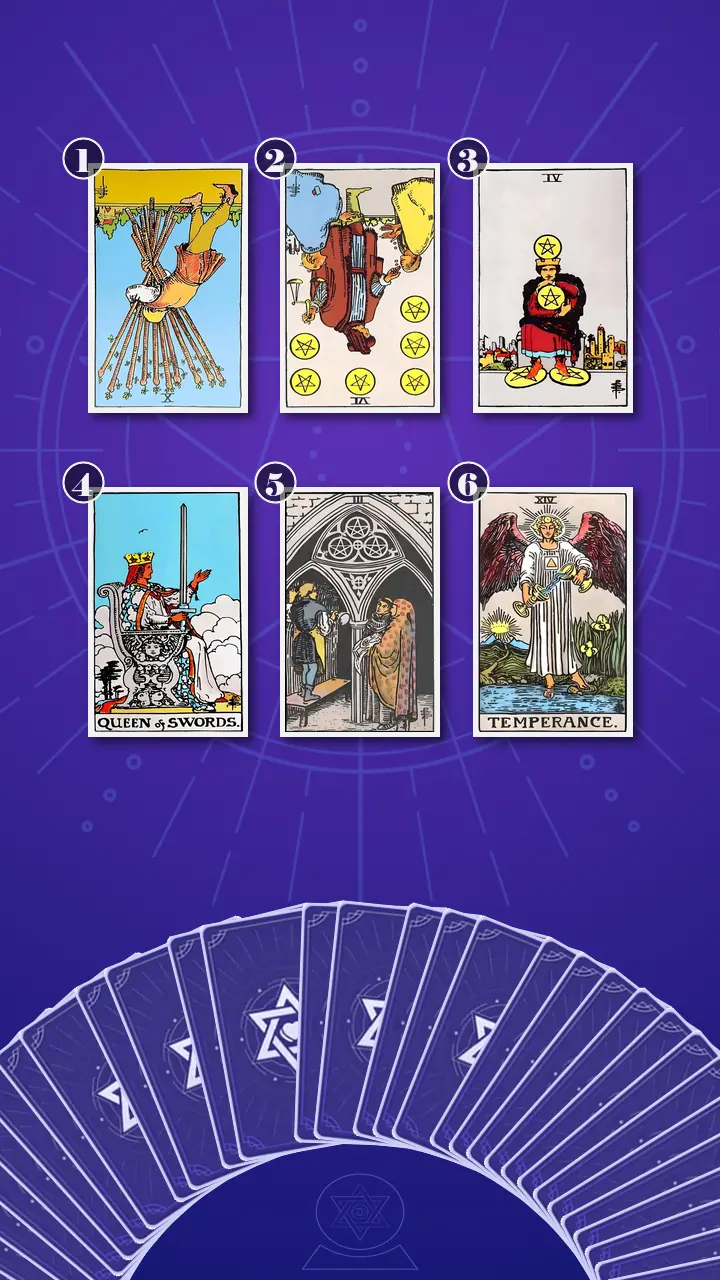
I chose the Transformation Path Grid (6) · Context Edition. The six-card tarot spread fits because Alex was not asking me to diagnose her friends or predict whether a particular dinner would succeed. She was asking why the same sequence kept returning: vague replies, immediate rescue, hidden coordination labour, private scorekeeping, and resentment after volunteering. The grid is small enough to show that causal loop clearly, while still leaving room for a practical route out.
In the top row, I would read the visible loop, the repetition trigger, and the underlying fear or payoff. Beneath them, the lower row would show the key interruption, the shared-action experiment, and the integrated relational pattern. I explained that the cards were prompts for card meanings in context, not verdicts. Alex remained the person making every decision about what to keep, question, or change.
The Work Hidden Inside a Good Time
The Bundle That Blocks the View
Now I turned over the card for the visible loop: the moment Alex takes over a friend's plan and the burden begins, including booking, correcting, and monitoring. The card was the Ten of Wands, in reversed position.
The hunched figure could barely see beyond the bundle in his arms. I translated the wands into the modern scene Alex had described: the reservation, the timing, the transport, the payment split, and every unanswered group-chat message carried into the restaurant even after the plan had technically worked. She had volunteered before roles were clear, and the successful dinner had not returned the experience to her. Her shoulders were still locked because she was mentally backstage, refreshing the status page while everyone else enjoyed the launch.
Reversed, the Ten of Wands shows excess that has become unsustainable. The energy is not a lack of care; it is care compressed into one person's body until helpfulness turns into weight. I asked, “Which task is genuinely yours before you add another obligation?” The question was deliberately narrower than “How do you stop caring?”
Alex gave a small, bitter laugh. “That is too accurate. It is almost rude.” Her mouth smiled, but her fingers tightened around the edge of the cushion. I let the discomfort remain without making her defend it. Control can make a plan work while making it impossible to enjoy.
The Scale Nobody Put in the Group Chat
Now I moved to the repetition trigger: the belief and reflex that convert a vague group response into rescuing, overgiving, and later scorekeeping. The card was the Six of Pentacles, in reversed position.
On the card, the merchant holds a scale above two kneeling figures while coins pass downward from one person to another. In Alex's life, the scale had become private. She paid the reservation or took the least convenient logistics task without checking what anyone else would own, then waited for friends to notice the sacrifice. When the thanks were brief or casual, she experienced the absence of recognition as rejection and rescued the next plan before anyone could ask.
Reversed, the Six of Pentacles points to blocked reciprocity and an exchange whose terms were never made visible. Care is not the same as carrying the whole group. A task she never named could become a burden, but it could not become a fair agreement simply by staying unspoken. I asked her, “Before you help, what are you giving, what are you asking someone else to own, and has either request actually been said aloud?”
She looked down at her phone and scrolled past the same old group chat. “I think I expect people to notice because I do not want to ask in a way that makes the whole thing feel transactional.” I heard the tenderness in that resistance. She was not asking for an exact exchange of favours; she wanted to be cared for without having to perform a briefing about how overwhelmed she was.
The Private Notes App and the Fear of Being Unnecessary
Now I turned to the underlying fear and payoff: the control, security, or belonging need protected by the Martyr Complex, along with the temporary relief that rewards repeating it. The card was the Four of Pentacles, in upright position.
The figure on the card held one pentacle to his chest, stood on two more, and balanced another above his head. I saw Alex's private Notes app in that image, crowded with the backup restaurant, alternate TTC route, payment reminders, dietary details, and the contingency plan nobody had requested. Control occupied her feeling, her ground, and her attention. Handing over one detail felt less like sharing and more like risking exclusion, disappointment, or becoming unnecessary.
I asked her to complete one sentence without editing it: “If I let go of this detail, then...” Alex stared at the table. Her inner answer arrived in pieces: someone might make a mess, everyone might be disappointed, and she might end up outside the decision or fixing everything later. The grip gave her a brief sense of security, but it also prevented friends from taking meaningful ownership.
Her breath paused first, and her thumb hovered above the phone. Then her gaze went unfocused, as if she were replaying several dinners at once: the route she had corrected, the reservation she had changed, the message she had typed and deleted. Finally, a nervous laugh escaped, followed by a long breath that lowered one shoulder before the other. “I do not trust anyone else with this because then I might feel unnecessary,” she said quietly. I named that as a protective reflex, not a character verdict. Wanting support and protecting the role that makes support unnecessary could exist in the same person.
When the Queen of Swords Cut the Silent Contract
The Raised Sword Before the Booking Tab
The room grew very still as I placed the next card below the Ten of Wands. Even the traffic outside seemed to recede. This was the key interruption: the clear boundary or direct communication that challenges the Martyr Complex without deciding for friends or punishing them. The card was the Queen of Swords, in upright position.
Her sword was raised and visible. Her other hand was open. Her gaze was alert, not cruel. I explained that the Queen of Swords brings clear perception, direct communication, self-respect, and boundaries without punishment. She does not wait until exhaustion becomes sarcasm. She names what is true while leaving another person room to respond.
The modern translation was simple enough to imagine in a group chat: “I can book the restaurant, but I cannot also coordinate transport. Can you own the route and post it by Thursday?” The sentence felt exposed because it revealed a limit before Alex had earned appreciation through overwork. Yet it also gave the friendship a fair chance to show what shared responsibility looked like.
At that point, I used one of my signature lenses, Gravity De-linking Analysis. I use it when people keep forcing alignment even though they are moving through different rhythms or life phases. Here, it did not mean that Alex and her friends were destined to drift apart. It showed the friction created when Alex tried to pull every person's planning speed, method, and attention into her own orbit. A friend could reply later or choose a different route without that difference automatically meaning exclusion. Separating care from forced alignment gave Alex a way to ask for an observable result without controlling the entire method.
I put the insight in plain language. “You do not have to take over a shared plan to prove that you belong in it. A clear limit lets responsibility become visible, so you can find out what is actually yours instead of turning silent overwork into evidence that nobody cares.”
The Sentence That Changed the Shape of the Room
I brought Alex back to the 8:47 p.m. Line 1 scene: the stalled chat, the warm phone, and the booking tab already open. She was waiting for a verdict from other people's silence, convinced that one missed detail would prove she was not needed or safely included. The urge to rescue felt like care, but it also protected her from asking for care.
Stop treating control as the price of belonging; use the Queen of Swords' raised blade to make one clear request before your help becomes resentment.
For a beat, Alex froze. Her thumb stopped moving, her breath caught, and her eyes widened slightly. Then her attention seemed to travel backward through the memories, replaying every time she had typed “all good” while waiting for someone to notice the unpaid shift. Her jaw trembled once before loosening. She pulled her hands apart, looked at the card, and said, “But does this mean I caused all of it?” There was anger in her voice now, followed by a softer, unsteady exhale. I answered, “It means the pattern has a lever. Responsibility is not the same as blame. You did what once made uncertainty feel survivable. Now you can choose a different first move.” Outside, a streetcar bell sounded cleanly through the window, and Alex sat with the relief and the new vulnerability of having a choice.
I asked, “Now, use this new perspective to remember last week. Was there a moment when one clear limit could have made your body feel different?”
Then I gave her a low-stakes proof rather than another theory: “Within the next 10 minutes, open a notes app and write two lines: ‘I can own...’ and ‘Someone else needs to own...’ for one upcoming plan. You do not have to send it yet. If the exercise feels too exposing, stop after naming one task and return to it only if you choose.”
I told her that this was the first movement in the larger transformation, from hypervigilant overfunctioning and silent resentment to clear boundaries, visible reciprocity, and balanced participation. The breakthrough was not a promise that every friend would suddenly become perfectly responsive. It was the moment Alex could notice the urge to rescue before it became a booking, a correction, and a private invoice for care.
The Lower Row: A Plan with More Than One Builder
The Shared Google Doc Comes to Life
Now I turned over the card for the shared-action experiment: one concrete way to distribute planning labour and tolerate a good-enough outcome instead of micromanaging. The card was the Three of Pentacles, in upright position.
Three people gathered around an architectural plan, each bringing a different skill to one structure. I translated the cathedral arch into a group message with three named tasks: one person books the restaurant, one checks the TTC route, and one handles dietary details. Alex could still contribute one meaningful piece, but she would no longer be the hidden project manager supervising the whole build.
I asked her to notice the thought that might appear when someone owned a task differently: “Their way is different, but is it actually failing?” The card's energy was balanced collaboration. It did not demand identical effort or identical methods. It asked for visible ownership and a usable result. Alex imagined letting a friend post the route without rewriting it and gave a small nod, though her hand still moved toward the phone before she caught it.
Two Cups, Enough Room to Breathe
Now I placed the final card in the integrated relational pattern: a sustainable way to contribute, receive, and address imbalance before it becomes resentment. The card was Temperance, in upright position.
The angel poured water between two cups, one foot on land and one in the stream. I saw a workable balance between emotional connection and practical limits. In real life, Temperance would look like Alex contributing one part of a plan, staying present while friends handled theirs, and naming a change directly if the balance shifted. It would not require her to swing from taking over to refusing every request, or to turn every difference into a debt.
“A good plan can have ordinary mess in it,” I said. “The measure of success is not whether every effort is identical. It is whether you have enough attention left to actually be with the people you made time to see.” Alex's shoulders lowered another fraction. She did not look transformed. She looked available, which was more honest and more promising.
The One-Task Ownership Map
When I read the six cards as one story, the logic became clear. The reversed Ten of Wands showed Alex carrying the visible success of the plan while losing the experience itself. The reversed Six of Pentacles showed why the burden returned: giving had become an unspoken contract, and private scorekeeping was being asked to communicate a limit that had never been spoken. The Four of Pentacles revealed the protection underneath it, a tight grip on control that briefly promised security and indispensability.
The Queen of Swords cut the loop with direct information. The Three of Pentacles turned that boundary into shared work. Temperance showed the destination, not as perfection, but as proportion: chosen contribution, room for another person's method, and a direct conversation before imbalance hardens into withdrawal. I had a small professional flashback to years of studying planetary movement. A changing orbit is not automatically a failure, and neither is a different rhythm between friends. The real friction begins when one person uses force to make every movement match.
Alex's cognitive blind spot was not that she cared too much. It was the assumption that friends should recognize and repay a burden they had never explicitly been asked to share, combined with the belief that a different method must become a future problem. The transformation direction was from control-based helpfulness to chosen contribution, from silent sacrifice to direct limits, and from proving usefulness to participating as an equal.
I called the next practice Boundary-First Planning. I also adapted my Constellation Release Protocol, a psychological closure technique I usually use when a friendship naturally fades. In that work, I help someone leave another person in their own orbit without chasing, punishing, or rewriting the history. For Alex, the first gesture was smaller: place one task back into the orbit of the person who agrees to own it, name the outcome and the check-in, and stop treating every unassigned detail as a summons. The point was not to abandon her friends. It was to release the role that had made friendship feel like administration.
- Make one task and one owner visibleBefore opening Resy or Google Maps for the next group plan, write what Alex can genuinely own and ask one named friend for one different task. A usable message is: “I can book the restaurant. Maya, can you own transport and post the TTC route by Thursday?” Agree on one check-in instead of monitoring every reply.Keep the message factual and specific. If the group does not respond, let the plan stay undecided or make it smaller rather than absorbing the uncertainty by default.
- Build the good-enough group planIn the shared chat, create three lines with three named owners: restaurant, TTC route, and dietary details. Ask each person to claim a task by a clear time, then let them complete it in their own workable way. When a task is safely good enough, close the document or mute the chat for 30 minutes.Define the outcome, not every step. The Constellation Release Protocol begins when the task leaves private notes and returns to shared space; one check-in is enough unless a real constraint changes.
I reminded Alex that the Transformation Path Grid was not asking her to become passive. It was showing her where a small behavioural choice could alter the entire loop. The practical question was no longer, “How do I stop being the default planner without withdrawing from my friends?” It was, “What can I name before I volunteer, and what can I leave in someone else's hands once they have agreed to own it?”

A Plan Alex Could Actually Enjoy
Four days later, Alex sent a message about Saturday: “I can book the restaurant; Maya, can you own the TTC route by Thursday?” She closed the booking tab, then reopened it once. When Maya posted the route, Alex felt a small jolt of worry, but left it untouched and ate dinner while rain moved softly against the window.
That was the proof. Not a perfect friend group, not a permanent cure, and not a guarantee that every contribution would feel equal. Alex had simply stated the limit before resentment had to speak for it. She remained caring without carrying the whole table, and the plan left enough space for her to participate in the friendship she had been trying so hard to protect.
I watched her leave with the sentence from the Queen of Swords still open in her notes. This Journey to Clarity had not handed her a prediction; it had returned her choices to her. She was beginning to move from hypervigilant overfunctioning and silent resentment toward clear boundaries, visible reciprocity, and balanced participation, one named task at a time.
When the group chat goes quiet and your jaw locks, you may start carrying every detail to prove that the plan, and your place in it, will be safe; no wonder the finished dinner can leave your body heavy instead of happy. If one small piece of the next plan could remain in someone else's hands without you pre-fixing it, what might you notice first: the discomfort, the room it creates, or something else?
Every reading at AceTarot is a journey to connect with inner wisdom and empower the path ahead. This reading shared here is a psychological mirror, not a private record—crafted to reflect universal emotional loops and help restore personal clarity. Please note that these insights do not replace professional psychological, medical, legal, or financial advice, and should not serve as the sole basis for major life decisions.
Learn more about our Journey to Clarity.
How did this insight land for you?
🫂 This Resonates Deeply
🌀 Living This Story
✨ Now I See Clearly
🌱 Seeing New Possibilities
🧰 Useful Framework
🔮 The Confirmation I Needed
💪 Feeling Empowered
🚀 Ready for My Next Step
Author Profile
 AI
AI Laila Hoshino
829 readings | 533 reviews
“After a decade of guiding people through the stars, I’ve come to see life much like the orbits of planets: everything has its inevitable cycles. When you feel lost, please don't blame yourself; you might just be in a natural low tide. I’m here to sit under the night sky with you, offering a gentle cosmic perspective to distinguish temporary pain from the beautiful breakthroughs just around the corner.”
In this Friendship Tarot Reading :
Core Expertise
- Orbital Drift Recognition: Objectively mapping how personal cognitive upgrades naturally lead to mismatched frequencies with old friends, removing the guilt of outgrowing them.
- Gravity De-linking Analysis: Identifying the painful friction that occurs when two friends try to force an alignment despite moving into completely different life phases.
Service Features
- The Constellation Release Protocol: A psychological closure technique to peacefully accept the natural fading of a friendship, leaving them in their orbit while you transition to your next.
Also specializes in :
Explore Related Patterns:
Control CopingAt 8:47 p.m., you refresh stalled messages, open a booking tab, and keep a backup restaurant and alternate TTC route in your notes. Controlling the variables gives you immediate relief because an organized plan feels safer than waiting for someone else to move. That strategy is effective at producing a dinner, but it also teaches your mind that security depends on your grip. You start treating a friend's slower reply or different method as evidence of a future problem, so delegation feels like exposure rather than cooperation. The useful audit is not whether you can control the plan, but which part is genuinely yours before control quietly consumes the experience.
Friendship OverfunctioningWhen the group chat goes quiet, you open Resy before anyone assigns a task, then take on the restaurant, TTC route, timing, payment split, and unanswered messages. The plan becomes successful, but your body stays on the backstage shift, which is why you reach the dinner having organized it without fully being there. That reflex turns uncertainty into usefulness and makes you the hidden project coordinator of a friendship. Because the sequence repeats from one group chat to the next, taking over is no longer just generosity. It is a learned way to reduce discomfort by making yourself responsible for the shared outcome, even when the cost is that you miss the experience you were trying to create.
People-Pleasing Resentment CycleYou tell everyone it is fine while softening your complaint, even as your jaw stays tight and your hands keep moving. You avoid asking someone to own transport because you do not want care to feel transactional, then hope your friends notice the sacrifice without needing a briefing. That silence turns an unspoken wish into a private agreement other people cannot reliably follow. When thanks are brief, you experience the lack of recognition as rejection, rescue the next plan before anyone asks, and carry the same unresolved need forward. The resentment is the delayed boundary of a yes that concealed your limit to carrying everything.
Usefulness-Based Self-WorthWhen you say that letting someone else own the task might make you feel unnecessary, the plan is carrying more than logistics. You are using usefulness as evidence that you belong, so booking, correcting, and monitoring do double duty as practical help and protection against exclusion. That makes the role hard to release even when it is exhausting. Wanting support and guarding the position that makes support unnecessary can coexist, leaving you to test your friends through sacrifices you never explicitly name. A more accurate measure of belonging begins when you remain included while contributing one part, allowing another person to matter without treating your own value as reduced.
Explore Related Struggles:
Control-Reciprocity LockAlex volunteers before roles are clear, completes the unassigned work, and then finds that nobody else has taken meaningful ownership. Her control stabilizes the plan so quickly that the group has little practical space in which to become responsible for it. You want reciprocity, but the method you use to guarantee the outcome removes the uncertainty through which reciprocity would have to reveal itself. Support cannot become observable while every gap is pre-filled, leaving you locked between distrusting shared ownership and resenting its absence. The deadlock becomes clearer when control is recognized as part of the exchange structure rather than proof that nobody else cares.
Indispensability TrapAlex's private Notes app holds the backup restaurant, alternate route, payment reminders, dietary details, and contingencies nobody requested. The collection does more than protect Saturday's dinner; it preserves her position as the person whose preparation keeps everything from falling apart. When indispensability becomes your most dependable route to relational security, another person's ownership can register as a reduction in your own importance. The role then closes around you: you resent being needed for everything, yet releasing a task threatens the place that constant usefulness has been protecting. Seeing that lock separates your actual belonging from the amount of failure-prevention you perform.
Pre-Resentment LockThe sequence begins with vague replies, moves immediately into rescue, and ends with Alex saying everything is fine while keeping a private account of the work. Resentment does not first appear at the dinner; its conditions are established when she volunteers without naming her capacity, her limit, or another owner. By the time you feel the full weight, the invisible contract has already asked your effort to communicate what you could not say directly. You remain caught between avoiding the exposure of a clear request and wanting others to respond as though that request had been made. The resentment is therefore not random or excessive; it is carrying information that was excluded from the original agreement.
Unspoken Expectation LoadAlex pays the reservation or accepts the least convenient task without naming what anyone else should own, then waits for her friends to recognize the sacrifice. Their brief thanks cannot answer an expectation they have never been allowed to see, so the private scale continues recording a debt that the group does not know exists. You want care to arrive freely rather than through what feels like a transactional briefing, yet the unspoken request leaves you carrying both the labor and the responsibility for interpreting everybody's response. The load is not only the task; it is the unresolved tension between wanting spontaneous recognition and needing a visible agreement before your contribution becomes sustainable.
Utility-Belonging FusionAlex opens Resy before anyone has assigned a task, then explains that being less useful could mean being less included. The restaurant, route, and timing therefore carry more than logistical importance: each completed task also reassures her that she still has a recognizable place in the group. When usefulness becomes your evidence of belonging, reducing your contribution can feel relationally dangerous even when nobody has asked you to carry the plan. You are pulled between wanting equal participation and preserving the function that seems to secure your invitation, which is why a simple division of labor can feel far more exposed than the task itself would suggest.
Accountability-Ownership FusionA quiet group chat prompts Alex to open the booking tab before anyone has decided who will do what. Silence does not remain an unassigned space for long; it becomes a responsibility she experiences as personally hers to absorb. You can become accountable for an outcome without anyone explicitly giving you ownership of it, especially when waiting feels indistinguishable from letting the plan fail. That fusion keeps you acting before shared responsibility can become visible, leaving you responsible for work the group never formally placed in your hands and unable to tell what others would have owned if given the chance.
Control-Participation SplitThe dinner happens, everyone relaxes, and Alex feels like the only person who never fully arrived. Her logistical control delivers the restaurant, route, timing, and payment split, but it keeps her mentally backstage after the social experience has started. You are caught between making the event dependable and having enough attention left to participate in it. The more completely you secure the outcome, the more your role shifts from friend to operator, so success itself can produce resentment: the plan works, but the work has displaced the connection that made the plan worth creating.
Monitoring-Safety FusionAt 8:47 p.m. on Line 1, Alex refreshes stalled messages with one hand while the booking tab is already open in the other. Her raised shoulders and tight jaw show that monitoring has moved beyond gathering information; continued oversight has become the condition under which the plan can feel temporarily secure. When checking is fused with safety, you cannot simply receive another person's contribution and stand down. A late reply or different route keeps the system active because workable difference is processed as a possible future failure. The later moment when Maya posts the route and Alex leaves it untouched exposes the real fault line: not whether the task can be completed, but whether you can remain connected while certainty sits in someone else's hands.
Explore Related Emotions:
Cautious TrustFour days later, Alex asks Maya to own the TTC route, closes the booking tab, reopens it once, and then leaves Maya's posted route untouched. The small jolt in her body remains, but it no longer decides who must carry the task or how the task must be completed. This is Cautious Trust rather than blind confidence. You notice the urge to check, retain a clear agreement and check-in, and still allow another person meaningful ownership. Trust grows through that measured handoff: not from assuming nothing will go wrong, but from learning that difference, ordinary mess, and connection can coexist.
Cautious VulnerabilityAlex practices the sentence "I can book the restaurant, but I cannot also coordinate transport" before she knows how anyone will respond. Her hands separate, her shoulders begin to lower, and the limit stays visible without becoming a punishment or an attempt to control her friend's method. Cautious Vulnerability is the feeling of showing what you can actually carry while accepting that the response is not yours to script. You remain careful because the request exposes a need previously hidden behind competence. That careful openness gives the friendship access to truthful information and gives you a way to participate without disappearing into the work.
Grounded AgencyAlex writes two lines in her notes: what she can own and what someone else needs to own. The exercise narrows a sprawling relational problem into an observable first move, allowing her to define the result she needs without supervising every step used to reach it. Grounded Agency does not depend on making the group perfectly responsive or making yourself passive. You recover choice by identifying where your action begins and ends: pause before rescuing, state one limit, make one request, and observe what actually happens. This keeps responsibility usable instead of turning it into blame for the entire dynamic.
Hypervigilant AnxietyAt 8:47 p.m. on Line 1, Alex keeps refreshing the stalled messages with her jaw tight and shoulders raised while a booking tab is already open in her other hand. No task has been assigned, yet her body and attention are preparing as though every unclaimed detail will soon become an emergency she must contain. When you scan silence, delays, and different methods for signs of future collapse, waiting stops being neutral. Hypervigilant Anxiety is the internal state of remaining on watch before a real problem has appeared. Naming it does not require you to ignore practical constraints; it helps you distinguish an observable issue from the bodily alarm that urges you to take over immediately.
Mutuality HungerEveryone relaxes at the dinner Alex organized, yet she feels like the only person who did not get to be there. She does not want a precise exchange of favors; she wants someone else to notice, participate, and help hold the evening without requiring her to demonstrate how overwhelmed she has become. Mutuality Hunger is what remains when your care moves steadily outward but very little comes back in a form you can receive. You are not asking for identical effort or flawless responsiveness. You are longing for evidence that connection can be co-created, leaving you enough room to participate as an equal rather than securing your place through service.
Need Exposure DreadAlex keeps softening her complaint and says she does not want to ask in a way that makes friendship feel transactional. The sentence "I can book the restaurant, but I cannot also coordinate transport" feels exposed because it reveals her limit before overwork has earned her appreciation and before she knows whether anyone will step forward. When you protect a need by staying highly useful, direct asking can feel riskier than carrying the task yourself. Need Exposure Dread describes the suspended moment in which another person is free to respond, misunderstand, or decline. That uncertainty is uncomfortable, but naming the need allows the relationship to answer a real request instead of an invisible test.
Resentful ExhaustionAlex opens Resy before anyone has taken a task, checks the TTC route, rewrites the timing, and tells the group everything is fine. By the time dinner happens, the plan has succeeded for everyone else while she is still mentally backstage, carrying the reservation, transport, payment, and unanswered messages in her body. When you create ease for other people by absorbing every uncertainty yourself, the event never fully registers as shared. Resentful Exhaustion names the combination of accumulated protest and depleted attention that follows: part of you objects to the unequal load, while another part has already spent the energy needed to enjoy the connection you were organizing.
Unseen Effort GriefAlex pays the reservation or accepts the least convenient logistics task without asking anyone else to own part of it, then waits for her friends to recognize what the evening cost her. Their brief thanks cannot acknowledge the full sacrifice because most of that sacrifice stayed inside her private notes, monitoring, and corrections. You may not be seeking an exact repayment when you want someone to notice how much you carried. You may be longing to have the care inside your effort recognized without first turning it into a report. Unseen Effort Grief names the ache of making a shared experience possible while feeling that neither your work nor the part of you asking to be cared for was fully witnessed.
Usefulness-Based Belonging FearAlex's Notes app holds the backup restaurant, alternate route, payment reminders, dietary details, and contingencies nobody requested. When she imagines handing over one detail, the risk is not merely that someone may choose an imperfect route; she says she might feel unnecessary. When you rely on usefulness to secure your place, helping can become a private test of whether you still belong. Usefulness-Based Belonging Fear captures the unease beneath the competence: if your function decreases, your place in the relationship can feel less certain. Seeing that link gives you room to ask whether a task is genuinely yours before using it as proof that you matter.
Reciprocal WarmthMaya posts the route, Alex leaves it alone, and the work of the evening is no longer hidden inside one person's phone and body. While rain moves against the window, Alex eats dinner instead of monitoring every detail, receiving her friend's contribution as part of the plan rather than as material to correct. Reciprocal Warmth emerges when care can travel in more than one direction. You contribute something meaningful, another person contributes differently, and enough attention remains for both of you to inhabit the friendship itself. The warmth comes from visible responsiveness and shared presence, not from identical effort or a perfectly managed evening.
Boundary GuiltAlex softens her complaint while describing the work she carries, and the moment a possible interruption becomes visible, she asks, "But does this mean I caused all of it?" Her attention moves quickly from what the pattern costs her to whether acknowledging her part makes her blameworthy. When you are accustomed to preventing inconvenience, a boundary can feel like an accusation even when it is only accurate information. Boundary Guilt is the heaviness that appears when protecting your capacity seems morally suspect. Separating responsibility from blame allows you to name your contribution to the loop without claiming responsibility for every friend, response, or outcome.
Explore Related Contexts:
Designated Organizer BurdenAlex opens Resy before anyone has assigned a task, then chooses the restaurant, checks the route, rewrites the timing, and carries every unanswered message into the dinner. The gathering succeeds, but she remains mentally backstage while everyone else participates in the event. Repeatedly absorbing unclaimed work turns an informal contribution into a designated social role. Because the role is activated by silence rather than assigned through agreement, the group receives reliable coordination without having to see how much labor has accumulated with one person. You can recognize this burden by separating the plan's visible success from the distribution of work that produced it. That distinction restores room to decide which contribution is genuinely yours before the default organizer role claims the entire event.
Friendship Role Lock-InAlex describes the same sequence moving from one group chat to the next. Replies remain vague, she rescues the plan, the dinner goes ahead, and she ends up managing the experience while her friends attend it. Each successful rescue stabilizes an unequal set of friendship roles. Alex becomes the dependable administrator without an explicit appointment, while the others have fewer reasons to initiate, decide, or learn which details need ownership because those details repeatedly disappear into her private workflow. You are not required to treat a repeated role as a permanent identity. Seeing the lock-in makes it possible to change the first allocation of responsibility while remaining part of the friendship, allowing participation to replace administration as your main position in the group.
Planning Labor ImbalanceThe Saturday dinner requires a reservation, transport research, timing changes, payment coordination, dietary tracking, and repeated monitoring, and Alex takes on nearly all of it. A trip intended to be shared becomes another unpaid shift before the group has even reached the restaurant. The imbalance is structural because the enjoyable outcome is collective while the preparation is concentrated. Stalled replies create an opening, Alex's rapid rescue closes it, and the completed plan conceals the fact that other people were never required to build planning capacity or assume visible ownership. You can audit this context by asking who owns each necessary outcome before measuring whether the event worked. A successful dinner does not by itself demonstrate a fair process, and making the labor visible gives you a factual basis for choosing a smaller contribution.
Scorekeeping FriendshipAlex takes the inconvenient tasks, carries the reservation and transport details, and then compares casual thanks with the full amount of labor she remembers providing. The scale remains private, so her friends encounter a completed plan without seeing the standard against which their response will later be measured. Private scorekeeping develops when real contributions lack visible terms for reciprocity. It records an authentic imbalance, but it cannot redistribute work because the people being assessed were not given a task, limit, or request they could knowingly meet. You can use the score as evidence that an exchange needs clearer terms rather than as proof that nobody cares. Moving one expectation into the shared conversation gives the friendship a fair test and lets you evaluate actual follow-through instead of relying on whether someone notices an invisible sacrifice.
Unspoken Expectations GapAlex pays the reservation or accepts the least convenient logistical task, tells the group that everything is fine, and then waits for her friends to recognize what the work cost. Their brief thanks respond to the visible offer, while her private expectation concerns a much larger exchange that was never stated. This creates two versions of the same plan. The group chat records voluntary help without conditions, while Alex's internal ledger records an expectation of shared ownership, care, and recognition. Neither side has access to the complete agreement because no complete agreement was made. You can clarify this gap without turning friendship into exact accounting. Naming what you can offer, what another person needs to own, and when a decision must be made converts silent expectations into information that everyone can actually respond to.
Friendship Role RenegotiationAlex moves from owning the restaurant, route, timing, payment details, and backup plan to owning the restaurant booking alone. Maya becomes visibly responsible for transport, and Alex allows that contribution to remain in Maya's hands. The shift changes more than a task list. It renegotiates who Alex is permitted to be within the friendship, replacing the hidden project manager position with a bounded contributor role and creating a legitimate place for other friends to exercise ownership. You do not have to withdraw from planning to alter the role. By contributing one chosen part and leaving another agreed part with someone else, you can test whether belonging remains available when usefulness is no longer measured by total control.