A Blank Figma Canvas Reframed What Side-Hustle Growth Must Protect

The 10:47 p.m. Blank Canvas
I recognized the side-hustle optimization trap before Alex had finished explaining it. They were a twenty-nine-year-old marketing coordinator in Toronto, running a digital-design shop after work, and every sales spike now sent them into funnels, bundles, and automation research instead of the design file they had meant to open.
At 10:47 on a Tuesday night, Alex joined our video call from the narrow dining table in their apartment. A Shopify dashboard glowed in the foreground of their shared screen while a blank Figma canvas waited behind it. Cold coffee had left a bitter film in their mouth, the refrigerator hummed into every pause, and their shoulders had crept so high that the collar of their sweatshirt bunched beneath their jaw.
They had intended to spend the evening developing a new design. Instead, they had checked conversion data, rewritten a bundle description, standardized several file names, and rearranged a customer-support workflow. The business had accumulated evidence of progress, yet the canvas remained untouched.
“I wanted more customers,” Alex said, rubbing the place where their neck met their shoulder, “but I didn’t expect every sale to become another system. The business is working better while the work feels worse.”
The extra income mattered against Toronto living costs, so simply refusing growth did not feel realistic. But scaling the shop into a commercially viable business seemed to require more distance from the hands-on work that had made it meaningful. Alex’s disillusionment had the texture of yesterday’s coffee: once warm and energizing, now flat, heavy, and difficult to swallow without wondering why they had wanted it so badly.
“I’m not going to ask the cards to decide how large your business should become,” I told them. “That choice stays with you. I want to use the reading to separate actual business constraints from the pressure, guilt, and endless what-ifs surrounding them. Let’s draw a map through the clutter and see what kind of growth still lets you recognize the work as your own.”
That was the purpose of our Journey to Clarity: not to produce a prediction, but to recover the decision criteria Alex’s dashboard could not provide.

Choosing the Signpost: A Five-Card Decision Cross
I asked Alex to place both feet on the floor, take one unforced breath, and hold one question in mind: “Why does scaling keep making my side hustle feel less meaningful?” I shuffled slowly and angled my overhead camera toward the table. The small ritual was a transition out of tab-switching mode, not a performance of mystery.
I chose a five-card Decision Cross tarot spread because Alex did not need ten layers of prediction or another sprawling analysis project. They needed the smallest useful structure for comparing two legitimate priorities: structured growth and protected creative meaning. The cross could show the present friction, examine each path without ranking it, reveal the concealed values conflict beneath both, and offer an integrating principle above them.
For anyone wondering how tarot works in a business decision, I use the positions as a stable set of questions. The centre would show what was happening now. The left and right cards would compare the operator’s need for structure with the maker’s need for direct creative contact. The card below would reveal why those needs felt incompatible, while the card above would identify an actionable way to test a different relationship between them.
I placed the cards like a signpost crossed by a plumb line. I explained that card meanings in context are not commands. They are visual prompts that help me distinguish patterns, challenge assumptions, and return authority to the person who must live with the outcome.
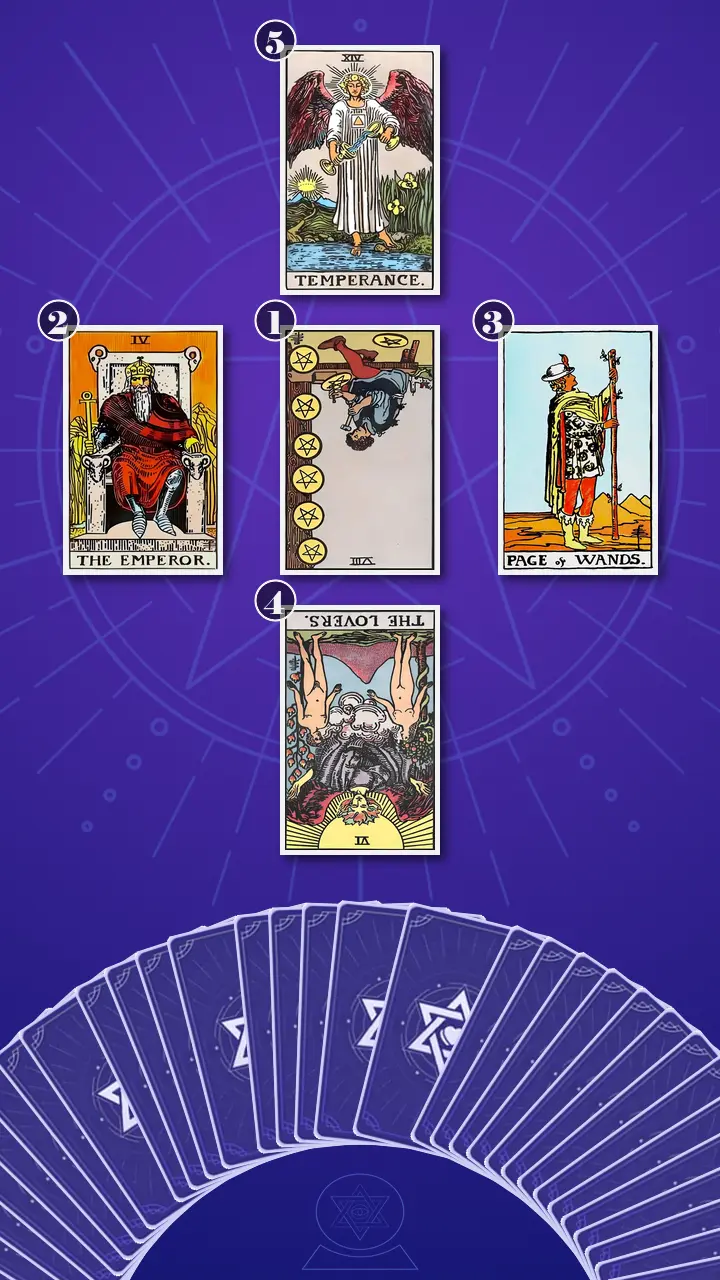
The Workbench, the Throne, and the Living Spark
Position 1: The Workbench Beneath the Dashboard
I turned the card representing the present symptom: the place where operational refinement and repeatable output were displacing the hands-on activity that had originally made the shop meaningful. It was the Eight of Pentacles, reversed.
In the Rider-Waite-Smith image, a craftsperson sits at a bench beneath a vertical row of completed pentacles. Upright, the card often describes disciplined practice. Reversed here, its Earth energy was blocked and misdirected. Alex was still applying real skill and effort, but the effort had become detached from creative contact. Repetition was serving output management more than craftsmanship.
I brought the card directly into the Tuesday-night scene. At 10:47, Alex had standardized file names, adjusted bundle thumbnails, checked conversion data, and closed Figma without placing anything on the canvas. Each completed admin task had joined the card’s row of pentacles: visible, orderly, and measurable. The missing object was the thing they had sat down to make.
“The inner monologue is something like, ‘I fixed the bundle, cleaned the workflow, and checked the numbers, so why does it feel like I made nothing?’” I said. “The operational work is not fake or useless. The problem is that it keeps occupying the time reserved for the craft.”
Alex gave one short laugh, but there was no amusement in it. Their fingers tightened around the mug before relaxing again. “That’s so accurate it’s almost cruel.”
“It lands sharply because the labour is genuine,” I replied. “I’m not using this card to accuse you of laziness. I’m using it to name productive procrastination without shaming you for it. The dashboard gives quick proof that something happened. The blank design asks you to tolerate uncertainty before there is proof.”
I let the card sit between us and asked which task had taken over their most recent maker session. Alex named the Shopify refresh first, then the bundle copy, then the support board. I nodded. “Your dashboard can report demand; it cannot report whether you still want to make the thing.”
Position 2: The Operator on the Stone Throne
I turned the card representing the scaling path as Alex currently imagined it, including the structure, authority, boundaries, and operator identity that growth would require. The card was The Emperor, upright.
The Emperor’s stone throne, concealed armour, and severe mountain landscape gave form to the legitimate work of running a business. Alex needed fulfilment rules, response-time boundaries, pricing decisions, and a release calendar if demand continued to grow. In balance, this Earth-and-Fire authority could make the shop more stable. In excess, it could make Alex responsible for maintaining a control layer around every creative act.
I described the modern version I could already see: Alex setting a two-business-day support policy, documenting delivery rules, limiting custom requests, and creating a release calendar. Those structures could protect attention. They could also become another system to monitor after a full day of coordinating marketing for someone else.
For a moment, I thought of the cafés where I had listened to people’s stories for twenty years. A good opening checklist does not decide which conversation matters; it prepares the room so a real conversation can happen. Structure has the same proper role here. It should hold the work, not start choosing the work.
I drew the first of two unranked columns on a sheet of paper. Under The Emperor, I wrote: support rules, release calendar, pricing boundaries, predictable delivery. “None of these is automatically a betrayal of creativity,” I said. “The question is whether each rule protects your time and attention or simply creates another layer for you to manage.”
Position 3: The Prototype Without a Forecast
I turned the card representing the meaning-preserving path, especially the curiosity, experimentation, and direct involvement Alex feared losing. It was the Page of Wands, upright.
The Page studies a sprouting staff in an unfinished landscape. The figure is not surveying a mature enterprise or asking the idea to justify its market size. The Fire energy was alive and available, but underused. Alex’s curiosity had not disappeared; it had been denied access to the calendar until it could present a product family, launch sequence, and forecast.
I added the second column: an odd prototype, an unfinished idea, forty-five minutes of private experimentation, curiosity without a revenue projection. I asked Alex to name one idea they would still want to prototype if it never had to become a collection or content series.
They looked away from the cards, then back toward the blank Figma window. “There’s a strange typography set I’ve been thinking about. I keep postponing it because I can’t see how it becomes more than one product.”
“That is the Page,” I said. “One unusual design gets a private session because it has energy. You do not have to promise that it will scale before it has taught you what it is.”
I could see how creator-business advice had trained Alex’s personal algorithm. Every unforecasted idea was being treated like a low-performing post and filtered out before it had the chance to surprise them. The system was optimizing for repeatability until it stopped showing the material that had made Alex open the app in the first place.
I pointed to the two columns. “The Emperor is not the serious adult and the Page is not the frivolous child. One says, ‘Give the work a container.’ The other says, ‘Leave something alive inside it.’ I hear your real fear as: ‘I want the structure to hold the work, but I’m afraid it will start choosing the work.’”
Alex’s shoulders shifted down by a fraction. “Exactly. I don’t want to stay small just to prove I’m authentic. I also don’t want my evenings to become a second marketing job.”
The Agreement Nobody Had Signed
Position 4: The Lovers Reversed Beneath the Choice
I turned the card representing the hidden root of the split: the place where growth and meaningful involvement had not yet been brought into an explicit values agreement. It was The Lovers, reversed.
I focused on the separated figures and the mountain rising between them. Reversed, the card’s connective energy was blocked by misalignment. This was not evidence that scaling itself was hollow, nor was it a warning that Alex must keep the shop small. It showed two legitimate commitments operating without negotiated terms: commercial viability on one side and personally meaningful involvement on the other.
I asked Alex to recall a growth tactic they had approved and then repeatedly delayed. They described a standardized offer that creator-business advice had framed as the responsible next move. They had prepared it, postponed publishing it for three nights, and felt irritated whenever customers asked for the simplified version.
“I said yes because a real business would,” Alex said quietly. “But some part of me never agreed to what the yes would cost.”
Their breathing paused first. Then their gaze lost focus, as if they were replaying each night the unpublished offer had remained open. Finally, they released a long breath from low in their chest, and their jaw loosened even while their eyes took on the shine of recognition.
“That delay may not be proof that you are afraid of success,” I said. “It may be information about a value the current model failed to protect. The blind spot is treating resistance as a character flaw before checking whether the agreement itself is incomplete.”
I turned the divided image into a sentence Alex could actually use: “This tactic can stay only if it protects ___ and does not routinely replace ___.” They filled the first blank with original concept development. They filled the second with direct design time.
I saw their hand stop gripping the mug. The conflict had not vanished, but it had changed category. It was no longer a verdict on whether Alex possessed enough ambition. It had become a business-design question with terms that could be named and tested.
“Growth is evidence to evaluate, not an instruction to obey,” I told them. “No creator thread, sales chime, or Stripe graph gets to make this agreement by default.”
When Temperance Asked What the System Gives Back
Position 5: The Two-Way Exchange
The refrigerator on Alex’s side clicked off as I reached for the final card. The sudden quiet made the light rain against their window audible, and the blue-white reflection of the dashboard softened on the glass. I turned the card representing an actionable integrating principle for testing selective scale without abandoning either viability or meaningful participation.
It was Temperance, upright.
I showed Alex the water moving between two cups, the angel with one foot on land and one in water, and the path leading toward an illuminated horizon. Temperance held the energy of balance through active adjustment. It did not offer a static compromise in which both sides received less. It showed a reciprocal exchange in which structure could remove repetitive labour and return time, attention, or creative freedom to the maker.
In Alex’s real life, this could look like a seven-day pilot: automate routine file delivery, keep final design judgment in their own hands, protect one maker session before opening analytics, and review both commercial performance and engagement with the work. The experiment would be bounded and reversible. Growth would succeed only if it supported the operation and gave something back.
I used a diagnostic lens I call Analysis Paralysis Deconstruction. I stripped away the abstract questions about whether Alex could scale forever, whether staying selective looked unserious, and whether every future sale would create another system. The grounded realities were simpler: Alex still needed the side income, could not leave the day job yet, had limited evening energy, and wanted direct control over the creative decisions that made the shop feel personally alive.
Then I applied Complexity Reduction. The decision was no longer the dramatic binary of “scale everything” or “reject growth.” The practical binary was this: does the next tactic remove a draining repetition and return capacity to meaningful work, or does it consume more creative contact than it gives back?
At that point, Alex was still caught in the old courtroom question: “Which future is the correct one?” I brought us back to 10:47 p.m. The business had moved forward through bundles and workflows, but the design itself had not moved at all.
You do not have to choose between a serious business and meaningful work; scale selectively, and let Temperance's two cups show that growth can be designed as a blend rather than a surrender.
I let the sentence remain in the quiet.
First, Alex stopped breathing for a beat, their fingers suspended above the mug as though their body had reached the insight before their words could. Then their pupils widened and their gaze drifted toward the blank Figma canvas, replaying the recent evenings in which measurable progress had swallowed the work itself. Their shoulders lowered, but relief did not arrive cleanly. A flash of anger tightened their mouth. “But doesn’t that mean I’ve been doing this wrong for months?” they asked, their voice suddenly sharper and thinner. I shook my head. “No. It means you used the most visible score available while trying to protect something financially real. Those systems gave you short-term certainty. Now you have better criteria. Clarity does not require you to punish the version of yourself who worked without them.” Their fist opened against the tabletop. They exhaled with a slight tremor, then gave a small, almost disoriented nod, as if setting down a heavy box had left their arms unsure what to do next.
“Now, with this new perspective, think back to last week,” I said. “Was there a moment when this insight could have made the evening feel different?”
Alex remembered spending nearly an hour researching support automation after three repetitive delivery questions. The useful move would have been to automate that routine handoff and return the saved time to the typography prototype. Instead, they had opened a broad automation template and started redesigning the entire business.
“So the first question isn’t ‘Can this be automated?’” they said. “It’s ‘What does this system give back?’”
“Exactly,” I replied. “Scale what drains meaning. Protect what creates it. Let growth prove that it can give something back to the maker, not only take more from them.”
I could see the first movement from disillusioned stagnation in the optimization trap toward grounded ownership of a selectively scalable creative business. It was not a final answer or a guarantee that every trade-off would feel easy. It was the more important first shift: Alex no longer had to treat maximum growth as an external command. They could design and evaluate growth according to commercial evidence and the quality of their engagement with the work.
The Two-Cup Plan for Selective Scale
I gathered the reading into one coherent story. The old rule had been that growth was the only reliable proof that the shop was viable. That belief pushed Alex to convert maker time into dashboards, systems, and standardized outputs. The Eight of Pentacles reversed showed the present result: skilled labour continuing after its connection to purpose had thinned. The Emperor and Page of Wands showed that the operator and maker both had valid needs. The Lovers reversed revealed why they kept obstructing each other: nobody had written the terms of their relationship. Temperance supplied the missing design principle, allowing systems to support creative participation rather than substitute for it.
“You have been converting a workshop into a control room,” I said, “then wondering where the pleasure of making went. The answer is not to tear out every control. It is to decide which controls protect the workshop and which ones merely give you more screens to watch.”
The cognitive blind spot was now clear. Alex had been interpreting flatness as evidence that the business needed more optimization, while interpreting resistance as guilt, laziness, or fear of success. The reading suggested another possibility: the flatness was feedback from a meaningful activity that had been repeatedly displaced.
I also pointed out that no Swords card had appeared. In elemental terms, Air was the missing function. Alex already had Earth through practical work, Fire through creative initiative, and Water through their desire for meaning. What they lacked was explicit language: a short set of acceptance criteria capable of mediating those forces before whichever pressure felt loudest made the decision.
The transformation direction was precise. Before adopting a scaling tactic, Alex would define the meaningful activity it must protect. Then they would test the tactic against two signals: commercial usefulness and engagement with the work. A serious business could have a deliberately human-sized centre.
The Coffee Bean Filter Protocol
I gave Alex three small next steps. The first used my Coffee Bean Filter Protocol, a twenty-four-hour sorting exercise for separating real constraints from borrowed urgency. By “Emotional Noise,” I did not mean that feelings were irrelevant. I meant the static created by comparison, imagined creator rules, and the pressure to prove seriousness before a tactic had earned its place.
- Run the 24-Hour Coffee Bean FilterAt the dining table tonight, spend ten minutes dividing one sheet of paper into “Absolute Must-Haves” and “Emotional Noise.” Under must-haves, write the real constraints and values, such as useful side income, original concept development, and final visual judgment. Under noise, place borrowed rules such as “every product must become a product line” or “a serious creator automates everything.” Leave the page alone for twenty-four hours. Tomorrow, use it to label one proposed tactic keep, revise, or pause.Minimum version: write one item in each column. No polished framework and no explanation to an online creator community are required.
- Protect One Maker-Before-Metrics SessionOn one evening this week, open the typography file before Shopify, Stripe, email, or Notion. Set a forty-five-minute timer and work only on the design. When the timer ends, record two things in a phone note: minutes of direct making and engagement from one to five. Do not add a productivity score and do not require a finished or publishable result.If forty-five minutes is unrealistic after the day job, use the ten-minute version. Keep analytics and automation tabs closed until the timer ends.
- Test One Selective Automation for Seven DaysChoose one repeated delivery or support task that requires no creative judgment, automate only that task, and keep final design decisions in Alex’s hands. After seven days, score the tactic from one to five for commercial usefulness and maker engagement, then ask: “What burden did this remove, and what meaningful activity did it protect?”Use a reversible test. If the workflow is too unstable to describe clearly, postpone the automation instead of redesigning the entire shop around it.
I reminded Alex that these were experiments, not vows. They did not need to approve or reject an entire future that night. The point was to create evidence that included the person doing the work, not only the business receiving the order.

A Week Later: The Quiet Proof
Six days later, I received a message from Alex. They had completed the ten-minute version of the Coffee Bean Filter, set up a simple automation for routine file delivery, and protected one forty-five-minute session for the typography idea. The design was not finished. It was not yet a product, a content series, or a forecast.
“I looked up and realized I hadn’t checked Shopify once,” they wrote. “I was just making it. I’d forgotten an evening could feel like that.”
The revenue graph had not suddenly become predictable enough for Alex to leave their job, and a new product-variation request still made their shoulders rise. The next morning, their first thought was still, “What if this is the wrong model?” They told me they smiled, opened Figma before Shopify, and let the question sit beside the work instead of sending it to the dashboard for an answer.
I did not see that week as proof that tarot had solved Alex’s business. I saw it as proof that Alex had reclaimed the authority to define what the business was for. The cards had helped tidy the reality in front of them, but Alex had chosen the boundary, run the experiment, and returned their hands to the work.
When every sales alert makes your shoulders rise, I want to leave you with this: the thing you built to feel more like yourself does not have to require you to stand farther away from it just to prove you are in control. Clarity is not the disappearance of every trade-off. Sometimes it is simply the moment the fog thins enough for you to name what growth must return.
If your next growth experiment had to pour something back into Temperance's maker cup, what small part of the work would you ask it to protect?