Carrying the Community Alone: One Clear Handoff Toward Shared Care

Finding Clarity in the 8:47 P.M. Task-Board Spiral
“You tell the group chat, ‘No worries, I’ve got it,’ then keep checking messages after your paid shift while your shoulders stay tense,” I said as my video call with Alex (name changed for privacy) opened at 8:47 on a Tuesday.
I heard their kettle click off and the apartment radiator hiss behind them. Their phone looked warm in their palm. When they tilted the screen toward me, I saw three ownerless cards on a Notion board, each newly moved into their own column. A cold mug sat beside the laptop while WhatsApp continued to pulse against the tabletop.
“What keeps me carrying our community alone?” Alex asked. “I want it to thrive. But if I step back, who notices what gets missed? And why am I getting so angry at people I’m supposedly helping?”
I watched them press two fingers into the hinge of their jaw. The guilt they described did not sound like a quiet moral nudge. It sounded like a wet Toronto winter coat hooked between their shoulder blades, growing heavier each time another message arrived. Underneath it, resentment sparked like a notification they could mute but never quite clear.
“I’m not going to ask whether you care enough,” I told them. “That part is obvious. I want to help us see where care becomes private rescue, where rescue becomes control, and where you still have a choice. Care is not measured by how much work stays in your column. Let’s make a map of the fog without pretending the cards get to write your future.”

Choosing the Map for a Care-and-Control Loop
I asked Alex to place their phone facedown, set both feet on the floor, and take three unforced breaths while holding the question in mind. I shuffled slowly. I use this pause as a transition for attention, not as a performance of mystery. It gives the nervous system a moment to stop answering the question before the question has even been heard.
I chose the Transformation Path Grid (6) · Context Edition, a six-card tarot spread designed to reveal a repeating system and the smallest available interruption. I chose it because Alex was not asking me to predict whether the community would survive. They were asking why overfunctioning in a volunteer group kept reproducing itself, even when everybody claimed to want shared responsibility.
For anyone wondering how tarot works in a reading like this, I treat the spread as a structured cognitive map. Card meanings in context help me separate observable behavior from the protective logic beneath it. The images provide enough distance for a person to examine a pattern without being reduced to that pattern.
I laid the cards in two rows of three. The upper row would show the Presenting Loop, the Immediate Block, and the Underlying Fear. The lower row would show the Leverage Point, the Action Plan, and Integration. The eye would move across the closed loop of overwork, control, and fear, then drop toward collaboration, fair agreements, and reciprocal belonging. It was less a forecast than a bridge diagram, assembled one plank at a time.
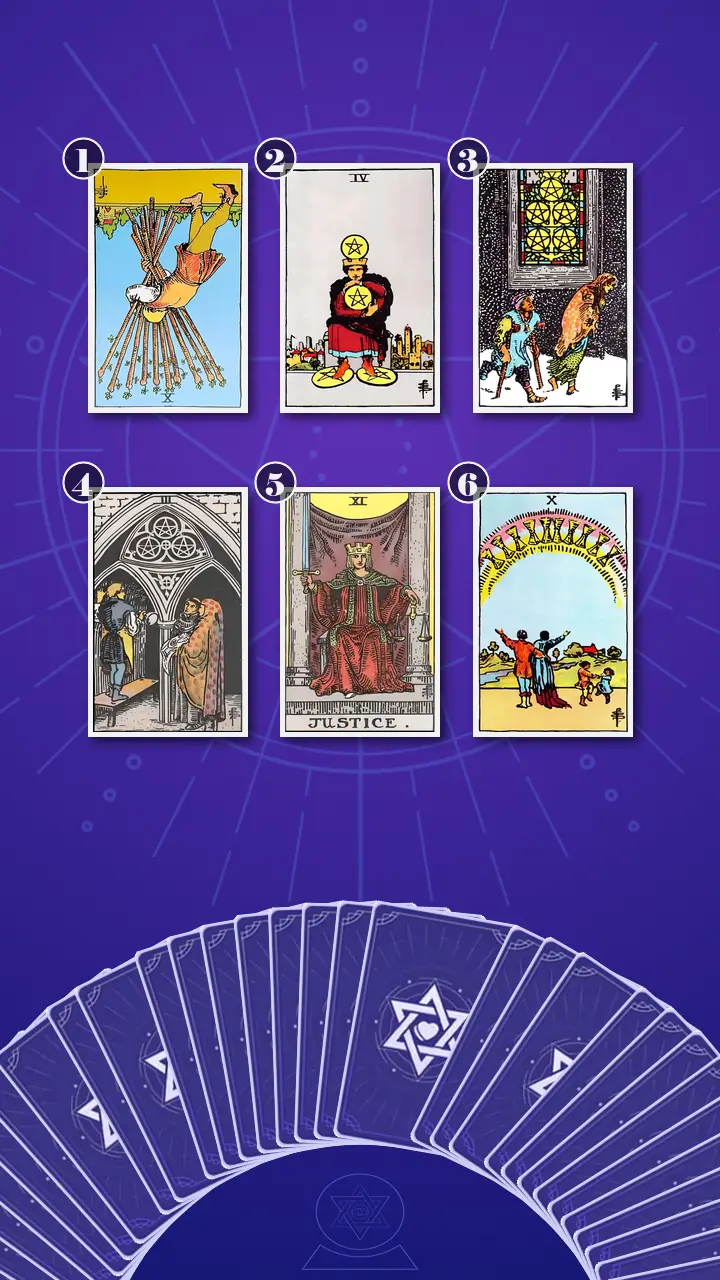
The Upper Row: How Shared Care Became a Private Shift
Position One: The Column That Kept Filling
Now I turned over the card representing the Presenting Loop: the visible behavior that kept Alex taking back tasks, working late, and treating exhaustion as proof of commitment.
It was the Ten of Wands, reversed.
I pointed to the figure bent beneath ten bundled wands. The load blocked almost the entire forward view, even though a town remained visible in the distance. “This is not a picture of someone who lacks dedication,” I said. “It is a picture of dedication becoming so congested that it hides every route except ‘carry more.’”
The modern scene was already open on Alex’s laptop. After a Toronto planning meeting, they saw unclaimed tasks on the shared board, moved each one into their own column, and answered messages until midnight while writing, “No worries, I’ve got it.” Like the frantic competence in The Bear, keeping the whole operation moving looked like devotion from the outside. Inside the pattern, nobody could tell where care ended and emergency mode began.
I read the reversal as both excess and blockage. The Fire of responsibility had become excessive, but the release of that responsibility was blocked. Alex kept acting because action gave them a few minutes of relief from uncertainty. The relief then taught the body that taking over was the safest response.
“The reversal does not tell you to dump every task and disappear,” I added. “That would preserve the same all-or-nothing script: total control or total withdrawal. It asks for one deliberate release. Which task followed you home after the last meeting even though nobody explicitly assigned it to you?”
Alex gave a short, bitter laugh. “The venue confirmation. The reminder email. And the accessibility checklist. So, three tasks. That’s so accurate it’s almost rude.” Their fingers tightened around the mug, then loosened as they looked back at the board.
Position Two: The Full Brief Kept Behind One Password
Now I turned over the card representing the Immediate Block: the place where protecting the community had become control of context, standards, information, and final decisions.
It was the Four of Pentacles, upright.
The figure held one pentacle against the chest, pinned two beneath the feet, and balanced another above the head. Nothing circulated. I saw a visual equivalent of one person holding the admin password, the style guide, and the final submit button for an allegedly shared project.
I asked Alex about a recent Google Drive draft. They told me they had given another organizer a narrow section to complete while keeping the full brief, the quality standard, and final approval in private notes. When that organizer used a different structure, Alex felt the familiar jolt in their chest. Instead of clarifying the agreed outcome, they rewrote the section after their paid coordination shift and returned a polished document as if nothing had happened.
“The thought is probably, ‘If I let go of this, then the quality drops, somebody gets hurt, and I have to repair it anyway,’” I said. “But there is a quieter consequence: if you silently take it back, no one gets to practice carrying it.”
In this position, the Four of Pentacles showed protective Earth operating in excess. Preservation had tightened into possession. The card did not accuse Alex of being controlling by nature. It showed a caring person trying to reduce real uncertainty with the tool that had worked fastest: keeping everything close. The cost was that collaborators received fragments to execute, not enough context to become trustworthy partners.
Alex’s jaw shifted sideways. Their eyes moved from the card to a tab of private project notes. “I call it quality control,” they said. “But, yeah. I’m also making myself the only route through it.”
I nodded. “That recognition matters because it gives us something more precise than ‘just trust people.’ We can ask what context, authority, and definition of done would make a bounded handoff possible.”
Position Three: The Shelter Visible Through the Snow
Now I turned over the card representing the Underlying Fear: what Alex’s self-sacrifice was protecting, including the fear that stepping back would leave people uncared for and make their own place in the community less secure.
It was the Five of Pentacles, upright.
Two injured figures moved through snow beneath an illuminated stained-glass window. As I held the card closer to the camera, sleet tapped Alex’s kitchen window. For a moment, the weather seemed to join the image: cold outside, shelter visible, and a threshold that still had to be approached.
I brought up the quiet WhatsApp chat Alex had described. When nobody replied, they assumed nobody cared, filled the empty volunteer slot, and scheduled the follow-up without making one direct request. Silence became evidence of exclusion. More work became the price of proving usefulness. Private rescue then created the very loneliness that seemed to justify another rescue.
“Is support actually absent,” I asked, “or have you learned to remain outside the lit window while insisting you have to manage the cold alone?”
The Five of Pentacles carries the felt deficiency of support, worth, or belonging. I was careful not to treat that feeling as proof that support was either available or guaranteed. Some collaborators really did have limited capacity. Some systems really were under-resourced. The card asked a narrower question: had Alex tested support with a specific, consent-based request, or only with a vague “Can anyone help?” followed by immediate takeover?
Alex’s breathing paused. Their gaze lost focus for a few seconds, as though they were replaying a series of meetings. Then they rubbed one thumb over the other and said quietly, “The worst part isn’t only that someone might miss a deadline. It’s that they might manage without me. I hate saying that out loud.”
“I don’t hear vanity in that,” I replied. “I hear a role that has become tied to belonging. If usefulness has been your admission ticket, rest can feel like being asked to wait outside. But belonging should not require a midnight shift.”
When the Three of Pentacles Made the Plan Visible
Position Four: Recasting the Only Load-Bearing Wall
The radiator went quiet just before I turned the fourth card. In the brief stillness, a streetcar bell sounded clearly from beyond Alex’s window. I told them we had reached the Leverage Point: the smallest available shift capable of interrupting the loop without requiring them to abandon the project.
The card was the Three of Pentacles, upright.
I saw a craftsperson, two collaborators, a visible plan, and one structure receiving several kinds of attention. Competence was not concentrated in a single figure. The building mattered, but nobody in the image had to become the building.
I brought Alex back to Tuesday night. The meeting was over, the unclaimed jobs were sitting on the task board, and the phone kept glowing beside a cold mug. Their familiar move was to say “I’ve got it” before anyone else had been given a clear task, outcome, or chance to answer.
Then I translated the Three of Pentacles into the ordinary language of a shared board. Instead of posting, “Can anyone help with the venue?” Alex could write, “Jordan, would you be willing to own the venue confirmation by Thursday? Done means the booking email and receipt are posted in this channel.” Jordan’s method could differ while the shared outcome remained visible.
“This is balanced collaborative Earth,” I explained. “It is neither blind trust nor a motivational poster about teamwork. It is a bounded, written, reversible experiment. One owner. One outcome. One due date. A real exception for safety or a critical deadline. Otherwise, the task remains with the person who accepted it.”
My artist’s mind went to casting rooms and collaborative productions. I used what I call Typecasting Analysis: I looked for the restrictive character arc that Alex’s social circle, reinforced by Alex’s own quick rescues, had learned to expect. Alex had been cast as The Fixer. Every “Alex will catch it” line strengthened the role, and every silent correction removed another person’s chance to audition for responsibility.
“Typecasting does not mean everyone maliciously assigned you this part,” I said. “A group can write a role through tiny repetitions. They hesitate; you step in. They praise your dependability; you hide the cost. Soon, your different choices look out of character, even to you. The Three of Pentacles offers a recast: you are not the structure. You help design a structure that can hold more than one person.”
Stop treating solitary sacrifice as proof of care; build visible shared roles and let the Three of Pentacles' collaborative plan replace the Four of Pentacles' private grip.
I let the sentence sit between us before adding, “You do not protect the community by making yourself its only load-bearing wall. Care becomes more sustainable when one real owner, one clear outcome, and room for a different method are visible. An explicit handoff is not abandonment; it is how shared care becomes visible.”
I watched Alex’s inhale stop halfway. Their hand froze above the mug, and their pupils widened before their gaze drifted toward the task board, as though old meetings were replaying across it. Their eyebrows pulled together, and a flush climbed into their cheeks.
“But doesn’t that mean I’ve been doing leadership wrong?” they asked. The words arrived sharper than anything they had said before. “I’ve spent a year building this. Was I just making everyone dependent?”
I allowed the resistance its full second before answering. “No. It means a strategy that once protected a fragile project has started limiting its growth. I’m not asking you to put your past self on trial. I’m asking whether that role still deserves every future scene.”
The anger did not vanish. I saw it soften first into grief, then into the slight dizziness that can follow setting down something heavy. Alex’s fist opened one finger at a time. Their shoulders dropped, but their eyes reddened. A long breath left them with a faint tremor. Relief was present, yet so was the vulnerable blankness of realizing that a clear path would require them to tolerate someone else’s choice.
“Now, using this new perspective, think back,” I said. “Was there a moment last week when this insight could have made you feel different?”
“Maya sent an event draft,” Alex replied after a pause. “It met the actual requirements. I just didn’t like the order. I rewrote it anyway. I could have left it. Or I could have asked one question instead of taking the whole thing back.”
“That is the crossing,” I said. “Not from caring to not caring, and not from control to instant trust. It is a move from guilt-driven hyper-responsibility toward the discomfort of leaving one agreed responsibility with someone else. The inner line can be: ‘Their method is different. Different is not automatically unsafe.’”
I made the emotional transformation explicit because insight can otherwise evaporate into a beautiful phrase. Alex was moving from private control and resentment toward visible shared ownership. The first proof would not be feeling perfectly calm. It would be noticing the clenched jaw and choosing not to convert that sensation into another stolen task.
Position Five: Justice Writes the Agreement Down
Now I turned over the card representing the Action Plan: the fair agreement, explicit handoff, and honest boundary Alex could test in their leadership role.
It was Justice, upright.
The scales were balanced, the sword stood upright, and the figure faced forward without flinching. I interpreted this as clarifying Air in balance: accurate language, visible consent, and consequences assigned to the choices that created them. Justice did not ask Alex to punish the group for failing to read their mind. It asked them to stop using guilt as an emergency management system.
I pictured old call sheets from collaborative art productions. When several people build one installation, affection for the work does not replace a schedule, access notes, or a named person responsible for the lights. Clear structure is not cold. It protects the people as well as the outcome.
For Alex, Justice looked like a one-page role map. It named who owned each recurring task, what counted as complete, when updates happened, and what Alex would no longer silently absorb. It also named a response window, such as no routine community replies after 9:30 p.m. If a deadline moved, the owner would communicate it; Alex would not automatically discover the delay through surveillance and then stage a private rescue.
“But these are volunteers,” Alex said. “Some people genuinely don’t have the capacity. I don’t want to turn a mutual-aid project into a corporate performance review.”
“Good,” I replied. “That objection protects something important. Fair ownership requires consent. A role can remain blank if nobody has capacity, and then the group can reduce scope, change the deadline, or decide the task will not happen. Justice is not forced availability. It is making the real capacity gap visible before your body quietly becomes the backup plan.”
I saw Alex sit back from the table. “So an empty owner field can be information,” they said, “not an instruction for me.”
“Exactly. Clarity may reveal that the project needs to do less. That is not the same thing as caring less.”
Position Six: A Home With More Than One Set of Keys
Now I turned over the card representing Integration: how commitment and belonging could feel if care circulated through the community instead of being proved through Alex’s solitary sacrifice.
It was the Ten of Cups, upright.
I traced the arc of cups above the gathered figures and the welcoming home beyond them. Water moved into the reading after overworked Fire, constricted Earth, and Justice’s clarifying Air. I read it as the potential for emotional reciprocity, not a promise that every collaborator would suddenly become reliable.
In Alex’s real life, the image looked like leaving a meeting with a clear shared plan while other people held visible deliverables. The final documents might not all sit in Alex’s folders. The event might carry several people’s styles. Appreciation could move toward more than one contributor, and Alex could go home without starting a private second shift.
“What would you notice if success included other people getting to contribute?” I asked. “Not merely helping you, but experiencing their own competence, ownership, and satisfaction?”
Alex looked down at the spread. Their mouth pulled into a small smile that still carried some sadness. “I’d have to stop reading their growth as my disappearance,” they said. “Maybe I’d leave a meeting knowing less about every detail, but more about who the community is becoming.”
I watched a little more space enter their chest. The Ten of Cups did not erase the unevenness of volunteer capacity. It offered a consciously chosen definition of belonging: a shared field rather than a reward given to the most exhausted person in the room.
The Visible Handoff and the Ten-Minute Role Audit
I drew the six cards into one coherent story. The reversed Ten of Wands showed the observable loop: Alex absorbed every loose task until the load obstructed their view. The Four of Pentacles showed why overload led to a tighter grip on context and standards. The Five of Pentacles revealed the emotional foundation: stepping back could feel like leaving others in the cold or losing a place that usefulness had secured.
The lower row changed the architecture. The Three of Pentacles turned vague help into visible, skill-based contribution. Justice gave that contribution names, definitions, consent, and limits. The Ten of Cups expanded success beyond one person’s output into reciprocal care. The movement was not from devotion to detachment. It was from “I am the community’s structure” to “I can help design a structure that several people are allowed to hold.”
I named the cognitive blind spot plainly: private rescue was not neutral. Each time Alex silently finished another person’s task, the immediate problem disappeared, but so did the evidence that the role, timeline, feedback, or project scope needed repair. Other people lost a chance to practise responsibility, and their reduced participation then appeared to prove Alex’s indispensability.
I used my Group Dynamic Rewriting lens to identify the invisible group script: a vague request produced silence; silence activated Alex’s fear; Alex volunteered; the group relaxed; Alex hid the cost; praise for dependability restarted the scene. We did not need every person to transform before Alex could alter one line.
I called the intervention The Recasting Exercise. At the next gathering, Alex would intentionally break the established social character of The Fixer. They would allow a short silence after an unclaimed task appeared, make one specific request, and leave room for a genuine answer. The goal was not theatrical rebellion. It was narrative freedom in one observable behavior.
Alex raised a practical obstacle. “Honestly, even five minutes feels hard when I know I could just finish the thing in that time.”
“Then we make the experiment smaller than your rescue reflex,” I said. “Two sentences, one low-risk task, and ten minutes maximum. We are testing the structure, not proving a moral point.”
- The Recasting Exercise: One Visible Handoff Before the next meeting, choose one low-risk task that does not require private access, safety judgment, or Alex’s final authority. In the shared channel, ask one specific person: “Would you be willing to own the venue confirmation by Thursday? Done means the booking email and receipt are posted here.” Once they consent, place their name, the outcome, and the due date on the shared board. Allow their method to differ, and do not reclaim the task unless a real safety or critical deadline issue appears. Start with the two-line request if a full handoff feels too activating. Ten minutes is enough. A “no” supplies useful capacity information; it does not require an immediate rescue.
- The Ten-Minute Justice Role Audit Set a ten-minute timer and list the five recurring responsibilities currently living in private notes or in Alex’s head. Mark one responsibility to delegate, one expectation that needs clarification, and one task Alex is no longer available to absorb silently. Bring the page to the next meeting or post it in the shared document so potential owners can edit it and consent. Keep disputed roles blank until the group discusses them. Add one realistic boundary, such as no routine replies after 9:30 p.m., and define a separate route only for issues the group has genuinely agreed are urgent.
Before we ended, I set a ten-minute timer. Alex chose the venue confirmation because Jordan had previously offered to help with logistics but had never received a defined piece of work. Alex typed the two-sentence request into the shared channel. Their thumb hovered over send.
I saw their shoulders rise. I asked them to notice the lift without treating it as an alarm. They inhaled, pressed send, and turned the phone facedown.
“I feel guilty,” they said.
“That makes sense,” I replied. “The guilt is arriving at the edge of an old role. It is a sensation and a learned signal, not a verdict that the handoff was wrong. You can reopen the app by choice if a genuine issue appears. Tonight, give the group time to answer before you answer for them.”

A Week Later: Belonging Without the Midnight Shift
Six days later, I received a message from Alex. Jordan had accepted the venue task, asked one clarifying question, and posted the confirmation in a format Alex would not have chosen. The outcome was complete. Alex noticed the urge to reformat the update, took one breath, and left it alone.
The role audit had exposed a less convenient truth: nobody currently had capacity for the printed programme. Instead of producing it after hours, Alex brought the gap to the group. They agreed to use a digital version. The community did less, but the work it kept was honestly owned.
Alex had slept through the night. At 7:06 a.m., their first thought was, “What if Jordan did it wrong?” They laughed once, left the phone facedown, and made coffee before checking.
I did not read that update as a perfect ending. Alex still cared intensely. Their body still expected an unanswered message to become their responsibility, and the group still had uneven confidence and availability. The difference was small and concrete: Alex had experienced discomfort without converting it into takeover. Another person had carried a real piece of the structure, and the structure had remained standing.
That was the quiet proof of our Journey to Clarity. The tarot had not rescued the community, assigned the work, or guaranteed the outcome. It had made the loop visible enough for Alex to choose a different action. The decisive authorship remained with them.
I think of anyone reading this with shoulders up by their ears at midnight, every loose thread held between two tired hands. Keeping all of it can feel safer than discovering whether the community might falter, or whether belonging will feel less secure, when exhaustion is no longer the proof of care. If that is where you are, simply noticing the script means you are no longer standing at its first line.
I leave you with the question I gave Alex: if one explicit handoff could be an experiment rather than a verdict on your commitment, what small responsibility might you let someone else own this week, in their own method, while you notice what your body does?