Who Decides When Authority Is Shared?

Explore the situation, related tarot cards, and reading insights from sessions shaped by delayed decisions, duplicated work, and divided accountability.

Shared Leadership Trial
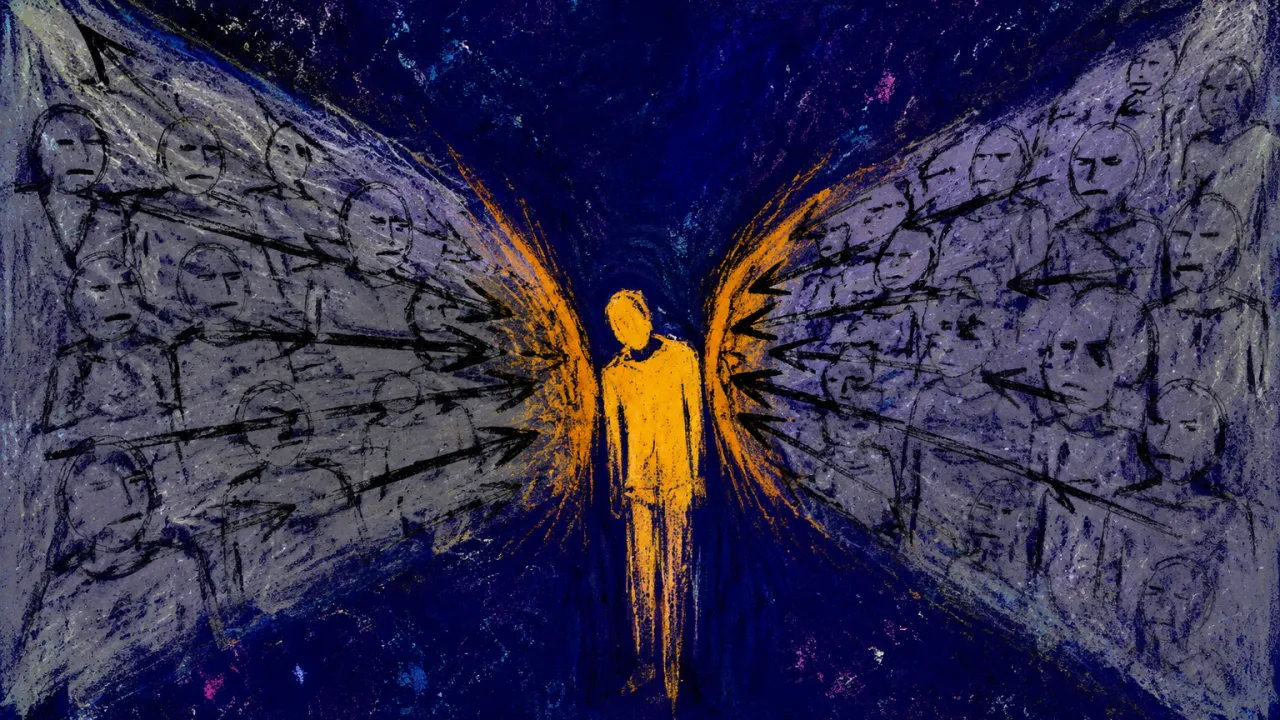
A solitary figure with shoulders bracketed by two steel-grey grids as the surrounding space presses inward.

What is this situation?

Shared Leadership Trial: you step into a temporary arrangement where you and another person are both expected to lead, while the boundaries between your roles remain unfinished. At first, joint meetings, shared documents, and matching titles make the setup look collaborative. Then the first ordinary decision exposes the gap: a team member asks for approval, one of you says proceed, and the other changes the priority after a separate conversation. The sponsor who launched the trial tells you both to work it out while continuing to judge whether the model succeeds. People begin sending the same question to each leader, waiting for the faster answer, or quoting one of you to challenge the other. Before meetings, you compare notes to avoid contradiction; after meetings, you repair mismatched promises, duplicated assignments, and deadlines that no longer belong to one owner. Credit is presented as shared when work lands well, but problems return as private questions about who approved what. Your calendar fills with alignment calls before the work can move, and routine messages arrive with both names copied because no one knows whose answer is final. By evening, your shoulders are tight from holding two decision lines together, yet another notification can reopen an issue you thought was settled. The trial stops being a simple division of leadership and becomes a daily performance of balance under observation, much like the Two of Pentacles, where a figure keeps two coins moving inside one looping band while ships rise and fall behind the figure.

Why it's not you?

The problem is not that you cannot collaborate; the trial has assigned shared responsibility without clearly assigning final authority. When decision rights, communication lanes, and escalation paths remain undefined, delay, contradiction, and shifting accountability are built into the arrangement.

Shared Leadership Trial in Tarot Cards

In a Shared Leadership Trial, every ordinary decision can become a negotiation between overlapping lines of authority, leaving your shoulders tight after another round of duplicated approvals. The pressure is environmental, the ambiguity is structural, and the dynamic is sustained by unclear decision rights rather than any single choice you make. The Tarot Cards below reflect the visible outline of that arrangement: divided control, constant balancing, and accountability that keeps moving.

The Emperor
Reversed
The armored ruler sits on a stone throne marked by rams, holding the symbols of command against a barren red landscape. Reversed, the throne remains visible but its authority no longer organizes the room; the structure signals leadership without a stable rule for who has the final say. A sponsor can launch a co-leadership trial and call the ambiguity a collaboration problem, but the missing governance is built into the arrangement. You are asked to perform authority together while the team tests both leaders, so every priority change becomes evidence for or against the model.
The Chariot
Reversed
The charioteer holds the reins while a black and a white sphinx pull in different directions before the city walls. Reversed, the vehicle has power but no unified traction: two forces can keep the system visibly moving while cancelling the direction of travel. That is the long-range risk of shared leadership without a settled decision lane. You may produce motion through meetings and announcements, yet the team cannot reliably convert that motion into a shared course because either leader can redirect the priority after the fact.
Justice
Reversed
The seated figure holds a sword and balances scales between two stone pillars. Reversed, the formal apparatus of judgment is present but the measure is uneven: responsibility, credit, and consequence do not land on the same person or in the same proportion. In the trial, shared credit can be easy to announce when a project succeeds, while a disputed approval sends the question back to one individual. You are left repairing the record of who decided what because the system has not made accountability as explicit as the title.
The Hanged Man
Upright
A figure hangs by one foot from a living tree, arms placed behind the back, with a halo marking a deliberate pause. Upright, the image holds action in suspension while the situation is viewed from an altered angle; it does not promise that the waiting period has an automatic end. The sponsor's evaluation keeps the co-leadership arrangement provisional, asking both leaders to operate while the organization watches for evidence. You keep revisiting settled questions because the trial has not reached a decision point, and the lack of a defined review threshold makes patience feel like part of the job.
Two of Pentacles
Upright
The figure keeps two coins in motion inside an infinity band, with ships riding uneven water behind them. Upright, the movement is a usable rhythm: competing demands can be held together when the system has enough flexibility to absorb change. A temporary leadership trial lives inside that rhythm, with the sponsor watching for whether shared authority can stay responsive without becoming slow. You are repeatedly reading the moment for action versus another alignment call, because the cost of mistiming is a team that either waits for permission or moves under contradictory instructions.
Reversed
The figure keeps two pentacles moving inside an infinity band while ships rise and fall behind them. With the card reversed, that looping band reads less like adaptable rhythm and more like a closed circuit: two authority streams remain active, but no handoff settles the next decision. The rough water becomes the operating environment of a trial that has shared responsibility without shared governance. You spend work hours comparing notes, repairing contradictory promises, and carrying the hidden cost of a leadership role whose final answer can be reopened by the other line.
Three of Pentacles
Reversed
Under the cathedral arch, a craftsperson stands below two observers who hold the plan and discuss the work. With the card reversed, the shared project still has multiple contributors, but the plan no longer guarantees that the people executing it share the same brief. That is the structural failure in a co-leadership trial: shared documents and meetings create the appearance of coordination while decision rights stay open to competing interpretations. You inherit duplicated assignments and mismatched promises because collaboration has been formalized without a reliable ownership map.
Two of Swords
Reversed
A blindfolded figure sits before dark water with two swords crossed over the chest, holding a decision in suspension beneath the moon. Reversed, the protected stalemate starts to leak: competing approvals, private conversations, and changed priorities expose the choice that the structure has been avoiding. A shared leadership trial turns each ordinary decision into a question of who can authorize movement. You face a choice between acting on one leader's instruction, waiting for convergence, or escalating the conflict, but none of those options feels clean while the authority boundary remains unwritten.
Five of Wands
Upright
Five figures raise wands in the same tight space, with no visible referee or single line of command. Upright, the scene contains energy and capability, but it also shows competing moves occupying the same field. A co-leadership trial can turn ordinary prioritization into a contest between legitimate instructions. You must defend one decision, reconcile it with the other leader's version, and keep the team moving while the absence of a final authority converts collaboration into repeated friction.
Ten of Wands
Upright
A figure bends beneath a bundle of ten wands, with the destination close but the face hidden by the load. Upright, the path remains available, yet the carrying method leaves little room to see, rest, or respond to anything outside the burden. The co-leadership trial adds alignment calls, duplicate messages, and evening repairs to the physical architecture of your week. You can still keep the work moving, but the cost appears in a calendar with no recovery space and a body that stays braced for the next notification.

Shared Leadership Trial in Tarot Card Reading Insights

Other people navigating a Shared Leadership Trial have also brought overlapping authority, delayed decisions, and shifting accountability into their readings. The articles below gather Tarot Reading Insights from sessions shaped by this same arrangement.

Psychological Contexts Related to Shared Leadership Trial