Overfunctioning to Prove Worth: From Automatic Yes to Shared Ownership

The 9:40 p.m. Slack Rescue: Carrying Everything Alone to Prove Worth
I knew the exact moment Jordan meant before they finished describing it: the late Slack message, the unclaimed task, the brief silence, and the automatic reply typed before the calendar had even opened. “Yep, I can take it.” Then, on the train home, a search such as “overfunctioning at work” or “why do I feel guilty delegating,” entered privately into a phone while the work itself remained publicly invisible.
Jordan joined our video consultation from the kitchen table of their Zone 2 flat at 9:40 on a wet Tuesday evening. Dinner had gone cool beside a laptop that was warm under their wrist. The radiator clicked irregularly, rain tapped the dark window, and Slack cast its pale glow across an unopened invitation to a career-development course.
They were still answering a project message when I appeared on-screen. Nobody had assigned them the task. Their shoulders sat close to their ears, and I could see the small sideways movement of a clenched jaw each time another notification arrived.
“Sorry,” Jordan said, closing the work window without closing the laptop. “I just need to make sure this doesn’t fall apart.”
After a moment, they gave me the question beneath the question. “Why do I keep proving my worth by carrying everything alone? I know I need help, but asking feels like admitting I can’t cope. I keep saying I’m fine and then resenting everyone for believing me.”
I heard the contradiction clearly. Jordan wanted to be valued for what they genuinely brought, yet every visible gap became another test of whether they deserved their place. If they shared the load, some frightened part of them feared that their value would remain unproven. Their exhaustion looked less like ordinary tiredness and more like carrying every flatmate’s groceries up four flights at once while refusing a second trip, because accepting another pair of hands would somehow make the first climb count for less.
“I’m not going to tell you that caring is the problem,” I said. “Your competence has protected projects, relationships, and probably your sense of security for a long time. We’re going to look at the point where that protection became a contract you never consciously agreed to. Let’s make a map of the fog, then find the smallest place where choice can re-enter.”

A Switchback Map Through the Ruins
I asked Jordan to place both feet on the floor, let one breath leave without improving it, and hold the question in mind while I shuffled. I do not use this pause as theatre or as a demand to believe in anything supernatural. I use it to separate the noise surrounding a question from the question itself.
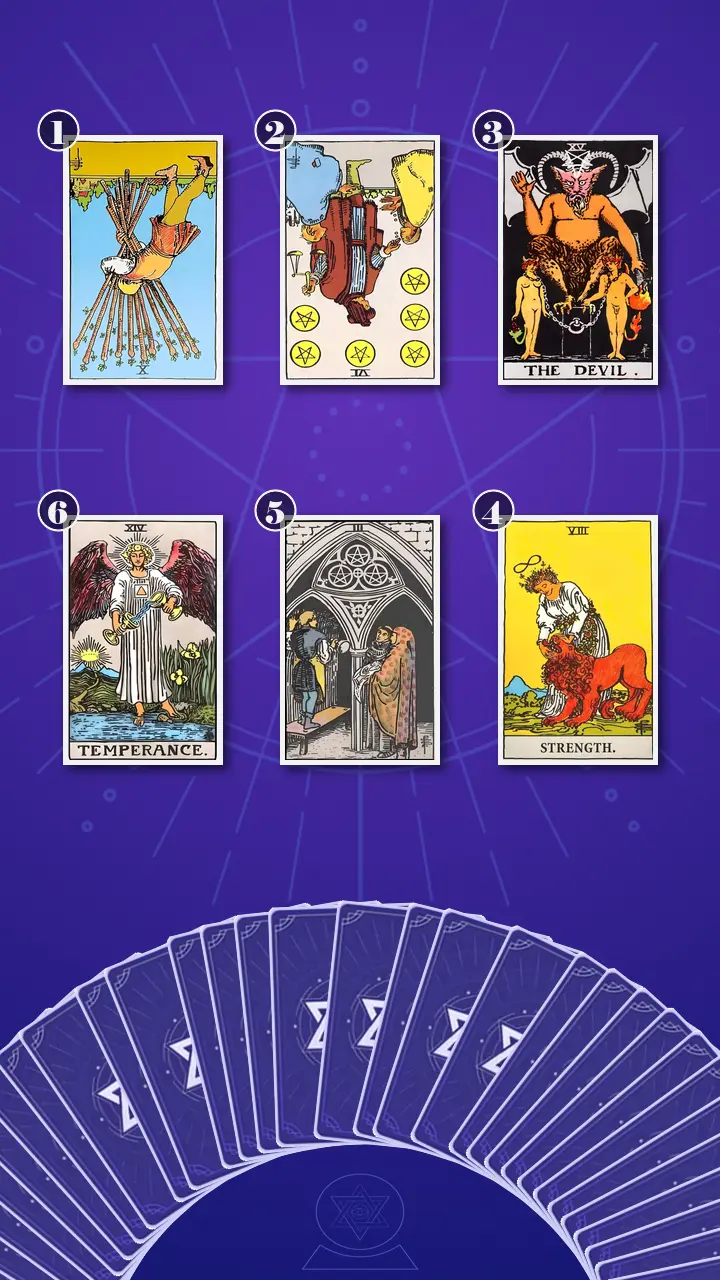
For this reading, I chose the Transformation Path Grid · Context Edition, a six-card tarot spread designed to map a self-reinforcing pattern. I explained that tarot would not predict whether Jordan’s colleagues would behave perfectly, whether every delegated task would succeed, or whether one boundary would transform a workplace overnight. I would use the cards as an organised set of mirrors: a way to place behaviour, belief, social reinforcement, and possible action where we could examine them without turning temporary circumstances into permanent fate.
I chose this spread because Jordan’s difficulty was not a single bad decision. It was a loop. Fear of becoming dispensable led to overfunctioning. Overfunctioning earned praise and trained other people to expect rescue. That dependence created exhaustion and resentment. The resulting strain then seemed to prove that Jordan was the only person who could be trusted. A broad situational reading would have scattered that mechanism across too many questions. This grid gave me the smallest useful map: symptom, blockage, root bargain, catalyst, practical experiment, and integration.
I arranged the cards in two rows of three, like a switchback path descending into an excavation and returning through the same ground under different rules. The first position would show the current pattern of carrying responsibility beyond capacity. The second would reveal how unequal giving and unspoken expectations kept it in place. The third would uncover the private bargain linking usefulness to worth. From there, the fourth card would offer the key transformation, the fifth would make that change operational, and the sixth would show what sustainable integration could look like.
The vertical pairs mattered as well. Burden would face balance. Unequal giving would face collaboration. Compulsion would face conscious strength. In my years around Cambridge collections and archaeological digs, I learned that a ruin becomes intelligible when its layers and load paths can be seen together. One fractured wall rarely explains itself in isolation. Neither does burnout.
“The cards will help us identify the structure,” I told Jordan. “But you will decide what is true, what is useful, and what you are willing to try. The reading is the map. It is not the authority over your life.”
The Workload That Blocked the View
Position 1: Ten of Wands Reversed and the Burden Called “Already Handled”
I turned the card in the first position, representing Jordan’s current state: the visible behaviour of accepting, retaining, and completing responsibilities beyond capacity to preserve an identity of competence. It was the Ten of Wands, reversed.
I pointed to the figure bent beneath ten bundled wands. The burden filled the foreground so completely that the figure could barely see the distant town, much less choose a route toward it. In Jordan’s week, the image became painfully literal: at 9:40 p.m., they were bent over a laptop finishing an asset check nobody had assigned while dinner cooled and their career-course invitation remained unopened. Even when support was offered, they often replied, “Already handled,” because delegation felt like evidence that they had failed to cope.
The reversal showed blocked release. Jordan did not lack awareness of the workload; they knew it was unsustainable. Nor did they lack motivation. The Fire of the Wands was in excess, but its movement was obstructed by accumulated duty. Action had become so abundant that it no longer carried Jordan toward their own destination. It merely held the bundle together.
“This card isn’t calling you weak,” I said. “It is showing that your strength has been recruited into maintaining a load that was never properly assigned. Think about the last unclaimed request you accepted. What did you silently move to make room for it?”
Jordan gave a short laugh, but there was no amusement in it. Their fingers tightened around the handle of a mug, their eyes dropped to the unopened course invite, and then the tension in their mouth shifted into a tired half-smile. “That’s too accurate,” they said. “Honestly, it’s almost cruel. I moved the course again. I told myself I’d do it next week.”
“Then we’ll keep the distinction precise,” I replied. “The card is not accusing you. It is showing the cost of a strategy that once made sense. The gap is visible, but that does not automatically make it yours.”
I also warned Jordan about the reversal’s opposite extreme. Releasing the burden did not mean waiting until collapse and then disappearing from every commitment. An abrupt cancellation without a handoff could create disruption and appear to confirm their fear that shared responsibility was unsafe. The invitation was proportion, not withdrawal: one named burden, one visible limit, and one negotiated transfer before resentment became the only available alarm.
Position 2: Six of Pentacles Reversed and the Capacity Missing From the Scales
I turned the card representing the primary blockage: the unequal distribution of time, labour, support, and practical ownership. It was the Six of Pentacles, reversed.
In the upright image, a standing figure holds scales while distributing coins. Reversed, those scales exposed a practical imbalance. Everyone else’s deadline appeared in Jordan’s calculations, while Jordan’s existing workload, rest, course, and evening remained in a hidden layer. They controlled the distribution of rescue work, but their own needs never reached the scale.
I connected the image to another scene Jordan had described. A colleague missed an update in a shared tracker. Before asking who owned the missing section, Jordan rewrote the plan, assigned themselves two extra steps, and checked the document repeatedly. The colleague had offered to help. Jordan had answered, “All handled.” Meanwhile, Jordan’s own request for support remained unsent in drafts.
“I want them to help,” I said, giving voice to the loop I could see, “but if I have to ask, it doesn’t count. If I wait, it may fail. So I’ll do it, and then resent that nobody stopped me.”
Jordan’s breath paused. Their thumb hovered over the edge of the trackpad as if a draft message had appeared beneath it. Their gaze lost focus for a few seconds, replaying some private sequence of rescues, and then they let out a low, involuntary “Oh.”
“I keep asking people to read needs I never state,” they said. “And I suppose I don’t really let them help. I give them half a chance, then I check everything anyway.”
“That doesn’t make the surrounding system fair,” I said. “A team can absolutely reward overwork, leave roles vague, or become dependent on the person who keeps saving the deadline. But your part of the loop is the place where you still have leverage. Resentment often grows where a limit stayed private.”
The reversed Pentacles showed an excess of giving, a deficiency of receiving, and a blockage in explicit negotiation. It was not asking Jordan to keep a rigid ledger of every favour. Reciprocity is not exact repayment on demand. The card was asking whether help had been freely chosen, clearly scoped, and allowed to travel in more than one direction.
“In the last shared task that left you resentful,” I asked, “what help did you want, what did you actually request, and whose name was attached to the missing part?”
Jordan looked at the blank space beside their laptop. “No name,” they said. “That’s the problem. There was just a gap, and I became the owner.”
Position 3: The Devil and the Auto-Renewing Role
I turned the card representing the root cause: the private attachment or belief beneath the unequal exchange. It was The Devil, upright.
I never present this card as punishment, corruption, or an external force condemning a person. I directed Jordan’s attention to the loose chains around the two figures’ necks. The image showed a binding arrangement that felt compulsory while still containing overlooked room for examination and agency.
Jordan had already described its modern form. During a performance review, their manager had said, “You always save the project when things get messy.” The praise brought a quick warmth, followed by a drop in the stomach. Jordan smiled and said, “Happy to help,” while hearing an implied permanent job description: keep rescuing, or risk losing the identity being rewarded.
“This card looks like an auto-renewing subscription to the role of ‘most useful person,’” I said. “Each rescue renews the agreement. The fee is paid in evenings, rest, personal priorities, and the right to be uncertain. Nobody has to send you a formal invoice. The possibility of becoming less necessary feels threatening enough that the agreement renews itself.”
I paused before adding, “Being needed can feel like being valued, but they are not the same contract.”
Jordan’s expression sharpened. Their shoulders did not relax; instead, they drew back slightly, as if the distinction had landed too close to something guarded.
“No one explicitly said I have to do all of it,” they said. “But not doing it feels dangerous because then they might find out I’m replaceable. Or they might just stop choosing me.”
“That fear deserves respect,” I replied. “It has probably offered you praise, control, and a legible way to secure belonging. I’m not going to shame you for using a strategy that protected you. I am asking whether the protection still fits the present.”
The Devil’s energy was not merely excessive work. It was attachment: the narrowing of perceived choice until usefulness seemed like the only reliable path to worth. It also helped explain why Jordan could recognise the cost and still keep renewing the pattern. The question was no longer simply, “Why is my workload too large?” It had become, “What do I fear losing if someone else is allowed to carry a real part of it?”
When Strength Replaced the White-Knuckle Grip
Position 4: Strength Upright and the Pause That Changed the Contract
The rain softened as I reached the card representing the key trigger: the inner quality capable of meeting Jordan’s rescue impulse while allowing a firm limit to be spoken. The radiator stopped clicking. For a few seconds, the room on my screen became unusually still.
I turned Strength, upright.
The woman in the card did not wrestle the lion to the ground. Her hands rested gently and deliberately at its jaws. The lion’s power remained present, but it was held in conscious relationship rather than allowed to dominate the moment. I explained that Strength was balanced, measured courage: neither compulsive takeover nor dramatic withdrawal, neither apology nor ultimatum.
I brought us back to Jordan’s familiar setup. It was 9:40 p.m.; dinner was going cold; an unassigned message glowed on the laptop; the course invite remained unopened. Their mind supplied the old verdict before the facts: if they did not catch the task, it might fail, and failure might expose their dispensability.
Worth is not earned by wrestling every demand alone; name a firm limit and share the task, letting Strength's gentle hands replace the white-knuckle grip.
I let the words sit between us before I gave Jordan the deeper sentence beneath them.
Your worth is not proved by how much strain you can hide. Strength begins when you can name a limit, stay connected, and let responsibility belong to more than one person.
Jordan froze first. Their breath stopped halfway in, and their fingers remained suspended above the mug without touching it. Then their eyes shifted away from me and fixed on the rain-dark window, pupils widening slightly as if a week of Slack threads were replaying across the glass. Their jaw loosened, tightened once more, and finally released. A faint flush rose across their face. Their shoulders dropped by a fraction, then farther, as though the body had received permission before the mind fully trusted it. Their eyes shone, but the emotion did not settle into simple relief. I saw recognition, grief for the evenings already surrendered, and a flash of anger at the responsibility now contained in the insight. When they spoke, their voice came out lower and rougher than before. “But doesn’t that mean I trained everyone to expect this? Does it mean I’ve been doing it wrong the whole time?” They released the rest of the breath in a tremor and opened both hands on the table, looking briefly unsteady in the space where certainty had been.
“No,” I said. “It means a protective strategy was reinforced by real praise, vague ownership, economic pressure, and your own fear of becoming dispensable. Responsibility for the system is not yours alone. Agency is different from blame. We are locating the point where you can introduce a new choice.”
This was where I used what I call Cognitive Stratigraphy. On an excavation, the object found at the surface is not automatically the origin of the site. It is an artefact carried upward by deeper layers. I treat sudden emotional triggers in the same way. The Slack ping was the surface artefact. Beneath it sat the urgent interpretation, “If nobody moves, I must.” Beneath that lay the bargain exposed by The Devil: “If I remain necessary, I remain valuable.”
I did not invent a childhood story or insist that a dramatic trauma had to exist beneath the pattern. Responsible excavation stops where evidence stops. The useful foundational layer was the obsolete rule Jordan had already named. It may once have protected security or belonging, but it was not an objective description of the present.
I placed The Devil and Strength side by side. Loose chains faced relaxed hands. The same desire to help appeared in both cards, but its direction changed. Under The Devil, the impulse governed Jordan. Under Strength, Jordan could feel the impulse without making it the decision-maker.
“I can feel the urge to take over,” I said, “and I do not have to obey it. I can stay kind while naming what I can actually carry. A warm limit is still a limit.”
Then I asked, “Now, with this new perspective, can you think of a moment last week when this insight might have made you feel differently?”
Jordan returned to 4:58 p.m. on Thursday in the Shoreditch studio. The fluorescent lights had hummed above old coffee. An account lead posted, “Can anyone pick up the final asset check?” An eyes emoji appeared, followed by silence. Jordan had a 5:30 train and an unfinished course assignment, but their hands typed, “Yep, I can take it,” before they checked either.
“The pause would have been the Strength card,” Jordan said slowly. “Not refusing. Just checking what was already true before urgency wrote the reply.”
“Exactly,” I said. “The first act of strength is not a flawless boundary. It is the pause in which the old agreement fails to auto-renew.”
I guided them through my Trigger Excavation Exercise. We gave the live reaction three layers: surface trigger, the visible unclaimed task; inherited rule, the belief that hesitation would expose inadequacy; and present evidence, the actual calendar, assigned scope, and available colleagues. Separating those epochs prevented an old rule from disguising itself as a current emergency.
I invited Jordan to set a ten-minute timer and open one current task thread. In a private note, they wrote three lines: “My actual capacity is...”; “The part I can own is...”; and “The part that needs another owner is...” I made the autonomy of the exercise explicit. They did not have to disclose personal details, justify the limit, or send anything before they felt ready. If the discomfort became larger than the exercise was useful, the minimum version was simply noticing the urge to type, “I can take it.”
Jordan drafted a possible reply: “I can review the final version tomorrow morning, but I can’t own the turnaround tonight. Who is taking the first draft?”
They read it twice. “That still sounds helpful,” they said, almost surprised.
“It is helpful,” I replied. “It is also truthful.”
I thought then of a principle I use in Ruins Restoration Thinking. A fracture does not always mark the end of a structure. Sometimes it reveals where pressure has been travelling and makes an honest reconstruction possible. Jordan’s exhaustion and fragmented priorities were not proof that their identity was failing. They were evidence that the old load-bearing arrangement could no longer be sustained.
This was the reading’s decisive movement: from braced exhaustion and worth-through-usefulness toward steady self-respect, shared ownership, and reciprocal connection. It was not the whole journey completed. It was the first clear crossing from “I must obey the urge” to “I can notice the urge and choose my response.”
Competence With More Than One Name on It
Position 5: Three of Pentacles Upright and the Visible Handoff
I turned the card representing the action plan: the practical behaviour that could give Strength a real-world form. It was the Three of Pentacles, upright.
Three figures met around plans beneath a stone arch. One held a skilled position on the bench; the others brought knowledge, requirements, and perspective. No single person disappeared from the work, but no single person performed every role offstage. The Earth energy that had been distorted in the reversed Six of Pentacles became constructive here: ownership, standards, contribution, and review were made visible.
I translated the image into Jordan’s agency. In a 15-minute project huddle, Jordan could name Sam as owner of a draft, agree on the expected result, provide one reference file, and schedule a Thursday check-in. Jordan could then close the document instead of privately rewriting the work. Their competence would remain visible as a skilled contribution inside a shared structure.
“My contribution can be skilled without being total,” Jordan said, testing the sentence.
“That is the card meaning in context,” I replied. “Collaboration is not vague encouragement to ‘ask for help.’ It is an operational agreement. Who owns the task? What outcome do they own? What support will you provide? When is the one agreed review point?”
I also named the difficult part. Delegation meant allowing the other person to make decisions within the agreed scope. If Jordan handed over the task but checked the document six times, rewrote it after hours, or silently reclaimed ownership at the first difference in style, the old system would remain intact under collaborative language.
Jordan glanced towards their phone. “Explaining it might take longer than doing it myself.”
“For the first ten minutes, perhaps,” I said. “But ‘quicker’ is often calculated task by task. It leaves out the repeated checking, the abandoned course, the resentment, and the system learning that you will always absorb uncertainty. Choose a low-stakes task where imperfection is tolerable. We are testing a structure, not gambling the entire project.”
Their hand moved towards the laptop, stopped, and returned to the table. The interruption was small, but I noticed it. Strength had already begun as a pause.
Position 6: Temperance Upright and the Return of Circulation
I turned the final card, representing integration: the state in which care and boundaries could coexist, worth would no longer be measured by workload, and support could circulate. It was Temperance, upright.
Water travelled in measured quantities between two cups. One foot rested on land and the other in water. I saw a closing answer to the opening burden: responsibility did not have to collect in one person’s hands until it became too heavy. Effort, help, feedback, rest, and attention could move through a system in workable proportions.
In Jordan’s life, this looked like a five-minute Friday review in which every open task was marked owned, shared, or unclear. It looked like protecting a 30-minute course block, contributing a fair share to a team deadline, and accepting a colleague’s help without immediately taking the work back or inventing a favour to repay. Reliability could mean clear, consistent, and honest about capacity rather than permanently available.
The energy here was not perfect balance as a static achievement. Temperance represented ongoing integration. Some weeks would require more effort; some relationships would not divide work evenly at every moment. The test was whether responsibility could be discussed and adjusted before resentment or collapse became the first visible signal.
“Support does not have to be repaid immediately,” I said, following the water between the cups with one finger. “And care does not have to collect in your hands.”
Jordan inhaled slowly. Their shoulders stayed lower this time. Then they frowned, not in rejection but in concentration. “I can imagine doing it,” they said. “I’m just not sure I’ll believe I’m still reliable while I’m doing it.”
“You may not believe it immediately,” I replied. “The belief was built through repetition, and a new one will need evidence. Temperance does not ask for instant certainty. It asks for a repeatable rhythm in which you gather that evidence without abandoning yourself.”
I noticed one more feature of the spread: there were no Swords. Jordan did not need another private night of analysing every possible failure. Air, the missing element, had to enter through language: a clear request, a named owner, a defined scope, and one spoken limit. The next insight would not come from thinking harder in isolation. It would come from making responsibility visible.
Restoring the Structure Without Rebuilding the Old Burden
I drew the six cards into a single story. The Ten of Wands reversed showed Jordan carrying tasks beyond capacity until their own priorities disappeared behind the bundle. The Six of Pentacles reversed explained how that burden kept accumulating: Jordan gave before ownership was negotiated, hid their capacity, and hoped other people would somehow recognise a need that had never been stated. The Devil uncovered the protective bargain beneath the pattern: usefulness had become the price of security, praise, and belonging.
Strength did not ask Jordan to stop caring. It changed who directed the care. The Three of Pentacles gave that inner authority a social structure through named ownership and one bounded review. Temperance extended the experiment into a rhythm in which work, help, personal priorities, and rest could circulate rather than pooling in one person’s calendar.
The vertical pairs made the restoration visible. The Ten of Wands faced Temperance: overload became proportion. The reversed Six of Pentacles faced the Three of Pentacles: unspoken, unequal giving became collaborative structure. The Devil faced Strength: a binding impulse became a conscious relationship with the same powerful desire to help.
“You have been living like a one-person bridge,” I told Jordan, “assuming every crossing must be held without visible strain. But sound restoration does not demand one heroic stone. An arch survives because pressure is distributed through a structure. Sharing the load is not evidence that the central stone has no value. Distribution is what allows every part to keep its integrity.”
The cognitive blind spot was now plain. Jordan had been using other people’s dependence as evidence that only Jordan could be trusted, even though those people had rarely been given explicit ownership, sufficient scope, or a genuine chance to contribute without being monitored. Jordan wanted support, but the request often stayed private. Then the absence of support seemed to prove the old belief.
I did not pretend that Jordan had created every workplace problem. Vague roles, praise for rescue labour, high living costs, and uneven team behaviour were real structural forces. A tarot reading could not make those conditions harmless. What it could do was separate the part Jordan could influence from the conditions they could only observe, document, negotiate, or make decisions around.
The transformation direction was specific: before accepting a new responsibility, Jordan would pause long enough to name current capacity and either delegate one defined component or negotiate the scope. The aim was not to become less dependable. It was to move from indispensable rescuer to dependable collaborator.
The Trigger Excavation and Named-Owner Plan
I gave Jordan three deliberately small next steps. Each could be kept private, adapted to the power dynamics of the workplace, or stopped if it felt unsafe. Tarot had provided a pattern map; the evidence would come from Jordan’s own experiments.
- Use the 90-Second Trigger Excavation When the next unclaimed Slack request appears, wait 90 seconds before replying. Open the calendar and write three private lines: “The surface trigger is...”; “The old rule says...”; and “The present capacity fact is...” Then offer only what genuinely fits, such as, “I can review this tomorrow morning, but I cannot own the full turnaround today.” If the full script feels too exposed, use the minimum version: ask one clarifying question before volunteering. No personal explanation is required.
- Send One Four-Line Named-Owner Handoff Choose a low-stakes live task and write the agreement in Slack or email: “Owner: Sam. Outcome: final captions in the shared document. Due: Thursday at 2 p.m. My role: one review at noon.” Close or mute the document until the check-in unless the owner contacts you. Choose work where some difference in style is tolerable. Do not privately redo it unless a genuine risk or an agreed quality standard requires intervention.
- Run a Five-Minute Temperance Review At Friday shutdown, mark each open task O for owned by you, S for shared, or U for unclear. Send one scope or ownership message about a U task, then protect one 30-minute personal block, including the career course, as “busy” on the calendar. This is a capacity check, not a productivity scorecard or a ledger of favours. If five minutes feels like another burden, mark only one unclear task and stop.
“The likely discomfort is not a sign that the limit is wrong,” I said. “It may simply be the feeling of an old contract losing its automatic authority. You can remain warm. You can remain competent. You can also decline total ownership.”
Jordan looked again at their draft reply. This time, they did not edit it into an apology.

A Week Later: The Quiet Proof in the Calendar
Six days later, Jordan sent me a short message. They had used the four-line handoff for a set of captions. Sam remained the owner; Jordan reviewed the work once at noon; the course block stayed in the calendar. Their dinner had been warm when they ate it.
The change was not polished into a triumph. Jordan admitted that they had woken the next morning thinking, “What if the work slips and they blame me?” Their thumb had hovered over the shared document for nearly a minute. Then they remembered the relaxed hands in Strength, left the file closed, and opened the course invitation instead.
That was enough evidence for one week. Jordan had not solved every workload problem or erased the fear of being dispensable. They had created one pause, one named owner, one check-in, and one protected piece of their own life. The clarity was cautious because it carried responsibility: if worth no longer depended on rescue, Jordan would have to practise believing in a value that did not arrive as an urgent notification or a manager’s relieved praise.
I have spent enough time among ruins to distrust stories that call every fracture a catastrophe. Sometimes a crack reveals that an old structure has been carrying pressure in the wrong place. Restoration begins when the load path becomes visible and a different arrangement can be tested.
The cards did not send Jordan’s boundary, assign Sam, protect the calendar block, or decide Jordan’s future. Jordan did. Tarot made the pattern easier to see, but the authority remained where it belonged: with the person living the life. Their Journey to Clarity was not a prophecy of effortless balance. It was the recovery of a choice at the exact moment the old pattern had once felt inevitable.
When the next visible gap makes your shoulders brace before anyone has even asked, it may still feel safer to carry the whole thing than to discover whether you are valued without becoming the sole owner. Noticing that old contract, however, means it is no longer operating entirely in the dark.
If your worth did not need proving in the next Slack silence, which one part of the load could you allow to rest in another named owner’s hands?