When "I've Got It" Deepens Powerlessness: Choosing Bounded Help

The Unread Offer: Why Accepting Help Felt Like Losing Control
You are the dependable friend with a hybrid city job and an overbuilt Notion system, yet your version of Help-Seeking Anxiety appears the second someone offers to proofread the message you have been avoiding.
At 9:18 p.m. on a Tuesday in a small Toronto apartment, I watched Jordan stare at a Slack draft while lukewarm takeout gave off the fading smell of garlic beside the trackpad. The laptop fan whined; the phone glowed with a friend's message, "Want me to proofread it?" Jordan turned the screen face down, their jaw clenched and shoulders rising toward their ears.
When I asked what had brought them in, Jordan said, "Why do I keep refusing help when I feel most powerless? I know I need support, but the moment someone offers it, I feel like they are taking the steering wheel. Then I say I'm fine, keep working alone, and resent being alone."
The helplessness they named had the physical texture of gripping a steering wheel after the road had disappeared: tight chest, heavy shoulders, restless fingers searching for a route that was no longer visible. Beneath it, I could hear shame, guarded irritation, and a very ordinary longing to be cared for without being managed.
"That makes sense," I said. "The offer is practical; the threat your mind hears is existential. We do not have to shame the part of you that protects your autonomy. We can look closely at the moment help becomes a story about losing control, then draw a map toward clarity. The cards will not decide for you. They will help us notice the choices that are already yours."

The Celtic Cross That Made Room for Choice
I invited Jordan to take one slow breath and hold the question in a simple form: what happens inside me when receiving support feels dangerous? I shuffled slowly, using the pause as a transition from the glowing screens and private task lists into deliberate attention, not as a supernatural test.
I chose the Celtic Cross · Context Edition, a non-predictive tarot spread for exploring the help-refusal loop, agency, and support boundaries. A standard Celtic Cross can show the present situation, the crossing obstacle, the deeper foundation, recent reinforcement, conscious attitude, environment, hopes and fears, and integration. This contextual version keeps the near-term card as a self-authored experiment and reads the final card as an integrated capacity rather than an inevitable event.
For anyone wondering how tarot works in a reading like this, the value is in placing one emotional question into several observable frames. The first card would show the exact behavior that appears under pressure; the card crossing it would reveal the control response. The foundation would name the belief beneath the cycle. Later, the Six of Pentacles would offer a bounded experiment, Strength would show the inner quality capable of holding vulnerability and agency together, and The Star would describe what connected agency might feel like without making a prediction.
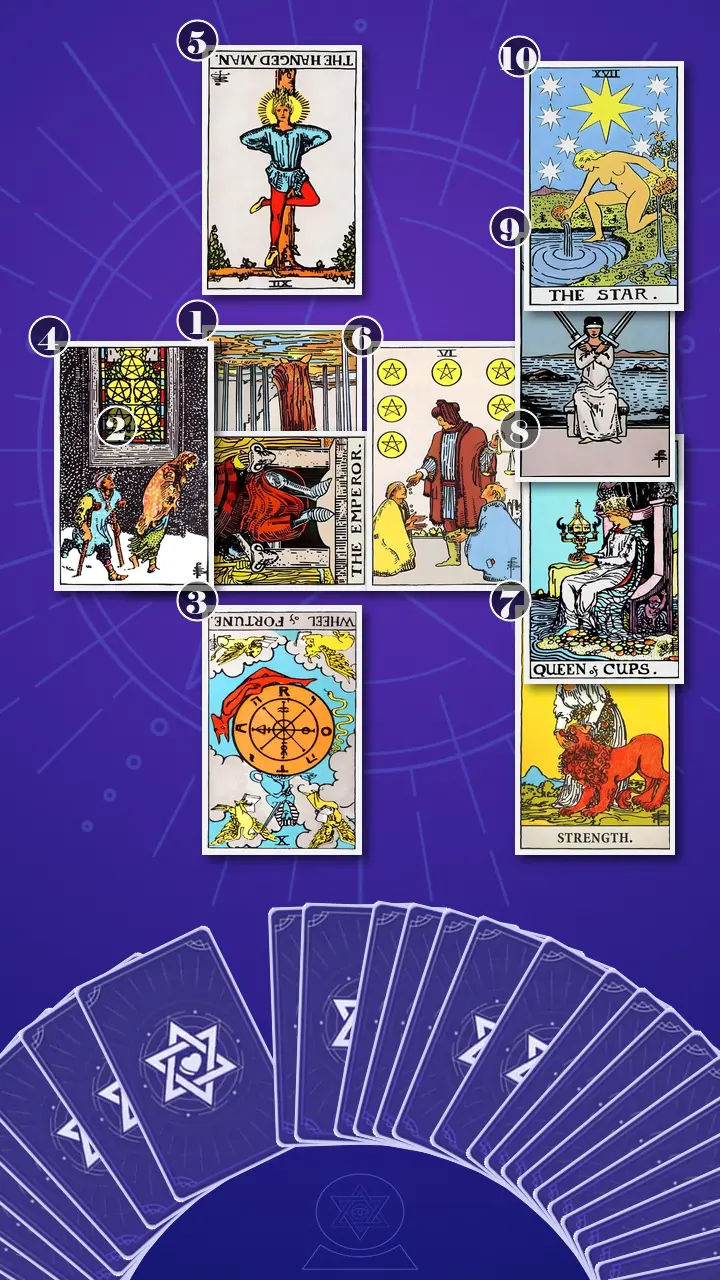
The Map of a Mind on Lockdown
I placed the cards in a cross, then followed the vertical line toward support and integration. I kept returning to the same practical question: what remains yours to decide, even when another person contributes?
The Present Situation: Eight of Swords, Reversed
"Now the card I have turned for the present situation, the specific behavior and emotional energy of refusing help while feeling most powerless, is the Eight of Swords, in reversed position."
In the Rider-Waite-Smith image, the blindfold, loose bindings, and surrounding swords make a narrow field of choice visible. In Jordan's life, that image was the phone beside the overbuilt private Notion board. A friend had offered one proofread, but Jordan's inner monologue translated it into a total loss of ownership: "I need the message checked, but if I accept that help, it means I could not handle my own account."
Reversed, the restriction is beginning to become visible. This is not a card saying that support is absent. It shows a blockage in interpretation: a limited offer becomes an all-access pass in the mind, so the available choice disappears before Jordan has inspected the terms. The private plan creates a brief hit of control, but the same task, the same deadline, and the same unanswered message remain.
Jordan gave a small, bitter laugh. "That is too accurate. Almost rude." Their eyes stayed on the phone for a second, then moved to the Notion board as if replaying the exact moment the offer had changed shape. I let the recognition stand without turning it into a verdict. Seeing the loop was already a different action from obeying it.
The Crossing Influence: The Emperor, Reversed
"The card crossing the present situation, the control response that turns a wish for support into a threat to autonomy, is The Emperor, in reversed position."
The Emperor normally organizes resources, sets boundaries, and gives structure to a difficult situation. Reversed, that structure has become rigid self-command. I pictured Jordan's internal operations manager responding to overload by taking every task back in-house: write the response, check the wording, research the policy, rebuild the timeline, stay green on Slack, and let no one touch the process unless they can follow rules that have never been stated.
"If I control every detail, nobody can corner me," Jordan said. "Even if I am the one getting crushed by the details." This was the agency-fate split in behavioral form. Jordan wanted help and also believed that only solitary control was safe.
I introduced my Persona Fatigue Diagnosis lens carefully. I was not diagnosing Jordan or assigning a fixed personality. I was looking at the toll of maintaining the social character of the unshakeable professional, the version who answers every customer escalation with a calm emoji while the private self reorganizes the crisis at midnight. It reminded me of the polished workplace split in Severance: not because Jordan was living that story literally, but because performing competence all day had begun to hide the cost of keeping it intact.
Jordan's jaw tightened. Their hands went flat against their thighs, and the room seemed to narrow around the sound of the refrigerator. "So my version of control is increasing the workload," they said. "I have been calling that independence."
"Sometimes it is a boundary," I replied. "Sometimes it is a wall. A boundary tells help where to stop; a wall prevents it from starting. Our job is not to remove your boundaries. It is to make them usable."
The Foundation: The Wheel of Fortune, Reversed
"The card at the foundation, the belief about agency, fate, and personal control that makes the help-refusal loop feel necessary, is The Wheel of Fortune, in reversed position."
The Wheel turns through changing conditions. Reversed, it can show the felt experience of repetition and resistance to change. I did not read it as fate deciding anything about Jordan. I read it as a story Jordan had learned to tell after a setback: "This was always going to happen. Circumstances control the whole thing. If I cannot control all of it, I control none of it."
That story made a private plan feel safer than a shared request. Jordan would scrap the week's schedule, research another system, collect more advice, and delay testing one small option. The wheel kept moving, but Jordan tried to freeze their position by tightening their grip. The energy was blocked agency, not absent agency. One circumstance could be fixed or unfair while one response inside it remained available.
I asked, "When the road changes, what is the smallest part of the route you can still choose?" Jordan's finger stopped above the edge of the card. Their gaze lost focus for a moment, then returned to the wheel. "Maybe who gets to sit beside me," they said, quietly enough that I almost missed it.
The Recent Reinforcement: Five of Pentacles, Upright
"The card in the recent-reinforcement position, the experience of isolation or perceived scarcity that has strengthened the refusal pattern, is the Five of Pentacles, in upright position."
I asked Jordan to remember Sunday at 10:42 p.m., when a LinkedIn promotion post had appeared above a message offering to bring dinner. Their description gave the Five of Pentacles its modern setting: blue light stinging tired eyes, the radiator knocking through the silence, an apartment that felt colder because the warm invitation was sitting unanswered on the screen.
The two figures moving through snow pass an illuminated window. The support is visible, but it is not yet being tested on Jordan's terms. The card carries a deficiency of felt access, not necessarily an actual absence of care. Needing help has begun to sound like being a burden, an outsider, or proof of inadequacy. Jordan walked past the warmth because entering it felt like admitting the week had defeated them.
"I did not even know whether my friend expected me to talk," Jordan said. "I just decided that going inside would make me the person who could not cope." They rubbed their palms together as if trying to bring feeling back into them. I reminded them that the card was describing an interpretation, not proving a fact about the friend or the relationship.
The Conscious Story: The Hanged Man, Reversed
"The card above the centre, the conscious self-reliance rule or fixed perspective Jordan is trying to maintain, is The Hanged Man, in reversed position."
The Hanged Man invites a voluntary pause and a changed viewpoint. Reversed, the pause has stopped creating perspective and started postponing contact. Jordan edits a support request until it includes every caveat, context paragraph, privacy condition, and possible response. Then the message goes into Notes, where it remains perfectly safe and completely unable to help.
"I tell myself I need perspective," Jordan said. "But really I am waiting until I can ask without sounding incapable."
I named the energy as a blockage rather than a character flaw. A temporary release of control is being confused with permanent surrender. The invitation here was not to become passive or hand the problem to someone else. It was to pause for ten minutes, write two possible interpretations, and allow one imperfect request to exist before the explanation was perfect.
Jordan looked down at their Notes app. Their thumb hovered, withdrew, and hovered again. The old rule was still present, but it no longer filled the entire screen.
The Near-Term Experiment: Six of Pentacles, Upright
"The card in the next self-authored-experiment position, the first bounded way to receive help while preserving the final choice, is the Six of Pentacles, in upright position."
Here the scales turn support into something measurable. The six coins are not an undefined rescue package; they are scope, time, and a clear stop point. I translated the card into one proofread, a 20-minute call, or dinner left at the door with no visit required. The energy is balanced reciprocity: Jordan can receive a real contribution without transferring authorship.
"Maybe I do not have to accept help as a whole package," Jordan said. "Maybe I can accept one defined thing."
Then they pushed back. "But I cannot even find five minutes. If I ask my colleague, I will have to explain everything, and then the request will become another project."
"Then we make the request smaller than the explanation," I said. "You can ask for comment-only access to one paragraph in a Google Doc. You can say what kind of feedback you want, when it ends, and that you will decide whether anything gets sent. Five minutes is not a moral test. It is a testable unit."
Jordan inhaled to object, stopped, and let the breath out slowly. Their shoulders lowered by a fraction. They opened the unread message, not to commit, but to see what had actually been offered. That distinction was the beginning of reciprocity.
When Strength Sat Beside the Lion
Before I turned the next card, the room became very quiet. Even the laptop fan seemed to recede, as though the practical noise of the evening had stepped back to make room for a more honest question.
The Self: Strength, Upright
"The card in the self position, the inner quality that can hold vulnerability and agency together instead of making them opposing choices, is Strength, in upright position."
The woman beside the lion is not winning through force. Her hands are calm, her posture open, and the infinity symbol above her head suggests a steadier kind of self-command. In Jordan's modern life, Strength looked like feeling the familiar urge to type "I'm fine," noticing the surge without crushing it, and choosing a response that kept the terms in their own hands: "I need company, not advice, and I will decide what to say."
I used my signature tool, Internal Monologue Auditing, to examine the destructive genre of the sentence beneath the sentence. Jordan's old thought was written like a high-stakes courtroom drama: accepting help became evidence, a caring friend became a judge, and one proofread became a transfer of authorship. I asked Jordan to hear the line in a different genre, one closer to a grounded documentary: "I am under pressure. A limited contribution could add capacity. I can set the terms and make the final decision."
It is 9:18 p.m.; the Slack message is still unfinished, dinner is going cold, and a friend's offer remains unread because accepting ten minutes of help somehow feels more exposing than losing another night to the problem.
I let that scene settle, then said the sentence I most wanted Jordan to carry with them.
You do not have to tame every need alone to remain in control; practice courageous receiving on your own terms, like the calm figure beside the lion.
The pause after it felt physical. Then I gave the practical version, the line that could travel beyond the reading.
Agency is not proved by carrying everything alone. It can look like choosing exactly what help enters, where it stops, and what remains yours to decide.
Jordan's face went still first. Their breath caught halfway in, and their pupils widened as the familiar argument replayed: if someone helped, someone else might gain access; if someone gained access, Jordan might lose the right to choose. Their fingers tightened around the phone, then slowly opened. A flush rose beneath their eyes. For one beat, there was no relief, only a blank space where the old rule had been, followed by the frightening responsibility of seeing another option.
Then Jordan exhaled from somewhere deep in the chest. The shoulders dropped; the mouth softened; the voice arrived low and unsteady. "I can feel exposed and still set the terms," they said. The sentence did not solve the week. It gave the week a different direction.
I asked Jordan to open a note with three headings: "Still mine to decide," "One thing someone could do," and "Where their role ends." Under the first, they wrote, "The final wording and whether I send it." Under the second, "Read one paragraph for clarity." Under the third, "No access to the backstory." We drafted, without requiring a send, "Could you proofread this for clarity for 20 minutes? I will choose the final wording and whether to send it."
"Now, use this new perspective to think back to last week," I said. "Was there a moment when this insight might have let you feel different?"
Jordan looked toward the face-down phone. "When I walked away from my friend's building. I thought accepting warmth meant admitting defeat. Maybe it could have meant choosing warmth for one hour." This was the emotional transformation in its first visible form: a move from contracted helplessness and rigid self-reliance toward grounded self-trust and connected agency. The hands stayed on the steering wheel, but the road no longer had to be travelled alone.
The Environment: Queen of Cups, Upright
"The card in the environment position, the kind of support that can respect privacy and autonomy, is the Queen of Cups, in upright position."
Her lidded cup, throne beside the water, and quiet blue landscape offered a different model of care. This was not someone demanding the whole story or taking command of the outcome. It was the friend who asks, "Do you want listening, brainstorming, or practical help?" and accepts the answer, including no.
I asked Jordan to name one person whose past behavior showed they could hear a boundary without pushing. The question changed the social field from an abstract threat called other people to actual evidence about one actual person. The energy here was receptive and emotionally intelligent, with boundaries intact. Jordan could share ten percent, keep ninety percent private, and end the conversation when the agreed time was over.
"My friend Mina does that," Jordan said. "She asks once, and if I say not today, she does not turn it into a referendum on our friendship." Their mouth lifted slightly. The support had not become safe because tarot promised it would be; it had become more assessable because Jordan could examine behavior, state conditions, and revise access.
The Hope and Fear: Two of Swords, Upright
"The card in the hopes-and-fears position, the ambivalence between being supported and remaining unreachable, is the Two of Swords, in upright position."
The blindfold and crossed swords show a guarded stalemate. I connected it to 7:35 a.m. on the TTC, when Jordan had drafted two messages: "Could you stay on the phone while I make this call?" and "Never mind, I sorted it." Neither was sent. The energy was not a lack of options; it was a protective pause that had become fixed because both choices seemed to threaten identity.
"I want someone to notice," Jordan said, "and I also want them to stay exactly far enough away that I never have to need them."
I did not argue with the contradiction. It was honest. Hope and fear were holding the same two swords. I suggested naming both needs in one message: "I want help with this part, and I will handle the rest." Jordan's arms slowly uncrossed. The movement was small, but it made room for a sentence that did not require choosing between dependence and isolation.
The Integrated Capacity: The Star, Upright
"The card in the integrated-capacity position, the self-understanding and relational agency Jordan can practice without forecasting an external event, is The Star, in upright position."
The Star's open sky and two streams widen the reading beyond the earlier blindfolds and enclosing forms. One stream reaches the pool and one reaches the land: support can replenish emotional capacity and practical participation at the same time. I returned to the phone face down on the table and imagined a different late-night scene, one in which Mina listened for ten minutes while Jordan made the final call.
"Being witnessed did not erase my direction," Jordan said after a moment. "It made the direction easier to hear."
I held the card as an image of cautious hope, not a promise. The Star's energy was openness with discernment. It offered a way to receive without self-erasure, allowing connection to add capacity while Jordan remained responsible for their values and decisions. The help-refusal loop did not vanish because one beautiful card appeared. It became something Jordan could notice, interrupt, and test.
When I finished, Jordan's shoulders remained lowered. Their phone was still on the table, but it was no longer face down.
The One-Task Reciprocity Contract: Finding Clarity Without Surrendering Choice
When I gathered the cards into one story, I saw a clear sequence. The Five of Pentacles showed recent isolation making support look like a lit window meant for other people. The reversed Wheel of Fortune supplied the belief that changing circumstances had already decided the outcome. The reversed Eight of Swords showed that belief becoming a narrowed interpretation, while the reversed Emperor tightened it into a private rule: if I do not control every detail, I am not safe. The reversed Hanged Man kept the request suspended until it could be perfectly explained. The Six of Pentacles, Strength, and the Queen of Cups offered the resources the loop had excluded: measured exchange, gentle self-command, and care with boundaries.
The blind spot was treating autonomy as an all-or-nothing permission setting: full admin access or blocked. A person could contribute to one Google Doc with comment-only access without owning the file or pressing Send. The key shift was to treat one clearly bounded act of receiving help as an intentional exercise of agency rather than a surrender of the right to choose. That is the movement from rigid self-reliance to bounded receiving and connected agency.
I told Jordan, "Refusal can feel like control for five minutes and become powerlessness for five more days. A boundary tells help where to stop; a wall prevents it from starting. You can receive support without transferring authorship."
Before Jordan chose an action, I offered my Director's Cut of Self-Compassion, a mental editing technique for interrupting the punitive internal judge. The first draft might say, "You should have handled this already. Do not let anyone see the mess." The director's cut does not pretend the pressure is fine. It edits the narration into an objective, supportive observer: "You are overloaded. One defined contribution may help. You can set the terms, keep the private parts private, and decide what happens next."
I asked Jordan to choose one small experiment, revise it if needed, or keep it as a private draft. The point was not to perform vulnerability correctly. It was to collect one new piece of evidence about receiving without giving away the self.
- The Retained-Decision RequestBefore Friday, text one trusted colleague at work: "Could you read this paragraph for clarity by 3 p.m.? I will make the final edits and decide whether to send it." The task is one paragraph, the person is named, the time limit is clear, and the final decision remains Jordan's.If sending feels too exposing, make the five-minute version: save the message as a draft or ask for comment-only feedback on one sentence.
- The Support Menu PauseWhen the next offer arrives, put both feet on the floor, unclench the jaw once, and take one full breath before replying. Then choose one line from a phone note: "Listen for 10 minutes," "proofread one thing," or "sit with me while I do it." A narrower counteroffer is also a complete answer.You do not need to explain the entire situation. Replace an automatic "I'm fine" with "Let me think about what part would actually help."
- The Fifteen-Minute WitnessDuring one difficult admin task this week, invite Mina or another trusted person to stay on an audio call for 15 minutes while Jordan completes the task. Say, "I want company, not advice," and end the call when the timer rings.Name the privacy boundary before the call begins. Receiving company does not create an obligation to disclose the backstory or accept follow-up help.

A Week Later: The Quiet Proof
Three days later, I received a message from Jordan: "I sent the proofread request. It felt weirdly formal, but my colleague read the paragraph and I made the final call." The update ended with a screenshot of the original Slack draft, now marked resolved without the usual private marathon behind it.
Jordan slept through the night after the call. In the morning, the first thought was still, "What if I get it wrong?" This time, they smiled at the question, opened the message thread, and made the decision themselves. The doubt had not disappeared; it simply no longer had sole custody of the steering wheel.
I think of that as the first quiet proof of the Journey to Clarity. The cards did not rescue Jordan or grant permission to receive care. Jordan noticed the old genre, set the terms of participation, and used support to recover capacity while keeping authorship.
When the offer arrives and your chest tightens before you can even answer, the hardest part may be wanting someone beside you while fearing that letting them close will cost you the last piece of control that still feels yours. That reaction deserves understanding before it deserves revision.
If receiving could be one small choice you author rather than a verdict on your capability, what part of the load might you be willing to let someone hold beside you, with one task, one time limit, and the final decision still in your hands?