The Deleted Follow-Up Sentence: Making the Cost of Delay Visible

The 6:40 p.m. Workaround
If you own the deadline but not the data, budget, software permission, or decision, accountability without authority can turn a normal project dependency into a private crisis of competence. I heard that sentence in the way Jordan (name changed for privacy) set their bag beside my chair and kept one hand around a paper coffee cup they had stopped drinking from.
At 6:40 p.m. on a Tuesday, Jordan had been at the kitchen table in their Toronto apartment, copying analytics figures into a spreadsheet because the dashboard request was still pending. Their laptop fan whirred against the quiet, reheated coffee tasted bitter, and their shoulders rounded as a heavy pressure gathered behind the sternum. The resource stayed locked, so the request got softer; the deadline stayed fixed, so the idea got smaller.
Jordan told me, I keep making the idea smaller so nobody can say it asks for too much. They had already deleted the sentence explaining that the missing permission would delay delivery, replacing it with I am refining the scope. Every follow-up started to feel like evidence that they were difficult. This was professional self-erasure under resource gatekeeping, not a lack of ideas or effort.
I could see powerlessness sitting in their chest like a locked elevator that kept displaying the correct floor but would not open. Frustration pressed beneath it, followed by the shame of needing something another person controlled. I said, You are not imagining the locked drawer, and you do not have to fold yourself into it. We would use the cards to separate the real constraint from the meaning Jordan had been forced to carry, and together we would find a clearer next move.
I also told Jordan that tarot could not make a manager approve access or guarantee a fair process. What it could do was give us a disciplined way to look at the pattern, name the power asymmetry, and return the pen to the person whose work had been shrinking around it. That was the beginning of our Journey to Clarity.

Choosing a Map for a Locked Drawer
I invited Jordan to place both feet on the floor, take one unhurried breath, and name the question without trying to make it sound reasonable. Then I shuffled slowly. The movement was not a supernatural demand for an answer; it was a small psychological doorway between reacting to the problem and observing it.
For this reading, I chose the Transformation Path Grid · Context Edition. I explained that this six-position spread was designed for a self-reinforcing workplace pattern in which denied access leads to shrinking, shrinking hides the dependency, and hidden dependencies allow the gatekeeping to continue. It was the smallest structure that could hold the visible symptom, the external bottleneck, the limiting belief beneath it, the catalyst, the practical response, and the integrated result.
I wanted anyone reading this to understand how tarot works here. I was not using a card as a verdict about Jordan's future, and I was not treating an emotional response as proof that a manager was malicious. I was reading card meanings in context, using the images as prompts for observable facts, organizational roles, communication habits, and choices that remained available.
I told Jordan that the upper row would show where the problem was currently visible: the self-censoring pattern, the resource being held, and the exclusion story it had created. The lower row would then show the leverage point, a collaborative response, and the form of professional agency Jordan could practise even if access remained conditional.
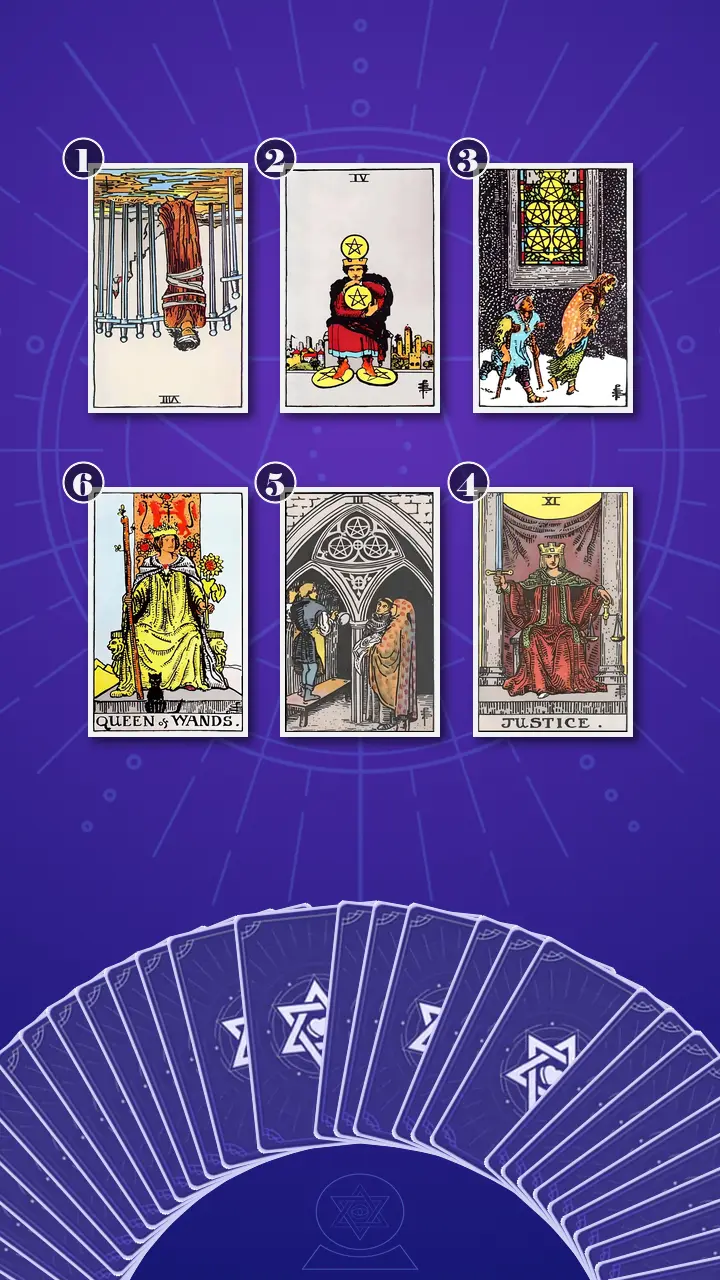
The Upper Row: Three Ways a Lock Gets Inside
The Deleted Sentence: Eight of Swords Reversed
I began with the position that shows the observable symptom described in the diagnosis: the way Jordan self-censors requests, reduces scope, and absorbs unnecessary work after access is delayed. The card I turned over was the Eight of Swords, in reversed position.
In the modern workplace scene of this card, Jordan had a direct access follow-up drafted. Before sending it, they deleted the sentence naming the blocked dependency, promised to preserve the deadline, and began another manual workaround. The missing permission was real. The reversed Eight appeared in the extra restriction Jordan created by treating an anticipated no as though it had already been delivered.
I read the reversed energy as obstructed Air: thought and communication were moving, but inward, through endless review and self-policing. The loose bindings in the image mattered to me. They did not mean Jordan could simply walk out of an organization-controlled system; they suggested that one binding could be loosened by leaving the dependency visible instead of deleting it from every update.
I returned to the Friday email draft. I asked Jordan to picture the direct sentence being written, deleted, and replaced with just checking in. The inner line beneath it was simple: I know what is blocking me, but naming it feels more dangerous than absorbing it.
Jordan gave a short laugh that held no amusement. Their fingers tightened around the coffee cup, and they said, That is painfully accurate. I did not rush to turn the recognition into a lesson. I said, The fact that you softened the message does not make you responsible for the access delay. It shows where anticipated rejection has started making decisions before anyone else has answered.
Jordan looked down at their hands, then back at the card. Their jaw stayed tense, but the direct sentence remained open on their laptop instead of being deleted. That small pause was enough for the external limitation and the self-imposed silence to become two separate things.
The Pentacles Held Against the Door: Four of Pentacles Upright
Next I turned the card for the external bottleneck sustaining the Stagnation Lock: the data, budget, tool, approval, or decision access controlled somewhere else. It was the Four of Pentacles, in upright position.
The organization already had the dataset, budget line, software licence, and decision authority Jordan needed. The problem was that each resource was concentrated around an owner who had offered neither a clear approval standard nor a definite refusal. The project remained accountable to a measurable deadline while the means of delivery stayed pinned beneath someone else's control.
The upright energy was an excess of holding. I pointed to the pentacle clutched against the figure's chest and the two pressed beneath their feet. This was not a picture of an empty workplace; it was a picture of resources being immobilized. The city in the distance reminded me of a shared drive that technically belonged to the whole organization but had one unnamed administrator who never approved the permission request.
I asked Jordan to identify the exact resource, the person who controlled it, the reason given so far, and the criterion that had actually been stated rather than imagined. That question changed the shape of the problem. A vague sense of being shut out became a map of ownership and missing process information.
Jordan's shoulders lifted again. They said, I know the access is being held somewhere, but saying that out loud feels accusatory. I answered, Naming where a decision lives is not the same as assigning a motive to the person who holds it. We can stay factual without pretending the power difference is not there.
The Warm Window: Five of Pentacles Upright
The third position reveals the limiting belief beneath the shrinking response: the way exclusion from resources has become evidence of low worth, weak influence, or permanent outsider status. I turned over the Five of Pentacles, in upright position.
I did not read this card as a prediction of failure or financial loss. I read it as the experience of walking outside a warm, illuminated window while support is visibly present but the route inside has never been explained. On the packed Line 1 train, Jordan had seen a colleague post in Slack that they had pulled fresh numbers from the dashboard Jordan had requested three times. The resource existed. The criteria did not.
Then the mind had translated process into identity: They have the resource, I am still outside, so I must not be someone the organization intends to invest in. I told Jordan that this was how a Four of Pentacles blockage fed a Five of Pentacles story. The organization might be concentrating access, but Jordan's nervous system was experiencing that concentration as a personal sentence.
I thought of the split feeling people recognize from Severance: being close to an institution's polished surface while remaining separated from the rooms, rules, and relationships that control what becomes possible. I did not use the reference to dramatize the situation. I used it because Jordan's competent meeting-self and exhausted after-hours-self had begun to feel like two employees with different access cards.
Jordan's breath stopped first. Their thumb hovered over the phone as if the Slack message had appeared again. Then their eyes lost focus, replaying the colleague's casual access update and the wet coat pressed against their arm on the train. Finally, a low Ah escaped from their chest, followed by a long exhale; their hand opened on their knee.
Jordan said, I was denied a resource, and my mind translated it into being denied a place. I nodded. I wanted that distinction to be accurate without being falsely comforting. The gatekeeping was real. The global conclusion about Jordan's worth was an additional interpretation, and interpretations could be examined.
When Justice Put the Facts on the Scales
The Sword Is a Sentence: Justice Upright
The room became noticeably quieter before I reached for the fourth card. Even the radiator seemed to pause between clicks. I knew this was the leverage point that had to interrupt both vague gatekeeping and self-blame, so I let the silence stay long enough for the next card to feel different.
This position locates the catalytic shift: naming facts, criteria, responsibilities, and consequences clearly. The card was Justice, in upright position.
In practical terms, Justice asked Jordan to replace an apologetic nudge with a concise decision record: the analytics access required, the deliverable it supported, the measurable effect of delay, the named approver, the date a response was needed, and a compliant fallback. This could not guarantee approval. It could stop an opaque process from silently becoming a verdict on Jordan's ability.
The energy here was balance rather than force. One scale held the documented resource requirement; the other held the concrete delivery impact of withholding it. The upright sword became a single direct sentence, factual and proportionate, rather than a confrontation. I said, A blocked permission is a process fact, not a performance review of your worth.
At that moment I brought in one of my signature lenses, Workplace Typecasting Analysis. I use it to notice when an office ecosystem has assigned someone a marginalized supporting role: the endlessly resourceful fixer who absorbs the missing tools, smooths the awkward dependency, and keeps the principal characters looking decisive.
I told Jordan, Your workplace may have learned to cast you as the person who makes things work quietly. That is a role in the current script, not proof of your proper place in the story. If you keep performing it, the system receives no visible evidence of what the locked resource is costing, and you receive no room to lead the conversation about what the work actually requires.
Jordan was still caught between two fears: if they named the constraint, they might be refused again; if they were refused again, they might finally have proof that they had no influence. I said the record could not control the other person's decision, but it could establish Jordan's agency over the request, the boundary, the next route, and the evidence.
A locked resource is not a verdict on your worth; place the facts on Justice's scales and let a clear request, transparent criterion, and firm boundary carry your full weight.
Jordan's breathing stopped before their face changed. Their eyes widened slightly, then settled on the scales. Their jaw tightened, and one hand closed into a fist against their thigh. For a second, the insight did not feel relieving; it felt unfairly demanding. They asked, But doesn't that mean I should have done this all along?
I answered, No. It means you have found one action that belongs to you now. The organization still owns the resource decision. You own whether the dependency remains hidden, whether the impact is documented, and whether your next request asks for a decision instead of permission to be taken seriously.
Jordan looked toward the rain-dark window. Their eyes became bright, not with a dramatic release but with the tired recognition of a pattern finally named. Their fist loosened one finger at a time. A shaky breath left them, their shoulders lowered, and then there was a brief, almost dizzying blankness, as if having a clear path meant they could no longer hide inside the fog. I asked Jordan to set a timer for no more than eight minutes and write four lines: I need; Without it, the impact is; The decision owner is; I am requesting a response by. No apologies. No motive. No promise to rescue the deadline alone.
I asked, Now, use this new perspective to recall whether there was a moment last week when separating the process fact from the story about your worth might have let you stand differently. Jordan closed their eyes for a moment, and I watched the answer arrive as a memory rather than a performance.
This was the first movement in the emotional transformation from powerless professional contraction to visible, evidence-based agency under imperfect access. Justice did not make the door open. It made the door, the lock, the owner, and the cost of waiting visible enough for Jordan to choose a proportionate response.
The Shared Plan: Three of Pentacles Upright
The fifth position turns clarity into a practical response through a defined request, documented dependency, lateral collaboration, or bounded pilot. I turned over the Three of Pentacles, in upright position.
The modern scene was no longer Jordan alone at 6:40 p.m. with a private spreadsheet. It was Jordan bringing a one-page dependency map to a technical owner, sponsor, or trusted colleague and asking for one defined contribution: approve the permission, clarify the criterion, join a 15-minute decision call, or support a two-week pilot.
The energy was cooperative Earth. Competence was not being measured by total self-sufficiency; it was being made visible through planning, roles, and shared craft. I told Jordan, Competence includes making dependencies visible; it does not require becoming dependency-free.
Jordan pushed back gently. They said, I do not want to make someone else do my work. I said, Asking one person for one defined contribution is not transferring responsibility for the whole project. It is showing how competent work is structured. A dependency map can make the request smaller without making the idea smaller.
I watched Jordan sketch four boxes in Notion: deliverable, missing input, current owner, and smallest useful contribution. Their posture was not suddenly confident. Their shoulders were still guarded, but their hands had stopped rebuilding the whole project in the air. That was enough. The reader who recognizes this pattern might feel the same hesitation, and the hesitation does not disqualify the action.
The Open Posture: Queen of Wands Upright
The sixth position defines integration: remaining visible, self-respecting, and appropriately assertive even when every requested resource is not immediately available. The final card was the Queen of Wands, in upright position.
I connected her open seated posture and upright flowering wand to the Thursday status meeting. In the integrated version of the scene, Jordan kept the full proposal visible beside the resource-constrained option. They named the blocked dependency, stated what the smaller option could and could not deliver, and offered a recommendation without pretending certainty had arrived.
The energy was Fire with a steady center. It was not performative confidence, forced optimism, or a demand to dominate the room. It was the ability to maintain signal strength when someone else controlled the permission setting. The answer could remain uncertain without making Jordan's contribution disappear.
Here I used my second signature lens, Leadership Narrative Construction. I told Jordan that professional authority is also a story built through repeated evidence. Each time they named the dependency, kept the full idea in the document, and offered a proportionate option, they were rewriting the role from accommodating supporting player to visible contributor with judgment.
Jordan imagined saying, The core work is complete. This item is blocked by analytics access. The current impact is a three-day delay. I recommend a two-week pilot while the approval is reviewed. Their voice dropped on the first attempt, then steadied. They did not become fearless. They became audible.
They took a fuller breath and sat back, then looked almost startled by the space their body occupied. I reminded them that the Queen of Wands did not promise that every gatekeeper would cooperate. She offered a way to remain present, warm, and clear without making the proposal smaller to protect other people from discomfort.
From Insight to Action: The Justice Sheet
When I read the whole grid back to Jordan, the story was architectural. The reversed Eight of Swords showed thought turning inward after each delayed request. The Four of Pentacles showed resources held close by concentrated authority. The Five of Pentacles showed that visible exclusion becoming an identity claim. Justice interrupted the chain by separating process facts from personal worth. The Three of Pentacles moved the work from private rescue into explicit collaboration, and the Queen of Wands returned Jordan to an open professional presence.
The cognitive blind spot was not simply a lack of confidence. Jordan had been measuring capability by whether they could succeed without needing access, while the organization measured delivery as though access were already available. The workaround solved tonight's task and hid tomorrow's resource problem. The key shift was to stop silently reducing the work after each denial and instead document the blocked resource, its impact, and one specific escalation or alternative route.
This is what practical tarot guidance looks like when it respects both inner life and workplace power. I was not asking Jordan to become fearless, confront someone recklessly, bypass security, or turn every delay into a battle. I was giving them actionable advice that kept the constraint visible while protecting judgment, boundaries, and professional risk awareness.
The Protagonist Reframe Directive
Before we finished, I gave Jordan my Protagonist Reframe Directive for the next cross-departmental meeting. It was a micro-behavioral script designed to disrupt the established subordinate persona without requiring a dramatic performance of authority. Jordan would speak in four parts: what is complete, what is blocked, what decision is pending, and what option they recommend.
I asked Jordan to keep the original proposal in the project document and label the smaller version Resource-constrained option. The full idea would remain visible beside its limits. That simple act mattered because an idea cannot be rejected for needing a resource if nobody has been allowed to see what the resource would enable.
- Make the blocker legibleBefore the next status update, open a plain note and spend eight minutes writing Required resource, Current impact, Decision owner, and Decision needed by. Send one factual follow-up to the named owner: To deliver X by Friday, I need Y by Tuesday. If Y is unavailable, please confirm whether you prefer a reduced-scope option or a revised delivery date.Keep the wording about the work, not the approver's motives. The minimum version is one sentence naming the resource and one sentence naming the impact. If sending feels professionally unsafe, draft it first and ask a trusted colleague to review the tone and risk.
- Replace the private rescue with one defined collaborationThis week, invite one lateral collaborator, technical owner, or sponsor to a 15-minute call and show a one-page dependency map containing the deliverable, missing input, current owner, and smallest useful contribution. Ask one process question or propose one compliant pilot with a single dataset, team, sponsor, and review date.Do not bypass access controls, share credentials, or ask someone to accept responsibility they did not choose. Limit the request to one person, one contribution, and one review point. The minimum version is sending the map to one trusted colleague with one clear question.
- Keep the protagonist visibleIn the next progress meeting, use the Protagonist Reframe Directive: state what is complete, name the blocked dependency, identify the pending decision, and give the option you recommend. Keep the full proposal beside the constrained option, and cap one after-hours workaround with a 20-minute timer before returning the unresolved dependency to the project record.A calm factual voice is enough. Visibility does not require disclosing private feelings or pretending the resource limit is harmless. If speaking live feels unsafe, use a written update or ask for support before escalating.
I watched Jordan copy the four lines into a note titled Justice Decision Record. Their hand paused over the keyboard when they reached decision owner. That field was still unclear. I did not fill it in for them. We wrote down the process question that would identify it, because clarity is not the same as certainty and agency is not the same as control over another person's answer.

A Voice That Does Not Fold
One week later, I received a message from Jordan before their next cross-functional meeting. The access request was still pending. That mattered because the reading had not promised a magical change in the organization. Jordan had written the dependency, its delivery impact, the approver, and the decision date into the project record, then presented both the original idea and a bounded alternative.
In the meeting, their throat tightened when the manager asked whether delivery was on track. Jordan still felt the familiar urge to say the scope was being refined. Instead, they said, The core work is complete, and the analytics permission is still blocking the final report. If approval is not available by Tuesday, I recommend the two-week pilot and a revised delivery date.
The room did not explode. Nobody applauded. The answer was still uncertain, but Jordan's contribution no longer vanished inside the uncertainty. That was the first visible evidence of the emotional transformation: not a solved career, but grounded professional agency under imperfect access.
That evening, Jordan stopped the workaround when the twenty-minute timer rang and ate dinner alone beside the window. The report was still unfinished, and the approval was still pending, but the blocked dependency now had an owner, an impact, and a date.
I think of that as a small proof rather than a final chapter. The cards did not create Jordan's authority. They helped Jordan see where the system ended, where self-censorship began, and where a clear sentence could carry the next piece of weight. Jordan had not become someone who never needed resources. They had become someone who could name the limit without making themselves the limitation.
When someone else controls the resource and your throat tightens before you ask again, it can feel safer to fold the whole idea smaller than to risk discovering whether the locked door also means you do not matter. But the locked door is a condition to examine, not an identity to inhabit. If the locked resource did not get to define the size of your professional voice, what is one clear sentence you might allow yourself to keep visible?