Carrying the Team, Keeping Final Approval; Testing a Bounded Handoff

When Serving the Group Starts to Look Like Control
If you are the longest-serving person in a London community team, volunteer for the difficult deadline task before anyone else can claim it, then refresh the group chat on the Tube home, you may recognise the burden of being indispensable. I heard that recognition in Jordan (name changed for privacy) before she had finished sitting down at my coffee-scented reading table.
She described 7:12 AM on a rainy Tuesday in her flat. Before the kettle clicked off, she opened the community group's WhatsApp chat, scanned three unanswered messages, and typed, "I can take this." Rain scratched the window; cold coffee left a bitter film on her tongue, and her shoulders rose as if serving everyone were safer than discovering whether anyone else would step up.
At 8:47 PM on the Overground home, she was still scrolling through progress messages and quietly rewriting a delegated paragraph on a warm phone while the carriage lights buzzed overhead. She was exhausted by being the safety net, yet afraid that stopping would let the whole project unravel.
At my table, she asked, "Why do I keep serving my group but resist handing over control?" She volunteered for the hardest tasks, kept final approval after delegating, checked every update, and redid other people's contributions late at night. The question had the shape of a career crossroads, even though no job offer was involved: how could she remain a good team lead without becoming the group's permanent control point?
Resentment sat like a hot coin beneath her tongue; guilt tugged at one sleeve, exhaustion made every notification feel like a hand pulling her back to the screen, and fear kept her thumb hovering over the chat. I said, "You say you are only protecting the standard, but your body is already working overtime to prevent anyone else from deciding differently." I was not there to shame her or predict the group's future. I wanted to help her turn the fog into a map, so we could begin a grounded Journey to Clarity in which the cards offered perspective and Jordan kept the choice.

Choosing the Decision Cross at a Leadership Crossroads
I asked Jordan to place her phone face down, feel both feet on the floor, and take one slow breath before I shuffled. The small ritual was a practical threshold: it moved her attention from the group chat to the question in front of us. There was no demand to surrender her judgment to anything mysterious.
I chose the Decision Cross · Context Edition, a six-card tarot spread for a control-and-delegation dilemma. For anyone wondering how tarot works in a grounded reading, I use each image as an objective prompt: card meanings in context can make a familiar behaviour visible, then give the person living it a more precise choice.
This question was about a trade-off in responsibility, not a prediction about whether the group would succeed. The spread could follow the visible burden of serving, the immediate grip that crossed it, the protective fear underneath, and the hidden emotional cost before turning toward balanced support and a small experiment in self-trust. I explained that the six-card Decision Cross would examine Jordan's participation in the pattern without treating her behaviour as a diagnosis or a verdict.
I told her how I would read the layout. The centre would show the visible pattern of volunteering, monitoring, and redoing work. The horizontal card would reveal the pressure that made control feel responsible. Below it would sit the root belief; above it, the blind spot and private cost. To the left, I would look for the conscious shift, and to the right, a practical direction that could be tested without abandoning standards.
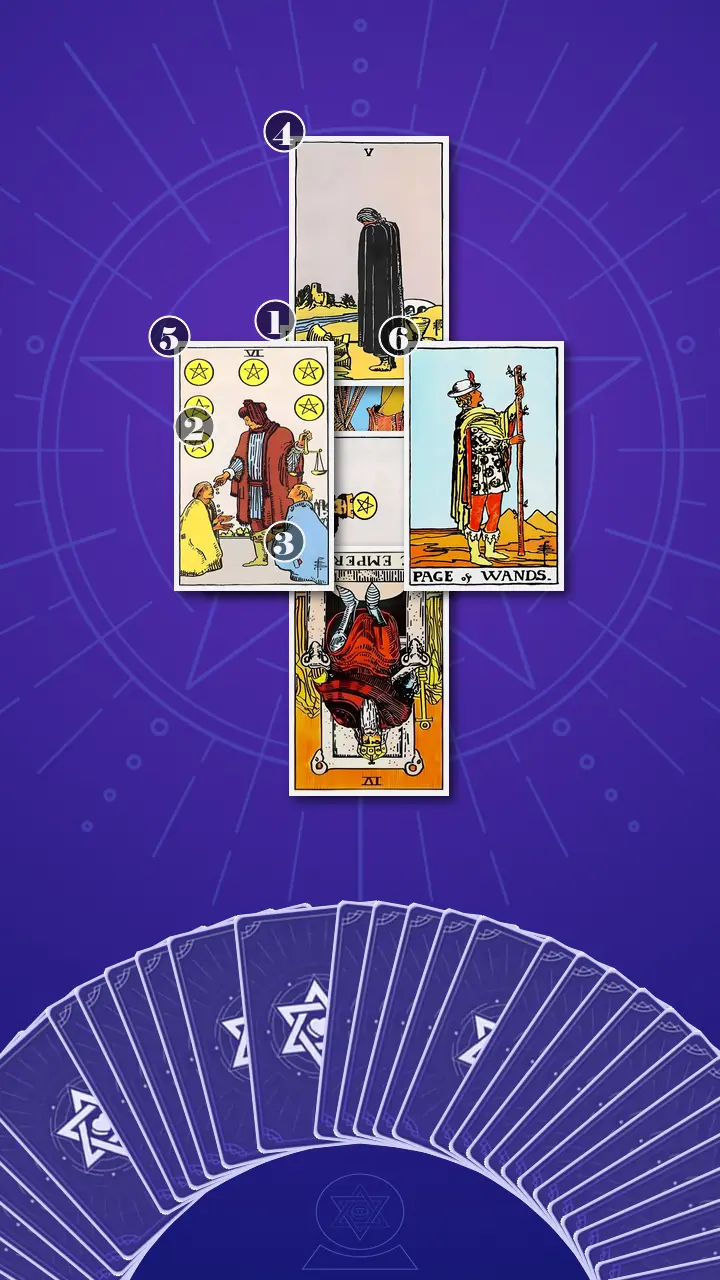
The Cross Where Every Unclaimed Task Landed
The Ten of Wands and the Task in Her Column
I began with the position that reveals the visible pattern of serving the group while retaining final control, including volunteering, monitoring, and redoing delegated work.
The card was the Ten of Wands, in reversed position.
The bundled wands on the image obscure the figure's view, and the bent posture makes the weight physical. I read the reversed Fire as overload and blockage, not as a lack of commitment. Responsibility has become so compressed that even care cannot move easily; the person carries the load, then uses the load as evidence that only they can carry it.
In ordinary life, this was Jordan accepting the difficult funding report at 9:10 AM, promising the group she had it handled, and then spending the evening irritated that nobody had noticed how much she was carrying. A shared project board could look neatly organised because every unclaimed task had migrated into her column, while one human being transported the whole deadline home.
Jordan did not nod. She gave a short laugh with a bitter edge and said, "That's too accurate, almost cruel." I let the sentence breathe before I answered. "The sharpness is in the loop, not in you. The burden is real, and the way you respond to it is also helping keep the burden assigned to you." Her thumb stopped rubbing the rim of her coffee cup; recognition had arrived before agreement.
I also named the overcorrection risk. Releasing the burden did not mean refusing every request or handing a task away without context. A clear standard does not need a second pair of hands inside someone else's work. I asked her to consider one recurring responsibility she could define clearly, hand over once, and leave untouched until an agreed check-in.
The Four of Pentacles and the Hand on the Lock
I turned to the crossing position, the one that reveals the immediate pressure making Jordan believe she must keep control: deadline risk, group dependence, missing context, or a method she cannot predict.
The card was the Four of Pentacles, in upright position.
The figure's arms close around a pentacle, the feet press down on two more, and the city stays at a distance. This is a concentrated holding energy: an excess of protection and a blockage in circulation. The card did not say that Jordan was selfish. It showed how security can become so tightly guarded that help travels outward while authority remains pressed against the chest.
I reconstructed the London community-team scene with her. She shares a Google Drive folder, but keeps the owner permissions, the relevant context, the final edit, and the right to approve every meaningful choice. The workload moves outward, but full ownership never leaves the doorway. It is like giving someone a spare key while keeping one hand on the lock.
I asked her to listen to the private question beneath the practical explanation: "I am giving them the task, so why does it still feel unsafe when they choose the method?" That was the difference between care and custody, between responsibility and possession. A deadline may require an actual boundary, but a different workflow is not automatically evidence of danger.
Jordan's shoulders lifted toward her ears. Her jaw worked once, and her fingers tightened around the phone she had promised to keep face down. Then she looked at the Four of Pentacles again and said, "I thought sharing the workload meant I was already sharing authority." I replied, "That is why the pattern can be so difficult to spot. The labour has moved, but the meaningful decision is still waiting for you."
The Emperor Reversed Beneath the Approval Chain
I read the position beneath the crossing card next: the underlying protective belief and fear that make handing over control feel unsafe, including the need to remain indispensable.
The card was The Emperor, in reversed position.
The stone throne, rigid posture, armour beneath the red robe, and ram motifs speak of structure and force. Reversed, the Emperor shows authority becoming a defended identity. Leadership is no longer simply a frame that holds the work; it starts to feel like a role Jordan must personally embody at every moment, or the structure might disappear with her.
In her daily life, this appeared when a newer colleague proposed a simpler event workflow. Jordan said it could work, then listed six risks, added several rules, asked for updates after every stage, and later changed the document back to her familiar structure. A different method had entered the room as information, but her hands treated it like a software bug that needed fixing before release.
A quiet professional memory passed through me. After twenty years of listening to people sort their lives over warm coffee, I have learned that a standard can live in a sentence, a deadline, and an agreed decision boundary. It does not have to live inside one person's nervous system. I thought of the difference between holding a structure and needing to be the structure.
I asked, "When you imagine handing over a meaningful decision, what would that seem to prove about your value or place in the group?" Jordan looked past the cards for a moment. "If I am not watching every moving part, someone will miss something. And if they do it differently, maybe I am not as necessary as I thought." Her voice grew quieter. "Being needed is not the same as being appreciated."
I watched her hands close and open once. The Four of Pentacles had shown that she shared tasks without sharing authority; the reversed Emperor showed why. This was not bad leadership. It was a protective structure that had outlived the pressure that built it, teaching the group to wait for her command while teaching her to mistake constant command for care.
The Five of Cups and the Private Ledger
I moved to the position that reveals the hidden cost of the current service strategy: resentment, exhaustion, and the group's reduced opportunity to develop its own ownership.
The card was the Five of Cups, in upright position.
The cloaked figure looks down at three spilled cups while two upright cups remain behind them, close to a bridge. I read the Water here as disappointment with a narrowed gaze. The loss was not imaginary; Jordan had carried late nights, corrections, and emergencies. But when attention stayed fixed on what the group had failed to return, the available support and capacity became harder to see.
She described the Tube ride after a successful project rescue. A message said the group could not have managed without her. The praise gave her a brief lift, then the next unclear problem arrived, and the same people reached for her again. On the journey home, she replayed every late night and missing thank-you while barely registering the two colleagues who had offered to take meaningful responsibility.
"Being needed is not the same as being appreciated," I repeated, not as a slogan but as an honest description of the private ledger. I asked her to name one loss without minimising it, then name one available partnership that the ledger had made difficult to notice. Jordan lowered her eyes. Her mouth tightened, and then she took a longer breath than before.
I did not push her toward forced gratitude. The Five of Cups asks for accurate accounting, not denial. The two upright cups represented capacity that could be tested, not a guarantee that everyone would suddenly become reliable. That distinction mattered: the reading could make a new choice visible, but it could not promise an external result.
When the Six of Pentacles Made Care Circulate
When I reached the fifth position, the room grew unusually quiet. Rain moved from the window to a softer tapping, and a pale strip of afternoon light fell across the empty space beside the spread. I turned the card slowly, giving Jordan time to notice her own breathing before I explained what I saw.
The Six of Pentacles: Care Without Custody
I read the position that identifies the most useful shift in the decision: a form of care that sets clear ownership without reclaiming the outcome.
The card was the Six of Pentacles, in upright position. Its strategic role in this reading was the antidote. Its invoked energy was steady, bounded care: practical leadership combined with trust in other people's capacity.
The balanced scales and measured coins gave the card a concrete language. In real life, this was a handoff with a named owner, a desired outcome, one non-negotiable standard, and one check-in. Jordan could offer context, resources, and support while another person held a real decision. Help could become an exchange that allowed responsibility to circulate, rather than a claim on the whole project.
I told her that the Six of Pentacles was not asking her to throw away quality or disappear from the group. It was asking her to stop supplying every answer before anyone else had the chance to think. Care is not the same thing as custody. The scales did not erase the giver's contribution; they made the boundaries of giving visible.
At that point, I reached for my signature diagnostic lens, Social Clutter Sorting. I use it to classify a broad network of work, relationships, and requests objectively into core-nourishing commitments and energy-draining loops, without treating any person as a problem to be discarded. With this card, Jordan's experience, context, and genuine support belonged in the core-nourishing column. Unreserved after-hours approvals, repeated rescue cycles, and decisions that had already been handed to someone else belonged in the energy-draining column. The question was not who deserved her care. It was which form of care actually strengthened the shared work.
I paired that lens with Obligation Decoupling: separating the guilt of declining a casual request from the accountability of a real promise. If Jordan remained available for the support she had agreed to provide, she did not owe the group unlimited access to her evening, her attention, or her final edit.
The Sentence That Let the Scales Move
She was still caught in the old equation: if a delegated paragraph went wrong, the group might fail, and failure would expose her as less necessary. I asked her to picture 8:47 PM on the Overground: a warm phone in her hand, buzzing carriage lights, and one more correction waiting.
I told her that care could let other people become capable without making her contribution disappear. Then I gave her the sentence I wanted her to carry.
Release the belief that care requires personal control, and practice clear shared ownership so the group's strength can grow beyond your hands, like the balanced exchange of water in the Six of Pentacles.
For one beat, Jordan froze. Her breath stopped halfway in, and her index finger hovered above the card. Then her pupils widened and her gaze went unfocused, as if the Overground carriage, the warm phone, and the late-night document were replaying behind the painted scales. Her jaw tightened once, holding the old argument in place. She looked at the measured coins, then at her own closed hands. Moisture gathered along her lower eyelids. A fist she had not noticed on her knee loosened finger by finger. Her shoulders lowered, and she released a shaky breath that was almost a laugh and almost grief. The relief left her briefly light-headed; the empty space where vigilance had been felt unfamiliar. Her voice came out small: "But does this mean I have been doing it wrong for years?" I answered, "No. It means a strategy that protected the group under pressure has become too expensive." When her breathing steadied, I gave the insight a safe size: "Set a ten-minute timer and write down one task you are currently carrying: the owner, the desired outcome, your one check-in point, and what is outside your role. Do not change the method during the experiment. If it feels too activating, stop and return to the decision later."
I asked, "Now, use this new perspective to recall last week: was there a moment when you could have offered support without taking the decision back?"
Jordan returned to the funding report. She remembered that she could have set the outcome and the one non-negotiable standard, then let the other person choose the route. She reread the line about balanced support and said, "I can be useful without being the place every decision has to pass through." I named the shift plainly: this was the first movement from resentful hyper-vigilance and indispensability-based control toward bounded care, shared responsibility, and curious trust in another person's method.
The Page of Wands and the Uncorrected Draft
I turned to the final position, the one that translates the insight into a small self-directed action while keeping Jordan responsible for her own boundaries and choices.
The card was the Page of Wands, in upright position.
The Page studies the upright wand in an open landscape. I read the Fire here as flexible curiosity returning after the earlier overload. This was not a demand for certainty and not an instruction to abandon the group. It was a contained experiment: remain engaged, widen the space around one piece of work, and allow a different method to become information.
I moved my finger from the Six of Pentacles' scales to the Page's open stance. I asked Jordan to imagine giving a newer member ownership of one contained event segment, agreeing on the result and one check-in, then asking what the person discovered instead of correcting the process in real time.
Her hand moved away from the imaginary edit button. She said, "This is different from my way, but different is not yet evidence of danger." I said, "Exactly. Let the result teach you something before you decide it has failed." The experiment would be low-stakes and reversible. It would not prove that the group was perfect or that Jordan was unnecessary. It would simply give her direct evidence about what shared capacity could look like when it was allowed to develop.
The Map Becomes an Owner, an Outcome, and a Check-In
When I read the six cards as one story, I saw how the pattern had built itself. The reversed Ten of Wands showed Jordan moving every unclaimed responsibility into her own column and then resenting the weight. The Four of Pentacles showed labour being shared while authority stayed locked against her chest. The reversed Emperor revealed the protected identity beneath that grip: she had begun to believe she needed to be the structure. The Five of Cups showed the cost, a private ledger of spilled effort that narrowed her view of the two upright cups still available. The Six of Pentacles offered calibrated support, and the Page of Wands turned that support into one curious, bounded handoff.
The core metaphor was a gatekeeper holding every key to a shared room, convinced that opening her hand would let everything fall apart. I named the cognitive blind spot: Jordan was treating a different method as a warning sign, and treating personal overload as proof of personal value. Those were not the same thing as accountability. The transformation direction was to move from proving care by personally controlling the outcome to expressing care through clear ownership and room for the group to learn through its own decisions.
I told her that the Six of Pentacles was a practical image of balanced support and shared ownership, not a promise about what the team would do next. The cards had not taken control away from her; they had helped her see where she was holding it. Jordan remained the person who could decide what to delegate, what standard mattered, what support she could offer, and when her availability ended. The point of actionable advice was not to make her trust blindly. It was to help her test trust with a boundary.
I wrote down three small next steps. They were designed for team lead burnout and decision fatigue in real life: a shared document, one contained task, one check-in, and enough structure to prevent the experiment from becoming either a silent takeover or an unsupported dump.
- Name one owner and one outcomeBefore the end of this week, choose one recurring responsibility in the community organisation. In the shared Google Doc or Notion page, record the actual owner, desired outcome, one non-negotiable standard, one check-in time, and three lines: "They decide," "We check together," and "I remain accountable for." Send: "You own this outcome. I can answer questions at [time]. Please choose the process that works for you."Start with a low-stakes task. If safety, legal compliance, or a genuinely non-negotiable deadline is involved, keep the oversight that belongs to you rather than staging a symbolic handoff.
- Run the different-method pauseGive a newer or less experienced member ownership of one contained segment of an event, report, or community project this week. Agree on the outcome and deadline, then ask them to explain their method at the single check-in instead of requesting updates throughout the day. If the formatting or workflow differs, leave it alone until that time and record one thing their approach made possible.Reduce the task until the result can teach you something without putting the organisation at unnecessary risk. Do not correct the process in real time unless it crosses the agreed boundary.
- Reserve the hours that are yoursFor the next seven days, use my VIP Section Strategy: make your after-hours attention reservation only. Put one ten-minute check-in on the calendar, mute WhatsApp, Slack, or Teams outside that window, and take a two-minute group-chat pause before intervening. Sort the request into core-nourishing work or an energy-draining rescue loop before you open the document.Use Obligation Decoupling to separate guilt from responsibility. Deferring an unreserved, low-value request is not abandoning the group; remain available for the genuine urgent matters you have explicitly agreed to cover.

A Week Later, the Quiet Proof of Finding Clarity
Four days later, I received a message from Jordan: "I gave the event segment to a newer member. I wrote the outcome, the standard, and one check-in. I wanted to change the headings when their format looked different, but I waited. At the check-in, their shortcut was actually easier for volunteers using their phones." The message did not claim that the whole group had transformed. It gave me one precise piece of evidence: a different method had become useful data instead of an emergency.
When we spoke a week later, I heard less urgency in her voice. Jordan told me she had slept through the night, although breakfast still began with the thought, "What if I am wrong?" She smiled into her coffee anyway and waited for the agreed check-in instead of opening WhatsApp. The relief was real, and so was the small tremor beneath it.
The Journey to Clarity had not made her certain, and it had not solved the group's future for her. It had given the burden a name, the control pattern a visible boundary, and the next decision a size she could actually test. Tarot had been a map of perception; Jordan was still the person choosing the route. Her contribution did not disappear when responsibility circulated. It became something she could offer without consuming herself to prove its value.
When the deadline tightens and your shoulders stay lifted, wanting the group to be capable while fearing that letting go will erase the only proof that you matter, remember this: care can circulate without carrying your name on every decision.
If one decision could belong fully to someone else for a little while, what part of their way of handling it might you be curious to see?