Explore the completion bottleneck, relevant tarot cards, and reading insights from people navigating final reviews and revisions.
Capstone Completion Trial
What is this situation?
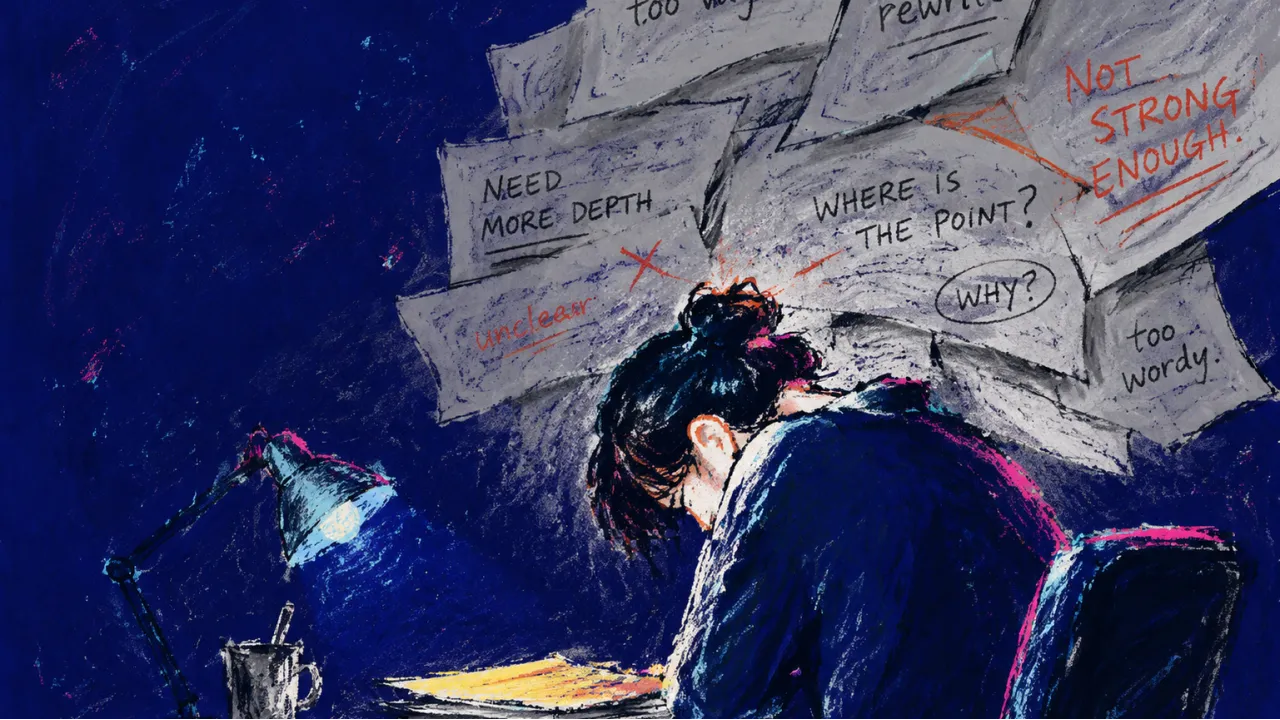
Capstone Completion Trial starts when the project presented as your final demonstration of learning becomes a prolonged test of whether you can secure someone else's approval. At first, the sequence looks manageable: choose a topic, submit a proposal, complete the work, present it, and finish the course or degree. Then a supervisor returns your draft days later with broad comments that do not match the rubric, a panel member asks for material that was never listed, or the next submission window arrives before anyone answers your questions. You revise the same sections, rename the file again, rebuild slides, correct formatting, chase signatures, and check an academic portal that still marks the requirement as incomplete. The power stays with the people who can approve the project, while the deadline, presentation date, and graduation timeline continue moving toward you. Other classes, work shifts, and ordinary commitments remain on the calendar, but evenings and weekends are repeatedly redirected into one more edit. Each reopened document pulls your shoulders toward the laptop, and each new email can replace a possible ending with another condition. Instead of a clean finish, completion becomes a narrow gate controlled by delayed responses, conflicting standards, and repeated review, much like the figure on the Ten of Wands moving toward the destination with a bundle so large it blocks the view ahead.
Why it's not you?
An assessment process becomes the problem when the standard for completion keeps shifting after the work is submitted. This is not evidence that you lack discipline or ability. When reviewers control sign-off while feedback arrives late or conflicts with the rubric, the bottleneck belongs to the system around the project.
Capstone Completion Trial in Tarot Cards
When a capstone's finish line keeps moving through delayed feedback, conflicting comments, and another required revision, Capstone Completion Trial names the situation clearly. Your shoulders folding toward the laptop after another late return are part of an environmental and structural dynamic: reviewers control approval while deadlines and portal status remain fixed. The Tarot Cards below mirror the visible outline of that bottleneck: accumulated demands, suspended completion, and a finish line blocked by external review.
The Emperor's stone throne, ram-headed arms, and armour beneath the robe concentrate power in a single immovable seat. In a capstone review, that geometry maps onto supervisors or panels that hold sign-off while you carry the deadline and the labour of meeting it. Reversed, the seat no longer supplies dependable structure; authority can add conditions, answer late, or substitute personal preference for the published rubric. You experience the project as technically finishable but administratively incomplete because the people controlling the gate can move it after each submission.
The Hierophant sits between two pillars above kneeling students, with crossed keys marking controlled access to an established institution. The arrangement mirrors a capstone process in which you enter as the learner while authorised reviewers control which interpretation of the rules opens the route to completion. Reversed, the hierarchy no longer transmits a dependable shared standard. Rubrics, panel expectations, and supervisor preferences can drift apart, leaving you compliant with the written process but still unable to obtain institutional recognition.
The great wheel turns while one figure rises, another descends, and four observers remain fixed at the corners. That motion resembles a review calendar in which files circulate, submission windows open and close, and your status changes without the project reaching a stable ending. Reversed, movement becomes recurrence rather than forward timing. You resubmit, wait, receive another condition, and return to the same document while graduation dates continue independently around the loop.
Justice holds balanced scales in one hand and an upright sword in the other, presenting evaluation as a process that should connect evidence, standards, and consequences. A capstone rubric is meant to perform the same function by making the basis for approval visible before you submit. Reversed, those instruments remain present but stop producing a consistent ruling. You can satisfy the written criteria and still receive contradictory comments or unlisted demands, so the academic result reflects unstable adjudication rather than the demonstrated quality of the work alone.
The Hanged Man's attached ankle, folded leg, hidden hands, and illuminated face show a capable person whose movement has been structurally suspended. In the capstone setting, you may have completed the intellectual labour while lacking the authority to certify that the requirement is finished. Upright, the image keeps awareness available even when action is limited. You can separate the academic content that still needs work from the administrative state that only a supervisor, panel, or portal can release, preventing institutional delay from being misread as evidence that no learning occurred.
The Moon hangs over a narrow path between two towers while a dog and wolf react from opposite sides and a creature emerges from the water behind. The route exists, but mixed signals dominate the landscape, much like a capstone rubric contradicted by broad supervisor comments and unexpected panel demands. Upright, the path remains visible without pretending that the information is complete. You move through an assessment environment where uncertainty is being produced externally, so confusion about the next revision can be traced to ambiguous signals rather than automatically attributed to poor comprehension.
The wreath surrounding the central figure presents learning as an integrated whole, while the four corner figures resemble witnesses to a completed public demonstration. That composition closely matches the capstone's intended function as a final synthesis evaluated and recognised by an academic community. Reversed, the demonstration exists but its completion status remains open. You may have submitted the document, delivered the presentation, and answered the academic questions while the portal, signature chain, or reviewer still prevents the requirement from becoming final.
The figure loops two pentacles through an infinity-shaped band while ships pitch on high waves behind him. The body remains active and adaptive, but the unstable background shows why balancing the capstone against classes, work shifts, errands, and rest requires constant recalculation. Upright, coordination is still possible, yet there is no visible spare capacity. You keep moving time blocks whenever feedback arrives, so the apparent flexibility of your routine is being purchased through repeated disruption rather than supported by a stable academic schedule.
A craftsperson works beneath three pentacles while two other figures hold a plan and examine the work inside an institutional building. The scene directly resembles a student presenting developed work to supervisors or panel members who are meant to compare it with an agreed design. Reversed, the plan no longer functions as a shared reference point. You revise inside a review relationship where the rubric, supervisor comments, and panel expectations do not align, so collaboration around quality becomes coordination failure around approval.
The figure pauses over a mature cluster of pentacles, inspecting work that has already required sustained cultivation. The image matches a completed or nearly completed capstone repeatedly returned to inspection instead of being converted into a final academic result. Upright, the visible growth confirms that the effort has produced something substantial. You may still examine the work critically, but the prolonged trial comes from having its value and sufficiency held open by external review rather than from having nothing ready to assess.
The craftsperson sits at a bench carving one pentacle while completed pieces are mounted in a row and the town remains in the distance. The repetitive workstation resembles revising the same sections, rebuilding slides, correcting formatting, and producing yet another named file version. Upright, repetition can refine genuine skill, but the row of completed pieces also makes existing labour visible. You are capable of doing the work; the trial begins when practice no longer serves learning and instead becomes the recurring price of vague feedback or a moving approval standard.
A boat carries cloaked passengers and six upright swords toward a distant shore, with a ferryman responsible for the crossing. The scene closely resembles the intended passage from student status to graduation, where a formal process must transport completed academic work into recognised completion. Reversed, the crossing cannot settle on the far shore. You remain tied to the degree and its administrative identity because capstone clearance has not arrived, even though your wider direction points beyond the course.
The blindfolded figure stands bound inside a loose ring of swords, with the castle visible but psychologically distant. Repeated capstone emails, portal checks, and changing demands can make a real approval dependency expand into the feeling that every move is prohibited. Upright, the gaps in the swords preserve a crucial distinction between constrained agency and no agency at all. You can register the frustration and freeze response without allowing the review system's opacity to define your entire competence or every available line of thought.
The figure sits upright in bed with both hands covering the face while nine swords line the dark wall. The private night setting mirrors how delayed capstone feedback can occupy the hours after the laptop closes, especially when any new email may reopen work thought to be finished. Upright, the card makes the mental cost visible without claiming that the feared deadline or reviewer response is imaginary. You are carrying a real institutional uncertainty into sleep and recovery time, where the mind repeatedly rehearses conditions it cannot resolve before the reviewer acts.
The figure stands beside three planted wands and looks over ships moving across the water toward a distant horizon. The scene captures work that has already been sent outward and now depends on responses, returns, and schedules beyond your direct control. Reversed, dispatch does not reliably become arrival. You submit the capstone or requested revision, but delayed feedback and missed review windows prevent the expected sequence from carrying the project toward its scheduled finish.
Five figures cross their staves in different directions, with no shared target or coordinated formation. The scene mirrors a capstone review in which a supervisor, second reader, and panel member each press a different interpretation of what the project must become. Upright, the conflict is visible enough to be named rather than silently absorbed as personal incompetence. You are being asked to revise inside competing standards, so every response to one reviewer can create a new point of friction with another.
The rider carries a laurel-topped staff while another wreath marks public recognition and a surrounding group witnesses the return. The image matches the capstone's promised role as a visible demonstration that converts sustained learning into acknowledged completion. Reversed, the work and the ceremony no longer align. You can finish the project and even satisfy substantive requirements while recognition remains withheld through missing sign-off, delayed grading, or another newly imposed condition.
The elevated figure braces one staff against six rising from below, while mismatched footwear makes the defence look hurried and imperfectly prepared. The scene resembles presenting a capstone under pressure and then having to defend choices against several unexpected or poorly coordinated challenges. Upright, the higher ground indicates that evidence and completed work still provide leverage. You are not facing an empty project; you are being required to keep proving a project whose criteria should already have established what a sufficient defence looks like.
The eight airborne wands form a parallel stream across a clear sky, suggesting a workflow in which each message reaches its destination and immediately enables the next step. Capstone work depends on that flow when a student needs clarification before revising or approval before submitting. Reversed, the communication chain stops functioning as academic infrastructure. You may be ready to work but unable to determine which version, standard, or requested change is current, so reviewer silence becomes a direct barrier to study progress.
The bandaged figure grips one wand while eight others form a barrier behind him, showing someone still standing after repeated rounds of pressure. The card closely resembles reopening a capstone after multiple reviews when each previous revision remains present as accumulated labour and vigilance. Upright, endurance is available, but it is not portrayed as cost-free. You can respond to another review while also recognising that repeated defence near the finish line reflects a demanding approval environment, not an endless reserve of student capacity.
The ten wands are gathered into one oversized bundle carried by a single figure toward a visible town. That bundle mirrors the merged academic load of research, writing, slides, formatting, file management, signatures, and reviewer follow-up placed on one student at the final stage. Upright, the figure can still move toward completion, but the load is so concentrated that it blocks clear sight of the route. You are demonstrating persistence while also carrying process failures that belong to the assessment system, including vague standards and delayed approval.
No cards available for this filter.
Capstone Completion Trial in Tarot Card Reading Insights
When a capstone remains unfinished because approval, feedback, and deadlines keep moving out of sync, other students have brought that same completion bottleneck into readings. The Tarot Reading Insights below show what surfaced in those sessions.