Four Rough Capstone Sentences: Beginning Before Panic Takes Over

The 8:40 p.m. Cursor: Inside Deadline-Driven Capstone Procrastination
I met Maya, a 24-year-old master's student in Toronto whose open evening had somehow become three corrected citations, two renamed PDFs, and zero draft paragraphs: productive procrastination in its most academically respectable form.
At 8:40 p.m., she joined our video call from the kitchen table of her shared apartment. Cold tea sat beside her laptop, and I could hear the fan producing a thin mechanical whine through the microphone. Her phone was warm from checking the course WhatsApp group; beneath the same unfinished heading, the Google Docs cursor kept blinking like a tiny red recording light waiting for her to perform.
Her fingers moved constantly, rubbing a thumbnail, touching the phone, returning to the trackpad. Each time she looked toward the blank section, her shoulders lifted a fraction. The anticipatory dread seemed to place her at the edge of a cold pool, toes curled over the tiles, waiting for a deadline to arrive from behind and push her in.
“I am always working around the draft instead of working on it,” she said. “I want to start earlier. But the second I see how much is unwritten, research feels responsible and drafting feels like proof that I have no idea what I am doing. Apparently my most reliable writing method is panic.”
I heard the contradiction clearly: Maya wanted steady capstone progress, but she also wanted immediate relief from the discomfort of producing prose that could be evaluated. By midnight, she was not less committed to the project. She was simply closer to the one condition that had reliably overridden the discomfort: deadline mode.
“You are not avoiding the capstone,” I told her. “You may be avoiding the moment when the capstone seems able to evaluate you. I am not going to use tarot to predict your grade or tell you what you must do. I want us to map the rhythm of this pattern, locate the beat where choice narrows, and find one practical way to widen it again.”
Choosing a Map for the Avoidance Loop
I invited Maya to take one unforced breath and hold a single question in mind: “What happens between opening the draft and leaving it?” I shuffled slowly, using the movement as a transition from self-judgment into observation rather than as a mystical performance.
I chose the Transformation Path Grid · Context Edition, a six-card tarot spread designed to follow a pattern from its visible form to its sustainable replacement. For readers wondering how tarot works in a consultation like this, I use the cards as structured prompts. Their images organize information Maya already carries in her body, browser history, schedule, and private rules. They do not take ownership of her decisions.
This spread fit because a general ten-card reading would have created more territory than the question required. Maya did not need a broad life forecast. She needed a precise account of a repeating system: the trigger, the immediate reward, the belief beneath it, the interruption point, the practical action, and the rhythm that could support that action over time.
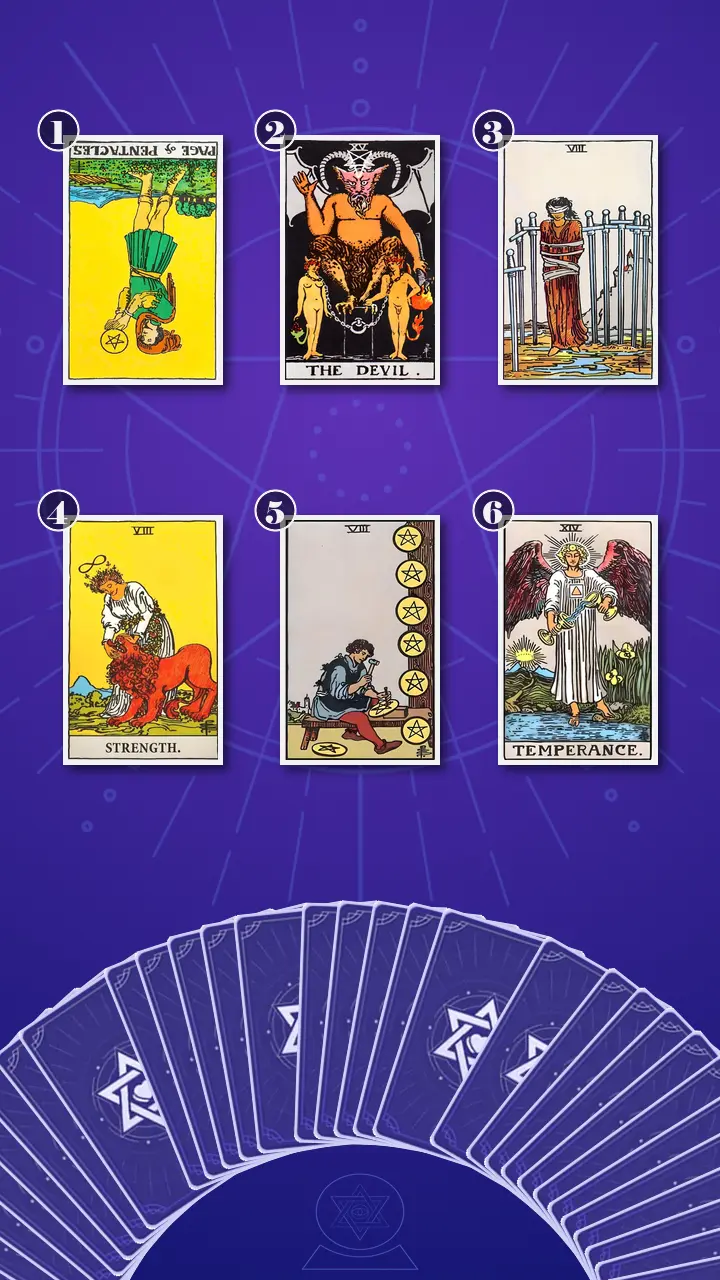
I arranged the cards in two rows of three. The upper row would show the observable capstone bottleneck, the reinforcement mechanism, and the underlying fear. The lower row would reveal the catalyst, the bounded drafting practice, and the integration of drafting, feedback, revision, and rest. It looked like a storyboard: the familiar loop above and a possible replacement pattern below.
The Work That Looked Like Progress
Position 1: The Paragraph That Never Reached the Page
“The card I am turning over now represents the observable capstone bottleneck,” I said, “the moment when the document opens, adjacent academic tasks begin, and draft prose is postponed.”
It was the Page of Pentacles, reversed.
I pointed to the Page holding the pentacle at eye level while standing still. The figure is attentive, serious, and surrounded by cultivated ground. Yet the distant mountains remain distant. Reversed, the card showed a blockage in practical earth energy: study and preparation were present, but they were not converting into a tangible unit of prose.
“This is your Tuesday night in one image,” I said. “You open the capstone at 8:40, reach the unfinished heading, and correct three Zotero entries. Then you rename two files, check the course chat, and close the laptop forty minutes later without a new paragraph. Your curiosity is real. Citation work is real work. The issue is its timing: it appears at the exact conversion point between preparation and writing.”
Maya gave a short laugh that carried no amusement. “That is accurate enough to be rude.”
I smiled gently. “Then let us be accurate without being cruel. The card is not calling you unserious. It is distinguishing attention to the project from movement inside the project. A beautifully organized Zotero library cannot give your supervisor a sentence to respond to.”
Her knee stopped bouncing for a moment. She looked at the reversed Page, then at the open document behind our call window, as if seeing two versions of the same evening placed side by side.
Position 2: The Two-Click Bargain
“The next card represents the reinforcement mechanism,” I said. “It asks why this pattern survives despite costing you sleep, revision time, and most of the following morning.”
I turned over The Devil, upright.
I kept my interpretation grounded in the loose chains around the two figures. The card's attachment energy was in excess: a short-term reward had become so well rehearsed that the sequence felt compulsory, even though a small decision point remained visible.
“You see the empty section, your chest contracts, and you open the class chat,” I said. “For the next few minutes, you are no longer producing anything that can be judged. Later, the supervisor deadline creates enough adrenaline for an overnight sprint. The sprint produces pages and rescues the meeting, so even the punishing part receives a reward.”
Closing the draft works immediately. That is why the cycle survives.
I watched Maya's fingers tighten around her mug. Her gaze dropped, and I saw the recognition arrive before she spoke.
“I never count the relief as a reward,” she said. “I only count how awful I feel later.”
I used one of my diagnostic tools, a Focus Disruption Audit, to isolate the dissonant chords in her writing session. The unfinished heading created the first sharp note. The visible Zotero icon offered respectable escape. The WhatsApp notification supplied a two-click route away from evaluation. A classmate's word-count update added comparison, and the eventual deadline brought a loud enough pulse to drown out everything else.
“The loop works like a recommendation algorithm,” I explained. “Every time leaving the page delivers fast relief, the system learns to suggest avoidance sooner. The private caption is: ‘I know this makes tomorrow harder, but closing the document makes the next five minutes easier.’ Noticing that bargain is not the same as blaming you for it. It simply reveals where the algorithm receives its training data.”
Maya exhaled through her nose. Her grip loosened, but the mug remained held close to her chest. I could see both discomfort and recognition in the slight downward turn of her mouth.
Position 3: The Rule Disguised as a Requirement
“The third position reaches beneath that reward,” I said. “It represents the underlying fear and the restrictive rule that make an imperfect early draft feel threatening to your academic worth.”
The card was the Eight of Swords, upright.
The blindfold narrowed the figure's awareness around the surrounding blades, while an open gap remained in the landscape. I read the card as an excess of air becoming a blockage: thought was not helping Maya test the next sentence; it was rehearsing everything the argument still lacked until movement seemed unauthorized.
I brought her back to the Line 1 train after her supervisor had asked for pages. The carriage screeched into the station, her phone felt warm in her palm, and her throat tightened as she pictured an awkward paragraph being read. Before reaching home, she had decided to find three more sources because the thought “I need to understand the whole argument first” sounded academically responsible.
“Try finishing this sentence,” I said. “A capable student would already know...”
“What the section is arguing,” she replied immediately. “So I cannot write the paragraph until I do.”
“And yet writing the paragraph may be how you discover which part of the argument is missing. A writing rule can feel like a fact before it has ever been tested. The blindfold is your attention cropping the frame around everything you do not know, until the available provisional sentence drops out of view.”
Her breath paused. Her eyes shifted away from the cards, unfocused, as if replaying the supervisor email and the sources she opened afterward. Then her shoulders sank by a few millimetres.
“I keep treating a thought from my Notes app like it is university policy,” she said.
“Exactly. Tarot is useful here because card meanings in context can turn an invisible rule into an object we can examine. You do not have to replace it with a more positive belief tonight. You can test it once against one knowingly rough paragraph.”
When Strength Put a Hand on the Urge
Position 4: The Quiet Force Before the Next Tab
The room seemed to settle when I moved to the lower row. A pipe clicked in Maya's kitchen, the laptop fan briefly softened, and the silence around the next card felt wider than the silence before the others.
“This position introduces the key interruption,” I said. “It asks what happens if you remain compassionately present with the urge to leave instead of waiting for panic to overpower it.”
I turned over Strength, upright.
I centred the woman's calm hands resting on the lion. I did not describe a battle, because the card does not show the lion destroyed, shamed, or handed control. It shows balanced courage: close contact with a powerful impulse, guided by firm, non-punitive attention.
“In your kitchen, this is the second before you open another tab,” I said. “Your chest is tight, your hand is restless, and the cursor hovers toward WhatsApp or Zotero. Instead of demanding confidence, you name what is happening: ‘This feels evaluative. I do not have to feel confident; I am only staying for this sentence.’ The discomfort remains, but it does not automatically select the next action.”
I brought her back to 8:40 p.m.: the tea had gone cold, Zotero was open, and the cursor still blinked under the same unfinished heading. She had spent forty minutes working, yet there was no sentence available to revise. Her mind was still bargaining for the clarity that never arrived before urgency.
Through ten years of sound energy research, I developed what I call Cognitive Tempo Calibration: I listen for the mismatch between a task's demanded tempo and the rhythm a person can actually sustain. Maya had been asking herself for a finished symphony on the first downbeat. When that demand froze her, the deadline entered as a brutal external metronome. Strength offered a different tempo: one rough note, held steadily enough for the next note to become possible.
The deadline is not the only force strong enough to move you; meet the urge to leave with one gentle, steady hand, as Strength meets the lion.
I let the sentence remain between us without rushing to soften it.
Maya's breath stopped first. Her fingers hovered above the phone, completely still, while her eyes widened and then lost focus. I could almost see her replaying a row of Sunday nights: the group-chat updates, the bargains about starting after dinner, the blue light at 1 a.m. when panic finally made rough writing permissible. Her shoulders lowered, and one hand opened on the table. A long breath left her chest with a faint, unsteady laugh. Then her jaw tightened again.
“But doesn't that mean all those nights were my fault?” she asked, her voice suddenly sharper. “That I could have done this differently the whole time?”
“No,” I said. “Recoverable agency is not retroactive blame. You learned a regulatory rhythm that worked just well enough to get pages produced under pressure. Strength does not condemn that survival strategy. It gives you another response to practise now. A choice point can be real without meaning you had total control over every demand, body reaction, or circumstance around it.”
Her eyes reddened slightly. Relief appeared first in her lowered shoulders, followed by a brief blankness that I often see when clarity returns responsibility to the person. The old explanation, “panic is simply how I work,” had protected her from choice. Letting it go created possibility, but also the vulnerability of having something small to try.
“Now, with this new perspective, can you think of a moment last week when this insight might have changed how the experience felt?” I asked.
“When my supervisor emailed,” she said after a pause. “I did not need to become calm. I could have written one bad sentence before searching for the three sources.”
I nodded. That was the critical movement in her Journey to Clarity: not from dread to perfect confidence, but from panic-dependent drafting toward compassionate tolerance of an imperfect beginning. She was recovering the ability to act while resistance remained present.
One Pentacle on the Workbench
Position 5: A Visible Unit Instead of a Heroic Night
“The fifth card represents the practical action,” I said. “It translates Strength into one bounded unit of prose completed before research, formatting, or messages absorb the session.”
I turned over the Eight of Pentacles, upright.
The craftsperson works on one pentacle beneath the tool while completed pieces remain visible nearby. Here, earth energy had returned to balance. Repetition was no longer maintaining the avoidance loop; it was becoming apprenticeship.
“Before opening Zotero on Wednesday, you set a twenty-minute timer and write 150 deliberately rough words under one heading,” I said. “When evidence is missing, you type [source]. When the transition is unclear, you type [better transition]. Then you save the document and stop at the timer. The unit counts because it leaves revisable material, not because the prose is polished or the argument is complete.”
I touched the single pentacle shown beneath the tool. “The inner line is: ‘This block does not have to finish the argument. It only has to leave one object on the bench.’ Do not finish the capstone tonight. Leave one paragraph available for revision.”
Maya reached for a sticky note and wrote while I watched. Her movements had become slower and more deliberate. “One object on the bench,” she repeated. “That feels less like the whole degree is sitting inside one paragraph.”
Position 6: Temperance in a Toronto Week
“The final position represents integration,” I said. “It shows a paced cycle of drafting, feedback, revision, and rest that does not depend on crisis.”
The card was Temperance, upright.
I highlighted the measured stream between the two cups and the figure's balanced footing on land and water. This was balance as active calibration, not a frozen state in which every session felt easy.
I pictured the rhythm with Maya: one short drafting block at the campus library, an incomplete page sent to her supervisor with one focused question, a later source check, and an evening that still contained dinner and sleep. Drafting could stop before exhaustion because another return already had a place in the calendar. Research and revision remained valuable, but they no longer silently replaced the prose-producing phase.
“Temperance does not promise perfect consistency,” I told her. “It asks for separate cups. Drafting is one phase. Research is another. Feedback is an exchange, not a verdict. Rest is part of maintaining the rhythm, not evidence that you have stopped caring.”
Outside Maya's window, a streetcar passed with a low metallic rattle and then faded. She looked from Temperance to the upper row: the stationary Page, the loose chain, the blindfold. When she returned to the lower row, her face had not become brightly certain. It had become quieter.
“Drafting can stop before I am exhausted because I have scheduled a return,” she said. The words came slowly, as if she were checking whether she was permitted to believe them.
A Writing Rhythm Small Enough to Trust
I gathered the six cards into one coherent story. Repeated deadline rescues had taught Maya that panic was her only reliable engine. The reversed Page showed the present bottleneck: substantial effort circling the draft without becoming prose. The Devil revealed the immediate relief that rewarded each departure. The Eight of Swords showed the fear beneath the bargain: if early thinking looked weak, Maya feared it might say something final about her ability. Strength returned authority at the moment of the urge, the Eight of Pentacles turned that authority into visible practice, and Temperance protected the practice from becoming another exhausting performance.
Her cognitive blind spot was not simply that she underestimated time. She treated clarity as permission to begin, rough prose as evidence about her worth, and deadline adrenaline as proof of her natural writing style. The spread suggested a different direction: clarity could emerge through revisable material, and repetition itself was not the enemy. The question was what she rehearsed when discomfort entered the session.
I translated that direction into my Syncopated Study Session. In music, syncopation prevents every note from carrying the same weight. For Maya, that meant separating rough drafting, source checking, revision, and stopping into small beats rather than forcing them to collide during one emergency night.
The Rough-Before-Research Protocol
- Beat One: Produce Material Before ProofBefore the first capstone-related task on one weekday, Maya will open only the draft at her kitchen table or campus library, set a 20-minute timer, and write 150 deliberately rough words before opening Zotero, Google Scholar, email, or the course chat. She will use placeholders such as [source], [define term], or [transition] instead of leaving the paragraph, then highlight the next unfinished sentence when the timer ends.If 20 minutes feels too exposing, use the 10-minute minimum or write one rough sentence. The words can remain private, and stopping at the timer is part of the exercise.
- Beat Two: Schedule the Return, Not the RescueFor the next seven days, Maya will place two 20-minute drafting blocks and one optional buffer block in her phone calendar. She will label separate sessions draft, source check, and revise, give each a fixed stop time, and spend the final three minutes writing a five-word return cue such as “next: explain why this matters.”A missed block is moved once or reduced to 10 minutes; it is never repaid with an all-nighter. Sleep, meals, paid work, and personal time remain protected.
“These are experiments, not commandments,” I told her. “The cards have helped us identify a plausible pattern, but you remain the person who decides whether a method fits your capacity and circumstances. Success is not feeling fearless. It is leaving one visible unit of prose before the supporting tasks begin.”

A Week Later: Four Rough Sentences
Six days later, I received a message from Maya with a photograph of her sticky note beside the laptop. Under it she had written: “Ten minutes. Four ugly sentences. Zotero stayed closed. I stopped when the timer ended.”
She had slept normally that night. The next morning, her first thought was still, “What if the paragraph is rubbish?” She opened it anyway, laughed once, and added a transition.
I did not treat that as proof that the capstone procrastination cycle was solved. I treated it as quieter and more useful evidence: Maya had begun before panic, survived the presence of imperfect prose, and preserved enough energy to return. Tarot had supplied the map; she had taken the step.
When a blank section tightens the chest, it can feel safer to keep proving that you are working around it than to risk one rough sentence seeming to prove you were never capable enough. I want the cards in Maya's spread to leave a gentler possibility beside that fear: a draft is a workbench, not a courtroom, and resistance does not need to disappear before your hand can return to the page.
When your own hand drifts toward the easier tab, what is the smallest imperfect sentence you could stay beside for one steady beat, even if the lion never goes quiet?