Explore a narrow graduate admissions reentry period through a detailed situation portrait, related Tarot Cards, and Tarot Reading Insights.
Grad Application Reentry Window
What is this situation?
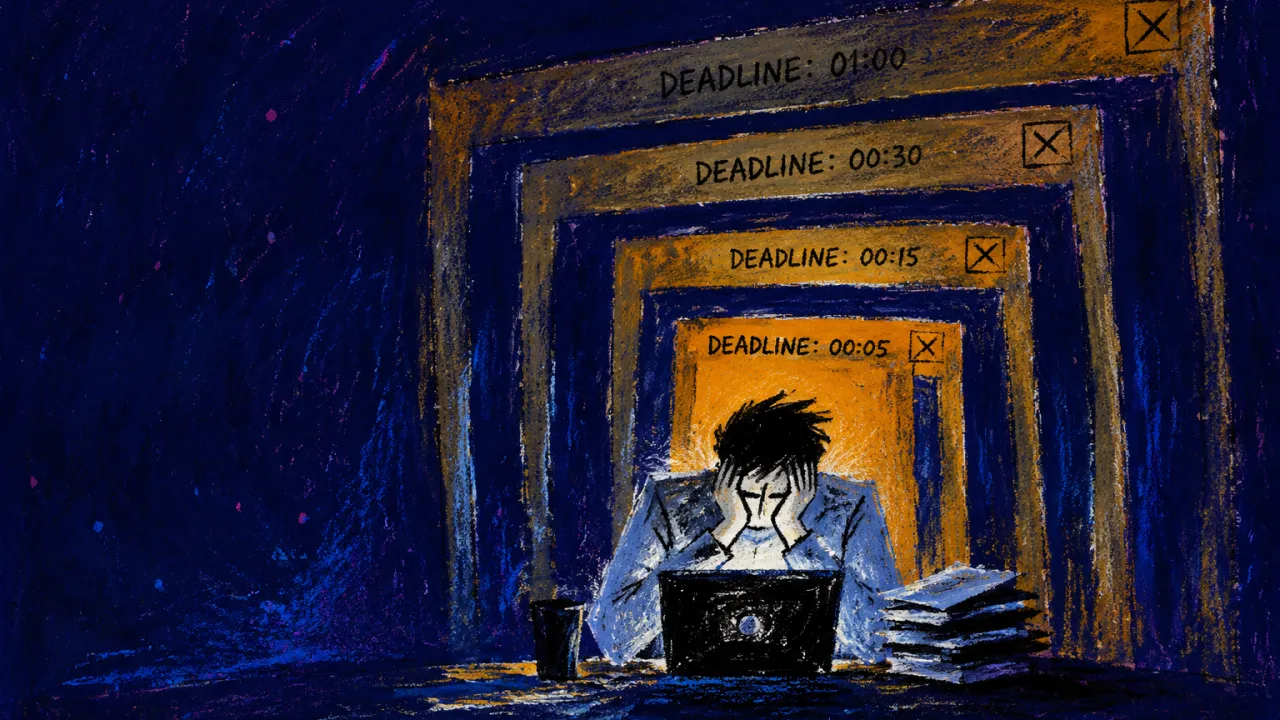
Grad Application Reentry Window — you decide to return to graduate applications and open a department website expecting a familiar process, only to find that the reentry period lasts a few weeks and the rules no longer match the previous cycle. One program wants a revised personal statement, another has replaced its application portal, and a third places its funding deadline before the general admissions cutoff. Your transcript still exists, but it must be sent again through an approved service; previous login details may no longer work; recommenders receive new forms with deadlines you cannot control. During work breaks, you compare department pages, reopen old drafts, check whether course prerequisites have changed, and keep several deadline tabs visible because each institution organizes the same information differently. Reminder emails arrive while reference requests remain pending, and questions sent to admissions offices may be redirected to policy pages that do not address your circumstances. Every task depends on another document, person, portal, or institutional timetable. The process asks you to present a clear, coherent next chapter while delivering that application through a fragmented system governed by fixed cutoffs. By midnight, your shoulders have drawn inward over the laptop, with forms still open and tomorrow's obligations unchanged. You are not simply deciding whether graduate school fits; you are trying to move a consequential decision through an opening that institutions determine when to offer and close, much like the figure on the Two of Wands, holding a globe at a stone wall while one staff remains fixed behind them and the horizon stays at a distance.
Why it's not you?
The difficulty is built into the window: institutions set a brief timeline, divide requirements across systems, and make applicants coordinate people they cannot schedule themselves. A process with changing instructions and fixed cutoffs would place pressure on anyone trying to reenter; it is not evidence that you lack commitment or preparation.
Grad Application Reentry Window in Tarot Cards
The Grad Application Reentry Window is shaped by a short admissions calendar, changed requirements, and several institutions requesting different materials at once. When your shoulders draw inward over the laptop as another deadline tab stays open, the strain is being produced by an environmental and structural dynamic, not by a lack of effort. The Tarot Cards below mirror the visible contours of that narrow opening, its competing demands, and its fixed timeline.
The stone throne, squared posture, armour, and barren mountains create a system built for control and durability rather than adaptation. Read in reverse, that physical stability hardens into administrative inflexibility: changed portals reject old credentials, policy pages substitute for contextual answers, and fixed deadlines remain unmoved by delays elsewhere in the application chain. The blocked quality belongs to the institutional design, not to your capacity for graduate study. You are encountering a process whose authority is centralised while its tasks are distributed across departments, vendors, and recommenders. Naming that imbalance separates the academic application you can build from the rigid infrastructure that may obstruct its delivery.
The seated institutional figure raises one hand above two petitioners, with crossed keys positioned at the threshold below. This is the architecture of formal academic entry: applicants approach an established authority, and access depends on recognised procedures, authorised documents, and rules communicated through official channels. The upright keys indicate that the route is available, even though it is standardised and gatekept. You can view transcript services, recommendation forms, prerequisites, and departmental policies as the institution's admission language rather than as measures of your private resolve. The difficulty comes from translating an existing academic history into the current authorised format before the institutional window closes.
The large wheel turns at the centre of the image while figures rise and descend around its rim and four winged figures remain stationed at the corners. That split between motion and fixed observation mirrors admissions cycles: application rules, portals, and openings change from one turn to the next, while institutions retain the authority to publish and interpret the timetable. The upright wheel places the current reentry period on the accessible side of the cycle. You are working inside an opening that is real but temporary, so old procedural knowledge cannot be assumed to match the present turn. The card makes the mismatch structural: the cycle changed around your existing documents, rather than your previous preparation somehow becoming evidence of personal inconsistency.
The scales are held level while an upright sword formalises the decision space. Those objects mirror an admissions process in which every file must be weighed against published criteria, yet the evidence reaches the institution only after passing through exact rules for transcripts, statements, prerequisites, references, and deadlines. The upright symmetry suggests that the requirements can be made legible, even when they are scattered. You can distinguish what each department formally requires from assumptions carried over from the previous cycle. The card exposes the real task as criteria reconciliation: one coherent candidacy must be rendered compliant with several different institutional checklists.
The suspended figure remains tied by one foot while the surrounding structure holds him in place. Reversed, the suspension loses the productive clarity of a deliberate pause and becomes waiting without useful return: recommendation requests remain pending, admissions replies redirect to generic policy, and transcript processing sits outside your schedule while fixed cutoffs continue approaching. The blockage is located in the dependency chain rather than in a lack of effort. You can see why additional hours at the laptop do not automatically release tasks owned by another person or system. The card names the timing distortion created when your application clock keeps running but the next actionable step belongs elsewhere.
A winding path runs between two towers under reflected light, while different creatures respond to the same uncertain landscape. That scene mirrors department websites that present fragments of one admissions route in different formats: a funding page indicates one cutoff, a portal presents another workflow, and a policy page appears authoritative without resolving the reentry exception in front of you. The upright path remains visible, but only in sections. You can recognise that incomplete information creates vigilance and repeated checking even when the underlying academic objective is clear. The card locates the uncertainty in the information environment, showing why navigating the process requires interpretation rather than simple compliance with one complete map.
The figures emerge with their past still visible behind and beneath them, responding to a call that reaches the whole landscape. In the graduate application process, old drafts, transcripts, coursework, and previous decisions become active evidence again, but they must be reviewed in light of current prerequisites and current-cycle questions. The upright call creates continuity without requiring duplication. You can treat the personal statement revision as an account of what has changed since the earlier application, while treating the existing academic record as material that needs current institutional packaging. The application becomes a structured reassessment of readiness rather than a total restart from nothing.
The silhouetted figure faces seven suspended cups whose contents cannot be evaluated by appearance alone. In an academic reentry process, each open tab can similarly conceal a different package of prerequisite courses, writing requirements, transcript rules, funding conditions, and recommendation forms. The upright image keeps the options present while exposing the need for discrimination. You can recognise tab proliferation as a symptom of nonstandardised admissions architecture rather than proof that you cannot focus. The practical study route becomes clearer when each program is understood as a specific evidence demand rather than as one more abstract graduate possibility.
Two pentacles circulate through one continuous loop while the background ships navigate separate waves. In the graduate application setting, academic materials and administrative delivery must be kept in motion together: revising a statement affects one program, checking prerequisites affects another, and recommendations continue on schedules that remain outside the main workflow. The upright balance is dynamic rather than effortless. You can see why repeated portal switching and tab comparison consume attention even when each individual task appears manageable. The card identifies the application as a coordination system whose academic and administrative components must remain connected without being mistaken for the same kind of work.
A craftsperson stands with two other figures beneath an unfinished institutional structure, and a plan is held between them. The scene mirrors a graduate application assembled through multiple roles: you produce the core materials, recommenders supply independent assessments, and departments or service providers determine whether each component meets the current specification. The upright architecture shows collaboration capable of producing a valid result when roles and plans connect. You can see why this application cannot be completed through solitary effort alone, even though you remain accountable for the final file. The card exposes the coordination burden created when contributors share an outcome but do not share one timetable, portal, or line of control.
Pentacles have already accumulated on the vine while the worker pauses to inspect their development. In an academic reentry process, the existing crop is your transcript, prior coursework, old statement drafts, and earlier research into programs; the pause is the current review of whether those materials still satisfy changed requirements. The upright growth makes prior preparation available without declaring it automatically sufficient. You can see the application as an audit of what remains valid, what needs revision, and what must be requested again through an approved channel. The card preserves the value of earlier academic work while exposing the institutional labour required to make it current.
The craftsperson sits at a bench producing pentacles one at a time, with completed pieces displayed separately from the one currently under revision. This is the texture of rebuilding graduate applications program by program: revising one statement, verifying one prerequisite list, resending one transcript, and checking one portal rather than completing a universal form. The upright bench provides a workable production environment, and the repeated pentacles make progress countable. You can recognise that repetition does not make the outputs identical; each application requires another calibrated version of the same academic history. The card names the labour as skilled adaptation to institutional specifications rather than meaningless duplication.
The figure surveys a distant landscape while holding a globe against a fortified wall. In an academic application setting, the horizon is the next stage of study, while the wall represents admissions infrastructure: prerequisite checks, approved transcript channels, departmental portals, and forms that translate educational intent into an admissible file. The upright staff in hand preserves active authorship within that system. You can distinguish the scholarly chapter you are trying to articulate from the fragmented process used to receive it. Old drafts and records remain usable source material, even when the current cycle requires them to be revised, reformatted, or transmitted through new channels.
The parallel staffs move quickly across one sky while remaining separate objects. That visual structure mirrors academic application updates arriving from different departments, portals, transcript services, and recommenders: they occupy one inbox but do not belong to one coordinated workflow. The upright trajectory indicates that information and materials are capable of moving through the system. You can read each update according to the application component it advances rather than allowing the whole stream to register as one emergency. The card makes communication velocity visible while preserving the distinction between a received message and a completed academic requirement.
Ten separate staffs obscure the carrier's view even though the destination stands close enough to see. In the academic application, statements, transcripts, prerequisites, recommendation forms, funding cutoffs, and portal credentials accumulate into one workload, making the next stage of study harder to see than the administrative bundle required to reach it. The upright route remains passable, and the town gives the labour a defined destination. You can separate the academic purpose of the application from the volume of evidence handling surrounding it. The card exposes overload as a property of the admissions delivery system, not as proof that the underlying study goal lacks coherence.
No cards available for this filter.
Grad Application Reentry Window in Tarot Card Reading Insights
The Grad Application Reentry Window has appeared in other readings where applicants were rebuilding materials around work, references, and fixed deadlines. The Tarot Reading Insights below show what surfaced when others brought that same admissions window into a reading.