When Application Anxiety Feels Like Focus: Drafting Before Panic

The 11:18 p.m. Application Procrastination Spiral
If you are a final-year student in Toronto who can manage a scheduled campus-library shift but keeps postponing the personal statement, a deadline reminder can turn ordinary planning into application procrastination.
Jordan had just finished a library shift when I met them at the kitchen table of their shared apartment. At 11:18 p.m., they toggled between an application portal, a half-written personal statement, two advice articles, and a color-coded tracker. The refrigerator hummed, their phone felt warm in one hand, and the monitor cast hard blue light across their knuckles while their chest tightened and their fingers kept moving.
They looked at the glowing countdown and said, ‘I have done everything for this application except write the part that matters.’
I could see the contradiction before we named it: Jordan wanted to submit thoughtful graduate and funding applications with enough time for feedback and revision, yet kept postponing the exposed writing until deadline pressure forced a rushed finish. They had done well enough in previous last-minute sprints to keep believing that panic was unpleasant but dependable.
The deadline anxiety was not simply a thought in the room. It moved through Jordan like a smoke alarm installed inside the ribcage: shallow breaths, shoulders drawn toward the ears, restless hands searching every tab for a task with a clear answer.
When I asked what the final rush temporarily gave them, Jordan rubbed the edge of their phone and answered, ‘The deadline is the only thing that makes my inner editor go quiet.’ Then they added, almost apologetically, ‘I keep making plans for the version of me who starts early.’
I did not call the pattern laziness, and I did not promise that a card could guarantee an acceptance. I told Jordan that we could use the cards as a reflective map, using the four-card Problem-Solution Spread · Context Edition to understand the loop and find one place where their own choices could change its shape. ‘Let’s draw a map for the fog,’ I said. ‘Not to hand your power to the cards, but to help you see where it already is.’

The Map Beside the Deadline Clock
I asked Jordan to put both feet on the floor, take one slow breath, and hold the question in a single sentence: Why do I keep rushing every academic application at the last minute? I shuffled slowly, treating the preparation as a transition from tab-switching to attention, not as a supernatural test.
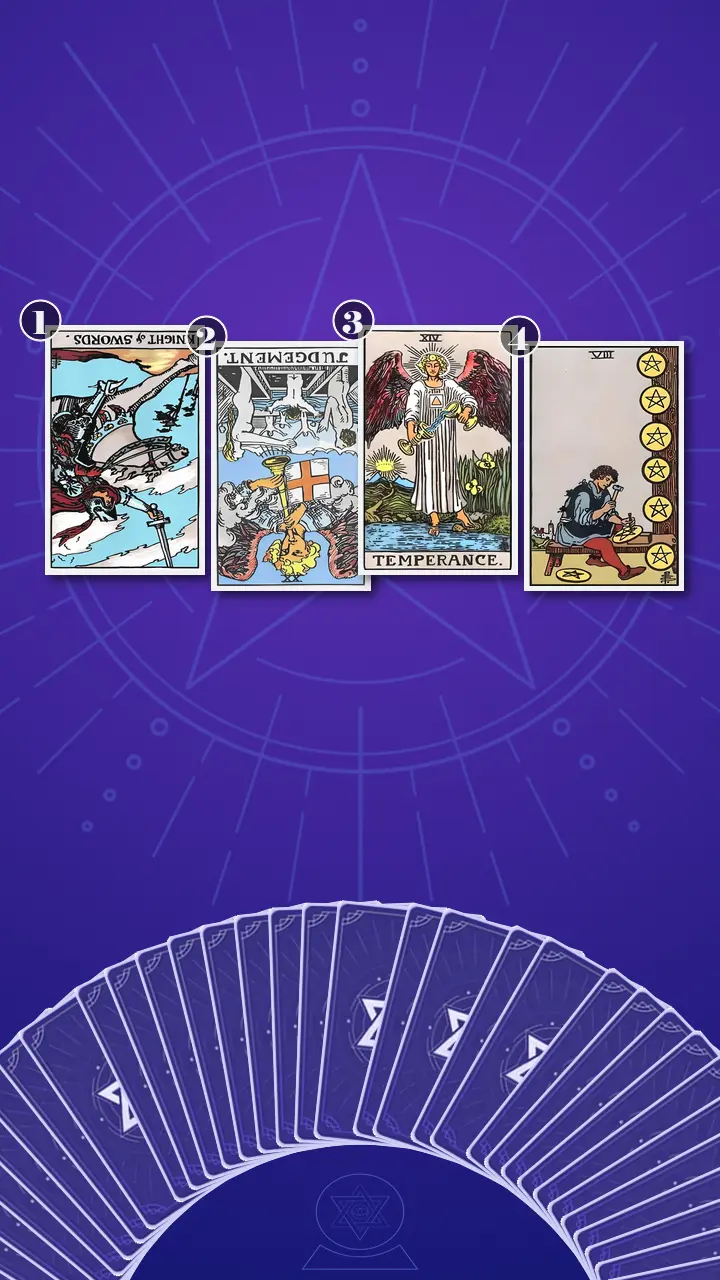
Today, I was using the Problem-Solution Spread · Context Edition. I chose it because Jordan was not asking for a fixed prediction; they were asking why the same procrastination-to-panic cycle kept rebuilding itself. This compact structure follows the visible symptom, the maintaining obstacle, the most constructive leverage point, and the observable evidence that a new response is beginning to take hold.
For the reader, the logic is deliberately practical. The first position shows what the academic application spiral looks like in the browser, body, and schedule. The second asks which inner verdict makes an imperfect draft feel dangerous. The third identifies a measured response, and the fourth treats progress as something to observe rather than a destiny to await.
I placed the first two cards as a diagnostic pair: current rush and hidden self-judgment. The central gap then led into the response pair: Temperance as the interruption, followed by the Eight of Pentacles as proof that repetition can become craftsmanship instead of crisis.
The Browser With No Agreed Next Click
Position 1: The White Horse at 11:50 p.m.
The first position was the observable deadline symptom: delaying major application sections and then attempting forms, essays, and uploads simultaneously in a rushed final sprint. I turned over The Knight of Swords, in reversed position.
In modern life, this was the 11:50 p.m. application sprint: Jordan opened the portal, personal statement, CV, transcript instructions, and reference emails together, then raced between them as the countdown closed. The speed briefly cut through hesitation, but it left almost no room to review whether the application said what Jordan intended.
I pointed to the charging white horse and the raised sword. The reversed air energy was in excess: rapid thought, rapid movement, rapid switching. Direction and sequence were in deficiency. The card did not say Jordan lacked courage; it showed courage being accessed only after urgency had made every task feel equally immediate. Momentum had replaced navigation.
Jordan did not nod. They gave a short, bitter laugh. ‘That’s too accurate. Almost cruel.’ First, their breath paused and their hand froze above the phone. Then their eyes moved from the card to the six imagined tabs, as if replaying the exact moment when organizing began to impersonate progress. Finally, they exhaled through their nose and let one shoulder drop.
I answered carefully. ‘I hear the card describing a sequence, not judging your character. The useful question is not “Why am I like this?” It is “When does purposeful movement become frantic tab-switching, and what could I do before that turn?”’ That distinction left the door open: the same ability to act quickly could be redirected toward a chosen next click.
Position 2: The Admissions Panel in Suggestion Mode
The second position was the maintaining obstacle beneath the rush: self-judgment makes an early imperfect draft feel like prolonged exposure to evaluation, so postponement provides immediate relief and preserves the cycle. I turned over Judgement, in reversed position.
The angel’s trumpet became the imagined admissions verdict inside every early draft. In the maintaining-obstacle position, Judgement reversed looked like Jordan rereading the first paragraph in Google Docs and imagining an admissions reader deciding whether they were academically capable. A small edit felt safer than a new sentence because a finished early draft would remove the excuse of deadline chaos.
I asked, ‘When you reread that first paragraph instead of adding the next one, what does an ordinary sentence seem to prove about you?’ Jordan stared at the document. I could almost see Google Docs suggestion mode turning into an imaginary admissions panel, every plain sentence arriving with a red comment about their potential.
The thought they had been avoiding finally came out: ‘If I begin properly and it still sounds ordinary, what will I have left to blame?’
Here the reversed energy was a blockage in honest self-review. Evaluation had fused with condemnation. Checking requirements, reorganizing Notion labels, answering easy emails, and finishing low-stakes coursework offered clean, temporary relief because those tasks had clear edges. The unfinished paragraph did not. It asked Jordan to make a claim in their own voice before certainty had arrived.
Jordan’s fingers tightened around the phone, then loosened. Their eyes stayed on the first paragraph, but the cursor stopped blinking at them like a challenge. A small, rueful smile appeared and disappeared. I said, ‘An imperfect draft is material to revise, not a verdict to survive.’ The sentence did not make the fear vanish; it gave the fear a boundary.
I explained that the deadline had become both pressure and protection. It forced action, but it also supplied an excuse for anything unfinished: the rushed result could be blamed on time. Starting early threatened to expose the more tender belief underneath the planning—if the work looked ordinary before the final hour, perhaps Jordan would have to decide what that meant. We did not have to accept that verdict in order to examine it.
When Temperance Poured Between Two Cups
Position 3: The Measured Draft That Interrupts the Alarm
The third position was the leverage point that interrupts procrastination and repetition compulsion: replacing all-or-nothing effort with one measured, deliberately imperfect unit of work. I turned over Temperance, in upright position. The room seemed to quiet around the card.
In the constructive-response position, Temperance was a 25-minute calendar block devoted to one deliberately imperfect section of one live application. Jordan would draft without opening advice or comparison tabs, save the rough version, and let a later session handle revision. The goal was not to make the application effortless; it was to make starting small enough that thoughtful work had time to develop.
The water passing steadily between two cups translated into transferring a manageable amount of work from one drafting session to a later revision session. One foot stood on land and one in water: structure and emotional tolerance held together. One cup did not have to contain the entire application. It only had to pass something usable forward.
My mind briefly went to a train map from one of my own journeys across cultures. The route had not become kinder because I demanded a direct line; it became usable when I trusted the next transfer. I brought that professional and personal association back to Toronto life: a sustainable drafting rhythm could work like a planned TTC route, with one deliberate transfer instead of waiting for a last-minute ride to create an emergency.
This was where I used my signature lens, Performance Anxiety Decoupling. I separated Jordan’s core self-worth from the quality of one application draft, from classmates’ LinkedIn timestamps, and from the imagined evaluation of an admissions committee. A committee might assess evidence in a document; it could not turn a rough paragraph into a measurement of Jordan’s human value.
I also recognized Draft Paralysis Deconstruction at work. Perfectionism was not proof that Jordan cared more than everyone else. It could function as a subconscious defense against potential academic criticism: if the exposed draft never began, it could not yet be judged. Naming that protection made a different choice possible—small contact with the work instead of a crisis large enough to silence the inner editor.
The Smaller Cup
Picture the 11:18 p.m. kitchen table: the portal, half-written statement, advice tabs, and color-coded tracker are all open, while your hands keep reorganizing the plan instead of writing. The application matters; the first imperfect paragraph simply feels more exposed than the final rush.
You do not need deadline pressure to pour out your best work; move one measured draft at a time, like Temperance passing water steadily between two cups.
For a few seconds, Jordan froze. Their pupils widened, their index finger hovered over the laptop trackpad, and their breath held so tightly that their lips parted without sound. Their eyes left the card and went unfocused, replaying the kitchen table: six tabs, the glowing countdown, the tracker being rearranged instead of the paragraph. Then their shoulders dropped a fraction, one clenched hand opened, and a shaky breath rose from the bottom of their chest. The refrigerator hummed on; for once it sounded like a metronome, not an alarm. Their eyes shone, but the release carried a thin dizziness: with the excuse of crisis gone, the next choice belonged to them. They swallowed. ‘So I can start before I feel ready,’ they said, their voice uneven. I let the silence hold, then invited them, ‘Now, using this new angle, can you think of a moment last week when this insight might have made you feel different?’
Jordan looked back at the six-tab scene and then at the single unfinished section in front of them. The phrase they mentally substituted was not I need pressure to focus, but I need a draft small enough to revise. That was the first step in the emotional transformation from deadline-driven crisis repetition and self-judgment toward measured drafting, visible progress, and grounded confidence. It was a crossing, not a finish line.
The Workbench Replaces the Fire Alarm
Position 4: One Pentacle Under Construction
The fourth position was observable evidence of integration: application work is completed through bounded drafting and revision sessions, creating visible progress before deadline urgency takes control. I turned over The Eight of Pentacles, in upright position.
In real life, the craftsperson’s workbench looked like a dated Google Doc with one more paragraph, one requested transcript, or one completed portal field than existed the week before. Each bounded session produced something concrete that could be improved later. The application became a series of practiced skills rather than one late-night performance required to prove worth all at once.
The single pentacle under construction mattered as much as the ordered row behind it. Upright earth energy brought balance through focused repetition, visible accumulation, and a stable container. It did not demand inspiration. It asked for one unit of attention, then another. I named the shift for Jordan: ‘Trade crisis repetition for craft repetition.’
I invited them to imagine opening a Google Drive folder after a library shift and seeing a dated draft beside an earlier version. Jordan’s mouth pressed into a line, then softened. They looked down at the empty portion of the tracker and said, ‘This is not impressive yet, but it exists now.’ Their hand moved to write the next physical action rather than redesign the labels.
That was integration in a form we could observe: not a new personality, not a promise that deadline anxiety would never return, but a changed relationship with repetition. Crisis repetition rehearsed exhaustion and regret. Craft repetition left evidence behind. Temperance had given the work a measured flow; the Eight of Pentacles gave that flow a workbench.
The One-Page Route Out of Last-Minute Application Panic
When I drew the four cards together, I saw a coherent story. A previous successful emergency submission had taught Jordan that panic worked, even though it had also brought shallow breathing, no calm review, and regret. The reversed Knight showed the visible result: every form, essay, upload, and reference email attacked at once. Judgement reversed revealed the engine beneath it: early drafting felt like an admissions verdict on worth, so postponement offered immediate relief. Temperance supplied the turning point, and the Eight of Pentacles showed how small, repeatable sessions could turn pressure into directed craft.
Jordan had been waiting for a fire alarm before leaving the building. The overlooked fact was that the alarm did not create skill; it only removed the time available for self-judgment and revision. The cognitive blind spot was confusing emergency focus with the only possible form of focus. As I wrote in the margin, ‘Urgency can make me move; it cannot make room for revision.’
The transformation direction was therefore modest and specific: move from waiting for enough pressure to begin toward completing one deliberately imperfect application section during a scheduled 25-minute session. The application could become a series of revisable work sessions rather than a single test of academic worth.
I offered Jordan three small actions, with permission to adapt or stop if any exercise felt too activating:
- Schedule the measured draftThis week, choose one live graduate or funding application and place a 25-minute Google Calendar block after a realistic anchor, such as a campus-library shift. During that block, keep one section visible, close comparison, research, and tracker tabs, write an imperfect first pass, save it as a dated draft, and record one next physical action.Set the timer before planning. Define success as contact with the draft, not quality, and remember that you may stop when the 25 minutes end.
- Run the Inner-Critic Mute ProtocolBefore a 20-minute drafting session at the kitchen table or in a quiet library corner, take 90 seconds to name the critical voice as a protective prediction, separate the document from your worth, and write ‘draft first, revise later’ at the top of the page. Then add one new paragraph without rereading or editing earlier sentences. A plain placeholder such as ‘evidence for this claim’ is allowed.Keep the phone out of reach and save the rough version separately. If 20 minutes feels too large, begin with five rough sentences; no outside feedback is required.
- Leave evidence on the workbenchCreate a private three-column note for this week: date, section touched, and next small step. After each short session, record only what physically changed—paragraph drafted, transcript requested, portal field advanced, or revision pass completed. At week’s end, review the list for two minutes without rating how impressive the writing feels.Track concrete outputs rather than confidence or inspiration. The smallest visible unit counts, especially when public accountability would add pressure.
These were not productivity rules disguised as self-worth tests. They were ways to give the nervous system a smaller doorway into work. The goal was not to finish an application today; it was to leave the next session something to work with.

A Dated Draft, Not a Verdict
Four days later, I received a message from Jordan after their Tuesday library shift: ‘I closed every tab except the statement and wrote three rough sentences. They are not good yet, but now I know what the next paragraph needs to answer.’ I could hear the difference in the message—not triumph, but a little more room around the decision.
That night, they slept through the night; in the morning, the first thought was still, ‘What if I get this wrong?’ Jordan smiled at it, opened the next section, and worked for five minutes. The fear had not vanished; it no longer held the calendar.
That small trace was enough to show the journey had begun. The cards had not written the personal statement or predicted an admissions decision. Jordan had used a measured draft, a separate revision window, and visible evidence to return authorship to their own hands. Grounded confidence was beginning to grow from contact with progress rather than from the temporary intensity of a deadline.
That is what Journey to Clarity looked like here: not perfect calm, but the movement from self-judgment and crisis repetition toward a process that could hold feedback, rest, uncertainty, and choice. The reflective four-card Problem-Solution Spread · Context Edition offered a way to see the pattern without turning it into a sentence. Jordan supplied the next step.
When an application sits untouched until your chest is tight and your hands are flying across six tabs, the rush can feel safer than an ordinary first draft because finishing early would leave your worth exposed without an excuse.
If one measured, imperfect paragraph could count as progress rather than a verdict, what might you let yourself draft for twenty-five minutes this week without deciding yet whether it is good enough?