Post-Rejection Procrastination: From Planning to a 25-Minute Draft

The 9:40 p.m. Portal: Post-Rejection Procrastination in Plain Sight
If you are a fixed-term university research assistant in Toronto who keeps opening the next grad-school portal, renaming the file, and closing it before the first paragraph, post-rejection procrastination may look suspiciously like preparation. That was the pattern Alex (name changed for privacy) brought into our consultation.
At 9:40 p.m. on a Tuesday, Alex joined my video call from the kitchen table of their shared apartment. Through my headphones, I heard the radiator click behind them and the occasional hiss of tires on wet pavement. A mug of tea had gone cold beside the laptop. When Alex shared their screen, the next postgraduate application glowed in one tab while a flagged rejection email waited in another. They renamed the statement, adjusted two color-coded deadlines, reread selection criteria they already understood, and still did not type the opening paragraph.
“I keep saying I need one more day before I can look at another application,” Alex told me. “But I know what the next step is, which somehow makes avoiding it feel worse. The rejection was one decision, but my brain keeps treating it like a final grade on me.”
I watched their shoulders fold toward the screen. Their disappointment had the physical weight of a subway door closing just as they reached it: a hollow drop in the stomach, followed by the urge to stand on the platform and study the route map instead of boarding the next train. The core tension was clear. Alex wanted to submit the next academic application, but drafting would make them available to another rejection before they felt recovered.
“I am not going to tell you that the rejection did not matter,” I said. “It did. I also will not use tarot to predict whether the next program will accept you. What we can do is map the loop between the hurt and the delay, then find one point where your choices can change its direction. Let us give this fog a structure.”

Choosing a Map for the Rejection-Avoidance Loop
I asked Alex to place both feet on the floor, take one unforced breath, and hold a precise question in mind: “Why does beginning the next application feel dangerous even when I know what to do?” I shuffled slowly. I treat this part as a transition of attention, not a supernatural performance. It marks the moment when scattered thoughts become one question we can examine.
I chose the Transformation Path Grid · Context Edition, a six-card tarot spread designed to reveal a feedback loop. For anyone wondering how tarot works in this kind of consultation, I use the cards as an objective pattern map. Their symbols help separate observable behavior, emotional pressure, underlying belief, available leverage, practical action, and a broader definition of progress. They do not replace evidence, personal judgment, or free choice.
I arranged the cards in two columns and three rows, like a compact staircase. The upper row would show what Alex was doing and what interrupted movement. The middle row would reveal why the loop persisted and what could change it. The lower row would translate that shift into one visible application task and a sustainable way of continuing.
I chose this spread because Alex's question was not simply about the past, present, and future. Nor did it need the ten positions of a Celtic Cross. We needed the smallest structure capable of distinguishing six connected nodes: condition, blockage, root, catalyst, action, and integration. That distinction mattered. If I compressed disappointment and the fear of being judged into one vague “obstacle,” any advice would risk sounding like generic productivity coaching.
“The first card will show the behavior visible on your screen,” I explained. “The second will identify the immediate emotional interruption. The third will go beneath that to the belief keeping the loop alive. The fourth is the turning key. The last two cards will show actionable next steps and a wider measure of progress. Nothing here will decide for you. We are looking for where your agency is currently getting lost.”
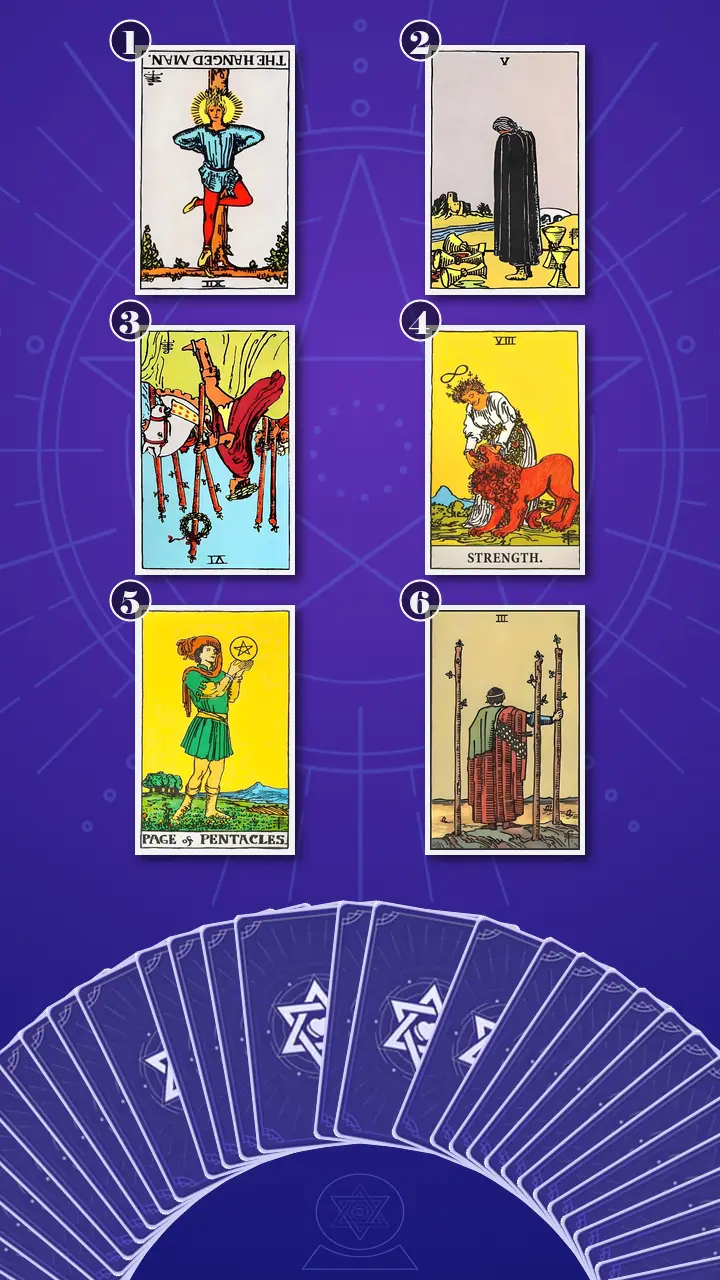
Reading the Closed Loop
Position One: The Browser Tab That Became a Waiting Room
I turned over the card representing the observable post-rejection behavior: opening the next application while remaining suspended in planning, rereading, and delayed starts. It was The Hanged Man, reversed.
I pointed to the figure hanging by one foot. Upright, I often read this card as a purposeful pause that permits a new perspective. Reversed here, its energy was blocked. A necessary period of recovery had hardened into indefinite suspension. Alex was standing between the rejection and the next draft, waiting for an emotional safety certificate that no calendar could issue.
The card's modern-life scenario was already open on Alex's screen. The portal remained active for forty minutes, but the actual application stayed untouched while they renamed the file, shifted the calendar block, and reread saved requirements. The internal monologue sounded productive: “I am technically working because I am updating my tracker, but the one thing I am not doing is writing something that could be judged.”
“The portal is open, but the application is still waiting outside the planning system,” I said. “A real pause has a boundary. This one keeps moving its own end date.”
Alex gave a short laugh that carried no amusement. Their fingers tightened around the cold mug before loosening again. “That is painfully accurate. I have absolutely called this preparation.”
I did not challenge the need for rest. “Rest is not the problem,” I said. “The question is whether the pause restores you or requires you to feel invulnerable before it will release you. There is also an overcorrection risk here. After postponing several small sessions, you may plan one heroic late-night sprint, making the task even more expensive to approach.”
Position Two: When One No Filled the Whole Screen
I turned over the card representing the immediate emotional blockage beneath the delay: attention fixed on the academic disappointment until the remaining applications became difficult to see. It was the Five of Cups, upright.
I traced the three spilled cups beneath the bowed figure, then the two upright cups behind the black cloak. I read the upright water as real feeling, but its distribution had become unbalanced. Too much attention was pooling around one loss; too little was reaching the programs still open, the referee willing to help, the reusable research examples, and the skills Alex still possessed.
I brought in the scene Alex had described from the TTC. An application reminder appeared above the flagged rejection email. The brakes squealed, a stranger's wet coat brushed their sleeve, and their phone felt hot in their palm. Alex tapped the old message instead of the new portal. It was as if their personal algorithm had been trained on one painful click and now recommended the same rejection story whenever a new opportunity appeared.
“I know other options exist, but right now this one no is louder than all of them,” I said, giving language to the loop. “One rejection can be real without becoming the whole horizon.”
Alex stopped turning the mug. Their gaze stayed on the two unspilled cups, and I saw their throat move before they spoke. “I think I keep rereading it because I am trying to find the sentence that explains everything. But it is a generic email. There is nothing new in it.”
“Then let us separate what the rejection deserves to mean from what it lacks the evidence to mean,” I replied. “It deserves to mean that you wanted this opportunity and did not receive it. It may deserve grief, frustration, and a change of plan. A generic decision does not contain enough information to determine your intelligence, your future, or your right to apply elsewhere.”
Position Three: The Private Scoreboard Behind the Draft
I turned over the card representing the underlying fear sustaining the procrastination: that another rejection might confirm Alex lacked academic worth or legitimate standing. It was the Six of Wands, reversed.
The rider's laurel wreath and the surrounding crowd usually speak to recognition. Reversed, that fire was trapped. Alex wanted recognition to provide confidence before the next attempt, but admissions recognition can only arrive after work has been submitted. The result was a closed circuit: no action without validation, and no possibility of validation without action.
I connected the card to the LinkedIn post Alex had seen during lunch: “Thrilled to announce,” a university logo, a polished success story with every private draft and rejection cropped out. Alex responded by polishing CV verbs and hiding the unfinished statement. Another application stopped feeling like one committee assessing one file. It began to feel like consenting to have their intelligence and belonging graded again.
“A private no can become a public scoreboard in your head,” I said. “The feared sentence underneath it is often, ‘If they say no again, maybe it means something final about me.’”
When I saw the reversed laurel, I flashed briefly to my years on Wall Street. After a loss, one red line on a monitor could commandeer attention until it seemed to narrate the entire book. The discipline was not pretending the loss was green. It was refusing to let one data point claim authority it did not possess.
I used my Academic ROI Auditing lens to make that distinction concrete. An admissions decision can provide limited information about the strategic yield of one application in one competitive context. It cannot calculate the total value of a person. If the rejection contains no specific feedback, the evidence supports only a narrow conclusion: one program declined one submitted file at one time. Any conclusion about Alex's fundamental legitimacy is an identity story added after the decision, not a fact delivered by it.
“When you imagine a second rejection,” I asked, “what exact sentence are you afraid you would say about yourself?”
Alex's jaw tightened. Their eyes moved away from the spread, as though an old scene were replaying just beyond the camera. After several seconds, they exhaled through their nose. “I would say I had been unrealistic. That I am good enough to assist with research but not good enough to become the person leading it.”
I let the sentence remain visible without endorsing it. “That is the verdict your avoidance is trying to prevent. It also explains why more deadline tracking has not solved the problem. The draft has become emotionally expensive because it seems to carry your entire academic identity.”
When Strength Put a Hand on What Hurt
Position Four: Courage Before Readiness
The radiator clicked once and then went quiet. In that small gap, I turned over the card representing the key psychological lever: meeting disappointment with compassionate courage so that action no longer depended on feeling fully recovered or guaranteed recognition. The card was Strength, upright.
I asked Alex to look first at the woman's hands around the lion's jaws. I did not read them as force. Her posture was steady, her contact gentle, and the infinity symbol above her suggested repetition rather than one dramatic comeback. Strength brought balanced energy into the spread: compassionate courage, emotional steadiness, and self-trust under uncertainty. It answered the reversed Six of Wands by locating legitimacy inside the quality of Alex's participation, not in applause received beforehand.
I brought Alex back to 9:40 p.m.: the portal open beside the flagged rejection email, the file renamed, the tracker adjusted, their stomach sinking. Writing three rough sentences had become dangerous because it would make them available to another answer. They were waiting for the hurt to leave before asking their hands to move.
You do not have to finish feeling disappointed before you begin again; the next small draft can sit beside the hurt without becoming a verdict on your worth.
I paused, then gave the image its sharpest form.
The rejection is not a lion you must defeat before moving; take one gentle, deliberate step while keeping a steady hand on what hurts, as Strength does.
Alex's inhale stopped. Their fingers hovered above the trackpad, perfectly still, while their gaze lost focus as if the previous week were replaying in fast, silent clips: the Sunday Notion board, the moved calendar blocks, the blank document, the laptop closing. Then their brows drew together. “But does that mean I have been doing recovery wrong this whole time?” they asked, the words arriving with a flash of anger before their voice thinned. “Because I really did need a break.” I answered carefully. “No. Needing a break was not a mistake. The problem began when readiness became an entrance fee you could never prove you had paid.” Their fist softened against the table. Their shoulders dropped, followed by a long breath that sounded relieved and slightly unsteady. I saw the vulnerability arrive behind the release: if action was possible before certainty, the next choice belonged to them again. That freedom felt lighter, but it also carried responsibility. “Now, using this new perspective, think back to last week,” I invited. “Was there a moment when this insight could have made the experience feel different?”
“Sunday,” Alex said. “I planned to finish the whole statement. If I had only asked for one paragraph, I probably would have started. I still would have felt awful, but I might not have closed the laptop.”
“That is the shift,” I said. “The brave part is not feeling ready; it is making the task small enough that readiness is no longer the price of entry. You do not need to feel fearless; you need a task small enough to meet while afraid.”
I then adapted The Research Sunk-Cost Audit, the framework I use to evaluate whether a stalled academic project deserves a pivot or another measured investment. I separated the closed outcome from the assets and choices still available. The previous committee's decision was complete. The usable material, references, research examples, and knowledge Alex had built were not erased. The next paragraph did not need to redeem the rejected application; it only needed to produce new information about what Alex could draft, revise, or decide next.
“An audit does not order you to persevere at any cost,” I clarified. “It protects your right to proceed, pause, or pivot according to fit, capacity, and evidence. It stops previous effort and previous hurt from becoming your manager.”
I proposed a low-stakes experiment: minimize the rejection email, set a ten-minute timer, and write three deliberately rough bullets answering one selection criterion. No editing, research, peer updates, or assessment of admission chances during the timer. When it ended, Alex could stop freely. If the discomfort became too intense, the minimum version was one bullet or simply pasting the criterion into a clean document.
This was the first movement from disappointment-driven withdrawal and fear of another verdict toward compassionate courage and cautious self-trust. It was not a promise that the next application would succeed. It was proof that disappointment and chosen action could occupy the same room.
The Paragraph That Became a Learning Object
Position Five: One Criterion, Twenty-Five Minutes
I turned over the card representing the practical action that would carry the shift into daily life: one bounded task producing a visible draft, feedback request, or completed section. It was the Page of Pentacles, upright.
I focused on the Page holding one pentacle at eye level. The figure was not juggling an entire future. They were studying one material object with steady attention. I read the earth energy as balanced and available, but underused. Alex had plenty of analysis; what the spread lacked was grounded evidence of participation.
In context, the Page became a clean document containing one selection criterion. Alex would set a 25-minute timer and draft 150 rough words using an example from their research job. Any questions that appeared would go into a parking-lot note instead of opening more tabs. When the timer ended, Alex would record the visible output before deciding whether it was good.
“For this session, the application is one paragraph, not your whole future,” I said. “The next paragraph is a learning object, not a verdict.”
I compared it to shipping one small software patch for focused review rather than waiting to unveil a flawless system. The patch may reveal something to revise. That is useful information, not an identity failure. Upright Page energy measures progress through contact, practice, and feedback.
Alex reached for their phone and typed “criterion two, 150 rough words, 25 minutes” into a note. Their mouth tightened briefly at the number, then relaxed. “I can imagine doing that,” they said. “Not confidently. But I can picture the task.”
Position Six: The Horizon Beyond One Committee
I turned over the final card, representing the integrative stance: measuring progress through repeated participation, learning, and submission without predicting the result of any application. It was the Three of Wands, upright.
I contrasted its standing figure and open water with the bowed gaze of the Five of Cups. The original loss had not disappeared, but the frame had widened. The planted wands showed that perspective rested on actions already taken, while the ships suggested work released beyond the private space of rumination.
In Alex's life, the card translated into reviewing no more than three realistic programs by fit, deadline, and next physical action. It did not mean applying everywhere or turning submission count into another scoreboard. It meant zooming out on the transit map after one route closed and noticing several viable connections, without pretending any of them was a guaranteed express line.
I read the card's outward fire as balanced because it no longer depended on the reversed Six of Wands' demand for recognition in advance. Alex could prepare one document, request focused feedback, and submit when ready enough. Each action would alter one row in the application pipeline. No single row could determine the status of the whole person.
“At the end of this week,” I asked, “what evidence would show that you participated again, even if no admissions result had arrived?”
Alex looked down at the note they had just made. “A paragraph that exists. Maybe one that another person has actually seen.” Their answer carried curiosity, but I also heard caution in it. That mattered. Clearer did not have to mean invulnerable.
As I looked across all six cards, I noticed there was no Sword in the spread. For me, that absence sharpened the cognitive blind spot: Alex kept assuming more analysis was the missing ingredient. It was not. We needed only enough air to define the task and tell the truth about the feeling. Earth and steady fire would do the rest through visible work and repeated participation.
The Rejection-Tab-Closed Draft
I traced the complete story back through the grid. The rejection was the real loss beneath the Five of Cups. Repeated attention to that loss trained every new opportunity to trigger the old story. The Six of Wands reversed then converted one committee's decision into an imagined ranking of Alex's legitimacy. The Hanged Man reversed protected them from another verdict through planning, rereading, and rescheduling. That protection brought temporary relief, but the growing backlog made the next attempt feel larger, which strengthened the original fear.
Strength interrupted the loop without denying the hurt. The Page of Pentacles gave that courage a defined output. The Three of Wands placed the original rejection inside a wider field of options and repeatable effort. The six-card Transformation Path Grid did not produce a prediction. It exposed why the loop persisted and where a chosen action could change its direction.
I named the blind spot directly: Alex had been treating complete emotional recovery as a prerequisite for application work, and treating repeated analysis of the rejection as if it might eventually reveal a final truth about their worth. The transformation direction was more practical and more humane. Progress would be measured by controllable actions such as drafting, requesting bounded feedback, and submitting, while acceptance remained an external outcome.
Using the Research Sunk-Cost Audit, I asked Alex to sort the situation into three clean categories before the next work block: what the rejection actually established, what useful assets remained, and what smallest experiment could produce new information. The first category contained one committee's no. The second contained research examples, references, reusable material, and several live options. The third contained one rough paragraph. That was enough for a start.
- The 10-Minute Re-entry On the next available evening, at the table where the laptop normally lives, close the rejection email and peer-update feeds. Type: “I feel disappointed and exposed, and this session is only about one small output.” Set a ten-minute timer and write three intentionally rough bullets for one selection criterion without editing or researching. Tip: Define the stop point before beginning. If three bullets feel too exposed, write one bullet or paste the prompt. Stopping when the timer ends still counts as re-entry.
- The One-Criterion 25-Minute Block Put one block in Google Calendar with a visible output, such as “draft 150 rough words for criterion two.” Work in a clean document containing only that prompt. Place questions in a parking-lot note and record the word count before assessing quality. Tip: If 25 minutes expands into “finish the whole application,” return to a five-minute version and write one topic sentence. The boundary is part of the method.
- Bounded Feedback and the Wider Horizon Send one paragraph to a trusted colleague, tutor, mentor, or friend with a narrow request: “Could you tell me whether this gives one clear example of research readiness? No line edit needed.” During a separate 15-minute weekend review, list no more than three programs using only fit, deadline, and next physical action. Tip: A wider horizon is not an obligation to apply everywhere. Remove options that do not fit your capacity or goals, and measure the week by completed outputs rather than confidence or submission count.
“These are experiments, not commands,” I told Alex. “You retain the right to stop, revise the scope, seek support, or decide that a program is not worth the investment. The purpose is to restore choice where the rejection-avoidance loop has been choosing by default.”

A Week Later: Re-entry, Not Resolution
Six days later, I received a message from Alex. At 9:18 p.m., back at the same kitchen table, they had closed the rejection tab, written the sentence naming how exposed they felt, and set the ten-minute timer. They produced three rough bullets. After choosing to continue into a 25-minute block, they turned one bullet into 163 words and saved the file as “re-entry complete.”
The next afternoon, Alex sent the paragraph to a colleague with the bounded research-readiness question. The reply did not crown the paragraph as perfect. It identified one clear example and one place needing context. Alex revised those two sentences instead of reopening the rejection email.
That night they slept through. Their first thought the next morning was still, “What if I get another no?” They made coffee, let the question remain unanswered, and opened the draft anyway.
I took that as the quiet proof of our Journey to Clarity. The cards had not removed uncertainty, written the statement, or guaranteed an acceptance. They had helped Alex distinguish a real disappointment from an unsupported verdict, and a recovery pause from a waiting room. Alex supplied the courage, set the boundary, and typed the words.
When the next portal opens and your stomach drops, it can feel safer to keep perfecting the plan than to risk another email that seems capable of grading your worth. If you can notice that private scoreboard without obeying it, you are already beginning to step out of the suspended loop.
If disappointment were allowed to sit at your kitchen table without becoming the admissions committee on your value, which learning object would you be curious to touch for ten minutes: one prompt, three rough bullets, or a single bounded paragraph?