Academic Rejection Felt Final Until One Page Became a Learning Step

The 8:47 p.m. Rejection-Linked Procrastination Loop
If you are a Toronto research assistant reopening graduate portals after rejection, then comparing one more program instead of submitting may be your version of grad school application anxiety. Jordan, a 28-year-old research assistant and part-time tutor, joined my video call from exactly that place.
It was 8:47 on a Tuesday evening in their small Toronto apartment. Blue laptop light flattened the colour from their face; the radiator ticked behind them, the laptop fan hummed, and their phone looked warm from being held too long. On the shared screen, a graduate application portal sat beside the same unfinished personal statement.
One hand moved toward Submit. The other opened another program page. “I want to try again,” Jordan said, “but if I submit again, I might find out what the last rejection actually meant.” Their chest drew tight and their shoulders rose, as if the ordinary button had been wired to a smoke alarm only they could hear.
They had already checked funding, supervisor fit, deadlines, and required documents. They had moved one paragraph between Google Docs and a notes app so many times that every sentence felt both overworked and unsafe. Acceptance announcements on LinkedIn made the cursor move faster, but never toward submission.
“Sometimes the unfinished application is not a lack of desire,” I told them. “It is the place where hope can hide from another verdict.”
I did not call the delay laziness or self-sabotage. It was protection with a cost: postponement gave Jordan ten minutes of relief from being evaluated, then returned as a heavier pair of shoulders and another evening without new evidence. I told them our goal was not to predict an admissions decision. We would use the Four-Layer Insight Ladder · Context Edition to map what the delay protected, separate outcome from identity, and identify one next step Jordan could freely choose.
Choosing the Compass: The Four-Layer Insight Ladder · Context Edition
I invited Jordan to take one unforced breath and state the question in plain language: “Why do I keep putting off reapplying after academic rejection?” I shuffled slowly while they held that question. The brief ritual was a transition from frantic problem-solving into focused observation, not a claim that the cards would decide their future.
This is how tarot works in my practice: the images create enough distance for a person to examine a pattern without being swallowed by it. Card meanings in context can reveal the difference between a real information gap and an emotional threat, but they cannot guarantee admission, diagnose a condition, or replace practical research.
I chose this four-card structure because Jordan was not primarily deciding between programs. A larger outcome-focused spread could have encouraged the very fixation already keeping them stuck. We needed the smallest sufficient map: the visible postponement, the wound beneath it, the perspective that could change its meaning, and one practical integration step.
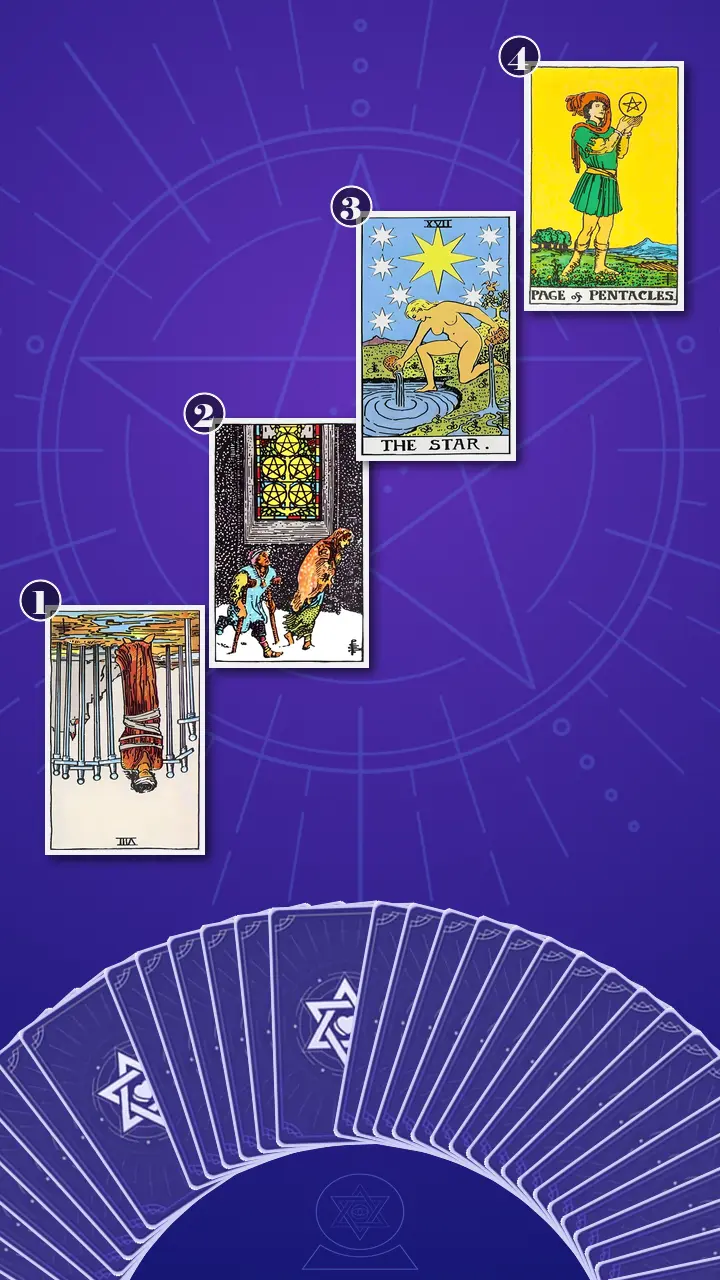
I placed the cards in a shallow staircase rising from lower left to upper right. The first position would show the observable editing-and-withholding cycle. The second would reveal why another application felt like returning to a place that had already excluded them. The third, our bridge, would separate rejection from identity. The fourth would bring that insight down to a real desk, a defined task, and a finish line.
Reading the Map Where Preparation Stopped Moving
Position 1: The Loose Bindings of the Eight of Swords
I turned over the card representing the presenting symptom: the observable cycle of opening, editing, and withholding the application. It was the Eight of Swords, reversed.
In Jordan's life, this was not an abstract image of feeling stuck. It was the portal already open, the statement mostly assembled, and eight program tabs waiting behind it. The true information gap was small, but the emotional risk felt enormous. The blindfold was the belief that one more credential or edit might become the safe key. The loose bindings were the repeated choice to close the portal before the application became visible to anyone else.
I read the reversal as Blockage beginning to expose itself. Jordan could already sense that the application was not physically impossible to submit. The trapped energy came from a narrowed interpretation: movement felt dangerous unless certainty arrived first. More research was useful until it became a way to avoid producing new evidence.
“When Submit appears,” I asked, “what exact action do you take instead, and what does it spare you from feeling for the next ten minutes?”
Jordan gave a short laugh, but there was no amusement in it. “That's so accurate it's almost cruel. I usually fix a sentence that wasn't a problem, check GradCafe, and reorganize the folder. Then I can say I worked on the application.”
I let the laugh settle before responding. “The card is not accusing you. It is showing us the intelligence of the defence. Editing gives you control at the exact moment submission would take control away. We can respect what that strategy has been trying to prevent while still asking whether it works now.”
Their hand stopped moving over the trackpad. Their eyes shifted from the card to the open document, and then they lowered the laptop screen by an inch without closing it. The distinction had landed: this was not doing nothing. It was productive-looking delay used as temporary shelter from evaluation.
Position 2: The Lit Window of the Five of Pentacles
I turned over the card representing the underlying wound: the fear that another academic rejection could confirm a lack of worth or belonging, and the protective strategy that kept Jordan outside the next attempt. It was the Five of Pentacles, upright.
I asked Jordan to look at the two figures moving through snow beneath an illuminated stained-glass window. In their modern life, the scene was a TTC platform near St. George: brakes squealing, cold air travelling through the station, metallic coffee on the tongue, and a former classmate's funded-offer announcement glowing on a phone. It was also the unread email from a former supervisor offering to review a draft.
The card carried an Excess of attention to exclusion and a Deficiency in felt access to support. The support itself was not imaginary, but shame made it look emotionally unreachable. The lit window did not promise that a supervisor's feedback would secure admission. It showed that Jordan's attention had become fixed on the cold outside while a usable source of information remained nearby.
I named the hidden sentence beneath the revision loop: “I can submit when I know more, because if I submit now, the answer might tell me I am not one of the people who belong.”
Jordan's breathing paused. Their gaze lost focus for a few seconds, as if the old rejection email had appeared between us. Then they rubbed both palms over their jeans and said, very quietly, “When my supervisor offered to look, I felt embarrassed that I was still trying. Everyone else seemed to have moved on.”
I could see how the first two cards formed a blockage pair. The reversed Eight of Swords was the closed laptop and the endlessly editable sentence. The Five of Pentacles was the lit university window that Jordan had begun treating as a permanently locked door. One card showed the behaviour; the other showed what the behaviour protected.
“A rejection can describe one application without being qualified to describe you,” I said. “It may contain information about fit, timing, funding, competition, or the material you submitted. It does not contain a complete measurement of your capacity to learn or your right to pursue meaningful work.”
Jordan nodded once, then shook their head slightly, holding recognition and grief in the same movement. I did not ask them to turn the rejection into a blessing. The point was proportion: one admissions outcome had been given authority far beyond the evidence it contained.
When The Star Made Visibility Bounded
Position 3: The Bridge Between Open Water and Solid Ground
The radiator behind Jordan stopped with a small metallic click. For a moment, the room became unusually quiet, and reflected light from the wet street moved across the wall like water. I turned over the card representing the transformative perspective: the quality that could loosen the equation between rejection and identity. It was The Star, upright.
The Star showed a figure with one foot on land and one in water, pouring two streams at once. In Jordan's application process, one stream carried the emotional truth that the rejection had hurt. The other carried practical information toward the next revision. Neither stream had to drown the other.
I read this as Balance: grounded hope, emotional openness, and a willingness to be seen while still learning. Hope here was not a prediction of admission or a demand to feel positive. It was Jordan sending one imperfect page with one precise question before the whole application felt criticism-proof. The application could function like an early pull request, visible enough for useful comments to change it, without placing the entire project or person on trial.
A memory from my Wall Street years crossed my mind. A model hidden until it looked flawless was often riskier than an early review built around one clear question. The purpose of controlled visibility was not exposure for its own sake. It was to discover what private analysis could no longer reveal.
I call that lens Institutional Resource Leverage. I treat a mentor relationship or university network as a strategic asset that benefits from proactive upward management: a clear brief, a constrained request, and a workable date. That does not make the relationship cold or transactional. The structure protects both people from the vague, unbearable request Jordan feared they were making: “Please judge whether I deserve an academic future.” A bounded request sounded different: “Could you tell me whether this one-page research question is clear?”
I asked Jordan to picture 8:47 again: the portal open, the radiator ticking, the phone warm, and another program tab offering one more hour of safety. They wanted another chance, yet their mind kept translating submission into a test that could make the first rejection final.
I lowered my voice. “The Star changes the question from, Will this application prove that I belong? to, What can this bounded attempt teach me?” Then I gave them the sentence at the centre of the reading.
Do not make rejection the measure of your worth; let The Star's open water turn the next application into a visible learning step.
I left a pause after it. Even the laptop fan seemed louder in the space where Jordan might otherwise have rushed to explain.
Jordan stopped breathing for a beat. Their fingers, curled tightly against the edge of the desk, stayed frozen there while their eyes moved past my screen, as though they were replaying every night they had kept the application technically alive but privately untouchable. Their pupils widened; then their mouth tightened. “But doesn't that mean I wasted months? That I was wrong about what the rejection meant?” The anger arrived before relief, sharp enough to put colour back into their face. I did not hurry to soften it. “It means the strategy protected you from a second injury, and it also stopped you from gathering new evidence. Protection can be understandable and still become expensive. You were not foolish. You were working with a threat model that made every outcome personal.” Their fist loosened one finger at a time. Their eyes reddened, their shoulders dropped, and a long, uneven breath left their chest. The release brought a brief blankness too, the slight disorientation of realizing that clarity would return responsibility to them. “So I would have to choose to be seen,” they said. “In a bounded way,” I answered. “Now, with this new perspective, look back at last week. Was there a moment when this insight might have let you feel different?”
“The supervisor email,” Jordan said after a pause. “I could have sent one page. I didn't need to hand them my entire future.”
I gave Jordan a ten-minute experiment drawn directly from The Star's two streams. On paper, they would write two columns: What this application genuinely needs and What I am editing because being seen feels risky. They would choose one item from the first column or write one specific feedback question, then stop when the timer ended. If the exercise made their chest tighten beyond what felt manageable, they could close the document and decide later whether to return. The boundary included the right to pause.
This was the central crossing: from shame-driven avoidance and fear of academic exclusion toward grounded hope, bounded visibility, and steadier self-trust. It did not erase the cold of the Five of Pentacles. It showed Jordan that the lit window could be approached without requiring them to surrender control over what they shared.
“Hope is not asking you to feel certain,” I told them. “It is asking for one visible step that can teach you something.”
The Page Put One Task at Eye Level
Position 4: An Apprentice's Finish Line
I turned over the card representing practical integration: one grounded action that could make reapplication observable, limited, and learnable rather than an all-or-nothing test of worth. It was the Page of Pentacles, upright.
The Page held one pentacle at eye level. In Jordan's life, that pentacle became one program, one short fit checklist, one precise question for the former supervisor, and one definition of finished. The green field suggested work already under cultivation. The distant mountain remained real, but the Page was not trying to climb every future academic challenge in a single evening.
I read the Page as Balance in Earth energy: focused attention, patient study, and tangible progress. The spread contained no Fire card, which mattered. Jordan did not need to manufacture dramatic motivation, apply indiscriminately, or turn volume into another performance test. A scheduled, modest action could create momentum without requiring them to feel fearless first.
“What would count as finished this week?” I asked. “One substantive revision, one feedback email, one program decision, or one submission step? Pick an object small enough to hold at eye level.”
Jordan pulled a notebook closer and wrote three lines: confirm fit, revise the research question, send one page. Their handwriting was still cramped, but it no longer ran diagonally down the page. “I am allowed to be a learner here,” they said, testing the sentence, “not a finished proof of worth.”
“Exactly. The next application does not have to prove that you belong; it only has to become real enough to give you information.”
From a Closed Door to a Worktable
I drew the four cards together as one coherent story. The previous rejection had not merely disappointed Jordan; it had seeded a fear of standing outside academic life. That fear turned thought into a narrow Air loop: research, comparison, revision, relief, shame, repeat. The Five of Pentacles gave the loop its weight by translating one outcome into scarcity and exclusion. The Star restored circulation, allowing disappointment to be emotionally true without becoming an identity statement. The Page returned the reading to Earth through a task with a visible endpoint.
The blind spot was not a failure to work hard. It was the assumption that more preparation was always neutral or useful. Some edits improved the application. Others preserved the fantasy that a criticism-proof version could remove the vulnerability of being evaluated. The unfinished draft kept hope safe, but it also kept Jordan outside the feedback, decisions, and submissions that could produce new evidence.
The transformation direction was therefore precise: stop using rejection as evidence about personal worth and treat reapplication as a bounded, feedback-seeking experiment. Tarot could help Jordan identify the pattern, but it could not determine actual program fit or make the next choice for them. Those answers had to come from criteria, conversations, completed work, and Jordan's own priorities.
I also applied an Academic ROI Audit to the temptation to earn another credential before reapplying. A course, literature review, or extra project deserved more time only if it changed eligibility, research readiness, program fit, or the strength of a specific claim. If it merely delayed visibility, its strategic yield was negative, regardless of how academically respectable the task looked.
When I proposed a 45-minute block, Jordan frowned. “Forty-five minutes is how I accidentally start a three-hour editing session.”
“Then the alarm ends the session,” I said. “It does not ask whether you have earned the right to stop. The finish line must exist before the fear starts renegotiating it.”
- Run the Research Sunk-Cost Audit.On one evening this week, at the kitchen table, choose one program that already meets the basic fit and funding requirements. Before opening the draft, divide the remaining work into two headings: Future Yield, for changes that improve fit, evidence, or clarity; and Sunk-Cost Shelter, for edits continuing mainly because weeks have already been invested or visibility still feels unsafe. Circle one Future Yield item, set a 45-minute timer, make that single substantive revision, and then either submit or schedule one bounded feedback step for a fixed date.If the full block feels too exposed, use ten minutes and one paragraph. Do not apply indiscriminately to prove movement; the audit is designed to improve the next decision, not inflate the application count.
- Build the One-Page Feedback Bridge.Email the former supervisor who already offered to help. Attach no more than one page and ask one specific question, such as whether the research question is clear or whether the program fit is visible. Suggest a mutually workable reply date so the request has a boundary and the feedback can arrive while it is still useful.Jordan controls what is shared, which feedback is accepted, and whether it is used. A delayed reply or disagreement is information about the draft, scope, or timing; it is not a measurement of personal worth.
I asked Jordan to treat both actions as experiments rather than moral tests. The observable result was not “I got admitted” or even “I felt confident.” It was simpler: I selected one application, asked one useful question, and allowed the process to generate information.

A Week Later, the Quiet Proof
Six days later, Jordan sent me a message: “I emailed the one page. My supervisor said the fit was clear but the research question was too broad. I fixed that, ran the timer, and submitted at 9:03. I still felt sick. I just didn't reopen it.”
Three mornings later, Jordan told me they had slept through the night. Their first thought was still, “What if this is wrong?” This time, they smiled, opened the supervisor's reply, and wrote down one useful revision.
I did not read that as a total victory over doubt. I read it as the first credible evidence of steadier self-trust. The result of the application remained unknown, the earlier rejection still hurt, and the next decision would still belong to Jordan. What had changed was the authority of the fear. It could advise caution, but it no longer had sole control of the cursor.
The cards did not submit the application. Jordan did. The Four-Layer Insight Ladder · Context Edition provided a map from the closed admissions door to a workable desk, but Jordan chose the page, wrote the question, accepted limited visibility, and made the attempt real. That was the Journey to Clarity: ownership without the impossible demand for certainty.
If your chest tightens when you approach the next admissions door, it can feel safer to keep polishing outside than to risk another no. Simply noticing that the polishing may be shelter, not proof that you are unready, already changes where you are standing.
If reapplying could become one small, visible learning step instead of a verdict on whether you belong, which one page, one question, or one final click would you feel even slightly more willing to let be seen?