Academic Rejection Felt Like a Verdict; One Application Stayed Open

The Rejection Email Beside the Unfinished Application
If you are an early-career research assistant in Toronto, you may know the moment a former cohort mate posts a funded-place announcement while your own statement sits unfinished in another tab: this is comparison fatigue with a deadline attached.
I saw that moment with Maya, a twenty-five-year-old research assistant applying for funded postgraduate opportunities while her short-term contract edged toward its end date. At 11:40 p.m., her laptop fan hummed into the quiet apartment, her phone felt warm against her palm, and the room smelled faintly of cold coffee. An old rejection email sat beside a new application. She edited three sentences, checked the same wording again, saw a former cohort mate announce a funded place, and renamed the draft maybe later.
I watched her shoulders drop as if someone had quietly added a heavy backpack to them. She still wanted the academic life that application might support, but another attempt felt like volunteering for a fresh verdict. Her mind had turned one committee decision into a forecast of every future decision: if I try again and they say no, maybe it will prove I never belonged.
Her discouragement was not simply a bad mood. It was like trying to carry a glass of water through a crowded subway car while every jolt made her grip tighten, spill a little more, and blame her hands for the mess. Shame, grief, and dread travelled underneath it. I could see that she wanted to keep going and wanted protection from the next evaluation at the same time.
I said, 'You are not failing at motivation. It looks to me as though part of you is trying to prevent another decision from saying something permanent about you. We can make room for the disappointment without handing it the whole building. Today, we will try to draw a map through the fog and return the choice to you.'

Choosing a Map for the Shadow
I asked Maya to put her phone face down, take one slow breath, and hold the question without trying to make it sound more confident. I shuffled at an unhurried pace. The purpose was not to summon a fixed future; it was to give her attention one steady object while we examined what happened between rejection and withdrawal.
Today, I used a five-card reading called the Shadow Spread. For anyone wondering how tarot works in a situation like repeated academic rejection, this spread is useful because it follows the actual mechanics of the shutdown: the visible pattern, the external trigger, the hidden belief, the resource that can counter it, and the grounded practice that turns insight into a next step. It is a reflective tool, not a prediction of admission, funding, publication, or failure.
The first position reveals the observable shutdown after rejection: rereading the decision, narrowing attention to loss, and abandoning the next application. The second identifies the recognition pressure that intensifies it. The third reaches the internalised belief that another no could become a final judgment on worth and belonging. The fourth is the antidote, the constructive capacity Maya can use without pretending she feels invulnerable. The fifth translates the reading into one manageable learning experiment.
The layout forms a shallow funnel. We begin with what has spilled into view, move through the social scoreboard and the inner tribunal, cross toward compassionate courage, and descend into one practical piece of application work. That shape matters because the aim is not to add more information to Maya's overloaded mind. It is to gather scattered reactions until one honest next move becomes visible.
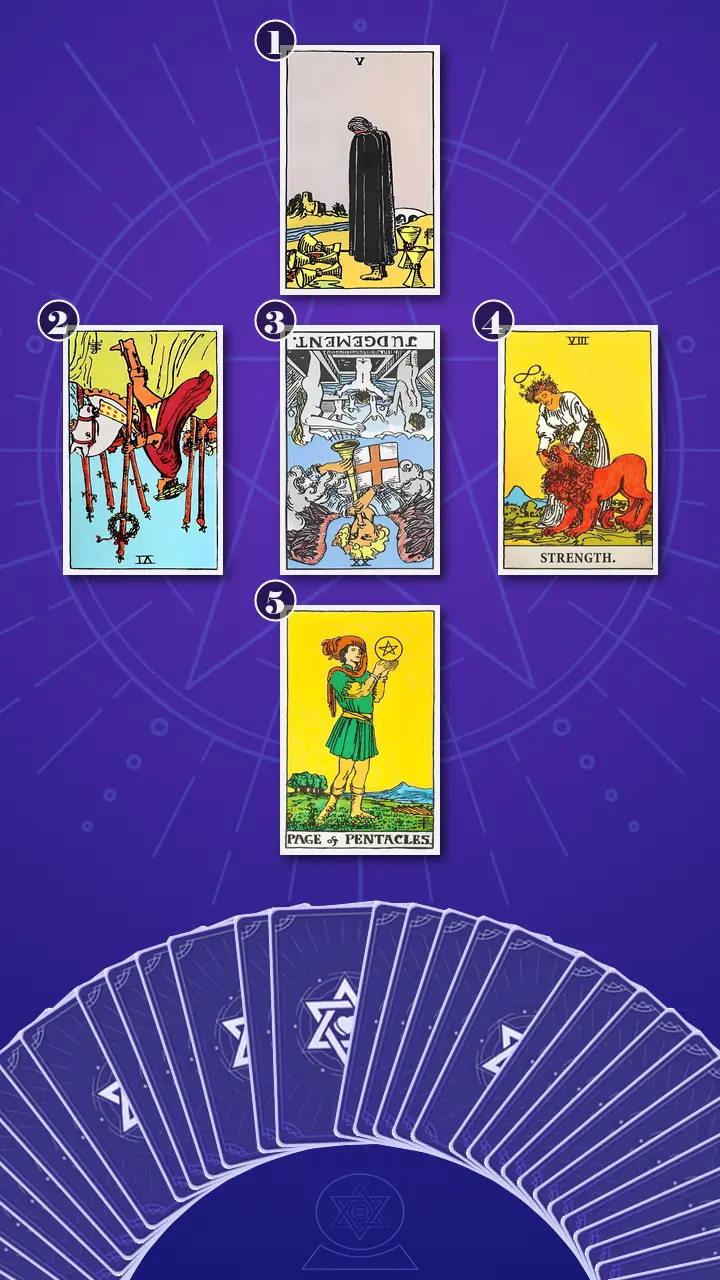
The Map Begins Where the Light Narrows
Position 1: The Three Cups in the Browser Tab
Now turned over is the card representing the observable shutdown after academic rejection: the habit of rereading the decision, narrowing attention to loss, and abandoning the next application.
It is the Five of Cups, upright.
In the Rider-Waite-Smith image, a black-cloaked figure bows over three spilled cups. The figure's attention is so concentrated on what has been lost that two upright cups remain unnoticed behind them. I saw the same posture in Maya's laptop glow. The old rejection email had become the three spilled cups, and the research experience, supportive friends, draft material, and possible directions behind her had moved outside the frame.
The upright water of the Five of Cups is real grief, but here it has become an attention blockage. The problem is not that Maya is pretending the rejection did not hurt. The problem is that the hurt has occupied the whole visual field. She keeps the old email open beside the new funded-program statement, edits three sentences, rereads the decision, and tells herself the next document can wait. A specific loss becomes an atmosphere in which every remaining possibility is harder to see.
Maya gave a short, bitter laugh. 'That is almost rude,' she said. 'I know one rejection is not supposed to mean everything, but it never feels like just one.'
I nodded. 'I am not going to ask you to be grateful for the two cups behind you. I am asking us to notice that the card holds both truths: something was lost, and not everything was lost. The part of you that wants to stop is trying to prevent another verdict, not necessarily reporting the full value of the goal.'
She went quiet, rubbed the edge of her phone with her thumb, and looked from the rejection email to the unfinished statement. The laugh had loosened nothing yet, but it had made the protective pattern speak aloud. That was enough for the first position.
Position 2: The Laurel Wreath as a Public Scoreboard
Now turned over is the card representing the external trigger that intensifies the pattern: dependence on academic recognition and comparison with peers' visible success.
It is the Six of Wands, reversed.
Upright, the Six of Wands shows a rider carrying public victory through a watching crowd. Reversed, the laurel wreath becomes unstable recognition: the acceptance badge, publication headline, funded-place announcement, or imagined admissions audience whose approval Maya has allowed to become the scoreboard for her worth.
I asked her to picture the TTC ride home from her research contract. At 7:18 p.m., the train braked, fluorescent light flickered across the window, and she saw a former cohort mate announce a funded place on LinkedIn. Her own unfinished statement was open in another browser tab. She checked three more announcements, scanned acceptance-rate pages, and lowered the confident language in her draft because it suddenly felt undeserved. She called this checking reality, but I could see the reversed fire: public recognition was no longer encouraging her effort; it was consuming it.
'A public scoreboard is being used to measure a private practice session,' I told her. 'An early draft cannot compete fairly with someone else's polished milestone. Let acceptance be an outcome, not the receipt that proves your work mattered.'
Maya's thumb stopped above the feed. Her jaw unclenched for a second, then tightened again when she imagined opening the statement. The comparison still had heat, but she could now see its job. It was not objective evidence that everyone else was progressing while she stood still. It was a trigger that made another attempt feel socially exposed.
Position 3: The Trumpet Inside the Courtroom
Now turned over is the card representing the hidden root beneath the visible pattern: the fear that another rejection could function as a final judgment on worth, capability, and belonging.
It is Judgement, reversed.
The Rider-Waite-Smith trumpet normally carries a call to wake up, review what has happened, and answer honestly. In reversal, I saw the call becoming an internal hearing. The committee's decision was limited information about one application in one context, but Maya had begun treating it as permission or refusal to become an academic person at all.
I placed a note card between us and divided it into two columns. Under documented facts, I wrote: The application was not selected. The field was competitive. The committee offered limited feedback. Under meaning I added, I wrote the sentence I heard beneath Maya's silence: This proves I am not capable. The email says this application was not selected. My fear says this proves I do not belong.
That distinction did not erase the sting. I did not use it to argue Maya out of disappointment. I used it to show where the inner tribunal had added a sentence the committee had never written. She had been rereading the phrase competitive field as though it were a system error saying her entire account was invalid. The reversed coffins in the card became the fixed identity she felt trapped inside, and the trumpet became the next decision she imagined would expose her permanently.
Maya's breathing paused. Her eyes lost focus as though she were replaying the rejection email and the peer announcement at the same time. Then she reached for the pen, wrote one line under each heading, and let out a low, reluctant sound of recognition. She did not say she felt better. She said, 'I can see the second sentence now. I just cannot stop believing it when it shows up.'
'You do not have to defeat that sentence tonight,' I said. 'You only need to stop giving it the committee's voice. Judgement reversed is the blockage because the review process has been turned into a trial. We can review evidence without putting your identity in the witness box.'
When Strength Took the Close Button Out of Her Hand
The room became unusually still as I reached for the fourth card. The laptop fan clicked off. Somewhere below the apartment, a streetcar bell sounded once and disappeared into the Toronto night. I turned the card toward Maya and felt the reading move from what had wounded her to what could meet the wound without force.
Position 4: The Wounded Lion and the Steady Hands
Now turned over is the card representing the hidden resource and the constructive capacity needed for the key shift: meeting disappointment with compassionate courage rather than using acceptance to establish worth.
It is Strength, upright. In this position, Strength is the antidote.
The image does not show a person overpowering a lion. It shows a woman meeting the lion with gentle hands, patience, and a calm authority that does not need to shout. I translated the lion into the surge in Maya's body after a rejection: the heavy chest, dropped shoulders, tight jaw, and restless hand reaching for the close button when a new application asks her to describe future potential with confidence.
At 11:40 p.m., I could see Maya caught between two statements: I still want to pursue meaningful academic work, and I cannot bear another verdict. The application stayed open while her hand hovered over close, as if ending the task could keep the next judgment from arriving.
I use a method I call Syllabus Deconstruction when a deadline has grown so large that it starts demanding a verdict about an entire life. I strip away the emotional scale of the deadline and reduce it to mechanical, emotionless daily tasks: open the prompt, name the fit, find one piece of evidence, write three rough bullets, stop. Strength gave me the permission to offer that method here. It did not ask Maya to feel fearless. It asked her to keep respectful contact with the frightened part of herself while making the task smaller.
You do not need to overpower rejection or earn back your worth; meet the wounded lion with steady hands, then choose one manageable next attempt.
I let the silence hold, then said, 'An academic rejection can evaluate an application without becoming a verdict on the person who made it. Your next attempt can be chosen with self-respect intact, even while disappointment is still present.'
Maya's fingers froze first, one hand suspended above the close button and the other still gripping the pen. Her breath stopped halfway in, and her face went blank. Then her eyes shifted out of focus as if she were watching the old rejection email, the funded-place announcement, and the sentence this proves I do not belong play again in a single compressed flash. Her pupils widened. A flush rose near her cheekbones, and for a moment the relief looked almost like anger.
'But does that mean I was wrong to care this much?' she asked. 'Or wrong to believe the last rejection mattered?'
I told her no. Caring was not the error, and the disappointment was not imaginary. Finally, her clenched hand opened against the table. Her shoulders dropped with a small shudder, and the next breath left her chest slowly enough to sound like a door unbolting. She looked dizzy for a second, not from certainty but from the responsibility of having a choice again. Then she said, almost under her breath, 'I can still feel exposed. I just do not have to make the exposure decide everything.'
I asked, 'Now, use this new perspective to recall whether there was a moment last week when this insight could have made you feel different.' She remembered the TTC announcement. She remembered reaching for acceptance statistics before writing. She remembered that she could have kept the application open, moved her phone face down, and written one imperfect sentence. That was the first credible movement from discouraged contraction toward cautious willingness: not the disappearance of grief, but a change in what her attention was holding.
Strength did not promise that the next panel would say yes. It restored a steadier kind of fire, one that could hold disappointment without being driven by it. Self-respect and another attempt could exist in the same room.
Position 5: One Pentacle at a Time
Now turned over is the card representing the grounded integration practice: approaching one well-matched application as a practical learning process rather than a verdict.
It is the Page of Pentacles, upright.
The Page studies one pentacle carefully while a cultivated field stretches behind him and mountains wait in the distance. I saw Maya's academic life in that image: existing research practice under her feet, a longer path she did not need to settle in one evening, and one application prompt held close enough to study without making it carry her entire future.
For Maya, the Page was not a promise of admission or funding. It was the identity of a dedicated beginner, someone willing to develop a craft without demanding a guarantee before beginning. She could choose one opportunity that genuinely matched her research interests, schedule two short drafting sessions, connect one prompt to one piece of evidence from her contract, and record what she learned before evaluating herself.
Maya moved her phone face down. She kept the application window open and wrote three rough bullets: why the opportunity fit, what her research contract had taught her, and which part of the prompt needed more information. The sentence was imperfect. She did not delete it. Her eyes stayed on the page, and the pressure behind her ribs eased by one small degree.
'This feels less like proving I belong,' she said, 'and more like seeing whether I can work with this particular opportunity.'
'Exactly,' I said. 'The Page of Pentacles turns an application into a bounded learning experiment. It gives you something real to examine without asking you to decide whether the whole building is accessible.'
Finding Clarity in One Bounded Application
I laid the five cards out again so Maya could see the movement as one story. The Five of Cups showed water pooled around the loss. The reversed Six of Wands showed public recognition turning that grief into a scoreboard. Judgement reversed showed the scoreboard moving inside her until a limited selection decision became an identity sentence. Strength restored compassionate authority, and the Page of Pentacles grounded that authority in one piece of work.
The reason this loop had felt so convincing was not that Maya lacked discipline. After a rejection, effort seemed to expose her to another verdict, so delaying the next application offered immediate relief. But that relief also removed the process evidence that could challenge the belief. No new draft meant no new fit information, no feedback, no practice, and no chance to discover that one application could be different from the last. Avoidance looked like protection while quietly making the future feel smaller.
I also pointed out the absence of Swords. Maya did not need another hour of abstract analysis before taking a small step. Her mind was already working hard, opening Google Sheets, programme rankings, acceptance statistics, GradCafe threads, statement-writing videos, and grammar-tool tabs. The missing movement was not more thought. It was feeling the disappointment, meeting it with steadiness, and then returning attention to a tangible task.
The blind spot was this: Maya had been asking acceptance to serve as proof of worth, then treating the absence of acceptance as proof of inadequacy. She had also been confusing the avoidance of a possible rejection with the protection of practical stability, even though an unfinished application could not provide fit, feedback, or new evidence. The transformation direction was more precise than simply trying harder. It was moving from acceptance as a referendum to fit, completion, feedback, and learning as controllable process evidence.
I said, 'A process measure cannot guarantee a yes, but it can keep one no from becoming the only evidence you have. Here are the next steps I would use. They are deliberately small. None of them requires you to submit, feel confident, or decide your entire academic future.'
- Choose one matched opportunityThis week, choose one funded postgraduate or early-career opportunity that genuinely fits your research interests and add its link to a plain document titled one experiment. On Tuesday or Wednesday, at a library desk or kitchen table, spend 10 minutes writing three bullets: why the opportunity fits, what evidence from your research contract is relevant, and which part of the application needs information.Use Syllabus Deconstruction to turn the large deadline into mechanical, emotionless tasks. Put your phone in another room. If ten minutes feels too exposed, write one bullet in two minutes and stop; the task is contact with the application, not a guaranteed outcome.
- Separate facts from the verdictCopy one rejection's factual wording into a note and create two headings: documented facts and meaning I added. Under the second heading, write the sentence your fear attached to the email, then identify what the available evidence does not establish. Finish with one neutral process question about fit, clarity, timing, or feedback.Use the rejection email once for five or ten minutes, not as a late-night self-punishment ritual. Write unknown when the committee's wording is vague. You do not owe the message a complete emotional analysis or an immediate decision about reapplying.
- Reset the desk and track the processBefore opening the draft, use Study Environment Auditing to notice which physical clutter or disorganised systems are quietly draining your limited attention. Then use my Desktop Reset Ritual: spend 15 minutes clearing the visible work surface, moving old cups and unrelated papers away, and leaving only the laptop, notebook, and one application prompt. Afterward, make a three-line note labelled fit, completion, and learning.Delay LinkedIn or Instagram Stories until the process note is finished if that boundary helps, but treat it as an experiment rather than a moral rule. If fifteen minutes is too much, clear one small square of the desk. The reset should restore visual order, not create another performance test.
Maya looked at the list and said, 'I can sometimes spend an hour organising a system. I am not sure I can find ten minutes for the actual application.'
'That is useful information,' I said. 'It tells us the system can become another hiding place. The smallest version is allowed to be almost embarrassingly ordinary: put the phone away, open the prompt, write one relevant experience, and stop. We are testing whether attention can return, not measuring your worth by how much you produce.'
The Page of Pentacles did not turn Maya into a person who never checked a peer announcement or never felt the drop in her chest. It gave her a way to notice the reaction, choose a bounded task, and gather evidence about what happens next. That is actionable advice without pretending that structural barriers, competitive funding, unstable contracts, or unequal access disappear through organisation alone.

The First Quiet Proof
Five days later, I received a message from Maya. She had used the Desktop Reset Ritual, opened one well-matched opportunity, and written the three bullets. She had not submitted the application yet. She had, however, asked a former supervisor one focused question about fit instead of rewriting her entire academic identity.
That night she slept a full night after the first draft, but woke with the old thought: What if I am wrong? The thought stayed. This time, she smiled, made coffee, and opened the document before LinkedIn.
I did not tell Maya that persistence would inevitably lead to admission, funding, publication, or a stable academic career. The cards had not predicted an outcome. They had helped us separate a documented application decision from the identity verdict her fear had added, then return the next choice to the person living with its consequences.
Her Journey to Clarity began with a smaller distinction: a rejection can evaluate an application without defining the person who made it. From there, compassionate courage made room for one bounded attempt, and the Page of Pentacles gave that attempt a learner's shape. Maya remained the author of the next chapter. The reading simply helped her see the page again.
When another rejection lands, your chest can go heavy as you quietly want to keep building an academic life while fearing that one more attempt will expose you as someone who never belonged. If the next application could be a small conversation with your craft rather than a verdict on your worth, what part of it might you feel curious enough to look at for ten minutes?