When Returning Feels Like A Test

Map the pressure of social return through grounded context, related tarot cards, and reading insights from similar sessions.

Social Reentry Trial
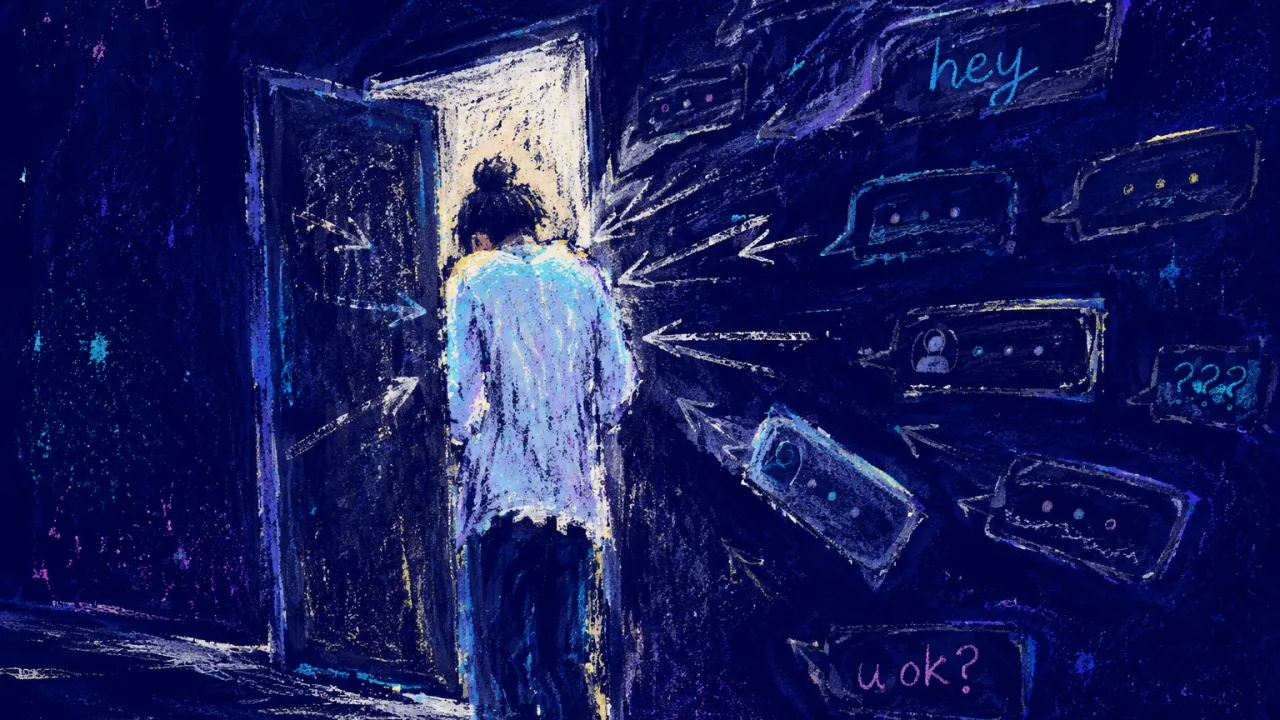
A solitary figure paused at a doorway as message bubbles and arrow-like lines press around lifted shoulders

What is this situation?

Social Reentry Trial — you step back into a room where everyone else seems to know the pace, the references, and the script. It might start with a group chat ping after months of missed drinks, a coworker's casual 'you should come out,' or a friend's birthday invite where saying no again would become its own explanation. You show up at the bar, the apartment, the office mixer, the campus event, and the first few minutes are all logistics: where to stand, who to hug, whether to mention why you went quiet, how fast to answer the 'where have you been?' Everyone is being friendly enough, but the room has already moved on without you; there are new in-jokes, new couples, new work updates, new plans you were not there for, and you can feel your shoulders lift while you try to rejoin a conversation that kept going in your absence. The trial is in the small public measurements: the pause after you say you're easing back in, the look when you leave early, the expectation that you can be your old self on demand, the way one invitation turns into a test of whether you still belong. You get home with your jaw tight and your phone still lighting up, not from one cruel moment but from the pressure of proving your place again, much like the figure on the Seven of Wands, standing above a cluster of raised staffs while every side asks them to hold their ground.

Why it's not you?

The issue isn't that you're awkward, behind, or failing at being social; the setup is asking you to re-enter as if no time has passed. Group chats that moved on, catch-ups that become status checks, and invitations with an unspoken attendance score are external pressures. They make belonging feel like something you have to prove on cue.

Social Reentry Trial in Tarot Cards

In a Social Reentry Trial, the lifted shoulders, tight jaw, and phone that keeps lighting up are part of the scene, not a private flaw. The room, group chat, and invite cycle create an environmental, structural dynamic where return is treated like a performance review. The cards below do not decide whether you should go out more or pull back; they reflect the shape of the pressure. Here are the Tarot Cards that tend to mirror this kind of social return.

The Hierophant
Upright
A seated hierophant raises one hand between two kneeling acolytes, with crossed keys placed at his feet. The formal arrangement turns the room into a small institution, where greetings, references, attendance, and the expected version of you function as membership rituals. The visible exchange between authority and acolytes makes the pressure legible as a group norm rather than a personal social defect. You are encountering a script that rewards continuity, while the structure leaves room for participation to be renegotiated around a present version of you instead of a performance of the past.
The Hermit
Reversed
An old figure holds a lantern on a narrow, snowy height, separated from the activity below by distance and terrain. With the card reversed, that solitary vantage becomes a difficult handoff: the private rhythm that protected you during the absence does not translate smoothly into a crowded, fast-moving room. Every pause over where to stand or how much to disclose marks the gap between being away and being socially legible again. The blocked path is not a verdict on your sociability; it shows a reentry system that offers little bridge between solitude and participation at the pace others expect.
Wheel of Fortune
Reversed
A large wheel turns beneath a changing sky, with figures climbing, falling, and holding different positions around its rim. The rotating structure mirrors a social circle that kept changing while you were away: relationships, references, and plans now occupy different places. Reversed, the wheel emphasizes a return that feels out of phase rather than a clean restart. The timing problem is external and cyclical: one invitation arrives after the group has entered a new chapter, so the event becomes a test of whether you can reconnect without pretending the old cycle is still intact.
Temperance
Upright
One foot rests in water and one on land as an angel blends two cups, with a path extending toward distant mountains. The balanced stance gives a physical image to easing back in: private capacity and public participation have to be mixed at a pace the room can actually hold. The open path supports gradual calibration instead of an all-at-once return, while the two cups preserve a distinction between what you bring and what the group already has in motion. The structure shows why one manageable invitation can reveal more than a forced performance of your former social availability.
Judgement
Upright
An angel sounds a trumpet above figures rising from open coffins, all of them turning toward the same call. The image gives the invitation a public force: returning is not just entering a room, but answering a summons from a social history that continued without you. The raised figures show a route back into collective life, yet the scene also makes assessment unavoidable because everyone is visible at once. You can separate the call to reconnect from the demand to reproduce your former persona; the structure reveals reentry as a negotiated renewal of place.
Three of Cups
Upright
Three figures raise their cups in a loose circle, bodies angled toward a shared celebration. The circle is an unmistakable friendship invitation, yet its synchronized gesture highlights what reentry asks you to recover: the timing of jokes, updates, toasts, and small responses that make participation look effortless. The connected cups provide a real support network, while the open circle makes absence visible because everyone else appears already coordinated. You can distinguish the friendship itself from the pressure to perform instant fluency in the group's current script.
Six of Cups
Upright
Two children exchange flower-filled cups in front of a village, with one figure offering a cup from the past to the other. The physical handoff carries the warmth of old friendship, but the flowers also preserve a version of the relationship that may no longer describe the people standing in the room. When you return to close friends, shared history can open the door and simultaneously assign you an old role. The card reveals the reentry tension between being remembered fondly and being allowed to arrive with changed routines, newer relationships, and a different pace.
Page of Swords
Reversed
A young figure grips a raised sword while wind pulls at the landscape and the figure's clothes. The alert posture turns every message, pause, and question into information to be scanned; reversed, that vigilance can become a messy social signal system of catch-up questions, side comments, and assumptions. That structure matches the group chat ping and the 'where have you been?' exchange: communication is active, but it does not automatically create a safe bridge back into the circle. You can read the friction as an information gap in the network, where others are filling in your absence, rather than as proof that you have failed the conversation.
Four of Wands
Upright
A garland spans four staffs while two figures lift their arms before a walled home, with another pair supporting the threshold in the distance. The scene carries the concrete promise of a gathering, but the decorated entrance also makes arrival public: crossing it places you inside a shared rhythm already underway. The stable structure gives you an actual point of return, not an imaginary welcome, while the social ritual can still make your timing and departure visible. The card frames the event as a community threshold where belonging is negotiated through ordinary participation rather than through an instant return to your old role.
Six of Wands
Reversed
A rider passes beneath a laurel wreath while a cluster of people and staffs frames the route behind him. The public procession makes social status visible, but the reversed orientation interrupts the clean arrival: recognition is present as a demand, not a settled welcome. When you return, old familiarity can be treated as a reputation you must reactivate on cue, with a short absence read as a change in relevance or rank. The structure exposes why a casual invitation can feel like an attendance score, while keeping the evaluation in the group system rather than in your character.
Seven of Wands
Upright
A lone figure stands on higher ground with a staff braced against six staffs rising from below. The uneven height, defensive stance, and concentrated cluster make the room feel like a social field that has already chosen its positions before you arrive. The figure is outnumbered but upright, and the staff is available rather than broken. That physical arrangement names the trial of reentry: invitations can be friendly while still asking you to keep pace, answer the questions, and hold your place under public attention. The raised ground keeps one position available without turning it into a verdict on whether you belong.

Social Reentry Trial in Tarot Card Reading Insights

Social Reentry Trial often shows up when someone brings the first night back, the group chat pressure, or the 'where have you been?' moment into a reading. The section below shifts from the cards themselves to how this situation appears across readings. Tarot Reading Insights from sessions shaped by this kind of return.

Psychological Contexts Related to Social Reentry Trial