Three Calendar Yeses Led to Two Drafts, Then One Repeatable Promise

The One Good Morning That Booked a Whole Week
If you are a late-twenties hybrid worker in London who treats one decent morning as proof you can handle a full week, your “back-to-normal anxiety” may show up before breakfast as three new calendar commitments. I heard that exact pattern from Jordan, a 29-year-old UX designer who came to me asking, “Why do I keep pushing myself back into life before I feel ready?”
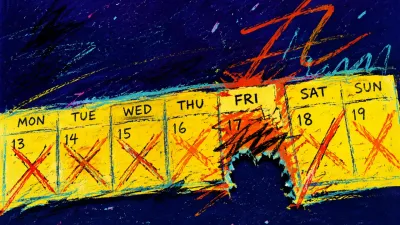
I asked Jordan to take me to the most recent moment it happened. At 7:40 on a Tuesday morning, the kettle clicked off in their small London kitchen. Blue phone light caught the steam while they stared at three open evenings in Google Calendar, then tapped yes to a gym class, birthday drinks, and an extra project meeting. Their jaw tightened before each confirmation; the coloured blocks still gave them ten brief minutes of relief.
When I asked what happened next, Jordan showed me Thursday's ending: an unopened meal container on the counter, the fridge humming behind it, takeaway spice cooling in the air, and two cancellation messages drafted on a buzzing phone. The boom-and-bust reentry cycle was complete. One good morning had become a full schedule; the full schedule had turned withdrawal into the only manageable option.
“I genuinely want to do those things,” Jordan said. “I miss work feeling normal. I miss saying yes without calculating the Tube journey, the noise, the money, and how wrecked I'll be the next day. But I keep treating one good day like proof that I can handle a full week.”
I watched urgent apprehension move through them like a smoke alarm triggered by kettle steam: there was no immediate fire, but their chest, jaw, and shoulders were already preparing to evacuate. Their conflict was painfully clear. They wanted to return to everyday life quickly, yet they did not feel ready for the pace they kept choosing.
“I don't think the problem is that you don't want your life,” I said. “I think you want it so much that every flicker of energy starts to feel like a deadline. I won't use the cards to decide whether you're officially ready. Let's use them to map what happens between the first good morning and the cancellation draft. Our journey today is about finding clarity in that gap.”

Choosing a Ladder Beneath the Calendar
I invited Jordan to take three unforced breaths and hold one question in mind: “What am I trying to secure when I restart before my capacity is clear?” I shuffled slowly. The breathing was not a mystical test; it was a practical transition from reacting to observing.
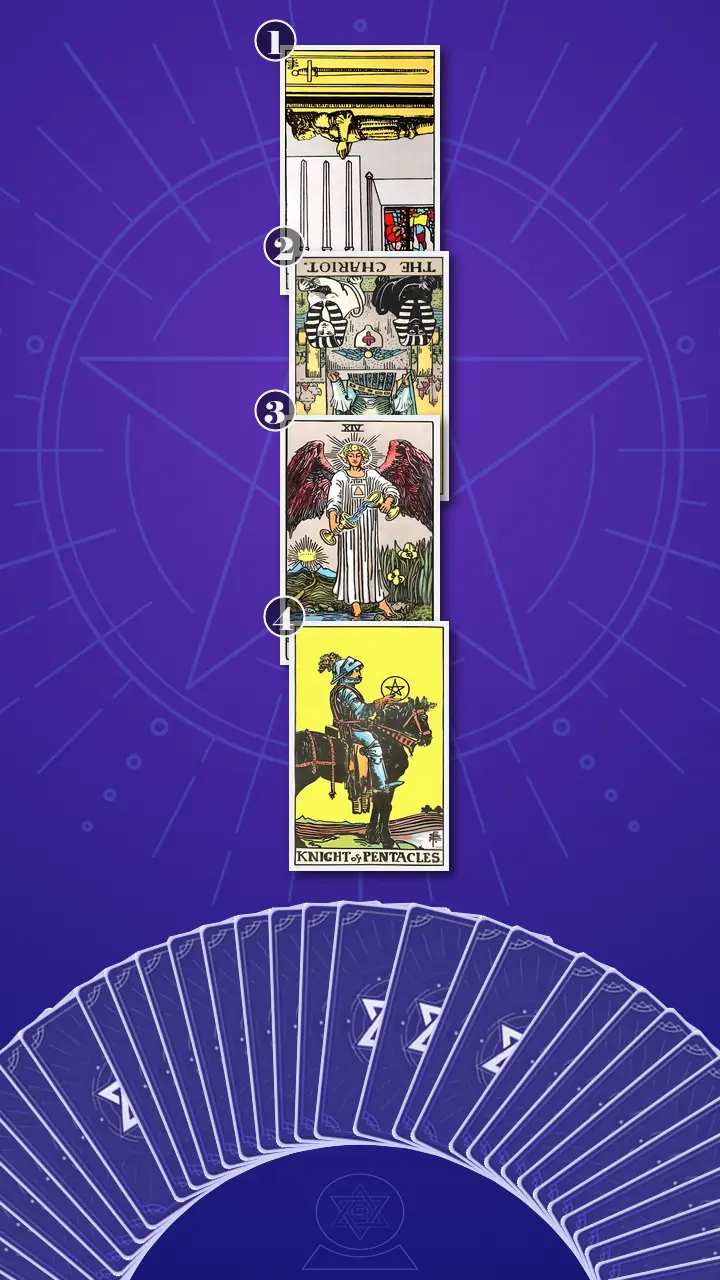
I chose the Four-Layer Insight Ladder · Context Edition, a four-card pattern-root-transformation-action tarot spread. I chose it because Jordan was not asking for a prediction or choosing between two fixed futures. They were describing a causal loop: pressure produced overbooking, overbooking interrupted recovery, cancellations made them feel stuck, and feeling stuck produced more pressure. A Past-Present-Future spread would have forced that loop into a timeline, while a larger Celtic Cross would have added complexity the question did not need.
I arranged the cards in one vertical line. The first position would show the observable forced-reentry pattern. The second would reveal the fear and control strategy beneath it. I left a slightly wider gap before the third card, the transformation point, where a different relationship between participation and restoration could appear. The final position would turn that shift into a paced-reentry experiment.
This is how tarot works best in a question like Jordan's: the images create enough distance for a person to inspect a familiar system without being swallowed by it. Card meanings in context are not verdicts about fate. They are structured prompts that help intuition, bodily evidence, and rational analysis meet on the same table. Jordan would remain the person deciding what counted as true and what to do next.
Reading the Rest That Never Became Rest
Position One: The Bed That Became a Control Room
“The card I'm turning over now represents the observable forced-reentry pattern: how a small improvement becomes an overloaded calendar and interrupts the rest you still need,” I said. I revealed the Four of Swords, reversed.
The image showed a recumbent figure beneath three suspended swords. The body was positioned for stillness, but the pressure remained visibly overhead. Upright, the Four of Swords can hold deliberate retreat and mental recuperation. Reversed here, that restorative energy was in blockage: rest was physically attempted but mentally interrupted, shortened, and used to prepare the next performance of being “back.”
I connected it to the scene Jordan knew too well. At 10:52 p.m. after an office day, their body was horizontal under a too-warm duvet, but their phone-warmed palm kept moving between Slack, WhatsApp, and Google Calendar. They accepted Saturday drinks, reopened the laptop for “one quick thing,” and checked the next day's empty spaces. The bed had stopped being a place of recovery. It had become a control room for tomorrow's reentry.
“What goes through your mind in that moment?” I asked.
Jordan rubbed one thumb across the side of their phone. “I'm technically resting, but if I leave tomorrow blank, it feels like I'm wasting the fact that I might be better.”
“That's the reversal,” I said. “The body is resting while the mind builds a case for ending rest early. The issue is not laziness or a lack of discipline. Your downtime is digitally permeable. It keeps being converted into a staging area for productivity.”
I asked Jordan to compare two recent commitments: one that left some usable concentration, appetite, patience, or desire for contact afterward, and one that merely looked like evidence of a comeback. Their lips pulled into a brief, bitter laugh.
“That's so accurate it feels a bit brutal,” they said. “I do this from bed and still call it downtime.”
I let the recognition settle without turning it into blame. “Brutal would be telling you that exhaustion proves you should try harder. This card is showing a mismatch you can observe and change. One good day is data, not a contract for the whole week. A pace that requires repeated disappearance is not yet a dependable pace.”
Position Two: Two Sphinxes, No Shared Destination
“The card I'm turning over now represents the root of the pattern: the fear of losing control and the belief that momentum must be forced before it disappears,” I said. The second card was The Chariot, reversed.
I pointed to the black and white sphinxes facing different directions. The armored driver had no visible reins. Upright Chariot energy can coordinate opposing forces toward chosen movement. Reversed, I saw an excess of command combined with a blockage of coordination. Jordan's willpower was active, but participation and restoration had not agreed on the same direction.
I described the modern version back to them. On Sunday night, Jordan built a strict five-day “normal week,” told the team they were fully back, and placed social plans on both sides of an office day. The full calendar felt controlled for ten minutes even while their chest tightened. When the plan later collapsed, they read the collapse as evidence that more discipline was required, rather than evidence that force had never created alignment.
“You are not only returning to life,” I said. “You are trying to prove the return is under your control.”
Jordan's inhale stopped high in their chest. Their eyes stayed on the two sphinxes. After several seconds, they said, “If I choose the slower need, it feels like the faster one isn't mine to command anymore. And with rent, deadlines, and everyone else moving, that doesn't feel neutral.”
I nodded. “Those pressures are real. London rent does not disappear because a tarot card recommends pacing, and actual job expectations still require direct conversations and practical decisions. But the cards can help us separate those realities from optional promises made mainly to stop uncertainty. If speed were reliable proof of control, the fastest restart would not keep ending with less choice later.”
I used one of my core diagnostic lenses, Systemic Friction Auditing, to strip the loop down to its working parts. The trigger was an open calendar or a better morning. The action was stacking work, exercise, errands, and social plans. The short-term relief was visible motion: the calendar looked normal, so life felt briefly commandable. The later cost was heavy limbs, reduced focus, cancellation drafts, and another retreat. The feedback loop then mislabeled those consequences as proof that Jordan should push harder next time.
“This is like pressing the accelerator while the parking brake is still engaged,” I said. “Hustle adds heat to the system, but it does not remove the friction. The useful question before an optional yes is not ‘Can I force myself through this?’ It is ‘Does this serve available capacity, or does it quiet the fear that I'm falling behind?’”
As I looked at the star-covered canopy above the Chariot, I thought of the years I had spent tracking long planetary cycles. No amount of impatience shortens an orbit. Human choice matters enormously, but choice becomes more effective when it responds to timing and conditions instead of treating both as personal insults.
Jordan's fingers tightened around the edge of the table and then released. “So the control isn't fake,” they said slowly. “It's just only lasting until the calendar catches up with my body.”
“Exactly,” I said. “Control-through-speed gives you a quick visual. Control-through-honest adjustment gives you choices you may still have tomorrow.”
When Temperance Changed the Meaning of Ready
Position Three: Water Moving Between Two Cups
A bus sighed to a stop outside my window, then the room became unusually quiet. Rain that had been smearing the glass thinned into individual taps, as if the evening itself had begun measuring water rather than throwing it all at once.
“The card I'm turning over now represents the key transformation: the capacity to coordinate participation and restoration without treating either one as failure,” I said. I revealed Temperance, upright, the reading's catalyst and antidote.
I drew Jordan's attention to the water flowing steadily between two cups, one foot on land and one foot in the pool, and the narrow path extending toward distant light. This was balance, but not a perfect still point Jordan had to achieve and preserve. Temperance held an active exchange: effort moved, recovery answered, and the proportion could be adjusted as new information arrived.
Its everyday expression was specific. Jordan could attend one high-priority design meeting, deliberately keep the evening afterward unbooked, and examine the next day's capacity before answering a weekend invitation. Participation and restoration would become a paired unit. The meeting's true cost would include its aftermath, not only whether Jordan managed to remain on the call until the end.
I brought in another lens I use, Macro-Cycle Phase Identification. I use it to locate the phase a person is actually inhabiting, not to predict their fate or hand authority to the stars. Jordan's evidence did not describe total retreat, nor did it support unrestricted expansion. It described early reentry: energy was returning in real but inconsistent intervals. The task of that phase was sampling, recovery, and calibration. Treating one better morning as full expansion was like scaling a beta feature to every user after one successful test session.
“A low tide is not a character flaw,” I said. “And reentry is not an exam you pass by pretending the tide is already high. You still choose the boat, the route, and when to leave shore. This card simply asks you to look at the water that is actually present.”
I asked Jordan to picture the familiar sequence: three open evenings, the quick lift of possibility, every gap filled before breakfast. By Thursday, their limbs were heavy and two cancellation messages waited in drafts. They were still trying to answer one punishing question: “Am I fully back, yes or no?”
I said, “Speed can make recovery look convincing for a day; readiness becomes trustworthy when effort and rest can alternate without either one having to prove your worth or your control.”
You are not failing when you stop pouring everything into one cup; Temperance asks you to alternate effort and rest until your real capacity becomes visible.
For one beat, Jordan stopped breathing. Their right hand, which had been flattening the edge of a card, stayed suspended; their pupils widened, then their focus slipped past me toward the rain-striped window. I could almost see the week replaying in order: meeting, gym booking, drinks, unopened dinner, cancellation drafts. Their fingers curled once, hard, then slowly opened. Their shoulders dropped, but the release did not look uncomplicated. Their eyes brightened; their mouth tightened. They took a breath that trembled on the way out and said, sharper than before, “But doesn't that mean I've been doing all of this wrong? That I caused the crashes?” After the words landed, their posture went strangely light, almost unmoored, as if putting down a heavy suitcase had revealed that they still had to choose where to walk. The anger faded into a quieter ache. “I really wanted to be back,” they said. “I still do.”
I kept my voice steady. “No. It means you used a strategy that gave you short-term relief when uncertainty felt intolerable. That strategy had a cost, but identifying the cost is not the same as prosecuting yourself for it. The cards are not putting you on trial. They are giving you enough distance to choose a more reliable experiment.”
Then I asked, “Now, with this new perspective, think back to last week. Was there a moment when this insight could have changed how it felt?”
Jordan looked down at Temperance. “Wednesday. I got through the important meeting and still had some concentration left. I booked the gym because I thought I had to use the momentum. If I'd kept the evening quiet, I might have answered my friend on Thursday instead of avoiding everyone.”
“What if readiness is not a gate you pass,” I asked, “but a ratio you can adjust?”
Jordan gave a small nod. “Then a quiet evening wouldn't automatically mean I'd gone backward. It might be part of what lets me show up again.”
That was the central crossing in our Journey to Clarity: from urgent pressure to prove recovery through speed toward grounded trust in paced, repeatable participation. It was not a promise of permanent balance. It was a first move from performed normality to observable capacity. Readiness was becoming a dial, not an on-off switch, and Jordan's hand remained on that dial.
The Horse That Paused on Purpose
Position Four: One Promise That Can Survive Friday
“The card I'm turning over now represents the paced-reentry experiment: one limited, repeatable commitment followed by an honest review of its actual cost,” I said. The final card was the Knight of Pentacles, upright.
The Knight held one pentacle level in both hands while the dark horse stood still before cultivated fields. I did not read the pause as stagnation. The horse was stationary because the rider was assessing one real resource before moving. This was grounded Earth in balance: practical effort, sequence, and stewardship replacing the Chariot's pressured motion.
In Jordan's week, the card looked like one modest rule kept long enough to produce evidence. They might leave the evening after an office day free by default for seven days, or choose one forty-five-minute coffee with a stated end time. On Friday, they could review what the commitment cost that day, what it cost the next day, and whether it could be repeated without borrowing capacity from tomorrow.
“The point isn't a flawless streak,” I said. “It is one promise that can survive an ordinary, messy week. The smallest repeatable promise tells you more than the biggest possible day.”
Jordan opened their calendar. Their thumb hovered over the coming week, but this time they did not start dragging blocks into every blank space. “Can I keep this one promise without borrowing capacity from tomorrow?” they read back to me. Then they exhaled. “That feels much less dramatic. Honestly, that's a relief.”
I smiled. “The Knight is not offering a comeback montage. It is offering evidence. You can keep the experiment, shorten it, or revise it. A conscious adjustment still counts as self-leadership.”
The 72-Hour Orbit Around One Honest Yes
I brought the four cards back into one line. The recent difficult period had required Jordan to reduce demands and protect privacy. As everyday life reopened, the Four of Swords showed their mind repeatedly ending that protection before the body had gathered its benefit. The reversed Chariot revealed why: a fast return made control visible, even when work, friendship, financial pressure, longing, and restoration were pulling in different directions. Temperance replaced forced command with calibration. The Knight of Pentacles grounded that calibration in one repeatable promise.
The cognitive blind spot was not simply overbooking. Jordan had been measuring whether they could complete a commitment while excluding the capacity it consumed afterward. Surviving birthday drinks did not answer whether they could think clearly, eat, work, or still want contact the next day. Once the aftermath entered the calculation, the meaning of readiness changed.
The transformation direction was precise: replace full-speed reentry with one deliberately limited commitment, then wait for a 24-hour capacity check before adding another. I offered two next steps as experiments, not commandments. The purpose of this actionable advice was to return decision-making to Jordan with better information.
- The Orbital Sync Protocol: 72 Hours For one 72-hour window this week, pause immediate yeses to optional invitations and non-urgent extra work. At hour zero, save the reply “Thanks for asking. Let me check my capacity and get back to you tomorrow” in Notes or text replacement. Use it once, then place a calendar hold called “decision window” 24 hours later. For the remaining 48 hours, add no extra obligation merely to quiet the discomfort of waiting; notice whether the impulse is asking for capacity or proof. If a full-day pause is impractical, use a ten-minute minimum delay. Real urgent role requirements can still be handled directly; this protocol is for optional commitments, and a pause never obliges you to say yes later.
- The One-Commitment Capacity Check Choose one meaningful, limited commitment for the next seven days, such as one forty-five-minute coffee or one office day ending at the agreed time. Leave the following evening unbooked and label it “protected, not available by default.” Twenty-four hours after the commitment, record physical energy, mental clarity, and desire for contact as low, mixed, or available. At a five-minute Friday review, decide whether to repeat, shorten, pause, or expand. Keep the check descriptive rather than turning it into another score. “Mixed” is useful information, not an automatic yes or no. If tracking creates pressure, write one thirty-second note after two instances and stop there.
I told Jordan that the Orbital Sync Protocol was not about waiting for the cosmos to grant permission. It was about bringing psychological expectations into the same orbit as observable capacity. The pause created enough space for their actual choice to arrive before guilt, comparison, or calendar aesthetics made the decision for them.
“You don't need to solve the whole week from one morning,” I said. “You only need enough space to notice what this yes costs, what it preserves, and whether you still choose it. Your data stays private. Your boundaries can change. The cards do not own the outcome.”

A Week Later, One Evening Was Still Open
Seven days later, I received a message from Jordan. They had kept one office-day evening protected and met a friend for the planned forty-five-minute coffee on Friday. Outside the Zone 2 café, buses hissed over wet pavement. When the friend suggested dinner, Jordan noticed the old urge to extend the plan just because the coffee had gone well.
“I left while it was still good,” Jordan wrote. “That felt weirdly sad for about five minutes. But when I got home, I still had enough brain left to eat and reply to a message. My note says ‘mixed, not empty.’ I think that's the first version I could actually repeat.”
They slept through the night. Their first morning thought was still, “What if I'm just avoiding life?” This time, they smiled, checked the note marked “mixed, not empty,” and left the next evening protected.
I did not read that update as a final cure or proof that uncertainty had vanished. I read it as a small, credible change in ownership. Jordan had participated without spending every available drop, and the decision came from their observation rather than the cards' authority. Tarot had provided the map; Jordan had chosen the pace.
That was the quiet proof of our Journey to Clarity. Jordan had moved from using speed to prove that recovery was under control toward trusting paced, repeatable participation. They were not waiting to feel perfectly ready, nor were they forcing readiness into existence. They were learning to distinguish a healthy stretch from an unsustainable leap.
If one good day makes your chest tighten with the need to spend it all at once, I hope you remember what I watched Jordan discover: wanting your life back and needing a slower return are not opposing truths. The moment you notice that tug, you are already gathering information instead of standing helplessly inside it.
So I will leave you with the question Temperance left on my table: if readiness could be a dial instead of a deadline, what is the smallest amount of participation you would be curious to pour into one cup this week while leaving enough in the other for tomorrow?