Degree Explorer at 8:12 p.m.: The Tabs That Start to Feel Like a Personality
If you’re a second-year student in Toronto who’s switched majors twice and still opens Degree Explorer like it’s going to finally hand you a personality… yeah, this is for you.
Maya found me on a rainy week when the campus started to smell like wet wool coats and printer paper. She came into my café with that look I’ve seen a hundred times—eyes a little too bright, shoulders a little too high, like her body had been holding its breath since midterms.
“I keep thinking the next major will finally make me feel sure,” she said, before she even sat down.
As she talked, the scene that kept returning—like a GIF her brain couldn’t stop replaying—was Robarts Library, 8:12 p.m. on a Wednesday. Fluorescent lights flattening everything into the same pale tone. The low hum of printers. A warm phone screen against her palm. Three tabs open: program requirements, a “best majors for jobs” list, and a Notes doc called life plan. Her thumb refreshing Degree Explorer like the page might change its mind and offer her a clean answer.
“My stomach gets… restless,” she told me, pressing her palm lightly to her abdomen like she could physically quiet the feeling. “And my jaw just locks. I keep telling myself I’m being responsible. But I also know I’m avoiding clicking ‘enroll’ on anything that would make it real.”
In my café, the espresso machine hissed and released its sweet-bitter cloud, and for a second I watched her inhale without meaning to—like her nervous system recognized something familiar in the routine of it.
Under all her research and spreadsheets, I heard the actual fear: not “What major should I pick?” but “What if I commit and it proves I can’t be trusted with my own life?”
Confusion can sound intellectual—pros and cons, practicality, timelines—but in her body it looked like someone bracing for an urgent decision that never arrives: a jaw held tight like a clenched lid, a stomach buzzing like a phone that won’t stop vibrating.
“We can work with this,” I said gently. “Not by calling you flaky. By mapping the pattern. Let’s make this a Journey to Clarity—not clarity as ‘the perfect forever answer,’ but clarity as your next workable step.”

Choosing the Compass: The Celtic Cross · Context Edition
I don’t do dramatic rituals. I run a café—if something can’t survive under daylight and deadlines, it’s not useful. So I started the way I always do: I asked Maya to put both feet on the floor, let her shoulders drop one millimeter, and take one slow breath in and out—not to “manifest,” but to shift her body out of emergency mode.
Then I shuffled, slowly enough that she could feel the pace change. A reading is a psychological handoff: you walk in with your mind sprinting, and you practice a different tempo on purpose.
“Today we’ll use a spread called the Celtic Cross · Context Edition,” I told her. “It’s perfect when you’re asking, ‘What pattern am I repeating?’ because it doesn’t just describe the present—it traces the chain: the behavior, the challenge, the root driver, the pressure around you, and then a grounded direction forward.”
To you, reading this: that’s why this spread works for choice paralysis and identity-building. It’s not predictive. It’s diagnostic. In this version, the near-future card is framed as next-step medicine, and the final card is framed as integration direction—so the outcome isn’t “fate,” it’s “what happens if you keep feeding the same loop vs. if you change the inputs.”
“We’ll start at the center,” I said, tapping the table. “Card one shows what the major-switching cycle looks like right now in your actual week. Card two crosses it—what keeps it repeating. Card three goes underneath: the deeper driver you might not even be naming.”
Maya nodded too quickly—like she wanted me to get to the answer before her doubt could interrupt.
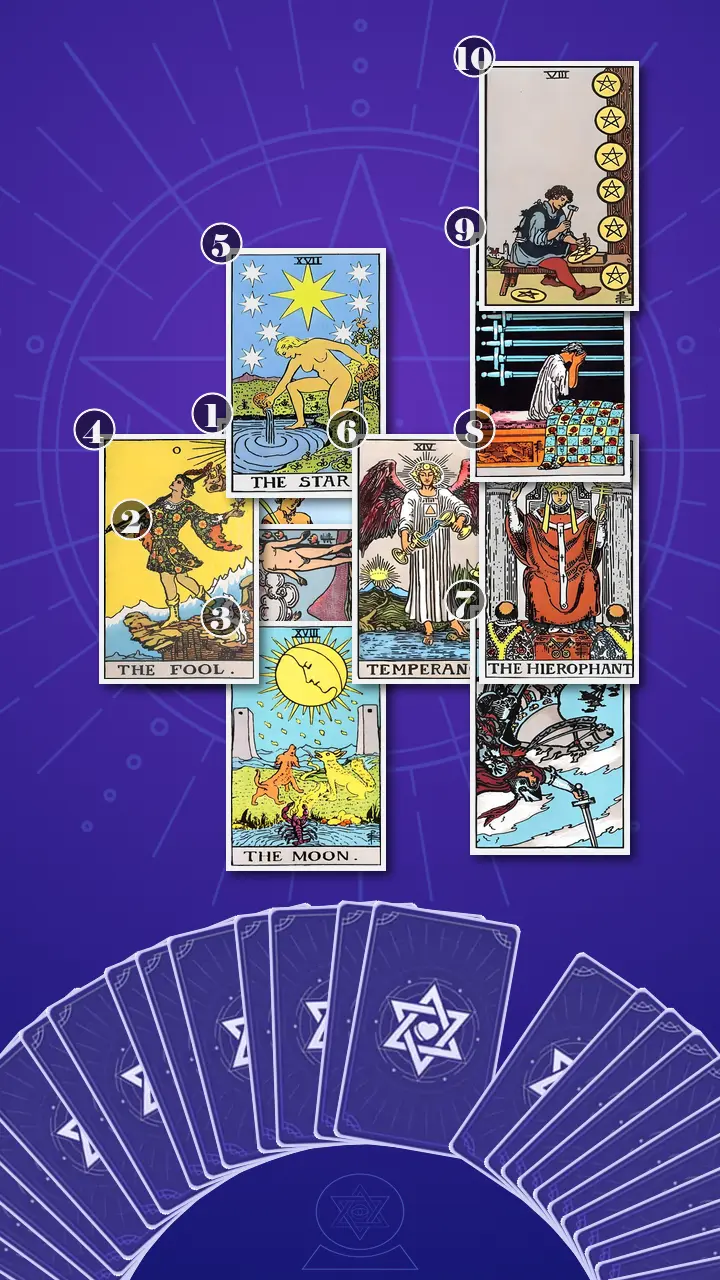
Reading the Map: The Loop, the Split, and the Fog
Position 1 — Present pattern snapshot
“Now we’re turning over the card that represents your present pattern snapshot—what the major-switching cycle looks like right now in daily behavior and momentum.”
Two of Pentacles, upright.
I angled it toward her. The juggler. The two coins looping in that infinity ribbon. The waves behind him pretending not to matter.
“This is like when Maya keeps two or three majors mentally ‘open’ at once, updating plans and backup plans so she never has to risk being all-in long enough to be measured by one choice.”
“Oof,” she said, and then she did the first unexpected thing—she laughed, but it was the kind of laugh that has a bruise in it. “That’s… kind of brutal.”
“I know,” I said. “But brutal doesn’t mean judgment. This card is actually giving you credit: you’re adaptable. You can handle change. The issue is the energy state.”
“Upright Two of Pentacles can be balance, but in your context it’s functioning as constant motion that prevents landing. Movement looks like progress. But it can also be a way to keep commitment at a safe distance.”
Maya’s fingers rubbed the edge of her phone case like she was trying to smooth something invisible. Her jaw tightened, then released a fraction.
Position 2 — Core challenge
“Now we’re turning over the card that represents your core challenge—what keeps the pattern repeating even when you want clarity.”
The Lovers, reversed.
“This is like when Maya picks a major based on what advisors, family, or job-market lists recommend, then feels strangely numb doing the work because the choice didn’t come from her own priorities.”
I watched Maya’s eyes flick down and to the side—the way they do when someone recognizes themselves and doesn’t love it.
“Here’s the scene,” I said, using a frame I’ve learned in twenty years of overhearing people talk about their lives over coffee. “It’s like picking a playlist for a party you’re hosting for other people. It’s technically a good playlist. Everyone will approve. But you can’t relax inside it. You can’t even tell if you like the songs, because you’re watching everyone else’s reactions.”
Her breath went out slow. “Oh… yeah,” she said, quietly. “I picked something that looks right… so why do I feel numb doing the work?”
“Exactly. Reversed Lovers is misalignment. Not failure—misalignment. The choice is crossing you because it isn’t anchored in values you can actually live with.”
Position 3 — Underlying driver
“Now we’re turning over the card that represents your underlying driver—the deeper uncertainty or fear feeding the repeated switching.”
The Moon, upright.
The room felt quieter for a beat, like the café itself was listening—steam softening the air, rain clicking the window in a steady metronome.
“This is like when Maya assumes a rough week in a class means she chose wrong, rather than seeing it as the normal ‘foggy’ phase of gaining competence.”
“The Moon is ambiguity,” I said. “Mixed signals. And a mind that fills in gaps with stories.”
Then I leaned on one of my own frameworks—because I’m not just reading symbols; I’m translating them into something you can use at 2 a.m.
“In my café, when a coffee tastes ‘off,’ I don’t throw away the entire bag of beans. I check the filter. Did the grind change? Did the water run too fast? The Moon is telling me your brain is absorbing everything—Reddit threads, LinkedIn posts, one tough assignment—without a filter. So the loudest, scariest story gets through and tastes like truth.”
This is my Knowledge Filtration lens: when information is everywhere, the skill isn’t “consume more.” It’s “filter better.” Under Moon energy, your mind is taking in the most anxiety-flavored data and calling it reality.
Maya swallowed. “So… uncertainty isn’t a stop sign,” she said, almost like she was trying the sentence on.
“It’s the winding road between towers,” I replied. “It’s the part where you can’t see far ahead yet. And that’s normal.”
Position 4 — Recent past
“Now we’re turning over the card that represents your recent past—what the last two switches were trying to solve or protect you from.”
The Fool, upright.
“This is like when Maya felt a surge of relief and possibility after each switch, as if she finally reclaimed agency—until the next wave of doubt arrived.”
“I want you to hear this clearly,” I said. “The Fool isn’t ‘you messed up.’ The Fool is sincere curiosity. Switching majors can be an honest attempt to find the right learning environment.”
“But the cliff edge matters,” I added. “New beginnings are powerful. They also become addictive when they’re used as the only way to escape the vulnerable middle part of learning—where you’re not instantly good, and you can’t hide behind novelty.”
She nodded, but her eyes were glossy—not dramatic, just the kind of shine that comes when someone finally gets permission to be human.
Position 5 — Conscious aim
“Now we’re turning over the card that represents your conscious aim—the kind of direction, meaning, or reassurance you’re trying to reach.”
The Star, upright.
“This is like when Maya feels calmer not because she found a perfect major, but because she remembers what she wants her life to stand for and can make choices that reflect that.”
“The Star is your north star,” I said. “Not a plan. A direction.”
And I gave her the contrast her nervous system needed—because The Star doesn’t work unless you place it against the night that came before it.
“At 2 a.m., your brain runs worst-case simulations like a broken notification system that won’t stop pinging,” I said. “But in the morning—when your body is less flooded—one page of values can feel like a compass. Not a full GPS route. Just enough direction to stop rerouting every time signal drops.”
She softened. The muscles around her mouth unclenched like they’d gotten tired of holding the line.
When Temperance Poured Between Two Cups
Position 6 — Next-step medicine
I paused before flipping the next card. Not for drama—for precision. “We’re about to turn over the card that represents your next-step medicine—the most helpful near-term orientation for breaking the repeat loop without needing a perfect answer.”
Temperance, upright.
On the card, water moves between two cups with zero panic. One foot on land, one in water. A path to a distant sun.
“This is like when Maya stops asking ‘Which major is the one?’ and instead builds a semester that tests her interests through real classes, office hours, and projects,” I said, letting the words land. “Temperance isn’t a new label. It’s an integration plan.”
Setup (the moment right before the shift): Maya was still caught in the old trap—like being in the campus library with three tabs open—program requirements, “best majors for jobs,” and a doc called “life plan”—refreshing them between texts like someone might finally hand her the right answer. She was trying to pick certainty, not a path.
Then I gave her the sentence I wanted her to keep.
Stop treating every doubt like a stop sign and start pouring your interests into one workable blend, like Temperance mixing two cups into something you can actually live.
I let the café noise return for a second—the grinder’s low growl, a spoon clinking against ceramic—so the line could echo in the space between us.
Reinforcement (the lived impact): Maya’s face did a whole quiet sequence. First: a freeze—her breath paused, and her fingers hovered over her phone like she’d been caught mid-refresh. Second: her eyes unfocused, as if she was replaying every moment she’d panicked after one hard assignment and called it “proof.” Third: her shoulders dropped, not dramatically, but in that unmistakable way of someone setting down a weight they didn’t realize they’d been carrying.
And then—the unexpected reaction—her brows pulled together. A flash of anger, almost protective. “But… if that’s true,” she said, voice sharper, “doesn’t that mean I was wrong? Like… I wasted time?”
I didn’t rush to reassure her. That would be another version of the same pattern: speed as relief.
“It means you were trying to get control,” I said. “And reset does feel like control. But practice creates actual control.”
I leaned forward, and this is where my café life became part of the reading—not as a cute metaphor, but as a lever. “When I create a new blend, I don’t declare, ‘This is my forever bean.’ I run tests. I brew it three ways. I take notes. I adjust the ratio.”
That’s Temperance: practical alchemy. Like making a semester playlist with two genres that actually works. Not ‘either/or identity,’ but ‘both/and experiment.’
“Now,” I said softly, “use this new lens. Last week—was there a moment when doubt hit, and you treated it like a stop sign? If you’d treated it like a signal to adjust the blend instead, what would you have done differently?”
Her voice went small. “Tuesday. Tutorial. I got confused, and I immediately opened other programs.” She exhaled. “I could’ve… gone to office hours. Or asked the TA instead of… spiraling.”
“That right there,” I told her, “is a shift from spinning uncertainty toward evidence and self-trust. Not a personality verdict. A new process.”
Climbing the Staff: Speed, Pressure, and the Workbench
Position 7 — Self-position
“Now we’re turning over the card that represents your self-position—how your mindset and coping style participate in the pattern.”
Knight of Swords, reversed.
“This is like when Maya feels she has to decide immediately so she can stop feeling uncomfortable, even though the fastest decision is rarely the most aligned one.”
I named the micro-moment, because that’s where patterns live. “Typing the subject line ‘Program Change Request.’ Backspacing. Refreshing requirements pages. Jaw clenched, shoulders up.”
“Reversed, this Knight is blocked speed,” I said. “The energy is still sprinting—but it’s sprinting inside your head. And the sprint is trying to rescue you from discomfort.”
Maya did that nervous little laugh again, but this time it wasn’t bitter—it was recognition. “I literally drafted an email after seeing an internship post,” she admitted.
“Don’t make forever-decisions in a 2 a.m. nervous system,” I said, and she blinked like I’d just described her sleep schedule with unfair accuracy.
Then I added my other diagnostic tool—because timing matters. “In my world, I watch caffeine sensitivity all day. Some people can handle an afternoon espresso; others get anxious. Your decision-making has its own sensitivity curve. We’re going to diagnose your Focus Period—the times of day your nervous system can actually think.”
Position 8 — Environment pressure
“Now we’re turning over the card that represents your environment pressure—how university structures, peer comparison, and external expectations shape the choices.”
The Hierophant, upright.
“This is like when Maya feels her options narrow because the university system rewards clear labels, prerequisites, and linear progress, even while she’s still learning what fits.”
“This card isn’t the villain,” I said. “It’s the system voice: credentials, prerequisites, ‘the proper path.’ Structure can support you. It can also drown out self-knowledge.”
I thought of my own past—signing leases, payroll, supply orders. People romanticize café life, but the truth is: structure is what lets warmth exist consistently. The Hierophant isn’t wrong for wanting structure. He’s wrong when he pretends structure is identity.
“You’re allowed to work with the keys,” I told her, nodding at the two keys on the card. “Learn the rules. Use the gates. But don’t let the institution define your interior life.”
Position 9 — Hopes and fears
“Now we’re turning over the card that represents your hopes and fears—what you most want to avoid or secure through switching majors.”
Nine of Swords, upright.
“This is like when Maya replays every switch and imagines future regret, then tries to fix the feeling by making another change instead of making a plan she can follow.”
“This is the 2 a.m. montage,” I said, keeping my voice steady. “Wasted time. Debt. Being behind forever. Being judged.”
“The story your mind tells at 2 a.m. is usually harsher than the reality you can plan for at 2 p.m.,” I added. “If it has to be 100% certain, it’s not a choice—it’s a trap.”
Her eyes dropped to the table. She didn’t cry. She just looked tired in a way that had nothing to do with sleep.
Position 10 — Integration direction
“Now we’re turning over the card that represents your integration direction—what helps you consolidate learning and build self-trust over the next season.”
Eight of Pentacles, upright.
“This is like when Maya commits to one semester of follow-through, tracks her engagement and skills weekly, and lets that evidence guide whether she adjusts, adds a minor, or stays.”
“This is the workbench,” I said. “Not glamorous. Not a rebrand. It’s Duolingo-streak energy. Tiny reps that quietly change your confidence.”
“Eight of Pentacles is grounded accumulation,” I continued. “And it’s the antidote to the reset loop, because it replaces ‘relief’ with ‘proof.’ Reset dopamine vs. earned confidence.”
Maya stared at the card, then at her hands. Her fingers were open now, not clenched. “So clarity isn’t… a feeling I wait for,” she said slowly. “It’s something I build.”
“Exactly,” I said. “Run the experiment. Let the evidence build your self-trust.”
The Two-Cups Plan: Actionable Advice for the Next 12 Weeks
I slid the cards into a simpler story, the way I’d explain a new blend to a barista who needed to make it consistently.
“Here’s the arc,” I said. “Right now, you’re juggling options (Two of Pentacles) because committing feels like getting trapped. But the real challenge isn’t that you’re incapable of choosing—it’s that you’re choosing for approval or safety instead of values (Lovers reversed), while your nervous system treats normal uncertainty like danger (Moon). The last two switches were honest exploration (Fool), and your deeper desire is a north star—meaning, authenticity, a life that feels like yours (Star). Temperance says: build a container that blends your real interests into a workable semester plan. Then the Eight of Pentacles says: stay long enough to gather evidence, and you’ll watch self-trust accumulate.”
“Your blind spot,” I added, “is thinking you need certainty before you commit. But your cards are clear: competence and evidence create clarity. Not the other way around.”
Then I gave her the next steps—small, specific, doable. Not as rules to obey, but as tools to interrupt the loop.
- Write a one-page Values ContractIn a Notes doc titled “Values Contract (Winter Term),” write: 3 values you want your education to serve (like stability, curiosity, impact), 2 non-negotiables (like manageable workload, a skill you can demonstrate), and 1 trade-off you accept (like “it won’t feel magical every week”). Use this to evaluate classes instead of ranking majors by prestige.If you hear “This is pointless unless it guarantees the right major,” label it as the reset-loop talking. Lower the bar: this contract chooses a test container, not a forever identity.
- Set a “Not at night. Not in panic.” boundary (48-hour delay rule)Make a personal rule: no program-change emails, form submissions, or big declarations within 48 hours of a stressful class, a comparison scroll, or any late-night spiral. If you feel compelled at 1 a.m., draft the email, save it, and schedule it for two days later—then revisit it in daylight.Put the reminder on your lock screen. This is Focus Period Diagnosis in real life: you don’t make high-stakes choices in a caffeine-and-adrenaline nervous system.
- Do the 10-minute Two-Cups Plan (Temperance → Eight of Pentacles)Open Notes and make two columns: “What I’m drawn to” and “What I’m willing to build.” Add 3 bullets in each. Circle one overlap you can test this week without switching majors (office hours once, one tutorial strategy change, one tiny project). Then set a calendar reminder titled “90-day review” for 12 weeks out.If your body flips into panic-mode (tight jaw, buzzing stomach), pause for 60 seconds—feet on the floor, one slow breath in/out—then come back only if it feels doable. The goal isn’t certainty today; it’s one repeatable test.
Before she left, I did something very on-brand for me—equal parts café owner and tarot reader. I poured her a small latte and, with her permission, turned my last bit of foam into a memory cue.
“This is silly,” she said, smiling for real now.
“Silly is underrated,” I told her. “With the Latte Memory Technique, you remember with your senses, not just your anxiety.” I wrote three words in the foam with a toothpick: Filter. Blend. Practice.
“When you’re back in Robarts with twelve tabs open,” I said, “I want those words to show up in your head like the smell of coffee on your sleeve.”

A Week Later: Ownership, Not Certainty
Six days later, a message from Maya popped up while I was restocking beans.
“I didn’t switch,” she wrote. “I went to office hours instead. It was awkward. But I got one concrete next step. Also I made the Values Contract and it made my schedule feel… less like a verdict.”
She added, almost as an afterthought: “I still woke up and thought ‘what if I’m wrong?’—but I didn’t spiral. I just… made tea and looked at my 90-day review date. Then I laughed a little.”
That’s the kind of clarity I trust: not fireworks, but a quieter nervous system and one action that proves you can stay present long enough to learn what’s true.
And if tonight you recognize that specific kind of strain—when choosing a major feels like choosing a whole life, so every normal doubt hits your body like an emergency—and restarting starts to feel safer than staying long enough to find out what’s actually true—remember: noticing the loop is already movement. It’s already you stepping out of the fog.
If you let your next step be a 90-day experiment instead of a forever-label, what’s the smallest evidence-gathering move you’d be willing to try this week?

Every reading at AceTarot is a journey to connect with inner wisdom and empower the path ahead. This reading shared here is a psychological mirror, not a private record—crafted to reflect universal emotional loops and help restore personal clarity. Please note that these insights do not replace professional psychological, medical, legal, or financial advice, and should not serve as the sole basis for major life decisions.
Learn more about our Journey to Clarity.
How did this insight land for you?
🫂 This Resonates Deeply
🌀 Living This Story
✨ Now I See Clearly
🌱 Seeing New Possibilities
🧰 Useful Framework
🔮 The Confirmation I Needed
💪 Feeling Empowered
🚀 Ready for My Next Step
Author Profile
AI Sophia Rossi
892 readings | 623 reviews
“For twenty years, I’ve listened to stories unfold over the warm aroma of coffee. I don’t believe life’s complexities always require grand theories to be solved; often, we just need a safe place to tidy up our reality. I don’t offer high-minded preaching—just grounded, heartfelt insights to help you regain your sense of control amidst the clutter of daily life.”
In this Study Tarot Reading :
Core Expertise
- Syllabus Deconstruction: Stripping the paralyzing dread from massive deadlines by reducing them to mechanical, emotionless daily tasks.
- Study Environment Auditing: Identifying physical clutter and disorganized systems that quietly drain your limited psychological bandwidth.
Service Features
- The Desktop Reset Ritual: A pragmatic 15-minute physical clearing exercise to instantly restore visual order and mental clarity before opening a textbook.
Also specializes in :
Explore Related Patterns:
Certainty SeekingMaya's repeated 8:12 p.m. scene in Robarts, with Degree Explorer, job lists, and a life plan document open, shows a mind trying to make uncertainty produce a clean answer. Her thumb refreshes the page while she avoids clicking enroll, so the research loop becomes a control ritual rather than simple academic planning. The mechanism is not that she lacks intelligence or seriousness. It is that her nervous system has made certainty the entry fee for action. You can hear it when she says the next major will finally make her feel sure, and when commitment starts to feel like a test of whether she can be trusted with her own life. Certainty Seeking repeats whenever normal ambiguity is treated as evidence that more proof is required before any step is allowed. The practical shift is to stop asking the major to remove all risk and start asking which next experiment can generate trustworthy evidence.
Commitment AvoidanceMaya keeps two or three majors mentally open at once, updating plans and backup plans so she never has to be all-in long enough to be measured by one choice. The avoidance is subtle because it looks flexible, practical, and responsible from the outside. Commitment Avoidance is operating as a protective strategy against the exposure of choosing. If one path becomes real, then confusion, difficulty, or disappointment might feel like a verdict on her judgment, so keeping options open protects her from that verdict. The pattern repeats when openness stops being exploration and becomes a way to avoid the vulnerable middle of learning. You do not have to force a forever identity, but you do have to stay with one experiment long enough for evidence to accumulate.
Approval SeekingMaya picks majors through advisors, family input, job-market lists, and the university's clean labels, then feels strangely numb doing the work. The playlist metaphor captures the mechanism well, because the choice may be technically approved by everyone else while she cannot relax inside it. Approval Seeking becomes the hidden decision filter when external safety signals replace internal values. The problem is not that advice is useless. The problem is that approval starts acting like evidence of fit, even when her own engagement and priorities are missing from the equation. This pattern matters because it explains why a choice can look right and still feel deadening. You regain signal by separating outside data from inner criteria, then using approval as information rather than as permission to have a life direction.
Identity ForeclosureDegree Explorer starts to feel like it might hand Maya a personality, and the major stops being a course of study and starts acting like proof of who she is. That is why a schedule can feel like a verdict instead of a tool. Identity Foreclosure appears when a label is pressured into solving identity before enough lived evidence exists. Maya is not just choosing classes. She is trying to make a major certify that she can trust herself, which overloads the decision with more psychological meaning than it can carry. The way out is not to reject structure. It is to use structure as a container for exploration rather than as a premature identity sentence. You build self-trust by testing interests and accumulating evidence, not by forcing one academic label to answer every question about your future self.
Explore Related Struggles:
Commitment Threshold StrainMaya keeps several majors open at once, refreshing Degree Explorer and updating backup plans while avoiding the click that would make one path real. The movement looks responsible from the outside, but the story shows her body tightening exactly where a choice would become measurable: jaw locked, stomach restless, shoulders held high. That is the pressure point of Commitment Threshold Strain. You are not simply unable to choose; you are reaching the edge where a choice stops being theoretical and starts asking for follow-through. At that threshold, commitment feels less like direction and more like exposure, because one path could reveal whether you trust your own judgment. The repeated switching pattern is built around that edge. Each reset briefly restores the feeling of agency, but staying long enough to gather evidence asks for a different kind of courage: letting a semester be a test container instead of a permanent identity verdict.
Inner Compass NumbnessMaya names the split clearly when a major looks right on paper but feels numb once she is inside the work. Advisors, family, job-market lists, program requirements, and institutional timelines all offer a version of the correct answer, yet none of those signals can tell her what she can actually live with. Inner Compass Numbness forms when outside standards become loud enough to mute the quieter data of lived engagement. You can keep making choices that are defensible to other people while losing access to the felt sense of whether the work has meaning, texture, or momentum for you. The repeated major switches are not random pivots; they are attempts to escape a choice that never fully belonged to her. The pattern keeps returning because the next approved option cannot fix the deeper problem of not being anchored in her own priorities.
Metric-Compass FusionMaya sits in Robarts with program requirements, a best-majors-for-jobs list, and a life plan doc open at the same time, waiting for the right arrangement of information to hand her a clean answer. The tools are useful, but the story shows them being asked to solve something they cannot fully solve: the question of what kind of life can feel like hers. Metric-Compass Fusion happens when external indicators become the instrument for navigating internal direction. You start treating employability lists, prerequisites, timelines, and comparison data as if they can replace values, appetite, and lived evidence. The pattern repeats because every new metric creates another angle to audit, not a place to land. Maya does not need less intelligence in the process; she needs the metrics to return to their proper role as tools, not the compass itself.
System Reset OverloadAfter each major switch, Maya feels a surge of relief and possibility, as if the reset has returned control to her hands. Then the vulnerable middle arrives again: a rough tutorial, a comparison scroll, an internship post, or a late-night replay of every prior decision. System Reset Overload shows up when restarting becomes the main way to regulate uncertainty. You get the emotional lift of a clean slate, but the underlying test has not changed: staying with a path long enough to build skill, collect evidence, and see what is actually true. The story points to a loop where novelty briefly protects Maya from the discomfort of being a beginner. What breaks the loop is not another rebrand, but a container that lets practice replace relief as the source of self-trust.
Explore Related Emotions:
Approval AnxietyMaya describes choosing based on advisors, family, and job-market lists, then feeling strangely numb once she is inside the work. The story compares it to picking a technically good playlist for other people and then watching their reactions so closely that she cannot tell whether she likes the songs. Approval Anxiety is the pressure of outsourcing the emotional permission to choose. Maya is not only asking what is practical; she is trying to make a choice that will be defensible to other people before it is honest to herself. That turns the university system, family expectations, and employability logic into a crowd inside her decision-making space. This matters because the pattern is not random switching. A choice made for safety or approval can look correct from the outside while feeling vacant from the inside, and that vacancy becomes one more reason to start over.
Wrong Choice PanicMaya sits in Robarts with program requirements, job lists, and a document called life plan open at the same time, while her jaw locks and her stomach keeps buzzing. The body detail matters because the choice is not staying on the level of academic planning; it is being processed as if one click could prove something permanent about her ability to direct her own life. Wrong Choice Panic fits because Maya keeps translating ordinary friction into evidence of personal misdirection. A confusing tutorial, a tough assignment, or one late-night comparison spiral does not remain a single data point; it becomes a whole verdict, and that verdict pushes her toward another reset before the current path has enough time to show what is actually true. The useful clarity here is that the panic is not proof that the major is wrong. It is a signal that her decision system has started treating uncertainty as an emergency, which means the pattern can be interrupted by slowing the body, gathering evidence, and refusing to let one hard moment become a full-life conclusion.
Ambiguity DreadMaya assumes a rough week in a class means she chose wrong, and after one confusing tutorial she immediately opens other programs. Her mind takes in Reddit threads, LinkedIn posts, job lists, and one hard assignment without enough filtration, so the loudest story starts to feel like reality. Ambiguity Dread names the way uncertainty becomes threatening before it becomes informative. The foggy middle of learning is treated like a stop sign, which means Maya keeps trying to escape the exact phase where competence would normally begin to form. The repeated pattern is a misread of uncertainty. When ambiguity is interpreted as danger, switching majors becomes a way to exit discomfort instead of a response to reliable evidence.
Certainty HungerMaya keeps opening Degree Explorer like it might finally hand her a personality, with three tabs open and her thumb refreshing the page as if the answer could arrive from outside her. She says the next major might finally make her feel sure, but she also avoids clicking anything that would turn one option into a real commitment. Certainty Hunger names the ache underneath the research. The spreadsheets, rankings, requirements, and backup plans are not only practical tools; they become a way to keep searching for a clean internal state before taking a step. That hunger makes every possible path feel unfinished because none of them can deliver total emotional safety in advance. The pattern repeats when relief is mistaken for clarity. Switching majors gives Maya a temporary sense of fresh air, but once normal uncertainty returns, the hunger for a cleaner answer starts the loop again.
Commitment ClaustrophobiaMaya keeps two or three majors mentally open, updates plans and backup plans, and avoids clicking enroll on anything that would make the decision real. The motion looks active, but it also keeps every door slightly ajar so no single choice can fully claim her. Commitment Claustrophobia fits because the pressure is not only about choosing correctly; it is about the sensation of being trapped once a choice becomes visible. A major starts to feel like a sealed identity, a measurement system, and a future label before she has had enough lived experience inside it. The repeating pattern is the attempt to stay unpinned. By keeping options in circulation, Maya protects herself from the exposed feeling of being all-in, but the same protection prevents her from gathering the evidence that could make commitment feel breathable.
Directionless UrgencyMaya enters the café with bright eyes, high shoulders, and a body that looks like it has been holding its breath since midterms. Later, she describes the micro-loop of typing a program-change subject line, backspacing, refreshing pages, and trying to decide quickly so the discomfort will stop. Directionless Urgency fits because her energy is sprinting without a stable destination. The speed gives the sensation of doing something, but the movement keeps folding back into more tabs, more drafts, more comparison, and more pressure to reroute. The emotional pattern is urgent motion replacing grounded direction. Maya is not lacking effort; she is spending effort inside a tempo that makes any choice feel like it has to be solved immediately rather than tested over time.
Grounded AgencySix days later, Maya does not switch. She goes to office hours, gets one concrete next step, makes the Values Contract, and uses the 90-day review date to stay with the experiment when the thought 'what if I'm wrong?' returns. Grounded Agency fits because her power comes back through specific, observable actions rather than a dramatic feeling of certainty. She is no longer waiting for a major to hand her an identity; she is using structure, timing, and evidence to build self-trust from the ground up. This is the cleanest answer to the pattern she is repeating. The interruption is not a perfect choice but a different relationship to choice: one small action, one review point, one decision made in daylight instead of panic.
Pattern Recognition CalmMaya can name the Tuesday tutorial as the moment doubt hit and she almost opened other programs. That recognition changes the shape of the experience: the urge to switch is no longer the whole truth, but a recognizable sequence with a trigger, a body response, and a choice point. Pattern Recognition Calm fits because the story shows calm arriving through visibility. Her shoulders drop, her hands unclench, and the schedule feels less like a verdict once the loop is mapped as a loop rather than treated as proof that she is unreliable. The calm is modest but important. It gives Maya enough distance from the pattern to choose the next evidence-gathering move instead of obeying the first wave of alarm.
Timeline PanicMaya's 2 a.m. montage is specific: wasted time, debt, being behind forever, and being judged. The imagined future arrives all at once, so the present choice stops feeling like a semester decision and starts feeling like a race against an invisible deadline. Timeline Panic fits because the fear is organized around time slipping away. Each previous switch becomes evidence that she may already be late, and that feeling pressures her to make another fast change before she has gathered enough information. The pattern tightens when urgency borrows authority from the future. By treating every delay as permanent damage, Maya's mind pushes her toward speed exactly when she needs a slower evidence-building process.
Cautious AutonomyMaya is told to learn the rules, use the gates, and work with the university structure without letting the institution define her interior life. That sentence matters because her decision field has been crowded by prerequisites, advisors, family, job-market logic, and peer comparison. Cautious Autonomy fits the early stage of reclaiming her own standards. The Values Contract, the 48-hour delay rule, and the 90-day review do not remove outside pressure, but they create a boundary where her values can be heard before the next external signal takes over. The autonomy is cautious because it is being practiced under pressure. Maya is not rejecting structure; she is learning how to use structure without surrendering her inner authority to it.
Emotional NumbnessMaya says she picked something that looks right, then asks why she feels numb doing the work. That flatness appears after the decision has already passed the external tests: advisors can understand it, the job market can justify it, and the plan can be explained. Emotional Numbness fits because the choice has become legible before it has become felt. Her research keeps moving, but her own desire does not get enough room to register, so the work loses texture even when the path seems sensible. This numbness is not a flaw in her motivation. It is a signal that a decision can be rationally defended and still fail to connect with the values she can actually live inside day after day.
Explore Related Contexts:
Academic Planning ParalysisMaya has Degree Explorer open at 8:12 p.m. with program requirements, a job-market list, and a Notes doc called life plan, while her thumb keeps refreshing instead of clicking enroll. The tools are real, but they have become a holding pattern: every new tab promises certainty and pushes the actual academic commitment one step further away. The structural pressure is that the university asks for a label while you are still collecting evidence about fit. In that gap, planning starts to perform the work of choosing without taking the risk of participating long enough to learn. Academic Planning Paralysis fits because the pain is not laziness or lack of intelligence; it is a campus decision system where information gathering has replaced sustained academic contact with reality.
Competing Study Advice SpiralMaya is surrounded by program requirements, best-majors-for-jobs lists, Reddit threads, LinkedIn posts, and internship signals, all arriving as if they should have decision authority. A hard assignment or a single market-facing post can suddenly outweigh the slower evidence of what she is actually learning in class. Competing Study Advice Spiral fits because the outside information field has become louder than the academic experiment itself. You are not just choosing among majors; you are trying to choose while every platform, list, and comparison point keeps changing the apparent stakes. The pattern repeats when unfiltered advice turns ordinary uncertainty into another reason to reopen the whole decision.
Premature Major CommitmentMaya avoids clicking enroll because that click would make the choice real, and each rough week in a class starts to look like proof that the whole program may be wrong. Even the subject line Program Change Request becomes loaded before the semester has had a fair chance to produce evidence. Premature Major Commitment fits because the external academic system turns a program label into something that appears bigger than one term of study. You are being asked to choose inside a structure that makes ordinary experimentation feel like a permanent declaration. The repeating pattern is not simply switching; it is treating commitment as something that must arrive fully certain before practice has had time to create clarity.
Triangulated Decision PressureMaya says she picks a major based on what advisors, family, or job-market lists recommend, then finds the work strangely disconnected from her own priorities. The choice is no longer happening between her and the subject matter; it is being triangulated through authority, employability, and approval. That pressure matters because you cannot build durable follow-through from borrowed criteria alone. The external voices may contain useful information, but when they become the main decision architecture, the major turns into a performance of what looks responsible. Triangulated Decision Pressure names the social setup where your academic path is being negotiated through other people's standards before your own evidence has enough room to speak.
Off-Script Academic PathMaya is a second-year student who has switched majors twice, which places her outside the clean campus script of picking a program, completing requirements, and progressing in a straight line. The story keeps showing her between labels: not fully inside the old major, not yet settled in the next one, and not convinced that any current option can hold. Off-Script Academic Path fits because the external tension comes from moving through an institution that treats linearity as the default. You may still be building a valid route, but the system makes non-linear exploration feel exposed and harder to trust. Naming this context separates the fact of an unconventional academic path from the harsher interpretation that every detour is evidence of failure.
Rigid Curriculum Lock-InThe university structure around Maya rewards clear labels, prerequisites, credentials, and linear progress, even while she is still learning what kind of work actually fits. Degree Explorer and requirements pages are not neutral screens in the story; they operate like gates that keep asking her to stabilize before she has enough lived academic data. Rigid Curriculum Lock-In names the external pressure created when an institution's timeline moves faster than a student's process of discovery. For you, the issue is not that structure is bad; it is that structure can start to impersonate identity. The useful move is learning the gates well enough to navigate them without letting the curriculum's demand for a clean label erase the messy but legitimate process of finding fit.
Career ROI ReckoningThe best-majors-for-jobs tab, the internship post that makes her draft a program-change email, and the 2 a.m. montage of wasted time, debt, being behind, and being judged all pull Maya's major decision into a market-facing frame. The degree stops looking like a learning path and starts looking like an investment that must justify itself immediately. Career ROI Reckoning captures the pressure of evaluating education through future employability before the present coursework has been properly tested. For you, this context matters because practical concerns are not imaginary, but they become distorting when every class difficulty is treated as a signal about long-term economic return. The outside market is part of the decision, yet it cannot be the only evidence source.