The 7:12 p.m. Gratitude Pivot
I recognized the pattern as soon as Jordan described it: the early-career nonprofit communicator in Toronto who genuinely values honest feedback, then feels their jaw lock when a Monday planning call stops sounding upbeat. Toxic-positivity conflict avoidance begins before they have asked what actually happened.
I asked Jordan to take me back to the exact moment. It was 7:12 p.m. in their rented apartment. The planning call glowed on the kitchen table, the laptop fan whined through a quiet patch, and reheated coffee left a bitter film on their tongue. A volunteer said the group's deadlines and communication had started to feel unfair. Jordan leaned toward the screen, chest braced, and typed, "I don't want this to become a negativity spiral." Before anyone named a deadline, an impact, or who had absorbed the extra work, Jordan proposed a gratitude round.
"I want us to be honest," they told me, pressing their tongue against their teeth. "But I can feel the whole group changing when someone brings that energy in. I think, I have to stop this before it poisons everything."
I watched the unease move through them like a smoke alarm wired directly into the jaw: the first sharp signal tightened the hinge, heated the face, and prepared the whole body to silence the sound before checking for smoke. The group mattered beyond a single meeting. Jordan's close friends overlapped with the volunteer circle, and building an entirely separate community was not a casual side project on a nonprofit salary and limited energy. One tense call could seem to threaten several forms of belonging at once.
The gratitude round lowered the visible temperature, but it did not settle the concern. By Sunday night, the public WhatsApp thread was full of hearts beneath a post about being "stronger than one hard moment," while two members were still discussing the dismissed workload issue in private messages. Jordan muted the DMs, reread the original speaker's wording, and tried to prove to themself that the delivery had justified the dismissal.
"I'm not hearing a bad person trying to silence people," I said. "I'm hearing a protective reflex that became faster than your curiosity. We aren't here to shame that reflex or predict whether the group will survive. We're here to slow it down, examine what it protects, and give you another response you can actually use. Let's draw a map through the fog."

Choosing a Map for Group Conflict and Belonging
I invited Jordan to place both feet on the floor, take one unforced breath, and hold the Monday exchange in mind while I shuffled. I treat this small ritual as a transition in attention, not a supernatural test: it helps separate the live question from the hundred other tabs still open in the mind.
I chose the Relationship Spread · Context Edition, a contextualized five-card Relationship Spread for group dynamics, toxic positivity, and belonging. This is how tarot works in my practice: the cards provide an external structure for examining assumptions, behaviour, social reinforcement, and available choices. They do not issue a verdict or guarantee an outcome.
I used this spread because Jordan's question was relational and specific. A broader Celtic Cross could have scattered our attention across distant possibilities. These five positions gave us the minimum useful sequence: a horizontal line for Jordan's contribution and the collective group climate, a central card for the unspoken contract holding both together, and a vertical line leading from the transformation challenge to a deliberate integration practice.
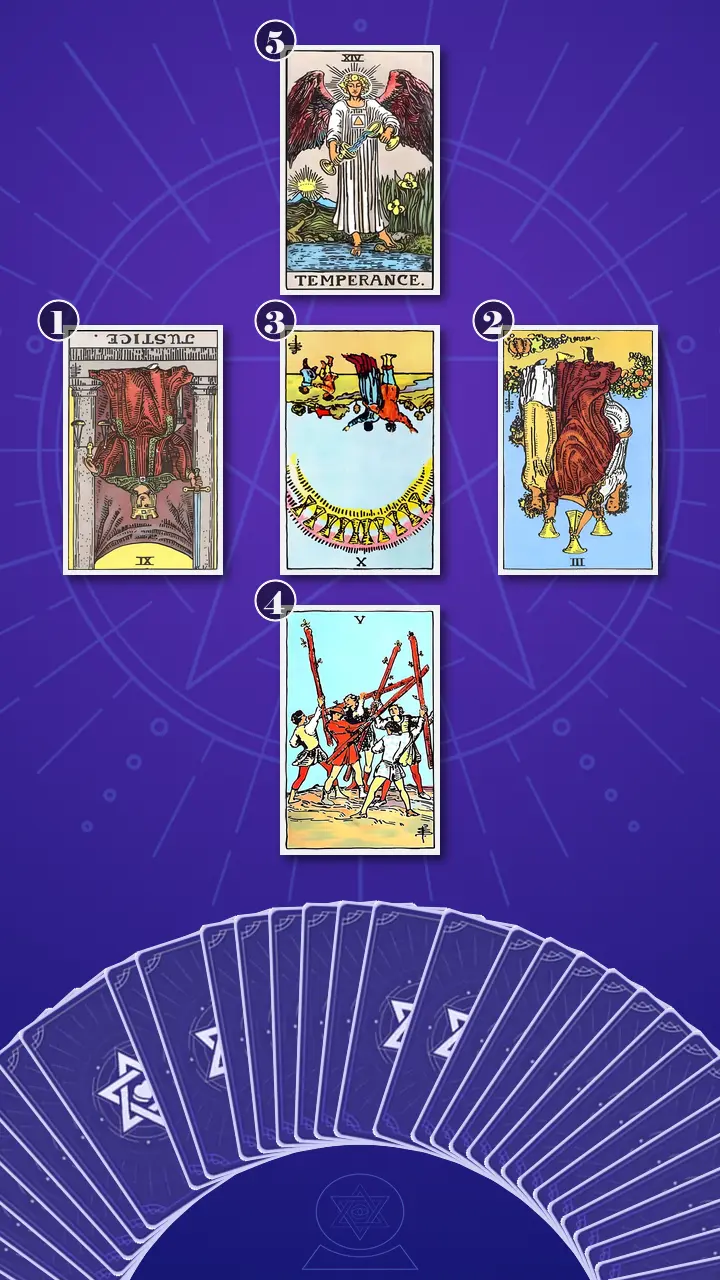
I placed the third card at the centre. Justice and the Three of Cups sat to its left and right; the challenge would appear below, and the way forward above. The cross looked like a bridge intersected by a calibration line. I told Jordan we would examine card meanings in context, moving from what happens in the first few seconds of conflict to what could happen next by choice.
The Verdict That Arrived Before the Evidence
Position 1: Justice Reversed and the Instant Tone Test
Now I turned over the card representing Jordan's current contribution to the relationship dynamic, specifically the rapid moral labeling that replaces curiosity about honest discomfort. It was Justice, in reversed position.
I pointed to the scales and the single upright sword. In its balanced expression, Justice asks for evidence, accountability, and standards that can be explained. Reversed here, discernment was blocked. Jordan's internal scales were weighing a speaker against an ideal of calm, solution-ready communication, while the sword delivered the label "negative" before the concern had been entered into evidence.
I returned to the Monday planning call. Jordan had heard strain in a member's voice and immediately measured that person against an internal definition of constructive behaviour. They said, "I don't want this to become a negativity spiral," before asking which deadlines felt unfair, who received the last-minute work, or what happened as a result. The pattern was not caring too much about fairness. It was treating a fast moral classification as though it were a fair process.
"Try finishing these sentences," I said. "I heard the tone, so I assumed the speaker was making the group harmful. I had not yet asked which concrete deadline or impact they meant."
Jordan's cursor had hovered over "Let's keep this constructive" like Justice's raised sword. The sentence sounded responsible, but it closed the case. I told them, "Tone can affect the conversation without cancelling the information. You can set a boundary around delivery and still examine the substance. Those are two separate decisions."
Jordan gave a short, bitter laugh. Their shoulders rose, then held. "That is uncomfortably accurate. Honestly, it's kind of brutal."
"Accurate doesn't have to mean condemning," I replied. "Justice reversed is not a character diagnosis. It shows us the second when a useful standard becomes a premature verdict. Once we can locate that second, you have somewhere concrete to intervene."
Position 2: The Three of Cups and the Cheerful Main Channel
Now I turned over the card representing how the collective group climate rewards visible positivity and moves difficult emotional material outside the public conversation. It was the Three of Cups, in reversed position.
The three figures normally raise their cups inside a circle of shared celebration. Reversed, that social Water had become blocked and conditional. Joy itself was not the problem. The problem appeared when participation in visible cheerfulness became an informal admission test for belonging.
I described the volunteer WhatsApp thread back to Jordan: someone questioned a shared decision, Jordan posted an affirming recap, and heart reactions quickly returned. The main channel looked connected again, but two members continued discussing the concern in DMs. The group had not eliminated the strain; it had redistributed the strain to less visible containers.
"A calmer channel is not the same as a resolved concern," I said. "The inner operating system says, The thread looks normal again, so why are three people still talking privately? The answer may be that public cheerfulness was restored before actual trust was repaired."
I used one of my diagnostic tools, Toxic Hierarchy Filtration, to examine the subtle status pattern beneath the mood shift. I asked: Who is praised for restoring the positive tone? Who has to soften a difficult experience before it qualifies for a hearing? Who then performs the unpaid repair work in DMs? I was careful not to declare the whole group toxic. The purpose of the filter is to identify where authority hides inside supposedly neutral words such as "constructive," "resilient," or "good energy."
Jordan looked down at their phone. Their thumb unlocked it, hovered over the WhatsApp icon, then pulled away. "The same two people always message afterward," they said. "I thought they just preferred talking privately. Maybe that's the only place they think the full sentence can survive."
Position 3: The Rainbow That Left No Room for Weather
Now I turned over the card representing the implicit relational contract that equates good belonging with emotional harmony and sustains the positivity-versus-negativity split. At the centre lay the Ten of Cups, in reversed position.
I traced the rainbow of ten cups above the idealized home and celebrating figures. I could almost place that perfect canopy over the nonprofit's values deck, the volunteer event photos, the Notion page about resilience, and every polished recap offered as proof that the culture was already caring. Reversed Water showed an excess of attachment to the image and a blockage in lived emotional exchange.
Jordan had compared a tense community meeting with an internal picture of what a caring, values-led group should look like. Because the real room contained disappointment, they interpreted the speaker as a threat to the community instead of someone reporting a possible gap between its values and their experience. The polished group identity functioned like the corporate world in Severance: the approved version stayed bright while difficult lived information was kept on another floor.
"Belonging that requires one approved mood is already charging an entry fee," I said. "The question is not whether harmony is valuable. It is whether your definition of a good group has enough room for someone to remain disappointed while repair is still unfinished."
Jordan's breath stopped just above the chest. Their gaze moved from the rainbow on the card to a framed volunteer photo behind their laptop, as if replaying several bright group posts with the cropped-out conversations restored. Their fingers tightened around the mug and then slowly loosened.
"If we're really a caring group, why does the conversation feel so bad?" they said quietly. "I think I've been using that feeling as proof that somebody must be doing care wrong."
"Or the feeling may be showing a gap between the ideal and the experience," I said. "That does not automatically make the group fraudulent, and it does not make every complaint accurate. It simply means the image cannot be used as evidence against the person reporting the gap."
When the Crossing Wands Kept the Question Open
Position 4: Five of Wands and Disagreement with Edges
Now I turned over the card representing the central challenge and transformation test: allowing bounded disagreement without converting different perspectives into opposing moral identities. It was the Five of Wands, upright, the key card in the reading.
The radiator clicked once and went quiet. Five staves crossed in several directions beneath the light over my table; no single wand owned the whole space, but every wand remained in contact. The upright Fire was neither an excess to fear nor a force to extinguish. Held inside clear rules, it was movement, contrast, and usable information.
I asked Jordan to imagine several members describing conflicting experiences of the same deadline process in one meeting. I saw a facilitator requesting examples, stopping personal attacks, allowing anyone to pass, and refusing to demand immediate consensus. The room would not necessarily feel calm. Its friction could still reveal who received late tasks, whose capacity changed, and which confirmations never arrived.
I brought Jordan back to 7:12 on Monday: the laptop fan humming, one strained sentence changing the call, their jaw tightening, and their cursor moving toward an upbeat reply. Part of them was already protecting the group before they knew what had happened.
"The room became uncomfortable," I said. "You called the discomfort negative. The label ended the investigation. Not every complaint is accurate, and not every delivery is acceptable, but neither can be assessed before the concern is understood."
You do not need to defend a perfectly positive identity; let the crossing wands hold several honest perspectives long enough to discover what the friction is protecting.
I let the sentence remain between us.
Jordan went completely still. Their inhale paused; their fingertips stayed suspended above the mug as if the next movement required new instructions. Their eyes lost focus for a moment, and I could see them replaying the planning call rather than looking at the card. Then their brow pulled tight and a flash of resistance crossed their face. "But doesn't that mean I got it wrong?" they asked. "What if I was the person making it less safe while telling myself I was protecting it?" The last word came out thin.
I did not rush to cover that vulnerable silence with reassurance. Their shoulders lowered first, almost reluctantly. Their fingers opened. Moisture gathered at the lower rim of their eyes, followed by a long breath that sounded more disoriented than relieved, like someone setting down a heavy box and briefly forgetting how to stand without it.
"It means one response had a cost you can now see," I said. "That is information, not a permanent identity. Now, using this new perspective, think back: was there a moment last week when this insight could have made you feel different?"
Jordan swallowed and looked at the Five of Wands again. "When they said the deadline process was unfair," they said, "I could have asked, 'Which part landed unfairly, and what happened because of it?' I wouldn't have had to agree. I could have just kept the question open."
That was the key emotional movement: from rapid tone-based moral sorting and fear of losing belonging toward one evidence-based question under tension. It was not instant mastery. Jordan still looked shaken by the responsibility inside the new clarity. But they had stopped treating discomfort as a verdict on the speaker, the group, or themself.
"Discomfort is information before it is identity," I said. "The goal is not unlimited conflict; it is disagreement with edges."
The Five of Wands also gave me a natural opening for Network ROI Analytics, a framework I carried out of my Wall Street years and rebuilt for human relationships. I never use it to reduce people to numbers. I use it to distinguish visible activity from meaningful relational return. One structured seven-minute disagreement may cost attention and still return concrete facts, repaired expectations, and reciprocal trust. By contrast, hours of upbeat messaging can look low-risk while producing no repair and pushing high-drain emotional work into private chats.
I told Jordan that the real return on a professional or social network was not applause, access, or the uninterrupted appearance of harmony. It was whether honest information could lead to mutual adjustment. The Five of Wands made that calculation visible: friction with boundaries can generate value; constant mood management can become a high-drain, zero-return investment masking itself as connection.
Temperance at the Mixing Desk
Position 5: Two Cups, One Grounded Response
Now I turned over the card representing a deliberate integration practice through which Jordan could combine candour, care, boundaries, and proportionate response without predicting the group's outcome. It was Temperance, upright.
I pointed to the water moving between two cups, then to the angel's one foot on land and one in water. Temperance held balanced energy. It did not demand compulsory calm, a perfect compromise, or endless emotional availability. It showed an adjustable process: transfer the meaning accurately, remain grounded, and decide the proportionate boundary after understanding the concern.
I gave Jordan the exact sequence I heard in the image: "What I hear is that last-minute tasks landed unevenly. Is that accurate? What impact did it have? What boundary do we need while we discuss it?" If the voice was sharp, Jordan could address that separately. If the claim was incomplete, they could ask for evidence. If the exchange became insulting, coercive, or threatening, they could pause or leave. Hearing information never required surrendering choice.
I compared Temperance to an audio mixing desk. A skilled operator does not mute the uncomfortable frequency and call the mix balanced. They separate the channels, listen for distortion, and adjust each one without pouring the others away. Concern, impact, tone, and boundary were four channels, not competing moral teams.
Jordan's shoulders lowered enough for the chair to take their weight. They opened their Notes app and typed the three questions. "This feels less like choosing a side," they said. "More like slowing the rate of the conversation so I can tell what I'm actually responding to."
I agreed. The spread contained no Pentacles, so the missing Earth element mattered. Insight alone would not stabilize the change. Jordan needed a repeatable meeting structure, a timed pause, and observable follow-through. Temperance offered the method; Jordan would have to give it a calendar, an owner, and a next date.
From an Instant Verdict to a Clarifying Question
I gathered the five cards into one story. Justice reversed showed Jordan correcting the emotional tone before examining evidence. The Three of Cups reversed showed a group climate that rewarded the correction with public warmth while unresolved concerns moved into DMs. The Ten of Cups reversed exposed the hidden contract beneath both: a caring group was expected to look emotionally resolved. The Five of Wands restored movement by allowing several accounts to remain visible, and Temperance turned that movement into a calibrated practice rather than an uncontrolled argument.
The spread's central metaphor was simple: Jordan had been muting a smoke alarm because the volume disrupted the room, then using the renewed quiet as proof that nothing was burning. Their cognitive blind spot was the belief that an immediate moral classification was the same as fair discernment, and that a difficult delivery could cancel the information it carried. The transformation direction was equally specific: replace the instant label of "negative" with one clarifying question and one concrete impact statement before deciding what the discomfort meant.
I gave Jordan three small next steps. None required a dramatic confrontation, public vulnerability, or agreement with every claim.
- Use the Verdict-to-Question Pause. During the next tense video call, wait thirty seconds before evaluating anyone's tone or character. Take one sip of water, write, "The concrete issue I heard was...," and ask in the same channel, "Is that accurate, or am I missing the main point?" Minimum version: say only, "I want to check that I heard the concern before I respond." The pause does not mean agreement.
- Run a five-minute Bounded Friction round. Add one agenda item to a low-stakes meeting this week. Give each person one line for Situation, Concrete Impact, and Missing Information. State the boundaries first: no insults, threats, forced disclosure, interruptions, or rebuttals during the listening round; anyone may pass. If five minutes feels too exposed, collect written responses and review only what the group has capacity to address.
- Create the Two-Cup follow-through and divestment gate. Pin four lines to the next agenda: Concern, Example, Impact, and Boundary. End with one owner, one small follow-up, and one check-in date. After repeated attempts, use my Social Divestment Plan to reduce your role, time, or channel access if the circle consistently punishes clarification, ignores boundaries, or exports all repair work to private conversations. Divest from a documented zero-return pattern, not from the first uncomfortable moment. If the exchange becomes coercive or threatening, step away immediately; no trial period is owed.
I reminded Jordan that these were tools for inquiry, not new standards for making hurt people speak perfectly. A valid impact does not excuse abusive conduct, and awkward conduct does not erase a valid impact. Their task was to keep those judgments separate long enough to make each one fairly.

A Week Later, the Quiet Proof
Six days later, I received a message from Jordan. In the next planning call, someone again questioned the deadline process. Jordan felt their jaw tighten, waited, and said, "The concrete issue I heard is that last-minute tasks keep landing on the same two people. Is that accurate?" The speaker corrected one detail, another member added an example, and the group assigned one person to review task allocation before the next meeting.
"It was not magically comfortable," Jordan wrote. "The thirty seconds felt like a full season of television. But nobody had to become the negative person, and we found an actual process problem."
That night, Jordan slept through until morning. Their first thought was still, "What if I handled it wrong?" This time, they smiled, opened the note, and checked what had actually happened.
I did not read that message as proof that every future conflict would go well or that this group would always deserve Jordan's investment. I read it as the first concrete evidence of the Journey to Clarity: defensive certainty had become curiosity, curiosity had produced information, and belonging had survived one unfinished conversation.
The cards did not make that change or choose the group's future. They gave Jordan an objective surface on which to see a reflex that had previously felt like moral truth. Jordan paused, asked, listened, set boundaries, and created follow-through. The map belonged to tarot; the next move belonged entirely to them.
When the room's mood drops and your jaw locks, it can feel as though hearing the concern means risking your place in the circle, even while part of you still wants to know whether someone was hurt. Merely noticing Justice's sword rise before the evidence arrives means you are no longer at the beginning.
If belonging did not require an instant verdict, what is one question you might let the crossing wands hold open before the main channel becomes cheerful again?
This story is adapted from psychological research, written so that those in a similar struggle can see their own pattern in it — and find their next step clearly.These insights are not a substitute for professional psychological, medical, legal, or financial advice.
Learn more about our Journey to Clarity.
How did this insight land for you?
🫂 This Resonates Deeply
🌀 Living This Story
✨ Now I See Clearly
🌱 Seeing New Possibilities
🧰 Useful Framework
🔮 The Confirmation I Needed
💪 Feeling Empowered
🚀 Ready for My Next Step
Author Profile
 AI
AI“I spent years in the intense, high-stakes world of Wall Street. I know exactly how isolating and heavy the weight of uncertainty can feel in the dead of night. I use strategic, commercial logic not to be cold, but to protect you from unnecessary friction. Think of me as a fellow traveler who has walked the same rocky path—offering sharp but deeply supportive wisdom to help you clear the fog and confidently win your narrative back.”
In this Social Tarot Reading :
Core Expertise
- Network ROI Analytics: Treating social engagements as investments to identify high-drain, zero-return relationships masking as 'networking'.
- Toxic Hierarchy Filtration: Deconstructing subtle power plays and status games within your broader professional or social circles.
Service Features
- The Social Divestment Plan: A cold, calculated protocol to tactfully liquidate your energetic investment in toxic circles without triggering unnecessary drama.
Also specializes in :
Explore Related Patterns:
Conflict AvoidanceJordan responds to a strained voice by warning about a "negativity spiral," initiating gratitude, and later muting the DMs where the issue continues. Each action reduces immediate contact with disagreement, but none establishes which deadline was unfair or what actually happened. When conflict feels capable of threatening several forms of belonging at once, you may reach for short-term calm before curiosity has time to operate. Conflict Avoidance becomes self-reinforcing because the restored quiet brings immediate relief, while the unresolved issue returns through side conversations and requires further avoidance or mood management.
Emotional GatekeepingThe main channel rewards an affirming recap with hearts while two members continue the difficult conversation in DMs. The practical effect is that a concern receives public space only when it arrives in an approved emotional register, and the label "negative" can disqualify it before its substance is heard. Emotional Gatekeeping operates when you use tone or mood as an admission test for legitimate participation. This can feel like protecting group safety, but it makes belonging conditional on emotional presentation and transfers the burden of translation to the person raising the issue. A boundary around harmful delivery is different from requiring comfort before granting a hearing.
Reality TestingJordan replaces the instant label with a concrete summary and asks whether it is accurate. That question produces a correction, an additional example, and a named review of task allocation; later, Jordan checks the written record and observed outcome when self-doubt returns. Reality Testing means comparing your first interpretation with information that can confirm, refine, or contradict it. You do not have to distrust every instinct, but you stop allowing a bodily alarm or preferred group narrative to function as the only evidence. The clarifying question turns discomfort from a verdict into a hypothesis that can be checked.
Toxic PositivityBefore anyone names the disputed deadline, its impact, or who absorbed the extra work, Jordan proposes a gratitude round. The intervention lowers the visible temperature and restores an upbeat surface, but the concern survives in private messages, showing that positive language has regulated the appearance of conflict without processing its content. When you use uplift to escape honest discomfort, relief can be mistaken for resolution. Toxic Positivity describes this defensive substitution: the room looks warmer, so the unresolved information becomes easier to dismiss, even though the emotional and practical cost has merely moved somewhere less visible.
Emotional ReasoningJordan's jaw locks, chest braces, and face heats as soon as the planning call loses its upbeat tone. That physical alarm is quickly translated into the conclusion that the speaker is bringing harmful energy and that the conversation must be stopped before it poisons the group. Emotional Reasoning appears when you treat the intensity of discomfort as evidence about what the discomfort means. The body is accurately reporting tension, but the mind adds an untested verdict: because the exchange feels threatening, the speaker or concern must be negative. This collapses the distinction between receiving an alarm and verifying its cause.
GroupthinkThe public WhatsApp thread quickly converges around hearts and a message about being "stronger than one hard moment," while two members continue discussing the workload issue privately. Visible agreement is socially rewarded, and dissent remains present but relocates to a channel where it cannot disturb the group's preferred self-image. Groupthink becomes relevant when belonging is reinforced through convergence on one emotionally acceptable account. When you see public warmth as proof that the group has reached the right conclusion, private disagreement becomes easier to interpret as unnecessary negativity rather than evidence that consensus may be performative or incomplete.
Cognitive DissonanceJordan sincerely values honest feedback, yet interrupts it when the group stops sounding upbeat. The belief that the circle is caring also sits beside evidence that members take unresolved concerns into private messages because the full sentence may not survive publicly. Cognitive Dissonance emerges from the gap between your stated value and the protective behavior used under pressure. Defending the speaker's delivery as unacceptable temporarily reduces that gap, because it allows the shutdown to remain compatible with a caring self-image. The later question about making the space less safe exposes the contradiction without turning it into a permanent identity judgment.
Uncertainty ToleranceOn the next planning call, Jordan lets the speaker correct one detail and allows another member to add an example before the group decides what the concern means. The conversation remains uncomfortable and incomplete, yet nobody has to become the designated negative person for the inquiry to continue. Uncertainty Tolerance develops when you can keep a question open without demanding immediate agreement, reassurance, or moral sorting. The discomfort remains real, but it no longer dictates an instant conclusion. This creates enough psychological space for several accounts to coexist until concrete information can narrow the uncertainty.
Emotional RegulationDuring the next call, Jordan's jaw still tightens, and the thirty-second pause still feels intensely uncomfortable. Instead of erasing the signal or acting from it immediately, Jordan waits, identifies the concrete issue, and asks for confirmation. Emotional Regulation here is not compulsory calm. It is your capacity to notice activation, delay the automatic defense, and choose a response that remains connected to evidence and boundaries. The feeling is allowed to exist without being promoted into a fact about the speaker's character or the group's future.
Explore Related Struggles:
Harmony-Safety FusionJordan feels their jaw tighten as the call's mood changes and thinks, "I have to stop this before it poisons everything." Because close friends and the volunteer circle overlap, the tense exchange appears to carry consequences for several forms of belonging at once. You are not responding only to an unpleasant tone in that moment. Emotional harmony has become evidence that the group is safe, so discomfort arrives as a signal that the connection itself may be in danger. Silencing the signal can therefore feel protective before there has been time to check what it is reporting. This fusion locks safety to one approved emotional climate. Reclaiming clarity begins with recognizing that a room can feel unsettled while its boundaries remain intact, and that renewed quiet cannot by itself prove that the relationship is secure.
Intention-Impact SplitJordan proposes a gratitude round before anyone identifies the disputed deadline, its impact, or who absorbed the extra work. The move is meant to protect a caring group, but it lowers the visible temperature by removing the concern from the shared conversation. You can act from a sincere wish to preserve connection and still create an impact that contradicts that wish. When protective intent becomes the only measure of the response, the members who need acknowledgment are left carrying both the original workload and the private work of keeping the issue alive. This split asks you to hold intention and consequence in view at the same time. Seeing the cost of one response does not turn it into a permanent identity; it gives you concrete information about where care stopped reaching the people it was meant to protect.
Performative HarmonyThe gratitude round lowers the visible temperature, and the public WhatsApp thread soon fills with hearts beneath a message about being stronger than one hard moment. At the same time, two members continue discussing the dismissed workload issue in private messages. You are shown a surface that looks repaired while the actual relational work has merely changed channels. When visible cheer becomes the evidence that connection is healthy, restoring the appearance of unity can take priority over discovering whether trust, workload, or expectations were damaged. The strain deepens because the public response is socially rewarded. The clearer the main channel looks, the easier it becomes to treat private continuation as unnecessary negativity rather than evidence that the shared space did not contain the full concern.
Tone-Truth FusionJordan hears strain in a volunteer's voice and types, "I don't want this to become a negativity spiral," before asking which deadline felt unfair or who received the extra work. The delivery is assessed first, and that assessment closes the case before the underlying information can enter it. You become locked when the way something is said starts functioning as proof about whether it is true or worth examining. A sharp tone may still require a boundary, but once tone and truth are fused, setting that boundary also erases the evidence that would let you judge the concern fairly. The label "negative" then feels like discernment even though it arrived before inquiry. Separating delivery from substance restores more than politeness; it returns your ability to decide what happened without surrendering your choice about how the conversation may continue.
Truth-Connection SplitJordan says they want honest feedback, yet their jaw locks as soon as the planning call loses its upbeat tone. Their close friends and volunteer circle overlap, so keeping the question open carries more than the risk of an awkward meeting; it appears to put several forms of belonging in play at once. You are caught where truth needs time to surface but connection seems to demand immediate emotional smoothness. Calling the discomfort negative closes the tension quickly, but it also removes the information that could make the relationship more honest and workable. The struggle is not a simple choice between conflict and community. It is the pressure of letting an unfinished truth remain visible when doing so seems capable of changing your place in the circle.
Social Accountability TensionOn the later planning call, Jordan feels the same tightening, waits thirty seconds, and asks whether the concrete issue is that last-minute tasks keep landing on the same two people. The speaker corrects one detail, another member adds an example, and the group assigns someone to review the process. You do not have to eliminate disagreement in order to keep a group bounded and workable. The tension lies in allowing several accounts to remain present long enough for responsibility to become specific, while still separating evidence, impact, tone, and behavioral limits. Accountability becomes possible when discomfort is neither treated as proof of harm nor granted unlimited control of the room. Your agency sits in keeping the question open until there is enough information to choose a proportionate response.
Explore Related Emotions:
Belonging Ambivalence"I want us to be honest," Jordan says, while their next move redirects a volunteer's difficult account into a gratitude round. Their commitment to candour is real, but so is their attachment to a circle containing close friends, professional purpose, and a valued identity as someone who protects the group. Belonging Ambivalence arises when you want the full truth and also want the relationship to remain recognizably safe and intact. The word "negative" resolves that internal split too quickly: it lets you reject the disruptive feeling without admitting that part of you still wants to know whether the speaker was describing real harm.
Conditional Belonging FearJordan's close friends overlap with the volunteer circle, and creating a separate community would demand money and energy they do not readily have. When one strained sentence changes the call, their jaw locks and their body prepares to restore the mood before the concern has been understood. When you depend on the same circle for friendship, shared purpose, and community, disagreement can feel larger than the issue being discussed. Conditional Belonging Fear names the inner weather in which allowing discomfort to remain visible seems capable of putting your place in the group at risk, making the label "negative" feel like an attempt to protect connection.
Grounded CuriositySix days later, Jordan feels their jaw tighten, waits, and asks whether the concrete issue is that last-minute tasks keep landing on the same two people. The speaker corrects one detail, another member adds an example, and the group identifies a process problem that the earlier label would have hidden. Grounded Curiosity does not require you to agree, abandon boundaries, or make every complaint accurate. It lets you stay with the available information long enough to distinguish concern, impact, delivery, and response. The question remains open, but it is anchored in observable facts rather than the room's changing mood.
Perfect Composure AnxietyAt 7:12 p.m., Jordan hears strain in a volunteer's voice and types, "I don't want this to become a negativity spiral," before asking about deadlines, impacts, or uneven work. The polished image of a caring group has become tied to how quickly the room can look calm again. When you experience emotional composure as proof that a group is healthy, ordinary friction can register as evidence that someone is damaging the culture. Perfect Composure Anxiety captures the pressure to correct the atmosphere before examining the facts, because an unresolved or visibly disappointed room feels incompatible with the group you believe you must preserve.
Regulated CourageThirty seconds feels like a full season of television, but Jordan allows the pause to finish and asks a clarifying question anyway. The discomfort remains present; what changes is their willingness to act without first muting it or turning it into a judgment about the speaker. Regulated Courage is the felt capacity to remain in contact with tension while keeping clear edges around the exchange. You can listen without surrendering choice, address a sharp delivery without erasing its information, and leave if stated limits are crossed. Courage here is not perfect calm; it is proportionate action while the room is still unsettled.
Defensive ReliefThe gratitude round lowers the visible temperature, and the public thread soon fills with hearts beneath a message about being stronger than one hard moment. Jordan receives an immediate sign that the room has returned to its approved tone, even as the dismissed workload concern continues in private messages. That rapid easing helps explain why the response repeats. When you feel your body settle as soon as visible conflict disappears, quiet can become emotionally rewarding before it becomes evidentially meaningful. Defensive Relief is the temporary release produced by restoring the surface, a release strong enough to make suppression feel like successful care.
Accountability DreadJordan goes completely still and asks, "What if I was the person making it less safe while telling myself I was protecting it?" Their fingers remain suspended above the mug, and the possibility that a protective response carried a real cost arrives before they know how to place it. When you recognize that good intent did not prevent impact, responsibility can initially feel like a verdict on who you are. Accountability Dread is the weight of seeing the cost clearly while fearing that the information might define you. Holding the response as revisable evidence, rather than a permanent identity, preserves your ability to repair what can be repaired.
Cautious Relief"Nobody had to become the negative person," Jordan writes after the later call produces a task-allocation review. They sleep through the night, then wake with the familiar question about whether they handled it wrong and respond by checking what actually happened. Cautious Relief arrives because you now have evidence that belonging can survive an unfinished conversation. It does not promise that every conflict will be constructive or every group worth preserving. The easing remains connected to observation, boundaries, and follow-through, which makes it steadier than the quick quiet produced by changing the subject.
False Alignment UneaseBy Sunday night, the WhatsApp thread is full of hearts, but two members are still discussing the workload issue in private. Jordan mutes those messages, rereads the original speaker's wording, and searches for proof that the delivery justified ending the public conversation. When you have to keep defending the appearance of agreement after the room has gone quiet, the restored harmony does not fully settle inside you. False Alignment Unease names the friction between what the main channel displays and what the private conversations reveal, signalling that visible warmth has arrived before mutual understanding.
Clarity ShockThe insight lands in Jordan's body before it becomes language: a bitter laugh, raised shoulders, complete stillness, moisture at the eyes, and a long disoriented breath. They suddenly see that calling the discomfort negative ended the investigation and may have produced the opposite of the safety they intended. Clarity Shock is what you can feel when a familiar moral certainty separates into intent, impact, tone, and evidence. The realization is destabilizing because the old explanation no longer holds, yet it also gives you a precise point of choice. You can examine the cost of one response without converting it into a final judgment about your character.
Conflict HangoverThe Monday call continues inside Jordan long after the public channel looks normal. By Sunday they are muting private messages, rereading the speaker's wording, and trying to establish that the delivery made dismissal reasonable; even after the improved call, their first thought is still, "What if I handled it wrong?" A Conflict Hangover forms when the meeting ends but the unresolved evaluation does not. You remain caught between replaying what happened and searching for a version that will finally settle the moral uncertainty. The lingering residue shows why restoring the room's tone cannot substitute for reaching a clear understanding of the concern.
Explore Related Contexts:
Conditional Belonging PressureJordan's close friends overlap with the volunteer circle, and replacing that community would require time and resources that are not readily available on a nonprofit salary and limited energy. A tense planning call therefore reaches beyond one agenda item because the same circle carries friendship, participation, status, and social support. When several forms of belonging depend on one group, its mood rules gain material force. You may call honest discomfort negative because the complaint appears to threaten more than a meeting; it seems capable of destabilizing your place across an interconnected network. The pressure is conditional because public warmth is restored around members who reinforce cheerfulness, while those carrying unresolved criticism are pushed toward less visible channels.
Gratitude PolicingJordan proposes a gratitude round at the exact moment a volunteer reports that deadlines and communication have become unfair. The intervention precedes every factual question, and the later post about being "stronger than one hard moment" turns the unresolved incident into an affirming group story. Gratitude becomes policing when appreciation is used to control when and how difficult information may appear. You are not seeing gratitude offered alongside accountability; you are seeing it occupy the place where accountability should begin. That sequence explains why discomfort is classified as negative so quickly: the group has a familiar ritual for converting disruption into appreciation before disruption can reveal a process failure.
Performative Care CircleThe nonprofit's values deck, volunteer event photos, resilience page, affirming recap, and heart reactions all present a coherent image of a caring community. At the same time, the people reporting unequal work have to continue their full conversation privately because the public discussion closes before any evidence is gathered. The circle becomes performative when its symbols of care carry more authority than the outcomes experienced by its members. You can audit this gap without declaring every value false: compare the public claim with the group's capacity to hear impact and make an adjustment. Honest discomfort is treated as negative here because it introduces evidence that the polished identity cannot absorb without being revised.
Tone PolicingJordan hears strain in a volunteer's voice and immediately measures the speaker against an internal standard of calm, constructive communication. The phrase "I don't want this to become a negativity spiral" arrives before any question about which deadline was unfair, who received the extra work, or what happened as a result. You can see how tone becomes an informal admission test for evidence. A sharp delivery may still require a boundary, but the group uses that delivery to decide whether the underlying information deserves examination at all. The external problem is therefore not simply an uncomfortable conversation; it is a discussion rule that gives polished speech more authority than a concrete report of impact.
Toxic Positivity CultureAt 7:12 p.m., Jordan calls the emerging discussion a "negativity spiral" and starts a gratitude round before anyone identifies the deadlines, impacts, or people carrying the extra work. By Sunday, hearts and resilience language have restored the appearance of connection in the public thread, but the original concern is still being discussed privately. You are looking at a group environment where positivity has become more than a preference for warmth. It functions as a governance rule that decides which information can remain visible. Honest discomfort is called negative because it interrupts the group's approved evidence of togetherness, while an upbeat surface is accepted as proof that the group is healthy even when the underlying workload has not changed.
Feedback Suppression CultureThe public WhatsApp thread fills with hearts while two members continue discussing the dismissed workload issue in DMs. Jordan later confirms that the same two people regularly message after difficult exchanges, suggesting that private conversation has become the only reliable place where an unsoftened concern can remain intact. You can distinguish visible quiet from actual resolution by following where the information goes. The concern does not disappear; it loses access to the channel where decisions, recognition, and shared responsibility are available. This creates a feedback suppression culture in which the group retains encouraging public communication but exports criticism and repair work to spaces with less visibility and less collective leverage.
Invisible WorkloadA volunteer reports that deadlines have become unfair, and the later planning call establishes that last-minute tasks keep landing on the same two people. Jordan also learns that these same members regularly continue unresolved discussions in private after the public channel has returned to normal. Two forms of work are being hidden at once: the operational labor of absorbing late tasks and the relational labor of carrying conversations the group will not hold publicly. You can see why the negative label has structural consequences. It does not merely change the mood; it prevents the group from counting who is doing the work, who is repairing the fallout, and whether the same people are repeatedly covering both costs.
Feedback Friction WindowSix days later, Jordan waits through the tightening jaw and asks whether the concrete issue is that last-minute tasks keep landing on the same two people. The speaker corrects one detail, another member contributes an example, and the group assigns someone to review task allocation before the next meeting. The call remains uncomfortable, but the friction now carries information through a bounded public process. You do not have to make the room instantly calm or accept every claim to use this window. The emerging structure protects clarification, conduct boundaries, and follow-through at the same time, allowing disagreement to become a source of evidence while the group's new capacity is still being tested.