Forced Positivity at Work: From a Deleted Sentence to a Boundary

When Forced Positivity Sends the Same Problem Back in a Brighter Outfit
If you are the upbeat one at work who can turn an impossible brief into a “growth opportunity” before the meeting ends, you may know the split between what your message says and what your body is still trying to report. I met Maya (name changed for privacy), a 27-year-old social media coordinator for a London wellness brand, inside that exact split.
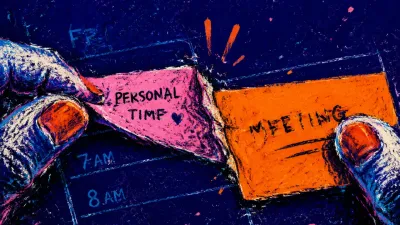
At 10:40 on a Tuesday night, she joined our video session from her Zone 2 flat. An unfinished bowl of pasta sat beside her laptop. The fork had gone cold in her hand, the fan whirred under the hard white screen light, and a gratitude video hummed from another tab. Minutes earlier, she had deleted “this workload is not sustainable” from a Slack draft and replaced it with “excited for the challenge.” Her shoulders stayed raised after she pressed send.
“I can usually find the lesson,” she told me, rubbing her jaw. “So why am I still upset? The same issue keeps returning in a different outfit.”
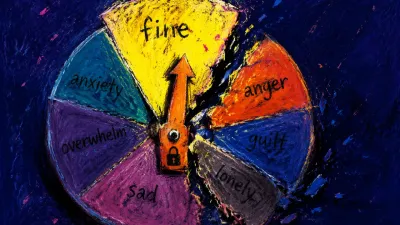
I heard frustration with sadness underneath it: a feeling like driving through London with a dashboard warning chiming while someone keeps repainting the warning light yellow and calling it sunshine. The fixed smile offered temporary quiet; the workload, disappointment, and unsent request remained in the car.
“I’m not going to ask you to become less hopeful,” I said. “I want us to find out what the hope keeps talking over. Let’s draw a map of the recurrence, then identify the smallest place where you still have a choice.”

Choosing the Map Behind the Mood
I asked Maya to take one ordinary breath and hold the question in plain language: “Why do the same problems return when I force a positive spin?” I shuffled slowly, using the movement as a transition from performing an answer to observing the pattern. There was nothing supernatural required of her. She only had to notice what felt accurate and reject what did not.
I chose The Shadow Spread · Context Edition, a five-card tarot spread for mapping forced positivity, recurring patterns, belonging fears, and emotional integration. I use this spread when the issue is not a shortage of insight but a loop: a trigger appears, discomfort rises, a positive interpretation brings relief, a necessary action disappears, and the practical condition returns.
For readers wondering how tarot works in a consultation like this, I treat the spread as structured reflection rather than a verdict. Card meanings in context give us distinct questions, preventing one polished explanation from swallowing the whole problem. The cards do not make Maya’s decision. They separate the moving parts so she can make it with better information.
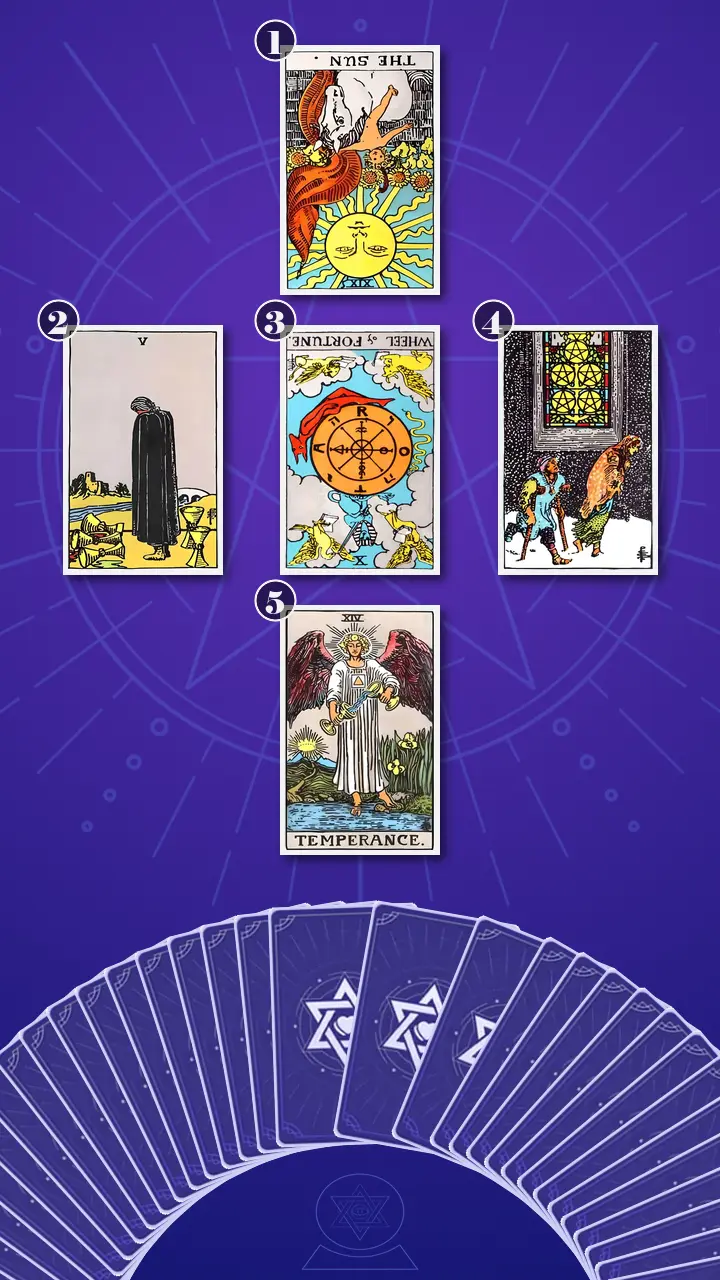
The upper position would reveal the positive story she consciously presented. The left position would name the feeling pushed outside that story. The centre would map the recurrence itself, while the right position would expose what the pattern was trying to protect. The final card beneath the centre would offer a practical form of integration. In its cross shape, the spread resembled a pressure valve: suppression on one side, belonging on the other, and a repeated cycle held between them.
Reading the Approved Brightness
Position 1: The Message Everyone Can Approve
Now I turned over the card representing the visible positive story Maya produced immediately after disappointment or conflict. It was The Sun, reversed.
I pointed to the oversized sun and the child lifting a red banner. Upright, this card can express candid vitality, illumination, and joy. Reversed here, its Fire energy had moved into excess and blockage: brightness was no longer revealing the whole scene. It had become pressure to display one acceptable emotional colour.
“Minutes after that difficult hybrid meeting, you deleted ‘this workload is not sustainable’ from Slack and posted ‘excited for the challenge,’” I said. “The visible brightness reassured the team, but it also removed the information they would need to change the scope, timing, or support.”
I asked her what her cheerful version of the story left out. She looked at the message still open on her screen and said, “That there is literally no space in the calendar for the extra campaign.”
The Sun was not condemning optimism. It was showing what happened when optimism became a social filter applied before anyone could inspect the original image. Her private script was simple: “If I can sound positive quickly enough, maybe no one will notice that this is not working.” The approval arrived. The resolution did not.
Maya gave a short, bitter laugh rather than nodding. “That’s so accurate it’s almost cruel.” Her fingers stopped on the rim of her bowl, then tightened, then released. “I’ve made it look manageable. Of course they think it is.”
“That recognition may sting,” I said. “But it is not proof that you caused the whole workload problem. It shows where your colleagues stopped receiving accurate capacity data. That is a point of influence, not a sentence of blame.”
Position 2: What the Uplifting Recap Left on the Floor
Now I turned over the card representing the grief, anger, disappointment, or unmet need pushed outside Maya’s acceptable self-image. It was Five of Cups, upright.
The cloaked figure faced three spilled cups while two remained standing behind them. I read this as a deficiency of acknowledged Water, not an excess of sadness. Maya had been turning toward what remained so quickly that the specific cost never received a full sentence.
Before posting another growth lesson, I asked her to name what the repeated demand had actually cost. She counted quietly: an evening, trust in the planning process, and an agreement that Friday deadlines would be raised earlier. Those facts could exist beside the colleagues and opportunities she still valued. The two standing cups did not cancel the three that had spilled.
“I know some things are still good,” she said, watching the card, “but this part actually hurt.”
“Exactly. Grief and ingratitude are not synonyms.” I thought of the emotional logic in Inside Out: sadness is not a system failure. It communicates what mattered and what was lost. An “at least” can close the case before the evidence is heard.
Maya inhaled, held the breath for a beat, and looked past the screen as if replaying the meeting. When she exhaled, her shoulders lowered by a fraction. The movement was small, but it was the first time that evening I saw her body and her words deliver the same update.
The Project Ticket That Kept Reopening
Position 3: Different Trigger, Same Script
Now I turned over the card representing the limiting repetition loop from trigger to positive reframe, temporary relief, omitted action, and recurrence. At the centre sat Wheel of Fortune, reversed.
I used the turning wheel as a diagram, not a prediction of fate. The figures around its rim moved, but its structure remained fixed. The reversed energy showed blocked adaptation: Maya encountered different deadlines and conversations, yet each followed the same sequence. Pressure appeared. Her chest tightened. She produced an uplifting interpretation. She postponed the boundary. The condition returned.
“It is like a recurring project ticket receiving a new title and then being marked resolved without anyone fixing the root cause,” I said. “New campaign, new conversation, same tight chest, same positive post, same missing request. Different trigger, same script, same omitted action.”
The image also reminded me of recommendation algorithms from my years around commercial systems: if every recurrence receives the same response signal, the system learns to serve more of the same. Movement is not necessarily adaptation. London’s Circle line can keep a carriage moving for hours without bringing a distracted passenger any closer to the right stop.
I applied what I call a Potential Actionability Assessment. We audited the practical execution rate of Maya’s insights. She had generated several convincing lessons, but none had changed scope, requested a priority decision, documented capacity, or opened a repair conversation. The point was not to mock reflection. It was to distinguish emotional relief from operational change.
Maya traced a circle beside the card with one fingertip. “So I keep trying to improve my interpretation when the missing part is the response.”
“Yes. If the positive spin had resolved the issue, the practical condition would not keep returning unchanged. The Wheel gives us a decision point: not ‘How do I feel better about this?’ but ‘Which omitted action can I test at the next turn?’”
Position 4: The Warm Window and the Cost of Speaking
Now I turned over the card representing the belonging fear that made compulsory optimism feel protective despite its long-term cost. It was Five of Pentacles, upright.
I drew Maya’s attention to the two figures moving through snow beneath an illuminated window. The card did not tell me that support was unavailable, nor did it let me assume her professional risk was imaginary. With London rent due and the job market uncertain, naming an unrealistic deadline could feel connected to income, future projects, and membership in the trusted group.
The card’s protective Earth energy had moved into excess. Material caution was treating every capacity concern as a possible expulsion. Maya performed enthusiasm not because she was naive, but because approval, connection, and professional security felt attached to it.
“What appears first when you imagine writing, ‘This is not workable’?” I asked. “Awkwardness, or an actual loss?”
“Being left out,” she said immediately. Then she paused. “Not just socially. I mean being passed over for projects, or being seen as someone who can’t cope.”
Her palm pressed briefly against the centre of her chest. Her gaze stayed on the glowing window, then dropped to the figures outside it. I let the silence hold long enough to respect the real stakes.
“Belonging bought with constant brightness is expensive,” I said. “But I am not going to tell you every workplace is equally safe or that you must disclose everything you feel. We are looking for a specific, proportionate statement that protects both accurate planning and your right to choose the level of exposure.”
When Temperance Let Both Truths Stay
Position 5: The Antidote Beneath the Wheel
The laptop fan slowed, and the room became unexpectedly quiet. Rain that had been tapping the window softened to an occasional drop as I turned over the card representing a bounded integration practice: one that could acknowledge pain, retain hope, and support a relevant corrective action.
It was Temperance, upright.
The angel moved water between two cups, with one foot on land and one in water. Here the energy was balanced: emotional truth could remain in motion without flooding the conversation, while practical reality kept the response grounded. Maya did not have to choose between distress and perspective. She could use both as information.
I translated the two cups into a two-part message: “This is what is not working; this is what would make it workable.” For her deadline, that became: “The current scope is not workable by Friday. I can deliver the launch copy by Friday, or the full package by Tuesday. Which should take priority?” She could still value the project. Hope now followed an accurate fact and supported a concrete decision.
At 10:40 p.m., dinner had gone cold while Maya rewrote “this deadline is not sustainable” into “excited for the challenge.” Her shoulders stayed high, the gratitude video started, and the problem had already been edited out of the story. She had been trying to produce the correct attitude before allowing herself to identify the relevant fact.
I brought in a diagnostic lens I call Pseudo-Growth Eradication. The severe name is aimed at self-help fluff, never at the person using it. I strip a growth claim down to two questions: What uncomfortable fact survived the lesson? What behaviour changed because of it? If both answers are “none,” the insight may have soothed the moment, but its real-world execution rate is still zero.
“Hope becomes useful when it follows the truth instead of replacing it,” I told her. “Name what hurt, then let one concrete response carry the meaning forward.”
You do not have to pour pain away to make room for hope; like Temperance moving water between two cups, let both truths inform your next grounded response.
I stopped speaking.
Maya’s breath paused first. Her fingers hovered above the table, motionless, and her eyes lost focus as though the last few months were replaying behind them. Then her brows drew together. “But doesn’t that mean I’ve been doing it wrong this whole time?” she asked, anger sharpening the last words. I told her no: the quick reframe had protected approval and reduced immediate friction when those things genuinely mattered. It had simply outlived some of its usefulness. Her jaw shifted; one hand opened slowly from a fist. The anger gave way to wet eyes, then to a long breath that seemed to begin somewhere below her ribs. Her shoulders dropped, but relief did not make her instantly certain. For a moment she looked almost unsteady, as if putting down a familiar weight had left her unsure what to do with her hands. I asked, “Now, with this new perspective, can you recall a moment last week when this insight might have changed how the situation felt?”
She returned to Friday’s team call. “I could have said I wanted the campaign to succeed and still asked which deadline should move,” she said. “That would have been honest without turning the meeting into a full confession.”
That was the breakthrough: a step from pressured cheerfulness and private rumination toward emotional accuracy, measured hope, and grounded boundary-setting. Not certainty. Not compulsory disclosure. A fuller account, followed by one proportionate choice.
The Warning Light Gets an Owner
I gathered the spread into one coherent story. The reversed Sun showed the visible coping strategy: make the update brighter and easier to approve. Five of Cups revealed the private cost excluded from that update. The reversed Wheel showed why the issue kept returning: temporary relief was being mistaken for resolution. Five of Pentacles explained the bargain beneath the loop, where honesty seemed capable of costing belonging, income, or opportunity. Temperance supplied the unused resource: Maya could hold pain and hope together, then let their combined information shape a bounded request.
Her cognitive blind spot was not that she lacked self-awareness. It was that she measured coping by how quickly she could find meaning, rather than by whether the relevant fact had been acknowledged and the practical condition had received a response. She had been repainting the warning light instead of checking what activated it.
The direction was therefore precise: move from an immediate positive interpretation to one painful fact and one relevant corrective action before searching for meaning. Optimism could remain, but its job would change. It would support action rather than erase the evidence needed to choose one.
The 30-Day Evolution KPI: Measure the Interruption, Not the Mood
I adapted my Evolution KPI Framework into a 30-day experiment. The KPI was not “feel positive” or “set perfect boundaries.” Maya would count only observable interruptions of the old loop. A difficult day could still qualify as progress if she recorded the fact before reframing it or drafted a measured response instead of deleting the concern.
- The Painful-Fact-First Check On one evening this week, Maya would open a private phone note, set a ten-minute timer, and complete one sentence: “What hurt or did not work was...” She would use one observable fact and add no lesson until the timer ended. If ten minutes felt exposing, she could stop after two. The note could remain private, be deleted, or never become a conversation; she controlled the audience and timing.
- The Two-Truth Temperance Draft After the next difficult meeting, Maya would draft: “The current timeline is not workable with X included. I can deliver A by Friday, or A and B by Tuesday. Which should take priority?” Her task was to save one fact and one request before opening a gratitude or mindset app. Sending was optional. If the stakes felt high, the minimum version was saving the draft, asking one clarifying question, or requesting time before agreeing.
I asked her to mark each completed interruption with a simple tally. No streaks, inspirational captions, or penalties for missed days. The framework existed to create evidence of agency, not another polished performance. Hope is useful after the truth has had a sentence.

A Week Later, One Message Stayed Sent
Six days later, Maya sent me a screenshot. She had used the two-truth draft after another campaign request. Her manager chose the Friday launch copy and moved the remaining package to Tuesday. The exchange was brief, almost boring, which was exactly what made it useful.
That night she slept through until morning. Her first thought was still, “What if they think I’m difficult?” She noticed it, smiled faintly, and left the sent message where it was.
I did not read that as proof that one tarot consultation had solved her work life. I read it as the first concrete evidence that she could recognise discomfort without obeying its old script. The power belonged to Maya: the cards supplied distinctions, but she supplied the sentence, assessed the risk, and chose the action.
For me, that was the real Journey to Clarity. The Shadow Spread · Context Edition did not promise that honesty would always be rewarded. It helped Maya see that painful truth and hopeful possibility could occupy the same frame, giving her more than one response when the Wheel turned again.
When keeping your place in the room seems to depend on staying upbeat, the Slack message can remain bright while your jaw tightens around the truth that something is not working. Simply noticing those two tracks means the approved version is no longer the only version you can hear.
If hope did not have to arrive first, what small honest sentence could you pour into Temperance’s first cup before deciding what belongs in the second?