The Future Montage That Kept Rewriting the Dealbreaker
At 11:40 p.m., I watched Jordan sit on the edge of their bed during our video call, one hand wrapped around a phone that had gone warm in their palm. They worked in Toronto tech, kept a private Notes page called What I Actually Need, and had spent the evening rewriting a relationship dealbreaker after imagining a shared future. Behind them, a radiator clicked in uneven bursts. Shared photos glowed on the phone beside the sentence they had just changed: I will not stay if this keeps happening had become I should allow room for growth.
“They said, ‘When we move in,’ right after the same issue came up again,” Jordan told me. Their jaw shifted as though they were trying to release it without being noticed. “Then I pictured the apartment, the kitchen, all of it. I don’t want one rigid rule to ruin something good. But every time I soften the rule, I feel relieved for five minutes and trust myself less the next morning. I need to know whether this is flexibility or self-abandonment.”
I could hear the real conflict underneath the wording problem. Jordan wanted their dealbreakers to remain reliable protections for their values, but keeping one intact felt as though it might erase the partner and the future they had already begun to inhabit in their imagination. The anticipatory loss was not a vague cloud. It was like hearing movers carry boxes out of an apartment they had not even rented yet: a future disappearing with enough sensory detail to make the body grieve it as a fact.
“You’re not only deciding whether this behavior works for you,” I said. “You’re trying to decide whether belonging depends on making the boundary smaller. I’m not here to tell you to stay, leave, or treat one sentence as sacred forever. Let’s give the fear, the evidence, the hope, and the value their own places. We’ll make a map of the fog, then you can decide what deserves to guide you.”

Choosing the Four-Layer Insight Ladder
I invited Jordan to put both feet on the floor and take one unforced breath. I shuffled slowly while they held the question in mind, using the small pause as a transition out of scrolling mode rather than as a mystical performance.
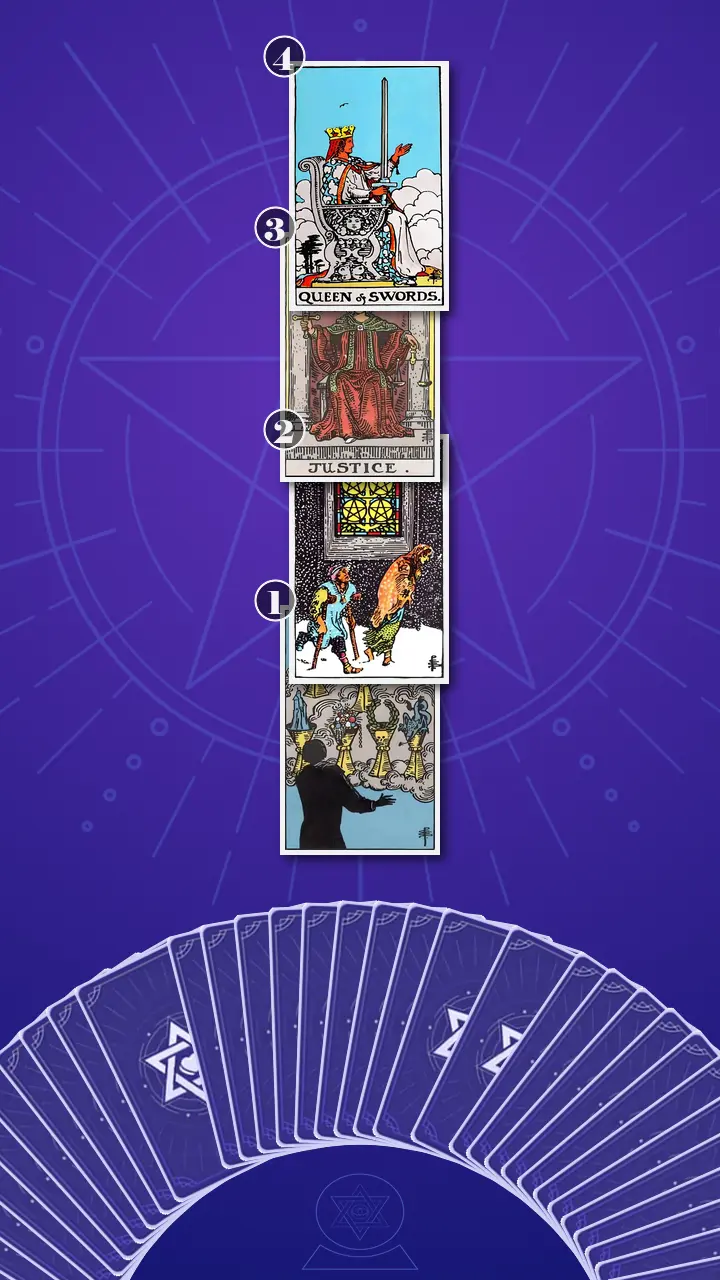
I chose the Four-Layer Insight Ladder, a four-card tarot spread for relationship boundaries and dealbreaker clarity. I use this spread when the real question is not “What will happen?” but “What keeps happening inside me, and where can I interrupt it?” A larger predictive spread would have pulled attention toward possible outcomes. This compact ladder kept the focus on Jordan’s agency.
The first position would show the visible pattern: imagining milestones, softening the wording, and postponing the conversation. The second would uncover the fear beneath that edit, especially the fear of losing belonging. The third would provide the transforming principle by separating observed evidence, protected values, and imagined potential. The fourth would translate that discernment into clear communication.
This is how tarot works in my practice: the cards do not issue a verdict from outside a person’s life. They externalize patterns so hope, fear, behavior, and values can be examined separately. Card meanings in context become a structured mirror. Jordan would remain the person making the choice.
The Relationship Moodboard in the Clouds
Position One: Seven of Cups and the Visible Rewrite
I turned over the card representing the visible pattern through which Jordan’s issue was currently being expressed. It was the Seven of Cups, upright.
I pointed to the silhouetted figure facing seven cups suspended in clouds. Among them were a castle and a veiled figure, images alluring enough to pull attention away from the ground beneath the person’s feet. In Jordan’s life, those cups had become future tabs: the apartment kitchen, the key handoff, a shared calendar, a trip pinned in Messages, and an ordinary Tuesday several years from now.
When their partner said “when we move in” after a present incompatibility, Jordan’s mind did not produce one hopeful thought. It cut a complete relationship montage. The vividness of that montage made the recurring behavior feel like an inconvenient interruption to something already real. The dealbreaker was softened so every imagined cup could remain available.
I read the card as an excess of imaginative Water. Hope itself was not the problem. The excess appeared when imagined milestones received the same evidentiary weight as repeated behavior. A relationship moodboard made from affectionate screenshots had started to look like a finished floor plan.
As an artist, I have seen a rough film cut feel inevitable because the music swells at exactly the right moment. Remove the score, and the audience can finally see whether the scene itself works. Jordan’s future montage had become that score: emotionally true as longing, but capable of covering dialogue the present scene still needed.
“A future can be real as a desire without being proof of present compatibility,” I said. “Which part of the montage is supported by repeated behavior, and which part has mostly been rehearsed in your mind?”
Jordan gave a short laugh, but there was no amusement in it. Their fingers tightened around the phone before they placed it screen-down. “That’s too accurate. Honestly, it’s a little brutal. I have a better visual prototype for our future apartment than I have evidence that this issue will change.”
I let the bitter humor breathe. “Seeing the projection clearly doesn’t make you foolish,” I said. “It means the future matters to you. We’re only changing its job description. It can express desire; it cannot testify about behavior it has never witnessed.”
Position Two: Five of Pentacles Outside the Warm Window
I turned over the card representing the underlying fear sustaining the editing behavior, especially the fear that holding a boundary would cost Jordan the relationship and access to belonging. It was the Five of Pentacles, upright.
Two figures moved through falling snow beneath an illuminated stained-glass window. The warmth was visible but seemed inaccessible. Outside Jordan’s real window, late Toronto snow had begun to catch in the streetlight, and for a moment the room appeared to borrow the card’s blue-gray cold.
I told Jordan that an activated dealbreaker was not registering in their body as one piece of relationship information. It was becoming the possible loss of the partner, shared routines, a future apartment, and the feeling of finally being chosen. An affectionate message became the glowing window. Keeping one standard felt like voluntarily walking into the snow before the boundary had even been discussed.
I gave the fear its full sentence: “If I hold this line, then I lose the relationship, the apartment, the routines, and the future. If I lose those things, it must mean I do not belong.”
The card showed a blockage in Pentacles energy. The need for security had contracted into scarcity. That contraction made the Seven of Cups more persuasive: once the future looked like the only warm building on the street, questioning it felt dangerous. Softening the boundary reduced the immediate cold, but the repeated behavior remained outside the edit. Relief arrived because the threat had been made smaller, not because the situation had changed.
“Relief is information, not a verdict,” I said. “It tells us the original wording touched a fear. It does not automatically prove the wording was unreasonable.”
Jordan’s inhale stopped halfway. Their eyes moved from the stained-glass window on the card to the snow beyond their own glass, then lost focus as though an old sequence were replaying. When the breath finally left, their shoulders dropped by less than an inch.
“That’s why one boundary feels like losing everything,” they said quietly. “I’m not only scared of this relationship ending. I’m scared it would confirm that everyone else gets to move forward and I’m still outside.”
“That fear deserves care,” I said. “But it is an emotional forecast, not a report from a conversation that has not happened yet. The Five of Pentacles is not predicting exclusion. It is showing us why your nervous system treats clarity as though exclusion has already occurred.”
When Justice Stopped the Edit
Position Three: The Inner Arbiter Takes the Scales
The radiator clicked once and then went quiet. I turned over the card representing the key cognitive transformation: separating observed evidence, protected values, and imagined potential before deciding whether the dealbreaker should change. This was the central card of the reading: Justice, upright.
I focused first on the level scales and the upright double-edged sword. In Jordan’s world, the scales resembled a UX research board with two clearly labeled areas. One side held what the partner had repeatedly said or done. The other named what the original boundary was designed to protect: reliability, respect, emotional safety, mutuality, or something else Jordan could define in their own language.
Justice brought balance through value-based discernment. It did not ask Jordan to suppress longing, prosecute their partner, or preserve the boundary out of pride. It asked whether the evidence had changed, whether the protected value had changed, or whether only the anticipated consequence had become harder to tolerate. The sword made one clean distinction: a conscious revision is not the same act as a fear-driven exception.
Here I used one of my signature tools, Dialogue Loop Auditing. I mapped the recurring exchange as a four-beat script: the phrase “when we move in” activated a future montage; Jordan’s chest tightened at the possibility of losing it; they opened Photos, listings, or Notes instead of naming the present issue; then a softer sentence produced temporary relief. Because the conversation disappeared, the same trigger returned with more power.
I placed the sword at the point where the loop could be interrupted and gave Jordan one audit question: “Am I changing the standard because the facts changed, or because the consequence feels unbearable?” The question did not dictate the answer. It stopped fear from answering before evidence had entered the room.
I brought Jordan back to 11:40 p.m.: the photo thread glowing, the Notes app open, and one firm sentence being softened before they had decided what had actually changed. They were still trying to find the perfect answer, but the small edit was already giving the imagined future more authority than present evidence.
The future story does not earn an automatic exception; place observed facts beside protected values on Justice's scales, and let a balanced evaluation determine whether the boundary truly needs revision.
I left a pause after the sentence.
Jordan’s breath froze. Their fingers hovered above the face-down phone without touching it, and their pupils widened before their gaze slipped past me. Then their eyebrows drew together. “But doesn’t that mean I’ve been wrong this whole time?” they asked, the words sharper than anything they had said so far. “That I kept choosing a fantasy?” I watched their shoulders rise again and their hand close into a fist against the duvet. “No,” I said. “It means you used the fastest tool you had to protect belonging. We’re evaluating that tool, not putting your past self on trial.” Their fist opened one finger at a time. Their eyes reddened, but they did not look away. A long exhale followed, carrying a small, unsteady “Oh.” Their shoulders lowered, then they went briefly still, as though the removal of the old script had left an unfamiliar blank page. I asked, “Now, using this new perspective, think back to last week. Was there a moment when this insight could have made you feel different?”
Jordan described the TTC ride when their partner’s voice note had said “when we find a place together.” They had saved a Realtor.ca listing and deleted the boundary text before reaching home. “I could have let the apartment be something I wanted without using it to answer what happened that day,” they said. Their voice sounded steadier, although the responsibility inside that clarity plainly frightened them.
I offered a sentence for the space Justice had opened: “I can feel the loss I am predicting without letting that prediction rewrite the evidence.” Waiting was not surrendering. Leaving the wording untouched for 72 hours would not force Jordan to stay, leave, or confront anyone. It would simply keep a temporary panic from making a permanent edit.
This was the reading’s decisive movement: from anticipatory loss and declining self-trust toward value-based discernment and grounded boundary communication. It was not certainty. It was the first cautious act of trusting Jordan’s ability to hold longing and evidence at the same time.
The Queen’s Sword and Open Hand
Position Four: Three Sentences That Do Not Predict the Ending
I turned over the card representing the embodied action through which Jordan could practice and integrate the insight: communicating the recurring issue and its protected value without predicting the outcome or erasing nuance. The card was the Queen of Swords, upright.
I showed Jordan the Queen’s vertical sword and extended open hand. The sword offered clean language; the hand remained receptive to new information. Together they contradicted a fear Jordan had been carrying: that clarity must be cold, punitive, or final.
In modern life, this card looked like Jordan replacing a long, qualified draft with three plain sentences: what had happened more than once, what value it affected, and what conversation was needed. No padding with apartment plans. No twelve-paragraph attempt to prevent hurt. No promise about whether the relationship would continue.
The Queen represented balanced Air: discernment moving into language. The spread contained no Wands and no explicit Fire, which told me Jordan did not need a dramatic ultimatum. Their missing resource was a small enacted response. One message or conversation request could supply enough Fire to turn recognition into new evidence.
I offered an example: “This issue has happened more than once. It affects the reliability and mutuality I need in a relationship. Can we set aside time tomorrow to talk about what would need to change for this to feel workable for me?”
I watched Jordan read the sentences twice. The old inner question had been, “How do I phrase this so nothing changes?” The Queen replaced it with, “Can I be clear and still stay receptive to what I learn?”
Jordan rubbed their thumb across the edge of the phone, then gave a slow nod. “That feels terrifyingly short,” they said. “There’s nowhere for me to hide the actual point.”
“Exactly,” I said. “And there’s also no verdict hiding in it. Clarity can leave the door open without leaving your values outside. Your partner’s response becomes information. It does not become a measure of whether you deserved to speak.”
From Imagine, Brace, Weigh, to Speak
I gathered the four cards into one storyline. Jordan’s analytical precision had served them well in UX research, but in this relationship it had become a way to keep rewriting the scene instead of learning what another person would do inside it. The Seven of Cups imagined. The Five of Pentacles braced for exile. Justice weighed facts beside values. The Queen of Swords spoke clearly enough for reality to answer.
The core problem was not that Jordan had a future fantasy, cared too much, or lacked flexibility. The future montage activated a scarcity script, and the scarcity script made a softer sentence feel safer than an honest conversation. The immediate release in their jaw was then mistaken for evidence that the revised standard was wiser.
That was the cognitive blind spot: Jordan had been treating reduced fear as proof of improved judgment. They had also been giving relationship potential the status of observed behavior. The transformation was not from “flexible” to “rigid.” It was from automatic revision to deliberate authorship. Jordan could keep a boundary, revise it, or decide it no longer reflected their values, but the choice needed to happen after proportion returned.
“But I know myself,” Jordan said. “At midnight I’ll tell myself the 72-hour thing is artificial, reopen the note, and write six nuanced versions.”
I adjusted the plan. “Then we make the first version almost annoyingly small. One copied sentence, one timestamp, and one phone reminder. You are not forbidden to feel, think, or reconsider. The only experiment is leaving that copy unchanged long enough to notice what happens around it.”
- Justice’s 72-Hour Boundary Hold Within ten minutes this week, copy one current dealbreaker into a separate note and add the exact date and time. Leave that copied sentence unchanged for 72 hours. Beneath it, record no more than three observable facts about what was said or done, then name the value the boundary protects. At the end of the hold, ask whether the facts or protected value changed, rather than whether the imagined future still feels attractive. Keep the threshold low: one sentence, one reminder, and up to three facts. The hold is not a commitment to stay, leave, or start a conversation. Close the note if it becomes another research spiral.
- The Pattern Interruption Script The next time future planning appears immediately after an unresolved incompatibility, interrupt the default sequence before opening Photos, Realtor.ca, or Notes. Say, “I want to enjoy imagining that too, and I need us to return to what happened today before we make the next plan.” Then use the Queen of Swords’ three-sentence structure: name the recurring behavior, name the value at stake, and request a specific time for a conversation. Rehearse the script aloud once for five minutes. Choose a medium and setting that feel reasonably safe; Jordan could pause, leave, or reschedule. The goal is to create new information, not guarantee a painless response.
I reminded Jordan that actionable advice was useful only when it preserved choice. Tarot had helped us identify the loop and mark an interruption point. It would not decide whether the relationship’s incompatibility was workable. That authority remained with Jordan, informed by their values, the repeated facts, and the response they received when they spoke plainly.

Four Days Later, the Sentence Still Stood
Four days later, I received a message from Jordan. They had copied the original sentence at 9:12 the morning after our reading and left it untouched for the full 72 hours. Under Facts, they had written two repeated behaviors. Under Protected Value, they had written one word: mutuality.
They had also sent the three-sentence conversation request. Their partner’s first response was complicated, neither the perfect reassurance Jordan had once tried to engineer nor the instant ending they had feared. It was real information, and Jordan had not edited their standard before receiving it.
That night, they slept through until morning. Their first thought was still, “What if I’m wrong?” They smiled at the familiar line, placed the phone face-down, and did not reopen the note.
I did not see a life suddenly solved. I saw a small, credible proof of movement: Jordan had shifted from future projection and declining self-trust toward value-based discernment and clear, receptive communication. The cards had not written the next act. Jordan had taken the pen back.
When keeping one clear boundary feels like walking through Toronto snow past the warm window of the life you pictured, I hope you remember that the tight chest is not proof that you should abandon yourself. It is the strain of trying to protect belonging while learning that your values deserve warmth too.
If you let the wording stay unchanged for 72 hours, what one piece of present-day evidence would you place on Justice’s scale before the warm window of the imagined future gets to answer for you?
This story is adapted from psychological research, written so that those in a similar struggle can see their own pattern in it — and find their next step clearly.These insights are not a substitute for professional psychological, medical, legal, or financial advice.
Learn more about our Journey to Clarity.
How did this insight land for you?
🫂 This Resonates Deeply
🌀 Living This Story
✨ Now I See Clearly
🌱 Seeing New Possibilities
🧰 Useful Framework
🔮 The Confirmation I Needed
💪 Feeling Empowered
🚀 Ready for My Next Step
Author Profile
 AI
AI“I’ve always felt our lives are films currently in production. As an artist, I know that when you feel stuck, it’s often because you’ve bravely stayed in a painful scene for just a little too long. I’m not here to coldly analyze you. I want to sit closely with you, look at those difficult moments with profound empathy, and gently hand you the pen so you have the courage to write your next beautiful act.”
In this Love Tarot Reading :
Core Expertise
- Toxic Script Identification: Recognizing the repetitive, destructive roles you both automatically play (e.g., the Savior and the Victim) during conflicts.
- Dialogue Loop Auditing: Analyzing the specific triggering phrases that consistently escalate your arguments into dead ends.
Service Features
- The Pattern Interruption Script: A creative role-play directive to consciously change your default response to a known trigger, forcing the relationship dynamic to shift.
Also specializes in :
Explore Related Patterns:
Boundary DiscernmentJordan leaves the original sentence unchanged for 72 hours, records two repeated behaviors, and writes "mutuality" beneath the protected-value heading. That structure separates what happened, what matters, and what Jordan fears might happen, so the boundary can be evaluated without being treated as either sacred wording or a disposable obstacle. Boundary Discernment allows you to ask whether the facts changed, the protected value changed, or only the anticipated consequence became harder to tolerate. The goal is not rigidity; it is deliberate authorship, where keeping, revising, or retiring a standard happens after evidence and values regain proportion rather than during the brief window when fear is demanding immediate relief.
Emotional ReasoningThe softer sentence gives Jordan about five minutes of relief, but the recurring behavior remains unchanged and self-trust is lower the next morning. The edit alters the intensity of the feared consequence, while Jordan's nervous system interprets that reduced discomfort as evidence that the revised standard is more reasonable. Emotional Reasoning occurs when you use how a decision feels immediately after making it as proof that the decision is accurate. Relief can confirm that a threat response has temporarily eased, but it cannot establish that the facts, values, or compatibility have changed; when those categories blur, short-term calm can repeatedly overrule longer-term trust in your own judgment.
Loss AversionOn the TTC, Jordan hears a voice note about finding a place together, saves a property listing, and deletes the boundary text before reaching home. The projected loss of the partner and apartment becomes so concrete that the body responds as though an inhabited future is already being taken away. Loss Aversion gives a possible ending more decision-making weight than the continuing cost of overriding your own standard. When an imagined future already feels possessed, holding a boundary can register as surrendering something valuable rather than gathering information about compatibility, so rewriting the line becomes a rapid attempt to prevent the loss before reality has established that it will occur.
Potential ProjectionWhen Jordan's partner says "when we move in" immediately after the recurring issue surfaces, Jordan's mind builds an apartment, a kitchen, shared routines, and an ordinary Tuesday years ahead. Those images are genuine expressions of desire, but their vividness allows imagined potential to compete with behavior that has already happened more than once. Potential Projection takes hold when you begin relating to what a relationship could become as though that possibility were evidence about what it currently is. The future then stops functioning as a hope and starts functioning as a witness, making a present incompatibility look like an obstacle to a life that feels emotionally real but has not yet been jointly built.
Reality TestingJordan places repeated behavior on one side of the evaluation and the protected value on the other, while the imagined apartment is reassigned to the category of desire rather than proof. After sending the conversation request, Jordan receives a complicated response that is neither perfect reassurance nor the instant ending previously forecast. Reality Testing means allowing observable events to correct both hope and fear. When you distinguish what has happened from what you have vividly rehearsed, a future can remain emotionally meaningful without testifying about present compatibility, and another person's actual response can become information before you alter the standard designed to protect what matters to you.
Self-AbandonmentAt 11:40 p.m., Jordan changes "I will not stay if this keeps happening" to "I should allow room for growth" after imagining the shared apartment and future routines. The revision protects access to the pictured relationship for the night, but Jordan trusts their own judgment less the following morning. Self-Abandonment emerges when you preserve belonging by withdrawing support from a need or value before anyone else has responded to it. Flexibility can involve a conscious revision based on changed evidence, but this loop moves the line because maintaining it feels emotionally dangerous; the resulting relief belongs to the relationship fantasy, while the cost appears as declining confidence that your own boundaries will still exist when fear becomes intense.
CatastrophizingOne activated dealbreaker expands in Jordan's mind into the simultaneous loss of the partner, apartment, shared routines, future milestones, and belonging. The possible ending is then treated as confirmation that other people get to move forward while Jordan remains outside, even though the relevant conversation has not happened. Catastrophizing compresses a chain of uncertain possibilities into one apparently inevitable outcome. When you experience a clear boundary as the opening scene of total exclusion, editing the boundary can feel like emergency prevention rather than a decision about values, leaving little psychological room for partial outcomes, negotiation, new evidence, or a response that is complicated rather than absolute.
Scarcity MindsetKeeping one standard makes Jordan picture not only the end of a relationship but the disappearance of the apartment, routines, future milestones, and feeling of finally being chosen. The feared ending also becomes evidence that everyone else is moving forward while Jordan remains outside, turning one possible future into the only visible source of belonging. A Scarcity Mindset narrows your decision field until protecting a value feels equivalent to rejecting your sole chance at warmth and connection. Under that pressure, making the boundary smaller can produce immediate safety even when nothing in the relationship has changed, because the edit preserves access to the one future your mind is currently allowing itself to see.
Conflict AvoidanceAfter the recurring issue appears, Jordan turns toward Photos, property listings, and private Notes instead of bringing the incompatibility into the relationship. The wording becomes softer, the immediate threat recedes, and the conversation disappears, allowing the same unresolved trigger to return with greater authority. Conflict Avoidance does not always look like silence or physical withdrawal; it can look like doing extensive private work so that another person's response never has to enter the evidence. When you revise your position before speaking, you can temporarily protect the relationship from tension, but you also prevent reality from showing whether mutual discussion, repair, or meaningful change is actually available.
Reflective DistanceJordan copies one boundary with a timestamp, leaves it unchanged for 72 hours, and observes facts and values around it rather than producing another version. Four days later, the familiar "What if I'm wrong?" thought still appears, but Jordan places the phone face-down and does not reopen the note. Reflective Distance does not require you to eliminate longing, doubt, or bodily tension before making a sound decision. It creates enough space for those experiences to remain present without becoming immediate instructions, interrupting the automatic route from future image to anticipated loss to boundary edit and allowing a choice to emerge after the emotional forecast is no longer the only voice in the room.
Explore Related Struggles:
Belonging-Authenticity SplitJordan's firm sentence protects mutuality, but the partner's phrase "when we move in" makes leaving it intact feel like erasing the apartment, routines, and relationship at once. Both sides of the decision remain visible: the standard carries Jordan's values, while the imagined future carries the promise of belonging and being chosen. When a future feels vivid enough to grieve in advance, you can find yourself bargaining with the wording before the relationship has answered the underlying issue. The friction lies in trying to remain connected to what matters to you while closeness itself feels exposed to loss. Desire and personal values can be given separate places in the decision. You can want the shared kitchen intensely without asking that image to overrule the repeated behavior that determines whether the relationship can support it.
Clarity-Exposure SplitJordan opens Photos, Realtor.ca, or Notes after future planning appears, while the recurring issue remains outside the conversation. The private edit lowers the immediate stakes, but a clear sentence would expose the relationship to an answer Jordan cannot design in advance. You may recognize this friction when speaking plainly seems capable of forcing an ending, even though postponing the conversation is already preventing reality from responding. Clarity then carries two demands at once: protecting what matters to you and remaining present for information that could change the relationship. Jordan's eventual three-sentence request shows that directness can preserve receptivity. You can state what has repeated, name the value involved, and let the other person's response become evidence without predicting the ending first.
Potential OveridentificationJordan has a clearer visual prototype for the future apartment than evidence that the recurring issue will change. The kitchen, key handoff, shared calendar, and ordinary Tuesday become detailed enough to resemble an established life, while present incompatibility is reduced to an interruption in that storyline. Once possibility acquires the weight of something already possessed, you are no longer evaluating only what might happen. Your decisions begin protecting an untested future as though losing it would dismantle a life already underway, and the dealbreaker is rewritten to keep that continuity intact. The future can remain emotionally real as a desire without serving as testimony about behavior it has never witnessed. Restoring that distinction lets you value the vision while returning decision-making authority to repeated facts and the response you receive when the issue is named.
All-or-Nothing BelongingJordan's single dealbreaker expands into losing the partner, the apartment, the routines, the future, and the feeling of finally being chosen. A possible relationship outcome becomes a verdict about whether Jordan belongs anywhere and whether everyone else will move forward without them. When the imagined future appears to be the only warm building on the street, you may make a standard smaller to avoid the forecast of total exclusion. The decision is compressed until preserving one relationship seems identical to preserving belonging itself, leaving little room to evaluate the recurring behavior on its actual scale. A boundary conversation can carry real relational consequences without deciding your entire access to warmth, progress, or connection. Separating those levels gives you more than one possible source of belonging and more room to assess this relationship without turning one line into a judgment on your whole future.
Relief-Progress FusionJordan changes "I will not stay if this keeps happening" into "I should allow room for growth" and feels relief for five minutes, then trusts their judgment less the next morning. The bodily release arrives before the partner's behavior, the protected value, or the unresolved conversation has changed. Inside that loop, you can mistake reduced pressure for improved judgment. Each softer sentence appears to solve the problem because it lowers the immediate threat of loss, but that relief also prevents the situation from producing the new evidence required for a deliberate revision. Relief still carries useful information because it identifies where the anticipated consequence feels hardest to tolerate. Treating it as one input rather than a verdict allows you to wait until facts, values, and relational feedback are present before deciding whether a standard should move.
Explore Related Emotions:
Anticipatory GriefJordan pictures the apartment kitchen, key handoff, shared calendar, and ordinary future Tuesdays so vividly that questioning present compatibility feels like watching movers empty a home that was never rented. The body begins processing the disappearance of that life before a boundary conversation has established whether anything will actually end. You may find that an imagined future can become emotionally real enough to generate a genuine pre-loss ache. Anticipatory Grief names the pain of mourning that possibility in advance, helping you recognize that the intensity of the loss forecast reflects how deeply you want the future, not how strongly present behavior supports it.
Conditional Belonging FearWhen Jordan's partner says, “When we move in,” immediately after the recurring issue appears, the future becomes a warm window and the intact boundary begins to feel like the snow outside it. Jordan is no longer evaluating one incompatibility in isolation; they are bracing for the loss of the partner, shared routines, the apartment, and the experience of finally being chosen. You may recognize the deeper question beneath that compression: whether you can protect a value and still be allowed to belong. Conditional Belonging Fear names the feeling that inclusion depends on reducing your needs, making it possible to examine that condition without assuming it must govern what you say or choose.
Scarcity AnxietyThe apartment montage begins to look like the only warm building on the street, while preserving one standard feels like choosing exclusion before the conversation has even happened. By concentrating security, companionship, and forward movement inside a single imagined outcome, Jordan experiences any threat to that outcome as much larger than the present issue alone. You can feel this narrowing without treating it as an accurate inventory of your future options. Scarcity Anxiety describes the constricted sense that one relationship path is the only available route to warmth, allowing you to reopen psychological space around a decision that had started to feel like everything or nothing.
Self-Betrayal AcheEach softened sentence gives Jordan about five minutes of release, yet the repeated behavior remains unchanged and self-trust is lower the following morning. The edit quiets the immediate threat by making the boundary smaller, but it also leaves Jordan less certain that their own words will continue to represent what they need. You may experience that mismatch as an inward ache rather than a clean decision. Self-Betrayal Ache names the pain of receiving short-term protection from an action that weakens your sense of internal reliability, clarifying why physical relief and value alignment can point in different directions.
Clarity HungerJordan keeps a private note called What I Actually Need, yet every new version leaves the central question unresolved: is the edit an intentional revision or an attempt to avoid a feared loss? Hope, evidence, values, and predicted consequences have been crowded into the same sentence, so increasingly precise wording does not produce a more trustworthy answer. You may recognize a need for clarity that no additional draft can satisfy while those categories remain blended. Clarity Hunger names the sustained desire to know which internal signal deserves authority, directing attention toward separation and discernment rather than toward another round of linguistic optimization.
Cautious Self-TrustJordan leaves the copied sentence unchanged for 72 hours, records two repeated behaviors, names mutuality as the protected value, and sends a concise conversation request. None of those actions guarantees a relationship outcome; together, they show that Jordan can remain present long enough for evidence and another person's response to enter the decision. You do not need perfect certainty in order to become more reliable to yourself. Cautious Self-Trust is the developing feeling that you can hold desire, doubt, and a clear standard at the same time, then revise your position through deliberate authorship rather than through the fastest available escape from discomfort.
Cautious ReliefJordan's fist opens one finger at a time after the editing loop is named without condemning the person who relied on it. Four days later, the boundary sentence still stands, the partner's response is complicated but real, and Jordan sleeps through the night without reopening the note. You may feel pressure ease even while the larger relationship question remains unresolved. Cautious Relief describes the measured release that comes from no longer forcing one sentence to prevent every possible loss, giving you enough internal room to receive reality without treating it as an immediate verdict on your worth or judgment.
Wrong Choice PanicJordan's breath freezes and their hand closes into a fist when they ask whether they have been wrong all along, and the same “What if I'm wrong?” thought returns four days later. The search for six nuanced versions is partly an attempt to create wording so perfect that no painful consequence can expose a mistaken judgment. You may feel uncertainty become a verdict on your intelligence, your past choices, or your right to trust yourself. Wrong Choice Panic names that surge without requiring you to eliminate uncertainty; it allows a decision to be evaluated through present facts and protected values instead of through the impossible demand to guarantee the ending.
Clarity ShockThe question “Did the facts change, or did the consequence become unbearable?” stops Jordan's breath, closes their hand into a fist, and exposes the edit as a tool for protecting belonging. Once evidence, values, hope, and predicted loss receive separate places, Jordan can see a distinction that the previous wording process had concealed. You can experience that kind of precision as destabilizing before it becomes useful. Clarity Shock names the jolt of seeing a familiar protective move in a new light, while leaving room to understand why you used it and to choose a more deliberate response without putting your past self on trial.
Explore Related Contexts:
Ignored Red FlagsJordan changes 'I will not stay if this keeps happening' into 'I should allow room for growth' after the same issue occurs again and the partner says, 'When we move in.' Four days later, Jordan can list two repeated behaviors under Facts, showing that the warning signs remained present even while the wording became less protective. You are making a relationship decision in a setting where observable repetition competes with a highly detailed future milestone. Naming Ignored Red Flags does not predetermine whether the relationship should continue; it identifies the point at which current evidence must regain enough weight for you to decide deliberately.
Open-Ended Conflict SilenceOn the TTC, Jordan hears 'when we find a place together,' saves a Realtor.ca listing, and deletes the boundary text before reaching home. At 11:40 p.m., the same substitution is visible again: shared photos and a private Notes edit occupy the space where the recurring issue still needs a direct conversation. When private revisions replace shared exchange, you carry the entire compatibility decision without receiving the other person's position or response. Open-Ended Conflict Silence names that external relationship state: the issue remains active, the future keeps advancing rhetorically, and the missing conversation allows the same trigger to return without resolution.
Partner Alignment GapThe same issue has happened more than once, and Jordan eventually records two repeated behaviors beneath the protected value 'mutuality.' The partner's first response to the direct conversation is complicated, leaving the practical question of what must change for the relationship to work still open. You are not simply choosing between a strict sentence and a flexible one. You are testing whether both partners can support the same standard of mutuality in practice, and the gap can only be evaluated through repeated behavior, explicit agreement, and follow-through rather than through the appeal of the shared future alone.
Shared Future NegotiationThe apartment kitchen, key handoff, shared calendar, and ordinary future Tuesday are vivid enough to feel established, yet Jordan acknowledges having a better visual prototype for the apartment than evidence that the recurring issue will change. The later conversation finally allows the desired future and the present incompatibility to occupy the same decision space. A shared future becomes negotiable when it is treated as a joint possibility supported by current conduct, not as proof that compatibility already exists. You can keep the apartment as a real desire while asking whether both people are building the reliability and mutuality required to make that future workable.
Values Alignment CrossroadsUnder Facts, Jordan writes two repeated behaviors; under Protected Value, Jordan writes 'mutuality.' The later conversation is framed around what would need to change for the relationship to feel workable, making the unresolved question one of lived compatibility rather than elegant wording. You are at a crossroads where future desire, present conduct, and a core relationship value need separate consideration. The partner's response and subsequent behavior can show whether mutuality is shared in practice, while you remain free to revise the boundary only when the facts or the value genuinely support that revision.
Relationship Boundary NegotiationJordan copies the original dealbreaker at 9:12 a.m., leaves it unchanged for 72 hours, records two repeated behaviors, and identifies mutuality as the value being protected. Jordan then sends a concise conversation request and receives a response that is complicated rather than perfectly reassuring or immediately final. The boundary has moved from a private sentence repeatedly edited around imagined consequences into a working term of a two-person negotiation. You retain the authority to keep, revise, or retire the standard, while the partner's response supplies evidence about workability instead of deciding whether you were entitled to raise the issue.