Peacekeeper Burnout: From a Deleted Message to a Boundary at Work

When Peacekeeper Burnout Follows You Home
If you are the 28-year-old project coordinator everyone calls “so calm under pressure,” but you spend the Overground home replaying the sentence you swallowed in a tense Slack thread, peacekeeper burnout may feel uncomfortably familiar.
At 10:47 p.m., Maya joined my video call from the narrow kitchen of her shared Zone 3 flat. Three WhatsApp typing bubbles pulsed on her phone while the fridge vibrated behind her and rain ticked against the dark window. She typed, “I felt overlooked too,” deleted it, and sent, “Maybe everyone’s tired, so let’s pause and talk tomorrow.” The blue-white screen warmed her palm as she held her breath.
“I can see everyone’s side except my own,” she said. “I keep the peace because I don’t want to lose anyone. But by the time I admit I’m hurt, I’m already exhausted.”
What she described was peacekeeper burnout caused by suppressing hurt, automatically mediating conflict, and carrying unequal emotional labour in relationships. She noticed the tension, fixed the mood, and only later realised what the repair had cost her. The room got calmer while her own feelings got louder.
I watched her press two fingers lightly against her throat. The hurt seemed to sit there like a stack of rain-soaked coats pushed against a door: each one manageable, until there was no easy way to open it.
“You’re not wrong for valuing harmony,” I told her. “I’m not here to turn you into someone colder or more confrontational. I want us to find out whether peace has become a role you perform at your own expense. Let’s give this fog a map and look for a form of clarity that still leaves you in charge.”

Choosing the Compass: A Five-Card Relationship Spread
I asked Maya to place both feet on the kitchen floor, take one slow breath, and hold a single question in mind: “Why do I keep the peace while my own feelings pile up?” I shuffled while she breathed. I use this small transition to focus attention, not to manufacture mystery.
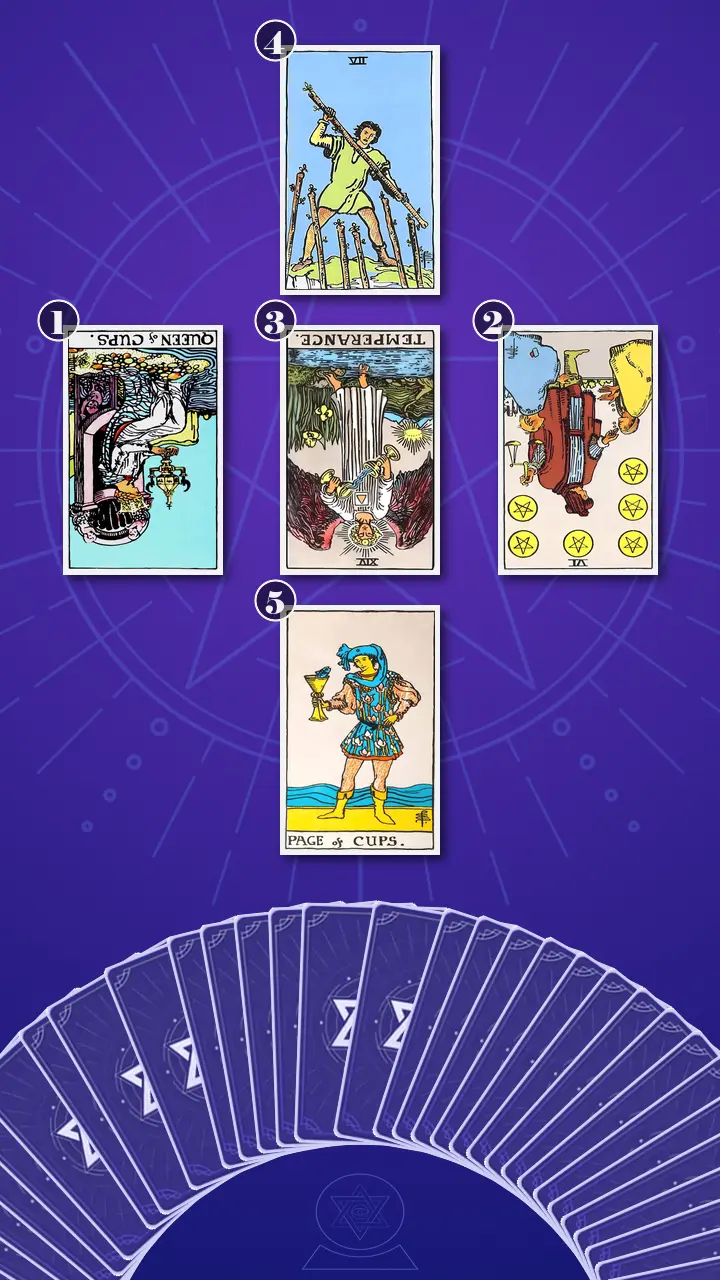
I chose the Relationship Spread · Context Edition, a five-card relationship tarot spread for peacekeeper burnout and relationship boundaries. A larger Celtic Cross would have supplied more information than this focused question needed. This spread gave me the minimum useful structure: Maya’s current stance, the demands she perceived, the central relationship pattern, the capacity that could interrupt it, and one self-led way to integrate the insight.
I also explained how tarot works in my practice. I do not use a relationship reading to claim access to someone else’s private thoughts or predict whether a person will stay. I use the cards as an objective cognitive mirror: each position separates one part of a tangled experience so that card meanings in context can reveal patterns, choices, and resources that ordinary mental rehearsal keeps blending together.
I placed the third card in the centre. The first and second sat to either side, showing Maya’s posture and the expectations entering the relationship. The fourth went above the centre as the challenge and transformative capacity. The fifth went below as the grounded next step. Together, the cards formed a compass: self-suppression and relational demand feeding the central strain, then boundary and emotional expression creating a new direction.
The Closed Cup and the Unequal Care Budget
Position One: The Feeling Kept Behind Glass
I began with the card representing Maya’s current behavioural and emotional posture: what happened inside her while she monitored and regulated everyone else’s feelings.
I turned over the Queen of Cups, reversed.
I pointed to the Queen’s elaborate closed cup, her concentrated gaze, and the water reaching the edge of the stone throne. Upright, the Queen can represent mature sensitivity and emotional receptivity. Reversed here, I read that sensitivity as an excess of outward monitoring paired with a deficiency of inward permission. Maya’s empathy was active, but access to her own immediate reaction was blocked.
I brought the image into her Monday morning. At 9:14 a.m. in the Shoreditch studio, a creative lead had cut across a client partner and both voices had sharpened. Maya had noticed the clipped tone, the folded arms, and a colleague staring at the table. Before checking how the dismissal had landed for her, she had softened both viewpoints and opened a clean action list. The meeting settled. Her throat did not.
“That closed cup looks like your Notes drafts,” I said. “You study the feeling carefully, but you treat it as something you must keep sealed until everyone else is stable.”
I asked, “In the first five seconds of that meeting, before you started translating, what did you feel?”
Maya gave a small, bitter laugh. “Honestly? That’s so accurate it’s almost rude. I felt dismissed. Then I immediately thought the client partner looked embarrassed, so I dealt with that instead.”
“The card isn’t accusing you,” I said. “It’s separating your skill from the cost of using it automatically. Emotional intelligence is still one of your strengths. The question is whether your own emotion is allowed into the intelligence you’re applying.”
Position Two: When Help Only Travels One Way
I moved to the card representing the demands and expectations Maya perceived around her peacekeeper role. I framed the position carefully: I was not reading her friends’ hidden motives. I was examining the role their observable requests repeatedly asked her to occupy.
I turned over the Six of Pentacles, reversed.
The scales and finite coins turned the reading from private emotion towards a relational care budget. Upright, this card can depict giving, receiving, and measured exchange. Reversed, its energy showed an imbalance: support moved reliably through Maya, while curiosity about her capacity and consent did not move back with the same consistency.
I asked her to remember the last time two friends had messaged privately after an argument. Each had asked what the other person “really meant.” Maya had spent nearly an hour carrying context between them, reassuring both, and preventing another flare-up. Both thanked her for being helpful. Neither asked what it had been like for her to be pulled into the middle.
“It’s like a shared subscription everyone assumes will renew,” I said. “The care looks free because you keep paying the emotional bill quietly. Usefulness gets acknowledged; reciprocity is less dependable.”
I watched Maya’s thumb rub the edge of her phone case. “I feel proud that they trust me,” she said, “and then I resent them for using me. Which feels unfair, because I agreed.”
“Agreement made under an automatic role is worth examining,” I replied. “You can be generous and still ask whether you freely consented to this particular job. Recognising the imbalance does not require you to refuse every ordinary request for support. It means support can have a limit, and care can move in more than one direction.”
I placed my finger between the Queen’s sealed cup and the Six’s inverted scales. “You can understand every side without surrendering your own.”
Position Three: The Message Edited Past Recognition
I returned to the centre and named the role before turning the card: this position revealed the shared pattern beneath the apparent calm, including the over-adjustment and unequal emotional labour that kept Maya’s inner conflict alive.
I turned over Temperance, reversed.
I traced the stream passing continuously between the two cups and the figure’s divided footing on land and water. Temperance upright integrates differences through proportion. Reversed here, that work had become an excess of adjustment and a blockage of stable self-positioning. Maya kept blending viewpoints before identifying which emotional ingredient was hers.
I took her back to 10:47 p.m. She had revised the WhatsApp message until every friend’s perspective had been acknowledged and every uncomfortable edge had been diluted. The first line, “I felt overlooked too,” disappeared. The final version calmed the thread but left hurt, resentment, and guilt sitting with her in the quiet kitchen.
“The inner script sounds like this,” I said. “If I can just find the perfect tone, nobody will be upset, and then I can deal with my part later.”
I call this Internal Monologue Auditing: I listen for the destructive film genre an anxious inner script has assigned to an ordinary moment. Maya’s internal editor had turned temporary awkwardness into a disaster film in which one badly received sentence could end belonging. Every pause received ominous music; every disappointed reply became foreshadowing.
I thought of long hours in an editing suite, where trimming half a second can sharpen a scene but cutting the central line can change what the scene is about. Maya was not merely polishing her messages. She was editing out the protagonist’s point of view.
“Balance is not everyone else staying comfortable at your expense,” I told her. “Manufactured calm asks one person to keep pouring. Mutual balance lets more than one truth remain in the cups.”
Her breath caught first. Then her eyes moved away from the cards and held on the rain-streaked window, as though she were replaying the exact moment her original sentence vanished. Finally, a long “Oh” left her chest, and I saw her raised shoulders drop by a fraction.
“I thought I was preventing conflict,” she said. “But I’m also preventing anyone from responding to the real me.”
“Yes,” I said, gently. “And that recognition is information, not a verdict. The blind spot is not that you lack communication skills. It is that your skill has been recruited into maintaining a counterfeit balance.”
When the Seven of Wands Refused to Leave the Field
Position Four: The Antidote to Disappearing
I lifted my hand to the card above the centre. This position represented the challenge and transformative capacity that could interrupt Maya’s cycle: holding a recognisable position and tolerating temporary disagreement without immediately mediating it away.
As I turned over the Seven of Wands, upright, the fridge in Maya’s kitchen clicked off. Even the rain seemed to thin. The sudden quiet gave the card’s protective Fire more space.
I showed her the figure on elevated ground, holding one staff while six rose from below. I did not frame the image as a battle Maya had to win. The elevation was simply a visible place to stand. Upright, the card carried balanced protective energy: agency without abandonment, firmness without emotional hardening, and enough tolerance to let discomfort exist without treating it as catastrophe.
I offered the familiar scenario. Two friends send Maya another pair of private messages and ask her to carry their words across the gap. This time, before she begins translating, she replies: “I care about both of you, but I’m not going to mediate this.” Heat rises into her face. She does not add a paragraph designed to make the boundary painless. She remains their friend while declining the role.
This was where I used my second diagnostic lens, Persona Fatigue Diagnosis. I told Maya that I did not hear fakery in her calmness; I heard a real social skill trapped inside an overworked character called “The Reasonable One.” That character had become permanently on call. She entered each scene already knowing her lines: soften, translate, reassure, disappear. The psychological cost came from never being allowed to step out of character long enough to have an unscripted reaction.
I asked Maya to return to 10:47 p.m.: the flat quiet, phone warm, honest sentence deleted, soothing message sent, throat tight. I could see how the demand to get the tone exactly right had turned her own feeling into collateral.
I said, “Your feelings pile up because you enter conflict as its manager before you enter it as a participant. Peace that requires your disappearance is not shared peace.”
Peace is not the same as disappearing; hold one clear boundary, like the Seven of Wands figure who protects their ground without leaving the field.
I let the sentence remain between us.
Maya’s breath stopped. Her fingers froze above the phone, and her eyes widened before narrowing with a flash of anger. “But doesn’t that mean I’ve been doing it wrong this whole time?” she asked. The last words came out thinner than the first, with grief underneath them.
I did not rush to turn that anger into relief. “No,” I said. “It means the strategy worked well enough to create short-term safety, and now the cost is visible. You learned to keep connection by being useful. We’re not putting your past self on trial for using what she had.”
Her gaze lost focus for a moment as memories seemed to move behind it. Then her fist loosened against the table. She exhaled with a slight tremor, shoulders sinking, but the clarity left her briefly exposed: if the role was not compulsory, the next choice belonged to her. I saw relief arrive beside that new responsibility, not instead of it.
“Now, with this new perspective, think back to last week,” I invited. “Was there a moment when this insight might have changed how the situation felt?”
She described the tense studio meeting again. Everyone had turned towards the calm project coordinator, and she had felt her shoulders lift in the half-second before she started translating. “I could have said, ‘Before I suggest next steps, I want to say how that landed for me,’” she said. “That would have kept me in the meeting.”
“Exactly,” I replied. “A boundary is how you stay in the conversation without disappearing inside it. This is the shift from managing conflict through self-erasure to grounded self-advocacy and honest relational participation.”
I named the practical mechanism beneath the breakthrough: a boundary-before-bridge pause that names one feeling and one limit before reassurance, mediation, or problem-solving. It did not guarantee that another person would respond perfectly. It ensured that Maya’s experience would no longer be excluded before the conversation had even begun.
The Small Message That Escaped the Final Edit
Position Five: From Emotional Expert to Honest Beginner
I moved to the card below the centre. This final position represented self-led integration: one small emotional message or boundary that would let Maya participate in a relationship instead of managing it from the sidelines.
I turned over the Page of Cups, upright.
I drew her attention to the fish emerging unexpectedly from the cup and meeting the Page’s gaze. The first cup in the spread had been ornate, sealed, and intensely studied. This cup produced a living message. Upright, the Page brought balanced, mobile Water: curiosity, sincerity, and permission to speak before emotional expertise had converted the feeling into a complete case.
I pictured the next morning with Maya. Instead of sending several paragraphs about everyone’s motives, she writes one line to a trusted friend: “I care about this relationship, and I felt dismissed last night.” She offers no evidence bundle and no immediate solution. The sentence is modest and slightly awkward, but it enters the relationship while the feeling is still alive and specific.
“The fish is the sentence hiding beneath your analysis,” I said. “‘I felt dismissed.’ Not the whole case. Simply the part that is yours.”
Maya’s mouth softened into a small smile. “That sounds almost too short.”
“Short can feel exposed when explanation has been your armour,” I replied. “Your first honest sentence does not need to be your final, perfect one. The Page is not asking for a dramatic confrontation. It is asking whether one timely truth can leave the Notes app before it hardens into distance.”
I also pointed out that no Swords card had appeared. I did not treat the absence as a warning. I read it as a practical correction: Maya did not need another private round of analysis before she was allowed to speak. Reversed Water had shown emotion trapped in overfunctioning. Reversed Earth had exposed unequal exchange. Temperance had revealed unstable blending. Upright Fire established a boundary, allowing Water to return as an honest message.
“You don’t need to replace sensitivity with hardness,” I said. “The Seven gives your sensitivity a protected place to stand. The Page lets it speak.”
The Boundary-Before-Bridge Method
I gathered the spread into one continuous story. Maya’s genuine empathy had repeatedly been praised at work and in her friendships, so calm usefulness had become one of the safest ways to secure belonging. The reversed Queen showed her containing personal reactions. The reversed Six showed a care economy in which mediation flowed through her more reliably than reciprocal attention flowed back. Temperance revealed why the pattern kept repeating: she manufactured balance by adjusting herself. The Seven restored a position of her own, and the Page showed that a protected position could support tenderness rather than replace it.
In the film language I naturally use, Maya had bravely stayed in one scene too long: the scene where everyone looked towards her, she fixed the tension, and the story moved on without recording what happened to her. The cards did not demand a personality rewrite. They gave us an edit point.
I named her cognitive blind spot plainly: she had been treating other people’s immediate comfort as evidence that a conversation was successful. The transformation direction was equally plain: replace automatic agreement with a pause, then name one feeling and one boundary before offering a solution. Harmony could include respectful disagreement. Connection did not need to be purchased through unpaid mediation.
For the next steps, I paired the cards with my Director’s Cut of Self-Compassion. This technique interrupts the punitive inner narration that often follows a boundary. Instead of replaying the scene as a judge saying, “You were selfish; fix it now,” I asked Maya to describe it like an objective, supportive director reviewing a difficult take: “I noticed the urge to reassure. I stated my capacity. Discomfort appeared. I stayed present.” Then I gave her three small experiments and asked her to choose only one.
- Take the Ten-Minute No-Mediation Pause.During one tense Slack or WhatsApp exchange this week, wait ten minutes before summarising anyone’s position or proposing a compromise. If a reply is expected, send: “I need a little time to work out what I think before I respond.”If ten minutes feels impossible, take one slow breath and allow ten unsent seconds. If the interaction feels coercive or unsafe, pause for longer or opt out entirely.
- State One Limit Before Building the Bridge.The next time two friends ask you to relay messages, write: “I care about you both, but I’m not able to carry messages between you.” Send the limit before explaining, reassuring, or negotiating.Keep the boundary about the role, not the people. Do not add several paragraphs to guarantee that nobody feels disappointed; their temporary discomfort does not automatically make the limit wrong.
- Make the Unsent First-Person Sentence Visible.Open Notes and set a five-minute timer. Complete: “Before I solve this, I feel…” and “What I am not available to do is…”. Choose one line that could be spoken in a low-stakes conversation within twenty-four hours of a small hurt.You do not have to send it. If guilt begins its courtroom monologue, use the Director’s Cut: describe what happened as a supportive observer, without prosecuting your need or rewriting the boundary.
“This is not homework you can fail,” I told her. “One pause counts. One private feeling counts. The purpose is not to become fearless; it is to gather evidence that you can feel boundary guilt without automatically handing the pen back to it.”

A Week Later: A Sentence of Her Own
Six days later, I received a message from Maya. In a studio meeting, a colleague had started steering past her timeline concern. She felt her shoulders rise and recognised the familiar cue to translate everyone else first. Instead, she said, “My concern is the timeline. After we address that, I can help organise next steps.”
She told me there had been seven uncomfortable seconds before anyone replied. Nobody applauded. The colleague looked surprised, asked a follow-up question, and the meeting continued. Maya did not solve her whole relationship with conflict. She simply remained visible inside one conversation.
That night, she slept through, then woke with “What if I made it weird?” as her first thought. This time, she smiled, made coffee, and left the message unedited.
I did not credit the cards with changing Maya’s fate. They had offered a structured view of the scene: a closed cup, unequal scales, endless pouring, defended ground, and one surprising message. Maya supplied the pause, the sentence, and the willingness to remain present. The pen had always been hers.
I think of this Journey to Clarity as movement, not arrival: from outward calm and private hurt towards cautious self-advocacy; from being needed as the conflict manager towards being known as a participant; from perfect reassurance towards one honest, imperfect line.
When the room gets tense, some of us become visibly calmer while our throats tighten, because being useful has started to feel safer than being fully known. If that is your familiar scene, noticing the moment you begin to disappear already gives you an edit point.
If you allowed one conversation to remain slightly uncomfortable, what small Page-of-Cups sentence might finally have room to exist while you keep your Seven-of-Wands ground?