The 11:40 p.m. Reply Gap
I first understood the shape of Alex's question when she described a Wednesday night in her one-bedroom Toronto apartment. Alex was a UX researcher who could interpret incomplete user data all day, then spend midnight treating a four-day reply gap like a dataset that had to contain the answer. Her research notes glowed on the laptop. The radiator clicked. Traffic hissed across wet pavement below as she scrolled back to the first week of a Hinge conversation, comparing an old twelve-minute reply with the silence on the screen now.
I could almost feel the phone heating her palm as she told me how she would place it face down, last less than five minutes, then turn it over again. The feeling behind her ribs was like a notification vibration that never completed: a constant bodily promise that something might arrive, followed by the hollow drop of nothing appearing.
“I don't need a full explanation,” she said, rubbing her thumb across the edge of her phone. “But I keep acting as if I do. If it meant something, how can it just disappear like this? How can I face this slow fade without chasing an answer?”
I told her that wanting an explanation did not make her needy, foolish, or incapable of letting go. An undefined ending can leave the mind circling because there is no final event around which to organise the grief. “We are not going to force you to pretend you don't care,” I said. “We are going to make a map of what you know, what you cannot know, and where your own authority begins.”

A Compass for the Slow Fade
I invited Alex to place both feet on the floor and take one unhurried breath before we began. I shuffled slowly, not as a performance of mystery, but as a transition from the restless speed of checking into the steadier pace of observation.
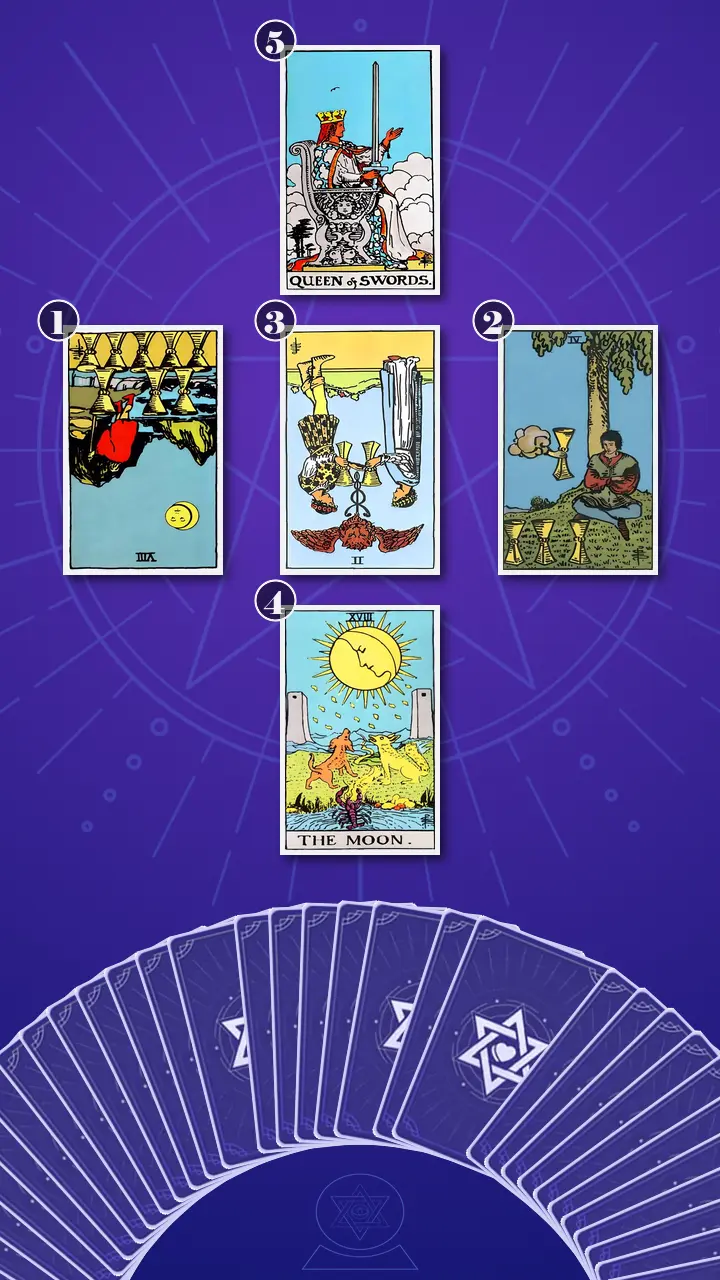
I chose the Relationship Spread · Context Edition, a five-card relationship tarot spread shaped like a compass. People often ask me how tarot works in an ambiguous dating situation. I do not use it to spy on another person's motives or predict whether a text will arrive. I use the cards to separate emotional experience, observable behaviour, relational patterns, and choices that remain within the querent's control.
This spread was precise enough for Alex's question. The first position would show how the slow fade was activating her checking cycle. The second would examine the other person's observable participation without pretending to know their private feelings. The centre would show the current condition of the bond. The lower card would reveal the uncertainty sustaining the chase, and the upper card would point toward a boundary Alex could choose for herself.
I placed the cards in their compass formation and rested my hand beside the first one. “The reading will not decide whether the past was real,” I said. “It will help us judge what the connection is offering now.”
The Cups That Kept Narrowing
Position One: The Departure That Would Not Stay Started
I turned over the card representing how the slow fade was activating Alex's checking, hesitation, and difficulty stepping back. It was the Eight of Cups, reversed.
I showed her the red-cloaked figure near the mountain path and the conspicuous gap among the cups. In its reversed position, I read the card as a blockage in the energy of departure. Alex could recognise that the current pattern was draining her, but every attempt to step back felt like a verdict on the entire connection.
“This is you putting the phone face down to begin tomorrow's research notes,” I said, “then reopening the conversation five minutes later because not checking feels more final than the slow fade itself. The thought underneath it sounds something like, 'I am not chasing. I am only checking whether the connection is still there.'”
Alex gave a short laugh, but it carried no amusement. “That's so accurate it feels a little brutal.” Her hand moved towards the phone beside her chair, then stopped halfway.
I softened my voice. “The card is not criticising the return. It is showing us why the return feels necessary. You are not only looking for information. You are postponing the grief that putting the phone down seems to represent.”
I let the distinction settle before adding, “Stepping back does not make the connection meaningless. It makes present reciprocity visible.”
Position Two: The Cup That Was Not Being Received
I turned over the card representing the other person's observable availability and participation, without claiming access to their private motives. It was the Four of Cups, upright.
I pointed to the cup extending from the cloud and the seated figure whose posture remained closed. Here, the energy showed a deficiency of visible receptivity. It did not tell me why the person was less engaged. It did tell me that Alex's openings were not being met with sustained participation.
I asked her to return to the 501 streetcar after work: wet coats carrying the smell of rain, rails shrieking through a turn, her shoulders held near her ears as she edited a check-in for the fourth time. She had removed anything that might reveal disappointment and sent, “Hey, hope your week is going okay.” Later, she saw that the person had been active on Instagram while the message remained unanswered.
“The inner bargain is, 'If I make the message easy enough to answer, maybe I will finally know,'” I said. “But this card asks a different question. How long do you want to keep holding a door open when you cannot see anyone walking towards it?”
Alex's lips pressed together. Her shoulders dropped by a fraction, and she looked away from the card towards the rain-streaked window. “I keep trying to make it impossible for them to feel pressured,” she said. “I don't think I've asked whether I'm under pressure the whole time.”
“Exactly,” I replied. “You can miss what was there without continuing to offer what is not being received. Taking low participation seriously is not the same as inventing a cruel motive for it.”
Position Three: Two Screenshots, Two Different Truths
I turned over the card representing the present quality of mutuality and the split between what the connection once meant and what it offered now. At the centre of the spread was the Two of Cups, reversed.
I read its energy as blocked and imbalanced reciprocity. The two cups are the minimum unit of a relationship: one person offering and another person receiving, then the movement returning in the opposite direction. Reversed, the exchange no longer forms a stable circuit.
I asked Alex to picture two screenshots side by side. In the first, the early Hinge conversation held quick replies, jokes, voice notes, plans, and an “I can't wait to see you again” message she still remembered word for word. In the second, the live conversation showed a four-day gap, brief replies, and Alex creating most of the openings.
“It was real then, and it is uneven now,” I said. “One truth does not have to cancel the other. This is like looking at an old version of a collaborative document while the live version shows only one active editor. The earlier work still exists, but it cannot stand in for current participation.”
Alex went still. Her eyes stayed on the reversed pair as if she were waiting for the two figures to turn back towards each other. “The beginning was too real for this to be the whole story,” she said quietly.
“It is not the whole story,” I answered. “It is the current chapter. The past can be real without being a contract for the present.”
I watched sadness move across her face, sharp but clean. It was not the shame of having imagined everything. It was the grief of recognising that genuine feeling does not automatically produce clear, sustained, mutual communication. No amount of extra analysis or perfectly calibrated messaging could perform both sides of a two-person bond.
Position Four: The Path Lit by Competing Explanations
I turned over the card representing the deeper uncertainty and projection that were turning an incomplete ending into a search for certainty. It was The Moon, upright.
As the card landed, a cloud moved across the window and the light over the table thinned. I traced the winding path between the two towers. The Moon showed the reading's central blockage: too little verified information and an excess of stories rushing in to fill the space.
I heard Alex's late-night sequence in the card. Maybe work was overwhelming them. Maybe intimacy had frightened them. Maybe there was another date. Maybe she had said something wrong. Each explanation briefly illuminated the path, then disappeared when another possibility replaced it. The available messages could confirm none of them, but her body reacted to each possibility as if it were established fact.
“Your professional strength is becoming an anxious algorithm,” I told her. “Every check teaches it that uncertainty is an emergency, so it serves you another Story view, timestamp, old message, or Reddit thread to analyse. The activity feels productive because it resembles research. But you are trying to complete a report from missing interviews and treating assumptions as findings.”
Alex's breathing paused. Her gaze lost focus, as though she were replaying several nights at once. Then she exhaled from deep in her chest and said, “Maybe it's work. Maybe it's fear. Maybe it's me. I do that exact loop.”
I asked her which parts she could verify. After a long silence, she said, “Only that the replies have become less frequent, they initiate less, and I feel worse after checking.”
“That is enough for the next card to work with,” I said. “The Moon does not promise that hidden information will be revealed. It asks whether you can move without mistaking every shadow for a fact.”
When the Queen's Sword Cleared the Air
Position Five: The Boundary Above the Fog
Before I turned the final card, the rain eased. The room became quiet enough for me to hear the paper edge move beneath my fingers.
I turned over the card defining an integration practice within Alex's control: separating past meaning from present evidence and choosing a clear contact boundary. It was the Queen of Swords, upright.
I read the Queen as balanced Air: discernment, direct self-honesty, language precise enough to protect tenderness rather than deny it. Her sword stood vertical and unobstructed, while her other hand remained open. To me, that pairing matters. Clarity does not require coldness. A boundary does not require punishment.
I described the modern version of the card: Alex opening her Notes app, writing two headings called “What was meaningful then” and “What is mutual now,” defining the level of communication she needed for dating to feel reciprocal, and choosing a no-initiation window. She would not announce a dramatic cutoff or use silence to provoke pursuit. She would simply stop treating another person's explanation as the permission slip required to protect her attention.
For a moment, I remembered my years at a perfumer's bench. A beautiful fragrance needs the right distance to diffuse. Held too close, distinct notes collapse into one dense cloud; released into a room with no receptive presence, even a remarkable composition disappears unheard. I call this Intimacy Distance Calibration, and it gave me the clearest language for Alex's pattern.
“Each time they moved farther away, you moved closer through checking, drafting, and interpreting,” I said. “You were trying to recover the original scent of the connection by reducing the distance. But closeness created by one person's pursuit is not mutual intimacy. The useful question is no longer, 'Was the fragrance ever real?' It is, 'Is there enough shared presence for it to breathe now?'”
I also applied my Boundary Permeability Assessment: where did Alex's attention end, and where did the other person's availability begin? The boundary had become porous. Their response timing was setting the temperature of her evenings, deciding whether she could focus at work, and acting as a verdict on whether she had been worthy of the original warmth.
I brought her back to 11:40 p.m.: the warm early messages, the waiting research notes, and her thumb searching a dimming screen for an explanation it could not provide. She was still trying to make a perfectly correct decision before allowing herself to protect her attention.
You do not need a final message to prove the connection was real; let the Queen's upright sword separate past meaning from present mutuality, then act on what is actually available.
You are not erasing what mattered by responding to what is available now. Closure can be the boundary that lets present reciprocity count, even when no final explanation arrives.
Alex's breath stopped first. Her fingers remained suspended over the phone in her lap, then curled slowly into her palm. I watched her pupils widen as the sentence reached whatever memory she had been protecting; her jaw tightened, her eyes shone, and for several seconds she looked more angry than relieved. “But doesn't that mean I got it wrong?” she asked. Her voice came out low and uneven. “That I kept this alive after it had already changed?” I let the question stand without rushing to soften it. Then her fist loosened. Her shoulders sank, and a long breath left her with a slight tremor. I told her, “It means you responded to uncertainty with the tools you had. Now you have clearer evidence and another tool. Growth is not a confession that your earlier self was stupid.” The release brought its own brief dizziness: if she no longer needed another reply to decide, the responsibility for her next boundary was genuinely hers.
I waited until her breathing steadied, then asked, “Now, with this new perspective, think back to last week. Was there a moment when this insight could have made you feel different?”
“Sunday night,” she said. “I knocked over my water reaching for a notification. It was a grocery delivery update. I could have admitted that I was grieving instead of opening Instagram to investigate.”
I asked her to set a ten-minute timer and create the two columns in her Notes app. She added one observable item under each. Then she chose only a twenty-four-hour no-initiation pause, not seven days, because that was the amount of space her body could imagine without locking into panic. I reminded her that she could stop if the exercise became overwhelming. The minimum version was one sentence and one evening.
I named the movement I had just witnessed carefully. It was not a transformation from grief into indifference. It was the first step from contracted uncertainty towards evidence-based clarity, and from needing another person's verdict towards steadier self-respect.
The Blank Space That Was Not a Test
I gathered the cards into one coherent story. The Eight of Cups reversed showed Alex repeatedly reaching the threshold of departure and turning back because stepping away felt like erasure. The Four of Cups showed that her carefully softened offers were meeting limited receptivity. The Two of Cups reversed placed disrupted mutuality at the centre. The Moon explained why missing information kept sending her back through the cycle. Above them all, the Queen of Swords introduced a criterion that did not require another round of contact.
I pointed out the narrowing sequence of the Cups: eight, then four, then two. The reading had reduced an overwhelming archive of memories, timestamps, theories, and screenshots to one present-tense question: Are two people participating now?
The cognitive blind spot was not that Alex cared too much. It was that she had made an explanation responsible for validating the connection's meaning and her own worth. She believed that if she could only discover why the person had withdrawn, she would finally receive permission to let go without feeling foolish. The cards showed a different direction: honour what happened, grieve what is no longer being sustained, and let observable reciprocity determine the present boundary.
I called the practical framework The Blank Space Protocol. In perfume, blank space allows individual notes to become perceptible. In relationships, intentional space can reveal whether mutual movement exists without using distance as manipulation. This protocol was not a tactic to reignite attraction or make anyone miss Alex. It was a way to return oxygen to her attention and allow current participation to become visible.
- Create a 24-Hour Blank Space WindowTonight, enter a start and end time in your phone calendar and do not initiate contact during that window. Mute the chat and the person's social updates if digital signals pull you back into analysis. When an urge appears, write one line under three headings: “Trigger,” “What I want the message to give me,” and “What I can verify now.” If twenty-four hours feels manageable, extend the window gradually towards seven days.Treat the window as observation, not punishment or a test. The minimum version is one evening, one reversible mute, and one sentence in the urge log.
- Run the Meaningful-Then, Mutual-Now CheckAt your desk or kitchen table, set a ten-minute timer. Write memories only under “What was meaningful then” and recent observable behaviour only under “What is mutual now.” Beneath both lists, write one present-tense standard, such as: “I want contact that both people initiate and sustain with reasonable consistency.” Before sending any message this week, read the second column first.Do not use the exercise to prosecute or defend the other person. Record behaviour without assigning motive. If ten minutes feels too intense, write one item in each column.
“You do not need to know why they withdrew to notice that you are carrying the contact alone,” I told Alex. “Your boundary does not claim to know what they will do. It defines what you will do with your attention.”

A Week Later: The Quiet Proof
A week later, I received a message from Alex. “I did the twenty-four hours and then extended it,” she wrote. “No dramatic breakthrough. I just stopped refreshing the chat during work. The two columns were painful, but they made the pattern impossible to blur.”
She had slept through the night. Her first thought was still, What if I am wrong? She smiled faintly, left the phone on the dresser, and made coffee before opening her laptop.
I did not read that as a perfectly resolved ending. I read it as proof of movement. Alex still missed the person. She still wished the connection had ended with clearer words. But the wish no longer had complete control over her hands, her evenings, or her definition of what had been real.
That was the heart of our Journey to Clarity. The cards had not granted Alex closure or predicted another person's return. They had helped her distinguish memory from current evidence, grief from pursuit, and a boundary from a punishment. Alex made the decision that followed.
I have learned from perfume and tarot alike that clarity is sometimes less like a door slamming shut and more like a window opening. The room is still yours. The trace of what happened may remain in the air, but your next breath no longer depends on someone else entering.
If your screen stays dark and your hand still reaches for it, I want you to remember that the ache is not only missing them. It may also be the fear that if you stop reaching, the connection and the part of you that believed in it will disappear together. They do not have to.
If you let present reciprocity count without asking it to rewrite the past, what small, breathable boundary could give tonight's attention back to you?
This story is adapted from psychological research, written so that those in a similar struggle can see their own pattern in it — and find their next step clearly.These insights are not a substitute for professional psychological, medical, legal, or financial advice.
Learn more about our Journey to Clarity.
How did this insight land for you?
🫂 This Resonates Deeply
🌀 Living This Story
✨ Now I See Clearly
🌱 Seeing New Possibilities
🧰 Useful Framework
🔮 The Confirmation I Needed
💪 Feeling Empowered
🚀 Ready for My Next Step
Author Profile
 AI
AI“As a perfumer for fifteen years, I’ve learned to perceive human boundaries through the delicate metaphor of scent. Relationships need the right amount of space to breathe, and I've seen too many kind souls exhaust themselves trying to please everyone. I’m here with warmth and understanding—not to teach you to be guarded, but to help you gently clear the air and rediscover the comforting, safe boundaries that are rightfully yours.”
In this Love Tarot Reading :
Core Expertise
- Intimacy Distance Calibration: Using the metaphor of scent diffusion to diagnose whether your relationship suffers from emotional suffocation or detached coldness.
- Boundary Permeability Assessment: Objectively evaluating where your personal identity ends and your partner's begins, identifying unhealthy enmeshment.
Service Features
- The Blank Space Protocol: A behavioral challenge to intentionally create comfortable emotional or physical distance, allowing the 'oxygen' needed to reignite mutual attraction.
Also specializes in :
Explore Related Patterns:
Boundary DiscernmentAlex opens her Notes app, separates what was meaningful then from what is mutual now, and chooses a twenty-four-hour no-initiation window that she later extends. The pause is not announced as punishment and is not designed to make the other person miss her. It defines what she will do with her own attention while leaving their choices with them. You practise Boundary Discernment when you distinguish self-protection from control. A boundary does not claim to know why another person withdrew or demand that they behave differently. It establishes the level of reciprocity you require and the action you will take when current participation does not meet that standard.
Closure ChasingEvery attempt Alex makes to step back becomes another return to the conversation because not checking feels more final than the slow fade itself. She is not only looking for new information. She is waiting for an explanation that can certify the connection as real, remove the fear that she misread it, and authorise her to grieve without feeling foolish. You enter Closure Chasing when another person's answer becomes the permission slip required for your own ending. The chase can continue indefinitely because the person who is no longer participating also controls the missing condition for release. Facing the fade begins when you allow observable non-reciprocity to guide your behaviour even while the complete story remains unavailable.
Pursuer DistancerAs the other person's replies become less frequent and their initiation declines, Alex moves closer through checking, carefully drafted messages, and interpretation. The increased effort is meant to recover the earlier sense of connection, but it also leaves her carrying more of the relational movement precisely when the other person is offering less. You may enter a Pursuer Distancer cycle when distance activates more pursuit rather than clearer evaluation. The closer you move on your own, the harder it becomes to see whether the other person is moving towards you at all. Interrupting the cycle is not a tactic to trigger pursuit; it is how you make current reciprocity visible again.
Reality TestingWhen Alex is asked what she can verify, she identifies three concrete facts. Replies have become less frequent, the other person initiates less, and she feels worse after checking. This move does not solve the hidden motive, but it separates observable participation from the stories generated to fill missing information. You use Reality Testing when you let evidence guide your next action without pretending it explains another person's private experience. A boundary does not require a prosecutable case or a cruel interpretation. Present behaviour can be sufficient data for deciding what contact is sustainable, even when the reason behind that behaviour remains unknown.
Uncertainty ToleranceAlex chooses only a twenty-four-hour pause because that is the amount of space her body can initially tolerate, then extends it without receiving the missing explanation. A week later, the thought that she might be wrong still appears, but she leaves the phone on the dresser and makes coffee before opening her laptop. You build Uncertainty Tolerance by acting without requiring every doubt to disappear first. The aim is not to become indifferent or force yourself to feel calm. It is to discover that an unanswered question can remain present without controlling your hands, your evening, or the boundary you choose next.
Compulsive CheckingAlex places the phone face down, lasts less than five minutes, and turns it over again. Each check offers a brief sense of action, but it also teaches her nervous system that uncertainty requires immediate monitoring. The relief is too short to resolve anything, so another timestamp, Story view, old message, or notification becomes the next possible source of certainty. You may recognise this pattern when checking stops being a way to receive information and becomes a ritual for managing the possibility that information might arrive. Compulsive Checking keeps the slow fade psychologically active because your attention remains organised around the next digital signal, even when the accumulated evidence is already clear enough to support a boundary.
External ValidationThe other person's response timing sets the temperature of Alex's evenings, interrupts her work, and begins acting as a verdict on whether the original warmth was real. The missing explanation gains authority over more than the relationship narrative. It also seems capable of deciding whether she was worthy, perceptive, or foolish for believing in the connection. You outsource validation when another person's reply is expected to settle questions that ultimately concern your own meaning and boundaries. Reclaiming authority does not require pretending that their response is irrelevant. It means allowing their observable participation to inform what you do without allowing their explanation or silence to define your worth.
Self-SilencingOn the 501 streetcar, Alex edits a check-in four times and removes anything that might reveal disappointment. Making the message easier to answer appears considerate, but it also removes evidence of her own experience from the interaction. The other person's possible discomfort is managed in advance while the pressure Alex carries remains unrepresented. You may use Self-Silencing when expressing a reasonable need feels more dangerous than continuing an unequal exchange. The strategy protects the possibility of contact in the short term, but it can make low participation harder to evaluate because your side of the relationship has been reduced to whatever seems least likely to trigger distance.
Cognitive FlexibilityThe two screenshots show different truths. The early conversation contains warmth, plans, and mutual enthusiasm, while the live conversation contains long gaps, brief replies, and mostly one-sided openings. Alex is invited to hold both realities without using either one to erase the other. You use Cognitive Flexibility when you can say that something mattered and that it is no longer being sustained. This releases you from choosing between idealising the past and declaring it meaningless. Missing someone, acknowledging changed reciprocity, and protecting your attention can all be true at the same time.
IntellectualizationAlex can interpret incomplete user data at work, then spends midnight treating a four-day reply gap as a dataset that must contain the answer. Her professional strength supplies a familiar defence against helplessness. By turning silence into a research task, she can remain busy with explanations instead of directly acknowledging that the relationship has changed and that the change hurts. You are not thinking too much simply because you want context. Intellectualization becomes costly when analysis performs the emotional job that grief, disappointment, or acceptance would otherwise have to perform. The investigation then feels productive while quietly postponing the experience that no amount of message analysis can complete for you.
Sunk Cost FallacyAlex compares a twelve-minute reply from the first week with a four-day gap now, and she keeps the early warmth present through remembered messages and screenshots. Past emotional investment begins functioning as a reason to continue spending present attention. Stepping back feels less like responding to current conditions and more like declaring that everything already felt or offered was wasted. You can honour what was meaningful without continuing to invest in order to prove that meaning. Sunk Cost Fallacy appears when the reality of the past is used to override evidence about the present. The earlier connection does not become false when you stop paying for it with more checking, interpretation, or one-sided contact.
Explore Related Struggles:
Ambiguity-Promise FusionAlex moves through maybe work, maybe fear, maybe another date, maybe something she said. Each explanation briefly keeps the path open, although the available messages confirm none of them. When you treat every unverified possibility as a live promise, missing information can hold the connection in suspension longer than present behaviour supports. The unanswered question then protects hope and blocks movement at the same time, because releasing the search feels like abandoning the last remaining version in which the bond could resume.
Closure-Authority SplitAlex keeps returning to the unanswered chat because putting the phone down feels like making a final judgment without the other person's testimony. The missing explanation has been given two jobs: confirming that the connection mattered and authorising her to stop pursuing it. When you need someone else's account before you can protect your attention, the boundary remains suspended even after their participation has visibly changed. The split sits between the evidence you already have and the authority you believe you still need, leaving your next move dependent on a reply that may never arrive.
Partial Exit LockAlex places the phone face down, lasts less than five minutes, and opens the conversation again. Each departure begins in her hands but is cancelled before it can become a lived boundary, because not checking seems more final than the slow fade itself. The return keeps the ending temporarily unfinished, yet it also keeps your attention attached to the same threshold. You can recognise that the exchange is draining and still remain unable to complete the first small act of leaving, because stepping back has become fused with erasing everything that came before.
Then-Now SplitAlex compares two versions of the same connection: quick replies, voice notes, plans, and anticipation at the beginning; four-day gaps, brief responses, and mostly one-sided openings now. Both sets of evidence are real, but they no longer describe the same level of participation. The strain appears when you ask the meaningful past to certify the present, or ask the present to prove that the past was false. You become caught between preserving what happened and responding to what is happening, even though neither truth needs to cancel the other.
Reciprocity DeficitAlex edits a fourth check-in until it carries almost no pressure, sends another opening, and receives no sustained movement back. The contact remains possible only because she continues supplying most of the invitations. A two-person bond cannot stay mutual through one person's precision alone. When you keep making your side easier to receive while the other side narrows, the struggle is not a failure to craft the right message; it is the growing gap between the relationship you are maintaining and the participation actually available.
Availability-Worth FusionAlex's evenings change temperature with reply timing: research stops, sleep is interrupted, and a notification pulls her across the room before she knows what it is. The other person's availability is no longer only information about their participation; it is being used as evidence about whether she was worthy of the original warmth. When another person's response becomes a verdict on your value, a four-day gap can feel like an appraisal you must overturn through better timing, softer language, or more analysis. That fusion gives their inconsistent presence authority over your attention and self-definition, even though availability can only show what they are offering now.
Explore Related Emotions:
Ambiguity DreadAlex moves from one explanation to another: work pressure, fear of intimacy, another date, or something she said wrong. None of these stories can be confirmed by the available messages, yet each one briefly takes over the path and makes her body react as though a conclusion has been reached. When verified information runs out, you can become trapped between possibilities that carry emotional force without offering direction. Ambiguity Dread is the atmosphere of having too little certainty to settle and too many plausible stories to disengage, leaving every silence charged with a meaning you cannot securely name.
Bittersweet ReleaseA week later, Alex still misses the person and still wishes the connection had ended with clearer words, but she leaves the phone on the dresser, makes coffee, and begins work without refreshing the chat. The ache remains while its control over her hands and evenings begins to loosen. Bittersweet Release is not a transformation into indifference. It is the experience of carrying what mattered without continually reenacting the search for an answer, allowing loss and regained attention to coexist without either one erasing the other.
Cautious Self-RespectAlex chooses a twenty-four-hour no-initiation window rather than a dramatic cutoff, and she treats the pause as observation rather than punishment or a test. The boundary is deliberately small because it must protect her attention without demanding that she stop caring before she is ready. You can take your own need for reciprocal contact seriously without condemning the other person or forcing yourself into emotional hardness. Cautious Self-Respect is the experience of giving your limits practical weight while allowing tenderness, doubt, and unfinished feeling to remain present.
Certainty HungerAlex says she does not need a full explanation, yet she keeps searching old messages, timestamps, Story views, and possible motives as though the missing detail must contain her permission to let go. The search is doing more than gathering information; it is being asked to validate that the connection mattered and that she was not foolish to believe in it. Certainty Hunger emerges when an answer is expected to settle your memory, your worth, and your next decision all at once. You keep reaching because uncertainty feels emotionally unfinished, even though no explanation from the other person could reliably carry every form of permission you have placed inside it.
Finality DreadAlex can place the phone face down, but she reopens the conversation because not checking feels more final than the slow fade itself. Stepping back seems to transform an ambiguous change into an ending she has personally declared, making a simple boundary feel responsible for erasing the whole connection. You can recognize that participation has narrowed and still recoil from the moment your own action acknowledges it. Finality Dread is the weight that gathers around that threshold, where protecting your attention feels less like responding to reality and more like becoming the person who makes the loss irreversible.
Grounded AcceptanceAlex places two screenshots side by side: one filled with quick replies, jokes, voice notes, and plans, and one showing a four-day gap with most openings coming from her. She is able to let the beginning remain real while acknowledging that the live version of the connection is uneven. Grounded Acceptance does not ask you to downgrade the past or manufacture indifference toward the present. It allows both truths to occupy their proper time, so memory can retain its meaning without being used as a contract that current participation must continue to honour.
Grounded AgencyAlex enters a start and end time for the pause, mutes the digital signals that pull her back into analysis, and writes a communication standard based on reciprocal participation. None of these actions claims to know why the other person withdrew or predicts what they will do next. Grounded Agency emerges when you stop making another person's explanation the permission slip required to protect your attention. You remain honest about what you cannot control while reclaiming authorship over the boundary, pace, and evidence that will guide your own next move.
Slow Fade DreadAlex compares a twelve-minute reply from the first week with a four-day silence while her research notes wait on the laptop. Because the connection has narrowed instead of ending through one clear event, each quiet interval feels provisional, as though the relationship might still return to its earlier shape if she watches closely enough. You are not simply waiting for a message in this state. You are living inside an ending that refuses to announce itself, where current withdrawal is visible but never definitive enough to stop hope from reopening the case. Slow Fade Dread names the suspended inner weather created when loss arrives by degrees and leaves you unsure when you are allowed to respond to it.
Solitary ClarityAlex writes two columns for what was meaningful then and what is mutual now, then identifies only what she can verify: replies are less frequent, initiation has decreased, and checking leaves her feeling worse. A week later, no final explanation has appeared, but the pattern has become difficult to blur. You do not need access to another person's private motives to reach a clear view of what the connection currently offers. Solitary Clarity is the steadiness of knowing enough from your own observations to make a present-tense choice, without pretending that every unanswered question has been solved.
Unspoken GriefThe early Hinge conversation held jokes, voice notes, plans, and an explicit wish to meet again; the live conversation now holds a four-day gap, brief replies, and openings mostly created by Alex. Nothing clearly names the transition between those two realities, so the loss has no shared sentence around which it can settle. You may keep investigating because investigation still implies that the relationship is an active question, while grieving requires contact with what is no longer being sustained. Unspoken Grief is the ache of losing something real without receiving a mutually acknowledged ending, leaving the heart to carry what the conversation never says.
Standby Mode AnxietyAlex turns the phone face down, lasts less than five minutes, and checks again; on another night, she knocks over her water reaching for what turns out to be a grocery delivery notification. Her work, commute, apartment, and sleep remain physically available to her, but part of her attention is continuously reserved for an arrival that may not come. You can keep completing ordinary tasks while your nervous attention stays parked beside one unresolved channel. Standby Mode Anxiety captures that half-paused condition, where life has not stopped but cannot fully move because your body remains prepared to respond at any moment.
Retroactive Rejection DreadAlex hears that she can act on present reciprocity and immediately asks whether this means she got the connection wrong and kept it alive after it had already changed. The current withdrawal threatens to travel backward through memory, recasting the early warmth as evidence of poor judgment rather than something that was meaningful at the time. Retroactive Rejection Dread appears when a present change seems capable of invalidating both your past experience and the version of you who trusted it. A boundary then feels like a verdict against your earlier self, which makes continued pursuit seem temporarily safer than admitting that a real beginning can still lead to an uneven present.
Clarity ShockAlex's breath stops, her fingers curl into her palm, and her jaw tightens when past meaning is finally separated from present mutuality. The recognition is clean enough to end the debate about what she can verify, but it also removes the uncertainty that had been postponing her responsibility to choose a boundary. When the pattern becomes visible all at once, you can feel insight as impact rather than immediate comfort. Clarity Shock names the sharp internal reorganization that occurs when you suddenly possess enough truth to act, even while the rest of you is still catching up to what that truth changes.
Reassurance CrashThe phone in Alex's palm feels like a notification vibration that never completes, and even a grocery delivery update briefly carries the promise of the message she wants. Every check creates a small surge of possible relief before the unchanged conversation delivers another hollow drop. You may reach for the screen because anticipation offers a momentary escape from uncertainty, only to feel the absence more sharply when nothing relational appears. Reassurance Crash names this repeated rise and collapse, where checking does not settle the ache but continually refreshes it.
Explore Related Contexts:
Chemistry to Consistency TestYou can place two versions of the connection side by side. One contains quick replies, jokes, voice notes, plans, and anticipation; the other contains a four-day gap, brief responses, and openings created mostly by you. Both versions are factual, but only the current one can show whether the bond is being sustained now. A Chemistry to Consistency Test begins when early intensity is no longer allowed to substitute for present follow-through. The question is not whether the first stage was real, but whether both people are converting that beginning into reliable participation. Using consistency as the criterion protects the meaning of the past while giving you a concrete basis for deciding how much access the connection receives in the present.
Relationship Reciprocity GapYou edit a check-in four times, remove anything that might reveal disappointment, and send another easy opening while the other person initiates less and leaves the message unanswered. The work of keeping contact possible has shifted toward one side even though a dating bond requires movement from both people. A Relationship Reciprocity Gap exists when access to the connection depends primarily on your continued effort. No perfectly calibrated message can restore mutuality by itself because mutuality is visible only when the other person also initiates, receives, and follows through. Naming the gap allows you to assess the exchange without turning their low participation into a verdict on your worth or a research problem you must solve.
Slow FadeYou are looking at a live Hinge thread that now contains four-day gaps, brief replies, and fewer initiations after an opening week of quick messages, voice notes, and plans. The withdrawal is occurring through reduced participation rather than a stated ending, so the external reality keeps changing without a single event that formally names the change. That pattern is the defining structure of a Slow Fade. You do not need to settle the other person's motive to take the contraction seriously because frequency, initiative, and follow-through already show what the connection is offering now. Facing it without chasing an answer begins with letting current participation count as evidence while allowing the earlier connection to remain meaningful.
Strategic Dating BoundaryYou open the Notes app, separate what was meaningful then from what is mutual now, and choose a twenty-four-hour period in which you will not initiate contact. The pause is time-bounded, reversible, and paired with a clear communication standard rather than an attempt to provoke pursuit. A Strategic Dating Boundary gives your attention a rule that does not depend on receiving a final explanation. It does not declare what the other person feels or predict what they will do; it defines how you will participate while the available evidence remains uneven. That structure returns decision-making authority to you and makes any future mutual movement visible without requiring another round of chasing.
Algorithmic Memory ExposureYou can reopen the first week of the Hinge conversation at midnight, compare a twelve-minute reply with a four-day gap, and see current Instagram activity while your direct message remains unanswered. The platforms preserve the most engaging evidence of the connection while continuously presenting new fragments that cannot explain the withdrawal. Algorithmic Memory Exposure turns relational absence into an always-accessible stream of timestamps, archived warmth, activity indicators, Story views, and suggested explanations. These signals create more material to inspect without creating more verified knowledge. Muting or limiting exposure is therefore an environmental boundary, not denial, because it removes a digital system's ability to place unresolved contact inside every work interval, commute, and late-night pause.