After a Sudden Breakup: From Clue-Seeking to Self-Authored Closure

Finding Closure After a Sudden Breakup at 12:40 a.m.
If you can map a user journey for work but keep redesigning the final weeks of a relationship in Notes, I may recognise the loop before you name it.
When Maya joined our video session from her small Toronto apartment, she told me she could still present polished UX work during the day. After the last Slack notification, though, the structure fell away. Her attention returned to the breakup as if it were an unfinished task waiting in another tab.
At 12:40 a.m. the night before our reading, she had sat on the edge of her bed with her work laptop still glowing. The fan hummed beside her. Cold streetlight lay across the duvet, while the phone in her palm had grown warm from moving between the brief breakup message, her ex's profile, and a Notes file titled What Actually Happened. She added another bullet, felt a hollow drop in her stomach, and deleted an unsent question.
"I don't want them back," she told me. Her thumb kept tracing the edge of her phone case. "But I want the ending to make sense. I keep thinking there has to be one detail I missed."
She wanted the search to end, yet every attempt to manufacture certainty kept the ending active. Her unresolved grief felt less like a passing mood than a browser session restoring itself inside her body every night: pressure behind the sternum, a locked jaw, and a hand reaching for the same tabs before she had consciously decided to open them. Beneath the grief, I could hear betrayal, anger, and the quieter fear of having become optional without warning.
"I understand why your mind is doing this," I said. "An abrupt ending leaves practical finality without emotional context, so intelligence steps in and tries to build the missing bridge. I am not going to tell you what your ex secretly thought, and I am not going to ask you to pretend the way they left was acceptable. I want us to find out what kind of closure remains available to you, even if another explanation never arrives. Let's make a map for this fog."

Choosing the Compass: The Shadow Spread · Context Edition
I invited Maya to place both feet on the floor and notice her stomach, chest, jaw, and hands without trying to change them. I shuffled slowly while she held one question in mind: What kind of closure do I need now? The breathing and shuffling were not mystical requirements. I used them as a transition from compulsive problem-solving into deliberate attention.
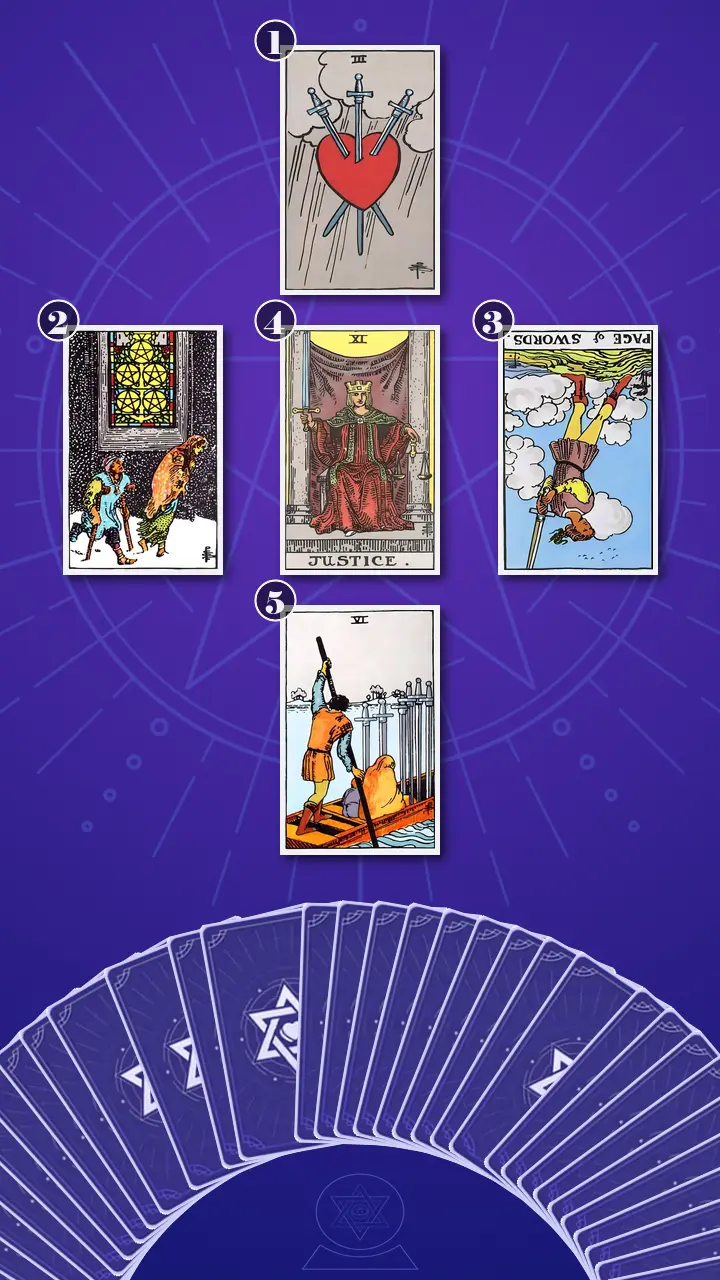
I chose The Shadow Spread · Context Edition, a five-card tarot spread for sudden breakup closure. For anyone wondering how tarot works in this kind of consultation, I do not use the cards to extract inaccessible facts or predict an ex's return. I use them as a structured psychological mirror. The images help me separate the visible pain, the fear beneath it, the defence trying to manage that fear, the capacity that can restore choice, and the behaviour that can carry the insight into everyday life.
A decision spread would have implied that Maya still needed to choose the breakup's outcome. A larger Celtic Cross would have introduced more layers than her question required. This compact Shadow Spread gave us the smallest sufficient map: heartbreak in the foreground, fear of insecure belonging underneath it, digital monitoring as protection, self-authored closure at the centre, and gradual movement as the final integration.
I arranged the cards like a keyhole or compass. The first card sat above the centre, showing the pain currently occupying her attention. The second and third cards faced each other as root and defence. The fourth waited at the centre as the interpretive hinge, and the fifth rested below it, showing how insight could become a repeatable choice. I wanted Maya to see from the layout alone that the reading would narrow toward clarity before opening into movement.
Reading the Wound Without Reopening the Case
Position 1: The Heart Under Continuous Rain
"The card I am turning over now represents the observable symptom," I said. "It shows the heartbreak and the repeated return to the sudden ending."
I revealed the Three of Swords, upright. A red heart hung exposed beneath dense grey clouds, pierced by three blades while rain fell without interruption.
I brought the image directly back to Maya's 12:40 a.m. routine. She would reread the brief breakup message and feel the ending happen again inside her body. Each ambiguous phrase became another blade to compare against an old timestamp. If the pain returned, her mind concluded that the investigation must still be incomplete.
The card's Air energy was operating in excess because thought had fused with injury. Maya's intelligence was not the problem. The assignment given to it was. She was asking analysis to make grief stop, so every fresh ache became apparent evidence that she had not researched the ending well enough.
"The hurt is real," I told her. "But the detective assignment is optional. Pain returning is not proof that a clue is missing. Sometimes it means the loss is still painful."
Maya gave one short laugh, but there was no humour in it. "That is too accurate," she said. "Almost cruel." Her breath paused, her eyes dropped to the card as if replaying the previous night, and then her fingers released the phone case by a fraction.
"The card is not blaming you for reopening the wound," I said. "It is helping us distinguish two things that have been arriving together: grief, which needs acknowledgement, and investigation, which offers ten minutes of control before the questions multiply again."
I asked what had happened immediately before her most recent message search. She remembered seeing her ex active online after her own message had gone unanswered. What she had hoped to find was not merely information. She had wanted the next five minutes to feel less powerless.
Position 2: The Lit Window Outside the Former Relationship
"The card I am turning over now represents the attachment-based fear beneath the search for answers," I said. "It shows why the missing explanation carries more weight than an ordinary informational gap."
I revealed the Five of Pentacles, upright. Two injured figures moved through snow beneath an illuminated stained-glass window. Warmth existed in the picture, but their attention and bodies were organised around the cold.
I asked Maya about a recent coffee with a mutual friend. She remembered standing near the counter when her friend paused before saying, "I haven't really talked to them." The milk steamer hissed. Maya's stomach dropped, and her fingers closed around the cardboard cup sleeve. She had immediately begun analysing the pause for hidden information.
The modern life scenario inside this card was painfully precise. When a shared friend mentioned a gathering or posted an unexpected Story, Maya did not receive it as neutral social information. She felt herself outside the secure world she had thought the relationship guaranteed. The question beneath "Will my ex be there?" was closer to "Was I the person who became optional?"
Here, Earth energy was contracted and deficient in felt security. The abrupt ending had activated a fear that closeness could disappear without warning. An explanation from the ex had therefore become more than an explanation. Maya was unconsciously asking it to prove that she had mattered, that the relationship had been real, and that she could trust belonging again.
"If I was truly important, I would have been given a better ending," she said quietly.
Her chest rose and stayed lifted. Her gaze moved away from the cards toward the dark window, and then she made a slower exhale. I watched the thought reach her in stages: first as a threat, then as recognition, and finally as sadness without an immediate question attached to it.
"The way someone ends a relationship can cross your boundary without becoming a reliable measurement of your worth," I said. "I also notice the lit window in this card. Your friends cannot replace what you lost, but the withdrawal of one person has narrowed your attention so sharply that current belonging has become harder to register."
Maya named two friends who had continued checking in. She admitted that she often redirected their care into another breakup debrief. The support was reaching her, but the investigation kept converting companionship into a search committee.
Position 3: The Breakup-Clue Algorithm
"The card I am turning over now represents the protective behaviour maintaining the problem," I said. "It shows what you do automatically to avoid being caught outside the truth again."
I revealed the Page of Swords, reversed. The Page held a sword high while turning in another direction. Hair, trees, clouds, and birds all moved at once, as if every signal in the landscape might require immediate interpretation.
I connected the card to Maya's 8:47 p.m. ride on the 504 streetcar. Wet coats smelled faintly of rain, the rails screeched through a turn, and her phone felt hot in her hand as she moved from her ex's active status to a mutual friend's Story and then to the Notes timeline. Ten possible explanations stayed open in her mind. Each fragment gave her a brief sense of preparedness, then generated another branch of uncertainty.
The Page's Air was both excessive and blocked. Inquiry had lost a clear stopping rule. Maya's alertness was like an algorithm trained on breakup clues: every profile check taught it that ambiguous evidence was important, so it served her more of the same. The volume of information began to resemble progress even when none of the sources could answer the question reliably.
This was where I used my Attachment Loop Diagnosis. I was careful not to label the relationship an anxious-avoidant trap or claim knowledge of her ex's internal pattern. The evidence did not support that certainty. I mapped only the loop I could observe: silence triggered the fear that belonging could vanish; checking created short-term control; ambiguous traces created more interpretations; the increased uncertainty then strengthened the belief that one decisive clue must still exist.
"I know checking makes it worse," Maya said, "but not checking feels unsafe."
"That makes sense inside the loop," I replied. "Your inner investigator is intelligent. It has simply been given an impossible assignment: prevent another emotional surprise by monitoring a relationship that no longer has a shared workspace."
I asked how long the relief lasted after she found something new. She looked at the phone beside her and said, "Maybe ten seconds." Her hand moved toward it, stopped, and turned it face down. That small motion did not resolve her grief, but it showed that the defence had become visible. Once a protection can be seen as a protection, it is no longer the only available response.
When Justice Closed the Open Tabs
Position 4: The Account No One Else Can Author
The room seemed to become quieter when I reached for the central card. Even the rain against Maya's window had softened. "The card I am turning over now represents the kind of closure you actually need," I said. "This is the corrective capacity hidden inside everything we have just named."
I revealed Justice, upright. The scales were level. The sword was singular, vertical, and still. Unlike the Three of Swords, its blade did not pierce the heart. Unlike the reversed Page, it did not scan a turbulent landscape. It established one steady standard.
Maya had been trapped inside the demand to make the ending completely coherent. She believed that stopping the search might mean approving what happened, while continuing the search preserved the possibility of one final, morally satisfying explanation. Justice interrupted that false choice.
Closure is not every missing answer. It is the account you can trust: what happened, what remains unknown, what was unacceptable, and what you will protect next.
I let the sentence remain between us before giving her the reading's central message.
Closure is not a verdict your ex must hand you; it is the balanced account you write for yourself, with Justice's scales separating what was yours from what was not.
For a second, Maya did not exhale. Her right index finger stayed suspended above the phone beside her laptop, as if the next refresh had been interrupted mid-command. Then her eyes moved away from the card and lost focus. I could see her replaying the midnight thread, the café pause, the streetcar Story, and the deleted message. Her jaw tightened before her shoulders dropped by a fraction.
The first sound she made was not relief but anger. "But doesn't that mean I've been doing this wrong for weeks? Like I gave them even more of my life?" Her voice caught on the word life.
I let the question sit. Outside her window, a streetcar bell cut through the wet street, one clean note against the remaining rain. "No," I said. "It means your mind found a protective job when the ending gave it nowhere to put the shock. We can respect why that job started and still decide that it no longer gets the night shift."
She pressed both feet into the floor, opened her hands, and took a breath that shook on the way out. The release was visible, but so was the blankness after it. If the search was no longer her task, she would have to feel some of the grief without the armour of research. Her eyes reddened, and she nodded once, slowly.
"Now, using this new perspective, can you think of a moment last week when this insight might have made you feel different?" I asked.
She returned to the café and her friend's tiny pause. "I could have admitted that I felt scared and left out," she said, "instead of spending the next hour trying to decide whether the pause meant they were hiding something."
I then used my Shadow Projection Analysis, not to dismiss her fear as imaginary, but to prevent the fear from impersonating a fact. I placed four distinctions in front of her. The observable behaviour was that her partner had ended the relationship abruptly and offered only a brief explanation. The triggered internal narrative was, "I was never important or securely loved." The full motive remained unknown. The boundary information was clear: abrupt disengagement without a fuller conversation did not meet Maya's standard for care, communication, or relational accountability.
I had a quiet Jungian association as I looked at the card. The shadow is not always a forbidden desire or a dramatic secret. Sometimes it is an unowned conclusion that keeps projecting itself onto every blank space. Maya's fear of being fundamentally unchosen had been writing captions beneath ambiguous online evidence. Justice did not tell her to suppress that fear. It gave her a way to identify its handwriting.
"An honest "I cannot know" is more stable than a comforting guess," I said. "You can be fair to what happened without pretending uncertainty was fair to you."
This was the reading's key shift: from externally dependent closure-seeking and hypervigilant breakup rumination toward balanced self-trust, proportionate responsibility, and clear boundaries. Maya did not suddenly possess certainty. She had begun changing the standard by which closure would be recognised.
Position 5: The Boat Leaves With the Swords Aboard
"The card I am turning over now represents practical integration," I said. "It shows how this awareness can become an everyday choice without demanding that the sadness disappear first."
I revealed the Six of Swords, upright. A small boat carried cloaked passengers toward calmer water. Six swords remained fixed in the bow. Nothing in the image suggested erasure. The travellers moved with what they had learned.
I showed Maya the difference between a memory and an assignment. She could keep the closure page, the lessons, the anger, and even the unanswered questions. What she could retire was the nightly responsibility to discover one more fact. In modern terms, she could archive the relationship without deleting its files. It no longer had to occupy the active dashboard.
The energy here was a developing balance between Air and Water. Thought was no longer being used to eliminate emotion. Clear thought could now hold emotion, choose a boundary, and direct attention toward a calmer shore. Fire was notably quiet across the spread, which told me that a forceful confrontation or one dramatic final message was unlikely to provide the medicine this reading described.
"You can carry the lesson without carrying the investigation," I said.
Maya looked back at the swords in the boat. "So moving on doesn't mean deciding it didn't matter?"
"No. It means the relationship can matter without controlling where your attention must report every night. You are not forgetting. You are ending an assignment that has no workable completion condition."
Her shoulders settled, then rose again slightly when she mentioned the Friday routines she would still miss. I did not rush to turn that sadness into optimism. The Six of Swords is a passage, not a teleportation. I saw the first credible possibility of movement precisely because Maya no longer needed movement to look painless.
The Justice Closure Account: Actionable Next Steps
I drew the full reading together for Maya. The Three of Swords showed a real wound being treated as an unfinished investigation. The Five of Pentacles revealed why the missing explanation felt like evidence about belonging. The reversed Page of Swords showed the protective strategy: monitoring digital traces, rebuilding timelines, and asking friends to reopen the case. Justice changed the job assigned to her mind, from eliminating uncertainty to creating a fair account. The Six of Swords showed that such an account could support movement while grief remained aboard.
The core metaphor was a support ticket left open because Maya believed the only person with admin access had stopped replying. Her cognitive blind spot was the assumption that feeling unsettled proved the information was incomplete, and that ending the investigation would mean approving the rupture. The transformation was not forced forgiveness or manufactured certainty. It was transferring authority from an unavailable external verdict to an internal account grounded in facts, unknowns, impact, crossed boundaries, and future needs.
I gave her three small experiments. I emphasised that none of them was a loyalty test, a moral rule, or a permanent decision. Maya remained free to pause, adjust, keep the page private, and choose the boundaries that supported her actual life.
- The Ten-Minute Justice Closure Account On one evening this week, sit at the kitchen table and set a ten-minute phone timer. Divide one page into four headings: What I know, What I cannot know, What crossed my boundary, and What I need in future relationships. Under facts, include only observable events. Give guesses and unanswered motives their own place rather than letting them merge with self-worth. Write one sentence under each heading if concentration is low. An honest "I cannot know from the information available" is a complete entry. Do not use the page to prosecute yourself or diagnose your ex, and stop if your body becomes more activated.
- The Two-Minute Projection Detachment Exercise When the urge to open your ex's profile appears, use a pinned phone note before checking. Record the observable trigger in one plain sentence, then complete: "The question I want answered is..." and "The need underneath that question is..." Stop after naming one need, such as reassurance, dignity, honesty, belonging, or protection. Keep actual behaviour separate from the triggered internal narrative. "They were active online" is an observation; "I never mattered" is a fear-based conclusion. The goal is not to argue with the fear, only to recognise which voice is speaking.
- The Seven-Day Attention Boundary Before the checking window that usually starts around 11:30 p.m., mute or restrict your ex and one account that mainly supplies indirect updates. Add a calendar reminder to review the boundary after seven days. Pair the space with one present-life plan, such as a forty-minute Friday walk through Trinity Bellwoods with a trusted friend or a twenty-minute breakup check-in followed by another topic.Muting is not punishment; it is attention management. Expect the first interruption of the checking ritual to feel uncomfortable before it feels peaceful. Keep supportive mutual friendships, and review the boundary instead of treating it as an irreversible rule.
"These are not ways to prove that you are over it," I told Maya. "They are small reality tests. Each one asks whether your attention can return to you for a few minutes without requiring the unanswered questions to disappear."

A Week Later: The Quiet Proof
A week later, Maya messaged me. She had filled the four headings, muted two accounts, and slept through the night. Her first waking thought was still, "What if I got it wrong?" She said she smiled, made coffee, and left the phone charging.
The unknowns column had been the longest, but it had not swallowed the page. She had also asked a friend for a bounded check-in and then walked through Trinity Bellwoods in damp afternoon light, talking eventually about a difficult design review, a new podcast, and what they wanted for dinner. The breakup was present, but it was no longer the only subject allowed in the room.
I did not see this as tarot magically giving Maya closure. The Shadow Spread · Context Edition gave us a structure, but Maya supplied the honesty, the boundaries, and the willingness to let an unanswered question remain unanswered. The meaningful change belonged to her: she had moved one step from external closure dependence toward self-trust, without denying either the love or the injury.
If tonight your phone is already warm in your hand and your chest tightens over one more possible clue, I want to name the fear beneath the gesture. Putting the phone down can feel like accepting both the way they left and the possibility that your place with them was never secure. It is neither. It can simply be the first moment you stop assigning the rupture another nightly shift.
If you allowed one unanswered question to remain in Justice's unknowns column tonight, what small part of your attention might you bring back into the room with you?