Chasing Closure at 11:47 p.m.
I said, “You can write a clean product launch brief before lunch in Toronto and still reopen one old friendship thread on the walk home. You can be competent and decisive in most of life and still rewrite one message when their online activity contradicts the hope that they are simply busy.”
Alex, a 28-year-old product marketing coordinator, sat on the edge of their bed during our video call. It was 11:47 p.m. in their shared Toronto apartment. A radiator clicked behind them, their phone cast a cold blue rectangle across the room, and one restless hand kept moving a fourth follow-up from Apple Notes into the message box and back again. “I don't even need us to be close again,” they said. “I just need them to acknowledge what happened.”
Their longing for acknowledgement had the physical insistence of a phone vibrating on a table even after it had stopped: chest braced, jaw locked, fingers still reaching for a signal that was no longer arriving. Underneath it, I heard resentment, grief, and the quieter shame of being practical everywhere else while one friendship breakup with no closure kept turning evenings into evidence-gathering sessions.
“If I stop asking, it feels like they get to rewrite the friendship,” Alex said. “One honest conversation would let me move on.”
I let that sentence rest before answering. “Wanting the rupture acknowledged is not embarrassing, and I am not going to tell you to just let go. I also won't pretend the cards can disclose what your friend privately thinks. What we can do is map why another message feels like the only available door, what that pursuit is costing you, and where your own choices begin. Tonight, we're looking for clarity, not a verdict.”

Choosing a Map That Does Not Read Minds
I asked Alex to put both feet on the floor, place the phone face down, and take one unforced breath. I shuffled slowly while they held one question in mind: “Why do I keep chasing closure from a low-contact friend?” The pause was not a mystical performance. It was a way to move from reflexive checking into deliberate attention.
I chose the Relationship Spread · Context Edition, a five-card relationship tarot spread adapted for unresolved friendship closure and self-directed boundaries. For anyone wondering how tarot works in a situation like this, I use the cards as structured prompts. They help separate observable behaviour, emotional history, repeated patterns, and available choices. They do not give me ethical permission to read another person's mind.
This spread was more useful than a larger Celtic Cross because Alex's question had a focused relational structure. The first position would show Alex's current stance and repeated return to the chat. The second would examine what the friend's low-contact pattern actually made visible, while leaving private motives unknown. The foundation card would show why the friendship carried so much weight. The centre would expose the checking-drafting-relief loop, and the final card would point toward a boundary Alex could choose without predicting the friendship's outcome.
I placed the fourth card at the centre, the first and second cards on either side, the third below, and the fifth above. The arrangement resembled a compass. Its north point was not an explanation the friend had to provide; it was a direction Alex could take.
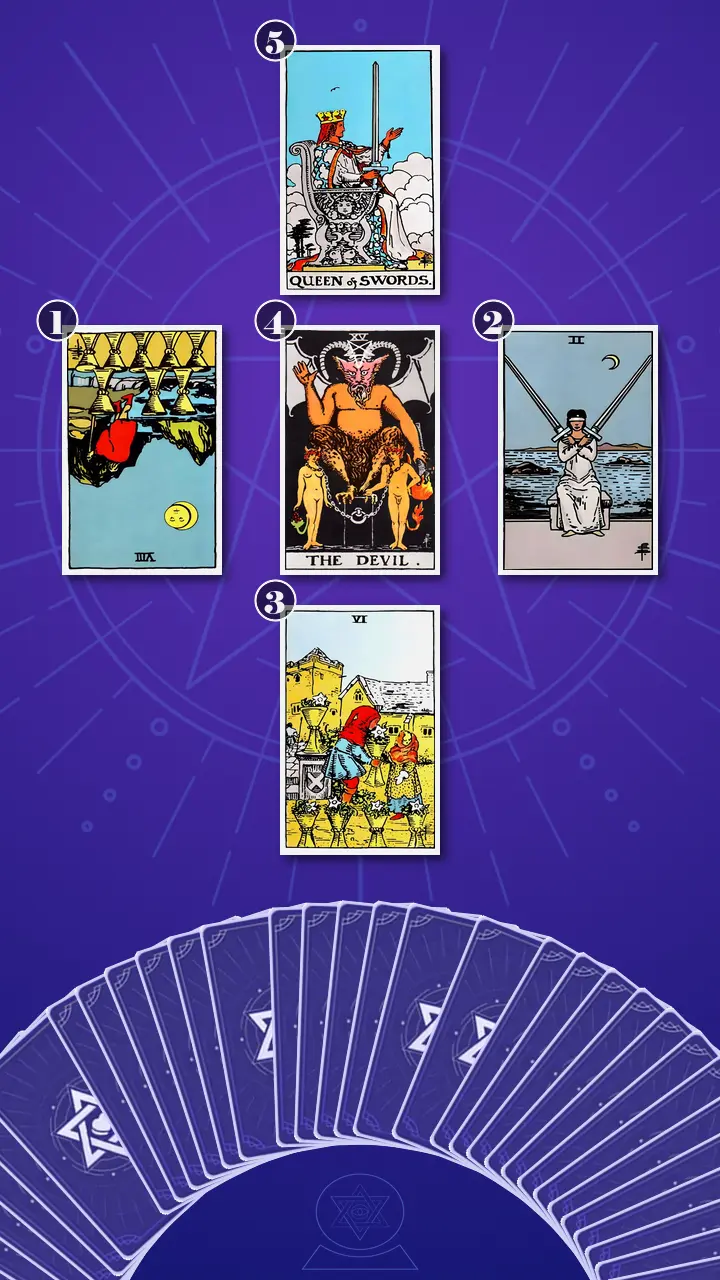
The Moonlit Return to the Chat
Position 1: Eight of Cups Reversed and the Tab That Never Closes
I turned over the card representing Alex's current stance, specifically the repeated return to messages and attempts to obtain acknowledgement. It was the Eight of Cups, reversed.
In the image, a cloaked figure appears ready to leave eight cups beneath a watchful moon, yet a visible gap in the arrangement makes the scene feel unfinished. Reversed, the departure stalls. I connected it directly to Alex closing the iMessage thread on the edge of the bed, reopening it later, and scrolling from a recent two-line reply back into months of affectionate messages. Each new follow-up looked like movement, but it returned their attention to the same emotional scene.
I described this as blocked Water energy. The feeling was not flowing toward grief, repair, or a chosen ending; it was recirculating. Closing the chat produced distance for a few minutes, but the missing explanation acted like a browser tab with one unresolved loading icon. Alex kept returning in case the emotional content had somehow changed.
“Before another message,” I said, “the useful question is not whether your wording can become more perfect. It is whether this contact seeks genuinely new information or temporary relief from uncertainty.”
Alex gave a short laugh that held more ache than humour. “That's so accurate it's kind of brutal.” Their thumb stopped above the phone, then curled into their palm.
“The accuracy is not an accusation,” I replied. “The card is describing a return pattern, not calling you weak for having one. The history matters. We still need to understand why leaving the question alone feels like abandoning the truth.”
Position 2: Two of Swords and the Limits of Incomplete Data
I opened the position identifying what Alex could responsibly infer from the friend's observable low-contact pattern and, just as importantly, what remained unavailable. The card was the Two of Swords, upright.
The blindfolded figure held two swords crossed over their chest. Water moved in the distance, but the pose allowed no clear approach. I told Alex the card did not reveal what their friend felt. It showed an information stalemate: several explanations might fit, but the evidence could not reliably choose between them.
Alex had built a Notion timeline from dates, reply lengths, old voice notes, and Instagram activity. At work, that kind of analysis could reveal a campaign pattern. Here, message length, punctuation, and response time were incomplete analytics. They could log visible activity, but they could not identify an unspoken motive. Studying the same screenshots at a higher zoom would not create a missing conversation.
The Two of Swords showed blocked Air energy. Alex had plenty of analysis, but too little dependable information for analysis to resolve the question. The blockage was maintained each time an unknown motive was treated as a solvable research task rather than an acknowledged limit.
I asked, “Looking only at the last month, what has your friend actually offered? Not what it might mean. What happened?”
Alex looked away from the screen. “Two brief replies. No answer to the actual question. No plan to talk. They still react to things in the group chat sometimes.”
“Those are facts,” I said. “They can tell you something about current availability. They cannot tell you that you never mattered, and they cannot tell us why the friend is unavailable. Silence can tell you about availability; it cannot, by itself, measure your worth.”
Alex's shoulders stayed high, but their hands became still. I could see the first uncomfortable distinction taking shape: leaving a motive unknown was not the same as surrendering reality.
Position 3: Six of Cups and the Friendship That Was Real
I turned to the card representing the remembered warmth and shared history beneath the present rupture. It was the Six of Cups, upright.
A child offers another child a cup filled with white flowers inside an old, protected courtyard. I read its Water energy as genuine emotional generosity and familiarity. Alex was not attached to an imaginary bond. They were remembering years of spontaneous plans, long voice notes, affectionate jokes, and the feeling of being understood without having to provide a full briefing first.
I asked which memory arrived most often when the current silence hurt. Alex answered without pausing. “They once came across the city after I had a terrible date. They brought fries, sat on my kitchen floor, and stayed until two. I didn't even ask them to.”
The muscles around Alex's mouth tightened. Their eyes dropped to the cards as if the flower-filled cup had become that paper bag of fries. I could see grief arrive beside resentment, not after it. That emotional overlap mattered. The past warmth was evidence that the friendship had been meaningful, but Alex had begun using its reality as an implicit contract: if the bond was real then, a full explanation should still be available now.
“Honouring what was does not require granting the past unlimited access to the present,” I said. “The old closeness can remain true without deciding what level of reciprocity exists today.”
Alex inhaled slowly through their nose. “So moving on wouldn't mean I made it all up.”
“No,” I said. “It would mean you are allowing two truths to coexist: the friendship mattered, and the present contact may not be capable of giving you what you need.”
When the Loose Chain Became a Notification Loop
Position 4: The Devil and the Price of Brief Relief
I revealed the central card, the position exposing the present Betrayal-Closure Lock and the way ambiguity, checking, renewed pursuit, and temporary relief reinforced one another. It was The Devil, upright.
I made one point immediately: I was not calling Alex's friend evil, and I was not turning Alex's longing into a diagnosis. The Devil describes bondage, compulsion, and a bargain that feels involuntary even when some part of the chain can be changed. In the card, the chains around the two figures are loose. That detail matters more than the horned figure above them.
I asked Alex to remember the previous morning on TTC Line 1. Their message had gone unanswered, but an Instagram Story appeared showing the friend at a rooftop bar. Alex described the brakes squealing, wet coats carrying a metallic smell through the carriage, and the phone warming their palm. Their thumb had hovered for half a second before opening the Story.
“What was the sentence underneath the impulse?” I asked.
Alex's jaw shifted. “I'm not trying to control them. I'm trying not to feel erased.”
There it was. The unanswered message created tension. Checking the Story provided a new data point and a short burst of control. Editing a follow-up extended that relief. Asking a mutual friend for clues extended it again. Then the same silence returned, now carrying more material to analyse. The chat thread behaved like an algorithmic recommendation loop: each check gave a tiny reward, so Alex's attention kept being served the same question.
I named the inner contradiction carefully: “I am only trying to understand. But I keep handing my attention to the same unanswered question.”
The Devil's upright energy showed an excess of attachment to one route of relief and a blockage of every route that did not involve the friend's participation. The next reply had become a permission slip for Alex to release their own experience. Yet the possibility of a reply was not the same as a reliable source of clarity.
“Closure-chasing is often a request for relief wearing the clothes of a question,” I said. “That does not make the question dishonest. It means we need to notice what the action gives you for five minutes and what it leaves unresolved afterward.”
Alex's breathing paused. Their gaze drifted past the screen as if replaying the Story notification, the follow-up draft, and the seconds of relief in sequence. Then their shoulders lowered by a fraction. “I hate that I know it isn't helping and still want to check.”
“Pattern recognition is not self-blame,” I said. “The loose chain does not mean you should have left sooner. It means the next small choice is available without requiring you to deny the friendship, block anyone in a surge of anger, or force a dramatic ending.”
When the Queen of Swords Drew a Humane Line
Position 5: The Antidote Above the Centre
The radiator behind Alex clicked once and went quiet. In the small silence that followed, I turned over the card above the centre, the position defining a self-directed route through facts, grief, and boundaries without predicting the friendship's outcome. It was the Queen of Swords, upright.
The Queen held one sword vertically while extending her other hand toward the horizon. I read the upright sword as a precise line between observable reality and hoped-for explanation. Her open hand kept that line humane. This was balanced Air energy: discernment that could contain grief without letting grief negotiate every fact.
In modern life, I saw the Queen sitting with Alex at a kitchen table in daylight. Two headings waited in Apple Notes: what I know and what I hope they will explain. The first held visible contact, dates, and direct words. The second held possible motives, unanswered questions, and the wish that one conversation could certify both the friendship and Alex's worth.
I could see Alex was still caught inside a brutal equation: if the friend explained, the bond became real; if Alex stopped asking, silence won. At 11:47 p.m., with a fourth draft waiting in Notes, the screen held years of history and no missing conversation.
You do not need one more reply to make your experience real; name the truth you can verify, choose the boundary you control, and let the Queen's upright sword separate clarity from pursuit.
For one beat, Alex stopped breathing. Their fingers remained suspended above the face-down phone; then their eyes lost focus, as though the sentence had sent them back through every carefully edited follow-up. Their pupils widened. The corners of their mouth pulled tight, and their eyes began to shine. Then resistance arrived before relief. “But doesn't that mean I was wrong the whole time?” they asked, sharper than before. “That I kept begging for something I should have known I wouldn't get?” I watched their shoulders rise again and their hand close around the edge of the duvet. “No,” I said. “It means your earlier messages were attempts to seek repair with the understanding you had then. Clarity changes your next choice; it does not put your past self on trial.” Their fist loosened one finger at a time. A long breath left their chest, followed by a small, unsteady “Oh.” Their shoulders dropped, but the new openness left them looking briefly exposed, almost dizzy with the responsibility of having a choice.
I asked, “Now, with this new perspective, think back to last week. Was there a moment when this distinction might have let you feel something different?”
“On the train,” Alex said. “The Story only proved they were available to post. It didn't prove they were available for this conversation. And it definitely didn't prove I wasn't important.”
I then used a lens from my work that I call Clique Power Dynamics. In tight friend groups, an informal hierarchy can form without anyone openly designing it. The person who stays silent can begin to hold the apparent authority over what the rupture means, while the person seeking acknowledgement is cast as the applicant, repeatedly auditioning to have their hurt accepted. Each time Alex asked a mutual friend to decode sparse replies or online activity, the unavailable friend was placed at the centre of the story again.
“This doesn't prove your friend is intentionally manipulating the group,” I said. “It shows how the social structure has been operating. Refusing to audition for acknowledgement is not letting them rewrite the friendship. It is refusing to treat their version, or their silence, as the only authorised cut.”
I thought of an editing room, where raw footage can be real even when the missing scene was never filmed. Alex had been rewriting their own line as if a more elegant performance could summon the absent actor back onto the set. The Queen of Swords asked for a different edit: preserve the scenes that happened, mark the gap honestly, and stop sacrificing the present production schedule to footage that may never arrive.
I set a ten-minute timer. Alex opened Apple Notes and wrote three observable facts. The replies had become brief. The rupture question had not been answered. No direct conversation had been offered. Under the unmet need, they wrote acknowledgement. Beside the fourth draft, they wrote reassurance.
“Keep it unsent for twenty-four hours and mute the thread for tonight,” I said. “A pause is not a permanent ending. If the exercise makes your body tighten further, stop after one fact. The boundary remains yours to adjust.”
I named the emotional crossing we had reached: from compulsive reassurance-seeking and outsourced closure to clear-eyed self-trust and a reciprocity-based contact boundary. It was not a leap from feeling to numbness. It was one step from feelings circulating without a container toward feelings held alongside evidence, choice, and self-respect.
The Boundary That Did Not Need Permission
I drew the five cards together into one coherent story. The Six of Cups showed why the loss carried such weight: the friendship's warmth had been real. The Eight of Cups reversed showed Alex repeatedly returning to that history because departure without acknowledgement felt like erasure. The Two of Swords showed why further analysis could not complete the picture: the available evidence did not disclose a private motive. The Devil revealed the bargain beneath the pursuit, with attention exchanged for the possibility of brief relief. The Queen of Swords offered the resource that had been present but underused: Alex's ability to distinguish fact from hope and make a humane decision from observable reciprocity.
The central blind spot was not simply overchecking. It was the belief that the friend's acknowledgement had to arrive before Alex could trust their own account, grieve the rupture, or set a contact standard. That belief also allowed silence to become evidence about personal worth when it was only evidence about current availability.
I noticed that the spread contained Cups and Swords but no Wands or Pentacles. Feeling and analysis had filled the frame; fresh action and repeatable routine were missing. The next step therefore needed to be modest and physical, not another comprehensive theory of the friendship.
“Name the fact. Name the need. Choose the boundary,” I said. “Those are your next steps. They are experiments in self-direction, not punishments and not predictions.”
- The 10-Minute Fact-Hope Boundary In daylight this week, open Apple Notes for ten minutes and create two headings: what I know and what I hope they will explain. Put only observable words, dates, and contact behaviour in the first column. Put interpretations and unanswered questions in the second. Name the unmet need beneath any draft as information, repair, acknowledgement, or reassurance, then keep the message unsent for twenty-four hours. Start with three facts rather than rebuilding the whole timeline. If your chest tightens, stop after one fact, place the phone across the room, and return only if you choose.
- The Role Resignation Act For seven days, resign from the role of friendship detective. Do not ask mutual friends to interpret online activity, and do not send a second request for explanation within twenty-four hours. If the topic comes up, use one calm pivot: “I'm not decoding their posts anymore. If they want to talk with me directly, they can. I'm making contact decisions from what is actually reciprocal.” Pin that sentence in Notes or schedule it as an 11:30 p.m. reminder. This is a boundary for your participation, not an ultimatum for the friend. Test one evening first if seven days feels too large, and revise the practice when you are calm.
I told Alex that muting a Story was not a declaration that the friendship meant nothing. It was an attention boundary, like putting an archived project outside the active workspace. Its value remained in the record; it simply no longer received unlimited access to the current day.

A Week Later, the Quiet Proof
A week later, I received a message from Alex: “I muted their Stories for one evening, left the draft in Notes, and slept through the night. My first thought in the morning was still, What if I'm wrong? But I didn't open the chat. I made coffee first.”
I did not read that as a perfect ending. The friend had not supplied the missing explanation, and Alex still felt the ache of the old closeness. The proof was smaller and more useful: uncertainty had appeared in the morning, but it had not issued the first instruction of the day.
That was the Journey to Clarity I witnessed. Tarot did not manufacture closure or decide the friendship's future. The cards made the structure visible; Alex authored the pause, the facts list, and the boundary. The pen was back in their hand.
If tonight your chest stays braced and your thumb keeps reaching for a quiet friend's thread, I would want you to remember this: the friendship can remain real in the archive without its next reply becoming the editor of your worth.
Before your thumb opens the thread again, what one sentence beginning with “I will” would you place on your side of the Queen's upright sword, and keep close tonight?
This story is adapted from psychological research, written so that those in a similar struggle can see their own pattern in it — and find their next step clearly.These insights are not a substitute for professional psychological, medical, legal, or financial advice.
Learn more about our Journey to Clarity.
How did this insight land for you?
🫂 This Resonates Deeply
🌀 Living This Story
✨ Now I See Clearly
🌱 Seeing New Possibilities
🧰 Useful Framework
🔮 The Confirmation I Needed
💪 Feeling Empowered
🚀 Ready for My Next Step
Author Profile
 AI
AI“I’ve always felt our lives are films currently in production. As an artist, I know that when you feel stuck, it’s often because you’ve bravely stayed in a painful scene for just a little too long. I’m not here to coldly analyze you. I want to sit closely with you, look at those difficult moments with profound empathy, and gently hand you the pen so you have the courage to write your next beautiful act.”
In this Friendship Tarot Reading :
Core Expertise
- Clique Power Dynamics: Deconstructing the subtle jealousy, micro-aggressions, and implicit hierarchies hidden within tight-knit friend groups.
- Sidekick Syndrome Diagnosis: Identifying how your friend group has boxed you into a specific, restrictive role (e.g., the clown, the therapist) to maintain their status quo.
Service Features
- The Role Resignation Act: A creative conversational pivot designed to gracefully but firmly refuse your assigned 'character' during your next group interaction.
Also specializes in :
Explore Related Patterns:
Certainty SeekingAlex builds a Notion timeline from dates, reply lengths, voice notes, and Instagram activity, applying the same analytical competence that works in product marketing. In this friendship, however, the missing variable is another person's unspoken motive, so a larger dataset cannot reliably produce the certainty Alex wants. You can recognise Certainty Seeking when analysis becomes a condition for action rather than a tool for understanding. The research promises protection from making the wrong relational choice, but it also keeps your choice suspended until information arrives from someone who has not made that information available.
Closure ChasingAt 11:47 p.m., Alex moves a fourth follow-up between Apple Notes and the message box after repeatedly reopening the friendship thread. The action feels like progress because it keeps one possible route to acknowledgement open, but every return places the power to end the rupture back with the person who is not answering it. You can see Closure Chasing in the belief that one honest conversation must arrive before your account becomes trustworthy and movement becomes legitimate. The pursuit is therefore doing more than requesting information. It is trying to prevent silence from becoming the final author of the friendship, even as that effort keeps your attention attached to the same unavailable source of closure.
Intermittent ReinforcementTwo brief replies, occasional group-chat reactions, and visible online activity keep producing signals without providing the direct conversation Alex requested. Opening a Story or finding a new data point gives a short burst of control, and then the original uncertainty returns. You can become caught in Intermittent Reinforcement when occasional signals make another check feel potentially different from the last one. This does not prove that the friend is intentionally creating the cycle. It shows how an unpredictable mix of contact and silence can train your attention to keep trying, because the possibility of a meaningful response remains psychologically active.
Outsourced Self-SoothingChecking the Story, editing another follow-up, and asking a mutual friend for clues each gives Alex a brief extension of control. The relief fades when no direct acknowledgement arrives, so the next possible response becomes responsible for calming the same tension again. You can see Outsourced Self-Soothing when another person's participation becomes the imagined requirement for regulating your own uncertainty. The hoped-for reply is no longer only information about the friendship. It becomes permission to believe your experience, feel the grief, and stop pursuing, which leaves your emotional release dependent on a person whose availability you cannot control.
Uncertainty ToleranceAlex accepts that several motives could fit the friend's low-contact behaviour and that the evidence cannot responsibly select one. A week later, the thought that they might be wrong still appears, but it no longer sends the first instruction of the morning. Alex makes coffee before opening the chat. You build Uncertainty Tolerance when an unanswered question can remain present without taking command of your next action. The aim is not to feel certain that the friendship is over or certain that another message would fail. It is to make a revisable choice from current reciprocity while allowing the missing explanation to remain genuinely unknown.
External ValidationAlex says that stopping would let the friend rewrite the friendship, while one honest conversation would make movement possible. Later, the underlying equation becomes explicit, with an explanation imagined as proof that the bond was real and silence felt as a possible verdict on Alex's importance. You can recognise External Validation when another person's acknowledgement becomes the certificate for an experience you directly lived. The friend's response is then asked to validate both the history and your worth, even though the current evidence only establishes limited availability. Separating availability from value reduces the authority that silence has been given.
Boundary DiscernmentAlex keeps the fourth draft unsent, mutes the thread for one evening, and steps back from asking mutual friends to decode online activity. Each limit applies to Alex's own participation and attention rather than demanding a response, assigning motives, or declaring the friendship meaningless. You use Boundary Discernment when you distinguish care for the relationship from unlimited access to your present attention. A humane boundary can preserve what was real, acknowledge what is currently unavailable, and remain adjustable. Its legitimacy comes from the behaviour you can observe and the participation you control, not from the friend's permission.
Compulsive CheckingAlex closes the iMessage thread, reopens it later, checks the Instagram Story on the train, and moves a fourth follow-up in and out of the message box. Each action creates a small sense of doing something with the uncertainty, even though the available information has not materially changed. You can experience Compulsive Checking when the next digital signal promises a moment of control but leaves you with more details to decode afterward. The checking is not random curiosity. It functions as short-term tension reduction, which is why recognising that it is unhelpful does not automatically remove the impulse to do it again.
Friendship OverfunctioningAlex prepares a fourth follow-up, builds an extensive timeline, and asks mutual friends to interpret sparse contact while the friend offers no answer to the rupture question and no plan to talk. Most of the work required to keep the possibility of repair active is therefore being supplied from Alex's side. You can recognise Friendship Overfunctioning when you respond to another person's limited participation by increasing your own investigative, communicative, and emotional labour. The extra effort tries to manufacture enough momentum for a two-person repair process, but it also places you in the position of repeatedly auditioning to have your hurt accepted.
Nostalgia LoopAlex scrolls from a current two-line reply into months of affectionate messages, while the memory of the friend crossing Toronto with fries returns whenever the silence hurts. Those memories accurately preserve a friendship that contained real warmth, spontaneity, and care. You can enter a Nostalgia Loop when the past does more than confirm that something mattered and begins to argue that the same reciprocity must still be recoverable. The memory then becomes an implicit contract with the present. Honouring the old closeness without using it to override current contact allows the archive to remain true without controlling your next decision.
Reality TestingAlex identifies that the Instagram Story proves only that the friend was available to post, while the last month establishes two brief replies, no answer to the rupture question, and no plan for a conversation. The fact-and-hope exercise gives those observations a separate place from possible motives and feared conclusions. You practise Reality Testing when you let observable behaviour guide a decision without pretending it reveals another person's private mind. This does not erase hope or grief. It prevents incomplete information from being promoted into evidence that you never mattered, giving your choices a firmer basis than message metadata or imagined explanations.
Internal ValidationAlex hears that no further reply is required to make the friendship or their experience real, then authors the facts list, leaves the draft unsent, and chooses an attention boundary. The friend's current availability remains relevant information, but it no longer has to function as a verdict on Alex's worth. You move toward Internal Validation when direct experience and observable facts become sufficient grounds for trusting your account. This does not mean declaring your interpretation infallible or denying the desire for acknowledgement. It means your ability to grieve, choose a contact standard, and respect what happened is no longer suspended until someone else confirms it.
Explore Related Struggles:
Availability-Worth FusionAlex compares two brief replies, an unanswered rupture question, and the friend's visible Instagram activity, then reaches for a conclusion about whether they mattered. The available facts describe limited contact, but the search converts those facts into a verdict about the value of the friendship and Alex's place within it. That conversion makes the friend's response carry authority it cannot reliably hold. You are no longer only waiting for someone to become available for a conversation; you are waiting for their availability to certify your worth and confirm that your account is legitimate. As long as silence is allowed to issue that verdict, each new online signal can reopen the same question without producing dependable clarity.
Betrayal-Closure LockAlex moves a fourth follow-up between Apple Notes and the message box while insisting that stopping would let the friend rewrite the friendship. The draft is carrying more than a request for information: it has become an attempt to protect the reality of the rupture and secure permission to leave it behind. When acknowledgment from the person who is not answering becomes the prerequisite for closure, you are held between two costly positions. Pursuing the conversation preserves your claim that something real happened, while stepping back can feel like surrendering that claim. The lock becomes visible when your ability to move forward remains dependent on participation the other person has not offered.
Relief-Progress FusionAn unanswered message leads Alex to open a Story, collect another data point, edit a follow-up, and ask a mutual friend for clues. Each action briefly changes the experience from waiting passively to doing something, but the sequence ends at the same unanswered question with more material to inspect. The friction lies in how easily immediate relief can resemble movement. You take an action that lowers uncertainty for a moment, so the action feels connected to closure even when it has produced no new conversation or reliable information. Progress remains out of reach because the short-lived reward of checking keeps renewing the route that returns you to the original impasse.
Memory-Loyalty BindAlex scrolls from a recent two-line reply into months of affectionate messages and repeatedly returns to the memory of a friend who once crossed the city with fries and stayed until two in the morning. Those scenes are concrete evidence that the friendship mattered, yet they also begin to function as a claim on what the friend should provide now. The bind forms when honoring the past and accepting the present seem mutually exclusive. You may experience stepping back as a betrayal of the closeness you remember, while continued pursuit feels like the only way to defend its reality. The history can remain true without requiring unlimited access to your present attention, but the struggle persists while loyalty to the memory remains attached to obtaining one more response.
Explore Related Emotions:
Ambiguity DreadTwo brief replies, no answer to the rupture question, and occasional group-chat reactions give Alex enough information to keep interpreting but not enough to know why the friendship changed. The Notion timeline and repeated return to the chat show what happens when an unavailable explanation is treated as a research problem that must still have a discoverable answer. You may keep chasing closure because leaving the motive unknown feels less like accepting an information limit and more like abandoning something unfinished. Ambiguity Dread names the internal weather created by that gap: the persistent sense that you cannot safely settle until the missing explanation has been found.
Cautious Self-TrustAlex places the phone face down, writes three observable facts, names acknowledgement as the unmet need, and leaves the fourth draft unsent. None of these actions proves why the friend is unavailable; they establish that Alex can make a contact decision without converting an unknown motive into a verdict about personal worth. You begin rebuilding trust in yourself when facts, needs, and choices are allowed to remain distinct. Cautious Self-Trust fits because the new boundary is neither absolute nor emotionally detached: you can preserve the friendship's meaning, admit that you still want an answer, and choose a pause that remains yours to adjust.
Certainty HungerA fourth follow-up moves between Apple Notes and the message box while Alex repeats that one honest conversation would let them move on. Dates, punctuation, reply lengths, old voice notes, and online activity are gathered because the desired answer is expected to settle several questions at once: what happened, whether the bond mattered, and whether Alex is permitted to stop asking. You may be chasing closure because uncertainty does not feel emotionally neutral; it feels like an unfinished demand for a definitive account. Certainty Hunger is the longing for one answer strong enough to organise the entire rupture, even though the available contact shows that this answer is not currently being offered.
Friendship Rupture GriefThe memory of the friend crossing Toronto with fries, sitting on Alex's kitchen floor, and staying until two shows why the current silence carries so much weight. This was a relationship with spontaneous care, familiar jokes, and the ease of being understood without having to explain everything first. You may keep seeking closure because the low contact is not only an unanswered question; it is the loss of a once-reliable form of closeness. Friendship Rupture Grief lets the bond remain real while making room for the pain of its present limits, so mourning does not have to depend on either dismissing the past or obtaining one final conversation.
Reassurance CrashOn TTC Line 1, Alex opens the friend's Story while an earlier message remains unanswered, gains one new piece of information, and then returns to drafting and interpretation. Checking offers a short burst of control, but the Story only confirms that the friend was available to post; it does not answer the rupture or make direct conversation available. You may return to the thread because each check briefly changes the feeling in your body even when it does not change the relationship. Reassurance Crash names the drop that follows: momentary control fades, the silence returns, and the fresh data leaves you more activated and more tempted to seek another small dose of relief.
Voice Erasure Dread“If I stop asking, it feels like they get to rewrite the friendship” reveals that Alex is pursuing more than an explanation. The unanswered message has become a struggle over who gets to define the shared history, with the silent friend placed in the position of final editor and Alex left repeatedly applying to have their account accepted. You may experience disengagement as dangerous when another person's acknowledgement seems necessary to preserve your version of what happened. Voice Erasure Dread captures the fear beneath the pursuit: if you stop asking, your hurt may become unspeakable, the friendship may be narrated without you, and your own memory may no longer feel authoritative.
Bittersweet ReleaseThe friend never supplies the missing explanation, and Alex still wakes with the thought, “What if I'm wrong?” At the same time, the friendship's warmth remains intact in memory, the draft stays unsent, and the morning begins with coffee rather than another search for evidence. You do not have to make the past meaningless in order to loosen its claim on the present. Bittersweet Release describes the mixed internal weather of carrying genuine affection and unresolved pain while no longer requiring the next reply to decide whether your experience counted or whether your life may continue.
Nostalgia Loop AnxietyAlex reopens the chat and scrolls from a recent two-line reply into months of affectionate messages, while the kitchen-floor memory of fries and company remains immediately vivid. The old closeness is not imagined; its reality is exactly what makes the present distance difficult to metabolise. You may revisit the archive because remembering restores contact with a version of the friendship that once felt generous and secure. Nostalgia Loop Anxiety appears when that comfort turns into renewed expectation, making past intimacy feel like evidence that a present explanation should still be obtainable and pulling you back into the thread when it is not.
Clarity ShockWhen Alex hears that another reply is not required to make their experience real, their breathing stops, their pupils widen, and resistance arrives before relief. The statement removes the friend from the role of certifying the entire history, but it also reveals how thoroughly that certification had become tied to Alex's sense of being right about what happened. You can experience insight as destabilising when it gives you responsibility for a choice you previously believed another person had to unlock. Clarity Shock names that exposed interval: the old equation breaks, the new distinction makes sense, and your body has not yet caught up with the freedom implied by it.
Agency ReliefA week later, Alex reports that they muted the Stories for one evening, left the draft in Notes, slept through the night, and made coffee before opening the chat. The missing explanation is still missing, but it no longer controls the first action of the morning. You may feel a quiet release when uncertainty remains present without becoming an instruction. Agency Relief comes from discovering that your next step can be self-authored before the relationship is resolved: the ache can stay, the question can stay, and your attention can still return to your own day.
Quiet ShameAlex can produce a clean launch brief before lunch yet spends 11:47 p.m. moving a fourth follow-up between Notes and the message box. When the pattern becomes visible, their first reaction is not simply relief; they ask whether they were wrong all along and should have known that the friend would not respond as hoped. You may judge this one unresolved attachment against every area in which you are usually competent, turning a relational wound into evidence that you have failed your own standards. Quiet Shame names the subdued exposure beneath the checking: the fear that needing acknowledgement makes you less practical, less self-respecting, or more foolish than you believed yourself to be.
Explore Related Contexts:
Breakup Closure LimboAlex has sent repeated follow-ups, reopened months of messages, and built a detailed timeline, yet the friend has supplied only two brief replies, no answer to the rupture question, and no plan to talk. The friendship has therefore changed in practice without receiving a mutually acknowledged ending. That missing transition creates a social waiting room in which another carefully written message can appear to be the only available exit. When you recognize this as closure limbo, the current absence of reciprocal engagement becomes usable information, allowing you to define your own contact boundary without requiring the other person to certify that the friendship was real.
Friendship Reciprocity GapAlex supplies four follow-ups, detailed analysis, repeated checking, and requests for acknowledgement while the friend supplies sparse replies and no direct conversation about the rupture. The practical work of sustaining contact and attempting repair has become concentrated on one side of the friendship. This imbalance places you in the role of an applicant repeatedly presenting a case, while the other person's participation becomes the scarce resource that determines whether the conversation can happen. Seeing the reciprocity gap clearly allows you to set future contact according to what is actually being exchanged, rather than continuing to increase your contribution in an effort to produce mutuality alone.
Mixed Signal LimboAlex's unanswered message sits beside an Instagram Story from a rooftop bar, occasional reactions in the group chat, and two brief direct replies that avoid the actual question. The friend is visibly active in some channels while remaining unavailable for the specific conversation Alex is requesting. Cross-channel visibility creates partial evidence without supplying a dependable meaning, which keeps the relationship socially present and structurally unresolved. You can reduce that ambiguity by keeping each signal within its real scope, treating a Story as evidence of availability to post and a group reaction as evidence of group participation, while using direct reciprocity as the measure of whether repair is currently available.