Canceled Date, Unanswered Invite: One Boundary Reclaims Friday

The Weekend Left in Draft Mode After a Canceled Date
You can turn ambiguous stakeholder feedback into a clean design brief, but one warm cancellation with no new date can leave your entire weekend in draft mode.
When Jordan joined my video consultation at 9:40 on a Thursday night, I could see Figma glowing on the laptop behind the call window. Rain ticked against their Toronto apartment window, the laptop fan hummed, and their phone looked warm from being held too long. I watched them turn it face down, wait three seconds, then turn it over again. A friend's message asking, “We're booking ramen for Friday, are you in?” remained unanswered beneath the dating chat Jordan had already refreshed four times.
“I don't want to chase someone who already knows I'm interested,” Jordan said. “Maybe they're busy. I keep saying I'm relaxed, but my weekend is still on hold.”
I heard the real contradiction underneath that sentence. Jordan wanted the other person's follow-up to confirm that the connection still mattered, but asking for a specific replacement plan might expose an imbalance they were not ready to see. Their uncertainty had become a progress bar stuck at 92 percent, close enough to completion that their whole chest kept humming with the expectation of movement.
“Waiting can look low-pressure while costing you the whole weekend,” I said. “I won't use tarot to guess their private motives or predict whether they'll come back. I want us to map what is observable: what you're investing, what they're contributing, what keeps you suspended, and which next step would return your time to you.”

Choosing a Compass for Canceled-Date Ambiguity
I asked Jordan to place both feet on the floor, take one slow breath, and hold a single question in mind: “What do I need to understand about why I keep waiting?” I shuffled at an unhurried pace. The pause was not a mystical performance; it was a deliberate transition from compulsive checking to focused observation.
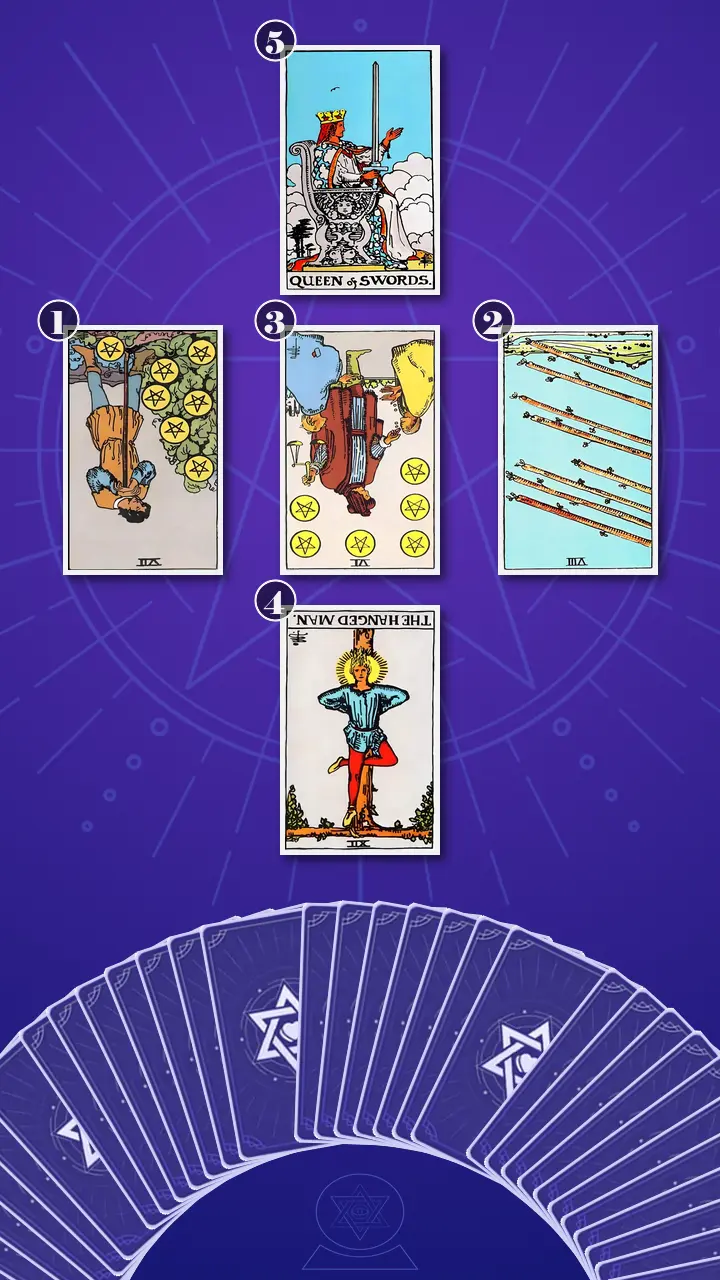
I chose the five-card Relationship Spread · Context Edition. For mixed signals after a cancellation, this relationship tarot spread is precise enough to compare both sides of the exchange without pretending that cards can enter another person's mind. A larger spread would have created more material to analyse when Jordan already had too much of that.
I explained the map for anyone wondering how tarot works as a clarity tool. The first position would show Jordan's repeated checking, held availability, and personal investment. The second would examine only the other person's observable engagement. The central card would test reciprocity. Beneath it, the challenge card would reveal why waiting felt safer than asking. Above it, the final card would offer a self-directed boundary rather than a forecast.
Card meanings become useful in context when they help separate facts, interpretations, fears, and choices. The cards would not issue a verdict on the relationship. They would give Jordan a structured surface on which to see the pattern they were already living.
Reading the Map of Investment and Interrupted Motion
Position 1: When Patience Becomes Sunk Attention
The card I turned first represented Jordan's current position: the repeated checking, held availability, and attention invested after the cancellation. It was the Seven of Pentacles, reversed.
I pointed to the worker leaning heavily on a staff, staring down at seven pentacles clustered on one vine. Upright, this card can describe patient assessment and delayed reward. Reversed, its Earth energy had moved into excess assessment and blocked return. Jordan was no longer gathering new evidence. They were inspecting the same emotional crop and hoping that sustained observation might make it grow.
I brought the image back to 9:40 p.m.: Figma open, the ramen invitation unanswered, and the canceled-date chat refreshed for the fourth time. Jordan approached the conversation like a UX problem that might become solvable after one more review. The inner logic was painfully efficient: “I've already waited this long, so reclaiming Friday now would make the waiting pointless.”
“That's sunk attention,” I said. “It doesn't mean you were foolish to care. It means the time already spent has quietly become an argument for spending more.”
Jordan gave a short, bitter laugh instead of nodding. “That's too accurate. Kind of brutal.” Their fingers tightened around the phone, then loosened as they placed it farther from the laptop.
“The card is describing a loop, not blaming you for entering it,” I replied. “Hope makes sense. The useful question is whether another hour of availability will produce new information or only protect the earlier investment.”
Position 2: Messages That Never Land as Plans
The next card represented the other person's observable contribution: the cancellation, the minimal follow-up, and whether communication had become a specific replacement plan. I turned the Eight of Wands, reversed.
The eight wands usually cross open sky with unmistakable momentum. Here, reversed, their Fire was blocked. Messages could still arrive, but they did not reach a destination. I kept the distinction narrow because the card could describe the communication pattern without claiming to know why the other person was behaving that way.
Jordan told me about a warm “Hope your week's going okay :)” text that had lifted their stomach for a second on the 504 streetcar. They had drafted three replies and taken the message as evidence that momentum had restarted. Yet there was still no acknowledgment of rescheduling, no day, no time, and no place.
“This is package tracking that says ‘label created' but never receives an in-transit scan,” I said. “The system is active, but nothing is travelling toward delivery. A warm message is not the same as a new plan.”
I watched Jordan's expression tighten. Their thumb hovered over the edge of the phone as if a typing bubble might appear through concentration alone, then went still. Several messages, they could now see, might still add up to zero forward movement.
Position 3: The Scale Beneath the Mixed Signals
The third card represented the shared relational dynamic. Its task was to test whether attention, initiative, flexibility, and practical effort were circulating in both directions. At the centre of the spread, I turned the Six of Pentacles, reversed.
I drew Jordan's attention to the scales held above the exchange and to the coins released from one person's hand. Reversed, the Earth energy showed imbalance rather than mutual circulation. One side supplied flexibility, monitoring, and open calendar space. The other supplied intermittent contact but no replacement plan. A small message acquired disproportionate value because Jordan was providing most of the structure around it.
I described the pattern as a split-screen. On one side, Jordan rearranged Friday, checked the chat between design tasks, and delayed answering a friend's concrete invitation. On the other side sat one warm message with no new booking beneath it. Jordan looked down and said, almost under their breath, “I'm not asking for much, so why does this take up so much of me?”
The question carried a quick sting of resentment, followed by a longer exhale. I remembered the position reports I used to read on Wall Street, where a vague sense of exposure became manageable only when it was translated into what had actually been allocated. I do not use that memory to price human connection. I use it to protect people from spending scarce attention on evidence that is not there.
“Let's turn the scales into two columns in your Notes app,” I said. “Did they initiate? Did they propose a specific replacement plan? You don't need a verdict on their feelings. You need to notice what is actually being exchanged.”
Jordan reached for the phone, but this time they opened Notes instead of the chat. The shift was small and visible. Mind-reading had become measurement; leverage had become reciprocity.
“You do not need to decode what a calendar can show,” I added. The Six of Pentacles was the central blockage, but recognising its measurable exchange also made it the catalyst for change.
Position 4: The Saturday Hanging Under “Maybe”
The fourth card represented the underlying reason Jordan kept waiting: delayed gratification, fear of a clear non-commitment, and suspension used to preserve hope. I turned the Hanged Man, reversed.
The figure hung by one ankle from a living wooden frame. The halo suggested that a chosen pause can produce perspective. Reversed, however, the pause had become a blockage. The sacrifice continued after insight had stopped arriving.
I asked Jordan to picture the grey Google Calendar block privately marked “maybe” over Saturday while real invitations passed beneath it. They had called the blank space patience because asking directly might produce vagueness, silence, or a refusal. The private sequence was stark: “If I do nothing, I cannot be rejected. If I keep waiting, the possibility stays alive.”
Jordan's breathing stopped for a beat. Their gaze moved away from the spread, unfocused, as though they were replaying each time they had told a friend, “I might have plans.” Then their shoulders lowered with a quiet, unhappy recognition.
“So I'm not only waiting for them,” they said. “I'm waiting to avoid finding out.”
“That is the protective function,” I replied. “It doesn't make you weak, and it doesn't make their inconsistency your responsibility. Waiting has been buffering you from an answer that feels connected to your worth. But the cost is that a hypothetical plan occupies real time.”
I let the rain fill the pause before adding, “Your availability is not a holding fee for someone else's uncertainty. You can remain open to a future invitation without reserving the present for one that has not been made.”
When the Queen's Sword Separated Contact From a Plan
Position 5: Clear-Eyed Self-Respect
The final card represented Jordan's constructive next step: one clear request, an observable standard for reciprocity, and a boundary around unconfirmed time. As I turned it, the laptop fan behind Jordan spun down, and the room seemed to become unusually still. The card was the Queen of Swords, upright.
I showed Jordan the Queen's vertical sword and her open, extended hand. Her Air energy was balanced: discernment without hostility, candour without punishment, and receptivity without indefinite access. She did not ask Jordan to deny their feelings or perform detachment. She asked them to distinguish a friendly signal from a real plan and communicate that distinction once.
I used one of my core diagnostic tools, the Resource Readiness Assessment. Jordan's internal assets were already present: genuine interest, the ability to communicate, and enough self-awareness to name what they needed. The external timing evidence was different: no confirmed day, no time, and no practical follow-through. The assessment did not tell Jordan to abandon the connection. It showed that their internal readiness was sufficient for one direct message, while the external evidence was insufficient to keep allocating their calendar.
I then applied Strike Timing Calibration. The decisive action node was not a dramatic closing speech or a string of follow-ups. It was one calm request after a cancellation had remained unrescheduled. Strategic holding would begin after that message, but Jordan would hold the standard, not hold the weekend.
I brought Jordan back to 9:40 Thursday: the unanswered friend invitation, the open laptop, and the fourth refresh. They had called it giving space, yet their tight chest and empty Friday showed that a message that had not arrived was already organising the weekend.
I said, “Indefinite waiting does not make a connection safer. Ask once for a concrete plan, then let follow-through, not hopeful ambiguity, decide what gets your time.”
You do not preserve connection by keeping yourself suspended; name the standard, follow the facts, and let the Queen's upright sword separate a real plan from hopeful ambiguity.
For one beat, Jordan did not move. Their breath stopped halfway in, and their fingers remained curled against the table. I watched their eyes lose focus as the sentence reached the memory beneath the chat: an unanswered ramen invitation, an untouched Figma frame, and several evenings organised around a possibility. Their pupils widened. Their jaw tightened.
“But doesn't that mean I got all of this wrong?” they asked, the words sharper than anything they had said before. Their eyes reddened, and the anger gave way to a quieter fear. “Like I cared more and just refused to admit it?”
“No,” I said. “It means you used waiting to protect something tender. The new information is that protection now costs more than it returns.”
Jordan's fist slowly opened. Their shoulders sank, followed by a long breath that trembled at the end. Relief arrived, but so did the slight dizziness of realising that clarity would require them to choose what happened to Friday. The cards could not take that responsibility from them, and I did not try to.
I asked, “Now, with this new perspective, can you think of a moment last week when this insight might have made you feel different?”
“The ramen invite,” Jordan said. “I could have treated no plan as no plan. I could have said yes without turning it into a statement about them.”
I named the movement I could see: this was a first step from tense anticipation and strategic detachment to clear-eyed self-respect grounded in follow-through. It was not certainty about the connection. It was relief from treating every notification as a referendum on personal worth.
I invited Jordan to set a seven-minute timer and open Notes. They drafted one line: “No worries. I'm still open to meeting; if you'd like to reschedule, send a day and time that works.” I made it clear that they did not have to send it. If contact felt unsafe, unwanted, or too activating, the private version was enough: “No confirmed plan means my time is available to me.” Jordan could stop the exercise at any point.
Reclaiming the Calendar With a Strategic Holding Pattern
When I read the spread as one story, the logic was clean. The Seven of Pentacles reversed showed previous attention becoming a reason to wait longer. The Eight of Wands reversed showed contact without arrival. The Six of Pentacles reversed revealed that Jordan's flexibility was supplying weight the exchange did not return. The Hanged Man reversed explained why the imbalance remained intact: indefinite suspension postponed a clear test. The Queen of Swords supplied the missing resource, which was plain language joined to a behavioural standard.
The spread moved from contracted Earth and blocked Fire into upright Air. No Cups appeared, so I did not encourage Jordan to infer hidden emotional meaning from intermittent warmth. In this reading, feelings had to become legible through initiative, specificity, and follow-through.
I returned to the restaurant image at the centre of the consultation. Jordan had been holding a table indefinitely for someone who had canceled the reservation. Keeping the table empty could not guarantee future connection; it only guaranteed an empty seat that night.
The blind spot was not caring too much. It was treating indefinite patience as proof of security and directness as a loss of leverage. The transformation was to ask once for a specific reschedule, then organise life around confirmed reciprocity rather than around the hope that a casual message might eventually become a plan.
I called the resulting micro-plan The Strategic Holding Pattern. In my former world, a useful holding pattern preserved resources while waiting for genuinely decision-relevant information. Applied here, it meant no repeated pursuit, no retaliatory silence, and no calendar sacrifice. Jordan could remain receptive while preparing a life that did not depend on one uncertain response.
- Draft the one-message reschedule request.In the existing chat, take seven minutes to write: “No worries. I'm still open to meeting; if you'd like to reschedule, send a day and time that works.” Remove apologies, hidden tests, and long explanations until it fits in two sentences. Send it once only if contact feels wanted and safe.The private minimum counts: keep the draft in Notes and use it to define what a real plan would require.
- Release one unconfirmed calendar hold.Choose one Friday or Saturday slot and set a personal cutoff, such as noon the day before. If there is no confirmed day and time by that cutoff, accept one concrete invitation or choose your own plan without checking the dating chat first.If reclaiming the whole evening feels too activating, begin with one ninety-minute block. This is a calendar boundary, not a punishment or relationship verdict.
- Run the two-signal reciprocity check.For seven days, record only two observations at the end of the day: “Did they initiate?” and “Did they propose a specific replacement plan?” When a message arrives, check whether it changes the practical status before changing your schedule.Record once, not after every notification. Mute the chat during one work block or confirmed social plan, and do not use the note to diagnose motives or measure your worth.
“Ask once; let follow-through answer the rest,” I told Jordan. That sentence contained the boundary and the freedom inside it. The Queen's sword defined the standard; her open hand left room for a response. Jordan remained the person deciding what happened to their time.

A Week Later, Friday Belonged to Jordan Again
Six days later, I received a short message from Jordan: “Sent the two-sentence text. They replied warmly but still didn't suggest a day. I booked ramen anyway and muted the chat until Saturday morning.” There was no triumphant declaration and no attempt to turn the other person into a villain. There was simply a concrete plan where an empty hold had been.
That night, Jordan slept through. Their first thought the next morning was still, “What if I read it wrong?” Then they saw the ramen photo in the group chat and smiled. The question remained; Friday had not been surrendered to it.
I saw that as the quiet proof of our Journey to Clarity. Tarot had not chosen for Jordan or revealed someone else's secret intentions. It had helped Jordan compare hope with evidence, recognise the cost of suspension, and make one choice from steadier self-respect.
I have sat with many versions of that tight-chested Saturday hold, including versions from my own years of watching uncertain positions move in the dead of night. A lot of us hope another person's follow-up will prove that we mattered, because asking for a real plan risks discovering that our hope has been carrying more weight than the connection. Merely noticing that your calendar has joined the argument means you are no longer standing at the beginning of it.
If your calendar no longer had to prove how patient or easygoing you are, which grey “tentative” block could you let the Queen's sword rename as your time this week?