When a Missing Detail Became the Breakup Trap: Choosing One Boundary

The 9:38 p.m. WhatsApp Loop
You can coordinate five client deadlines at a London creative agency, yet one quiet evening and a visible WhatsApp activity status can pull you straight back into breakup rumination. Jordan, a twenty-nine-year-old project coordinator, said this almost word for word when she sat across from me, both hands wrapped around a coffee she had barely touched.
At 9:38 p.m. the previous Tuesday, she had been sitting on the edge of her bed in her small London flat, scrolling from the final WhatsApp exchange back to messages sent three weeks earlier. The radiator clicked. The screen felt hot against her palm. Her thumb had started to ache, but each change in punctuation seemed to offer one more possible route into the locked room of the ending.
“There must be one detail I missed,” she told me. “I know it is over. I just cannot accept that I might never understand why it ended like that.”
Her grief did not arrive as a clean wave. It behaved more like a lift dropping unexpectedly between floors: her chest locked, her stomach shifted, and her hand reached for the phone before she had decided to move. That physical drop had become the opening signal for forensic breakup rumination, compulsive rereading of her ex's messages, and checking social media for hidden meaning.
“If I stop replaying it,” she said, “I am afraid the ending wins.”
I let the sentence settle before answering. “The replay makes sense as a search for safety; it just cannot produce the safety it promises. Accepting that the relationship ended is not the same as approving the way it ended. Today, I want us to map the mechanism carefully, so you can recover some control over where your attention goes.”
I was not asking Jordan to forget, forgive, delete everything, or perform being over it. I was inviting her into a Journey to Clarity in which the cards could make the loop visible without pretending to know her former partner's private motives. The question was not whether the relationship mattered. The question was why proving that it mattered had begun to require reopening the wound every night.
A Six-Card Map Through the Locked Room
I asked Jordan to place both feet on the floor, take one unforced breath, and hold a single question in mind: “Why does replaying the breakup feel safer than allowing it to be finished?” I shuffled slowly, using the small ritual as a transition from incoming notifications and competing theories into focused attention.
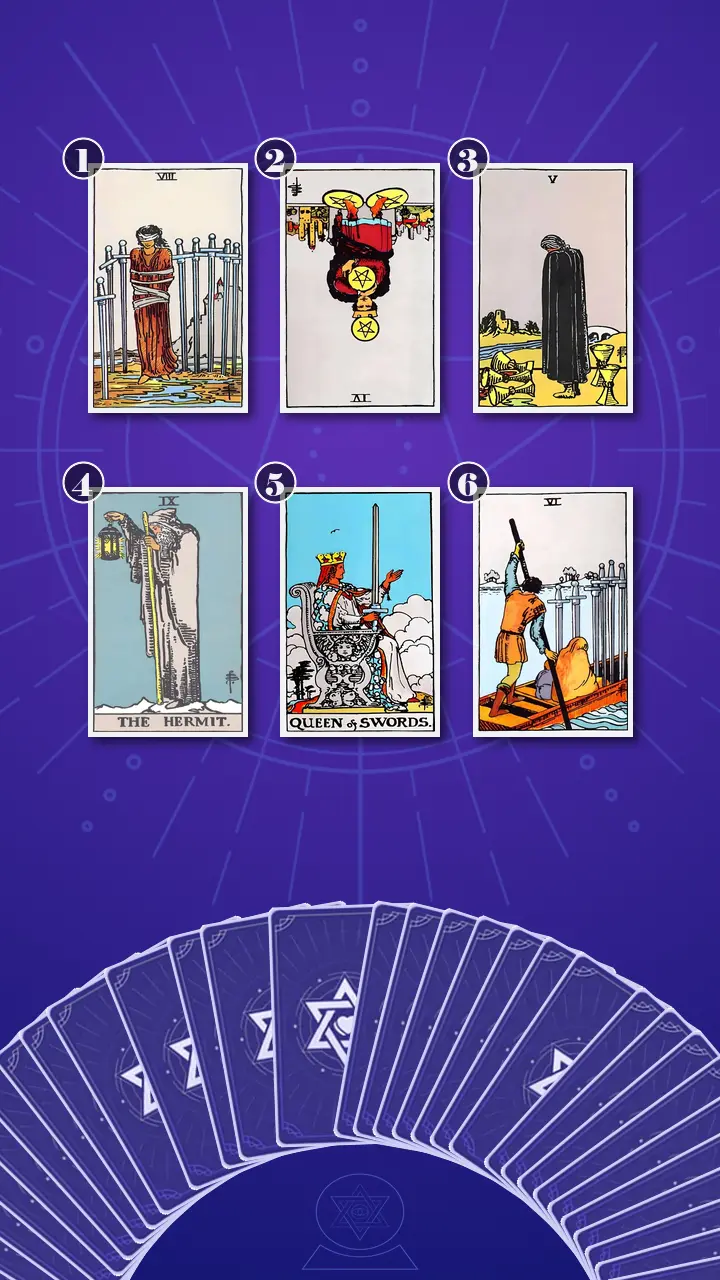
I chose the Transformation Path Grid, a six-card tarot spread for closure after a sudden breakup. This was not a choice between two possible futures, so a comparison spread would have been the wrong tool. Jordan was caught in a self-reinforcing system: reminder, replay, brief emotional closeness, renewed grief, and another replay. The grid was designed to show both how that system was maintained and where a small interruption could change it.
I arranged three cards in an upper row and three beneath them. The upper row would reveal the surface loop, the immediate lock, and the grief beneath the investigation. The lower row would identify the inner turning point, a practical boundary experiment, and the gradual movement that could follow.
This is how tarot works in a consultation like mine: not as a verdict and not as surveillance of an absent person, but as a structured mirror. Each position gives one part of an emotionally tangled pattern a separate place on the table. Once the parts are visible, the querent can decide what to do with them.
“The top row may feel confronting,” I told Jordan, “because it names what keeps the case open. The lower row is not a promise that grief disappears. It shows where your choices still exist inside the uncertainty.”
The Upper Row and the Case That Would Not Close
Position 1: The Screen That Became the Whole Field of Vision
The card I turned for the surface loop, the observable replay behaviour and the emotional state it creates, was the Eight of Swords, upright.
I pointed to the blindfold, the narrow enclosure of swords, and the bindings that looked restrictive without being completely fixed. “This is the trapped analyst,” I said. “You are intensely active, but all that activity is taking place inside a shrinking field of attention.”
I connected the image to the moments Jordan knew too well: sitting on the edge of her bed or travelling on the Northern line with the final message enlarged on her screen, treating a pause, a punctuation mark, or a delayed reply as the clue that could release her. Each interpretation created another question. The phone offered a narrow rectangle of facts, while her mind built an expanding architecture of theories around it.
I read the card's energy as Blockage. Air, the element of thought and perspective, was circulating without ventilation. The issue was not that Jordan had failed to analyse carefully enough. The analysis itself had become the enclosure. Like replaying the same five seconds of CCTV footage and expecting the camera angle to change, repetition created activity but no new evidence.
“The last time you opened the thread,” I asked, “what happened in the thirty seconds before you reached for it?”
“I was on the train,” she said. “I heard someone use a phrase my ex used. I missed my stop because I was testing three different meanings of the same sentence.”
Jordan gave a short laugh, but there was bitterness at its edge. “That is painfully accurate. Almost cruelly accurate.” Her fingers tightened around the coffee cup before loosening again, and her eyes moved from the blindfold to the loose bindings.
“The card is not calling you foolish or weak,” I said. “It is showing that feeling unable to redirect your attention is not the same as having no available movement. The first opening is learning to distinguish the words that are actually on the screen from the meanings your fear keeps adding.”
Position 2: The Evidence Held Against the Chest
The card I turned for the immediate lock, the attachment to details, access, and control that makes stopping feel unsafe, was the Four of Pentacles, reversed.
The figure held one coin against the chest while two more pinned the feet in place. I asked Jordan about the pinned WhatsApp thread, the hidden screenshot folder, and the profile that remained only a few taps away whenever uncertainty rose.
“I have thought about deleting everything,” she said quickly. “But even imagining it makes my stomach drop. I do not necessarily want to contact them. I just need to know the messages are still there.”
That distinction mattered. In Jordan's daily life, access had become linked with control, proof that the relationship mattered, and the possibility that the ending could still be explained. The reversed card showed an Excess of gripping combined with an unstable attempt at release. She alternated between preserving every trace and wanting to delete everything in anger. Neither extreme felt chosen.
“Complete this sentence,” I said. “If I release the evidence, then...”
Her breath caught. Her gaze drifted toward the phone beside her chair, then returned to the card. “Then maybe I cannot prove that I did not imagine the closeness. Maybe the relationship becomes whatever the person who left decided it was.”
I nodded. “Keeping the receipts keeps the case open; it does not make the ending safer. Archiving is not erasure, and a boundary is not an admission that the other person's version was correct. Right now, protecting unrestricted access to the evidence is interfering with your ability to protect your attention.”
Jordan went quiet. Her palm flattened over her sternum in almost the same position as the coin on the card. I could see recognition arrive before she had language for it.
Position 3: The Grief That Had Been Given a Job
The card I turned for the hidden root, the grief, fear, or unmet need beneath the repeated search for an explanation, was the Five of Cups, upright.
I held the frame on the three overturned cups before drawing Jordan's attention to the two standing behind the cloaked figure. I did not present the standing cups as a silver lining or tell her to focus on what remained. Grief does not become easier because someone points impatiently toward gratitude.
I asked about the familiar song that had caught her on a crowded morning train. Jordan remembered the damp coats pressing against her arm, the rails shrieking around a bend, and the hollow pressure spreading through her chest. Instead of saying, “I miss our shared mornings,” she had opened Notes and added another question to the breakup timeline.
“What happened?” I said, placing one hand near the overturned cups. Then I moved it slightly. “What have I lost? Those are different questions.”
The Five of Cups revealed a Deficiency of direct mourning, not because Jordan lacked feeling, but because every feeling was being converted into an investigation before it could be experienced in its simpler form. She could describe every painful detail of the final conversation, yet struggled to name that she missed the expected future, the feeling of being chosen, and the version of herself who believed she was safe in the relationship.
“I keep calling it closure,” she said, her voice lower now, “but what I want is one more chance to feel chosen inside the ending.”
Her breathing paused. Her gaze lost focus as if the train scene were replaying somewhere behind her eyes. Then she released a long, chest-deep exhale and wiped beneath one eye with the side of her thumb.
“The investigation gives grief a task,” I said. “A task can feel less exposed than missing someone. But the task has no natural finish line, because no theory can return the future you thought you had.”
The two standing cups did not cancel the loss. They represented the parts of Jordan's life, support system, judgment, and capacity for care that the breakup had not taken. The bridge in the distance suggested movement, but only after the overturned cups were allowed to be real.
When The Hermit Lowered the Phone's Glare
Position 4: A Lantern for the Truth That Was Already Hers
The rain against the window softened as I reached for the first card in the lower row. The consultation room seemed to become quieter with it. I switched off the brighter overhead light, leaving the small lamp beside us to cast a contained pool of warmth across the table.
The card I turned for the inner turning point, the quality of attention that could interrupt the Betrayal-Closure Lock without requiring another conversation, was The Hermit, upright.
The lantern immediately changed the direction of the reading. Jordan's phone had flooded her vision with messages, activity statuses, screenshots, TikTok explanations, and midnight r/BreakUps theories. The Hermit's light was smaller. It did not claim to expose every hidden motive. It illuminated only enough ground for one honest next step.
I described its modern expression: Jordan placing the phone in another room, sitting beneath a small lamp, and writing what she knew about how the breakup affected her, what she was inferring about her former partner, and what she might never know. The turning point was not a brilliant new explanation. It was the quiet recognition that her experience remained valid without external confirmation.
I read The Hermit as Balance: deliberate solitude rather than isolation, self-inquiry rather than self-interrogation, and discernment that did not require ten competing voices to confirm it.
This was where I used my Daily Friction Deconstruction. I stripped the pattern of dramatic accusations such as “I am pathetic” or “I should be over this,” and laid out its ordinary mechanics: a reminder appeared, Jordan's body contracted, her hand moved toward the phone, one check produced brief proximity, and the resulting activation kept the relationship mentally present for another evening. Once the chain was visible, shame became less useful than leverage.
I also used Emotional Clutter Sorting to separate three things Jordan had been storing in one crowded emotional drawer: what the relationship had genuinely revealed about her needs, what the abrupt ending had wounded, and what fatigue, an empty flat, algorithmic advice, and repeated checking were amplifying after dark. Those categories interacted, but they were not identical.
Jordan was still caught in the demand to find the correct interpretation. She had treated certainty like a passcode, believing that one exact sequence of words would unlock permission to grieve, trust herself, and move. The Hermit asked her to stop entering codes and notice who was already holding the lantern.
The replay cannot manufacture the missing closure; step back from the locked scene, lift The Hermit's lantern toward your own experience, and let a boundary become the first form of understanding.
I let the sentence remain in the room without immediately explaining it.
“Closure is not a verdict you have to win from someone who already left the room,” I said at last.
The replay keeps asking the past for permission to close; The Hermit asks what boundary your present self can choose without that permission.
Jordan's breath stopped first. Her fingers stayed suspended above the table, and her eyes shifted from the lantern to the dark phone beside her chair. I watched recognition move across her face, followed almost immediately by resistance.
“But doesn't that mean I was wrong?” she asked, her voice suddenly sharper. “If I stop looking, doesn't that mean I accept their version and admit I should have seen it coming?”
I kept my voice level. “No. A boundary does not rewrite the ending, excuse the lack of honesty, or declare your previous trust foolish. It only decides how much access an unanswered question receives tonight.”
Her jaw remained tight for another moment. Then her gaze went distant, as if she were replaying the evenings when she had postponed food, sleep, and calls from friends for one more check. Her eyes reddened. Her shoulders lowered by a few centimetres, her curled hand opened against the table, and a trembling breath left her chest. The relief was not simple. I saw a brief, almost dizzy blankness in her expression, the vulnerability that comes when an old burden is removed and the next choice becomes unmistakably one's own.
“Now, using this new perspective, think back to last week,” I said. “Was there a moment when this insight could have made you feel different?”
“Sunday night,” she answered. “After I listened to three voice notes from friends and opened the screenshots again. I could have said, I am hurt, and I do not need a fourth theory to prove it.”
I placed a notebook in front of her. “For ten minutes, imagine the phone is in another room. Write one fact you know, one answer you may never receive, and one choice available tonight. Nothing has to be deleted. Nothing permanent has to be decided. Even one minute away from the screen counts.”
This was the first visible step in the deeper emotional transformation: from possessive replay and dependence on an ex-partner's explanation toward emotional honesty, self-trust, and deliberate control over where attention went. It did not remove grief. It returned authorship of the present.
Position 5: The Clean Line of the Queen's Sword
The card I turned for the boundary experiment, the smallest clear action separating self-respect from continued investigation, was the Queen of Swords, upright.
I saw the upright blade as clarity made practical. It brought to mind a well-run project board, where confirmed tasks are separated from speculative risks so that every possibility does not become an emergency. Jordan could organise five client deadlines because she knew how to distinguish facts, assumptions, and actions at work. Her breakup had become the one project permanently pinned in Notion, continuously active and never permitted to move to Done.
The Queen offered Balance: precision without cruelty, honesty without emotional shutdown, and a boundary firm enough to hold grief without punishing it.
“You can reject how it ended without giving the ending unlimited access to your attention,” I told her.
I drew three columns on the notebook page: Facts, Inferences, and Next Choice. Jordan wrote that the relationship had ended abruptly under Facts. Under Inferences, she wrote that the breakup proved she had never mattered and could not trust her judgment. Under Next Choice, she wrote: “No rereading in bed for seven days.”
“I do not need to prove the theory before I decide what access this story receives tonight,” she read aloud.
Her fingertip traced the straight line between the columns. I could see that the structure appealed to the competent part of her that had not disappeared, even while grief had been telling her otherwise.
Position 6: Carrying the Swords Without Living in the Storm
The final card, representing integrated movement and the way closure could become an ongoing practice rather than an answer supplied by someone else, was the Six of Swords, upright.
I showed Jordan the boat moving from rough water toward calmer water, with the swords still visible inside it. This was not a promise of forgetting. The memory, anger, and unanswered questions could travel with her. What changed was the route.
I described an ordinary after-work evening in which a familiar song or quiet platform still brought the relationship to mind, but the reminder did not automatically become a two-hour investigation. Jordan might wait five minutes, name the tightness in her chest as grief, and continue toward a planned café or park without opening the thread. She could carry what she had learned about trust, communication, and her own needs while allowing the final conversation to become history rather than a location where her attention lived.
The card held the energy of Balanced movement. It did not demand that Jordan feel nothing. It asked her to measure transition by how often she returned automatically and how gently she redirected herself afterward.
“Moving on can mean fewer returns, not zero feelings,” I said.
Jordan looked at the boat for a long time. Her expression was not triumphant. It was quieter and more sober than that. “I think I have been waiting to wake up and not care,” she said. “Fewer returns feels possible. Not easy, but possible.”
I thought of the emotional restraint in Past Lives, where unresolved feeling can remain meaningful without becoming an instruction to reopen a relationship. The Six of Swords held that same distinction: a feeling can be honoured without being placed in charge of the next action.
The Lantern Boundary for the Next 24 Hours
The full spread told one coherent story. An abrupt ending had damaged Jordan's sense of safety and trust in her own judgment. The Eight of Swords showed her narrowing attention around the final conversation. The reversed Four of Pentacles revealed why she kept the messages and possible explanations close: access felt like proof, control, and continued connection. The Five of Cups uncovered the grief beneath that grip. The Hermit returned authority to her own experience, the Queen of Swords gave that authority a precise boundary, and the Six of Swords turned the boundary into gradual movement.
The cognitive blind spot was not simply overthinking. Jordan had been treating acceptance as approval and attention as evidence that the relationship mattered. She feared that reducing access to the story would erase her place in it. In reality, the replay gave the abrupt ending more influence over her present while offering only temporary closeness to the past.
The key shift was clear: closure did not have to remain a missing verdict held by the person who ended the relationship. It could begin as a boundary Jordan practised, even while she continued to dislike how the relationship ended and mourn what she had lost.
I gave her three small experiments. None required permanent deletion, perfect consistency, forgiveness, or certainty.
- The 24-Hour Micro-Boundary ResetFor the next twenty-four hours, move every screenshot, photograph, and breakup note into one archived folder, unpin the WhatsApp thread, and make the bed a no-rereading space. Keep the phone in the kitchen or hallway from the moment you get into bed until morning.If twenty-four hours feels too activating, begin with sixty minutes. Archiving is containment, not erasure, and one lapse calls for a reset rather than punishment.
- The Ten-Minute Lantern NoteOn one quiet evening, put the phone in another room, set a ten-minute timer, and complete two sentences on paper: “What I know about how the ending affected me is...” and “What I may never know is....” Stop when the timer ends, even if the page is unfinished.The minimum version is one minute and one truthful sentence. If the exercise becomes overwhelming, stop and choose a grounding activity rather than forcing insight.
- The Facts, Inferences, and Next Choice CheckBefore the next profile check or message reread, draw three columns and add no more than three items to each. End by choosing one action available in the present, such as making dinner, texting a trusted friend for company rather than analysis, or delaying the check for five minutes.Keep the page deliberately small. Its purpose is to separate confirmed events from feared meanings, not to build a more sophisticated breakup case file.
Jordan chose the first experiment. “No rereading in bed for twenty-four hours,” she said. “I can do one night without pretending it has to be forever.”
“Exactly,” I replied. “You are not waiting to feel fully resolved before acting. You are collecting one small piece of evidence that your attention still belongs to you.”

A Week Later: The Quiet Proof
Six days later, Jordan messaged me: she had slept through the night after leaving her phone in the kitchen. Her first morning thought was still, “What if I missed something?” She said she smiled, made coffee, and did not open the thread.
That was not a solved life or a perfectly finished breakup. It was a small, bittersweet proof. The unanswered ending still existed, but it had not organised her entire morning. She had remembered the relationship without automatically reopening the investigation.
For me, that was the truth of this Journey to Clarity. The Transformation Path Grid did not hand Jordan closure or predict when grief would end. It helped her see the mechanism, recover her own point of view, and choose a boundary that the absent person did not have to authorise. The cards provided the map; Jordan made the movement.
When a quiet flat makes your hand move toward the phone before you have even named the ache in your chest, stopping the search can feel like losing control of the story and proof that you mattered inside it. Noticing that fear is already a change in orientation: the lantern is no longer pointed only at the locked scene.
So if closure could begin as one lantern-sized boundary around your attention, what would you place outside that circle just for tonight: the pinned thread, the profile check, or the demand for one more theory?