The 10:47 p.m. WhatsApp Loop: Family Triangulation in Plain Sight
I know how family triangulation can hide inside ordinary WhatsApp wording. If you are a late-twenties hybrid professional in London who can run a calm design critique but feels your jaw tighten when a relative texts, “Can you tell them...”, the default family peacekeeper role may already be living in your body.
At 10:47 p.m., Maya joined my video call from the edge of her bed in a London flat. One relative's voice note was open on her phone beside a half-written message to another. As the radiator clicked in the background, she deleted “angry,” typed “hurt,” reconsidered it, and changed the word to “upset.” The phone looked hot in her palm. Her jaw stayed fixed, and each breath stopped high in her chest.
“If I don't pass it on, nothing gets resolved,” she told me. “I'm not taking sides. I'm just keeping things moving. But somehow their silence became my job.”
I could hear the contradiction before I touched the deck. Maya wanted her relatives to speak, so she kept speaking between them, even as her help gave them less reason to speak directly. She wanted to protect a valued family connection, but protecting it had come to mean carrying conversations that the adults involved refused to have themselves.
The tension in her body looked like someone trying to hold two closing doors apart with her own chest. Each notification tightened the hinge. Each carefully softened message bought a few minutes of quiet, but it left her standing in the doorway.
“I don't hear someone who is trying to control everyone,” I said. “I hear someone whose care has been recruited into a job she never consciously accepted. We are not here to decide whether you are a good relative. We are here to make the pattern visible, so you can decide what part of it is actually yours. Let's give this fog a map.”

Choosing the Compass: A Relationship Spread for the Middle
I invited Maya to place both feet on the floor and take one ordinary, unforced breath. I shuffled while she held one question in mind: “Why do I keep mediating when I already wish they would speak directly?” The pause was not a mystical test. It was a transition from reacting to observing.
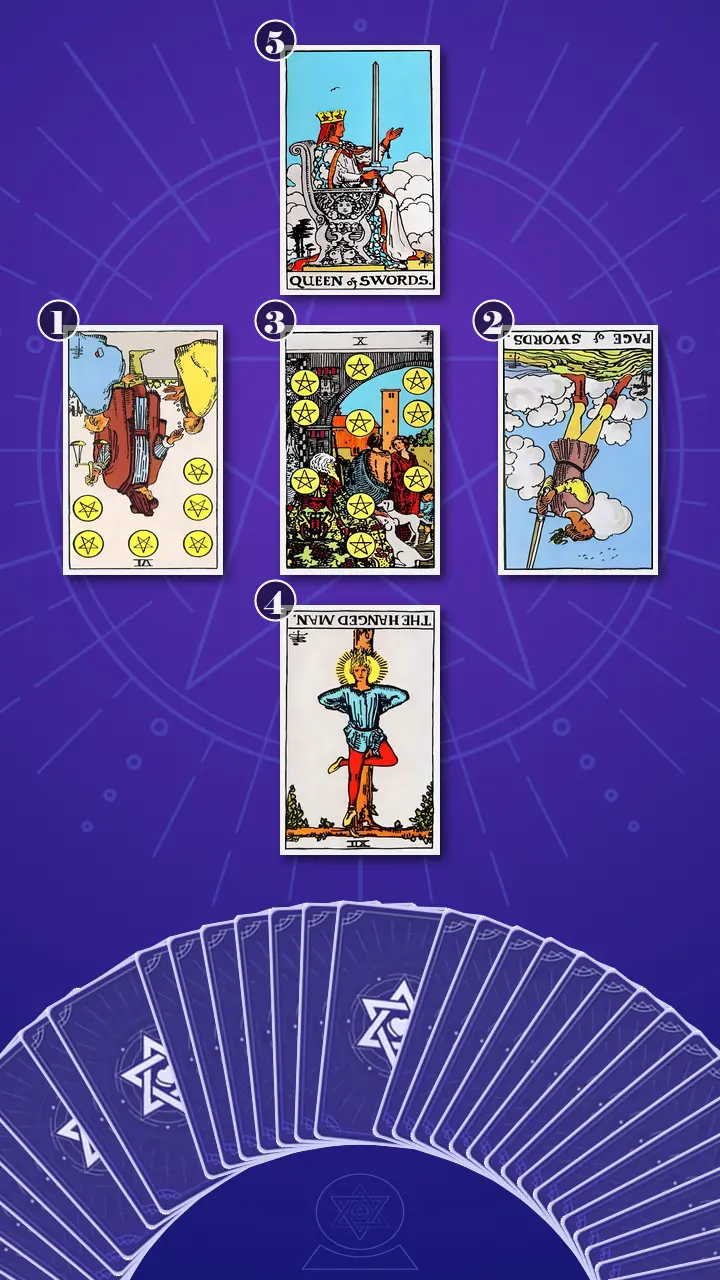
I chose the Relationship Spread · Context Edition, a five-card relationship spread designed here to examine family triangulation and communication boundaries. For anyone reading along, I chose it because Maya did not need a prediction about the family's future. She needed a clean view of the system operating in the present: her role, the observable behaviour that recruited her, the bond beneath the pattern, the blockage maintaining it, and the healthiest direction available to her.
I also explained why I had adapted the second position. I would not claim to know what her relatives secretly thought or why they avoided one another. That position would show only what Maya could actually observe: screenshots, separate voice notes, requests to interpret another person's words, and messages beginning with “Can you tell them...” Clear tarot reading should not turn speculation into certainty.
I laid the cards in a cross. Maya's role sat on the left, the relatives' indirect message traffic on the right, and the family bond at the centre. Below the centre waited the dynamic keeping everyone suspended. Above it waited the boundary-based direction. The horizontal line would show what Maya had been carrying; the vertical line would show what could change.
This is how tarot works in my practice. The cards do not issue a verdict or take ownership of a decision. They externalise a pattern so that card meanings in context can be compared with observable life. Maya would remain the authority on what fit, what did not, and what she chose next.
Reading the Horizontal Traffic
Position 1: The Scales That Never Counted Her Time
I turned over the card representing the diagnosis-level behaviour in the relationship: Maya's overextended role as message editor, translator, and emotional distributor.
It was the Six of Pentacles, in reversed position.
In the image, one figure holds scales while distributing coins to two people below. I asked Maya to imagine that her attention was the currency. At 2:18 p.m. between UX meetings, two family threads could sit beside her Slack notifications while she weighed the emotional impact of each message, edited one complaint into softer language, and distributed reassurance to both sides. The immediate calm looked like successful help, but her time, attention, and consent were absent from the calculation.
Energy dynamic: excess and deficiency. Her generosity was operating in excess, while shared responsibility was deficient. The reversal did not accuse Maya of caring too much. It showed that care had been organised unequally. The relatives received interpretation, reassurance, and message delivery; Maya absorbed the work required to produce all three.
“If I give each side the same amount of explanation, nobody can accuse me of choosing,” she said, describing the rule she had been following without ever writing it down.
I pointed back to the reversed scales. “Neutral intent does not make an arrangement equal. You can distribute the same number of words to both people and still be the only person paying for the exchange.”
Maya gave one short laugh, but there was no humour in it. Her mouth pulled to one side, and she looked down at her phone. “That is so accurate it is almost brutal.”
“Then let's let it be accurate without letting it become an accusation,” I said. “The card is questioning the distribution, not shaming the part of you that learned to be helpful. The useful question is whether this form of help builds mutual responsibility or quietly replaces it.”
Position 2: The Messenger Lost in the Notifications
I turned to the card representing the observable indirect communication that triggered Maya's response, without making claims about anyone's private motives.
It was the Page of Swords, in reversed position.
The Page's sword rises into restless air while birds circle above wind-bent trees. In Maya's life, that unsettled sky was a phone full of cropped screenshots, forwarded voice notes, blue ticks, timestamps, and disappearing typing indicators. A relative would ask what another family member “really meant,” then request that Maya deliver a response outside the shared chat. Maya compared wording as though one more layer of analysis might produce a neutral interpretation nobody could reject.
Energy dynamic: blocked direct speech and excessive vigilance. Information moved quickly, but it moved around the relationship rather than through it. The more Maya monitored, the more fragments she collected. The more fragments she collected, the more responsible she felt for constructing a coherent story.
I thought of a film assembled entirely from reaction shots while the central conversation remained off camera. As an artist, I know that careful editing can improve clarity, but no edit can create dialogue that the original speakers have declined to record.
“This isn't about declaring indirect communication universally wrong,” I told her. “It is about noticing that this particular arrangement depends on your unchosen labour and leaves you depleted. You are being asked to interpret the scene and perform both missing lines.”
I asked, “What was the most recent secondhand request you received: a screenshot to interpret, a voice note to explain, a complaint to soften, or a message to deliver?”
Maya's thumb stopped rubbing the edge of her phone. She looked toward the dark window and said, “A screenshot. Then a voice note explaining the screenshot. Then they asked me what to say back.”
“And who eventually contacted the person in the screenshot?” I asked.
Her eyes returned to the reversed Page. “I did.”
The Family Archive and the Scene That Would Not Move
Position 3: The Arch Built from Birthdays, Photos, and Belonging
I turned over the card representing the relationship's foundation: the value Maya placed on family continuity and the fear that secure belonging depended on keeping contact intact.
It was the Ten of Pentacles, upright.
Several generations share one architectural space in the card. The scene holds an elder, younger family members, dogs, an archway, and ten pentacles distributed across a structure larger than any one figure. I asked Maya to think of the family's long-running group chat: years of photos, familiar jokes, recurring birthdays, train plans, recipes, and relatives spread across the UK. One period of silence could make the entire archive feel endangered.
Energy dynamic: a real resource in balance, with a risk of over-identification. The Ten of Pentacles validated Maya's desire for continuity. Family connection mattered to her, and the card did not ask her to become detached from that value. The problem began when living within the family structure became confused with personally holding it up.
“When you imagine declining the next request to pass on a message, what specific loss do you fear?” I asked. “A cancelled gathering? Prolonged silence? Blame? Or doubt about your place in the family?”
Her breath paused. Her fingers remained suspended above the phone, and her eyes lost focus as though she were scrolling through old family scenes without moving her hand. Then her shoulders shifted inward.
“I think I'm scared they'll stop speaking for good,” she said. Her voice dropped. “And then everyone will know I could have helped and didn't. Maybe they won't trust me in the same way.”
I heard the deeper equation arrive: usefulness had begun to feel like evidence of belonging. Her mediation was not merely a preference for precise wording. It was an attempt to protect her place within something she genuinely loved.
“The card is not asking you to care less about the family,” I said. “It is asking whether holding a spare key to a shared building made you believe you were responsible for every locked door inside it. You can care about the relationship without carrying the conversation.”
Maya's eyes shone briefly. She nodded once, then shook her head as if both movements were true. “That sounds obvious when you say it. It does not feel obvious in my body.”
“That matters,” I said. “An insight can be correct before it feels familiar. We do not need to force your nervous system to catch up in one evening.”
Position 4: The Evening Left Permanently in Draft Mode
I turned over the card representing the central limiting cycle: Maya's sacrifice created temporary calm while allowing direct communication to remain stalled.
It was The Hanged Man, in reversed position.
The figure hangs by one foot from a living wooden support. Upright, the card can describe a chosen pause that produces perspective. Reversed here, it showed a pause that had hardened into a role. Maya remained between two positions because releasing the role felt more threatening than continuing it.
I returned to a Sunday afternoon she had described. She had been sitting in a cafe beside an Overground station before a family birthday call. Her flat white had gone cold. Trains ground against the tracks while two typing indicators appeared and vanished. She cancelled a walk, sent a conciliatory update to each relative, and watched both private threads grow calmer while the shared conversation remained untouched.
“You give up the evening,” I said. “The temperature drops. The conversation does not move.”
Energy dynamic: blockage. Maya's sacrifice reduced the immediate temperature, but it did not create contact between the original speakers. Her availability removed the discomfort that might otherwise have required them to choose whether and how to speak directly.
“Temporary quiet is not the same as direct communication,” I said. “The quiet may feel like proof that you helped, but it can also be the mechanism that keeps the triangle available for the next dispute.”
Her jaw tightened first. Then her gaze dropped to the bound foot in the card, and I watched recognition move across her face with the slow discomfort of a bruise being located. Finally, she released a breath from deep in her chest.
“Yes,” she said. “Nothing actually changes after I help. I just get a few days before it starts again.”
I did not ask her to leap from automatic mediation into a dramatic confrontation. I turned the reversal into a smaller experiment: the next time a family name appeared after a disagreement, she could set a ten-minute timer and place the phone face-down. During that pause, she could notice the urge without converting it into a task.
“But what if it really is urgent?” she asked. Her hands closed around the phone again. “Ten minutes can feel like ages when I know something is happening.”
“Then we separate an actual time-sensitive emergency from emotional urgency,” I said. “You choose the length. Start with two minutes if ten is too much. The point is not to endure distress or prove anything. It is to create one beat between the notification and the old role.”
Her grip loosened by one finger, then another. “I can feel the urge without turning it into a task,” she repeated, testing the sentence rather than promising to believe it.
When the Queen Drew One Clean Line
Position 5: The Open Hand and the Upright Sword
Before I turned the final card, the radiator behind Maya clicked once and fell quiet. A bus passed below her window, laying a narrow bar of white light across the wall. I let the room settle around that single clean line.
I turned over the card representing the healthiest available direction: compassionate clarity, refusal to relay messages, and respect for each relative's responsibility to communicate directly.
It was the Queen of Swords, upright, the key card of the reading.
The Queen holds her sword vertically in one hand while extending the other hand, open, toward what approaches. I read those gestures together. The open hand could hear, “I am really upset.” The sword could answer, “I care about both of you, but I won't carry messages. Please contact each other directly.”
Energy dynamic: disciplined balance. The Queen's clarity was not emotional coldness. It was mature air after the reversed Page's storm of fragments. She separated listening from delivering, compassion from compliance, and personal participation from control over somebody else's response.
Maya was still caught inside the equation that a good decision would keep everyone calm. Her jaw was tight because each request felt less like information than a test: could she phrase the message perfectly enough to preserve both contact and her own secure place in the family?
I told her I was going to use one of my central narrative lenses, Family Casting Analysis. I use it as a way of examining a repeated role, not as a diagnosis of a person or family. In Maya's family film, she had been cast as the Peacemaker, with an uncredited second job as Dialogue Editor. The cue was “Can you tell them...” Her expected line was a softened translation. The short-term reward was quiet and a renewed sense of usefulness. The cost was that she surrendered her evening, attention, and authorship of her own part.
“A role repeated for years can feel like personality,” I said. “But the Queen is showing us the difference. You are careful with words. That is yours. Being required to carry everyone else's words is a part you have been performing. The skill can stay even when the role changes.”
I let the bar of light on the wall become the Queen's sword, then said the central message without cushioning it:
You are not responsible for keeping every conversation alive; choose a clear, compassionate boundary, and let the Queen's upright sword return each message to its rightful speaker.
Maya's breath stopped. Her fingertips froze against the phone case, and her pupils widened as though she were replaying several years of private message threads at once. Her forehead tightened before her eyes became wet.
“But doesn't that mean I have been doing it wrong all this time?” she asked. The question arrived with a flash of anger, then cracked into something more vulnerable. “I gave up so much time to keep this together.”
“No,” I said. “It means you used a strategy that created short-term safety and belonging. We can respect why it formed without requiring you to perform it forever.”
Her shoulders descended slowly. Her closed hand opened on her knee. She exhaled with a slight tremor, then looked almost dizzy in the new space the idea had created.
“I can care and still let it be awkward,” she said. “That is a relief. It is also scary, because then I have to let them be unhappy with me.”
“Yes,” I said. “Clarity gives you responsibility for your choice, not control over their reaction.”
I invited her immediately: “Now, with this new perspective, can you think of a moment last week when this insight might have made you feel different?”
She remembered a dinner in Soho. Her friends had been ordering while a family message lit up beneath the table. Instead of tasting the food or hearing the story opposite her, she had started drafting. “I could have listened to my relative without opening the second thread,” she said. “I could have stayed at dinner.”
I named the crossing I had just witnessed. It was not a leap from tension to perfect confidence. It was the first movement from tense, guilt-driven vigilance and resentful overfunctioning to compassionate detachment and steadier care with clear boundaries. The relief was real, and so was the vulnerability of no longer hiding inside a familiar job.
“Fair does not mean equally available to everyone else's conflict,” I told her. “The scales in the first card asked you to manage their reactions. The Queen's sword asks you to define only the terms of your own participation.”
Changing the Family Admin Permissions
I gathered the spread into one continuous story. The reversed Six of Pentacles showed Maya spending her time as though it were an unlimited family resource. The reversed Page of Swords showed the secondhand message traffic recruiting that labour. The Ten of Pentacles revealed why stepping back felt dangerous: family continuity mattered, and usefulness had become entangled with belonging. The reversed Hanged Man exposed the cost: Maya's sacrifice lowered the temperature while the real conversation remained suspended. The Queen of Swords offered the available resource, not as a prediction, but as a new rule for participation.
In the spread's central metaphor, Maya had been standing in a hallway between two closed doors, passing notes through both keyholes. Her blind spot was not a lack of intelligence or courage. It was the belief that temporary quiet proved she was preserving connection, and that declining the courier role might cancel her membership in the family itself.
The transformation direction was precise: stop relaying content and return each conversation to its owners. Maya could remain available for direct relationships, ordinary affection, and feelings shared with her in confidence. What would become unavailable was the delivery service between adults who had another way to contact one another.
Maya rubbed her palms together. “I can already hear someone saying, ‘It is only one message. Why are you making this a thing?’”
“That response may happen,” I said. “A boundary describes your participation; it does not guarantee agreement. The boundary returns the message; it does not control what happens next.”
- Save the No-Courier BoundaryDuring a calm two-minute window this week, open Notes and save: “I care about both of you, but I won't carry messages. Please contact each other directly.” Use it once for one low-stakes request, without rewriting the complaint, defending your fairness, or promising to follow up.Tip: The minimum version is only saving the sentence. Use it solely where it feels safe. Clarity needs one or two sentences, not a legal brief.
- Try the Script-Flipping RehearsalBefore the next family call or gathering, spend five minutes role-playing with a trusted friend. Ask the friend to give the familiar cue, “Can you tell them...?” Deliver the deliberately out-of-character response once. Have the friend push back with “Just this time,” then practise repeating the limit without adding new reasons.Tip: The goal is not a perfect performance or a permanent shift in one exchange. Rehearsal lets your mouth experience the new line before guilt and adrenaline enter the scene.
- Use the Mine-Theirs-Unknown PauseWhen a family name appears after a disagreement, place the phone face-down and set a ten-minute timer. Write three headings: “Mine,” “Theirs,” and “Unknown.” Put your reply choice under Mine, their relationship under Theirs, and their possible reaction under Unknown. If asked to interpret or deliver a message, ask, “What would you like to say to them directly?”Tip: Begin with two minutes if ten feels unmanageable. Actual emergencies can be handled as emergencies, and no exercise requires you to stay in a situation that feels unsafe.
I called the rehearsal a script flip because it changed Maya's line, not because it gave her control of the other actors. Her relatives might communicate directly, delay, object, or remain silent. None of those outcomes would retroactively decide whether her boundary was valid.
“Choose one experiment,” I said. “You do not need to become the Queen of Swords as a new permanent character. You only need to borrow her posture long enough to discover that an open hand and a clear limit can exist in the same body.”

A Week Later: The Silence She Did Not Fill
Six days later, I received a message from Maya after a design review. A relative had asked her to pass along a change to a family travel plan. Maya used the saved sentence, muted the thread for thirty minutes, and took the shower she would normally have postponed while monitoring both chats.
The first five minutes felt awful, she told me. At minute twelve, she reached for the phone, remembered the three headings, and put it down again. Later, the relative contacted the original person directly about the train time. Maya did not supervise the exchange.
She also sent that relative a separate message the next day about a show they both watched. Their direct relationship remained available; the courier service did not. That distinction mattered more than whether one wider family pattern changed immediately.
That night she slept through, but her first thought at 7:02 a.m. was, “What if I made it worse?” She laughed once, softly, then made coffee before checking WhatsApp. The doubt remained. It was no longer directing the scene.
I do not credit the cards with setting Maya's boundary. She did that. The cards gave visible structure to a loop that had previously felt like a hundred unrelated notifications. For me, that is the most useful work of the five-position Relationship Spread: Context Edition. It can turn a painful production into a map, then hand the pen back to the person whose choices matter.
If your phone lights up and your jaw tightens before you have even read the message, it can feel as though keeping your place in the family depends on keeping everyone else in contact. I would invite you to notice the familiar hallway without immediately taking up the notes. Recognition alone means you are no longer standing there unconsciously.
If caring did not require carrying the message, what is one small piece of dialogue you could allow its original speaker to own while you keep your place in the family without standing between the doors?
This story is adapted from psychological research, written so that those in a similar struggle can see their own pattern in it — and find their next step clearly.These insights are not a substitute for professional psychological, medical, legal, or financial advice.
Learn more about our Journey to Clarity.
How did this insight land for you?
🫂 This Resonates Deeply
🌀 Living This Story
✨ Now I See Clearly
🌱 Seeing New Possibilities
🧰 Useful Framework
🔮 The Confirmation I Needed
💪 Feeling Empowered
🚀 Ready for My Next Step
Author Profile
 AI
AI“I’ve always felt our lives are films currently in production. As an artist, I know that when you feel stuck, it’s often because you’ve bravely stayed in a painful scene for just a little too long. I’m not here to coldly analyze you. I want to sit closely with you, look at those difficult moments with profound empathy, and gently hand you the pen so you have the courage to write your next beautiful act.”
In this Family Tarot Reading :
Core Expertise
- Family Casting Analysis: Identifying your forced role (e.g., The Scapegoat, The Golden Child, The Peacemaker) within a toxic family script.
- Narrative Enmeshment Diagnosis: Recognizing when your personal life story has been hijacked to fulfill your parents' unfulfilled plotlines.
Service Features
- The Script-Flipping Rehearsal: A role-play directive to deliberately deliver an 'out-of-character' response at the next family gathering, permanently disrupting the established power dynamic.
Also specializes in :
Explore Related Patterns:
Boundary DiffusionMaya says, "Their silence became my job," and repeatedly carries conversations that the adults involved could conduct themselves. Her own role, their relationship, and the future of the wider family connection have become psychologically bundled into one responsibility. Boundary Diffusion describes the loss of a clear line between what belongs to you and what belongs to other people. You may still know intellectually that their communication is theirs, yet your body and behavior respond as though you are accountable for keeping it alive. Restoring the distinction does not require emotional detachment; it means allowing care to exist without taking ownership of someone else's choices.
Defensive OverfunctioningMaya does not merely forward a message. She edits "angry" into "hurt" and then "upset," compares wording, interprets screenshots, reassures both sides, and gives up her own plans to keep the exchange moving. The additional labor lowers the immediate temperature, so doing more appears to work even though the direct conversation remains stalled. When you respond to relational uncertainty by becoming more useful, precise, and available, effort can operate as a defense against helplessness, blame, and possible disconnection. Defensive Overfunctioning describes this attempt to manufacture safety through excess responsibility: you keep taking action because stopping would expose the unresolved conflict that your labor has been temporarily containing.
Guilt-Driven People-PleasingMaya tries to give each relative the same amount of explanation so that nobody can accuse her of taking sides. She also imagines that if she declines to help, everyone may know she could have intervened and chose not to, turning one boundary into evidence that she has failed the family. When you measure a decision by whether everyone remains calm and approving, guilt can make compliance feel morally compulsory rather than optional. Guilt-Driven People-Pleasing keeps you mediating because another person's disappointment is experienced as proof that you were unfair, uncaring, or insufficiently helpful, even when the request was never yours to carry.
Rescuer IdentityThe cue "Can you tell them..." repeatedly casts Maya as Peacemaker and Dialogue Editor. She supplies the softened line, the immediate quiet returns, and her usefulness is confirmed. Because this sequence has repeated for years, a role she performs has begun to feel like a defining part of who she is. Rescuer Identity forms when being the person who fixes, translates, or stabilizes becomes a primary route to belonging and self-recognition. You may genuinely be thoughtful and skilled with words, but those real strengths become fused with an obligation to repair every rupture. Separating the skill from the role lets your care remain yours without making every family impasse your assignment.
TriangulationA screenshot is followed by a voice note explaining the screenshot, then a request for Maya to decide what should be said back. When she eventually contacts the original person herself, the information has moved through her rather than between the two people whose relationship is actually involved. When you become the dependable third point in this arrangement, every successful relay can strengthen the route around direct conversation. Triangulation names that repeating structure: your intervention creates immediate movement and calm, but it also lets the original speakers avoid owning the exchange, making your continued involvement feel increasingly necessary.
Conditional Self-WorthWhen Maya imagines refusing the next relay request, she does not fear only an awkward exchange. She fears permanent silence, blame for not preventing it, and a change in how much her relatives trust or value her. Her usefulness has therefore become entangled with evidence that she still has a secure place in the family. Conditional Self-Worth develops when your value feels clearest while you are solving, stabilizing, or carrying something for other people. Under that rule, stepping back from mediation can feel less like declining a task and more like risking membership itself, which explains why an apparently simple boundary can produce disproportionate guilt and fear.
Boundary DiscernmentMaya separates her reply choice under "Mine" from the relatives' relationship under "Theirs" and their possible reactions under "Unknown." She also keeps ordinary affection available while making one specific service unavailable: carrying messages between adults. Boundary Discernment allows you to identify the exact limit of your participation without turning distance into rejection. You can listen to a relative's feelings, maintain a direct bond, and still return their communication to them. The psychological shift is from asking how to keep everyone calm to deciding what form of involvement is genuinely yours.
Relational HypervigilanceBefore Maya has even completed a reply, her jaw is fixed, her breathing is high, and her attention is tracking screenshots, blue ticks, timestamps, wording changes, and disappearing typing indicators. The phone does not register as neutral information; it becomes a live monitoring system for whether family contact is about to deteriorate. Relational Hypervigilance keeps you scanning ambiguous cues for evidence that a bond is in danger and that immediate action is required. The more closely you monitor, the more fragments you find, and the more responsible you may feel for interpreting them correctly. That vigilance can recruit you into mediation before you have decided whether the message is urgent, accurate, or yours to manage.
Assertive CommunicationWhen a relative asks Maya to pass on a travel-plan change, she uses the saved sentence instead of editing the message, defending her fairness, or promising to supervise the outcome. The relative later contacts the original person directly, while Maya preserves her own relationship through a separate conversation about a show they both watch. Assertive Communication lets you state the terms of your participation clearly without attacking, appeasing, or disappearing. The limit does not demand agreement and does not predict the other person's response. It simply makes your care explicit while refusing the specific behavior that keeps you positioned between two speakers.
Reflective DistanceMaya places the phone face-down, mutes the thread, takes her shower, and notices the urge to check again at minute twelve without obeying it. The following morning, the thought "What if I made it worse?" remains present, but she makes coffee before opening WhatsApp. Reflective Distance creates one usable interval between a trigger and the familiar role it activates. You do not have to eliminate guilt, uncertainty, or bodily tension before choosing differently. By separating emotional urgency from an actual emergency, you gain enough space to observe the old instruction and decide whether acting on it serves your values or merely repeats the loop.
Explore Related Struggles:
Caretaker Role LockMaya has spent years performing as the family's Peacemaker and unofficial Dialogue Editor, responding whenever the cue “Can you tell them...” appears. The role uses genuine strengths such as care and precision, but repetition has made the assigned function feel indistinguishable from her personality and her value to the family. You may feel locked into a caretaker role when changing what you do appears to change who you are allowed to be. That lock can keep you sacrificing evenings and attention even after the work has stopped producing lasting repair. Your capacity to listen and choose careful words remains yours; recognizing the role as a function rather than an identity allows those strengths to exist without obligating you to carry every conversation.
Triangulated BelongingMaya imagines one period of silence endangering years of birthdays, photos, recipes, travel plans, and familiar family jokes. When two relatives stop speaking directly, she stands between them and keeps information moving, because leaving the middle feels capable of threatening both the wider bond and her place inside it. You can become anchored to a family triangle when being the available third person starts to function as evidence that you still belong. The structure asks you to preserve connection by occupying the position that prevents direct responsibility from returning to its owners. Seeing that arrangement clearly makes room for a different truth: your individual relationships can remain meaningful even when you stop serving as the bridge between other adults.
Boundary Ambiguity LockA relative sends Maya a screenshot, follows it with a voice note, and asks what to say back; Maya eventually contacts the person in the screenshot herself. Listening, interpreting, advising, and delivering have become compressed into one response, so the exact point where care turns into ownership is difficult to see in real time. You can care about someone's distress without becoming the route through which their unresolved conversation must travel. The lock forms when declining delivery appears equivalent to withdrawing affection or abandoning the relationship. Separating direct support from third-party message carrying gives you a boundary that preserves connection without making another person's dialogue part of your role.
Responsibility-Authority SplitAt 10:47 p.m., Maya is editing one relative's words while a message to another waits in draft. She is carrying responsibility for whether the family conversation moves, yet the original speakers retain every decisive choice about whether they contact each other and what they eventually say. You can become trapped when accountability is handed to you without the authority needed to produce the expected outcome. The strain is larger than having too many messages to send: you are positioned as answerable for connection while the actions that create connection remain someone else's. Naming that split helps you return each responsibility to the person who still holds the corresponding choice.
Short-Term Maintenance TrapAt the cafe near the Overground station, Maya cancels her walk and sends conciliatory updates into two private threads. Both relatives become calmer, but the shared conversation remains untouched; a few days later, another request arrives and the same route opens again. You can become trapped when immediate relief is the only visible evidence that your effort worked. Each intervention lowers the temperature while also removing the discomfort that might require the original speakers to decide whether and how to communicate. The loop is maintained by a real short-term benefit, which is why stepping back can initially feel irresponsible even when it is the action that stops your labour from replacing direct contact.
Fairness-Agency SplitMaya explains that giving each relative the same amount of information should prevent either person from accusing her of taking sides. The distribution looks balanced when measured in words, but her time, attention, and consent never enter the calculation, leaving her as the only person required to remain equally available. You may recognize the conflict between wanting to act fairly and needing the freedom to decide whether the exchange is yours to manage. When fairness becomes defined as equal service to everyone else's conflict, your own agency disappears from the equation. A more workable standard can include impartial care while still allowing you to set the terms of your participation.
Urgency-Compass FusionA family name appears on Maya's phone during work, at dinner, beside her bed, or before a shower, and the notification immediately becomes a drafting or monitoring task. The speed of her response is set by the intensity of the message rather than by an assessment of whether anything is genuinely time-sensitive or belongs to her. You can lose access to your own direction when another person's emotional urgency becomes indistinguishable from an emergency requiring your action. The fused signal bypasses choice and lets the newest notification reorganize your attention. Creating even a brief pause restores a missing decision point: you can recognize that something feels urgent, determine what is actually yours, and choose your response without treating intensity as an instruction.
Explore Related Emotions:
Boundary GuiltSix days later, Maya uses the saved no-courier sentence, mutes the thread, and allows the original speakers to handle the travel-plan message. Even after they communicate directly and nothing requires her supervision, her first thought the next morning is, "What if I made it worse?" The limit has changed faster than the emotional rule underneath it. Boundary Guilt appears when you make a legitimate choice about your participation but still feel responsible for another person's discomfort, silence, or disapproval. That feeling can be witnessed without treating it as a verdict that the boundary was harmful or unfair.
Conditional Belonging FearWhen Maya imagines declining the next request, she pictures permanent silence, blame, and relatives no longer trusting her in the same way. Years of birthdays, photos, familiar jokes, and family plans make each communication gap feel larger than the immediate disagreement. Usefulness has therefore started functioning as evidence of membership. You may experience a request to mediate as a test of whether you still deserve your place, which makes stepping back feel relationally dangerous even when you know the conversation is not yours to carry. Naming that equation allows you to examine whether belonging is actually conditional on performing this role.
Enmeshed ResentmentMaya's relatives receive edited messages, interpretation, reassurance, and delivery, while she absorbs the time and attention required to produce them. When the accumulated cost becomes visible, her first vulnerable question carries a flash of anger: she gave up so much time trying to keep the family together. Care has become entangled with compliance, making it difficult to know where another person's communication responsibility ends and yours begins. Enmeshed Resentment is the feeling that grows when you remain deeply invested in people while repeatedly being recruited beyond your chosen role. It can be acknowledged as information about crossed limits rather than used as evidence that you care too little.
Fairness FatigueBetween UX meetings, Maya keeps two family threads beside her Slack notifications and tries to give each side the same amount of explanation. Her private rule is explicit: if the wording is equally careful, nobody can accuse her of choosing. Equal word counts do not make the arrangement equal when your time, consent, and attention are missing from the calculation. Fairness Fatigue develops when you repeatedly measure your behavior against everybody else's possible reaction while your own limits remain uncounted. The feeling points toward a more workable definition of fairness, one that includes the terms of your participation.
Hypervigilant AnxietyAt 10:47 p.m., Maya deletes "angry," replaces it with "hurt," changes it again to "upset," and keeps her jaw fixed while each breath stops high in her chest. During the day, she also tracks screenshots, blue ticks, timestamps, and disappearing typing indicators as though one missed signal could worsen the entire exchange. Your attention can become organized around detecting and preventing the next relational escalation. Hypervigilant Anxiety is the inner weather of being physically and mentally on watch, even before a message has made a direct demand. Seeing the monitoring response clearly creates room to distinguish an actual emergency from a nervous sense that every notification requires immediate intervention.
Messenger GuiltA relative sends Maya a screenshot, follows it with a voice note explaining the screenshot, and then asks what to say back. Although both original speakers can contact each other, Maya becomes the person who eventually delivers the response. Their silence has been converted into a responsibility she feels morally uneasy leaving unfinished. You may know intellectually that the message belongs to somebody else while still feeling that refusing to pass it on would make you responsible for whatever remains unresolved. Messenger Guilt names that subjective burden without treating the assignment itself as legitimate or permanent.
Clarity ReliefMaya's shoulders descend and her closed hand opens when she says, "I can care and still let it be awkward." The distinction between hearing a relative's feelings and delivering that relative's message turns a confusing stream of notifications into one recognizable pattern. Clarity Relief arrives when the problem becomes specific enough to navigate. You no longer have to decide whether to care or withdraw from the family; you can decide what form your participation will take. The release comes from discovering that compassion and refusal can occupy the same response.
Resentful ExhaustionMaya cancels a walk, lets a flat white go cold, drafts messages beneath a dinner table, and postpones a shower while watching two private threads. Each intervention buys a few quieter days, but the original speakers still do not address each other directly. Your energy can be depleted by the repetition while another part of you objects to how much ordinary life the role consumes. Resentful Exhaustion combines those two felt realities: being worn down by the work and increasingly unwilling to pretend the cost is insignificant. The feeling becomes useful when it reveals that temporary quiet is not providing enough return for the attention being surrendered.
Cautious ReliefAfter using the saved boundary, Maya mutes the thread, takes the shower she would usually postpone, and later learns that the relative contacted the original person directly. She sleeps through the night, although doubt returns when she wakes. Cautious Relief holds both parts of that experience. You can feel space returning without pretending the wider relationship has become predictable or that nobody will object next time. The release is credible precisely because it does not require certainty; it only reflects that one piece of responsibility has been returned to its owner.
Unseen Effort GriefWhen Maya hears that she can stop carrying other people's conversations, her eyes become wet and she says, "I gave up so much time to keep this together." The cold drink, cancelled walk, interrupted dinner, and years of private threads suddenly register as a continuous personal cost. Unseen Effort Grief is the sorrow of recognizing how much attention was spent on work that remained uncounted and did not produce the lasting repair you hoped for. You can honor that loss without converting it into a reason to continue the same role. The time already given explains the depth of the reaction, but it does not remove your authority over what you give next.
Explore Related Contexts:
Accountability Evasion CycleOn the Sunday before a family birthday call, Maya cancels her walk, sends conciliatory updates to both relatives, and watches the two private threads settle while the shared conversation remains untouched. A few days later the same arrangement is available again, so the observable result is temporary quiet rather than movement between the original speakers. Your intervention absorbs the immediate social cost of their non-communication. By lowering the temperature, you also remove the point at which each adult would otherwise have to decide whether, when, and how to make direct contact. Recognising the cycle allows you to distinguish helpful listening from taking over accountability that the communication structure has displaced onto you.
Designated Peacekeeper BurdenBetween UX meetings, at a cafe before a family call, and during dinner with friends, Maya interrupts her own life to soften complaints and distribute reassurance to both sides. Her ability to stay measured has become a standing family assignment, so you are repeatedly recruited to lower the temperature whenever contact between relatives breaks down. The short-term reward is quiet, but the role has no clear hours, consent check, or shared workload. Because the family system repeatedly relies on your competence, stepping back can be framed as withholding care when it is actually a renegotiation of responsibility. The burden persists not because you are uniquely obligated, but because your successful interventions have made the role convenient to reuse.
Emotional Labor ImbalanceMaya gives each relative explanations, reassurance, edited wording, and message delivery while trying to distribute the same amount of care to both sides. The visible exchange may look balanced, but your time, attention, and consent are missing from the calculation, leaving one person to finance the apparent fairness of the whole arrangement. The imbalance is material as well as relational. Other people receive calmer messages and relief from direct contact, while you lose work focus, social time, rest, and control over your availability. This context redirects attention from whether you were perfectly neutral to the more useful question of who performed the labour and who benefited from it.
Triangulated Family MediatorAt 10:47 p.m., Maya is holding one relative's voice note beside a half-written message to another, changing “angry” to “hurt” and then “upset” before passing anything on. Repeated requests beginning with “Can you tell them...” place you inside a three-person communication structure where two adults route contact through your wording, timing, and availability. That middle position turns their silence into your operational role. You become responsible for interpreting fragments, managing tone, and keeping information moving even though the original relationship remains untouched. Naming the structure makes clear that the pressure comes from how communication has been organised, not from any failure to discover the perfect neutral wording.
Family Boundary CreepFamily message traffic reaches Maya at the edge of her bed, between UX meetings, beside an Overground station, and under the table during dinner in Soho. She cancels a walk, lets a drink go cold, and postpones a shower because each new notification quietly extends the family's dispute into another part of her day. You are not only being asked for a single favour. Repeated access has blurred the boundary around when your attention is available and which conversations belong inside your personal time. The problem becomes visible when ordinary work, friendship, rest, and privacy are repeatedly reorganised around conflicts that originated between other adults.
Family Boundary NegotiationSix days later, Maya responds to a request about a family travel plan with the sentence she saved, states that she will not carry the message, and mutes the thread for thirty minutes. She does not demand agreement or withdraw from the family; she defines the terms under which her own time and communication will be available. The family relationship is therefore entering a negotiation over participation rather than a test of whether you care. Other relatives may object, delay, or continue asking, but those reactions do not determine the legitimacy of your limit. The emerging structure gives you responsibility for your own involvement while returning each message to the person who owns it.
Family Support RenegotiationThe day after refusing the travel-plan relay, Maya sends the same relative a separate message about a show they both watch. Their direct relationship remains active even though the courier service is unavailable, giving her evidence that affection and ordinary contact do not have to be bundled with mediation. You can remain available for conversations that genuinely involve you while declining work that belongs between other adults. This renegotiates support at the level of role and exchange: care remains, but interpretation, delivery, and conflict management are no longer automatic conditions of connection. Your place in the family can be expressed through direct relationship rather than constant usefulness.