The Door Left Open Two Inches
When a warm, low-drama work-from-home person in a city apartment tells me she still leaves the bedroom door cracked before a Zoom call so it doesn't look too intense, I know I'm not hearing a bad-manners problem. I'm hearing boundary guilt.
Maya sat across from me on a rainy Toronto morning and described 9:57 a.m. in her apartment so clearly I could almost hear it: Slack pinging from her laptop, the kettle clicking off in the kitchen, the hallway floor giving that tiny warning creak. She had one hand on the cool brass doorknob. She went to close it. She stopped. She reopened it two inches. Then she sent a cheerful message before anyone had asked a thing.
'I know it's just a door,' she said, looking down at her tea, 'but it still feels loaded.' The contradiction was right there in the room: she wanted privacy, and she was afraid that claiming it would make her look rude. The guilt lived in her body like a smoke alarm with no visible fire—shoulders up, breath held, that tiny flinch whenever she needed space.
I nodded. 'That makes sense to me,' I told her. 'If you grew up with porous privacy, a closed door can feel weirdly moral. But half-availability keeps the peace for a minute and drains the connection for hours. So let's not treat this like a personality flaw. Let's make a map for it, and see where the guilt is coming from—and where your clarity actually lives.'

Choosing the Shadow Spread for Boundary Guilt
I asked Maya to take one slow breath and keep the question simple in her mind: why does closing the door still feel rude? Then I shuffled slowly, not to create mystique, but to help her nervous system cross a threshold—from reacting inside the problem to observing it with me.
For this reading, I chose The Shadow Spread. I use it when the real issue isn't an external choice, but an old internal belief that still carries charge. In this case, the question wasn't whether closing a door is acceptable. It was why privacy still felt like a social offense. This spread works cleanly because it moves through exactly the layers the problem needs: the visible symptom, the inherited family script under it, the corrective truth that restores fairness, and the grounded daily practice that makes the shift real.
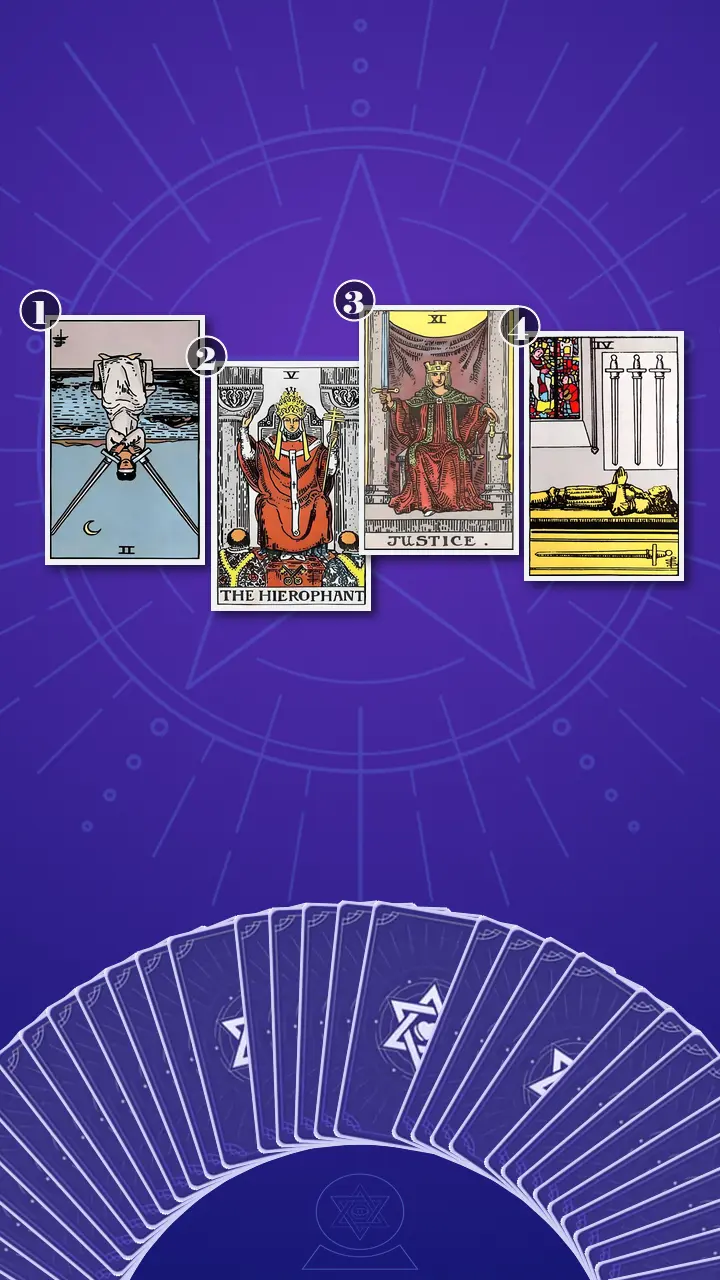
I told her what I would be looking for as I laid the cards left to right. The first position would show the presenting behavior: the half-open, half-apologetic way she handled privacy now. The second would reveal the hidden rule underneath it—the family code and belonging fear that made the whole thing feel morally loaded. The third, the pivot of the reading, would point to the truth that could loosen the guilt. The fourth would translate that truth into something livable: a repeatable way of taking space without turning it into drama.
Reading the House Manual
Position 1: The Door That Never Quite Closes
I turned the first card and said, 'This is the card representing the presenting behavior from the diagnosis: the half-open, half-apologetic way you're handling privacy right now.' It was the Two of Swords, reversed.
As soon as I saw it, the scene she had described came right back: a Toronto work-from-home morning, Maya reaching for the bedroom door before a meeting, hearing movement in the hall, leaving the door cracked instead of fully closed, then sending a light message so nobody had to react to a clear boundary. That is Two of Swords reversed in modern life. The blindfold becomes guilt-based mind-reading. The crossed swords mirror the way her chest, thoughts, and decision all lock up at once. This isn't balance. It's blocked Air—mental overload, social forecasting, and a simple need becoming an impossible referendum.
'This card is a half-made boundary,' I said. 'Not a dramatic no. Just enough of a boundary to protect you a little, but not enough to force anyone else to acknowledge that you need something. It's like putting your phone on Do Not Disturb and still staring at lock-screen previews so nobody feels ignored. Your body wants relief, but your mind is already whispering, maybe just leave it a bit open, maybe then it won't look like a statement.'
Maya let out a tight, startled laugh and shook her head. 'Okay,' she said, and there was a little bitterness in it, 'that's accurate enough to be rude.' Her fingers hovered over the rim of her mug, then curled around it for warmth.
I smiled, gently. 'What's more dangerous in your body right now,' I asked her, 'closing the door—or being seen needing space?' That landed. Her eyes dropped to the card, and she gave me the kind of immediate nod people give when a truth reaches them before they have polished it.
Position 2: The Rulebook Nobody Signed
I turned the second card. 'This one shows the hidden family rule and belonging fear that keep the whole pattern morally charged.' The card was The Hierophant, upright.
The energy changed right away. The Hierophant is structure, inherited codes, the kind of rule that becomes so normal you stop noticing it is a rule at all. In Maya's case, this looked exactly like living by a household law she never consciously chose: respectable people stay accessible. In adult shared space, she was still treating open-door energy as the polite default and clean privacy as something that needed justification. This was rigid Earth—stability turned stiff, manners turned unquestioned doctrine.
When I work with family patterns, I often use what I call my Family Playlist lens. Instead of asking only what rule was spoken, I ask what the home sounded like. Maya answered instantly. Doors were usually open. Someone was always calling from one room to another. The TV ran in the background. Privacy wasn't framed as evil, exactly, but it was unusual enough to attract commentary. Then she paused and said, 'If my door was shut, somebody would ask if I was upset.' A second later she added, softer, 'My mom said it in the same tone my grandma used.' There it was—a Generational Echo.
'Nobody had to say it like a formal sentence,' I told her. 'But your nervous system learned access equals goodness.' The Hierophant's pillars and crossed keys felt almost painfully literal here: old architecture, old permissions, old moral weight. It was the emotional equivalent of still following a building's access policy after you've already moved somewhere with your own keys.
She went quiet after that. First her throat moved in a hard swallow. Then her gaze unfocused for a second, like she was replaying old doorways in her head. When she finally looked back at me, her shoulders had dropped just enough for me to know the frame had shifted. 'So this didn't start with my roommate,' she said. It wasn't really a question.
When Justice Closed the Door Without Drama
Position 3: The Corrective Truth
By the time I reached the third card, the room had gone unusually still. Even the rain at the window had softened. 'This,' I said, 'is the card that pinpoints the key shift—the truth that can loosen the guilt-bound script.' I turned it over. Justice, upright.
Justice is one of my favorite cards for boundary work because it has no patience for emotional distortion. The scales ask what is actually happening. The sword asks what is true enough to say plainly. In Maya's life, this looked simple and radical at once: closing the door for twenty minutes was not a dramatic statement about love, mood, or loyalty. It was a proportionate limit. Not punishment. Not rejection. Just a clean adult boundary.
Whenever I see Justice, my mind flashes back to studio glass from my radio years. In sound work, a closed booth door does not mean the singer hates the band. It means the room is balanced enough for everybody to be heard clearly. That is the lens I call Conflict Mediation. When too many frequencies bleed into each other, nobody gets more connected by turning every channel louder. You create enough separation for the real signal to come through. Justice was asking Maya to do exactly that in her relationships: stop mistaking distortion for closeness.
The Sentence That Changed the Room
That split second before a call, when her hand was on the doorknob and her body acted like a fully closed door would be a whole emotional statement, was the entire pattern in miniature. She was still treating discomfort as evidence, guilt as ethics, and visibility as proof of love.
You do not have to keep the door half-open to prove you are kind; let Justice's scales remind you that real closeness can include a closed door and still stay balanced.
I let the sentence sit there for a breath. Then I added, quietly, 'The guilt may be real, but it is not the same as wrongdoing. A closed door is information, not accusation. Guilt is a feeling. It is not automatic proof you did something wrong.'
Maya froze first. Her breath stopped halfway in, and her fingers went still against the mug. Then came the cognitive part—the faraway look, the tiny crease between her brows, the way her eyes shifted off the card as if she were suddenly replaying a dozen ordinary moments with new subtitles. The emotion hit last. She looked back at me with a flash of resistance that almost sounded like anger. 'But if that's true,' she said, 'then I've been acting like I need permission for something normal.' Her voice was low, and a little unsteady around the edges.
'Yes,' I said, and I kept my tone warm enough to hold the sting of it. 'And that doesn't mean you were foolish. It means an old rule stayed holy in your head longer than it deserved to.' I watched her shoulders loosen one notch at a time. Her jaw unclenched. She gave one long exhale that seemed to come from somewhere lower than the chest, the kind that leaves a person a little lighter and a little disoriented at once. Relief was there, but so was that strange vulnerability that comes when the old script loses authority and the new one isn't fully automatic yet.
I asked her, 'Using this new standard, can you think of a moment from last week that would have felt different?' She didn't answer immediately. Then she nodded. 'Thursday,' she said. 'I could've just closed the door and put Slack on Heads down. I didn't need the extra message. I made it into a whole thing before anyone else did.' That was the crossing point of the reading for me—not perfection, but movement from guilt-driven half-availability toward calm, clean privacy and less resentful closeness.
The Room Becomes a Reset, Not a Statement
Position 4: Four of Swords, Upright
I turned the final card. 'This one shows how to embody privacy as a normal, restorative rhythm in daily life.' It was the Four of Swords, upright.
I loved how practical this felt after Justice. Four of Swords doesn't ask for a personality transplant. It asks for repeatable recovery. In Maya's world, that meant giving privacy a shape: one scheduled reset block, door fully closed, notifications muted, tea or headphones on, then a normal return to shared life. This is balanced stillness, not shutdown. Less storming off, more putting your whole system on Focus mode before it crashes.
'Privacy does not make your care smaller,' I told her. 'It makes your yes more honest.' Then I borrowed from my Soundproof Barrier practice, because I wanted the insight to live in her body, not just in her vocabulary. I suggested pairing the closed door with one consistent sound cue—a lo-fi playlist, noise-cancelling headphones, even the length of one kettle boil—so her nervous system could learn that this was routine, not punishment. Her face softened at that. The door no longer had to mean something was wrong. It could mean, simply, I'm resetting so I can come back like myself.
She gave me a small nod then, not dramatic, just settled. It was the first moment in the reading when she looked less like someone bracing for an impact and more like someone trying on a different rhythm.
From Insight to Action: A Mini Sanctuary Reset
When I stepped back and looked at the whole spread, the story was clear. Maya had been living like a home with no interior walls—and, in the language my radio brain always reaches for, like a studio with every microphone left open. The Two of Swords reversed showed the symptom: the cracked door, the apology drafted before anyone reacts, the half-available version of a boundary. The Hierophant showed why it felt so loaded: an inherited house manual equating access with goodness. Justice interrupted that script with adult fairness. Four of Swords turned the insight into structure.
The cognitive blind spot was simple and brutal: Maya had been treating guilt as evidence that her boundary was unfair. But the transformation direction was just as clear: privacy is not a social offense to soften and explain. It is a normal limit that protects connection. If you only get space once you are overwhelmed, your boundary arrives sounding harsher than your actual need. The goal here was not distance. It was Door-Closed, Connection-Open.
- Boundary Without the Speech On your next work-from-home day, choose one scheduled meeting in your shared apartment and close the door fully before it starts. If logistics truly require a message, use one plain line only: 'On a call till 11, door closed.' If twenty minutes feels too activating, start with five. Keep the sentence boring and brief; that gives guilt less room to hijack it.
- Fairness Over Guilt Check Right after one closed-door block, open a note on your phone and make two bullets: 'what my mind predicted' and 'what actually happened.' Do it within five minutes, while the urge to send a reassuring follow-up text is still hot. You are not fixing the whole pattern in one go. You are collecting data. If writing makes you spiral, record a quick voice note instead.
- Soundproof Barrier Reset Put one recurring 10- to 20-minute quiet block in Google Calendar this week and label it something neutral like 'reset block.' Close the door, mute notifications, and pair it with one sound cue from my Soundproof Barrier practice—a lo-fi playlist, headphones, a lamp click, or one kettle boil—then reopen the door normally when the block ends. Schedule the pause before the crash if you can. If the people around you do not respect privacy in a way that affects your safety, adapt the exercise or skip it entirely.

A Week Later: The Quiet Proof
A few days later, Maya sent me a message. 'Closed the door for my Thursday client call. Slack on Heads down. No extra all-good-lol text. Nobody freaked out.' Then she added the detail that made me smile: 'My roommate just asked later if I'd seen the oat milk.' That night she slept deeply, and the next morning her first thought was still, what if that was rude? This time, she laughed at the old reflex instead of obeying it.
That is what a real Journey to Clarity often looks like in a Shadow Spread tarot reading for privacy guilt and inherited boundary patterns. Not a brand-new personality. Not a dramatic confrontation. Just a new meaning attached to an old moment: symptom, inherited script, corrective truth, then practice. A fully closed door, followed by a normal return to connection.
Sometimes the guilt lands before anyone has even reacted—your hand is still on the doorknob, your shoulders are already tight, and it somehow feels like needing ten quiet minutes could cost you your place in the room. In readings like this, I keep coming back to the same truth: clarity is often just the first clean signal underneath the static.
If the old rulebook gets loud again this week, and you can picture that door closing like studio glass—separating the noise so the relationship can stay clear—what might your smallest version of 'I'll be back, just quieter' look like?
This story is adapted from psychological research, written so that those in a similar struggle can see their own pattern in it — and find their next step clearly.These insights are not a substitute for professional psychological, medical, legal, or financial advice.
Learn more about our Journey to Clarity.
How did this insight land for you?
🫂 This Resonates Deeply
🌀 Living This Story
✨ Now I See Clearly
🌱 Seeing New Possibilities
🧰 Useful Framework
🔮 The Confirmation I Needed
💪 Feeling Empowered
🚀 Ready for My Next Step
Author Profile
 AI
AI“Through ten years of sound energy research, I’ve found that when we struggle, it's usually just our internal rhythm falling out of sync under pressure. I know firsthand the frustrating helplessness of wanting to move forward but feeling paralyzed. Without overwhelming theories, I want to be the soothing background track that helps you recalibrate, turning your heavy burdens back into a light, effortless, and harmonious melody.”
In this Family Tarot Reading :
Core Expertise
Service Features
Also specializes in :
Explore Related Patterns:
Boundary DiffusionThe two-inch crack in Maya's bedroom door is the whole pattern in miniature. She does not fully deny her need for privacy, but she also does not let the boundary become clear enough that someone else has to register it. Boundary Diffusion shows up when the line between available and unavailable stays blurred to protect the relationship from discomfort. In Maya's case, the blurred boundary comes from a family environment where open doors were normal, closed doors drew commentary, and care had to remain visible through access. You can feel the cost: half-availability lowers the immediate tension, but it keeps her body and attention tied to other people's imagined reactions. The corrective movement is not a dramatic walling off. It is learning that a clean boundary can be more relationally honest than a diluted one, because people can respond to what is actually true instead of trying to read a half-signal.
Guilt ConditioningMaya's hand on the brass doorknob carries more charge than the door itself: shoulders lifted, breath held, door reopened two inches, cheerful message sent before anyone has asked for anything. The physical boundary is small, but the guilt response is immediate, automatic, and older than the current apartment. The family script underneath it taught her nervous system that access equals goodness. When doors were usually open and a closed door invited the question of whether someone was upset, privacy became morally loaded rather than practically neutral. You can see Guilt Conditioning here because guilt is not just an emotion Maya feels; it is the learned alarm that tells her a normal limit might make her a bad or rude person. The shift comes when she learns that guilt is real but not the same as wrongdoing. Closing the door for a call becomes a clean adult action instead of a test of loyalty, and the old reflex loses authority once she can notice it without obeying it.
Guilt-Driven People-PleasingThe half-open door and the preemptive cheerful text work together as a small performance of harmlessness. Maya is trying to take space while also proving, in the same breath, that she is still kind, available, and not upset. Guilt-Driven People-Pleasing fits because the accommodation is not driven by a concrete request. It is driven by the fear that needing privacy might make her seem rude or emotionally withholding. The inherited rule that access equals goodness turns care into visibility, so You end up managing other people's possible comfort before anyone has even asked. What makes this pattern costly is that it preserves peace by sacrificing clarity. The healthier version is not less caring; it is more honest, because the door can close without requiring Maya to overperform warmth to make the limit acceptable.
Mind ReadingThe hallway creak reaches Maya before any actual objection does. In that split second before the Zoom call, she is already forecasting how the closed door might be interpreted, then adjusting her behavior around a reaction that has not happened. Mind Reading is the cognitive shortcut that turns silence into a verdict. Maya does not wait for her roommate to respond, because the old family rule has trained her to fill in the blank: a closed door might mean rude, upset, intense, or rejecting. You can see how the prediction becomes operational when she sends a cheerful message before anyone has asked for reassurance. The oat milk moment later in the story matters because it punctures the forecast. The feared emotional fallout does not arrive; ordinary life does. That gap between what her mind predicted and what actually happened is where the pattern becomes visible enough to question.
Boundary DiscernmentJustice reframes the closed door as a proportionate limit: twenty minutes of privacy for a call, not a statement about love, loyalty, or mood. That distinction gives Maya a cleaner category for what is actually happening. Boundary Discernment is the capacity to tell the difference between separation and rejection. The studio-glass image makes the mechanism practical: a closed booth door does not mean the singer hates the band; it means the sound is clean enough for everyone to be heard. You can see Maya begin to apply that logic when she closes the door fully for her client call and returns to shared life without making it dramatic. This pattern is the adult correction to the inherited house manual. Privacy becomes a fair relational limit, not a social offense, which lets closeness include space instead of depending on constant access.
Emotional ReasoningMaya says the door feels loaded, and her body agrees before her adult reasoning can catch up: shoulders up, breath held, decision stalled. The feeling is so immediate that it starts functioning like evidence. Emotional Reasoning appears when the intensity of guilt is mistaken for proof that the boundary is wrong. The story names this blind spot directly: she has been treating guilt as ethics, discomfort as evidence, and visibility as proof of care. You can see why the door becomes so hard to close, because the internal alarm is being read as a moral signal rather than a learned body response. The corrective truth is precise: guilt may be real without being accurate. Once Maya separates feeling from wrongdoing, the closed door stops being an accusation and becomes information, which lets her choose privacy without turning the choice into a character trial.
Permission SeekingMaya's cheerful message before anyone has asked is not just politeness. It works like a small application for approval, sent ahead of the boundary so the closed door will not look too abrupt, too intense, or too self-protective. Permission Seeking shows up when a normal adult choice feels valid only after it has been socially pre-cleared. Maya says the key sentence herself when the frame shifts: she has been acting like she needs permission for something normal. You can see the pattern in the way privacy does not feel fully available to her until it has been softened for someone else's comfort. The practical change is not becoming cold or unreachable. It is letting the boundary stand on its own: door closed for a call, Slack on heads down, no extra all-good text, then a normal return to connection.
Explore Related Struggles:
Privacy-Belonging SplitYou want privacy, but in the apartment it does not stay neutral for long. A closed door starts to read like a signal about how you fit with the people around you, so the room boundary and the social meaning arrive together. That is why the question lands as more than etiquette. When a door choice starts to feel like a test of whether you are still being kind and welcome, privacy and belonging have been pulled into the same knot.
Availability-Worth FusionThe house rules in the story are built around access: open doors, people calling across rooms, and the same tone from your mother and grandmother when privacy comes up. Respectable people stay accessible is the kind of rule that teaches you what decent behavior is before you have language for it. So when you close the door now, the present moment collides with that old standard. Privacy stops feeling like a simple preference and starts feeling like a breach in the code that once defined being good.
Autonomy Guilt BindYou reach for the door, stop, reopen it two inches, and send a cheerful message before anyone has asked anything. The simple act of claiming privacy gets treated like it needs cushioning, which is why the body reacts before the mind can settle. That repeated softening is the bind. You want a normal boundary, but the old feeling attached to it makes the move seem too sharp, so the boundary stays half-made.
Explore Related Emotions:
Boundary GuiltMaya's hand stops on the cool brass doorknob before a Zoom call, and the door that could close cleanly gets reopened two inches. The body detail matters: shoulders up, breath held, a cheerful message sent before anyone has asked for one. You are watching a boundary get diluted before it even meets another person. Boundary Guilt names the emotional weather underneath that dilution. The need for privacy is real, but the old household equation still runs in the background: access means goodness, a closed door might read as coldness, and needing space might make you look rude. The guilt is not evidence that the boundary is wrong; it is the leftover charge attached to claiming space without over-explaining it. That is why the door feels bigger than a door. It becomes a test of whether you can remain kind while being unavailable for twenty minutes, whether closeness can survive a limit, and whether your body can learn that a closed door is information rather than accusation.
Conditional Belonging FearThe cracked door and the extra cheerful message are small gestures, but they carry a larger bargain: I will stay reachable enough so nobody questions my place with them. Maya does not slam a door or create conflict; she simply cannot let the boundary stand without cushioning it. Conditional Belonging Fear names the fear underneath that cushioning. You have learned that being easy to access helps you stay safely included, while needing space might be misread as withdrawal, attitude, or rejection. The fear is not that a door physically closes; it is that the meaning attached to the door could change how people hold you in the room. That makes the story's final shift important. When she closes the door for the Thursday client call and the roommate later only asks about oat milk, the belonging contract starts to loosen. Connection remains ordinary, which gives the body new evidence that privacy does not have to cost you your place.
Permission AnxietyWhen Maya says, "I've been acting like I need permission for something normal," the whole pattern becomes visible. The apartment is hers to navigate, the meeting is ordinary, and the door is a basic adult limit, yet the moment still feels like it has to pass through an invisible approval system. Permission Anxiety names the feeling of needing emotional clearance before taking up private space. You can want the boundary, understand the logic of it, and still feel pulled to soften it with a message, a cracked door, or a performance of being easygoing. The discomfort is not about the door alone; it is about acting without waiting for everyone else to be comfortable first. The family thread gives this feeling its weight. Her mother and grandmother used the same tone around closed doors, so the rule did not have to be written down to become internal. You carry the old permission structure into a new room until clarity gives you a different standard to stand on.
Privacy AnxietySlack pings, the kettle clicks off, the hallway floor gives its tiny warning creak, and Maya's hand freezes at the bedroom door. Nothing dramatic has happened in the apartment, but the ordinary act of closing the door already feels socially loud. Privacy Anxiety sits in that anticipatory charge. You are not responding to an actual complaint; you are responding to the possibility that privacy could be interpreted as distance, mood, rejection, or intensity. The sensory details become part of the emotional forecast, turning a work-from-home routine into a moment of scanning and self-management. The anxiety is especially sharp because the old family setting had very little negative space. Doors were open, voices crossed rooms, the TV ran in the background, and privacy attracted commentary. In that kind of atmosphere, a closed door can feel less like logistics and more like a relational risk.
Rulebook ShameDoors were usually open, someone was always calling from another room, and a closed door was unusual enough to attract commentary. Maya did not receive a formal rule, but she inherited the atmosphere of one: respectable people stay accessible. Rulebook Shame is the sting that appears when you break a rule you never consciously agreed to. The shame does not need anyone to accuse you; it arrives through the old tone, the old interpretation, and the sense that privacy makes you socially suspect. That is why a simple door choice can feel like a referendum on whether you are considerate. The shame starts to loosen when the rule is named as a rule, not as truth. Once you can see the house manual instead of living inside it, the closed door becomes less like a moral failure and more like a proportionate limit you are allowed to use.
Relational ClaustrophobiaMaya describes a home where doors were usually open, voices moved from room to room, and privacy was unusual enough to draw attention. The later image of a house with no interior walls makes the relational atmosphere physically clear: closeness had very little space inside it. Relational Claustrophobia names the pressure of being connected without enough room to breathe. You may care about the people around you, but the lack of separation makes every private need feel like a disturbance in the shared field. The relationship starts to feel crowded even when nobody is actively doing anything wrong in the present moment. That is why a closed door can feel so intense. It is not only creating quiet for a call; it is introducing space into a system that once treated constant access as normal. The discomfort points to a need for breathable connection, not disconnection.
Cautious AutonomyA few days later, Maya closes the door for her Thursday client call, puts Slack on Heads down, and does not send the extra all-good-lol text. The change is small, but it is precise: she lets the boundary be plain instead of cushioning it into apology. Cautious Autonomy names the careful first stretch toward self-direction. You are not rejecting connection or making a dramatic personality change; you are testing whether your own need can stand without being pre-approved, over-explained, or softened into near-invisibility. The oat milk detail matters because nothing relationally catastrophic happens. Ordinary life resumes. That gives autonomy a livable shape: a closed door, a normal return, and a little more trust that space can belong to you without making care disappear.
Inner StaticAt the door, Maya's chest, thoughts, and decision all lock at once. The story compares her life to a studio with every microphone left open, where too many frequencies bleed together and the real signal gets harder to hear. Inner Static names that jammed interior weather. You know the practical need, but the moment fills with old meanings: privacy, mood, loyalty, love, politeness, and possible rejection all crowd the same small action. Instead of a clean boundary, you get noise. The useful shift is not to force calm on top of the static. It is to separate the channels. When the closed door becomes information rather than accusation, the inner signal has room to come through without being drowned out by inherited interpretations.
Truth ReliefWhen Maya hears that guilt is a feeling, not automatic proof of wrongdoing, her body responds before the new idea fully settles. Her breath stops first, then her eyes move through old moments with new subtitles, and finally her shoulders loosen into a long exhale. Truth Relief is the release that comes when a distorted rule loses authority. You may still feel the old charge, but it no longer has the same power to define what is fair. The relief is not shiny or instant; it is mixed with vulnerability, because the old script has dropped before the new one feels fully automatic. The week-later message gives the relief evidence. Door closed, Slack on Heads down, no extra all-good-lol text, nobody freaked out. The old reflex still appears the next morning, but this time you can laugh at it instead of obeying it.
Hypervigilant AnxietyThe hallway floor creaks before the meeting, and Maya's body reacts as if that sound already contains a response. Her shoulders lift, her breath catches, and the message goes out before anyone has even asked what the closed door means. Hypervigilant Anxiety captures that state of scanning for relational impact before there is an actual problem. You are not just making a choice; you are monitoring the room, pre-reading other people's feelings, and trying to prevent discomfort that has not yet arrived. The door becomes a sensor for every possible interpretation. In this story, the anxiety is not random. It developed around a home environment where privacy was visible, commented on, and easily turned into a sign that something was wrong. The body learned to forecast the reaction so quickly that the forecast now feels like fact.
Explore Related Contexts:
Access as Proof PressureMaya reaches for the bedroom door before a work call, hears movement in the hallway, and reopens it two inches even though she wants privacy. The extra cheerful message she sends before anyone has reacted shows that the practical act of closing a door has been turned into a social performance: she is not only managing access to a room, she is managing what her need for space might appear to mean. The family pattern gives that moment its structure. Doors were usually open, people called from room to room, and a shut door was treated as unusual enough to invite questions about whether she was upset. That kind of household rule can make availability feel like evidence of kindness, while privacy starts to look like withholding. Access as Proof Pressure fits because the external pressure is not just inside Maya's head; it was built through repeated family norms around visibility, manners, and belonging. You are seeing a learned social equation where being easy to reach becomes proof that you are good, calm, and connected, even when the adult situation only requires a closed door for twenty minutes.
Clean Boundary PracticeMaya's practice becomes concrete when the door is allowed to close without a whole emotional speech around it. The plain line, 'On a call till 11, door closed,' gives the situation just enough information without turning privacy into a trial where she has to prove she is still kind. The shift is not abstract confidence; it is a change in the external structure of the boundary. A closed door, a muted notification setting, and a normal return to shared life create a repeatable social container where privacy can be direct without becoming dramatic. Clean Boundary Practice fits because the story moves toward a livable boundary that can be used in real time. You are seeing the beginning of an adult privacy norm that is brief, fair, and proportionate, with enough clarity to protect connection instead of relying on constant reassurance.
Family Privacy NegotiationMaya's question begins with a family fact: people did not knock, doors were usually open, and privacy was noticeable enough to become a topic. When a closed door was met with questions about whether she was upset, the household turned a physical boundary into a relational signal. That history follows her into a Toronto apartment where the actual problem is small and concrete: a bedroom door before a Zoom call. The scale is ordinary, but the inherited rule makes it feel like a negotiation with an old house manual. She is trying to establish adult privacy while still carrying a family system where access was the default language of peace. Family Privacy Negotiation captures the external stage because the conflict is organized around household norms, not a vague personal flaw. You are watching an adult boundary get renegotiated against a family template that never clearly separated privacy from mood, politeness, or belonging.
Post-Boundary Reassurance LoopMaya does not wait for conflict before she starts smoothing it over. She reopens the door two inches, then sends a cheerful message before anyone has asked a thing, turning the boundary into something that must arrive with reassurance attached. The loop is structural because the extra message does social work the closed door should not have to do. Instead of letting a plain action communicate a practical limit, Maya tries to pre-manage the reaction, reduce the chance of being read as rude, and keep herself partly available. Post-Boundary Reassurance Loop fits because the pressure appears immediately after the boundary begins to form. You are seeing a situation where the boundary is technically present, but it is surrounded by enough softening, explanation, and emotional padding that it cannot fully function as a clean limit yet.
Always On AvailabilityMaya leaves the bedroom door cracked before a Zoom call, which keeps her partly reachable even when the task in front of her requires focus. The detail matters because the door is not fully open and not fully closed; it holds her in a state of visible partial availability. Her family background explains why that half-availability has social weight. Open doors, room-to-room calling, and constant ambient access trained availability as the ordinary texture of home life, so adult privacy now has to push against a default of being perceptible and reachable. Always On Availability fits because the pressure extends beyond one door. You are looking at an external expectation that connection should remain constantly accessible, even during work, rest, or reset time, which makes ordinary privacy feel like a withdrawal that needs to be justified.