The Monday-After Crash on Line 1
If the visit was ‘fine’ but you’re wiped, irritable, and weirdly numb on Monday, you’re not lazy—you’re paying the bill for people-pleasing.
Jordan showed up to our session looking like they’d been carrying their weekend in their body. They’re 29, Toronto-based, a mid-level tech project coordinator—the kind of job where Slack doesn’t care that your nervous system had company.
They described it like a time-stamped clip they’d watched too many times: 10:03 AM on the first workday after the visit, on the Line 1 subway heading south. Their reflection floats in the dark window while the train squeals into a curve. Slack pings stack up like dropped coins. Their jaw is so tight it feels like a hinge that forgot how to be a hinge, and their stomach sits flat and empty as if it’s bracing for commentary instead of breakfast.
“It was fine,” they said. Then, softer: “So why does it feel like I ran a marathon I didn’t train for?”
I watched their shoulders—heavy, lifted, like the muscles were still waiting for a “helpful” remark. Exhaustion wasn’t an abstract concept in the room; it was a physical posture. The kind where your body keeps performing even after the audience leaves.
Jordan’s question landed clean and specific: after a parent visit, why does burnout flare—what’s out of balance?
I nodded. “A ‘fine’ visit can still be expensive,” I said. “Not because your parent is villainous. But because the version of you that shows up during family time can be… labor-intensive. Let’s make this practical. We’re going to map what your system is doing, and find where the cost gets hidden.”

Choosing the Compass: The Celtic Cross · Context Edition
I asked Jordan to take one slow breath—not as a mystical ritual, just a nervous-system handoff from ‘surviving’ to ‘seeing.’ I shuffled while they held the question in mind: What’s out of balance—and why does it flare after contact?
“Today I’m using the Celtic Cross · Context Edition,” I told them.
For readers who’ve typed “how tarot works” into a search bar at 1 a.m.: this isn’t about predicting whether your parent will text next weekend. This is diagnostic tarot—using a structured spread to trace a chain: present symptoms → what’s actively stressing you → the older family rule underneath → your coping strategy → your environment pressures → and then an integration outcome that’s actually doable.
The Celtic Cross is ideal for a career crossroads or a relationship spiral, but it’s just as sharp for feeling stuck after family contact because it shows the system. And in this Context Edition, positions 8 and 9 explicitly name the family dynamic and the approval loop—the two things most people try to downplay while their body screams the truth.
I pointed to the layout as I dealt. “Card 1 will show the burnout flare as it looks in real life right after the visit. Card 3 will go deeper—what learned family rule your body slips into. And the final card, position 10, will show the most empowering balance to practice so visits cost less of your life-force.”
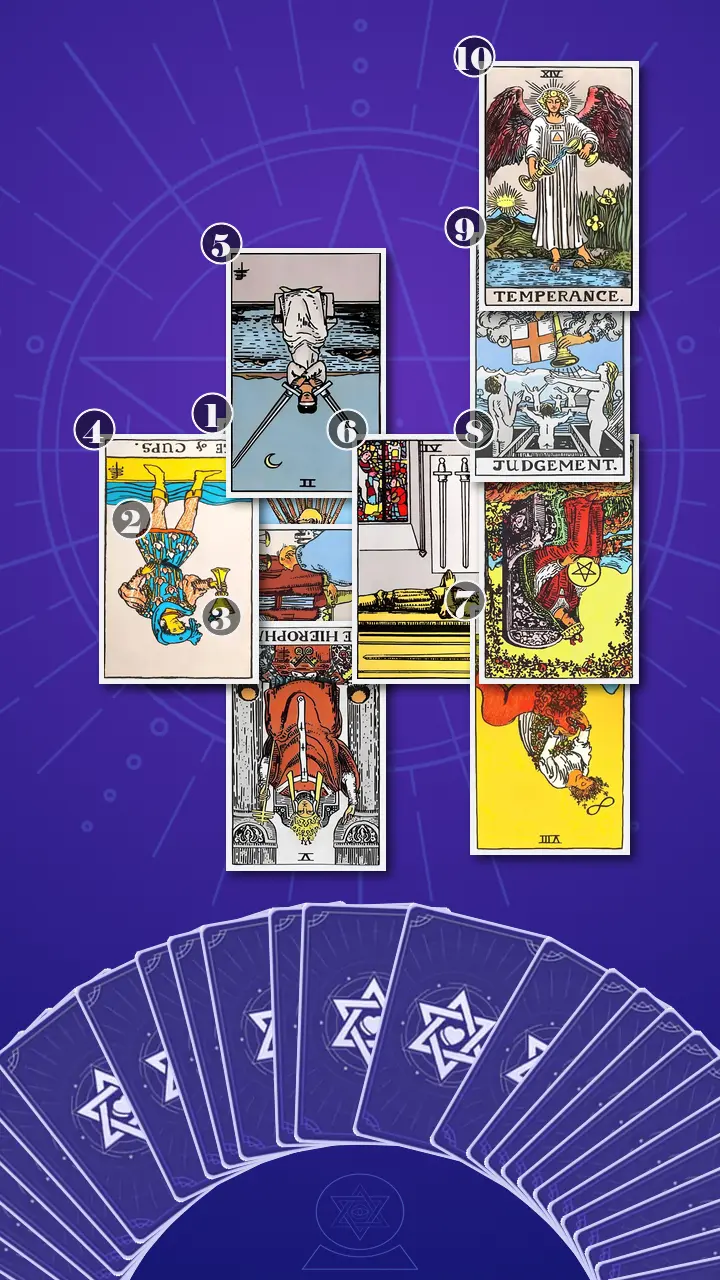
Reading the Map: The Invisible Receipt
Position 1 — The burnout flare as it shows up right after the parent visit (observable overload pattern).
“Now I’m turning over the card that represents the burnout flare as it shows up right after the parent visit,” I said.
Ten of Wands, upright.
I didn’t need to dramatize it. The image does that on its own: a figure bent forward, arms full, face blocked by what they’re carrying.
I connected it to Jordan’s life in the plainest modern translation: “The morning after your parent leaves, you’re staring at your Monday backlog like it’s a distant town you can’t reach—because you just spent the entire visit carrying logistics, emotions, and the ‘competent adult’ performance. Your body feels bent-forward even while you’re sitting still, like the weight didn’t leave when they did.”
“That’s… disgusting,” Jordan said, and let out a little laugh that had more salt than humor. “It’s accurate. But gross.”
“Brutal honesty is one of tarot’s better traits,” I said gently. “Energy-wise, Ten of Wands is excess—too much responsibility, too much emotional labor, too much ‘I’ll handle it.’ And notice the detail: the wands block the figure’s vision. Burnout narrows your options to two settings: push through or shut down. No middle path.”
I watched Jordan’s fingers tighten around their mug, then loosen. Their jaw flexed once, like a reflex.
Position 2 — What is actively throwing your energy out of balance (the main stressor or friction point).
“Now I’m turning over the card that represents what’s actively throwing your energy out of balance,” I said.
Six of Pentacles, reversed.
“Here’s the problem underneath the overload,” I told them. “This card is the exchange rate. Reversed, it’s imbalance—giving to earn safety, not giving by choice.”
I used the translation the way it wants to be used—like a mirror. “During the visit, you give time, attention, reassurance, and flexibility like you’re trying to keep the scales even—except the scales are tilted. You say yes in real time, then later you keep a private tally: sleep lost, routines dropped, emotional labor spent. The imbalance is what makes the Ten of Wands load unsustainable.”
Jordan swallowed and looked away from the screen for a moment, like they were trying to locate the feeling in the room rather than in their head.
“I have receipts,” they said. “Like, literal ones from groceries, but also… internal ones. The whole weekend is a spreadsheet.”
“Exactly,” I said. “And here’s the line-item truth: If you buy peace with effort, burnout collects interest.”
I let that hang. The hum of Jordan’s apartment—some distant HVAC, the faint city hush—filled the pause like background music in The Bear when no one’s saying the thing but everyone’s feeling it.
“So the energy dynamic here is a blockage,” I continued. “Not because you lack capacity. Because your generosity has become a survival strategy. You’re overpaying in emotional currency.”
Position 3 — The deeper root: the learned family rule you slip into during the visit that sets up the crash afterward.
“Now I’m turning over the card that represents the deeper root,” I said. “The learned family rule you slip into during the visit.”
The Hierophant, reversed.
As a Jungian psychologist, this is the moment I stop listening only for events and start listening for archetypes—the inner roles that take the stage when a certain person walks into the room.
“A parent visit quietly boots up an old operating system: you slip into scripted politeness, explain your choices like you need permission, and prioritize tradition/approval over your current values. You’re not only hosting a person—you’re hosting a whole internal rulebook, and that takes energy to run.”
Jordan’s eyes sharpened. “That’s it,” they said. “I hate how fast it happens. Like I become… fourteen.”
“That’s the Hierophant’s domain,” I said. “Family rules, inherited expectations, the ‘right way’ to be. Reversed doesn’t mean you’re failing—it means your adult self is quietly disagreeing, but your body still knows the choreography. That disagreement costs energy, because you’re editing yourself in real time.”
They nodded once, but it wasn’t a clean yes. It was a reluctant recognition.
Position 4 — What the visit re-activates from the recent past (the emotional trigger loop you fall back into).
“Now I’m turning over the card that represents what the visit re-activates from the recent past,” I said.
Page of Cups, reversed.
“This card is tender,” I told them. “Not fragile—tender. It’s about the small sting you minimize because you think you ‘should’ be fine.”
And I used the modern-life scenario like a direct quote from their nervous system: “One small comment lands weird, you smile anyway, and you tell yourself it shouldn’t matter. Later—alone—the feeling pops up like an unexpected fish: raw, tender, distracting. Because you minimized it in the moment, it comes back as fog, irritability, and the inability to start simple tasks.”
Jordan exhaled through their nose, almost a snort. “The ‘cozy’ comment,” they said immediately, without me asking.
“The fish,” I said. “It’s not about whether the comment was objectively rude. It’s about the moment your body heard evaluation. Page of Cups reversed is deficiency of emotional acknowledgement—so the feeling doesn’t metabolize. It leaks out later as doomscrolling, numbness, and snapping at slow Wi‑Fi.”
Jordan’s shoulders lifted, then dropped. The tiniest release.
Position 5 — Your conscious strategy right now: what you think you must do to keep things smooth (and how that contributes).
“Now I’m turning over the card that represents your conscious strategy,” I said. “What you think you have to do to keep it smooth.”
Two of Swords, reversed.
I didn’t have to ask if Jordan had drafts they never sent. Their whole posture said: I’ve rehearsed this in my head until the words turned to sand.
“Your current strategy is ‘don’t choose, don’t rock the boat’: you keep your boundary phrases locked in your head and maintain a neutral mask. But it’s cracking—late-night replays, drafts you never send, and a body that won’t calm down are signs the avoidance tax is due.”
Jordan’s mouth twisted. “I had a draft text,” they admitted. “Sunday evening. Deleted it. Rewrote it. Deleted it again. Then I… worked late. Like if I just prove I’m fine, I’ll feel fine.”
“That’s the reversal,” I said. “Two of Swords upright is the freeze. Reversed is the crack in the freeze—where clarity becomes possible. It’s like having 18 browser tabs open about ‘how to say it’ and realizing none of them will send the message for you.”
They gave a small, defeated nod. Then another, steadier one. The second nod mattered more.
Position 6 — Near-term direction: what helps you stabilize in the days after (the most realistic next phase).
“Now I’m turning over the card that represents near-term direction,” I said. “What stabilizes you after a flare.”
Four of Swords, upright.
“Good,” I said out loud before I even elaborated. “This is the off-ramp.”
“The realistic next phase isn’t ‘catching up’—it’s a deliberate downshift: a protected hour, phone on DND, basic food, and quiet. Not as a treat, but as maintenance. This is the pause that stops a normal tiredness from turning into a full shutdown.”
Four of Swords is balance—not in the sense of ‘perfectly healed,’ but in the sense of a system that gets to reset before it breaks. It’s permission with structure.
Jordan’s eyes softened. “It feels cringe to schedule rest,” they said, like they were confessing a crime.
“That’s the old rulebook talking,” I said. “Not truth.”
Position 7 — Your role in the pattern: how you hold yourself during and after the visit (self-talk, self-control, capacity).
“Now I’m turning over the card that represents you in the pattern,” I said.
Strength, reversed.
“In the pattern, you try to be strong by ignoring limits—then shame yourself when your body crashes. Strength reversed is the moment you realize white-knuckling isn’t resilience. Soft strength is believing your capacity is real data and protecting it without apologizing.”
Jordan’s expression shifted—first a flicker of offense, then recognition. Their eyes went slightly glassy, but they blinked it back fast.
“I hate that I’m not tougher,” they said.
I kept my voice steady, coach-like but kind. “You’re being tough in the wrong direction. This card isn’t calling you weak. It’s showing you a mismatch: you’re treating depletion as a moral failure instead of information.”
They pressed their lips together, then released them. A micro-adjustment, like loosening a belt one notch.
Position 8 — The environment factor: the family dynamic and practical pressures around the visit that shape your nervous system.
“Now I’m turning over the card that represents the environment factor,” I said. “The family dynamic and practical pressures around the visit.”
Queen of Pentacles, reversed.
“Your home becomes a proving ground: you host, nurture, manage details, and keep everything comfortable—while your own grounding routines (sleep, food, quiet) get sacrificed. After the visit, your space feels drained because you used your ‘home resources’ on everyone else.”
Jordan laughed once—this time with that sharp edge of ‘Sunday Scaries but it’s the Monday-after-family-visit version.’ “I cleaned the counter three times,” they said. “Like it was a performance review.”
“That’s Queen of Pentacles reversed,” I said. “Caretaking without self-inclusion. Environmentally, it’s not just your parent—it’s the whole hosting setup, the small apartment feeling like a stage. Energy-wise, it’s misallocation: your resources go outward until you’re internally underfunded.”
Position 9 — The hope/fear engine: what you secretly want from a parent visit and what you fear it might confirm about you.
“Now I’m turning over the card that represents your hopes and fears,” I said. “The engine underneath the whole thing.”
Judgement, upright.
“Under the visit is a loud, silent question: ‘Do they approve of who I am now?’ You hope for recognition and a clean reset—and fear an old verdict (‘not enough’). That fear turns an ordinary weekend into a high-stakes performance, and the burnout is the aftermath of being on trial in your own head.”
Jordan went still. A three-part reaction chain ran across their face and body, fast but readable: their breath paused; their gaze unfocused as if replaying a moment at the streetcar stop; then their shoulders dropped with a slow, tired exhale.
“I don’t want to be on trial,” they said, barely above a whisper. “But it’s like my body volunteers me anyway.”
“That’s why this isn’t solved by ‘try harder,’” I said. “It’s solved by changing the structure of the exchange.”
When Temperance Spoke: Mixing Two Cups on Purpose
“We’re turning over the final card,” I said. “This is the integration outcome—the most empowering balance to practice so visits cost less of your life-force.”
The room felt quieter, even through a screen. Like the air itself leaned in.
Position 10 — Integration outcome: the most empowering balance to practice so visits cost less of your life-force.
Temperance, upright.
“Integration looks like designing visits with an actual exchange rate: clear start/stop points, built-in recovery, and a realistic division of labor. You blend care with self-care on purpose—so connection doesn’t require self-erasure and you leave tired but not wrecked.”
Setup (the stuck place): Jordan was living inside a binary: either be the easy, impressive version of themself during the visit—or risk being seen as ungrateful. Either carry everything and crash, or set a limit and trigger “a whole thing.” Their body kept choosing the first option, then paying for it in fog and shutdown.
Delivery (the sentence):
Stop carrying the whole visit on your shoulders; start blending your needs and their needs like Temperance mixing two cups on purpose.
I let a beat of silence do its work.
Reinforcement (the moment it lands): Jordan’s face did something I’ve seen thousands of times—on cruise ships mid-Atlantic when someone finally names the pattern and the ocean inside them stops pretending it’s calm. First their eyebrows lifted in a small, startled way, as if the concept of “designing” a visit had never been allowed into the room. Then their mouth opened slightly, closed again, and they swallowed hard. Their jaw—so clenched at the beginning—released by a few millimeters. Not dramatic. Real. A slow exhale followed, shaky at first, then steadier, like their lungs had been waiting for permission to stop bracing.
And then: a flash of resistance. Their eyes narrowed, heat rising. “But… doesn’t that mean it’s my fault?” they asked, voice tighter. “Like I did this to myself?”
I didn’t flinch. “It means you’ve been carrying a strategy that once kept you safe,” I said. “That’s not fault. That’s adaptation. Temperance is not blame—it’s agency. Balance isn’t a vibe—it’s a ratio.”
In my mind I saw Venice—how the canals don’t demand you never touch the water. They demand you learn where the edges are, where the stones begin. On cruise ships, I used to teach intuition as a navigation skill: you don’t argue with the tide; you set your route.
Then I pulled in my signature lens—the one that always makes family dynamics feel less moral and more workable. “In Murano glassmaking,” I told them, “if you pour everything at once—too hot, too fast—the whole piece warps. If you cool it too quickly, it cracks. The craft is in the ratio: heat, time, breath, and pauses. Temperance is that workshop. You don’t ‘hope’ the glass becomes stable after the fact—you make stability while you’re shaping it.”
Jordan stared at the card on their screen. Their hands unclenched, then rested flat on their thighs as if to prove to themself they could exist without gripping.
I asked, exactly as I always do when a key insight lands: “Now, with this new lens—can you think of one moment last weekend when you felt your first internal ‘no’? The first tiny flare in the body. If you’d had this ratio idea then, what might have been different?”
Jordan blinked, looked up and to the left—memory access. “Saturday,” they said. “They wanted to do one more stop. I felt it in my stomach. Like… a drop. If I’d had a plan, I could’ve said, ‘I’m done at four.’ Instead I smiled and we went.”
“That’s the shift,” I said. “Not from love to rejection. From performing ‘the good child’ to pacing the visit with explicit boundaries and a fair give-and-take.”
This is what finding clarity looks like in real life: not certainty, but a new internal rule. A movement from braced politeness and post-visit shutdown toward honest naming of needs and small, sustainable experiments. From self-doubt to grounded self-trust.
The One-Page Plan for Actionable Advice (and a Nervous System That Can Breathe)
I summarized the story the cards told, so Jordan could hear it as one coherent thread instead of ten separate insights.
“You’re not crashing because the visit is objectively terrible,” I said. “You’re crashing because Ten of Wands says you carry the whole weekend—logistics, mood management, adulthood performance—while Six of Pentacles reversed says the exchange isn’t fair. The Hierophant reversed shows the old family rulebook hijacks your adult self, so you spend energy editing yourself in real time. Page of Cups reversed shows the unacknowledged sting that turns into fog. Two of Swords reversed shows avoidance is cracking. Four of Swords says rest has to be structured. Strength reversed says shame is making the crash worse. Queen of Pentacles reversed says your home becomes a proving ground. Judgement says the real pressure is feeling evaluated. Temperance says the solution is measurable pacing and reciprocity.”
“Here’s the cognitive blind spot,” I added. “You keep treating the burnout like a mysterious after-effect you should ‘get over.’ But the cards show it’s a predictable invoice. You’re funding connection with self-erasure—then trying to ‘catch up’ as if your body didn’t pay.”
“So we redesign the exchange,” I said. “And we keep it small. You don’t have to become a boundary superhero overnight.”
I offered Jordan a short, concrete plan—real next steps, not a vibe.
- Schedule a Recovery HoldPut a literal “Recovery Hold” on your calendar for the first workday after a visit: 60 minutes (or 15, or 5). During it: phone on Do Not Disturb, camera off if needed, and choose one simple task only—either shower + food, or one admin task like submitting expenses.If guilt spikes (“I should be catching up”), name it as the old ‘good kid’ reflex—not a truth. Set a timer. When it ends, you’re allowed to stop.
- Write an “Energy Receipt” (Two lines)Open Notes and write exactly two lines: “What I gave by choice:” / “What I gave by pressure:”. No explanations. No defending your feelings. Just the line items.This is data, not drama. If your mind tries to litigate it like a courtroom (hello, Judgement), stop at two lines and close the app.
- Send one “Smaller Yes” as a Schedule FactPre-plan one smaller yes for the next visit (start time, end time, or one quiet hour). Send it 48–72 hours in advance in one text with no long justification: “I’m free 11–4.” or “Saturday lunch is takeout at my place.”You can set logistics without debating your worth. If you start over-explaining, delete everything except the sentence that names the plan.
Before we ended, I added one last tool from my own Venice vocabulary—simple, physical, not poetic for poetry’s sake. “Think of boundaries like a dock bollard,” I said. “You’re not rejecting the boat. You’re giving it a place to tie up so it doesn’t slam into the stone all night.”
That’s my Bollard Marking Method in one line: a boundary is a fixed point you return to—start time, end time, quiet hour—so the relationship can moor without you holding the rope in your teeth.

A Week Later: The Quiet Proof
Eight days later, Jordan emailed me a screenshot of their calendar. One block was highlighted in pale blue: Recovery Hold — Monday 9:30–10:00. Under it, a note: “DND. Shower OR expenses. Not both.”
“I did it,” they wrote. “And I didn’t die. Also… I sent the smaller-yes text for next time. My hands shook, but I sent it.”
They added one more line that felt like the real win: “I still woke up thinking, ‘What if it becomes a whole thing?’ But I unclenched my jaw and got up anyway.”
That’s the Journey to Clarity in real life: not a perfect family system, not zero fatigue—just an adult self who believes their capacity counts, and designs the exchange accordingly.
When a visit is ‘fine’ but your shoulders stay braced and your jaw won’t unclench, it’s often because you spent the whole weekend being the easy, impressive version of you—and your body is tired of paying for that afterward.
If balance is a ratio you get to set, what’s one small part of the next visit you’d want to pace on purpose—start time, end time, or one quiet hour that belongs to you?
This story is adapted from psychological research, written so that those in a similar struggle can see their own pattern in it — and find their next step clearly.These insights are not a substitute for professional psychological, medical, legal, or financial advice.
Learn more about our Journey to Clarity.
How did this insight land for you?
🫂 This Resonates Deeply
🌀 Living This Story
✨ Now I See Clearly
🌱 Seeing New Possibilities
🧰 Useful Framework
🔮 The Confirmation I Needed
💪 Feeling Empowered
🚀 Ready for My Next Step
Author Profile
 AI
AI“Having traveled across cultures... I've learned that what we often lack isn't a simple answer, but a moment of being truly understood. I use a Jungian psychological lens to help you deconstruct your subconscious patterns—not to prove anything, but to be the gentle companion who helps you unravel your knots, free of judgment, so you can reconnect with your inner wisdom.”
In this Family Tarot Reading :
Core Expertise
- Adult-Child Regression Auditing: Decrypting the specific environmental triggers that force you to regress into an anxious, defensive teenager around your parents.
- Emotional Blackmail Deconstruction: Identifying guilt-trips, silent treatments, and subconscious manipulation tactics used to enforce family loyalty.
Service Features
- The Regression Circuit Breaker: A cognitive grounding protocol to maintain your adult psychological sovereignty and objective reasoning during high-stress family interactions.
Also specializes in :
Explore Related Patterns:
Boundary DiffusionJordan feels the first internal no on Saturday when another stop is suggested, but the signal stays inside the body instead of becoming an external boundary. They smile, go along, and later try to process the cost through deleted drafts, tight jaws, and Monday shutdown. That is boundary diffusion: You can sense the limit, but the relationship field makes it hard to locate where your needs end and the parent's expectations begin. The mind treats a simple schedule fact as if it might become a verdict on your character, so the boundary gets softened into silence. The burnout flares because an unspoken no still uses energy. When you do not give the relationship a clear start point, end point, or quiet hour, your body becomes the container for every unmade decision. Balance returns when the limit becomes specific enough to live outside your nervous system.
Defensive OverfunctioningJordan carries logistics, mood management, hosting details, and the competent adult performance, then works late after deleting the boundary text. The effort looks responsible from the outside, but the body tells a different story through jaw tension, fog, and the Monday-after crash. Defensive overfunctioning is the attempt to stabilize the room by becoming more capable than the situation should require. You handle, smooth, anticipate, and absorb because competence feels safer than conflict or disappointment. The imbalance is that performance starts replacing honest capacity. When You treat depletion as something to outrun, the system only has two settings left: push through or shut down. Real balance begins when capability includes recovery, pacing, and the right to stop before collapse becomes the first clear signal.
Family Role RegressionJordan names the shift directly: around the parent, they become fourteen. The visit boots up an older family operating system where choices need explaining, politeness becomes choreography, and the adult self starts editing in real time. Family role regression is the mechanism underneath that sudden collapse in capacity. You are not losing adulthood; you are being pulled into a well-practiced role that once organized safety, approval, and belonging. The body remembers the script faster than the conscious mind can debate it. This explains why a technically fine visit can create a disproportionate crash. You are not only hosting a parent; you are also hosting an inherited rulebook, monitoring yourself against it, and suppressing the adult part of you that quietly disagrees. The imbalance is the cost of living in two developmental time zones at once.
People-PleasingJordan's real-time yeses, hosting labor, reassurance, and polished 'easy adult' performance show a system that buys temporary peace with effort. The visit is described as fine on the surface, but the Monday crash reveals that the smoothness was not free; it was paid for through self-editing, emotional labor, and delayed recovery. The psychological mechanism is people-pleasing as a survival strategy: You reduce friction by becoming agreeable before anyone has to ask. That can feel practical in the moment, especially around a parent whose approval still matters, but it trains your nervous system to treat your own needs as the negotiable part of the exchange. The burnout flare makes sense because the compliance does not end when the parent leaves. Your body keeps carrying the role, then switches into fog, irritability, numbness, and shutdown once the performance is over. The imbalance is not that you care too much; it is that care has been routed through self-erasure instead of consent.
Approval SeekingJordan's parent visit carries a silent question underneath the logistics: Do they approve of who I am now? That question turns ordinary moments into evidence, so a comment, a glance, or a change of plan can feel like a verdict before anything explicit has happened. Approval seeking works by shifting your center of gravity outward. Instead of checking whether the visit is workable for your body and schedule, You start tracking whether your parent recognizes you as acceptable, successful, grateful, or mature enough. The crash follows because being evaluated, even internally, is exhausting. When the weekend becomes a performance review of adulthood, your nervous system stays braced for commentary, and Monday arrives with the accumulated fatigue of trying to win a verdict that was never formally on the table.
Boundary DiscernmentJordan can locate the first internal no in the body: the stomach drop when another stop is suggested. The change begins when that private signal becomes a concrete schedule fact, like 'I'm free 11-4,' instead of staying trapped as guilt or resentment. Boundary discernment is the ability to separate a limit from a rejection. You are not refusing relationship; You are marking the conditions under which the relationship can happen without turning your body into the shock absorber. That pattern is the healthy counterweight to the post-visit crash. When capacity becomes data, You no longer need to wait for shutdown to prove that something was too much. The balance shifts from braced politeness to explicit pacing, where your needs and the parent's needs can both exist without being fused into one demand.
Resource AlignmentJordan's practical shift is small but precise: a Recovery Hold, Do Not Disturb, one simple task, and a smaller yes sent in advance. Instead of hoping the visit will cost less, they begin designing the exchange rate before the cost accumulates. Resource alignment is the adaptive pattern of matching care to actual capacity. You do not have to stop caring, over-explain, or perform total availability; You redistribute time, attention, labor, and recovery so the visit is not funded entirely by your nervous system. This directly answers what is out of balance. The issue is not love versus rejection; it is resource flow. When rest, food, quiet, schedule boundaries, and emotional labor all belong in the same equation, connection becomes something You can pace rather than something that quietly empties you out.
Conflict AvoidanceJordan's boundary text exists, disappears, returns, and disappears again. The words are rehearsed privately, but the actual message never leaves the draft because naming the limit feels like it could trigger a whole thing. Conflict avoidance reduces immediate anxiety by keeping the surface calm. You stay neutral, delay the choice, and redirect energy into work or competence so you do not have to feel the discomfort of disappointing someone in real time. The cost is that the conflict does not vanish; it relocates into the body. The unsent message becomes jaw tension, late-night replay, irritability, and a shutdown that looks mysterious only because the confrontation was postponed rather than processed.
Energy ScorekeepingJordan says they have receipts, both literal grocery receipts and internal ones. The weekend becomes a spreadsheet of sleep lost, routines dropped, emotional labor spent, and effort given to keep the visit smooth. Energy scorekeeping appears when the nervous system tracks an imbalance that the relationship has not openly named. You may look generous in the moment, but part of you is privately calculating the cost because the exchange does not feel mutual or chosen. The pattern matters because the tally arrives after the boundary moment has already passed. Instead of using the receipt as data for the next visit, You can get trapped in resentment, depletion, and a sense that connection always collects interest. The balance point is to convert the tally into design: clearer limits, smaller yeses, and recovery built in before the invoice comes due.
Explore Related Struggles:
Approval-Safety FusionA parent visit quietly boots up the rule that Jordan has to explain choices, stay polite, and keep the atmosphere smooth, as if adult life still needs to pass an invisible review. The weekend is not described as openly hostile, yet their body responds as though one wrong move could disturb the whole relational field. Approval-Safety Fusion captures how approval stops feeling like a preference and starts functioning like protection. Saying yes, staying agreeable, and performing competence become ways to keep the visit emotionally stable, even when those choices pull Jordan away from their current values and real capacity. That is why the imbalance flares afterward. You are not only recovering from time spent with a parent; you are recovering from treating approval as the thing that keeps the room safe. Once safety and approval fuse, even a fine visit can feel like being evaluated the whole time.
Boundary CollapseJordan knows where the boundary wants to be: the draft text, the first internal no on Saturday, the idea of being done at four, the smaller yes for next time. The problem is that the limit stays trapped inside while the visit keeps moving forward, so the body has to absorb what the voice does not yet place into the room. Boundary Collapse here is not about having no standards or no self-awareness. It is the moment when a real limit loses its external form because keeping the peace feels more urgent than naming the limit clearly. The crash after the visit is the boundary arriving late. You may not say no at the extra stop, the repeated counter-cleaning, or the unspoken expectation to be the easy adult, but your jaw, stomach, fog, and shutdown still mark the line. The imbalance is that the relationship gets a smooth weekend while your body becomes the enforcement mechanism.
Inherited Role LockJordan describes becoming fourteen again when the parent visit starts, even though they are a 29-year-old adult with a job, a home, and a current life. The old choreography returns quickly: scripted politeness, explaining choices, reading comments for evaluation, and prioritizing approval over present-day values. Inherited Role Lock names the way an old family position can take over before you have time to choose a different stance. Your adult self may be quietly disagreeing, but the role still runs in the body: be easy, be impressive, do not trigger a whole thing. That inherited role is labor-intensive because it asks you to live in two timelines at once. The burnout flare makes sense when you see that the visit is not only a weekend in the present; it is an old role being performed again while your adult self strains to stay online underneath it.
Reciprocity DeficitJordan keeps a private ledger after the visit: groceries, sleep lost, routines dropped, emotional labor spent, and the whole weekend converted into line items. The visit may look mutual from the outside, but the exchange rate inside Jordan's body is tilted. Reciprocity Deficit names the strain of giving care, flexibility, attention, and reassurance into a system where your own recovery and comfort are not equally built in. The issue is not that generosity exists; it is that generosity has become the price of keeping things calm. This is why burnout collects interest on Monday. When you buy peace with effort, the visit ends before the exchange is actually balanced. Your body carries the remainder, and the flare is the delayed signal that care flowed outward while replenishment never fully came back.
Self-Erasure ReliabilityJordan keeps the parent visit looking fine by becoming the version of themself who can host, reassure, flex, explain, clean, smile, and keep the whole weekend frictionless. The cost does not appear while the parent is present; it shows up on Line 1 as a clenched jaw, an empty stomach, stacked Slack pings, and the strange feeling of having run a marathon no one else saw. Self-Erasure Reliability names the bind where being dependable starts to require disappearing from your own needs. You stay readable as capable and easy, but your sleep, food, quiet, and honest limits are quietly removed from the exchange. The burnout flares because your body becomes the only place the unpaid bill can land. When connection depends on you being low-maintenance, the crash is not laziness or weakness; it is the system finally showing the cost of being useful at your own expense.
Systemic DepletionJordan's crash is described through the body before it is explained through ideas: heavy shoulders, tight jaw, flat stomach, fog, shutdown, and the need for a Recovery Hold just to prevent normal tiredness from becoming a full collapse. The system has been drawing from the same reserve all weekend. Systemic Depletion names the cumulative drain created when hosting labor, emotional labor, old family rules, approval monitoring, and work recovery all compete for one body. No single moment has to look extreme; the depletion comes from the way every small demand pulls from the same limited source. The imbalance is not a lack of toughness. You are trying to run connection, performance, self-control, and Monday productivity on a reserve that was never refilled. Burnout flares because the system has been underfunded long before the first Slack ping arrives.
Unseen Cost BindJordan says the visit was fine, but the first workday after tells a more precise story: the dark subway window, the squealing train, the Slack pings, the tight jaw, and the body still braced for commentary. Nothing dramatic has to happen for the cost to be real. Unseen Cost Bind captures the trap where the visible event looks manageable while the invisible labor gets charged to the body later. Hosting, smoothing, self-editing, and staying impressive can pass as normal family time until Monday exposes the hidden invoice. The imbalance is that the visit is judged by whether it looked okay, while your system is paying for what it had to suppress to make it look okay. Burnout flares because the cost was not counted when it was being spent.
Explore Related Emotions:
Adult Child PanicJordan says it happens fast, like they become fourteen. A parent visit boots up an old operating system where choices get explained, politeness becomes scripted, and the adult self starts moving through the room as if permission still has to be earned. Adult Child Panic fits because the panic is not loud in a dramatic way; it is a rapid inner demotion. You are still twenty-nine, still in your own apartment, still responsible for your life, but the body slips into an older relational choreography before the mind can fully object. The post-visit crash is partly the cost of that role-switching. Spending a weekend editing yourself in real time creates a split between who you are now and who the family dynamic seems to summon, and the body has to carry that split into Monday.
Approval AnxietyUnder the parent visit sits the silent question, 'Do they approve of who I am now?' When that line is named, Jordan's breath pauses, their gaze unfocuses, and the body registers the visit as something closer to being evaluated than simply spending time together. Approval Anxiety emerges from that high-stakes listening. A small comment can land as a verdict, a domestic detail can feel like evidence, and a normal weekend can become a performance review of adulthood. You are not only hosting a parent; you are scanning for confirmation that your current self is acceptable. This is central to why the burnout flares afterward. The nervous system spends the visit waiting for judgment, trying to prevent disappointment, and smoothing the room before anything can become a problem. By Monday, the body is tired from being on trial in its own head.
Emotional NumbnessJordan names the Monday feeling as wiped, irritable, and weirdly numb. A small comment gets minimized during the visit, the smile stays in place, and later the feeling returns as fog, task paralysis, and a flattened body state. Emotional Numbness here is not a lack of feeling; it is the shutdown that follows too much unprocessed feeling. You keep the moment smooth while it is happening, but the body still has to do something with the sting, the evaluation, and the effort of acting fine. The numbness explains why the burnout flare feels strange rather than straightforward. Jordan is not only tired from doing too much; they are temporarily cut off from clear signals after spending the weekend overriding them.
Grounded AgencyA week later, Jordan still wakes up thinking, 'What if it becomes a whole thing?' Their hands shook when they sent the smaller-yes text, and the fear did not magically disappear, but they unclenched their jaw and got up anyway. Grounded Agency fits because the change is practical, embodied, and self-directed. You are not waiting to feel perfectly confident before acting; you are letting capacity count while the old alarm is still present. The adult self starts setting the exchange instead of only absorbing it. This is the balance the story moves toward: not zero fatigue, not a perfect family system, but a reliable inner rule that your needs belong in the design. The agency is grounded because it shows up as a calendar block, a shorter text, a clear stop time, and the decision to stop holding the whole visit in your body.
Resentful ExhaustionJordan says they have receipts, not only grocery receipts but internal ones: sleep lost, routines dropped, emotional labor spent. During the visit, they give time, reassurance, flexibility, and domestic effort in real time, then Monday arrives with the whole hidden cost still sitting in the body. That is why the exhaustion carries a resentful charge. The problem is not generosity by itself; it is generosity used to keep the peace while the exchange becomes quietly uneven. You can feel the imbalance in the private tally, the cleaned counter, the lost recovery time, and the sense that connection was funded by overextension. Resentful Exhaustion names the moment tiredness stops being neutral. It becomes the body's record of an unfair ratio: too much outward care, too little self-inclusion, and no clean moment where your own needs were allowed to count as part of the visit.
Self-Betrayal AcheJordan remembers Saturday: the parent wanted one more stop, and Jordan felt it in the stomach like a drop. The body gave a first internal no, but the smile arrived, the plan continued, and the smoother version of the self took over. Self-Betrayal Ache names the bruise left by that moment. The ache is not about blaming yourself for adapting; it is the felt recognition that a clear limit appeared and was overridden to keep the visit easy. You can still care about the relationship and feel the cost of abandoning your own signal. That ache helps explain why the crash feels heavier than ordinary tiredness. The body is not only recovering from activity; it is recovering from being asked to disappear in small, socially acceptable ways until the weekend can stay pleasant for everyone else.
Survival Mode FatigueJordan is on the Line 1 subway with a clenched jaw, an empty stomach, stacked Slack pings, and shoulders that still look ready for a helpful remark. The visit is over, but the body is still carrying the weekend as if the parent were still in the room. That physical residue points to Survival Mode Fatigue because the system has been running on performance, monitoring, logistics, and emotional labor without a real reset. You are not simply tired from hosting; you are feeling the aftershock of staying socially available while your own limits were pushed into the background. The burnout flare makes sense when Monday asks for normal executive function from a body that has just spent the weekend bracing, smoothing, and proving. The fatigue has the texture of being operational on the outside while internally still trying to stand down.
Clarity ReliefJordan is asked to write two lines: what they gave by choice and what they gave by pressure. The crash stops being a vague personal failure and becomes a visible exchange pattern with line items, ratios, and places where the cost was hidden. Clarity Relief appears when the body finally has a map for what it has been paying. You are not asked to condemn the visit or erase care; you are allowed to see the difference between chosen generosity and pressure-driven overextension. That relief is empowering because it returns the situation to something adjustable. Once the imbalance has shape, Jordan can set a Recovery Hold, send a smaller yes, and treat capacity as information rather than as a mystery to push through.
Rest GuiltJordan says scheduling rest feels cringe, almost like confessing a crime. Even after the visit has clearly cost them, the idea of a Recovery Hold has to push against the reflex that they should be catching up, proving competence, or needing less. Rest Guilt fits because rest is not experienced as simple maintenance at first. It arrives with an inner accusation: that needing recovery means failing at strength, adulthood, or gratitude. You are asked to treat capacity as real data while another part of you still treats depletion as a character flaw. The imbalance becomes visible when recovery has to be defended against the old rulebook. The body needs food, quiet, and one simple task, but the inherited pressure says rest must be justified. That tension is exactly where the guilt hooks in.
Cozy SuffocationJordan's small apartment becomes a stage: counters cleaned three times, food and quiet sacrificed, hosting handled like a performance review. The space that should help them settle becomes the place where they have to prove they are capable, considerate, and easy. Cozy Suffocation names that compressed domestic feeling. Nothing has to look openly hostile for the room to feel tight; the pressure lives in the details, the routines dropped, and the home resources redirected outward until there is little left for the person who lives there. This matters because the visit does not only drain Jordan socially. It drains the physical container that usually restores them. By Monday, the apartment may be quiet again, but the body still remembers having turned home into a set.
Performance FreezeJordan has a draft text on Sunday evening, deletes it, rewrites it, deletes it again, and then works late as if proving they are fine might make them feel fine. The boundary exists in rehearsal, but it cannot quite cross into action. Performance Freeze captures that suspended state. You are not unaware of what needs to be said; you are locked between the urge to protect the relationship's smooth surface and the body's mounting need for relief. The neutral mask keeps functioning while the inside grows louder. This freeze contributes directly to the Monday crash because the unsent boundary does not vanish. It turns into late-night replays, physical bracing, and a sense of being mobilized with nowhere to put the energy. The system is active, but the action that would complete the cycle stays trapped.
Explore Related Contexts:
Authority Approval BottleneckUnder the parent visit sits the question of whether they approve of who Jordan is now. A small comment can land like evaluation, adult choices start needing explanation, and an ordinary weekend becomes a silent audition for being enough. Authority Approval Bottleneck fits because the flow of ease, autonomy, and self-expression is being routed through an approval gate. You are not free to simply host or connect; You are also waiting for a verdict from someone whose opinion still carries family authority. That bottleneck makes the visit costly even when nothing dramatic happens. If every choice has to pass through the imagined parent response, Your energy is spent before Monday begins.
Designated Peacekeeper BurdenJordan keeps boundary phrases locked in their head, deletes and rewrites the Sunday text, smiles through the small comment, and says yes when their body has already registered a no. The visit stays smooth because the friction gets absorbed before anyone else has to feel it. Designated Peacekeeper Burden names the role underneath that smoothness. You are not simply being polite; You are managing the social temperature so the visit does not become a whole thing. Peace is being produced by Your effort, and the invoice arrives later as the Monday-after crash. The imbalance is that conflict prevention has become unpaid labor. Once that role is visible, You can begin separating genuine care from automatic smoothing, which is where practical agency starts to return.
Emotional Labor ImbalanceDuring the visit, Jordan gives time, attention, reassurance, flexibility, groceries, hosting labor, and a polished version of competence while their own sleep, food, quiet, and routine get pushed aside. By Monday morning on Line 1, the Slack pings are not landing on a normal tired person; they are landing on someone who has already spent the weekend paying for connection in invisible labor. That is why Emotional Labor Imbalance fits the story. You are not just tired because a parent came over. You are dealing with an exchange where one side carries the smoothing, anticipating, explaining, reassuring, and absorbing, while the cost is booked privately afterward as fog, irritability, and inability to start basic tasks. The balance issue is structural: care is flowing outward faster than restoration or reciprocity can come back in. Once You can see the exchange rate clearly, the problem becomes less about proving You are resilient and more about redesigning what You give, what You keep, and what the visit is allowed to cost.
Family Boundary NegotiationOn Saturday, Jordan feels the first internal no when the parent wants to do one more stop, but they smile and go anyway. Later, the workable alternative becomes concrete: a smaller yes, a clear end time, and a text sent before the next visit instead of a boundary drafted and deleted in private. Family Boundary Negotiation fits because the balance is not solved by cutting off care or becoming endlessly available. You are learning to move the boundary out of Your head and into shared logistics, where start times, stop times, and quiet hours can actually shape the visit. This is an upright context because it shows agency becoming practical. The family system may still create pressure, but You are beginning to convert invisible limits into visible structure.
Family Script PressureA parent visit quietly boots up Jordan's old operating system: scripted politeness, explaining choices as if permission is required, and prioritizing approval over current adult values. The visit does not need to be openly hostile for that rulebook to consume energy; the cost comes from editing the self in real time. Family Script Pressure fits because the external structure is not a single comment or one awkward moment. It is the inherited expectation that there is a right way to be during family contact, and that going off-script could threaten the peace. You end up managing a role before You even decide what You actually want. The burnout flare points to the labor of compliance. When Your adult life has to squeeze itself through an older family script, the body pays for the translation after the visit ends.
Parentified Adult Child RoleJordan is 29, working a mid-level tech role in Toronto, yet the parent visit makes them carry the weekend like the responsible adult in the room while also slipping into a younger role that needs approval. They host, manage comfort, track logistics, and perform competence, then describe the shift as becoming fourteen. Parentified Adult Child Role names that split position. You are expected to be the capable adult who handles the practical and emotional load, but the family script still treats approval as something You have to earn. That double assignment is expensive because it gives You responsibility without a stable adult seat inside the interaction. The Monday crash makes sense when the role conflict is named. You are not only recovering from hosting; You are recovering from carrying adulthood for everyone while being pulled back into a child position where Your limits feel negotiable.
Private Recovery WindowEight days later, Jordan's calendar shows Recovery Hold - Monday 9:30-10:00, with Do Not Disturb, shower OR expenses, and not both. That detail matters because the solution is not a vague promise to rest more; it is an actual protected container placed where the crash usually happens. Private Recovery Window fits because the Monday-after problem is partly a missing buffer between family performance and work reentry. You are expected to move straight from hosting, smoothing, and approval management into Slack, transit, and backlog, with no protected space for the system to downshift. The recovery window restores balance by making capacity visible. It tells the outside world, and Yourself, that contact has a cost and that recovery is part of the schedule, not a reward for catching up first.