Rest Feels Undeserved?

A clear breakdown of proving your worth through output, with related tarot cards and reading insights that mirror the pattern.

Conditional Self-worth
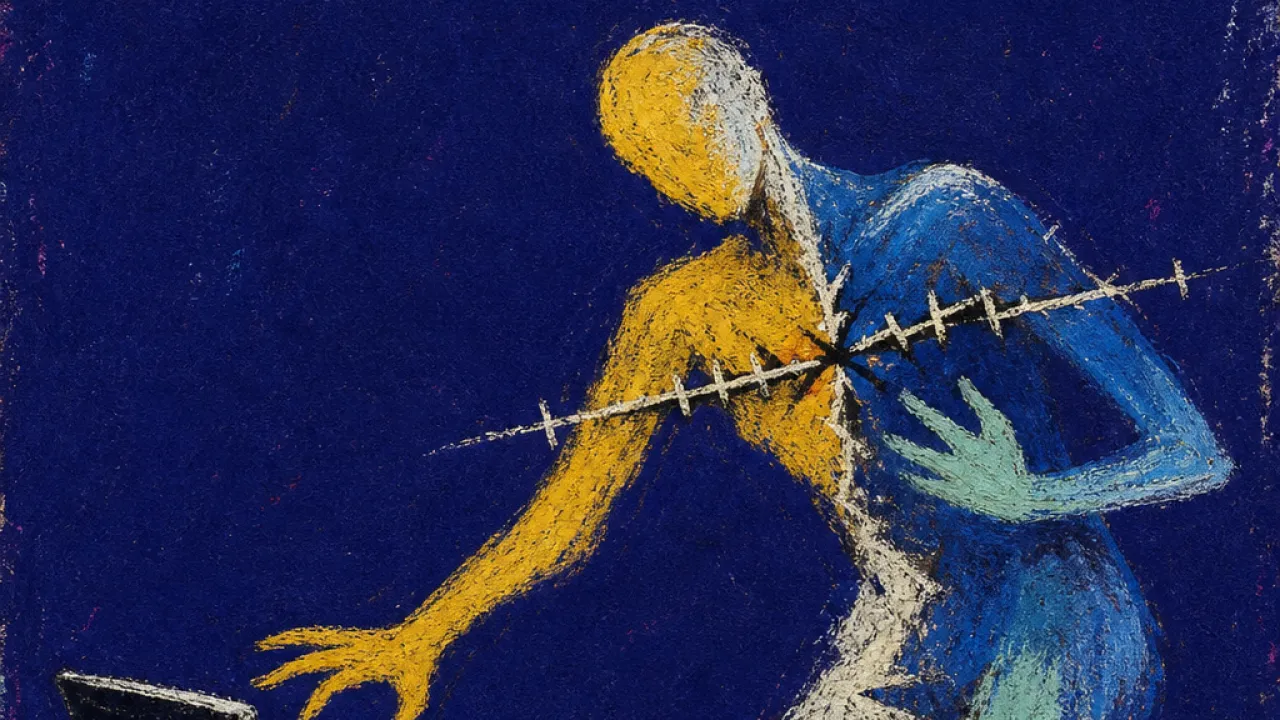
A leaning figure grips a glowing grade screen beside a half-closed laptop, a fractured gold-blue line on the chest

What is this really?

You check for your value in an external validation loop: grades, promotions, fast replies, praise, being useful, looking put-together, or becoming the person no one has to worry about. Underneath that, you are trying to make acceptance feel less random; if you can meet the condition, you can quiet the fear that your place with people might disappear. But the scoreboard keeps moving, so rest starts to feel like evidence against you, and the tired part of you has nowhere to stand - much like the rider in the Six of Wands, lifted above the crowd with a laurel on their staff, visible only while the procession keeps moving.

Why did it happen?

When approval used to arrive after you were impressive, helpful, easy, or ahead of the curve, your body learned to scan for the next condition before it could relax. That once made the room feel more predictable: do the thing, earn the smile, stay included. Now the same inner pattern can become a subconscious loop even when no one is grading you, turning downtime into a tight chest, a restless jaw, and the feeling that you must prove yourself before you are allowed to breathe.

How does it feel?

  • After sending a project, essay, or application, you reopen the tab, hover over the feedback portal, and refresh even though nothing has changed. In that pause, your chest may tighten, your jaw may feel restless, and the room can seem like it is waiting to mark you. The urge can be present without needing an instant answer.
  • When someone praises you, you give a quick smile, tilt your head, and answer with a smaller detail about what still needs work. A little heat may move up your neck, while the compliment seems to bounce off your chest instead of landing. Letting it land unevenly is allowed.
  • On a free evening, you close your laptop, sit down, then immediately tap your foot and reach for the notes app to add one more task. Under your ribs, there may be a low buzz, like your body has not received permission to stop. Let the buzz be there for one breath; uncertainty about resting is still allowed.
  • When a friend or date takes longer to reply, you reread your last message, trim a follow-up until it looks effortless, then delete it. Your thumbs may feel stiff, your throat dry, and your pulse louder than the screen. Not knowing where you stand can remain unfinished for a moment.
  • In a group catch-up, when someone asks what you've been up to, you straighten your spine, smooth your shirt, and lead with the achievement before mentioning how tired you are. Your cheeks may hold the smile a few seconds too long, while your shoulders stay lifted. A polished answer and a tired body can both be present.

Conditional Self-worth in Tarot Cards

That moving scoreboard, the one that makes rest feel like evidence against you, shows up in the foot-tap and the low buzz under your ribs. From a Jungian perspective, archetypal theory can hold the split between the version that earns applause and the quieter body that needs to stop. The cards below do not solve the external validation loop; they reflect the unconscious dynamics under it. Here are the Tarot Cards that speak to this pattern.

The Hierophant
Upright
The central authority sits above two kneeling figures, surrounded by formal symbols that communicate inherited order and approved conduct. The acolytes' matching posture shows how belonging can be organised through compliance with a shared standard. You may measure your value through the family's rules about achievement, respectability, emotional control, or being the good child. Conditional self-worth internalises these standards as eligibility requirements, allowing the family authority to remain active inside self-evaluation even when no one is currently issuing a judgment.
Judgement
Reversed
The trumpet-bearing angel hovers above people rising with open arms, arranging awakening as a response to an unmistakable summons. Reversed, the call is filtered through self-doubt and harsh evaluation, so transformation becomes another occasion to determine whether you have improved enough. You may pursue growth in order to escape an unacceptable present self rather than to expand a self that already has standing. Conditional self-worth turns every insight, habit, and healing milestone into a new test, allowing development to continue while the basic verdict of inadequacy remains untouched.
The World
Reversed
The dancing figure occupies the centre of a closed wreath, surrounded by four witnesses that stabilise the image of completion. Reversed, the complete circle cannot be inhabited as complete, leaving personal development perpetually one condition short of arrival. You may move the definition of enough whenever you approach it, replacing one growth target with another before the earlier change can be integrated. Conditional self-worth depends on this unfinishedness because a final arrival would remove the familiar proving project that has organised motivation and identity.
Four of Cups
Upright
The seated figure crosses both arms beneath a tree while three cups remain within view and a fourth is offered directly from a cloud. The closed posture prevents the offered cup from entering an already crowded field of evaluation. You may receive praise and immediately minimise it, identify the remaining flaw, or question whether the speaker really meant it. Conditional self-worth seeks validation but cannot store it because each compliment is tested against a stricter internal condition, causing recognition to bounce away before it can become part of your self-perception.
Two of Pentacles
Upright
The dancing figure keeps two pentacles moving inside an infinity-shaped loop while ships rise and fall on the waves behind him. His posture presents flexibility, but the closed loop suggests a routine that maintains itself by ensuring there is always one more demand to balance. You may use constant coordination to generate visible evidence that you are coping well enough to deserve approval. Conditional self-worth can make an empty slot in the schedule feel threatening, because without something to juggle there is no immediate performance confirming that you are competent and necessary.
Three of Pentacles
Upright
The elevated craftsperson presents work beneath three carved pentacles while two observers hold the plan and assess what has been built. The setting makes learning visible through an artefact that can be compared with an external standard. You may let a grade, supervisor comment, or examiner's response determine whether you are genuinely intelligent or capable. Conditional self-worth fuses the assessed work with the learner's identity, so useful correction can feel like exposure and praise can become something that must be repeatedly re-earned.
Five of Pentacles
Upright
The two figures pass beneath a glowing pentacle window while remaining outside in the snow, visibly separated from the warmth associated with the building. Their posture and damaged clothing make perceived social lack impossible to hide. You may treat not being invited, acknowledged, or quickly welcomed as confirmation that you lacked the quality required for inclusion. Conditional self-worth makes the boundary of a group feel like a verdict on identity, so a single experience of being peripheral can outweigh other evidence of connection.
Six of Pentacles
Reversed
The standing figure distributes coins while holding the scale that determines the exchange, and the recipients remain physically lower in the scene. Reversed, care and hierarchy become difficult to separate, revealing how support can be shaped by conditions of worthiness. You may earn family approval through helping, succeeding, staying easy, or becoming the person no one has to worry about. Conditional self-worth reproduces an old exchange in which meeting the family's needs appears to guarantee acceptance, while receiving care without first proving usefulness can feel undeserved.
Seven of Pentacles
Upright
The gardener leans his weight onto a tool and studies seven pentacles growing from the vine, with one pentacle already separated near his feet. The image suspends him between labour and outcome, making evaluation rather than action the emotional centre of the scene. You may experience the interval before feedback, results, or recognition as a period in which your worth has not yet been confirmed. Conditional self-worth makes waiting feel like exposure because the external scoreboard is temporarily inaccessible, so patience becomes entangled with the fear that your effort may not produce an acceptable verdict.
Eight of Pentacles
Reversed
The worker repeats the pentacle motif across a carefully ordered display, giving improvement a visible, countable form. Reversed, refinement loses its natural stopping point because every completed piece immediately supplies material for another comparison. You may consume insights, optimise habits, or continuously fix yourself while still feeling fundamentally defective. Conditional self-worth turns development into maintenance of eligibility, so improvement cannot disconfirm inadequacy; it merely becomes the latest condition required to keep inadequacy under control.
Nine of Pentacles
Reversed
The solitary figure is surrounded by cultivated abundance, nine displayed pentacles, and a hooded falcon held under careful control. Reversed, the polished environment becomes a fragile support for identity rather than evidence that can be calmly integrated. You may build confidence from achievements, appearance, discipline, or visible independence while remaining unsure who you are when those markers are absent. Conditional self-worth creates a version of growth that improves the display but leaves the underlying self-concept dependent on maintaining it.
Four of Swords
Reversed
The resting figure remains enclosed by four swords, with three overhead and one aligned beside the body beneath a stained-glass window. Reversed, the formal image of retreat carries the tension of a pause that has been physically entered but not psychologically permitted. You may interpret a slower season as proof that other people are advancing while your value is becoming less visible. Conditional self-worth converts timing into rank, making deliberate waiting feel like falling behind and creating pressure to act before either your energy or the external conditions are ready.
Eight of Swords
Upright
The blindfolded figure stands loosely bound inside eight swords, while open ground and a path remain visible around the enclosure. The restrictions are real enough to shape posture and perception, but they do not form a fully sealed prison. You may experience rules such as being worthy only when productive, admired, attractive, or useful as unquestionable facts rather than learned conditions. Conditional self-worth narrows what you can perceive about yourself, making available evidence of inherent or non-performed value difficult to recognise while the blindfold of evaluation remains in place.
Ten of Swords
Upright
The fallen figure lies beneath ten swords while the sky is almost entirely black, even though a narrow sunrise appears at the horizon. The visual scale turns one ending into a totalising scene in which no part of the self seems separate from defeat. You may interpret one poor grade, rejection, or failed exam as proof that your broader identity as a capable person was false. Conditional self-worth converts a specific academic outcome into a global self-verdict, obscuring the distinction between performance under particular conditions and enduring capacity to learn.
Five of Wands
Upright
Five figures raise intersecting wands in a crowded field, each occupying space by pushing into the same contested centre. No stable winner is visible, so comparison and effort continue without producing a settled hierarchy. You may scan a social group for who is more attractive, accomplished, connected, or articulate and then use that ranking to estimate your own value. Conditional self-worth converts difference into competition, ensuring that belonging remains provisional because there is always another person against whom you can be measured.
Six of Wands
Upright
The mounted figure wears a laurel and carries another wreath above a crowd whose presence turns achievement into public recognition. The image does not merely show competence; it shows competence made visible, ranked, and socially confirmed. You may rely on praise, promotion, or high-profile success to decide whether you are professionally legitimate. Conditional self-worth makes recognition feel regulating but temporary, because the reassurance lasts only until the next review, project, or colleague provides a new comparison point.
Ten of Wands
Upright
The figure's back curves beneath all ten wands as he carries them toward the settled town, with no free hand and little visibility beyond the burden. Responsibility is not merely present; it occupies the whole body and narrows the available role. You may become the competent child, stabilising sibling, or dependable relative whose exhaustion remains hidden behind performance. Conditional self-worth makes family responsibility proof that you deserve your place, so asking others to carry part of the load can feel like becoming disappointing, difficult, or less lovable.

Conditional Self-worth in Tarot Card Reading Insights

For anyone tracking value through grades, praise, replies, or usefulness, others have brought the same moving scoreboard into readings too. Below are Tarot Reading Insights where this pattern meets the cards.

"Maybe Next Week" Stayed Unsent, Then a One-Hour Coffee Felt Possible

Topic:Timing Tarot Reading

Struggle:Recovery-Action Split

Context:Conditional Belonging Pressure

Three Deleted Holiday Answers—And the One Sentence That Stayed True

Three Deleted Holiday Answers—And the One Sentence That Stayed True

Topic:Introspection Tarot Reading

Struggle:Belonging-Authenticity Split

Context:Family Privacy Negotiation

After Oversharing to Feel Included, a Brief Answer Tests Reciprocity

After Oversharing to Feel Included, a Brief Answer Tests Reciprocity

Topic:Social Tarot Reading

Struggle:Emotional Contract Drift

Context:Performative Intimacy Circle

A Friend's Voice Note Became a Project, Then Care Became a Choice

A Friend's Voice Note Became a Project, Then Care Became a Choice

Topic:Friendship Tarot Reading

Struggle:Unseen Cost Bind

Context:Fixer Friend Dynamic

When a Casual Invite Becomes a Belonging Test: The One-Sentence No

When a Casual Invite Becomes a Belonging Test: The One-Sentence No

Topic:Social Tarot Reading

Struggle:Relational Boundary Drift

Context:Social Performance Loop

Going Home Without the Script: From Shame Loops to Honest Direction

Going Home Without the Script: From Shame Loops to Honest Direction

Topic:Timing Tarot Reading

Struggle:Belonging-Authenticity Split

Context:Social Clock Pressure
Party Exit Guilt—and the Shift From Scoreboard Thinking to Self-Trust

Party Exit Guilt—and the Shift From Scoreboard Thinking to Self-Trust

Topic:Introspection Tarot Reading

Struggle:Permission Paralysis

Context:Post-Party Social Drain

Friendship Overfunctioning: Replacing Planner Panic With Reciprocity

Friendship Overfunctioning: Replacing Planner Panic With Reciprocity

Topic:Social Tarot Reading

Struggle:Caretaker Role Lock

Context:Designated Organizer Burden

Full Calendar, Wrong Career: Learning to Use a Respectful No

Full Calendar, Wrong Career: Learning to Use a Respectful No

Topic:Direction Tarot Reading

Struggle:Capacity Misalignment

Context:Always On Availability

When Body Shame Writes the RSVP: A Pool Party Story of Honest Choice

When Body Shame Writes the RSVP: A Pool Party Story of Honest Choice

Topic:Choice Tarot Reading

Struggle:Binary Choice Lock

Context:Social Performance Loop

Grad Application Paralysis—and Testing the Life, Not the Gold Star

Grad Application Paralysis—and Testing the Life, Not the Gold Star

Topic:Choice Tarot Reading

Struggle:Grade-Identity Fusion

Context:Post-Graduation Limbo

When the

When the "I'm Nearby" Text Hit, Hello Came Before Sorry

Topic:Friendship Tarot Reading

Struggle:Aesthetic Self-Management Trap

Context:Safe Harbor Friend

Psychological Patterns Related to Conditional Self-worth