A Heart Followed Her Deleted Refusal; One Family Boundary Stayed Sent

The 8:40 P.M. Heart Reaction
If you are the dependable daughter with a client-facing job in a city like Toronto, you may know the exact family group chat anxiety of saying yes before you have even checked your calendar. Jordan, a 27-year-old customer success specialist, brought that moment into our session while it was still unfolding.
At 8:40 on a Sunday evening, I watched her sit at the kitchen counter of her small Toronto apartment as the family WhatsApp chat filled with cheerful plans for the next gathering. The radiator clicked beside her, her phone had grown warm in her palm, and each new notification added another bright sound to the quiet room. She typed, "I am exhausted and cannot host this time," held her thumb above the screen, deleted the sentence, and replaced it with, "Of course, happy to help!" followed by a heart.
I saw her throat work before she spoke to me. Her breath had stalled as if the answer she needed to give were a perfume accord trapped inside a stoppered bottle: distinct, real, and increasingly concentrated because no air could reach it.
"I can manage an angry customer on Zoom," she said. "I can write the calmest Slack follow-up you've ever seen. But with my family, I just... edit. It is easier if I go along with it."
She glanced at the message again. "Why do I keep hiding my needs to make my family look happy? We look close, so why do I feel absent?"
"I don't hear a lack of needs," I told her. "I hear how quickly you begin managing everyone else's possible reaction before your own answer reaches the room. We are not going to use tarot to predict whether your family will approve of a boundary. We are going to use it as an objective map of the pattern, so you can find the point where choice becomes possible again."

Choosing a Map for the Family Fog
I asked Jordan to place the phone face down and take three unforced breaths. I shuffled while she held one focused question in mind: "What keeps happening between knowing what I need and saying it out loud?" The pause was not a mystical performance. I used it as a transition from reacting to observing.
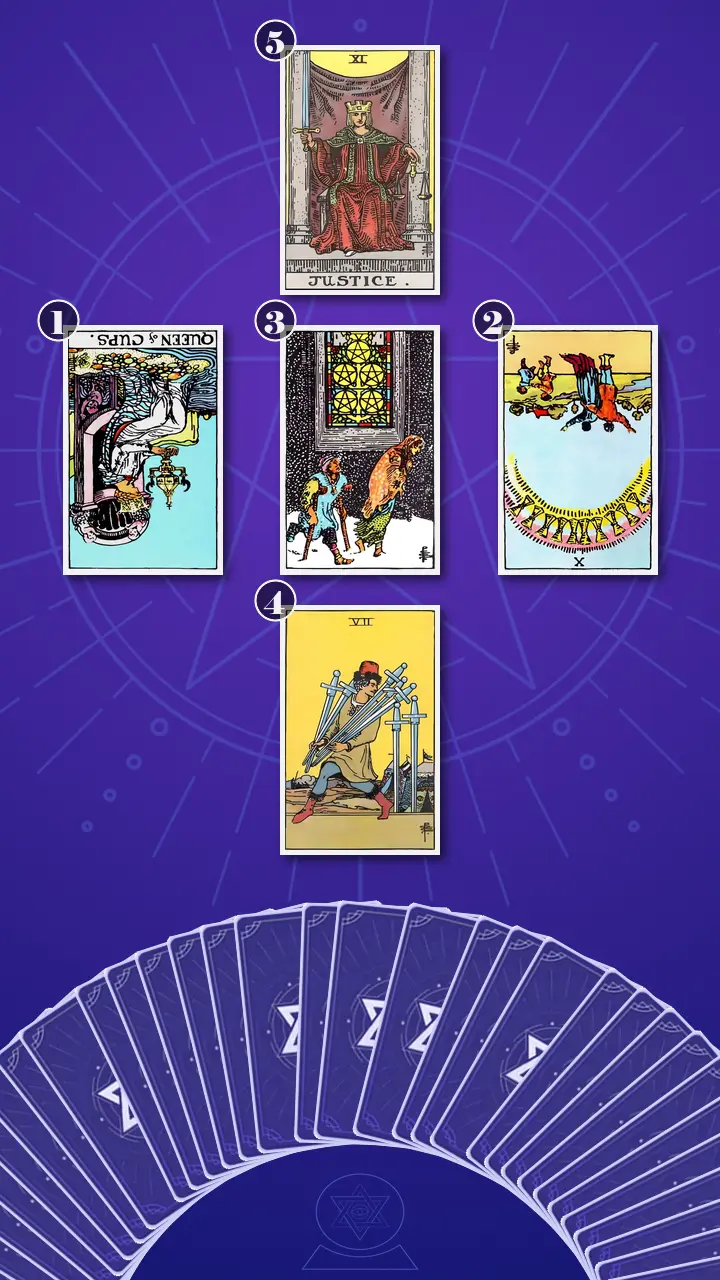
I chose the Relationship Spread · Context Edition, a five-card relationship tarot spread for family boundaries and hidden needs. I want readers to understand how tarot works here: the cards do not reveal secret verdicts about Jordan's relatives. Their positions organise the emotional evidence so that card meanings can be read in context.
This spread was precise enough for the issue without adding the unnecessary layers of a Celtic Cross. The first position would show Jordan's habit of monitoring family emotions while suppressing her own needs. The centre would reveal the belonging fear underneath that habit. The card below would map the defence loop that preserved short-term calm, while the card above would show a more constructive direction.
I placed the cards in a cross. Jordan's stance and the family's shared image sat on opposite sides, like the two pans of a scale. The central line descended from the fear of exclusion into the strategy of concealment, then rose toward fairer self-expression. Even before I turned over a card, the layout gave us a useful question: what had Jordan been placing on everyone else's side of the scale while leaving her own side empty?
The Sealed Cup and the Muted Tab
Position One: The Care That Leaves the Self Unanswered
I turned over the card representing Jordan's current stance: her habit of monitoring family emotions while suppressing her own needs. It was the Queen of Cups, reversed.
I drew her attention to the ornate cup held tightly in both hands. Upright, I read the Queen as emotional attunement, compassion, and receptive care. Reversed, I saw an excess of attention flowing toward other people and a blockage in receiving information from the self. The sensitivity was not absent. It was working overtime in only one direction.
I connected the card to the scene Jordan knew well. After a day of monitoring customer moods, she would join a family call and immediately track every pause, sigh, and change of tone. She might have a request prepared, but the instant someone asked whether she could host, she would protect the room with "I'm fine" and return her attention to everyone else. Her family received her reassurance, but no accurate information about her capacity.
"It is like running customer support for the family while your own ticket stays marked 'pending' forever," I said. "You are not short on feelings; you are used to editing them before anyone else can react. I can see every relative's emotional status open in a separate browser tab, while the tab containing your own need stays muted."
I asked, "On the last call where you said you were fine, what specific feeling or limit appeared immediately before you answered?"
Jordan's lips parted, but no answer came at first. Her fingers stopped rubbing the edge of her phone, her gaze settled on the sealed cup, and then she gave a small, bitter laugh. "That is too accurate. Kind of brutal, actually."
"I am not reading the card as an accusation," I replied. "This is an emotional skill that has become overextended. You learned to read the room so well that reading yourself began to feel less urgent. The work is not to become less caring. It is to include yourself among the people whose feelings count."
Position Two: The Instagram Carousel Is Not the Whole Day
I turned over the card showing how the collective family image of happiness creates relational pressure. It was the Ten of Cups, reversed.
I saw the bright rainbow of cups above the celebrating family, then considered what the reversal did to that image. The affection could be real while the picture remained incomplete. I read the energy as a blockage in honest emotional exchange: warmth was displayed, but inconvenient differences struggled to enter the frame.
When I asked Jordan about the last polished family moment, she described standing in a restaurant lobby after a tense Sunday lunch. She remembered the smell of espresso and wet winter coats, the harsh overhead lights, and the ache in her jaw while a relative selected a smiling photo for Instagram. Jordan had approved the caption and added a heart even though the disagreement from ten minutes earlier remained untouched.
"The Instagram carousel is real," I said. "It just is not the whole day. A happy picture can be real and still leave someone outside the frame."
I used the family-image tension in Encanto carefully because it captured the distinction I wanted Jordan to keep: noticing a crack is not the same thing as causing it. Naming the missing emotional information would not retroactively erase every genuine laugh in the photograph. It would only stop one polished image from claiming to represent the entire relationship.
"If I name the missing part," Jordan said, "I feel like everyone will think I ruined the whole day."
I watched her jaw tighten in the same way she had described at the restaurant. "Then the pressure is not simply to be happy," I said. "It is to keep everyone else's memory uncomplicated. That is too much emotional responsibility for one person to carry."
Outside the Glowing Window
Position Three: The Rejection That Arrives Before the Reply
I returned to the centre and turned over the card representing the underlying belonging fear beneath Jordan's self-silencing. It was the Five of Pentacles, upright.
I pointed to the two figures moving through snow beneath an illuminated window. I did not treat the image as a prediction that Jordan would be rejected. I read it as the felt possibility of exclusion operating at excess volume, so loudly that an imagined outcome was deciding her answer before reality had supplied any evidence.
I asked her to picture declining one low-stakes gathering. Before anyone received the message, she could already see the chat going quiet, relatives becoming colder, and future plans continuing without her. The glowing screen became the warm window in the card, and she placed herself outside it before she had even pressed send.
"You can feel excluded before anyone has actually excluded you," I said. "Nobody has rejected you yet, but your answer is already organised around surviving rejection."
Her reaction came in three small movements. Her breathing paused. Her eyes lost focus as if she were replaying several deleted messages at once. Then she exhaled from deep in her chest and lowered both shoulders by a fraction.
"The first thing I imagine is the chat going quiet," she said. "Then I assume they will stop asking me. I never realised I was responding to that whole movie instead of the actual request."
"That distinction is our first point of movement," I told her. "The fear deserves care, but it does not get to impersonate evidence. We can separate what your relatives have actually done from what your mind predicts one boundary will mean about your place in the family."
Position Four: The Sentence Behind the Redaction
I turned over the card mapping the defence strategy through which hidden needs preserve short-term calm but prevent accurate reciprocity. It was the Seven of Swords, upright.
I centred the reading on the figure carrying some swords away while leaving others behind and looking back toward the camp. I read the sword energy as strategic intelligence in excess: Jordan was using careful editing to avoid a direct test of belonging, then remaining mentally preoccupied with whether anyone had noticed what she withheld.
Jordan recognised the modern version immediately. At her kitchen counter, she might write, "I cannot organise this one; I need someone else to take it," then redact the difficult clause and send only, "What time works for everyone?" The agreeable facts reached the conversation. The one line other people needed in order to understand her situation was left behind.
"The relief is immediate," I said. "No conflict appears. But the family cannot offer an informed, reciprocal response to information it never receives. You stay connected without finding out whether your full answer can be connected too."
Jordan looked from the Seven of Swords back to the Five of Pentacles. Her mouth tightened in recognition, then softened. "So I am hiding because I am scared," she said, "and then I resent them for not seeing the thing I worked so hard to hide."
"Yes, and I would call that a protective relationship strategy, not a character flaw," I replied. "The useful question is not, 'Why am I dishonest?' It is, 'What single truth am I carrying alone that I could express without turning it into a complete family reckoning?'"
When Justice Put Her Back on the Scales
Position Five: The Difference Between Approval and Fairness
The radiator gave one clean knock and then fell quiet. In that small pocket of silence, I turned over the card defining the key transformation: giving Jordan's needs equal weight through proportionate honesty, clear limits, and accountable choice. It was Justice, upright.
I read Justice as balance rather than punishment. The scales represented an honest capacity check. The upright sword represented the concise sentence that communicated the result. The direct gaze opposed the backward glance of the Seven of Swords: accountable presence replaced reaction management.
I asked Jordan to imagine checking her actual calendar, workload, budget, and need for recovery before answering a Saturday request. A fair response might be, "I cannot host this weekend. I can join for lunch if someone else organises it." In Justice's fair scheduling poll, her no counted as valid data, not as a system error.
Seeing the scales, I thought of my fifteen years at a perfume bench. A beautiful material can overwhelm an entire formula when it is not measured, and another note can disappear even though it remains chemically present. Balance is not a mood. It is a structure that gives each material enough space to be perceived.
I brought that professional instinct into what I call an Enmeshment & Permeability Diagnosis. I was not diagnosing Jordan's relatives or declaring the family unsafe. I was examining the boundary through which their anticipated moods entered her decisions. Her emotional boundary had become so permeable that imagined disappointment diffused into her answer before her own capacity could take shape. Justice acted like a scent blotter between the notes, separating care from compliance long enough for Jordan to evaluate both.
I asked Jordan to picture the familiar sequence: she types the honest answer, her throat closes, and her thumb replaces it with a heart. The chat stays cheerful for a moment, while she carries both the request and the hidden truth alone.
Peace built on self-erasure is not balance; give your needs equal weight, and let Justice's scales hold both care and truth.
I let the sentence remain in the quiet, then added, Your need does not become unfair just because someone else feels less comfortable when they finally hear it.
Jordan did not relax immediately. First, her breath stopped and both hands went still on the counter. Then her pupils widened and her gaze moved past the cards, as though she were replaying years of instant yeses through this new frame. The first emotion to break through was not relief but anger. "But doesn't that mean I was wrong all this time?" she asked, her voice sharper and then suddenly unsteady.
"No," I said. "It means a protective strategy helped you preserve closeness in the only way that once felt available, and now you can see its cost. Recognition is not a guilty verdict." Her fingers slowly opened. Her eyes brightened, her shoulders descended, and a long breath left her, but the release carried a slight disorientation. I could see the new vulnerability in her expression: if she stopped managing every response, she would have to tolerate not knowing what came next. Clarity had returned responsibility to her without handing her certainty.
I invited her, "Now, with this new perspective, think back to last week. Was there a moment when this insight might have made you feel different?"
She remembered seeing a technically empty Saturday on her calendar after five days of client escalations. "I treated an empty afternoon as family capacity," she said. "If I had counted recovery as real, I still would have felt guilty, but I would not have had to call myself selfish."
"That is the shift," I told her. "You are moving from apprehensive reaction-monitoring and automatic agreement toward proportionate honesty, reciprocal connection, and grounded self-respect. Their disappointment is information, not a verdict on your fairness. You can care about their feelings without making those feelings the only measure of your choice."
The Airlock Between a Request and a Yes
I gathered the five cards into one coherent story. The reversed Queen showed Jordan absorbing everyone else's emotions while sealing her own experience inside. The reversed Ten expanded that private containment into pressure to protect a polished family image. The Five revealed the fear underneath: one visible difference might move her outside the warmth of belonging. The Seven showed how she managed that fear by sending an edited answer. Justice did not ask her to care less. It asked her to stop standing outside the family portrait while holding it upright for everyone else.
I named the cognitive blind spot directly: Jordan had been treating another person's discomfort as evidence that her boundary was unfair. She had also mistaken the absence of conflict for proof of connection, even when that calm depended on nobody receiving accurate information about her. The transformation was smaller and more demanding than "just speak your truth": before an automatic yes, she would name one specific feeling, need, or limit and let it carry equal evidentiary weight.
I also pointed out that no Wands appeared in the spread. Insight, emotion, and language were all present, but the fire of action would not arrive automatically. Jordan did not need a dramatic confrontation. She needed one scheduled, observable experiment that remained fully under her control.
Three Low-Stakes Ways to Practise the New Weight
- The 10-Minute Quarantine Zone Protocol When the next low-stakes family request arrives, do not answer from the notification screen. Say, "Let me check and get back to you," then place the request inside a 10-minute psychological airlock. Open your calendar and check workload, money, recovery time, and actual preference before drafting a reply. The airlock protects the decision from the immediate emotional atmosphere; it does not cut you off from the relationship. Keep the airlock impenetrable for only those 10 minutes: no reaction-reading, no cheerful pre-yes, and no extra task offered to soften the pause. If 10 minutes feels impossible, use a two-minute version.
- The Two-Sentence Justice Boundary On one low-stakes call or WhatsApp exchange this week, send one capacity statement and one specific limit or request: "I am feeling stretched this week. I need someone else to handle the booking." A bounded alternative such as, "I cannot host, but I can bring dessert," belongs in the message only if it genuinely fits your capacity. Draft first and send only if you choose. Use one limit, one optional reason, and no more than one apology. The minimum version is writing the first sentence in Notes without sending it.
- The Facts-versus-Forecast Check For the same request, open Notes and make two headings: "What has actually happened" and "What I predict will happen if I say no." Write at least one item under each. After any honest reply, wait 20 minutes before treating silence, a delayed response, or a disappointed emoji as proof of rejection. This exercise does not have to prove that the family is safe or unsafe. It only separates observation from rehearsal. If the request carries real practical or relational risk, choose a safer topic, delay the conversation, or seek support.
I reminded Jordan that the protocol belonged to her. She could stop, revise, delay, choose a smaller request, or decide not to disclose. Justice was not an order from the cards. It was a framework for making a proportionate choice without surrendering authorship of that choice to fear, approval, or tarot.

The Reply That Stayed Sent
Three days later, I received her screenshot: "I can't host Saturday. I can join lunch if someone else organises it." One relative wrote, "That's disappointing"; another took the booking. Jordan left the message untouched. She slept, woke thinking, "What if I got it wrong?" and smiled anyway.
I did not call that a solved family system, and neither did she. I called it the first observable proof of finding clarity: she had felt guilt without using guilt as an instruction to disappear. Her family received accurate information, and her recovery time remained visible on her side of the scales.
For me, that is the value of a five-card contextual Relationship Spread. The cards did not manufacture Jordan's courage or predict a happy ending. They made the sequence visible enough for her to recognise the moment where an old protective reflex had been making the choice. She remained the person who paused, weighed the evidence, wrote the sentence, and decided to let it stand.
I know that when the family chat lights up and your throat closes around the answer you actually want to give, the hardest part is not only needing something. It is fearing that one honest sentence could move you outside the warmth you have worked so hard to maintain. Simply noticing that fear before it edits your answer means you are no longer at the beginning.
I will leave you with one question: if your next answer did not have to prove that you are easy to love, what one small truth could you let through the airlock and place on your side of the scales?