The Serving Bowl at 6:42
“You can flag a missed deadline as a 28-year-old junior project coordinator, but one sharp comment at Sunday dinner turns you into the family mood manager before the plates are cold,” I said after Chloe (name changed for privacy) had described the moment to me.
At 6:42 p.m. in a South London dining room, a relative had made a cutting remark and the table had gone quiet for two seconds. Chloe could smell roast onions and hot gravy. She heard a fork tap porcelain. Before anyone could name what had happened, she reached for the serving bowl, asked about everyone’s weekend, and laughed more brightly than the moment required.
“I wanted to say, ‘That was hurtful,’” she told me. “But I could already hear the fallout. I hate feeling fake, but I hate being the problem more.”
I watched her hand reproduce the movement towards the bowl, as though usefulness were still the nearest emergency exit. Her throat tightened. Her jaw stayed locked. What followed each gathering was not relief but a resignation that felt like wet cement setting through her arms and legs: heavy, cooling, and difficult to move once the room had decided everything was fine.
At 8:47 p.m. on the Overground home, she had typed, “I did not like what happened at dinner.” The carriage smelled of wet coats, the rails squealed around a bend, and the phone grew warm in her palm while she read the message four times. She imagined denial, jokes, blame, awkwardness, and exclusion. Then she deleted it before her stop.
By 9:06 the next morning, the family WhatsApp chat held a smiling photograph captioned, “Perfect Sunday with my favourites.” Burnt coffee sat beside Chloe’s keyboard near Old Street while Slack pinged through one earbud. She added a heart reaction because leaving it unanswered felt conspicuous.
“We are fine as long as nobody asks what fine means,” she said.
I told her I was not going to push her towards confrontation, label her silence as weakness, or pretend that honesty guarantees a respectful response. Silence can be protective. The question was whether it remained a conscious choice or had become an automatic fee she paid for belonging.
“Let’s make a map of the fog,” I said. “Not so the cards can decide whether you should speak, but so you can see what happens between noticing the hurt and deleting the sentence.”

Choosing a Map for the Happy-Family Performance
I invited Chloe to take one slow breath and hold the consultation question in plain language: “Why do I always stay silent to keep my family looking happy?” I shuffled while she did that. The pause was a way to narrow our attention, not a mystical test she could pass or fail.
I chose the Relationship Spread · Context Edition, a five-card relationship tarot spread designed here as a non-predictive framework for family self-silencing and boundary-setting. I use tarot this way to place an internal pattern outside the person for a moment. Once the pattern is visible on a table, assumptions can be inspected rather than obeyed automatically.
I chose this spread because Chloe’s question lived inside a relationship field. A larger Celtic Cross would have added future and outcome positions we did not need. This smaller map could examine her participation, the family presentation rules as she experienced them, the hidden contract connecting silence with belonging, the behaviour maintaining that contract, and the capacity available to change her own position within it.
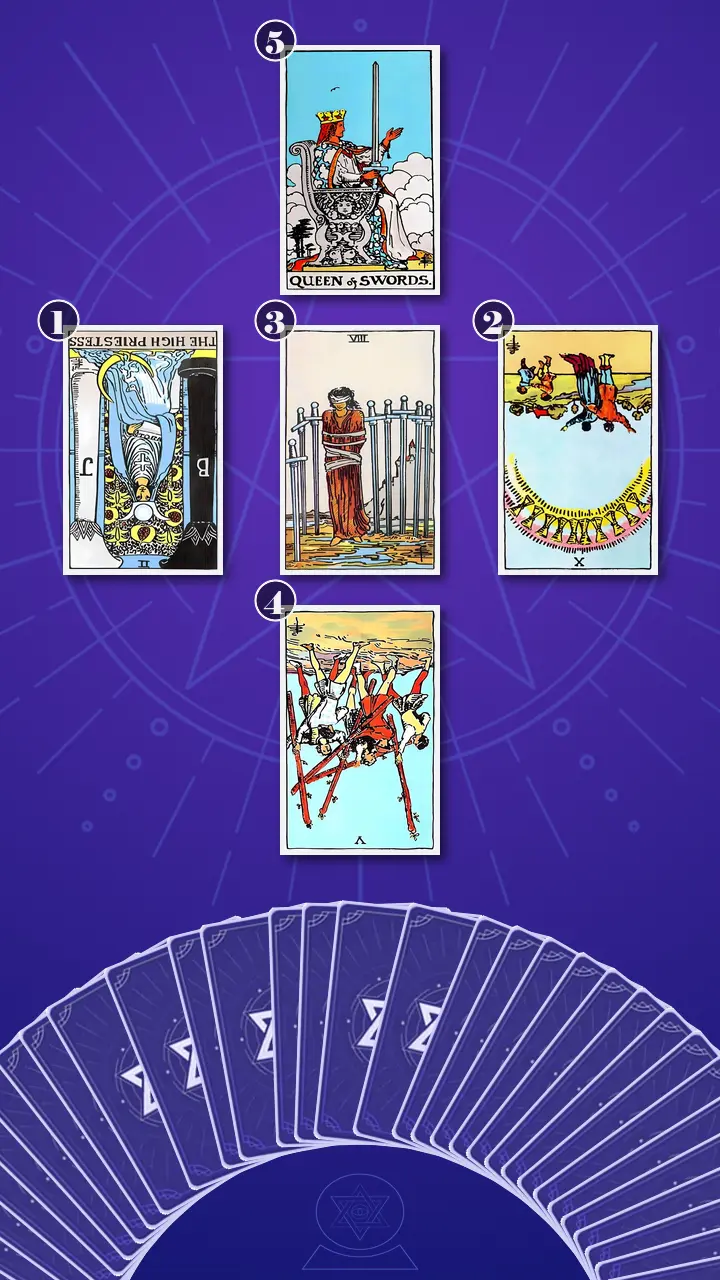
I placed the third card at the centre. The first and second would sit to either side, contrasting Chloe’s private knowledge with the visible image of family harmony. The fourth would sit below the centre, showing the habit that kept the loop operating. The fifth would rise above it, showing the constructive potential.
I was careful with the second position. I would not claim to know what her relatives privately thought or intended. I would read only the expectations Chloe had directly encountered: the captions, jokes, quick subject changes, and cheerful resets that taught her what the family image appeared to require.
“The cards won’t tell us whether your family is secretly good or bad,” I said. “They can help us ask a more useful question: what happens when the person who sees the performance stops treating her perception as betrayal?”
The Hidden Draft and the Polished Photograph
Position One: The Sentence Behind the Veil
“Now I’m turning over the card representing your current stance: the observable pattern of recognising family tension, withholding your response, and presenting calm instead.”
The first card was The High Priestess, reversed.
I pointed to the partly concealed scroll behind the patterned veil. Upright, the High Priestess protects inner knowledge and waits before revealing it. Reversed here, that energy had become blocked and over-contained. Chloe was not failing to understand the room. She was treating what she understood as confidential evidence that could not safely cross into speech, and eventually as evidence she should distrust herself.
I connected the card to the scene she had given me: Chloe in the bathroom after the sharp comment, typing the exact sentence that named what hurt while the tap ran beyond the door. She locked her phone, returned to the table, and said, “Everything is fine.” The truth already had language. It simply remained behind a digital veil.
“I know exactly what bothered me,” I said, voicing the loop I had heard in her account. “But if I say it, they’ll call it dramatic. If they call it dramatic, maybe I read the room incorrectly. So perhaps I shouldn’t trust the sentence in the first place.”
Chloe gave a brief, bitter laugh rather than nodding. “That is painfully accurate. Almost cruel, actually.”
I let the reaction stand without trying to make it prettier. “The card is not accusing you,” I said. “It is showing the cost of a strategy that may once have reduced risk. You are not short of words; you have learned to treat them as dangerous.”
Her fingers tightened around her mug, then loosened. I asked what exact sentence had formed at the table and what she had done instead. She looked down at the card and said, “I wanted to say, ‘Please do not speak to me like that.’ I passed the potatoes.”
I told her the first move did not have to be disclosure. The High Priestess can preserve privacy without requiring self-erasure. Recording the swallowed sentence would allow Chloe to retain her own account before making a separate decision about whether, when, and with whom it was safe or useful to share.
Position Two: The Rainbow That Cropped the Evening
“Now I’m turning over the card representing the family presentation rules as you experience them: the pressure to maintain visible happiness without pretending we can read anyone else’s private mind.”
The card was Ten of Cups, reversed.
I showed Chloe the rainbow of cups arching over the family scene. Upright, the image can represent shared affection, emotional security, and the pleasure of belonging. Reversed in this position, its energy was imbalanced. The ideal had become so visually complete that difficult information struggled to remain inside the frame.
I brought the reading back to Monday morning: the WhatsApp photograph, the “Perfect Sunday” caption, the heart reactions accumulating beneath it, and Chloe’s stomach dropping at her desk. The smiles might have been genuine. The affection did not have to be fake. Yet the caption asked everyone to endorse an uncomplicated version of a night that had contained both warmth and hurt.
“It’s a bit Fleabag,” Chloe said quietly. “Everyone looks normal in the photo, and the pauses are doing all the talking.”
“Exactly,” I said. “The photo can hold a real smile and still leave out a real hurt.”
I read the reversal as an excess of image management and a deficiency of room for complexity. The problem was not that the family had ever looked happy. The problem was the felt requirement that happiness remain the only admissible record. It was the family equivalent of an Instagram carousel that kept the smiling table and cropped the argument between slides.
Chloe’s mouth pulled into a small smile, but her eyes stayed wet. “The photo isn’t exactly false,” she said. “It just makes me feel disloyal for remembering the rest.”
I asked her to notice the distinction. Genuine connection and compulsory performance can coexist. Naming the second does not erase the first. That separation mattered because an all-or-nothing conclusion, “Either my family is happy or everything is a lie,” would only create another trap.
Position Three: Every Reply Written Before the Message
“Now I’m turning over the centre card, representing the hidden relational contract: the learned belief that silence preserves belonging and that speaking cannot produce meaningful change.”
The card was Eight of Swords, upright.
I studied the blindfold, the loose bindings, and the uneven ring of swords. The figure was genuinely constrained; I did not minimise that. Yet the enclosure was not completely sealed. In Chloe’s reading, the air element of thought had moved into excess. Analysis was no longer generating options. It was generating a cage.
I asked Chloe to describe what happened before she deleted a message. She listed the imaginary replies in order: denial, minimisation, a joke, blame, an awkward next dinner, and a second conversation about why she had made everything so serious. Her mind opened so many hypothetical threads that the original two-line message disappeared beneath them.
“If I say it, they’ll deny it,” she said. “If I explain, I’ll make it worse. If I leave, I’ll prove I don’t belong. So there is no point.”
“Imagined fallout can feel final before anyone has actually replied,” I said. “That does not mean the risks are imaginary. It means possible consequences and guaranteed consequences have merged.”
Years earlier, on a Wall Street trading floor, I had learned that exposure was not the same thing as a booked loss. A serious risk deserved controls, but treating every scenario as already realised destroyed the ability to choose. I heard that old distinction again as I looked at the Eight of Swords: risk assessment had become a verdict.
I also used my Family Power Dynamic Decoding lens before suggesting that any visible gap between the swords was usable. I asked whether a relative controlled Chloe’s rent, employment, transport, access to essential care, or another resource that could be withdrawn to punish disagreement. She told me that she paid her own rent and could arrange her own journey home. The leverage she feared most was emotional: colder messages, fewer invitations, or being recast as the difficult one.
That check did not make the emotional risk trivial. It made it more accurately defined. When money, housing, inheritance, or essential support is being used as leverage, a boundary plan must protect those realities first. In Chloe’s case, the audit showed that she had practical room to test a small expression, while retaining the right to decide that a particular moment or person was not safe enough.
I drew two columns on a sheet: Directly experienced and Predicted. Chloe placed minimising jokes in the first column. She placed total exclusion from future family plans in the second. Her breathing paused, her gaze moved away as if replaying old conversations, and then her jaw released by a fraction.
“I’ve been treating both columns as facts,” she said.
“Yes,” I replied. “The opening is not proof that everything will go well. The opening is the ability to see constrained choice as different from zero choice.”
Position Four: The Conflict That Moved Into Her Body
“Now I’m turning over the card representing the maintaining challenge: your concrete habit of redirecting, smoothing, and internalising disagreement whenever friction appears.”
The card was Five of Wands, reversed.
I pointed to the crossing staves and the figures moving in different directions. Reversal did not make those differences disappear. It pushed the fire out of sight. The energy of disagreement was blocked in the room and redirected into Chloe’s locked jaw, aching throat, late-night scrolling, and delayed resentment.
I returned to the exact second two voices sharpened at Sunday dinner. Chloe had stood to clear plates that were still in use, made a joke, explained what the speaker probably meant, and asked about weekend plans. Visible smoothness returned. Agreement did not.
“If I can keep everyone moving, maybe nobody will notice what happened,” Chloe said. After a pause, she added, “Including me.”
“Conflict avoided is often conflict relocated,” I told her.
The card showed the behavioural support beneath the Eight of Swords. Every time Chloe interrupted visible disagreement before testing a different response, she received immediate relief. The evening continued. Later, the unexpressed conflict returned as depletion, which strengthened her belief that family tension was unmanageable. The loop then presented its own repetition as proof.
I did not shame the strategy. Becoming funny, useful, or practical may have helped Chloe reduce friction in situations where she had less freedom. The question was whether she still wanted that response to launch automatically every time a tone changed.
She rubbed the side of her thumb and said, “I don’t even decide to clear the table. I’m standing before I know I’ve moved.”
I asked her to imagine one low-stakes conversation with a trusted person. Instead of making a joke, she could say, “I see that differently,” and allow five seconds to pass. The purpose would not be to win or force agreement. It would be to learn that a difference could remain visible without Chloe immediately becoming responsible for repairing the room.
When the Queen Raised Her Sword and Opened Her Hand
Position Five: One Sentence, Not a Family Trial
The rain against the window had stopped. In the brief quiet, the radiator clicked once, and a line of late-afternoon light fell across the top card like the edge of a blade. I told Chloe we were turning over the reading’s central antidote.
“Now I’m turning over the card representing the integration potential: a self-led capacity for precise truth, proportionate boundaries, and consciously chosen communication without responsibility for controlling the family response.”
The card was Queen of Swords, upright.
I showed Chloe the vertical sword and the Queen’s open left hand. The sword defined what was true and where the boundary stood. The open hand left room for response. This was air in balance: thought disciplined into concise language, clarity without prosecution, and self-respect without an attempt to control the verdict.
In Chloe’s life, the card looked like choosing a low-stakes time, arranging her own route home, and saying, “I am not comfortable pretending that did not affect me.” It did not require a case against the entire family. It did not require her to stay until everyone agreed. She could describe her participation, hear a response, pause, or leave.
I brought her back to 8:47 p.m. on the Overground: her phone holding the sentence she could not say at dinner, read four times and deleted before her stop, while the family was free to remember the evening as uncomplicated. She still thought the only meaningful outcome was total change.
Silence is not the price of harmony; one clear, bounded sentence restores choice, like the Queen of Swords holding her blade upright while keeping an open hand.
I stopped speaking.
First, Chloe’s breath froze halfway into her chest and her fingers remained suspended above the card. Then her eyes lost focus, as though the sentence had sent her back through every dinner where she had equated a smooth ending with a successful one. Her pupils widened. Colour rose around her eyes, and her shoulders slowly dropped from the guarded position they had held since she arrived. The release did not look peaceful at first. It looked disorienting.
“But doesn’t that mean I’ve been doing it wrong this whole time?” she asked, anger sharpening the tremor in her voice. “That I erased myself for nothing?”
“No,” I said. “It means you used a strategy that had reasons, and now you can audit whether its cost still serves you. Clarity can hurt because it returns responsibility without offering control. You are responsible for your choice, not for manufacturing the perfect response from everyone else.”
Her fist opened against her knee. She released a long, unsteady breath, and the next inhale came more fully. Relief was present, but so was the slight dizziness of someone setting down a weight and discovering that free hands still have to choose what to hold.
I asked immediately, “Now, with this new perspective, think back to last week. Was there a moment when this insight could have made the experience feel different?”
Chloe looked at the Queen. “Monday morning,” she said. “I could have waited before adding the heart. I could have admitted to myself that I loved parts of Sunday and still hated what was said. Nobody else even had to know yet.”
I placed a blank card beside the Queen and used another of my diagnostic tools: Guilt-Debt Neutralization. Chloe’s internal invoice read, “If honesty makes anyone uncomfortable, I owe the family an immediate repair.” I asked her to audit that obligation as unverified psychological bad debt: Who assigned it? What evidence proved that one person must absorb every difficult feeling? Had she freely agreed to maintain the official family story at the cost of her own account?
I was not assigning malicious motives to her relatives. I was separating a familiar feeling of obligation from a verified duty. Respect, safety, and proportionate speech could remain on the books. The demand that Chloe guarantee everyone’s comfort did not become legitimate merely because guilt presented it as overdue.
“A boundary can name your part without putting you in charge of everyone else’s response,” I said. “The Queen is not the family prosecutor. She is the adult who can hold a clear blade and an open hand at the same time.”
I gave Chloe a ten-minute maximum and asked her to open a private note with three lines: “What happened,” “What I felt,” and “One sentence I might want to own.” She did not have to send it, confront anyone, or decide that day. If the exercise became too uncomfortable, she could stop after the factual first line. The smallest version was simply, “I noticed that I wanted to say…”
When she read her final sentence aloud, her voice shook once and then steadied: “I am not comfortable pretending that did not affect me.”
I named the movement I was witnessing: from resigned vigilance and compulsory family mood management to cautious agency, clear self-respect, and conscious choice. It was not a completed transformation. It was the first credible step from automatic silence towards deciding when to speak, pause, or step back.
The Missing Earth Beneath the Cards
I drew the five cards together into one sequence. The High Priestess reversed showed that Chloe already knew what she felt but concealed the record. Ten of Cups reversed showed why concealment seemed relationally useful: the family image allowed affection, but struggled to display tension without treating it as a threat. Eight of Swords showed the hidden contract, where anticipated backlash narrowed limited options into no option. Five of Wands reversed showed the daily mechanism: Chloe made disagreement invisible and carried it home in her body. Queen of Swords returned the withheld knowledge to language, one bounded sentence at a time.
The spread’s central metaphor was a family portrait Chloe had been holding upright while disappearing behind one corner of the frame. She did not need to smash the portrait or prove every smile false. She needed to stop using her own disappearance as its support.
I also pointed out what the spread lacked: there were no Pentacles. We had insight, emotion, thought, and suppressed fire, but no earth-level container. Clear language needed timing, privacy, transport, a limit, and permission to leave. Without practical structure, even a good insight could remain another elegant sentence in a locked note.
Chloe’s cognitive blind spot was not simply people-pleasing. She had confused being able to predict backlash with being responsible for preventing it. She had also treated honesty as though it must mean either total disclosure or a family-wide confrontation. The cards revealed a middle position: preserving her own account, checking confirmed risk against predicted fallout, and choosing one proportionate boundary only when emotional and practical conditions were safe enough.
I translated that middle position into my Strategic Disengagement Plan. The word “disengagement” did not mean cutting contact or withholding affection. It meant reducing the leverage of panic in the moment by deciding in advance what Chloe could say, how long she would remain, and how she would leave. The goal was not maximum disclosure. It was maximum conscious choice with minimum unnecessary friction.
- The Three-Minute Swallowed-Sentence Log After the next family interaction, Chloe will go somewhere private, set a three-minute phone timer, and complete: “The sentence I swallowed was…” She will not rewrite it into diplomatic language. Beneath it, she may label one feared response “known” if she has directly experienced it or “predicted” if she has not. The minimum version is five words beginning with “I wanted to say…” Recording the sentence commits her to nothing and can be deleted if privacy requires it.
- The Five-Second Difference Pause Once this week, with a trusted person and on a low-stakes topic, Chloe will say, “I see that differently,” then wait five seconds before explaining. The exercise ends after the pause; she does not have to persuade anyone or turn it into a deeper conversation. Practise with an ordinary preference first. If the setting feels threatening, coercive, intoxicated, or practically unsafe, skip the exercise and preserve the sentence privately instead.
- Exit-Ready Honesty Before the next family visit, Chloe will arrange her own journey home, send one trusted friend an approximate leaving time, and save this line in Notes: “I’m going to head off now; we can leave this here.” If tension rises, she can speak one boundary, pause, or use the exit without negotiating for permission. Treat the plan as private infrastructure, not an announcement. A boundary describes what Chloe will do; it does not guarantee that anyone else will respond well.
These were experiments, not moral tests. If Chloe chose silence after checking the circumstances, that could still be discernment. The transformation was from compulsory silence to chosen silence, from automatic reassurance to deliberate participation, and from trying to manage the whole family narrative to owning the next sentence or next exit available to her.

A Week Later, Five Seconds of Unrepaired Air
Six days later, I received a message from Chloe. It began, “I did the tiny version.”
After a family group call, she had set the three-minute timer and written, “The sentence I swallowed was: I did not find that funny.” She had not sent it. She had read it aloud once and kept it in a locked note. That alone prevented the evening from being exported immediately under the title “Everything was fine.”
Two days later, a trusted cousin described the previous dinner as “lovely, as always.” Chloe answered, “I liked seeing everyone, but one part was difficult for me.” She waited five seconds. Her cousin did not offer a perfect response. There was an awkward pause, followed by, “I think I know which part you mean.”
Chloe did not explain the entire family history. She did not demand agreement. She changed the subject only after her sentence had been heard.
That night she slept through. In the morning, her first thought was still, “What if I’m wrong?” This time, she noticed it, smiled faintly, and got out of bed without opening WhatsApp.
I did not credit the cards with changing her life. The five-card Relationship Spread · Context Edition gave us an objective map of a repeating pattern. Chloe supplied the courage, the safety judgement, the words, and the right to stop. Tarot clarified the field; she remained the person with authority over every next step.
I think of that reading whenever I picture a hand reaching for a serving bowl while a sentence waits behind clenched teeth. When your throat tightens and you become cheerful or useful to protect both the happy-family image and your place inside it, I want you to remember this: noticing the hidden cost means you are no longer entirely behind the frame.
If you did not have to repair the whole family or guarantee anyone’s response, what is one small truth you might let move from the High Priestess’s hidden scroll into a private note, simply so you can hear it clearly?
Every reading at AceTarot is a journey to connect with inner wisdom and empower the path ahead. This reading shared here is a psychological mirror, not a private record—crafted to reflect universal emotional loops and help restore personal clarity. Please note that these insights do not replace professional psychological, medical, legal, or financial advice, and should not serve as the sole basis for major life decisions.
Learn more about our Journey to Clarity.
How did this insight land for you?
🫂 This Resonates Deeply
🌀 Living This Story
✨ Now I See Clearly
🌱 Seeing New Possibilities
🧰 Useful Framework
🔮 The Confirmation I Needed
💪 Feeling Empowered
🚀 Ready for My Next Step
Author Profile
 AI
AI Lucas Voss
951 readings | 561 reviews
“I spent years in the intense, high-stakes world of Wall Street. I know exactly how isolating and heavy the weight of uncertainty can feel in the dead of night. I use strategic, commercial logic not to be cold, but to protect you from unnecessary friction. Think of me as a fellow traveler who has walked the same rocky path—offering sharp but deeply supportive wisdom to help you clear the fog and confidently win your narrative back.”
In this Family Tarot Reading :
Core Expertise
- Family Power Dynamic Decoding: Uncovering how resources (money, housing, inheritance) are weaponized by elders to maintain hierarchical control.
- Guilt-Debt Neutralization: Treating parental emotional blackmail as unverified psychological 'bad debt' that needs to be audited and dismissed.
Service Features
- The Strategic Disengagement Plan: A calculated protocol to establish clear financial and emotional boundaries, systematically minimizing the leverage points your family uses against you.
Also specializes in :
Explore Related Patterns:
Approval-Driven Self-SilencingAt Sunday dinner, Chloe already has the words "That was hurtful," yet she reaches for the serving bowl, brightens her laugh, and redirects the conversation. On the train, the same sequence continues when she deletes a clear message, and the next morning she adds a heart to the polished family photograph. Silence is functioning as a defensive payment for continued approval rather than as an absence of perception or language. When belonging appears conditional on being agreeable, your own account can start to feel more dangerous than the original comment. Approval-Driven Self-Silencing names the repeated trade in which you suppress a valid response to avoid being recast as difficult, dramatic, or disloyal. The pattern becomes visible once you separate a conscious decision to stay private from an automatic belief that acceptance must be purchased with silence.
Compulsive PeacekeepingTwo seconds after the table goes quiet, Chloe reaches for the serving bowl, asks about everyone's weekend, and laughs more brightly than the moment requires. At another point she clears plates that are still being used, makes a joke, and explains what the speaker probably meant. These actions rapidly reduce visible friction, so immediate relief negatively reinforces the same response the next time tension appears. When you automatically become funny, useful, or practical at the first sign of conflict, peacekeeping stops being a freely chosen contribution and becomes a defensive ritual. Compulsive Peacekeeping captures the urgency to repair the atmosphere before you have decided whether it is yours to repair. The key audit is not whether smoothing ever helps, but whether your body launches the role before your own position has been allowed to exist.
Emotional Hyper-ResponsibilityBefore Chloe's message can be sent, she mentally generates denial, jokes, blame, awkwardness, and exclusion, then acts as though preventing every possible reaction is part of her responsibility. Her internal invoice makes the rule explicit: if honesty creates discomfort, she owes the family an immediate repair. Prediction has expanded into obligation. When you feel responsible not only for speaking proportionately but also for controlling everyone else's response, emotional labour has no workable boundary. Emotional Hyper-Responsibility turns another person's disappointment, defensiveness, or awkwardness into evidence that you have failed. Recognising the pattern restores a crucial distinction: you can take responsibility for your timing, words, and exit without taking ownership of the entire relational atmosphere.
Family Role RegressionChloe can flag a missed deadline at work, yet a sharp family comment turns her into the mood manager before the plates are cold. Her hand moves towards the serving bowl so automatically that usefulness looks like an emergency exit, and she begins clearing before consciously deciding to stand. The contrast shows that the difficulty is not a global inability to identify problems or communicate. When a familiar family setting reactivates an older relational role, capacities available elsewhere can temporarily narrow around the behaviour that once maintained connection. Family Role Regression names this context-dependent return to a rehearsed position, not immaturity or weakness. Seeing the role as a triggered procedure allows you to pause between the family cue and the automatic job assignment, so your adult choices can re-enter the room.
People-Pleasing Resentment CycleEach gathering appears to continue successfully after Chloe jokes, redirects, serves, or clears, but the calm does not travel home with her. The unresolved conflict returns as a locked jaw, an aching throat, depletion, and delayed resentment. Immediate social relief rewards the accommodation, while the later cost remains private and therefore does not correct the behaviour in the moment. When you repeatedly trade self-expression for short-term approval, resentment can become the delayed signal that a boundary was abandoned. The People-Pleasing Resentment Cycle explains why the strategy persists despite feeling terrible afterward: the reward arrives immediately, while the psychological cost is deferred. Mapping both halves of the loop makes it possible to evaluate the whole exchange rather than mistaking a smooth ending for a successful one.
CatastrophizingOn the Overground, Chloe reads her unsent message four times while imagining a sequence that runs from denial and jokes to blame, awkward future dinners, and exclusion. No one has replied, but the forecast already feels final enough to make deletion seem like the only viable action. Risk assessment has shifted into a verdict. When your mind converts a bounded disagreement into a chain ending in lost belonging, the most painful possibility can dominate every other outcome. Catastrophizing does not mean that backlash is impossible or that caution is irrational; it means possibility and certainty have merged. Separating what has happened before from what is merely predicted gives you room to plan for real risk without treating the worst-case scenario as completed fact.
Self-GaslightingChloe knows exactly what hurt and can state the boundary clearly, but imagined accusations of being dramatic lead her to wonder whether she read the room incorrectly. The "Perfect Sunday" photograph then makes her feel disloyal for retaining information that the image leaves out. Instead of only questioning whether speaking is useful, she begins questioning whether her own perception deserves to exist. When anticipated invalidation from other people becomes your internal narrator, you may erase your evidence before anyone else has to challenge it. Self-Gaslighting names that recursive distrust: you notice the hurt, predict dismissal, and then use the prediction to discredit what you noticed. Preserving the original sentence privately interrupts the loop by keeping your account available for later reflection, even when you decide not to disclose it.
Boundary DiscernmentBefore speaking to anyone, Chloe records the swallowed sentence in a private note; later, with a trusted cousin, she says only that one part of the dinner was difficult. She allows five seconds of unrepaired air, does not demand agreement, and does not turn the moment into a trial of the entire family. Timing, privacy, transport, and permission to leave give the boundary practical structure. When you separate preserving your own account from disclosing everything, privacy no longer has to require self-erasure. Boundary Discernment means deciding what belongs to you, what belongs to other people's responses, and what the current setting can realistically hold. The resulting choice may be speech, delay, or silence, but it is guided by evidence and self-respect rather than by an automatic duty to keep the room comfortable.
Internal ValidationAfter the family call, Chloe writes "I did not find that funny" in a locked note and reads it aloud without sending it. She also permits two facts to coexist: she liked seeing her family, and one part of the evening was difficult. Her experience is retained without requiring the group chat to confirm it. When you allow your perception to count as information before anyone endorses it, the official family narrative loses some of its power to overwrite your private record. Internal Validation does not make every interpretation automatically correct; it gives your experience enough standing to be examined rather than immediately deleted. That creates a stable point from which you can seek perspective, revise your view, speak, or remain private without abandoning yourself first.
Reality TestingOn the consultation sheet, Chloe places minimising jokes under "Directly experienced" and total exclusion under "Predicted." She also acknowledges that the smiles and affection can be genuine while the cutting remark remains real. This comparison neither dismisses relational risk nor lets an imagined outcome masquerade as observed evidence. When you distinguish confirmed leverage, prior behaviour, and present conditions from a feared forecast, your decisions can become cautious without becoming predetermined. Reality Testing restores complexity to a narrative that had narrowed into "there is no point." Its value here is not proving that speaking will go well; it is recovering the ability to choose with a more accurate map of what is known, what is uncertain, and what practical protections are available.
Explore Related Struggles:
Belonging-Authenticity SplitChloe wants to say, "That was hurtful," yet she passes the serving bowl, brightens her laugh, and redirects the table. You can see both sides of the conflict operating at once: she wants to preserve a relationship she values, and she also wants her experience to remain real enough to name. When honesty appears capable of turning you into "the problem," authenticity and belonging stop feeling jointly available. Silence then protects your place while requiring part of you to remain outside the relationship. The central struggle is not a lack of care for your family; it is the apparent requirement to choose between staying connected and staying recognisable to yourself.
Consequence LockBefore Chloe deletes her message, she mentally receives every possible reply: denial, a joke, blame, awkwardness, and eventual exclusion. You can see a serious assessment of relational risk becoming so complete that the actual two-line message disappears beneath responses that have not yet occurred. When every consequence is treated as already settled, constrained choice starts to feel identical to no choice. This does not make the risks unreal or require you to speak regardless of context. It shows how prediction can close the decision before timing, wording, recipient, privacy, or the option to leave can be evaluated separately.
Performative HarmonyBy 9:06 the next morning, the smiling photograph and "Perfect Sunday" caption have turned one version of the evening into the public record, and Chloe adds a heart while remembering what the frame excludes. The affection in the photograph can be genuine, yet you can still see how the available family story has room for warmth only after the hurt has been cropped out. When harmony must be continuously displayed, your participation becomes evidence that nothing difficult happened. You may care about the people in the picture and still be pushed behind its frame whenever your account introduces complexity. The struggle is the pressure to preserve a believable image of closeness by withholding the information that would make that closeness more emotionally complete.
Responsibility-Authority SplitWhen two voices sharpen, Chloe explains what the speaker probably meant, makes a joke, changes the subject, and clears the table. The gathering moves again, but you can see her taking responsibility not only for her own conduct but also for the emotional outcome of everyone present. That responsibility extends beyond the authority any one person can possess. You can choose your words, timing, presence, or exit, but you cannot manufacture a comfortable interpretation for every relative. When responsibility remains total while authority remains limited, silence becomes an endless assignment rather than a freely chosen response.
Utility-Belonging FusionTwo seconds after the cutting remark, Chloe's hand reaches for the serving bowl; when voices sharpen again, she stands to clear plates that are still being used. You can watch usefulness take over before a conscious decision is available, converting an interpersonal rupture into a practical task she knows how to perform. When becoming helpful is the nearest route back to inclusion, you are placed in a hidden exchange: your service stabilises the room, while your own sentence loses its place at the table. Belonging begins to feel earned through emotional labour rather than held alongside your full participation. The locked structure is not generosity itself, but the sense that you must remain useful to remain welcome.
Voice-Safety FusionAt 8:47 p.m., Chloe reads her message four times and deletes it before her stop, just as she had replaced a clear sentence with serving food at dinner. You can see that her voice is present and precise; the blockage begins when that voice could cross from private knowledge into a relationship where the response is outside her control. Once speaking and danger have become fused, even a proportionate sentence can carry the weight of denial, blame, awkwardness, and exclusion. You do not remain silent because you have nothing to say. You remain silent because using your voice has come to feel inseparable from risking your place, making the recovery of choice depend on distinguishing a possible response from an automatic verdict.
Internal Authority CollapseChloe can name the exact remark that affected her and the exact boundary she wanted to state, but the imagined accusation of being dramatic makes her question whether she understood the room at all. You can see direct knowledge being placed beneath an anticipated family verdict before anybody has actually examined what happened. When another person's possible dismissal becomes the test of whether your perception is valid, authority over your own account moves outside you. The conflict no longer needs an argument at the table because it continues internally as self-doubt, deletion, and retrospective rewriting. Reclaiming clarity begins with allowing your private record to exist without requiring immediate family approval.
Self-Editing ExhaustionAcross one evening, Chloe converts "That was hurtful" into a brighter laugh, an unsent message, and a heart beneath a polished photograph. You can trace the same edit across speech, movement, text, and digital participation, with each version removing whatever might complicate the family's preferred account. Every edit helps the interaction continue, but the discarded material does not disappear; it returns through her locked jaw, aching throat, heavy resignation, and delayed resentment. You are left carrying both the original experience and the work of making it socially invisible. The exhaustion comes from repeatedly producing an acceptable version of yourself while preserving the unedited version alone.
Explore Related Emotions:
Belonging AmbivalenceLooking at the "Perfect Sunday" photograph, Chloe can recognise that the smiles may be genuine while the caption still crops out something that hurt. With her cousin, she eventually says, "I liked seeing everyone, but one part was difficult for me," without withdrawing either side of that statement. Belonging Ambivalence is the capacity to feel attachment and discomfort within the same relational picture. For you, this can mean that naming an injury does not require declaring the whole family false, and valuing the connection does not require treating every painful moment as disloyal evidence.
Conditional Belonging FearOn the Overground, Chloe reads her message four times and deletes it after imagining colder replies, awkward dinners, fewer invitations, and being labelled difficult. Her silence is therefore connected to more than avoiding one argument; it protects her anticipated place within the family. When you experience belonging as safest only while you endorse the shared version of events, an honest sentence can feel like a threat to connection itself. Conditional Belonging Fear captures the inner weather beneath Chloe's silence: the sense that warmth and inclusion may depend on keeping the difficult part of her experience out of view.
Grounded AgencyChloe separates directly experienced reactions from predicted ones, arranges her own route home, and prepares a sentence that names only her part. Six days later, she speaks to a trusted cousin, waits five seconds, and decides for herself when to change the subject. Agency becomes tangible when you can identify what remains yours to choose without pretending you control the outcome. Grounded Agency captures Chloe's emerging sense that she can speak, pause, preserve a sentence privately, or leave, with practical structures supporting each option and no requirement to put the entire family on trial.
Peacekeeper GuiltWhen two voices sharpen, Chloe stands to clear plates that are still in use, makes a joke, explains what the speaker probably meant, and asks about the weekend. Her body begins repairing the room before she has consciously chosen whether the tension is hers to manage. If you have learned to treat other people's discomfort as a bill addressed to you, allowing five seconds of unresolved air can feel like neglecting a duty. Peacekeeper Guilt names the pressure Chloe experiences when her own hurt competes with the internal demand to restore everyone else's ease immediately.
Performative CalmAt 6:42 p.m., Chloe reaches for the serving bowl, changes the subject, and laughs more brightly than the moment requires. The next morning, she adds a heart beneath the "Perfect Sunday" photograph even though her body and private memory hold a more complicated version of the evening. When you repeatedly display ease before you have had room to register what happened, calm becomes a social performance rather than an expression of your internal state. Performative Calm names the strain of keeping the visible atmosphere polished while your throat, jaw, and unsent words carry everything the presentation leaves out.
Self-Betrayal AcheChloe knows the exact sentence she wants to say, "Please do not speak to me like that," but passes the potatoes instead. Later, she writes another accurate sentence, reads it repeatedly, and deletes it before leaving the train. The wound is not a lack of insight; it is the repeated experience of watching your outward participation contradict what you privately know. Self-Betrayal Ache captures the pain of protecting the shared atmosphere by abandoning your own account, even while remaining fully aware that the account is real.
Voice Erasure DreadChloe types the sentence, locks the phone, returns to the table, and says, "Everything is fine." By Monday morning, the family's cheerful photograph has a caption and a trail of heart reactions, while her account survives only as something deleted, swallowed, or privately remembered. When your words repeatedly disappear so the shared record can remain uncomplicated, you may begin to fear not only speaking but losing confidence in your own version altogether. Voice Erasure Dread names the experience of having language internally while feeling that letting it become visible could threaten both your credibility and your place in the relationship.
Anticipatory DreadAt 8:47 p.m., Chloe's phone grows warm while she imagines denial, jokes, blame, awkwardness, and exclusion before anyone has received her message. By the time she reaches her stop, those possible replies carry enough emotional weight to make deletion feel like the only viable action. When you live through several versions of the fallout in advance, uncertainty can harden into an internal verdict. Anticipatory Dread names the oppressive sense that the consequences of speaking have already arrived, even though Chloe's audit later shows that some risks are directly known while others remain predictions.
Cautious Self-TrustAfter the group call, Chloe writes, "I did not find that funny," keeps the sentence in a locked note, and reads it aloud once. Later, she tells her cousin that she liked seeing everyone and that one part was difficult, allowing both statements to remain true without waiting for complete validation. Cautious Self-Trust appears when you preserve your perception before deciding whether disclosure is useful or safe. Chloe's doubt still returns the next morning, but it no longer automatically erases her account or sends her back into WhatsApp, showing a tentative capacity to stay alongside what she noticed.
Conflict HangoverAfter the gathering, Chloe's jaw stays locked, her throat aches, and resignation settles through her limbs like cooling wet cement. The table may look repaired, but the disagreement returns later through depletion, scrolling, and resentment. When conflict is removed from the room without being metabolised, your body can continue carrying the exchange long after everyone else has moved on. Conflict Hangover describes this delayed emotional aftermath, where apparent harmony produces no genuine release because the unsaid part remains physically and mentally active.
Truth ReliefChloe's fist opens and her next inhale becomes fuller after her unsent sentence is treated as legitimate. Days later, she lets a smaller version of that truth remain audible for five seconds, receives an imperfect acknowledgement, and sleeps through the night. Truth Relief does not depend on winning agreement or producing a flawless family response. It emerges when you no longer have to erase your own account before the relationship can continue, allowing some of the pressure held in vigilance, rehearsal, and compulsory repair to leave the body.
Explore Related Contexts:
Conditional Family BelongingOn the Overground, Chloe types a direct sentence about dinner, reads it four times, and deletes it while anticipating denial, jokes, blame, awkwardness, and exclusion. The following morning, she adds a heart to the family's smiling photograph because leaving it unanswered would make her nonparticipation visible. The story carefully distinguishes practical dependence from relational leverage. Chloe pays her own rent and can arrange her own journey, while the consequences attached to disagreement are colder messages, fewer invitations, and being recast as the difficult family member. Minimising jokes are directly experienced; complete exclusion remains predicted. Together, those facts show a family membership structure in which agreement with the public script appears to protect access and social position. When belonging seems contingent on keeping disruptive information private, you are not choosing between speech and a neutral response. You are calculating whether one honest sentence could alter your place in the network. Separating confirmed family responses from predicted ones makes that conditionality visible without pretending that every feared consequence has already happened.
Designated Peacekeeper BurdenAs soon as the dinner turns sharp, Chloe passes food, asks about weekend plans, laughs, explains what the speaker probably meant, and later clears plates that are still being used. She describes the movement as so established that she is standing before she knows she has moved. Those actions perform real social labour: they redirect attention, lower visible friction, and allow the gathering to continue without anyone else naming the remark. The burden falls on the person who notices the disruption fastest, while that person has no authority over what was said or how the other relatives will respond. A functional adult role is replaced by responsibility for the emotional presentation of the entire room. If you repeatedly become useful whenever conflict appears, the family can regain smoothness while the unresolved difference travels home with you. Naming the peacekeeper burden does not condemn the strategy that once reduced friction. It identifies the external role you have been carrying so you can decide when restoring the room is actually yours to do.
Emotional Suppression CultureChloe already has exact language for the problem: 'That was hurtful,' 'Please do not speak to me like that,' and 'I did not like what happened at dinner.' Those sentences are typed in a bathroom or on a train, then locked away or deleted before they can enter the shared family conversation. The surrounding environment supplies a consistent removal system for difficult information. Minimising jokes, quick subject changes, cheerful resets, polished captions, and approving reactions move the group from disruption back to 'fine' without creating a recognised place for disagreement. Her silence therefore occurs inside a communication culture that rewards rapid smoothing and gives complexity little staying power. When you are operating under those rules, having words is not the same as having a usable channel for them. The relevant pressure comes from what the relationship field repeatedly permits to remain visible. Seeing that distinction allows you to preserve your own record first, then choose whether a particular person, time, and setting can hold any part of it.
Happy Family PerformanceAt 6:42 p.m., a cutting remark stops the table for two seconds, and Chloe immediately reaches for the serving bowl, brightens her laugh, and asks about everyone's weekend. By the next morning, the family WhatsApp chat has converted the same evening into a smiling photograph captioned 'Perfect Sunday with my favourites,' and she adds a heart because withholding approval would be conspicuous. The repeated movement from disruption to polished normality creates a social stage on which warmth may be genuine but complexity has no stable public place. The pressure is not merely to attend or behave politely; it is to help produce an uncomplicated family record by redirecting the live moment and endorsing the edited version afterward. When you occupy this stage, silence protects more than one dinner. It helps keep the shared portrait upright, even when doing so requires your own account to remain outside the frame. Recognising that presentation rule lets you preserve real affection without treating compulsory endorsement as the only legitimate form of belonging.
Family Boundary NegotiationChloe identifies one sentence she can own: 'I am not comfortable pretending that did not affect me.' She also confirms that she pays her own rent, can arrange her own route home, and can distinguish directly experienced minimisation from predicted exclusion before choosing whether to speak. These details turn a vague demand for honesty into a bounded negotiation with practical limits. The boundary concerns Chloe's participation, not a prosecution of the whole family; it can be stated once, followed by a pause or an exit. Timing, privacy, transport, and a prepared stopping point keep the conversation from becoming an unlimited obligation to explain or remain until everyone agrees. When you approach a family boundary this way, your agency does not depend on manufacturing a respectful response from every relative. You can assess the actual leverage in the situation, select the smallest truthful statement, and retain authority over how long you participate. The negotiation is still developing, but it now has an external structure capable of supporting conscious choice.
Family Peacemaker Role ResetSix days later, Chloe tells a trusted cousin, 'I liked seeing everyone, but one part was difficult for me.' She waits through five seconds of awkwardness, receives the imperfect reply 'I think I know which part you mean,' and changes the subject only after her sentence has been heard. Nothing in the exchange repairs the whole family or guarantees agreement. Its significance lies in the redistribution of responsibility: Chloe names her part, the cousin owns the response, and the pause is allowed to exist without Chloe immediately becoming funny, useful, or explanatory. Her former peacekeeping role begins to loosen through one bounded interaction rather than a dramatic family reckoning. For you, a role reset can begin wherever visible difference no longer creates an automatic duty to restore everyone's comfort. The new position remains under construction, which is why the small scale matters. Each proportionate exchange supplies evidence that you can participate in family life without serving as the sole maintenance system for its public harmony.