The 10:45 p.m. Family Guilt Spiral
I had heard this pattern before: someone can handle a campaign deadline in a downtown Toronto office, sound composed on Slack, pay impossible rent, and still see one family text saying, "I'm disappointed," and lose an hour to apology drafting before identifying a single thing they did wrong.
Casey sat across from me with her phone face down on the table, as though its screen might reopen by itself. She told me about Tuesday at 10:45 p.m., perched on the edge of her bed in her Toronto apartment with a six-paragraph apology open in Notes. Streetcar brakes hissed below her window, her phone had grown warm in her palm, and blue light caught the untouched water beside her. She kept rereading one sentence from the family thread until it seemed to expand and occupy the whole room.
"Why do I keep carrying family blame until their anger takes over?" she asked. "I know they are upset, so I must have missed something. I just need to explain it better so nobody is angry."
I could see the physical cost in the way she held her throat and folded inward at the stomach. Her guilt was not an idea; it was an elevator drop caught halfway through her body, leaving her braced for impact long after the message had stopped moving.
"Their anger can be real without becoming your assignment," I told her. "We are not here to make anyone's feeling disappear. We are here to make a map of what is yours to repair, what is not yours to carry, and how you can stay caring without leaving yourself out of the reply."

Choosing a Map for Family Guilt
I invited Casey to take one unforced breath, place both feet on the floor, and hold the question in mind while I shuffled. For me, that small pause is not theatre or a promise of certainty. It is a way of moving from the speed of a notification into enough stillness to notice the pattern beneath it.
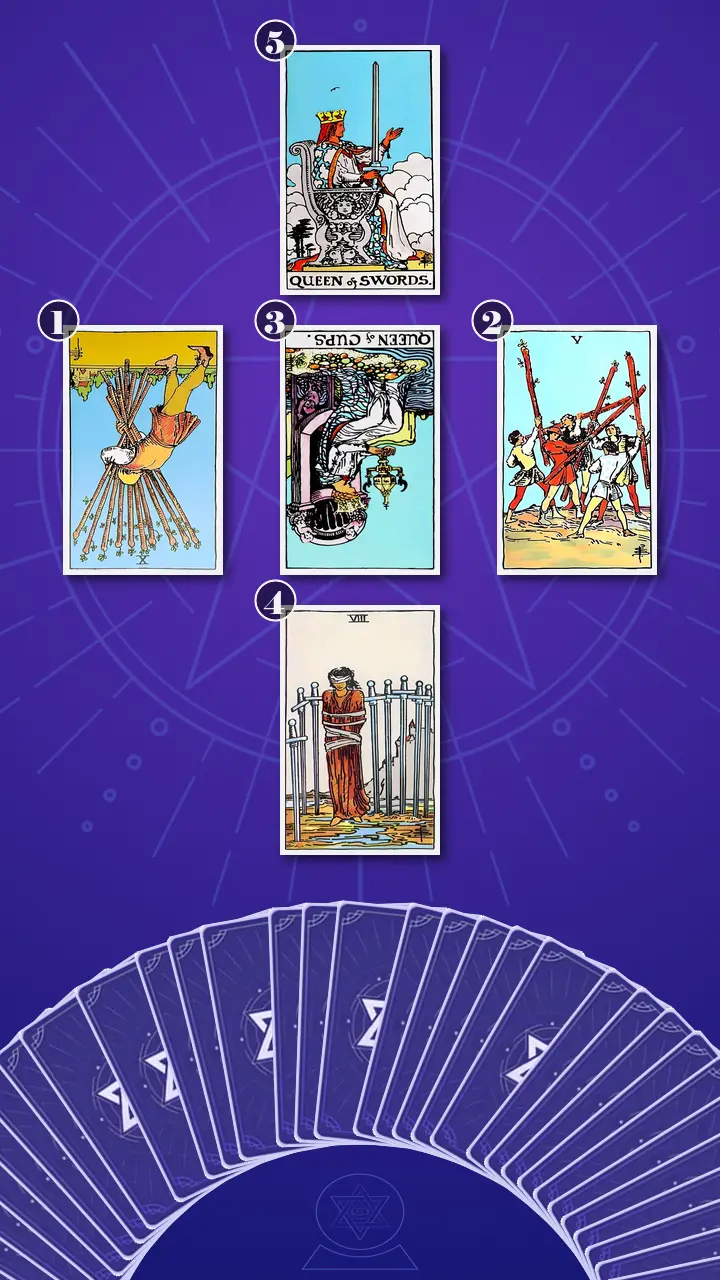
I chose the Relationship Spread · Context Edition, a five-card relationship tarot spread for family conflict and emotional responsibility. When people ask me how tarot works in a difficult family dynamic, I explain that I use the cards as a structured lens: they do not decide who is right, predict a relative's reaction, or instruct anyone to tolerate harm. They give the live situation distinct places on the table so guilt does not get to speak as though it were the only witness.
This spread was right for Casey because it could hold five separate things at once: her present response to blame, the family's expressed pressure as she experiences it, the interaction loop between them, the belonging fear beneath it, and a self-directed boundary practice. I placed the third card at the centre, Casey's card to the left, family pressure to the right, the hidden fear below, and the practical bridge above. It made a cross like a bridge on a buried foundation: the visible conflict across the middle, the old belief underneath, and a route upward toward clearer communication.
Reading the Burden, Not the Verdict
The Draft That Blocked the Original Message
I turned the first card. "Now I am opening the card that represents Casey's present response to being assigned family blame." It was the Ten of Wands, reversed.
I pointed to the figure bent beneath ten staffs, unable to see clearly past the load. "This is blocked release and overextension," I said. "At 10:45 p.m., that disappointed text becomes a queue of tasks: review the entire thread, draft a long apology, anticipate objections, offer solutions, and stay awake until everyone feels better. Each additional paragraph is another wand. By the sixth paragraph, the draft is blocking your view of the original facts."
The reversed card did not say Casey was failing to care. It showed her beginning to recognise that care had become unassigned emotional labour. A specific repair might be hers. Managing every consequence of another person's mood was not automatically hers. A long apology can be alarm trying to write a peace treaty.
Casey gave a small, bitter laugh and pressed her thumbnail into the edge of her phone. "That is painfully accurate. I call it being thoughtful, but I usually have no clue what I am actually apologising for." Her smile faded, and I saw the next-day resentment behind it: the familiar feeling of having done all the work while her own account never entered the conversation.
The Family Thread With Five Tabs Playing at Once
I turned the second card. "Now I am opening the card that represents the family system's expressed anger and pressure as Casey currently experiences it." The Five of Wands, upright appeared under my hand.
"This is active fire: friction, competing viewpoints, and several people trying to be heard at once," I said. "It is not a final ruling on your character. No figure in this card is clearly winning, and the staffs point in different directions."
I asked Casey to picture the group chat she had described: one relative disappointed, another reviving an old issue, someone else sending a pointed question mark. The notification sounds stack up, but they are not one authoritative message. It is closer to a chaotic Slack thread where five people are debating different problems and one person reads the whole channel as a performance review. I mentioned the dinner scenes in The Bear, where volume fills the room so completely that it can briefly feel like truth.
"They are all upset, so they must all be saying the same thing about me," Casey said, voicing the conclusion the card exposed.
"Conflict is real," I replied, "but conflict is not automatically a verdict. In the last disagreement, what did each person actually say? Which parts did you combine into the sentence, 'They all think I am wrong'?"
Her shoulders lowered a fraction. She looked again at the crossed staffs and said, "One of them was actually arguing with another person. I just took the whole thing home with me."
The Covered Cup at the Centre
I turned the third card at the centre of the spread. "Now I am opening the card that represents the interaction loop through which Casey absorbs conflict and turns it into personal responsibility." It was the Queen of Cups, reversed.
Her covered cup sat close to her chest at the edge of the sea. I explained that upright, the Queen of Cups is emotional receptivity and empathy; reversed, that same sensitivity can become porous. The energy is not absent. It is overflowing its container.
"I see this in the Sunday call you described," I said. "You hear a clipped tone, accurately sense that someone is hurt, and then edit your own experience sentence by sentence until it cannot upset them further. You apologise, explain, and make yourself available before anyone has named a concrete harm. You can describe everybody else's feelings by the end of the call, but not what happened for you."
I let the paired thoughts sit between us: I can feel that they are hurt. Then, almost instantly: Therefore I caused it and must fix it.
"Understanding a feeling is not the same as admitting you caused it," I said. "The Queen's covered cup is a useful image here. You can hold the information that someone is upset without pouring it into an automatic apology, and without allowing it to replace your voice."
Casey's fingers closed around the glass of water. She went quiet, her eyes resting on the card instead of on me. "I can explain everyone else's feelings," she said eventually, "but when someone asks what I wanted, I kind of blank out."
"That is the loop," I told her. "Your empathy is valuable. The problem is not that you notice emotional weather quickly. The problem is that you have been trained to treat the weather report as an assignment to control the sky."
The Third Option Below the Fold
I turned the fourth card. "Now I am opening the card that represents the underlying fear and blind spot that make this pattern difficult to interrupt." The Eight of Swords, upright showed a blindfolded woman, loose ropes around her body, and open ground visible between the surrounding swords.
"This is restrictive air: a thought pattern that feels total because fear has narrowed the available choices," I said. "At 12:18 a.m., you can see only two drafts. One accepts every accusation. The other is sharp enough to end the conversation. It feels like a pop-up that offers only 'Accept all blame' or 'Leave the relationship,' while the custom-settings button is hidden below the fold."
I named the fear carefully: Casey had come to believe that a brief, respectful limit would intensify family anger and prove she no longer belonged. The fear was real in her body, but the card's loose bindings and gaps between swords suggested that the feared binary was not the whole menu.
"A boundary may disappoint someone without proving you do not belong," I said. "If you sent a concise reply tonight instead of a long apology, what does your mind predict after the words, 'Then they will...' ?"
Her breath caught. For a second her gaze slipped past the cards, as if she were replaying a late-night screen in the dark hallway outside her bedroom. Then she exhaled through her nose and said, "Then they will decide I do not care. And if they decide that, I will not know how to get back in."
I did not argue with the tenderness of that fear. I simply asked her to notice that it was a prediction, not yet a fact. The third response was still available: acknowledge the feeling, name one thing she could honestly address, and decline responsibility for the rest.
When the Queen of Swords Raised Her Blade
An Open Hand With a Working Lock
The room grew quieter as I reached for the final card. Even the traffic below seemed to pause between one streetcar and the next. "Now I am opening the card that represents a self-directed boundary practice that lets Casey stay caring without carrying emotions that are not hers." The Queen of Swords, upright appeared: direct gaze, upright sword in one hand, open hand extended in the other.
"This is clear discernment, self-respect, and direct communication," I said. "Her open hand receives what is being said. Her raised sword separates what requires an action from what is simply another person's feeling. She is not cold. She is precise."
At digs, and later in the long historical corridors of Cambridge, I learned that a ruin is never one thing. It is a layered record. I use that same lens here, and I call it Inherited Belief Stratigraphy. Beneath Casey's present fear, I could see three layers: her authentic value of being thoughtful; an inherited rule that she must manage family anger to earn belonging; and the actual, present-day fact of what she did or did not do. The middle layer may be old and powerful, but it is not automatically true.
At 10:45 p.m., the warm phone in her hand and the sixth apology draft had made family anger feel less like conflict and more like a review of whether she belonged. Her throat tightened because she was trying to find wording that could guarantee safety. I paused before offering the card's antidote.
You do not need to become the container for everyone else's anger; use the Queen of Swords' raised blade to separate care from responsibility and state one clear limit.
Casey stopped breathing for a beat. Her thumb froze above the edge of her phone, then her eyes lost focus as though the old text threads were replaying behind them: missed calls before work, a relative's flattened voice on Sunday, Friday dinner cancelled outside the Queen West restaurant. Her mouth opened without sound. Then her expression tightened with a brief flash of anger, not at me but at the weight of the recognition. "But does that mean I have been doing all of this wrong?" she asked. "Like I have made every family conflict worse?"
"No," I said. "It means this pattern may once have helped you seek safety. It is not evidence that you are defective, and it does not erase any real repair you may choose to make. It simply asks for evidence before you accept blame."
Her shoulders descended slowly. Her grip loosened. Her eyes brightened with tears that did not fall, and the next breath came out shaky but deeper, as though she had set down something heavy and felt briefly unsteady without it. "I could have kept my dinner on Friday," she said. "I could have said I heard them, then replied tomorrow."
"Now, with this new perspective, look back over last week: was there a moment when this insight could have helped you feel differently?" I asked.
That was the first visible movement from absorbing family anger as guilt and a test of belonging toward caring connection with evidence-based responsibility, self-respect, and clear boundaries. The card did not promise that her family would instantly approve. It returned the choice of her next response to her.
Turning Insight Into a Boundary Practice
I drew the whole story together for Casey. The reversed Ten of Wands showed her carrying emotional tasks nobody had assigned. The Five of Wands showed that the family's conflict field could be loud, scattered, and unresolved without becoming one unanimous judgment. The reversed Queen of Cups showed how her sensitivity had turned into self-erasure. The Eight of Swords named the buried belief that only total blame could preserve belonging. The Queen of Swords offered a different structure: care, truth, and a defined edge.
The cognitive blind spot was not that Casey cared too much. It was that she had been treating a bodily alarm and another person's feeling as evidence that she had caused harm. Her next direction was not emotional detachment or an abrupt cutoff. It was to separate the observable action she owned from the surrounding anger, then speak only to that action. I call this moving from emotional firefighting to evidence-based responsibility.
I also gave her a version of my Lineage Artifact Review. I asked her to imagine placing two inherited beliefs on a quiet table: keep the value of being thoughtful and dependable; bury the rule that another person's anger must be solved before she is allowed to return to her own life. The point was not to reject family history. It was to decide, consciously, which belief deserved to travel forward with her.
- The Mine-to-Address SplitBefore replying to one charged family message this week, Casey will open Notes and make two headings: "Mine to address" and "Not mine to carry." For 10 minutes, she will list only observable actions under the first heading and feelings, assumptions, or unrelated grievances under the second. She will not decide whether to apologise until the timer ends.If 10 minutes feels impossible, she can do a 60-second version: one fact and one feeling. If a message includes threats, coercion, or a genuine safety concern, I would rather she pause and seek support from someone she trusts than treat a reply as her only option.
- The Three-Line Clarity PracticeAfter work, at a time that fits her actual capacity, Casey will draft three lines in Notes: one acknowledgment, one truthful statement, and one limit. For example: "I hear that you are upset. I can discuss the part I did, but I do not agree that this defines how much I care. I am going to pause here and can talk tomorrow." She will read it aloud once, mute the thread until her chosen response window, and stop adding defensive paragraphs.Answer the action; do not audition for emotional clearance. If the full script feels too exposed, she can begin with: "I've seen this. I need time to think, and I'll reply tomorrow." Clarity does not require immediate agreement.

A Small Proof of Care Without Carrying
Four days later, I received Casey's message: "I kept coffee with Maya. I sent the three lines, muted the thread, and still checked twice." Her photo showed streetcars moving through slush outside the cafe. No one had declared peace, but she had kept her evening.
I did not read that as a finished transformation, and neither did she. I read it as a small, credible proof of a Journey to Clarity: Casey had allowed family anger to exist without immediately converting it into a night-long shift. She had made room for connection and for herself in the same hour.
When a family notification tightens your throat before you have even opened it, it can feel as though belonging depends on finding the exact words that absorb their anger and make you safe again. I want to leave room for the possibility that the old alarm is understandable, while the next response can still be yours to choose.
If caring did not require carrying the whole storm, what one honest sentence could you let the Queen's open hand and raised blade help you imagine saying next time?
This story is adapted from psychological research, written so that those in a similar struggle can see their own pattern in it — and find their next step clearly.These insights are not a substitute for professional psychological, medical, legal, or financial advice.
Learn more about our Journey to Clarity.
How did this insight land for you?
🫂 This Resonates Deeply
🌀 Living This Story
✨ Now I See Clearly
🌱 Seeing New Possibilities
🧰 Useful Framework
🔮 The Confirmation I Needed
💪 Feeling Empowered
🚀 Ready for My Next Step
Author Profile
 AI
AI“Having spent a lifetime at Cambridge and on archaeological digs, I’ve witnessed the rise and fall of countless civilizations. Please know that your current struggles are not a permanent fate, but merely a necessary fracture before rebuilding. I won't lecture you; instead, I invite you to sit with me in the ruins, using a patient, historical perspective to gently dust off the true, enduring value hidden beneath your temporary doubts.”
In this Family Tarot Reading :
Core Expertise
- Generational Trauma Excavation: Tracing the origins of toxic family behavioral loops across multiple generations to remove your personal blame.
- Inherited Belief Stratigraphy: Separating your authentic values from the obsolete, fear-based dogmas passed down by your ancestors.
Service Features
- The Lineage Artifact Review: An intellectual exercise to objectively decide which family traditions/beliefs to consciously preserve, and which to permanently bury.
Also specializes in :
Explore Related Patterns:
Defensive OverexplainingAt 10:45 p.m., Casey responds to a disappointed message by reopening the thread, drafting six paragraphs, predicting objections, and searching for words that might guarantee safety. The draft grows until it blocks her view of the original facts, so explanation becomes a defence against uncertainty rather than a route to clarity. You can see defensive overexplaining when the reply is designed to manage every possible reaction before the actual issue has been named. The three-line practice interrupts that loop by limiting the response to an acknowledgment, a truthful statement, and a boundary. You retain the option to repair a real action without turning your message into an audition for emotional clearance.
Emotional Hyper-ResponsibilityThe disappointed text does not remain a message for Casey to assess. It becomes a late-night workload: rereading the thread, drafting six paragraphs, anticipating objections, offering solutions, and staying awake until the family atmosphere feels calmer. Her first response is to take responsibility for the emotional field before identifying any specific action that is actually hers to repair. You can see the mechanism in the jump from noticing that someone is hurt to deciding that you caused the hurt and must make it disappear. That jump turns empathy into emotional hyper-responsibility, leaving little room for your own account of events. The Mine-to-Address Split creates a factual pause between another person's feeling and the responsibility you genuinely choose to accept.
Emotional ReasoningThe family text tightens Casey's throat, folds her inward, and launches an urgent apology before she has identified a single action that needs repair. The bodily force of guilt makes the conclusion feel settled: because she feels responsible, she must be responsible. You can see emotional reasoning in the instant move from sensing another person's hurt to treating that sensation as proof of causation. Feelings can signal that a relationship matters and that a pause is needed; they are not a verdict on fault. Asking what observable action occurred lets you honour the feeling without allowing it to decide the facts.
Guilt-Driven People-PleasingCasey drafts apologies before she knows what she is apologising for, edits out anything that could upset a relative, and makes herself available before anyone has identified a concrete harm. These moves seek emotional clearance from the family rather than a clear account of what happened. You can see how guilt-driven people-pleasing takes hold when a respectful limit feels equivalent to not caring or no longer belonging. The pattern offers short-term relief through appeasement, but it also leaves your own perspective out of the conversation. A concise acknowledgment, truthful statement, and limit make care possible without requiring total agreement or self-erasure.
Boundary DiscernmentCasey begins to separate what she can honestly address from feelings, assumptions, and unrelated grievances that do not belong to her. Her three-line reply acknowledges that someone is upset, names what she can discuss, and sets a pause without trying to settle every emotion in the thread. You can see boundary discernment in the shift from chasing a wording that guarantees belonging to assessing evidence and choosing a response window. Keeping coffee with Maya after muting the thread shows that connection with family and connection with yourself do not have to compete for the same hour. A limit does not erase care; it defines the part of the conflict you can meet truthfully.
Personalization BiasIn the family thread, several people are reacting to different issues, yet Casey combines their messages into one conclusion: everyone is saying the same thing about her. When she later notices that one relative was actually arguing with someone else, the original conclusion loses some of its certainty. You can see personalization bias when shared conflict becomes evidence of your individual failure. A clipped tone, a pointed question mark, or another person's unresolved frustration may be information worth noticing, but none automatically establishes your responsibility. Separating each person's actual words from the meaning your alarm assigns to them restores a more accurate map of the situation.
Explore Related Struggles:
All-or-Nothing BelongingAt 12:18 a.m., Casey can see only two possible replies: accept every accusation or write something sharp enough to end the conversation. When she imagines a brief limit, her next prediction is that the family will decide she does not care and she will not know how to get back in. That prediction turns an ordinary boundary into a referendum on belonging. You may still want connection and accountability, but the available response space contracts until preserving the relationship appears to require surrendering your entire position. The real tension is not simply whether to reply. It is whether care, disagreement, and continued belonging are allowed to exist in the same exchange. Naming that restricted menu makes room to examine a third response in which you acknowledge the reaction, address one honest responsibility, and keep your place in the relationship without accepting the rest.
Anger-Ownership SplitCasey opens a six-paragraph apology before she can identify a single thing she did wrong. The document is built to reduce the family's anger, so their emotional reaction begins assigning her work before any specific responsibility has been established. When you can recognize that someone is upset but cannot yet tell what belongs to you, anger and ownership pull in different directions. You remain responsible for examining your actions, yet the pressure to make everyone feel better tries to settle the question before that examination can happen. The struggle becomes visible in the gap between hearing the family's anger and deciding what it actually requires from you. Keeping that gap open long enough to review the evidence lets care remain present without giving another person's reaction automatic authority over your accountability.
Family System OveridentificationIn the family thread, one relative expresses disappointment, another revives an old issue, and someone else sends a pointed question mark. Casey initially combines those separate signals into one sentence, "They all think I am wrong," even though one relative is actually arguing with another. The family's internal conflict is then processed through you as though you were its single subject and resolution point. Different viewpoints, old grievances, and disputes between other people lose their separate origins, leaving one concentrated verdict that follows you out of the thread and into the room. Taking the messages apart does more than reduce their volume. It restores the distinction between a system having conflict and you having a specific responsibility within that conflict. You can respond to the part that genuinely concerns your actions without becoming the representative, cause, and repair crew for the whole family exchange.
Guilt-Evidence FusionOn the Sunday call, Casey hears a clipped tone, accurately recognizes that someone is hurt, and almost immediately reaches the conclusion that she caused the hurt and must fix it. Her throat tightens before anyone has named a concrete harm, and the bodily alarm enters the case as though it were factual proof. Once that sequence locks into place, another person's reaction and your responsibility become difficult to examine separately. The stronger their anger feels in your body, the more convincing your presumed guilt can appear, even when the observable action remains unclear. This is why explanation alone does not release the pressure: the conclusion has been reached before the evidence review begins. Separating what they feel, what you physically register, and what you actually did restores three distinct sources of information, allowing responsibility to be specific rather than inherited from the intensity of the moment.
Inherited Repair BurdenCasey's present-day response contains three layers the story names directly: her genuine value of being thoughtful, an inherited rule that family anger must be managed to earn belonging, and the observable facts of what she did or did not do. When a disappointed message arrives, the inherited layer turns rapidly into a queue of repair tasks. Because that rule is already embedded in the meaning of family connection, you do not have to be assigned the work explicitly. Anticipating objections, offering solutions, cancelling plans, and staying available can feel like the price of remaining recognizable as a caring person. The burden persists by attaching a valid value to an unlimited job description. You can keep thoughtfulness and dependable care while examining whether every relative's emotional outcome was ever yours to control. That distinction lets the value travel forward without requiring the inherited condition to travel with it.
Self-Erasure ReliabilityDuring the Sunday call, Casey edits her own experience sentence by sentence until it cannot upset anyone further. By the end, she can describe everybody else's feelings, yet when asked what she wanted, she blanks; the six-paragraph apology has left no working space for her account. This arrangement allows you to remain legible as thoughtful and dependable only while the parts of your experience that might complicate the conversation are removed. You can become highly articulate about other people's reactions while losing access to the information needed to represent yourself. The struggle is carried in that unequal visibility: your care stays in the exchange, but the person providing it disappears from the record. Noticing where your factual account was edited out gives you a concrete place to re-enter, with one truthful sentence that does not require anyone else's immediate approval to be valid.
Real-Time Care BindAt 10:45 p.m., one disappointed text becomes an hour of rereading, drafting, anticipating objections, and offering solutions. The message has stopped moving, but Casey's body and reply process remain on duty as though family care must be demonstrated before the night can continue. When you experience responsiveness as proof of care, your actual capacity has to compete with the demand to answer now. Sleep, dinner, work, and reflection become postponable, while another person's unresolved reaction receives immediate access to your time. The bind lies in treating timing as a moral signal: a delayed response risks looking uncaring, while an immediate response leaves little room to determine what is true. Choosing a response window does not erase the relationship; it returns enough time for your reply to come from considered responsibility rather than notification speed.
Explore Related Emotions:
Boundary GuiltAt 10:45 p.m., Casey has a six-paragraph apology open before she can name one thing she did wrong, and her body stays folded around the phone. Another person's upset has become an immediate debt, so stopping the draft feels morally risky rather than simply incomplete. When you have learned to equate care with taking charge of every reaction, a limit can produce Boundary Guilt even when the facts do not support total responsibility. Naming that feeling separates the discomfort of not fixing everything from evidence that you actually caused harm, leaving you free to choose a specific repair without surrendering your whole evening.
Clarity ReliefLooking at the crossed staffs, Casey realises that one relative was actually arguing with another person and that the family thread was never one coherent accusation. Her shoulders lower as the message field separates into distinct voices, facts, assumptions, and reactions. Clarity Relief arrives when you no longer have to solve an undifferentiated wall of blame. The distinction between what is yours to address and what is not yours to carry restores proportion without denying the conflict. You can remain caring because your response is anchored in observable evidence rather than in the impossible task of making every feeling disappear.
Conditional Belonging FearAt 12:18 a.m., Casey can imagine only two replies: accept all the blame or answer sharply enough to threaten the relationship. When she considers a brief limit, her mind immediately predicts that her relatives will decide she does not care and that she will not know how to get back in. That prediction turns disagreement into a test of membership. You can experience Conditional Belonging Fear when connection seems available only if you absorb the whole conflict, suppress your own account, and restore everyone else's comfort. Seeing the condition clearly makes room for a different possibility: someone can remain disappointed while your place in the relationship is not yours to purchase with self-erasure.
Emotional FloodingOne sentence from the family thread expands until it seems to occupy Casey's entire bedroom, while her throat tightens and her stomach folds inward. Several voices, old issues, and pointed messages stop arriving as separate pieces of information and begin to land as one total demand. Emotional Flooding names the subjective experience of having more relational input than you can sort in the moment. When every signal feels equally urgent, your own facts and preferences become difficult to hear beneath the volume. Recognising the flood does not dismiss anyone's feelings; it gives you permission to slow the intake until each claim can be examined on its own.
Verdict DreadOne relative says they are disappointed, another revives an old issue, and someone else sends a pointed question mark. Although the messages address different tensions, Casey reads the entire thread as a unanimous performance review and concludes that everyone thinks she is wrong. Verdict Dread emerges when conflict feels less like a collection of negotiable claims and more like a final ruling on your character. Under that pressure, you may draft for acquittal rather than communicate about the specific facts. Separating each voice and each allegation weakens the imagined unanimity, allowing you to answer what happened without accepting a total judgment about who you are.
Voice Erasure DreadCasey edits her own experience sentence by sentence until it cannot upset anyone further, then blanks when she is asked what she wanted. Her six-paragraph apology contains space for every anticipated objection while her own account never enters the conversation. Voice Erasure Dread is the felt expectation that your perspective will disappear as soon as someone else's reaction becomes intense. You may keep speaking and still experience yourself as absent because every word is organised around preventing their response. Acknowledging their feelings while retaining one truthful sentence gives your voice a defined place without requiring you to overpower theirs.
Cautious AutonomyFour days later, Casey sends three lines, mutes the family thread, and keeps coffee with Maya, even though she still checks the messages twice. No one has declared peace, but the unresolved reaction no longer consumes her entire evening. Cautious Autonomy is present in that imperfect return of choice. You may still feel the pull to monitor the conflict while discovering that the pull does not have to decide your plans, timing, or wording. The checking shows that the old alarm remains active; keeping the coffee shows that your life can remain present beside it.
Enmeshed ResentmentDuring the Sunday call, Casey notices a clipped tone, edits her own experience sentence by sentence, and makes herself available before anyone names a concrete harm. By the end, she can describe everybody else's feelings but cannot say what happened for her, and the next day she is left with the bitter sense that she did all the work. Enmeshed Resentment grows where emotional receptivity has no working edge. You keep absorbing, explaining, and repairing until care becomes indistinguishable from abandoning your own position. The resentment is useful information: it marks the point where connection has stopped being mutual and where your perspective needs room alongside everyone else's.
Explore Related Contexts:
Conditional Family BelongingAt 12:18 a.m., Casey can see only two acceptable drafts: one accepts every accusation, while the other appears sharp enough to end the conversation. She explicitly predicts that a brief limit will be read as proof that she does not care and that she may not know how to regain her place in the family. The inherited rule she names links belonging with the successful management of family anger. Under that rule, you are not merely discussing what happened; you are being pushed to demonstrate your eligibility for connection by restoring approval, which makes a proportionate response much harder to access even before the family has stated a concrete repair request.
Emotional Labor ImbalanceAt 10:45 p.m., Casey turns one disappointed family text into a six-paragraph apology, a review of the whole thread, anticipated objections, and proposed solutions. The disagreement therefore generates a private second shift in which she performs the interpretation and repair work before anyone has identified a specific action that belongs to her. That workload is relationally imbalanced because everyone else's anger receives analysis and accommodation while Casey's account and existing plans lose space. You may recognize this context when caring no longer means responding to one concrete issue and instead requires you to manage the entire emotional aftermath before you are permitted to return to your own evening.
Family EnmeshmentOn the Sunday call, Casey hears a clipped tone and then edits her own experience sentence by sentence until it cannot upset the other person. The same boundary collapse extends across settings: the family thread occupies her bedroom at 10:45 p.m., missed calls reach into work time, and a Friday dinner is canceled while she manages the conflict. The external issue is not simply that relatives have strong feelings; it is that information about those feelings crosses immediately into Casey's time, plans, and responsibility. You are inside an enmeshed family context when another person's anger is treated as shared property that must be processed through your schedule and voice before your separate life can resume.
Adult Voice ErosionBy the end of the Sunday call, Casey can describe every relative's position but cannot say what happened for her. Her six-paragraph apology follows the same structure: other people's objections, reactions, and proposed solutions fill the document while the original facts and her own account disappear behind the draft. This is an erosion of adult standing inside the family conversation, not a lack of communication skill. When the exchange recognizes you primarily as the person who must absorb and repair the conflict, your voice is reduced from evidence to a potential source of further upset; reclaiming it begins with keeping one truthful statement in the reply even when agreement is unavailable.
Family Boundary NegotiationFour days later, Casey sends three lines, mutes the thread, and keeps coffee with Maya even though no one has declared the conflict resolved. She acknowledges that her relatives are upset, identifies the part she can discuss, and chooses when the conversation will resume without using immediate agreement as the price of ending her evening. The boundary is being negotiated in real time because the family remains connected while its access to Casey's attention becomes more defined. You can stay responsive without making yourself continuously available, and each bounded exchange provides concrete evidence about which parts of the relationship can adapt to clearer terms.
Family Peacemaker Role ResetCasey's first response to family anger is to review every message, anticipate objections, offer solutions, and stay engaged until everyone is settled. Her later response narrows that role: she addresses one observable action, states her own position, sets a limit, and allows the remaining conflict to exist without turning it into another night-long shift. This role reset creates a third position between absorbing all blame and withdrawing from the family. You remain capable of care and repair, but your function is no longer to manufacture peace for the entire group; responsibility becomes evidence-based, and your own commitments retain legitimate standing alongside the relationship.