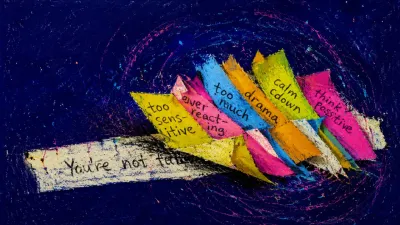
After Advisor Pushback: Three Closed Drafts, Then One Small Test

When PhD Advisor Pushback Locked the Whole Building
Maya, a third-year doctoral candidate in New York, joined my video room at 10:12 a.m., minutes after her advisor had said, “I don't see this working,” during a Zoom meeting and moved on without explaining whether the problem was a rule, an evidence gap, or a preference. When Maya shared her screen, I watched her close three Google Docs containing alternative chapter outlines and reopen the advisor's tracked changes instead. Her laptop fan hummed through the microphone. Cold coffee sat beside the keyboard, and the blue edge of an unsent Gmail draft glowed at the bottom of the screen.
Her gaze stayed lowered. Her shoulders had folded toward her chest, and when she tried to speak, she cleared her throat twice. “Once they say no, I stop being able to see the other routes,” she told me. “I know I could ask a follow-up, but it feels like arguing. Maybe the safest option is to do exactly what they said.”
I recognised authority-triggered learned helplessness after PhD advisor pushback: a real hierarchy activates a protective reflex, and one critical response gets promoted by the mind from a single data point to a full recommendation marked “No options available.” What Maya called powerlessness felt like a fake system permission error spreading across her body. One document appeared blocked, so her throat, shoulders, and heavy hands reacted as if the entire drive had been locked.
“You are trying to take feedback seriously,” I said, “but your brain is translating one response into a total stop. I am not going to tell you that the hierarchy is imaginary, and the cards will not tell us what your advisor secretly intends. What we can do is examine the pattern between the comment and the moment you surrender every remaining choice. Let us make a map of that space.”
Choosing the Switchback Map
I invited Maya to take one ordinary breath and keep the exact consultation question in view: Why do I keep assuming I have no options when my advisor pushes back? I shuffled slowly, using the movement as a practical transition from replaying the meeting to observing it. Nothing in the ritual required belief in prediction. Its purpose was attention.
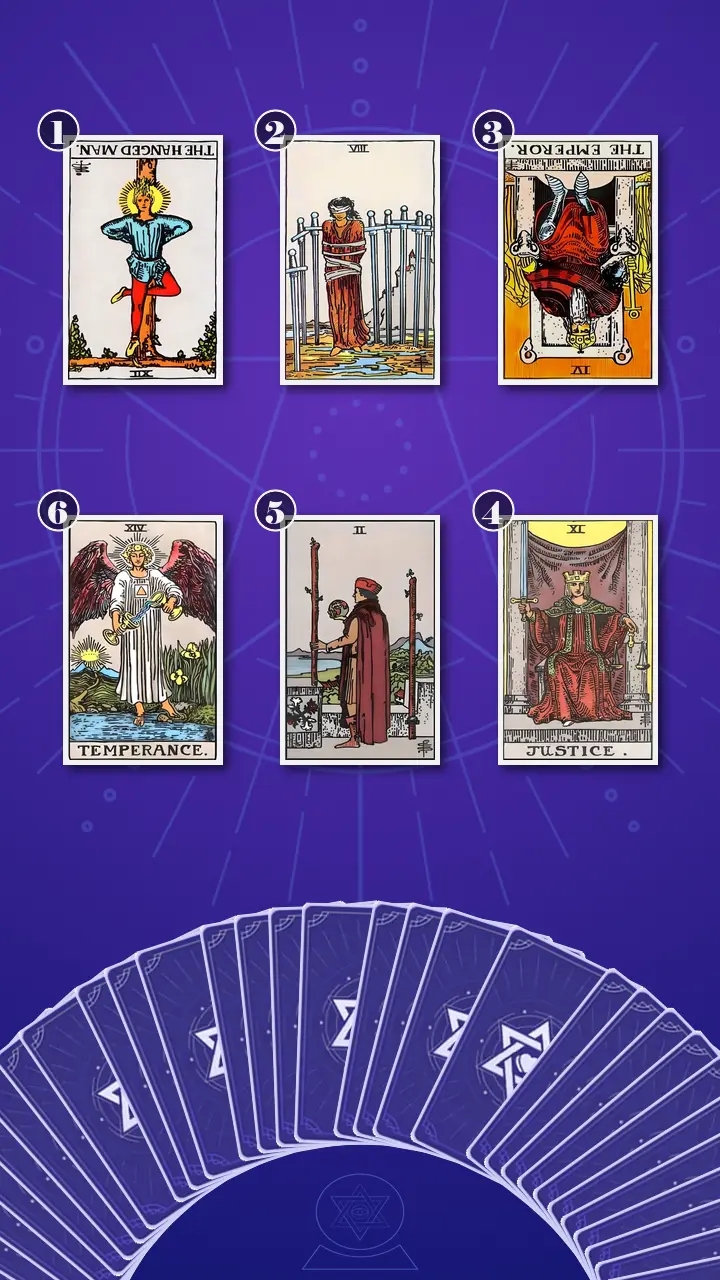
I chose the Transformation Path Grid · Context Edition, a six-card transformation spread arranged like a switchback staircase. I selected it because this was not a simple decision between two visible alternatives. The difficulty was that Maya stopped perceiving alternatives as soon as authority entered the conversation.
For anyone wondering how tarot works in a situation like difficult PhD supervisor feedback, I use card meanings in context as an external cognitive map. This grid let me trace the whole feedback loop: a real power imbalance triggered the belief that no options remained; that belief produced silence, automatic compliance, and stalled work; the delay increased dependence; and the increased dependence made the advisor's authority feel even more total. A spread focused only on hidden feelings would have over-internalised a genuine structural issue. A conventional decision spread would have assumed Maya could already see her choices.
The first card would show the behaviour visible in the ten minutes after pushback. The second would identify the thought that enclosed her options. The third would examine the authority-based root. The lower row would then turn the path around: Justice would provide the catalytic distinction, the fifth card would identify one bounded experiment, and the final card would show the feedback practice Maya could cultivate. I reminded her that the last position was an integration target, not a forecast. The cards could organise the evidence, but Maya would remain the person deciding what to ask, test, send, or leave alone.
Where Waiting Started to Look Responsible
Position 1: The Pause That Would Not End
Now I turned over the card representing the visible behaviour through which the problem appeared: Maya stopped generating alternatives, delayed clarification, and waited after advisor pushback. It was The Hanged Man, in reversed position.
I pointed to the suspended figure and the living tree. Ten minutes after the Zoom meeting, Maya had left all three alternative chapter outlines untouched and begun copying the advisor's suggested structure into a new Google Doc. One approach had been questioned, but she experienced the pause as a command to suspend every line of exploration. The work represented by the green, living tree was still available; her relationship to it had become frozen.
In this position, the Hanged Man's energy was in Blockage. A productive pause should create a different angle of view. Reversed, the pause had hardened into indefinite waiting. No one had instructed Maya to cancel every adjacent idea, yet remaining motionless felt more professionally responsible than testing what was still within her control.
I used a lens I call Draft Paralysis Deconstruction. I explained that her urge to reproduce every comment perfectly was not simply diligence. It was also a subconscious defence designed to reduce the chance of future criticism: if she followed each instruction literally, she hoped no one could blame her for choosing badly. The defence offered immediate cover, but it purchased that cover by suspending her authorship.
Maya gave one short laugh, sharp at the edges. Her fingers tightened around the cold mug before she set it down. “That is so accurate it feels a little brutal,” she said. “I call it revising, but sometimes I am just waiting in a more productive-looking way.”
“That distinction is useful, not condemning,” I replied. “The question is not why you failed to be fearless. It is what you routinely stop doing first, and whether that action was actually required.”
Position 2: The Comment That Became the Whole Map
Now I turned over the card representing the immediate blocking belief: advisor resistance meant no question, revision, source of support, or choice remained. The card was the Eight of Swords, upright.
I placed the image beside the tracked-change comment on Maya's screen. The advisor had written, “This may not be the strongest route.” Maya had closed the alternative files before identifying what evidence was missing, checking the written milestone criteria, or asking what part of the approach remained open. The advisor's influence was real. The fear-added conclusion was larger: the discussion was finished, consultation would be inappropriate, and no small revision was worth testing.
I kept my attention on the blindfold, the loose bindings, and the incomplete ring of swords. I did not tell Maya that the restrictions were imaginary. An advisor who affects progress reviews and references holds meaningful institutional power. The card showed something more precise: while Maya was under that pressure, she could not inspect the actual boundary because her first frightened interpretation had completed the enclosure.
The energy here was Excess air becoming Blockage. Analysis no longer served inquiry. It looped through the advisor's wording, generated possible objections, and selectively collected evidence that the authority imbalance was absolute. Her internal algorithm had turned one critical sentence into an entire map before checking the permissions.
Her breath caught first. Then her eyes lost focus as if she were replaying the tracked-change scene. Finally, her grip loosened, and one thumb slid away from the mug's rim. “I do turn one comment into the whole map,” she said quietly. “They said the route might be weak. I heard that I was not allowed to ask where it was weak.”
“That added sentence is where we can work,” I said. “Not by pretending the swords are absent, but by removing the blindfold long enough to count which ones are actually fixed.”
Position 3: When One Throne Became the Entire Institution
Now I turned over the card representing the structural root: the interaction between learned helplessness and an advisor's genuine power, which made one person's pushback feel like a total boundary. It was The Emperor, in reversed position.
The massive stone throne and visible armour gave Maya an immediate picture of how concise criticism landed in her body. When she heard, “I am not convinced,” she treated the statement as final governance. She did not check whether the issue came from a formal program requirement, an evidentiary gap, or the advisor's preferred structure. The department handbook, milestone criteria, and routine channels for consultation vanished behind the throne.
The Emperor's energy combined Excess external authority with a Deficiency of access to Maya's own legitimate judgment. This did not mean the advisor had no authority, nor did the reversal prove that the advisor was controlling. It described how the power dynamic was being internalised. Before the boundary had been clarified, Maya outsourced every decision to the most powerful person in the room.
Looking at the reversed throne, I found myself remembering how differently deference had been coded in the cultures through which I had travelled. The surface rules changed, but I had repeatedly seen the same bodily contraction when an outer authority activated an older inner command: stay agreeable, create no extra burden, and do not risk belonging by asking for precision. Through a Jungian lens, the advisor had become the visible face of an internal Emperor whose authority extended far beyond the words actually spoken.
“Your advisor's authority is real,” I told Maya. “It is not the whole map. A red MTA service alert can close one line without closing every route across New York. Before cancelling the journey, you still need to know which line, for how long, and what counts as an available reroute.”
Maya rubbed the base of her throat. “The problem is that asking feels risky when they influence my review and future references. I keep thinking they might withdraw support if I make this harder.”
“That fear deserves proportion, not dismissal,” I said. “We are not going to turn self-advocacy into a demand for confrontation. We are going to look for the smallest question that gives you usable information.”
When Justice Put the Verdict on Trial
As I placed the next card directly beneath the reversed Emperor, Maya's radiator knocked once and went quiet. The Gmail cursor continued blinking at the edge of her screen, a thin vertical line waiting for language. Even the laptop fan seemed to settle as the reading reached its turning point.
Position 4: The Scales Between Evidence and Fear
Now I turned over the card representing the key leverage point: separating formal constraints, the advisor's specific concern, and Maya's automatic no-options interpretation. The card was Justice, upright, the catalyst of the spread.
I showed Maya the balanced scales and the upright sword. In her academic life, the scales became a three-column note comparing requirement, concern, and interpretation. The sword became one precise, neutral question: “Could you help me distinguish whether this is a formal requirement, an evidence concern, or a preferred structure?” Justice did not ask her to win an argument. It asked her to recover proportion before choosing a response.
The card's energy was Balance: neither denying the hierarchy nor allowing fear to enlarge it without evidence. One comment could receive one clarifying question. A concern about one section did not automatically justify a total chapter overhaul.
At 10:12, Maya had been trapped inside the demand to make the correct response: close the alternatives, copy the tracked changes, and avoid the question. The work was paused, but the decision to pause had started to feel like an order even though no total-stop instruction had been spoken.
This was where I brought in Performance Anxiety Decoupling. I asked Maya to separate four things that her body had fused together: her advisor's institutional authority, the specific evaluation of the chapter approach, the quality of the current draft, and Maya's core worth as a researcher. The first three could matter materially and deserved evidence. The fourth was not logically established by a mentor's criticism, a progress review, or comparison with a more assertive cohort peer. Justice could weigh a draft. It could not reduce a person to the outcome of that weighing.
Pushback is not a total verdict; place the fixed facts and your assumptions on Justice's scales, then use the upright sword to name one clear question and one remaining choice.
For a beat, Maya did not breathe. Her fingers stopped above the trackpad, her pupils widened, and the muscles around her mouth held as if she were bracing for another correction. Then her eyes slid away from the card and seemed to replay the week behind it. Her shoulders lowered a fraction, but the release did not look peaceful. It looked disorienting, like stepping off a moving train. “But doesn't that mean I was wrong every time I just did what they said?” she asked, sharper than before. The anger arrived first; then her voice thinned and her eyes shone. “I lost so much time.” I did not rush to convert that grief into a lesson. I told her that compliance had been a protective move inside a real hierarchy, not proof that she was weak or foolish. Her fist opened against the desk. She let out one uneven breath, then another, and the second reached lower into her chest.
I waited until her hands rested open and asked, “Now, with this new perspective, think back to last week. Was there a moment when this insight could have made the situation feel different?”
“Wednesday,” she said. “They wrote that the framework was not working. I could have asked what evidence would make it worth reconsidering. I did not have to defend the whole dissertation. I only needed to find out what that sentence meant.”
I opened a blank note with her and set a ten-minute timer. We wrote three headings: Fixed constraint, Point to clarify, and Choice I can test. Under each, Maya added one factual line from the latest feedback. I told her she did not need to send the note, challenge anyone, or solve the chapter. She could stop when the timer ended and leave the page unfinished. If her throat tightened further or the exercise made her more activated, she could look away from the screen and return only if and when she chose.
The inner script shifted from “How do I defend my entire idea?” to three narrower statements: “What I know is... What I am assuming is... What I can ask is...” I named the transition carefully. This was not a leap from feeling powerless to becoming certain. It was one movement from automatic compliance toward evidence-based self-trust and bounded academic agency inside a hierarchy that still existed.
The Route That Was Still on the Map
Position 5: One Question and One Test
Now I turned over the card representing the practical action: generating limited options, asking one precise question, and testing one proportionate next step. It was the Two of Wands, upright.
I highlighted the globe in the figure's hand, one wand fixed to the wall and one held freely. Maya could not immediately change her advisor's role, the program's formal requirements, or the financial pressure created by her stipend. Those were part of the fixed structure. She could still draft two bounded responses to the concern: one clarification question and one small revision to a single paragraph or outline section.
The card's fire was in Balance. It was initiative without grandiosity. Instead of trying to secure approval for the entire dissertation, Maya could choose the lower-risk experiment, use Google Docs version history to preserve the original, record what the test changed, and bring that observation into the next conversation. Planning restored authorship without pretending the hierarchy was irrelevant.
Maya gave me a tired, disbelieving look. “But I have a grading queue tonight and a seminar tomorrow. Even fifteen minutes feels like something I will turn into a three-hour rewrite.”
I adjusted the scale rather than arguing with the obstacle. “Then make the first version five minutes and one paragraph,” I said. “Success means learning one thing, not producing something ready to show. When the timer ends, stop. The fixed wand matters as much as the one in your hand.”
She glanced back at the three closed documents. I watched her reopen one without editing it. That was not a solution to the chapter. It was the first visible proof that one questioned route had not erased the entire field.
Position 6: Water Between Two Working Cups
Now I turned over the card representing the integration target: a workable feedback relationship in which Maya could respect expertise while retaining authorship and adaptive choice. It was Temperance, upright.
I centred the water moving between two cups and the figure's balanced stance between land and water. In Maya's real workflow, the image became a repeatable cycle: ask, test, review, and adjust. She could return to the next meeting with a narrow question, a fifteen-minute experiment, and one sentence stating what the test did or did not address. She could listen to the advisor's response without abandoning her own record of the work.
Temperance expressed Balance through motion. It did not ask Maya to alternate between total compliance and confrontation. The advisor's expertise and Maya's authorship could remain audible like two tracks in the same mix. I compared the card to version control for a working relationship: make a small change, review the result, keep what works, and adjust the next version.
“So the goal is not to prove I have control,” Maya said. Her fingertips moved once across the reopened document, then became still without closing it. “It is to stay in the conversation without handing over every decision.”
“Exactly,” I replied. “Temperance is not promising that every question will be welcomed or every alternative approved. It is showing you the practice you can cultivate: participation that remains measured, documented, and responsive.”
The Bounded Agency Map
I drew the six cards together as one coherent story. The reversed Hanged Man showed the visible shutdown: a pause became indefinite waiting. The Eight of Swords revealed the thought maintaining it: incomplete feedback became a complete enclosure. The reversed Emperor traced that enclosure to a real power imbalance amplified by an internal rule that asking for precision could threaten support. Justice restored clear categories. The Two of Wands returned one bounded choice. Temperance turned that choice into a sustainable feedback cycle rather than a single act of defiance.
The cognitive blind spot was not simply that Maya underestimated herself. It was that she fused three different things: the advisor's professional role, the content of one comment, and the sentence fear added afterward. Once fused, a locked door became proof that the entire building was sealed. The transformation direction was equally specific: pause before complying, identify what is fixed, clarify what remains uncertain, and test one proportionate option without requiring certainty.
I also pointed out that no Pentacles card had appeared. The spread contained thought, initiative, emotional regulation, and several Major Arcana insights, but little earth. Finding clarity would not be enough if it remained conceptual. We needed to add earth deliberately through dated notes, exact wording, version history, time limits, and one observable next step.
Before we designed those next steps, I taught Maya my Inner-Critic Mute Protocol. It was not an attempt to silence every worried thought. It was a brief pre-study exercise that prevented the loudest thought from chairing the meeting. She would place both feet on the floor, take one ordinary breath, and write: “This is feedback on a draft, not a verdict on my worth. My task is to classify one comment, not prove my entire project.” Then she would begin while the critic was still present but no longer in charge.
- Mute, then map the feedback.Within ten minutes of the next advisor pushback, open a plain private note beside the draft. Use the Inner-Critic Mute Protocol, then create the headings “Fixed constraint,” “Point to clarify,” and “Choice I can test.” Copy the advisor's exact words under “Fixed constraint” only if they clearly state a requirement. Add one sentence under each heading and save the note with the meeting date.If ten minutes feels too exposed, use a three-minute version. Add an “Unknown” line when the evidence is incomplete, and keep the note private unless sharing it serves you.
- Ask one question, run one test.Before the next meeting, write a two-line question in a Google Doc or meeting agenda: “Could you help me distinguish whether this is a formal requirement, an evidence gap, or a preferred structure?” Ask it in the meeting or send it beforehand only if that fits the established communication norm. Then use version history to test one paragraph or outline heading for fifteen minutes and record one observation beginning “This addressed...” or “This still leaves...”Use five minutes if grading or teaching has consumed the day. Stop when the timer ends. The goal is to learn one thing, not overhaul the chapter or win approval.
I told Maya that checking a handbook, consulting another faculty member through a routine channel, sending the question, or keeping it for the next meeting were all context-dependent choices. Direct communication was not a moral test. The point of the Justice-led Constraint-Clarify-Choice check was to prevent fear from making those choices on her behalf before she had inspected them.
The six-card Transformation Path Grid had not issued instructions from outside Maya. It had slowed the loop enough for her to see where the advisor's words ended and her own protective conclusion began. The actionable advice belonged to her only if it fit her circumstances. So did the decision to pause.

Six Days Later, the Cursor Moved
Six days later, Maya messaged me from a cafe near campus. She had sent the two-line question, then worked on one paragraph for fifteen minutes, alone with a cooling coffee. Her first thought was, “What if that was a mistake?” She noticed it, smiled once, and reopened the chapter anyway.
The hierarchy had not disappeared. Her dissertation was not suddenly solved, and the question still left her feeling exposed. What had changed was observable: she had asked for precision before rewriting everything, preserved an alternative in version history, and continued working without waiting for perfect permission.
I did not credit the cards with moving her cursor. Tarot had given us a stable surface on which to separate evidence, interpretation, power, and choice. Maya supplied the breath, the question, and the fifteen minutes. That was the quiet proof of our Journey to Clarity: not certainty, but a move from shoulders folded beneath an assumed verdict toward evidence-based self-trust and bounded agency.
If one concise “I don't see this working” makes your throat tighten and your shoulders drop, exact compliance may feel safer than asking whether another route exists, especially when support, funding, or references are genuinely at stake. I hope Maya's story leaves you with one compassionate distinction: being cautious does not require treating uncertainty as closure.
If you placed your latest piece of feedback on Justice's scales tonight, what is one small route you might quietly return to the map after separating what is fixed from what is still a question?