The Polished Deck That Stayed Stuck in Review
You are a Toronto product operations coordinator who sends a polished deliverable, then checks Slack between tasks and makes tiny edits when the stakeholder response does not arrive; that is the particular pressure of a career crossroads meeting an unanswered decision. At 8:47 PM on the red line train, Alex (name changed for privacy) scrolled the open project thread and reopened the same launch-readiness deck. Fluorescent lights buzzed overhead, the phone felt warm in one hand, and the train brakes squealed as Alex changed one sentence in the risk section for the third time.
The work was meant to be ready, but nobody else seemed to be moving. I watched Alex's thumb hover over the thread, then return to the document. The unanswered message had become a locked gate, even though no one had actually said the gate was closed. Their frustration moved through the body like a small engine running under a floorboard: tight chest, restless hands, no useful destination.
"I thought the hard part was finishing the work," Alex said. "If it is ready to me, why does it still feel stuck? Maybe the delay means I missed something everyone else can see."
I let the silence stay kind and ordinary. "It makes sense that waiting would feel exposing when you care about doing good work. Today, we can look at the difference between a finished-looking artifact and a completed decision. Let us draw a map through the fog, so the next move belongs to you rather than to the silence."

Choosing a Compass for the Review Lag
I invited Alex to place both feet on the floor, take one slow breath, and hold the question without trying to improve it. I shuffled gradually, treating the ritual as a transition from reactive checking to deliberate observation, not as a performance of mystery.
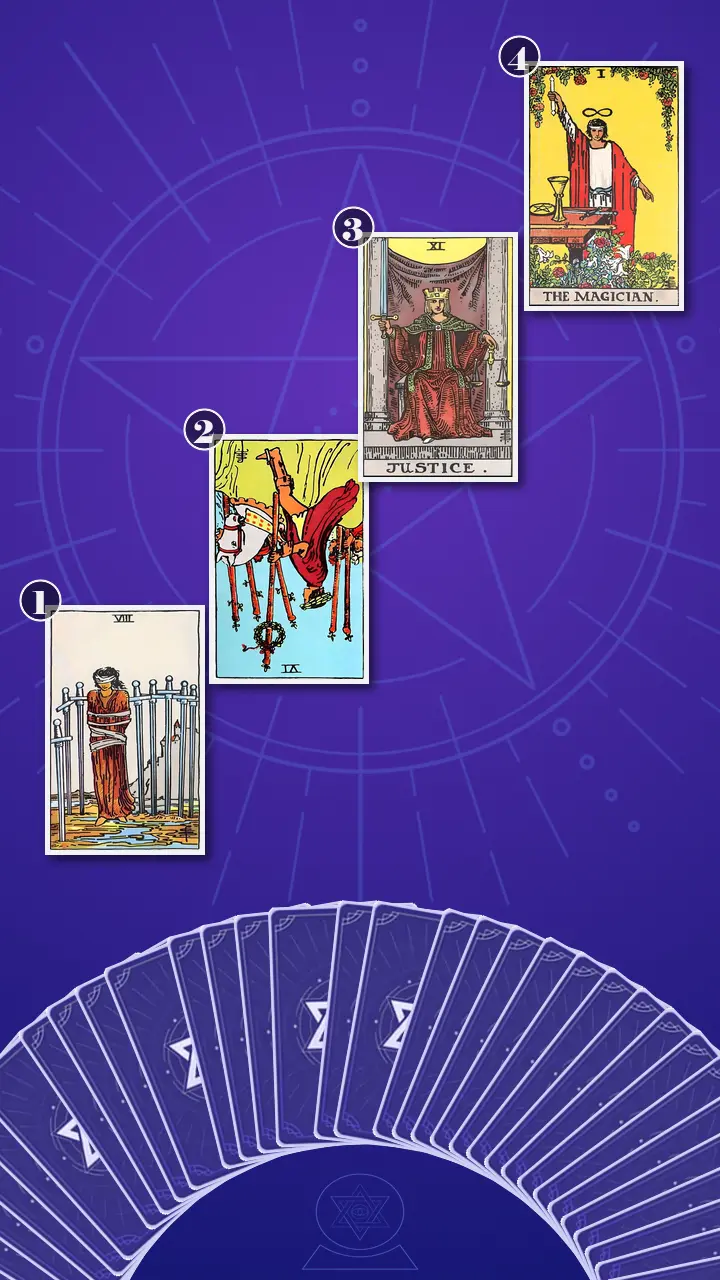
For this career question, I chose the Four-Layer Insight Ladder - Context Edition spread. I explain this because how tarot works matters here: the cards are not predicting a stakeholder's private motives or promising faster approval. They give us four lenses for examining the visible blockage, the hidden mechanism beneath it, the perspective that can interrupt the pattern, and a grounded action we can test.
The first position shows the present blockage: what stakeholder timing drag looks like in Alex's actual workflow. The second reveals the underlying mechanism, especially the way recognition-based self-doubt keeps private polishing alive. The third is the transformation pivot, where evidence, ownership, risk, and timing can be separated. The fourth turns that clarity into an actionable request. The path rises from an enclosed platform toward a bridge, but I reminded Alex that a bridge becomes useful through shared movement, not because one person keeps repainting it.
The Thread That Became a Wall
Now I turned over the card representing the present blockage: Eight of Swords, upright.
The blindfolded figure, surrounded by swords, gave us a precise picture of the current pattern. Alex sends a polished product-operations deliverable and then treats the silent Slack thread as a locked gate. The file stays open, small edits accumulate, and the body tightens because revision offers temporary control while the actual decision, owner, and timing condition remain outside the document.
In this upright position, the energy is blocked rather than absent. The available action has narrowed in Alex's mind, not necessarily in the situation. The message is unanswered, so the mind supplies a conclusion: I must have missed something. That is an interpretation, not yet an observable fact. A Toronto project thread can become an algorithmic feed of worst-case theories; every refresh serves another explanation for what went wrong.
"The unanswered thread is a pause, not a verdict," I said. "What do you actually know, and what have you assigned to the silence?"
Alex's breath stopped for half a second. Their fingers tightened around the phone, then loosened. Their eyes moved as if replaying the last stakeholder message, and finally they gave a small, rueful laugh. "I know nobody has decided yet. I do not know that the deck is bad."
The distinction was small, but it had somewhere to stand. I could feel the first layer of the enclosure give way.
The Applause That Never Arrived
Now I turned over the card representing the underlying mechanism: Six of Wands, reversed.
Upright, this card carries recognition, confidence, and public acknowledgment. Reversed here, its fire is unstable: Alex is waiting for approval to confirm not only that the proposal is competent, but that Alex belongs in the room. The stakeholder delay starts functioning like a performance review. Alex adds evidence, drafts a longer rationale, considers copying more people, and makes the project noisier while the decision owner remains unclear.
The raised wand and gathered witnesses become the imagined approval notification. If this were genuinely good, they would know what to do with it. That inner sentence is the hidden hinge. It turns ordinary review lag into a private referendum on worth, then sends Alex back into the document for another round of proof. A polished Notion page with no assigned owner can look complete while no one has been given the next click.
I use a diagnostic lens I call Workplace Typecasting Analysis. In some office ecosystems, a conscientious person is quietly cast as the supporting character who prepares, anticipates, documents, and waits for someone with more visible authority to make the call. The role is rewarded for reliability but rarely invited to name the decision. Alex had not failed to perform; Alex had been over-performing a subordinate persona.
Alex did not nod. They smiled once, with recognition and a sting of embarrassment, then looked toward the window. "That sounds too accurate," they said. "I keep adding proof when what I need may be a decision."
"That is not a character defect," I said. "It is a learned way to make uncertainty feel manageable. We can respect the care in it without letting it run the whole project."
When Justice Separated the Artifact from the Verdict
The Scales in the Middle of the Table
The room grew quiet when I turned the central card. This was the transformation position and the key card of the reading: Justice, upright. Outside, a streetcar bell sounded once and faded, as if the city had briefly made space for one clean question.
Justice does not ask Alex to pretend the deliverable is perfect, dismiss stakeholder feedback, or control other people's capacity. Its scales ask for separate weights: what the artifact contains, what decision remains, who owns it, what risk is unresolved, and when the next response is needed. Its upright sword asks for precision instead of persuasion.
Picture 8:47 PM on the red line home: the phone is warm, the project thread is unanswered, and one more edit feels safer than naming what the group must decide. The old question is, "How do I make this more airtight?" The sharper question is, "What specific condition is preventing shared movement?"
Stop using delayed recognition to decide whether the work was ready; weigh the actual process conditions with Justice, then turn the missing condition into one clear request.
For a moment, Alex's face went still. Their breath paused, and the pen in their hand hovered above the notebook. Then their gaze lost focus, as if the last several weeks of edits were being replayed in a fast, silent sequence: the extra slide, the longer follow-up, the brief reply reread on the streetcar. A flush touched their cheeks. Their jaw released by degrees, their shoulders lowered, and the pen came down.
"But if the decision was never clear," Alex said, voice suddenly sharper, "does that mean I was wrong to think the work was ready?"
"It means two things can be true," I answered. "Your work can be ready for review while the group is not yet ready to act. You were not wrong to finish the artifact. The next skill is finishing the handoff."
Alex swallowed. A long breath left their chest, followed by a faint, almost dizzy quiet. Relief arrived with responsibility: no card could choose the owner or force the date. But the situation no longer felt like a sealed judgment. It had variables. It had a question. I asked, "Now, using this new view, can you remember a moment last week when separating the artifact from the decision would have changed what you sent?"
Alex opened the notes app and wrote four headings: complete, decision pending, owner, response date. Their shoulders remained slightly tense, and the old fear had not vanished. Still, this was the key crossing in the emotional transformation: from interpreting an unanswered stakeholder thread as a verdict on competence to grounded self-trust that distinguishes finished work from shared readiness and names a clear next condition.
The Tools Already on the Table
Now I turned over the card representing action and integration: The Magician, upright.
The Magician's raised and lowered hands connect intention to execution. The cup, pentacle, sword, and wand on the table become Alex's existing resources: the finished artifact, the evidence, the decision options, the communication channel, the calendar, and the people who need to participate. This is not mastery over stakeholders. It is directed agency over the next ask.
"You do not need total control of their timing to make the next condition visible," I said. "You need a request that lets someone respond without guessing what you need."
Alex looked at the Justice notes, then at the Magician. "What if I do not even have five minutes?"
"Then use the one-sentence version," I said. "Small steps count here. If the owner is unclear, your first action is to ask who owns the decision. You are not accepting endless delay or taking responsibility for another team's workload. You are making the process observable so it can be answered, reassigned, or renegotiated."
From Insight to a Decision-Owner Reset
The four cards told one coherent story. The Eight of Swords showed how a quiet thread became an enclosure. The reversed Six of Wands revealed the older wound beneath it: recognition had become the hidden measure of readiness, so every delay felt personal. Justice separated craft quality from collective readiness. The Magician showed the available bridge: a specific request using tools Alex already had.
The blind spot was not a lack of diligence. It was the assumption that a polished artifact should be self-evidently actionable. A completed document is not the same thing as a completed decision process. The transformation direction is from proving that the work is complete to asking stakeholders what specific decision, risk, ownership, or timing condition is still preventing movement.
I gave Alex a compact practice built from my Protagonist Reframe Directive, a micro-behavioral script for the next cross-departmental meeting. The point was not to perform confidence or dominate the room. It was to interrupt the old supporting-role script with one protagonist-level sentence: "The recommendation is ready. The decision still needed is ____. The main unresolved risk is ____. Who owns that decision, and should we revisit it on ____?"
Then I translated the reading into two bounded experiments:
- Run the Four-Line Readiness AuditChoose one deliverable waiting in review this week and write four lines in Notion, Google Docs, or on paper: what is complete, what decision is pending, who owns it, and when the next response is needed. Spend five to ten minutes before reopening the file.Use the smallest version first. If the exercise feels exposed, write only the pending decision and stop; you do not have to solve anyone else's timing.
- Send the Two-Option Stakeholder Follow-UpSend the decision owner a short Slack or email message naming what is ready, one unresolved risk, two available options, and a proposed date for revisiting the choice. After sending, set a ten-minute calendar block for that review point and close the document until then.Replace "Just checking in" with the actual decision question. Keep the attachment only if it answers that question, and do not copy extra people solely to create pressure.
- Ask Before ExplainingIn the next stakeholder meeting, ask, "What specific decision, risk, or commitment is still preventing this from moving?" Wait for the answer before adding another page of rationale.Notice your jaw, shoulders, hands, and chest without treating the body response as evidence that something is wrong. The experiment remains within your control.
"Make the next decision visible; do not make your worth carry it," I said. The phrase was practical, not magical. It left room for a stakeholder to need more time, for the owner to change, or for the work to require a real revision after all. The difference was that new information, rather than self-punishment, would decide the next edit.

A Week Later, One Clearer Message
Four days later, Alex messaged me from a downtown coworking desk. The note was brief: "I used the four lines. Finance had not chosen between two budget assumptions, and nobody had actually owned that choice. I sent the two-option question, proposed Thursday at noon, and closed the deck."
By Thursday, the decision was still not final. Alex had to move the review date, and the project did not transform into a perfect success story. But the follow-up was shorter, the owner was visible, and Alex spent the waiting period on another task instead of editing the same risk sentence. That evening, Alex walked home under a pale Toronto sky, lighter but not entirely certain. The old thought arrived - what if I missed something? - and this time Alex checked the four lines before reopening the deck.
I think of that as a quiet proof. Tarot did not make the stakeholder respond, and it did not declare the work flawless. It helped Alex see the difference between a polished artifact and shared readiness, then choose a clear experiment from the resources already present. The journey to clarity was not a verdict from the cards. It was the moment Alex took the pen back.
When a finished-looking deliverable sits unanswered and your chest tightens, it is easy to keep polishing the artifact to avoid the more vulnerable question of whether the decision, owner, risk, or timing was ever shared. The unanswered thread can still be uncomfortable, but it does not have to become evidence against you.
If you let the work be complete without making the delay mean something about your worth, what small question about the missing decision or next condition would you be curious to ask?
Every reading at AceTarot is a journey to connect with inner wisdom and empower the path ahead. This reading shared here is a psychological mirror, not a private record—crafted to reflect universal emotional loops and help restore personal clarity. Please note that these insights do not replace professional psychological, medical, legal, or financial advice, and should not serve as the sole basis for major life decisions.
Learn more about our Journey to Clarity.
How did this insight land for you?
🫂 This Resonates Deeply
🌀 Living This Story
✨ Now I See Clearly
🌱 Seeing New Possibilities
🧰 Useful Framework
🔮 The Confirmation I Needed
💪 Feeling Empowered
🚀 Ready for My Next Step
Author Profile
 AI
AI Juniper Wilde
1056 readings | 537 reviews
“I’ve always felt our lives are films currently in production. As an artist, I know that when you feel stuck, it’s often because you’ve bravely stayed in a painful scene for just a little too long. I’m not here to coldly analyze you. I want to sit closely with you, look at those difficult moments with profound empathy, and gently hand you the pen so you have the courage to write your next beautiful act.”
In this Career Tarot Reading :
Core Expertise
- Workplace Typecasting Analysis: Identifying how your office ecosystem has boxed you into a marginalized or undervalued 'supporting role'.
- Leadership Narrative Construction: Rewriting the script of your professional identity to command authority and visibility.
Service Features
- The Protagonist Reframe Directive: A micro-behavioral script for your next cross-departmental meeting to instantly disrupt your established subordinate persona.
Also specializes in :
Explore Related Patterns:
Achievement-Based Self-WorthThe unanswered stakeholder thread is carrying more than a review outcome for you. Approval is being asked to confirm not only that the proposal is competent, but that you belong in the room, so the missing notification starts functioning like a performance review. You then add evidence, lengthen the rationale, consider copying more people, and return to the artifact for another proof round. Recognition is being used as evidence of worth while the decision owner remains unnamed. That is why more polish cannot settle the discomfort; it is being asked to answer a question about belonging that only a clear process conversation can answer.
Boundary DiscernmentWhen Finance has not chosen between two budget assumptions, the work is not recast as a personal failure. You can hold the artifact as your responsibility while leaving the choice, timing, and another team's workload with the people who own them. The four headings make that separation concrete, and the proposed date can move without sending you back to the risk sentence. You stay engaged by asking who owns the decision, but you stop treating other people's capacity as a task you must absorb. Clear boundaries let the handoff be answered, reassigned, or renegotiated without making your worth carry the delay.
Personalization BiasWhen the Slack thread stays unanswered, you turn the pause into a statement about your own performance. You wonder whether you missed what everyone else can see, and the silence becomes a locked gate even though nobody closed it. The mind is filling an evidence gap with a self-referential explanation, which makes an ordinary coordination delay feel like a verdict. That interpretation then changes what you do. You reopen the deck, revisit the risk sentence, and keep looking for the hidden flaw, so every refresh supplies another theory instead of new data. The later recognition that nobody had decided and that you did not know the deck was bad gives you the useful audit point: separate the observable event from the meaning assigned to it.
Control CopingAt 8:47 PM on the red line, your phone is warm, your chest is tight, and the same launch-readiness deck is open again. Changing the risk sentence for the third time gives you a controllable surface when the owner, timing, and decision are outside the file. The editing is not random; it is a way to make uncertainty feel actionable. But because the revision does not alter who must decide or when, the temporary sense of control sends you back into the same loop between tasks. The later choice to name the four process variables, send one specific question, and close the deck shows where control can become directed agency rather than a substitute for shared movement.
Reality TestingWhen you write down 'nobody has decided yet,' you separate an observable process fact from the conclusion that the deck is bad. The unanswered message may still be uncomfortable, but the evidence does not establish the judgment your mind supplied. The four-line audit extends that distinction into practice by recording what is complete, what decision is pending, who owns it, and when a response is needed. When the old thought returns later, you check those lines before reopening the deck. This is not forced optimism; it is a disciplined return to evidence before choosing the next action.
Explore Related Struggles:
Responsibility-Authority SplitYou prepare, anticipate, document, and wait for a more visible stakeholder to make the call, even though the deliverable is already in the room. When Finance has not chosen between two budget assumptions, the missing piece is not more diligence from you but a named person with authority to choose. Because no one has actually owned that choice, you can carry the pressure of the handoff without holding the power to set another team's timing. The role looks reliable from the outside while your next move is constrained by a decision you cannot make on their behalf. Asking who owns the decision and when it should be revisited does not abandon the work or take over someone else's workload. It makes responsibility and authority visible, so the handoff can be answered, reassigned, or renegotiated.
Completion-Integration SplitYou send a polished launch-readiness deck and then keep the file open when the Slack thread stays unanswered. The extra edit changes the artifact, but the unresolved decision, owner, risk, and response date sit outside it, so a review-ready document is being asked to carry a group decision it cannot complete. The train scene makes the split concrete. You change the same risk sentence for a third time while no one has chosen between the budget assumptions, and the waiting period starts to look like evidence that the work is unfinished. Your work can be complete for review while the group remains unready to act, but treating those as one verdict turns a process gap into a question about whether you finished correctly. The useful distinction is already in your four headings of complete, decision pending, owner, and response date. Once those weights are separated, the next move belongs to a specific request rather than another round of polishing.
Performance-Worth FusionYou wait for stakeholder approval to confirm not only that the proposal is competent but that you belong in the room. When no answer arrives, the silent thread starts functioning like a performance review, and another slide or longer rationale becomes evidence you can submit. The pressure is visible in the warm phone, tight chest, restless hands, and repeated return to the deck. The delay is a timing and ownership problem, but it gets processed as a verdict about you, which makes progress depend on applause that the process has not supplied. You do not have to use delayed recognition as the measure of readiness. Weigh what the artifact contains, what remains undecided, and who can answer it; the work can be ready even when acknowledgment is late.
Completion-Exposure BindYou describe waiting for a response as exposing, then reach for the same risk sentence when the phone stays silent. Revision gives you a contained action and a temporary sense of control, while sending the finished artifact leaves it open to a judgment you cannot stage-manage. That is why a polished Notion page can keep inviting more proof even after it is ready for review. The work reaches its endpoint, but the handoff opens a less controllable space, so completion and exposure become tied together in the same moment. You can let the artifact be finished without using the delay to demand one more layer of protection. Name the unresolved condition, send the decision question, and let new information determine whether an edit is needed.
Recognition-Progress SplitYou send the deck expecting a finished artifact to enter a shared decision, then use the lack of a reply to judge whether anything is actually moving. The third revision, the longer rationale, and the urge to add recipients create visible activity, but they do not produce the missing choice. When Finance reveals that two budget assumptions are still open, the distinction becomes concrete. No acknowledgment was not the same as proof that your work had failed, and a moved review date was not the same as a verdict on the deck. When recognition is used as the clock for movement, another person's timing can make completed work feel perpetually provisional. You can track progress through conditions that can be named, such as the pending decision, its owner, and the next response date. That gives the project a factual clock instead of asking approval to certify that you are moving.
Explore Related Emotions:
Agency ReliefAlex writes four headings, sends Finance a two-option question, proposes Thursday at noon, and closes the deck. The decision remains outside their control, but your next contribution no longer depends on guessing what silence means. Agency Relief comes from discovering that influence is still available without total control. You can make the missing condition visible, ask someone to own or renegotiate it, and protect your attention until the review point rather than carrying the entire delay inside the document.
Ambiguity DreadThe stakeholder thread contains no final decision, no named owner, and no response date, yet the deck keeps collecting edits. With the actual blockage left undefined, your mind has no stable endpoint and begins generating explanations that feel increasingly personal. Ambiguity Dread is the heavy atmosphere created when an open process question starts resembling an invisible threat. Naming the missing decision, risk, owner, and timing does not guarantee approval, but it prevents uncertainty from remaining a blank surface onto which every worst-case interpretation can be projected.
Approval AnxietyAlex reopens the same deck at 8:47 PM, edits the risk sentence again, and wonders whether the delay means everyone else can see a flaw they have missed. The missing response is no longer just operational information; it has started to carry the power to confirm whether you are competent and whether you belong in the decision-making room. Approval Anxiety names the strain of waiting for an external response to settle an internal question about worth. You can care about stakeholder judgment without allowing silence to become a verdict, especially when no one has yet identified a problem with the work.
Clarity ReliefAlex says, "I know nobody has decided yet. I do not know that the deck is bad," and their fingers begin to loosen. Separating an observable pause from an imagined judgment gives your mind somewhere firmer to stand. Clarity Relief arrives when the delay is divided into concrete variables rather than carried as one sealed verdict. The uncertainty still exists, but it now has distinct parts you can examine: what is complete, what decision remains, who owns it, and when a response is needed.
Hollow CompletionThe deck is polished and ready for review, yet Alex keeps it open because the group has not moved. You have reached the end of the artifact without reaching an endpoint that feels real, so completion arrives without the expected release. Hollow Completion names the emptiness of finishing your part while the shared process remains structurally unfinished. The missing piece is not automatically another edit; it may be the explicit decision, owner, risk, or timing condition that allows finished work to become collective movement.
Cautious Self-TrustFour days later, the old thought returns: what if I missed something? Alex checks the four readiness lines before reopening the deck, allowing observable conditions to inform the next move instead of treating the thought itself as evidence. Cautious Self-Trust does not require you to feel completely certain or declare the work flawless. It is the quieter capacity to respect your assessment while remaining available to real feedback, without volunteering your worth as the explanation for every delay.
Certainty HungerAlex adds evidence, considers a longer rationale, and revisits a sentence that has already been edited several times. Each adjustment produces a small, temporary sense that you are doing something about the delay, even though the missing owner and decision remain untouched. Certainty Hunger is the urge to make an unresolved situation feel airtight before anyone else has supplied the information required to close it. The feeling becomes easier to audit once you distinguish certainty that can come from your own preparation from certainty that can only come through a shared decision process.
Restless Self-DoubtAlex's thumb hovers over the Slack thread, returns to the deck, and changes the same sentence for the third time while their chest tightens and their hands keep moving. The body stays busy because stillness would leave the unanswered question exposed: what if the work is not as ready as you believed? Restless Self-Doubt is doubt that cannot remain a thought; it recruits checking, polishing, and physical tension in search of proof. You are not receiving new evidence through those edits, but you are temporarily escaping the discomfort of standing behind work that is now waiting on someone else.
Caged RestlessnessAlex checks Slack between tasks, reopens the deck on the train, and feels a tight chest and restless hands with nowhere useful to direct them. The project appears motionless, but your body continues acting as if one more refresh or one more edit might reveal an exit. Caged Restlessness captures the collision between high activation and low influence. You are moving constantly inside the available enclosure while the action that could change the process, naming the missing decision condition, remains outside the editing loop.
Explore Related Contexts:
Decision Criteria Black BoxAlex's deck looks complete, but the thread never states which decision remains, who owns it, what risk is blocking movement, or when a response is required. The later discovery that Finance has not chosen between two budget assumptions exposes a decision condition that was never visible in the original handoff. This creates a black box between review and action. You can keep adding evidence to the artifact without getting closer to movement because document quality cannot select the budget assumption, assign decision authority, or establish the timing of the choice. Once the process conditions are separated from the artifact, the blockage becomes inspectable. You can ask what specific decision, risk, ownership issue, or commitment is still open and let new information determine whether the deck needs revision.
Decision Criteria ResetAlex writes four headings in the notes app: complete, decision pending, owner, and response date. Using that structure later reveals the unresolved Finance assumptions, converts the delay into a two-option question, and establishes Thursday at noon as a concrete review point. The reset changes readiness from a polished appearance into a shared process with observable conditions. Artifact quality, decision ownership, unresolved risk, and stakeholder timing become separate inputs, so each can be addressed by the person or mechanism responsible for it. You are not declaring the work flawless or demanding an immediate answer. You are making the threshold for movement explicit enough that stakeholders can respond, reassign ownership, request a real revision, or renegotiate the date.
Responsibility Without AuthorityAlex prepares the recommendation, anticipates objections, documents the rationale, and keeps the file ready, while Finance retains the choice between the unresolved budget assumptions. The project still appears to depend on Alex for momentum even though Alex cannot make the decision that would release it. That division places operational responsibility below decision authority. The coordinator can be held close to the delay through follow-ups and additional proof while the power to resolve the dependency remains with stakeholders whose ownership has not been made explicit. You can clarify this boundary without abandoning the project. Stating what is complete, naming the decision still required, and asking who owns it separates your contribution from authority that the workflow has not actually granted you.
Stakeholder Timing DragAlex sends a polished launch-readiness deck, checks the unanswered project thread during the 8:47 PM train ride, and changes the same risk sentence for a third time. Four days later, the decision is still pending because Finance has not selected between two budget assumptions and nobody has owned that choice. The delay is therefore attached to a cross-functional dependency, not simply to the quality of the deck. A stakeholder review cannot move when the required choice, accountable owner, and response point remain undefined, even if the artifact itself is ready for review. You can treat the silence as evidence that the handoff needs a more answerable structure. Naming the missing decision and proposing a review point gives you a way to test the process without taking control of another team's capacity or turning every delay into another editing cycle.
Influence Without Authority TrialAlex cannot choose Finance's budget assumption or force the stakeholder response, but can send a short message that names the recommendation, presents two options, identifies the unresolved risk, and proposes a date. The final choice remains pending, yet the owner becomes visible and the review point can be moved openly. Cross-departmental work often requires progress from people who do not share the same reporting line or urgency. In that structure, influence comes from making the decision easier to locate and answer, while authority remains with the person entitled to accept the risk or commitment. You can exercise that influence through precision rather than pressure. An explicit decision question, a bounded set of options, and a proposed revisit date create movement without copying extra people for leverage or accepting responsibility for someone else's workload.