A Finished Proposal, Three Open Chats, and a First Checkpoint

Finding Clarity at 10:40 p.m.
“You know what you think until someone sounds more certain.” That was the first thing Maya said when she joined my video call from her Toronto apartment. She was 27, a junior product designer, and a finished Figma proposal glowed on the laptop behind her. Three group chats were tiled beside it. The radiator ticked, yesterday's coffee sat cold near her wrist, and the phone in her hand had gone warm from constant refreshing.
“The proposal is technically ready,” she said. “But I keep waiting for someone to make it feel safe. Why do I need approval before I can trust my own direction?” Her cursor hovered over Submit while her chest remained lifted around a held breath. I could almost see the self-doubt under her ribs: a blinking password field that seemed to require somebody else's confidence before it would unlock.
I told her I was not going to use tarot to issue that password. I would not tell her that the cards knew the correct career move, or that she should ignore useful advice and simply trust her gut. “I want us to examine the sequence,” I said. “Where does your own judgment disappear, and what takes its place? Our Journey to Clarity is about mapping that process so you can decide what happens next.”
Choosing the Ladder Through the Noise
I invited Maya to put her phone face down, rest both feet on the floor, and take one unforced breath. I shuffled while she held the question in mind. I use this kind of preparation as a psychological transition: it gives the attention somewhere deliberate to land. It is not a test of belief and it does not make the reading more supernatural.
I chose the Four-Layer Insight Ladder, a focused four-card tarot spread for self-trust and external validation. I use it when the real question is not which external path fate has selected, but which inner mechanism keeps turning a workable direction into decision fatigue. A larger spread could have introduced predictions and environmental detail that Maya did not need. This one would move directly from visible behaviour to root belief, transforming resource, and practical integration.
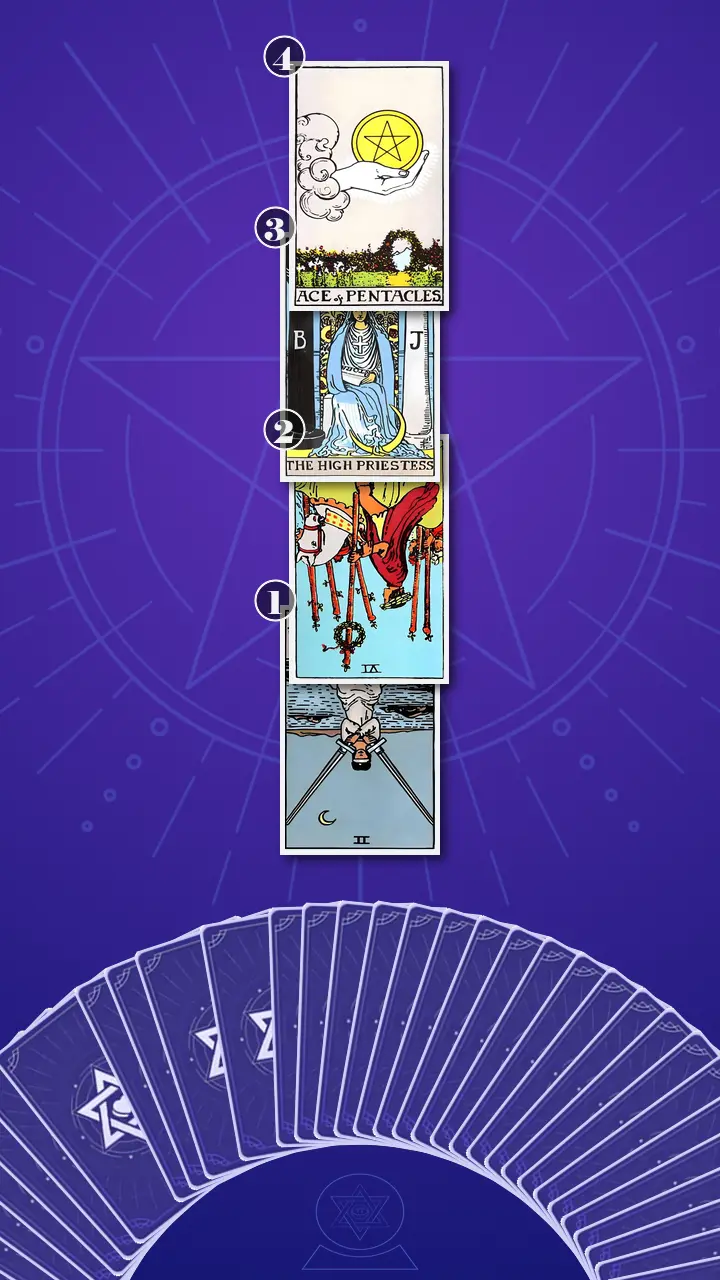
I arranged the cards in a vertical column like four rungs. The bottom position would show the visible approval-seeking behaviour: the requests for confirmation, the revisions after every reaction, and the delay when reassurance did not arrive. Above it, the root position would identify the fear maintaining that behaviour. The third card would reveal the perspective capable of changing the sequence. The top card would translate that perspective into one low-stakes action. That is how tarot works in my practice: the positions create an analytical structure, while the card meanings in context help us notice patterns that ordinary overthinking has blurred.
“Nothing here will dictate a decision,” I told her. “The cards are a map of the terrain. You are still the person walking through it.”
Reading the Open Tabs
Position One: The Figma File in Endless Review
I began with the card representing Maya's visible approval-seeking behaviour: repeatedly requesting confirmation, revising choices around other people's reactions, and postponing action when reassurance was unavailable. I turned it over. It was the Two of Swords, reversed.
I pointed to the blindfolded figure and the two swords crossed defensively over the chest. Behind the figure, rocky water interrupted an otherwise still horizon. Upright, the card can hold a deliberate pause between competing judgments. Reversed here, its Air energy had moved into excess and blockage. Maya was not lacking information. She was accumulating so much information that no single choice was permitted to become real.
Looking at those crossed swords, I thought less about a medieval stalemate than about a Figma file trapped in endless review mode. Maya already had a workable answer on her screen, but every open chat created another acceptance criterion. Her internal script sounded like this: I know enough to submit, but before I do, let me check one more person, one more typing bubble, one more confident opinion. Each reply appeared to promise clarity while providing another reason to hold the finished decision motionless.
“You are saying you want clarity,” I told her, “but the repeated checking is trying to buy protection from criticism. Those are different goals. More comments might improve the proposal, but no number of comments can guarantee that choosing will feel risk-free.”
Maya gave a short laugh that carried more sting than humour. Her thumb stopped rubbing the edge of her phone, and she looked away from the card. “That's so accurate it's kind of brutal,” she said. “I call it collaboration, but sometimes I've already done the research. I'm just waiting for someone to make pressing Submit feel less exposing.”
I slowed down there. “Accurate does not have to mean condemning,” I said. “This is an observable protection strategy, not a personality defect. It gives you short-term relief from uncertainty. The cost is that your first answer becomes harder to hear every time the choice is reopened.”
I asked her which low-stakes decision already contained enough information for a reversible test. She glanced at the proposal behind her. Her answer was immediate, which told me the decision itself was not as hidden as the approval loop had made it seem.
Position Two: When the Crowd Becomes a Scorecard
I moved to the card representing the maintaining belief and underlying fear: the belief that personal direction was unsafe or invalid unless recognition protected Maya from the possibility of being wrong. The card was the Six of Wands, reversed.
The traditional image shows a rider wearing a laurel wreath, holding another wreath aloft while a crowd gathers around him. In Maya's life, I translated that crowd into a hybrid meeting grid, a Slack channel, and a LinkedIn feed. The laurel became an enthusiastic manager comment. The raised staff became a row of emoji reactions. Public recognition had started functioning as a live performance dashboard for private worth.
The reversed Fire in this position showed a deficit of self-authorised expression and an excess of energy spent monitoring reception. Maya had described presenting researched recommendations as “Maybe we could possibly try...” while watching for a senior colleague to supply firmer language. If someone responded warmly, her shoulders dropped. If the Slack thread stayed quiet, the old operating system generated two rapid conclusions: If they were impressed, I would know by now. If they are quiet, I must have missed something.
“Silence is missing data, not automatic disapproval,” I said. “A neutral response may still require follow-up, but it is not a secret verdict on your competence.”
I used one of my diagnostic lenses, Limiting Belief Deconstruction, to lay the mechanism out without moralising it. First came the trigger: a decision became visible and another person did not immediately confirm it. Then came the belief: If I move without approval and it fails, people will discover I was never as capable as they thought. Next came the protective behaviour: poll several people, soften the recommendation, and polish until praise seemed more likely. The relief arrived quickly when somebody agreed. The long-term cost arrived quietly: fewer self-directed experiments, less firsthand evidence, and a growing belief that independent judgment could not be trusted.
Traveling across cultures has taught me how many different forms approval can take, but I have also learned that the wish to be understood can quietly turn into a search for a verdict. Maya did deserve thoughtful feedback. What she did not need was to make universal agreement the price of beginning.
Her shoulders rose as I described the loop, then held there. Her gaze shifted from the card to the dark laptop screen beside her, as though she were replaying a team review. After several seconds, her jaw loosened. “In a meeting last week, my manager asked what I recommended,” she said. “I thought she was testing me. Maybe she was actually asking me to lead.”
“Possibly,” I said. “We do not have to invent a positive meaning for her question. We only have to stop treating your most fearful interpretation as confirmed evidence.”
The distinction between the first two cards was now clear. The Two of Swords reversed showed the delay. The Six of Wands reversed showed why delay felt protective. The problem was not that Maya sought feedback; it was that feedback had been given permission's job.
When the High Priestess Closed the Group Chat
Position Three: A Private First Checkpoint
I turned over the card representing the key transformation: recovering private discernment and allowing Maya's personal criteria to exist before outside opinions entered the decision. At that moment, the radiator clicked off. The room on my screen became noticeably quieter, and the notification light on her face-down phone faded. The card was The High Priestess, upright.
I showed her the seated figure between the black and white pillars. The High Priestess does not destroy either side or pretend ambiguity has vanished. She remains between them, holding a partly concealed scroll in her lap. In a Jungian reading, I see her as the Inner Knower: the part of the psyche capable of receiving complexity, naming a private value, and allowing judgment to form before displaying it to an audience.
This was balanced, Water-like energy entering a spread that had been crowded by overactive Air and recognition-hungry Fire. The card did not tell Maya that intuition was always correct. It showed her a pause that was neither avoidance nor surrender. In modern life, it looked like closing Slack, putting the phone face down, and writing one honest recommendation at a quiet kitchen table before imagining how a manager or friend might respond.
I asked Maya to picture the proposal at 10:40 p.m. The work was finished, but three chats remained open beside it. Every reply changed the paragraph, while silence tightened her chest. The missing element was not another design opinion. It was permission to believe the person who had already done the research.
Self-trust does not require you to ignore feedback. It asks you to let your own criteria speak before feedback enters the room.
I let the sentence settle. Then I introduced Imposter Syndrome Decoding, the lens I use to separate authentic potential from the fear of being found out. I drew an imaginary line between two channels. On one side was Maya's signal: user research, product constraints, her design rationale, and a genuine preference for the clearer flow. On the other was the exposure alarm: If they question this, they will realise I do not belong here.
“Your alarm is behaving like an algorithm trained only on applause,” I said. “Praise is classified as safety. Silence is classified as failure. A confident disagreement is classified as proof that the other person has better data, even when they do not. The High Priestess does not delete the alarm. She stops letting its prediction masquerade as product evidence.”
I thought of the stations and border halls I had passed through while traveling across cultures: different languages, different signs, the same need to decide which direction to take. A compass becomes useful only when the traveler accepts that she is the one holding it. Maya had been holding her personal compass beside a crowd and waiting for everyone to confirm where its needle pointed.
I placed my finger between the two pillars on the card.
Approval is not proof that your direction is valid; name your own criteria first, then take the High Priestess's seat between the pillars and listen before opening the room to other voices.
At first Maya did not exhale. Her fingers froze half-curled above the face-down phone, and her eyes widened as if the sentence had interrupted a familiar reflex in real time. Then her focus drifted past me toward the proposal, and I watched her silently replay a sequence of meetings, screenshots, softened recommendations, and deleted first answers. Her eyebrows pulled together. Colour rose along her cheeks. “But doesn't that mean I've been doing this wrong the whole time?” she asked, sharper than before. The anger lasted only a moment before her voice thinned. “I've wasted so much time.” Her hand closed into a fist, loosened one finger at a time, and finally rested flat on the desk. A long breath left her chest. Her shoulders dropped, but the release carried a slight disorientation, as though putting down a heavy bag had revealed that she was now responsible for choosing where to walk. Her eyes shone without spilling over. “I can hear how quiet it would be,” she said. “Not peaceful, exactly. Just mine.”
“I would not call your earlier choices wrong,” I said. “You built a strategy that helped you manage the real social risk of being evaluated. We are noticing that the strategy now runs even when a choice is reversible and you already have relevant evidence. You do not owe your past self a prosecution. You can give your present self a better sequence.”
I leaned a little closer to the camera. “Now, using this new perspective, can you think of a moment last week when this insight might have made you feel different?”
Maya returned to the design review. Before the meeting, she had written that option B reduced user friction and fit the sprint. Then a senior colleague had asked one confident-sounding question, and she had abandoned the recommendation before the team discussed her evidence. “If my criteria had gone first,” she said, “I could have answered the question without treating it like a veto.”
“Exactly. You do not have to choose between listening to yourself and listening to other people. The sequence is the issue. Your criteria get the first checkpoint. Other people's views enter as information after that.”
I named the shift plainly. This was not instant certainty. It was one step from contracted, approval-dependent self-doubt toward grounded confidence built through private discernment and firsthand evidence. Maya was not being asked to become immune to discomfort. She was learning that discomfort could be present without automatically becoming decision authority.
The Garden Path Beyond the Verdict
Position Four: One Choice That Can Teach You Something
I turned over the final card, representing the integration step: making one low-stakes choice, acting within a defined time, and using firsthand evidence to refine rather than invalidate Maya's judgment. It was the Ace of Pentacles, upright.
A hand emerges from a cloud holding a single pentacle. Beneath it, a flowering garden opens onto a path that passes through an arch toward distant mountains. I followed that path with my finger. The card did not demand that Maya see the entire route. It offered one tangible beginning.
The spread had now reached grounded Earth. This was potential in balance: practical, measurable, and small enough to cultivate. I cautioned Maya that an Ace is not a guarantee of success. The proposal might need revision. An application might receive no response. A class might be useful in one way and disappointing in another. None of those outcomes would prove that independent judgment was a mistake.
“Think of it as shipping a limited beta instead of debating the perfect product in Notion for another month,” I said. “You submit one reversible proposal using criteria you wrote first. Then you review the actual response at a scheduled time. The experiment does not have to prove you are right. It only has to give you real information.”
Maya looked at the laptop again. This time, she did not reach for the phone. “So the point isn't to make a brave decision and never change it,” she said. “It's to make a decision I can learn from before I ask the group chat to tell me who I am.”
“Yes,” I said. “A small test can teach you what consensus cannot.”
I saw her chest rise and fall without catching at the top. The path in the card seemed to continue into the narrow stripe of light behind her laptop, making the environment an understated accomplice to the reading. Nothing about the road had become certain. One next step had simply become visible.
The First Checkpoint Before the Next Review
I gathered the four cards into one coherent account. Maya's feedback-heavy role, Toronto's high living costs, and the polished career announcements on her feeds had made ordinary choices feel more permanent than they were. The Two of Swords reversed showed how she responded by gathering more opinions. The Six of Wands reversed revealed the deeper bargain: recognition would be allowed to create legitimacy and protect her from exposure. The High Priestess restored a private interval in which her own criteria could be heard. The Ace of Pentacles converted that inner answer into one bounded experiment.
The cognitive blind spot was not simply caring too much about opinions. It was treating other people's confidence as evidence and treating silence as a verdict. That distortion kept Maya's compass in public review mode. The transformation direction was equally specific: move from collecting consensus before every choice to writing personal criteria first, requesting only relevant feedback, and building self-trust from real-world tests.
I told Maya that clarity did not require a personality overhaul. It required a repeatable change in sequence. I adapted my Cognitive Reframing Protocol into two next steps that were small enough to begin without performing confidence.
- Run a seven-minute private first checkpoint. Before the next work-from-home design review, close Slack, put the phone on Do Not Disturb, and write: “My current choice is ___ because I care about ___ and ___.” Then add three short lines: the feared outcome, the observable evidence for that fear, and one reversible safeguard. Finish by naming the smallest step you could take this week. Keep the criteria provisional. If seven minutes feels too exposed, write one criterion and stop. Use qualified guidance for urgent safety, legal, medical, contractual, or high-impact financial decisions.
- Create one Evidence, Not Verdict experiment. Choose one proposal, application, class, booking, or direct message that can be revised or cancelled. Take the next visible step by Friday with a ten-minute timer. Add a calendar review point and record what happened, what the result taught you, and what you would adjust before seeking wider input. Keep the test intentionally small. Ask one relevant person one scoped question, such as “What usability risk do you see in this flow?” Then wait until the scheduled review time before rewriting.
“These are not obedience exercises,” I told her. “You can stop, revise, or decide a particular choice needs expert input. The purpose is to let your judgment generate one piece of evidence instead of asking reassurance to generate certainty.”
Maya opened a private Notes file. I watched her type two criteria for the proposal: reduce user friction and fit the current sprint. She hesitated before the second line, looked once at the face-down phone, and kept typing. It was not a dramatic declaration of independence. It was a quieter form of ownership, which made it more credible.

A Week Later: The Quiet Proof
A week later, Maya messaged me: she had posted the recommendation before opening the group chat. Her manager requested one revision. She slept through the night, woke with “What if I got it wrong?”, smiled, and opened her evidence note instead of the chat.
What mattered to me was not that the proposal received a positive or negative verdict. Maya had created a small piece of firsthand evidence: she could state a direction, tolerate a question, revise for a relevant reason, and remain the owner of the decision. The cards had not given her that capacity. They had helped her see where it was being interrupted, and she had chosen to practise it.
I think many of us know the held breath, the tight chest, and the reflex to reach for a warm phone when a choice finally becomes ours. Being disagreed with can feel less frightening than discovering that we trusted ourselves and still got something wrong. If that is where you are tonight, I want you to remember that noticing who gets the first word already changes the sequence.
So I will leave the High Priestess's partly hidden scroll with you: if your own criteria could have the first word without needing the final word, which small, reversible choice would you write there before opening the room to other voices?