Finding Clarity on the 8:47 Line 1 Train
If someone asked for more time after an honest conversation and you have checked iMessage read receipts on the TTC ride home, I know this loop: warmth remains, but no shared timeline appears.
Jordan, a 29-year-old communications coordinator in Toronto, could make a messy work brief sound precise. After work, though, she kept deleting the one relationship question she actually wanted answered.
She described 8:47 p.m. on a Line 1 train: fluorescent lights buzzing above her, the carriage rocking beneath her shoes, and her phone growing warm in her palm as she opened the same thread for the fourth time. She typed a question about where the relationship was going, then erased it before the next stop.
“Why do I keep waiting when we’re never ready at the same time?” she asked me. “I want clarity. I just don’t want clarity if it means losing us.”
I could see the effort in the way she held her shoulders close to her ears. Her longing and uncertainty seemed to sit inside her chest like a train paused in a tunnel: power still running, doors sealed, breath held while everyone waited for an announcement that never came.
She told me affectionate messages still arrived. The connection felt emotionally significant. Yet whenever she tried to discuss a shared timeline, the answer returned to some version of “I care about you, but I need more time.” She kept Friday nights tentative in Google Calendar, studied punctuation as if it were evidence, and watched friends post engagements and new apartments while her own life remained in draft mode.
“I can wait a little longer if it keeps the door open,” she said. Then her eyes dropped to her phone. “But I’m starting to resent the door.”
I told her I was not there to tell her to stay, leave, or treat another person’s hesitation as proof of anything sinister. I would not use tarot to claim access to someone else’s private thoughts. “Let’s use the cards to make a map of what you can observe, what you fear, and what remains yours to choose. We’re looking for clarity, not a verdict.”

Choosing a Relationship Map Without Predicting the Destination
I invited Jordan to place both feet on the floor, take one slow breath, and hold the question without rehearsing an answer. I shuffled as a way of narrowing our attention. The gesture was a psychological threshold, not a performance of certainty.
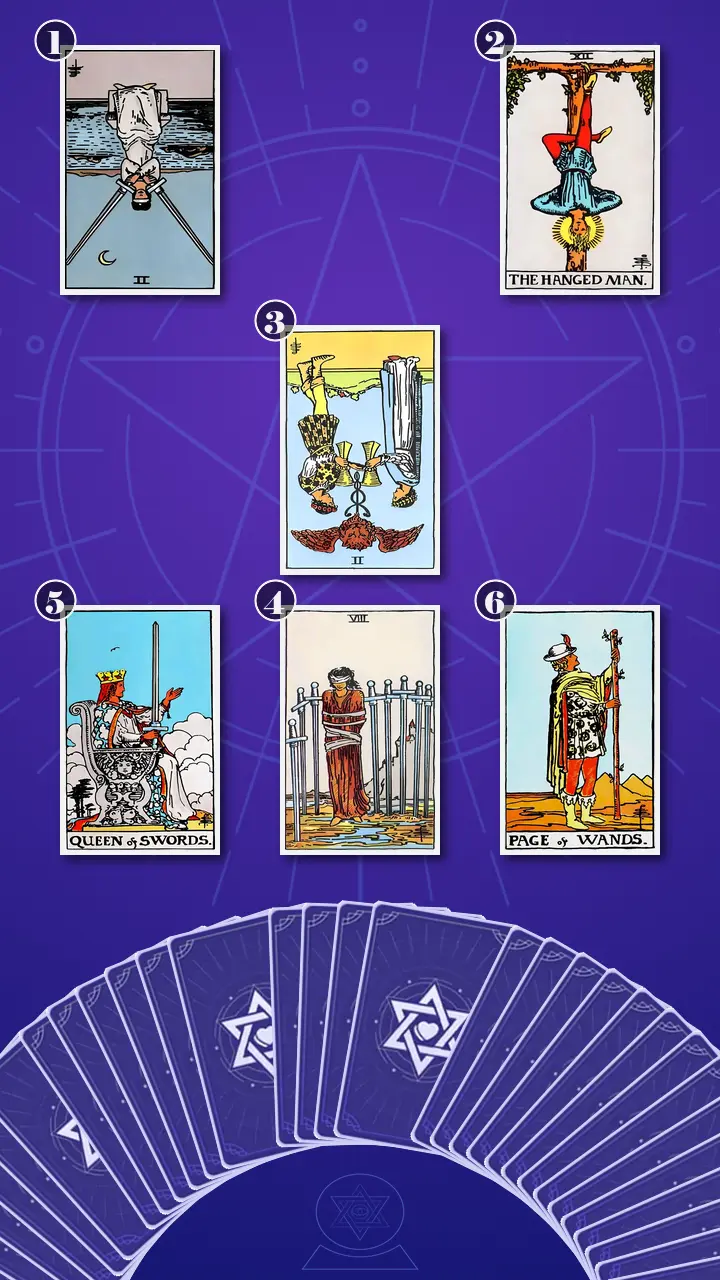
I chose the Relationship Spread · Context Edition, a six-card relationship tarot spread designed for mismatched readiness, relationship limbo, observable signals, boundaries, and a self-directed next step. A broad spread could have scattered our attention across distant possibilities. This one followed the actual mechanics of her question.
This is how tarot works in my practice: the cards provide an external symbolic structure for patterns that are difficult to see while living inside them. Through a Jungian psychological lens, an image can give form to a defended thought, a projected fear, or an unlived choice. The cards do not take authority over the person in front of me. They help us examine card meanings in context, then return authority to that person.
The upper-left position would show Jordan’s present stance toward the timing mismatch. The upper-right position would describe only the other person’s observable readiness signals, not their hidden motives. The central card would reveal the exchange created between those two positions, and the card beneath it would expose the fear maintaining the cycle. The final pair would identify an honest relational resource and one conscious next step.
The layout resembled a bridge: two perspectives at the entrance, pressure concentrated in the middle, and two openings on the far side. Jordan did not need to know where the bridge ultimately led. She needed to know which foot was hers to move.
The Algorithm That Kept Recommending One More Sign
Position 1: The Choice Hidden Behind the Screen
I began with the card representing Jordan’s present stance toward the timing mismatch, showing how she was responding to repeated waiting. I turned over the Two of Swords, reversed.
The blindfolded figure held two swords across her chest while dark water waited behind her. Reversed, the card did not tell me Jordan lacked information. It showed a blockage beginning to surface: she already knew she wanted a direct conversation, but she was protecting herself from the emotional consequence of acting on that knowledge.
In her week, the image became painfully ordinary. It was the same iMessage thread opened after work, the same vague but warm reply, the same clear question drafted and deleted. The blindfold was selective attention. The crossed swords were two rules held against her chest: protect the connection, and protect herself from an answer.
I told her the reversed energy could move in two directions. Continued blockage would keep her monitoring signals while her own position remained undefined. An overcorrection could produce an ultimatum sent in a burst of panic, which would replace prolonged silence with an action taken mainly for immediate relief. Neither extreme represented honest choice.
Her relationship had begun to function like an algorithm trained on uncertainty. Every heart emoji, delayed response, and warm sign-off became another data point, so the algorithm kept recommending more analysis. Yet the answer she needed could not be generated from punctuation because she had not asked the question directly.
“When you open the thread,” I asked, “what are you already ready to say before you start waiting for their next signal?”
Jordan gave a short laugh with a bitter edge. “That’s so accurate it’s kind of brutal.” Her thumb rubbed the side of her phone, stopped, and then pressed flat against the table. “I’m ready to ask what this actually is. I’ve been ready for months.”
Position 2: The Pause That Was Never Put on the Calendar
I turned to the position representing the other person’s observable readiness signals, explored through what Jordan could actually see and hear. The card was The Hanged Man, upright.
The Hanged Man can represent a deliberate pause, surrendered control, and a change of perspective. Upright suspension can be balanced when it is conscious and clearly chosen. Here, however, Jordan had begun treating another person’s request for time as if both people had entered a mutually defined pause.
The modern scene looked like a Google Calendar event marked “tentative” even though no follow-up date had been agreed. Jordan had observed kind messages, delayed planning, and future-oriented phrases such as “maybe soon.” Those were real signals. The promised future she attached to them was an interpretation.
“A pause can be genuine,” I said, “but it is not automatically an agreement, a commitment, or a shared timeline. What have they explicitly said they can offer, and what part of the future are you filling in because the words remain vague?”
I used the card as a restrained form of shadow work. I did not assign a secret motive to the absent person or announce that Jordan’s childhood had predetermined this relationship. Instead, I asked where the blank space had become a projection screen. Jordan recognized that the silence often filled itself with an old fear: if she asked for more than someone could give, she would become too difficult to choose.
Her shoulders rose on the inhale, then lowered only halfway. “So I’ve been calling it our pause,” she said, “but it might just be their pause. I’m the one who built a whole private timeline around it.”
Position 3: Warmth Without a Shared Direction
I opened the card representing the relationship’s current exchange, the repeated pattern produced when the two levels of readiness did not meet. It was the Two of Cups, reversed.
The two figures still held their cups toward each other, but the reversal disrupted the exchange. This was blocked reciprocity, not proof that the connection was false and not a prediction that it was doomed. Affection, late-night vulnerability, and emotional significance could all be real while expectations, timing, and concrete agreements remained out of sync.
For Jordan, the card was a loving voice note that softened her whole body, followed hours later by another vague response when she asked about a plan. The space between the two cups was the distance between affectionate contact and an actual conversation with a timeframe.
“You can feel deeply connected to someone and still be alone in the timing,” I told her. “Warmth can be real without being a timeline.”
The reversed Cups energy showed blockage in mutual exchange. Jordan had been treating emotional warmth as evidence that practical alignment was approaching, then swallowing the heavy drop in her stomach whenever no shared direction followed. The relationship stayed close enough to sustain hope and unclear enough to sustain waiting.
She looked at the open space between the figures. Her lips pressed together, and the muscles in her jaw shifted once before releasing. “That’s the part I keep trying not to know,” she said. “The warmth is real. It just doesn’t answer my question.”
Position 4: The Third Option Inside the Circle
I moved to the card representing the central obstacle and underlying fear, exposing the belief that acting alone could threaten the bond. I turned over the Eight of Swords, upright.
Its energy was active and excessive: air, thought, and conditional logic had formed a narrow enclosure. The blindfolded figure appeared trapped by surrounding swords, yet the bindings were not absolute and the ground offered more movement than fear initially allowed her to see.
I brought Jordan back to a Sunday morning she had described. A Toronto rent notification sat at the top of her phone. An Instagram Story showed friends announcing that they were moving in together. She moved a brunch in her calendar because the other person might suddenly be available, although no plan had been made.
Inside the circle of swords, her mind presented two commands: keep waiting and preserve the bond, or ask directly and lose it. The third option remained hidden: state what she needed, define what she could continue participating in, and allow the other person to answer independently.
“I’m trying to protect the connection,” she said slowly, “but the protection is making my whole life provisional.”
Her fingers froze above the table. Her gaze lost focus as if she were replaying several cancelled weekends at once. Then a long breath left her chest, and her hands settled in her lap. The resentment she had been judging was not an instruction to blame anyone. I saw it as information about the cost of an unspoken boundary.
“Their uncertainty is information about their timing, not a command to suspend your life,” I said. “Which part of this situation is an observable constraint, and which part is a rule you created because uncertainty feels dangerous?”
She pointed toward the swords. “The rule is that I can’t move until they move. No one actually said that. I just thought moving first would mean I was ending us.”
When the Queen Raised Her Sword
Position 5: A Boundary with an Open Hand
The room grew unusually quiet when I reached the advice position, the place identifying what Jordan could say, own, or clarify without deciding for the other person. Rain traced a thin line down the window, and the edge of my lamp caught the card’s blade as I turned over the Queen of Swords, upright.
The Queen held her sword vertically while extending her other hand. Her energy was balanced: discernment without cruelty, independence without emotional exile, truth without coercion. The sword created a precise boundary between responsibilities. The open hand allowed conversation to remain an invitation rather than a command.
I pictured Jordan at the coworking cafe where she edited client communications. She knew how to remove ambiguity, define the request, and leave the recipient responsible for a reply. In her personal life, however, she softened the message until it no longer asked for anything. Her inner sentence was: I want to say what I need, but I think I have to wait until they can guarantee the same feeling.
At this point I used one of my core analytical tools, Attachment Loop Diagnosis. I was careful about the name. I could map the relational loop in front of me, but I could not diagnose the absent person or label them avoidant from a handful of messages.
Jordan’s side of the loop was visible. A vague delay activated her fear of not belonging. Message monitoring offered a brief sense of contact and control. Self-silencing reduced the immediate risk of hearing an unwanted answer. The temporary relief then gave way to more ambiguity, resentment, and checking. Her anxious response was not a character flaw. It was a protection strategy that had begun charging more than it gave back.
I returned her to the scene at 8:47 p.m.: the warm phone, the loud train, and the draft question moved back into Notes after another deletion. She wanted a real answer while trying to keep the connection untouched. That was the waiting loop in one frame.
Do not keep your sword sheathed while waiting for perfect alignment; name your truth and boundary, and let the Queen's raised blade separate your responsibility from the other person's timing.
I left the sentence in the room without rushing to explain it.
Jordan’s inhale stopped. Her eyes widened, then moved from the raised sword to the Queen’s open hand as if the two symbols were slowly resolving into one image. Her shoulders remained rigid for several seconds. Then her jaw tightened, and a flash of anger crossed her face. “But doesn’t that mean I’ve been doing this wrong the whole time?” she asked, her voice suddenly sharper. “Like I wasted months because I was too scared to say one sentence?”
I let the objection stand before answering. “No. Waiting protected something you were not ready to risk. That deserves understanding, not punishment. The question is whether the strategy still protects you now.” Her fingers curled once against her palm, then gradually opened. A fuller breath came out with a slight tremor. Her eyes grew wet, but beneath the release I saw a moment of blankness, the vulnerable dizziness that can arrive when a familiar rule disappears and choice returns.
“Now, with this new perspective, can you think of a moment last week when this insight might have made you feel different?” I asked.
Jordan looked toward the rain. “Sunday. I moved brunch even though nobody asked me to. I could have kept my plan and still cared about them.” She paused. “And when they said they needed more time, I could have believed that sentence without turning it into instructions for my life.”
That was the key crossing: from hopeful monitoring and fear-driven waiting toward self-trust, truthful communication, and agency without demanding a shared outcome. I told her, “You do not need simultaneous readiness to speak clearly about your own readiness, needs, and limits. A clear question does not control their answer; it stops your silence from answering for you.”
Position 6: The Message That Creates Information
I turned over the final card, representing the conscious next step available to Jordan. It was not a forecast of whether the relationship would succeed or end. The card was the Page of Wands, upright.
The Page studied a sprouting wand in an open landscape. This was balanced, emerging fire: initiative small enough to remain curious, yet alive enough to interrupt paralysis. The card did not ask for a life verdict. It suggested one honest message, one defined conversation, or one personal experiment.
In Jordan’s life, the Page could send a concise request to talk that week. She could name her readiness, ask what the other person could honestly offer, and receive the answer, delay, or silence as information rather than a measurement of her worth. The sprout was movement, not certainty.
I thought of changing trains in unfamiliar cities during my years of travelling. A person can name the route they are taking without forcing another traveller onto the same platform. That inner image made the Page’s lesson feel exact: self-directed movement is not the same as abandonment.
“Before, the rule was, ‘I need to know they’re ready before I can say I’m ready,’” I said. “After, it becomes, ‘I can say where I stand and ask what they can honestly offer.’ You do not need matching readiness to speak from your own.”
Jordan nodded, but she did not look triumphant. “I’m still scared of the answer.”
“Of course,” I said. “Clarity does not remove emotional stakes. It gives you a way to meet them without making yourself invisible.”
Ariadne’s Thread Out of Relationship Limbo
What the Six Cards Said Together
I gathered the spread into one coherent story. Jordan had carried forward a fear that clear needs could cost her belonging. In the present, the reversed Two of Swords turned that fear into postponed choice. The Hanged Man showed an observable pause that she had interpreted as a shared agreement. The reversed Two of Cups revealed a warm connection without matched timing, while the Eight of Swords transformed that mismatch into an internal prison with only two imagined exits.
The Queen of Swords introduced the missing hinge: Jordan could speak accurately without speaking for the other person. The Page of Wands then moved that clarity into a small experiment. Air that had been circling the problem could become language; language could become a modest spark of action.
I used the image of Ariadne’s thread. The thread does not remove the maze, guarantee what waits outside it, or carry the traveller by force. It provides a line that can be followed. Jordan’s thread was one sentence about her readiness, one boundary about what she could continue, and one timeframe for a direct conversation.
Her cognitive blind spot was the belief that a boundary was automatically an ultimatum, and that waiting was neutral while speaking was the action that might change the relationship. The spread showed something more precise: waiting was already shaping her evenings, calendar, nervous system, and resentment. Silence was not preserving a neutral situation. It was participating in one.
The transformation was therefore not “become fearless” or “make the other person ready.” It was to replace synchronized waiting with boundary-based clarity: name her own readiness, ask one clear question, and leave the other person’s timing in their hands.
Two Small Experiments for the Next Week
I told Jordan that tarot insight becomes useful only when it can survive contact with an ordinary Tuesday. We chose two low-pressure actions. Neither required her to send a message immediately, and neither assumed a particular relationship outcome.
- The One Honest Question Experiment On Tuesday after work, open Apple Notes and spend ten minutes writing three lines: “I am ready for…,” “I am not available for…,” and “I want to ask….” Keep each line about your own position. Turn the third line into one direct question, such as: “I am ready to talk about what this relationship means to me. Are you available for that conversation this week?” Read it once for clarity and once for pressure. Remove any sentence that tries to predict, persuade, or manage the answer. Draft it during daylight, wait one hour, and then choose whether to send, revise, or leave it unfinished. A boundary communicates what you can choose; it does not require another person to change.
- The Projection Detachment Exercise For the next three urges to check the thread, make two columns titled “Observable” and “Story.” Put only exact words, actions, and agreed plans under Observable. Put predictions, interpretations of response speed, and feared meanings under Story. Take one full exhale, answer “What do I actually know right now?”, and limit relationship processing to one twenty-minute window after work. If twenty minutes feels restrictive, begin with three. The goal is not to stop caring or force your mind to become quiet. It is to prevent inferred meaning from having unlimited access to your evening.
I explained that the Projection Detachment Exercise was not a way to shame her imagination. Projection often rushes in where information is missing because the psyche dislikes an empty space. By placing fact and triggered narrative side by side, Jordan could honour the fear without allowing it to impersonate evidence.
“And if I write the message but can’t send it?” she asked.
“Then you will still have named your position to yourself,” I said. “That is not nothing. The first act of agency can be private. You decide when, how, and whether the next act becomes relational.”

A Week Later, the Quiet Proof
Six days later, I received a message from Jordan. She had completed the three sentences, left the draft alone for an hour, and sent the clear question without adding an apology. The response was caring but not magically decisive. The other person still needed time, though they agreed to a specific conversation on Sunday.
What changed was smaller and more important than an instant resolution. Jordan placed the reply in her two columns. Under Observable, she wrote the exact request for time and the agreed Sunday call. Under Story, she wrote, “I asked for too much, and now everything is ending.” Seeing the two sentences separated kept the second from swallowing the first.
She also kept a dinner plan instead of holding the entire evening open. She told me the decision felt light for ten minutes, sad for another ten, and then ordinary. That ordinariness mattered. Self-trust was beginning to enter her calendar rather than existing only as a beautiful idea.
That night, she slept without checking her phone. In the morning, her first thought was still, “What if I ruined it?” She smiled, put both feet on the floor, and read her own sentence again.
I did not know what the relationship would ultimately become, and I did not need to pretend that the cards knew. The Journey to Clarity had not delivered certainty about another person. It had helped Jordan distinguish warmth from direction, pause from agreement, and care from self-suspension. The proof belonged to her: she had made one truthful move while allowing the other person to make their own.
If another vague reply tightens your chest tonight, and you find yourself keeping one hand on the relationship while holding the other over your own life, I hope you remember what the Queen’s open hand made visible: choosing your timing does not prove you never belonged. It means your belonging no longer requires your disappearance.
If you let your own readiness be information rather than a demand for someone else to match it, what is one honest Queen of Swords sentence you might quietly allow yourself to imagine saying before the next train arrives?
This story is adapted from psychological research, written so that those in a similar struggle can see their own pattern in it — and find their next step clearly.These insights are not a substitute for professional psychological, medical, legal, or financial advice.
Learn more about our Journey to Clarity.
How did this insight land for you?
🫂 This Resonates Deeply
🌀 Living This Story
✨ Now I See Clearly
🌱 Seeing New Possibilities
🧰 Useful Framework
🔮 The Confirmation I Needed
💪 Feeling Empowered
🚀 Ready for My Next Step
Author Profile
 AI
AI“Having traveled across cultures... I've learned that what we often lack isn't a simple answer, but a moment of being truly understood. I use a Jungian psychological lens to help you deconstruct your subconscious patterns—not to prove anything, but to be the gentle companion who helps you unravel your knots, free of judgment, so you can reconnect with your inner wisdom.”
In this Love Tarot Reading :
Core Expertise
- Attachment Loop Diagnosis: Logically decoding whether your relationship friction is driven by an anxious-avoidant trap or deep-seated insecurity.
- Shadow Projection Analysis: Identifying the unacknowledged fears or unmet childhood needs you are unconsciously projecting onto your partner.
Service Features
- The Projection Detachment Exercise: A structured psychological journaling prompt to separate your partner's actual behavior from your triggered internal narrative.
Also specializes in :
Explore Related Patterns:
Anxious AttachmentA vague request for more time activated Jordan's fear that asking for what she needed would make her too difficult to choose. She then monitored messages for contact, interpreted warmth as reassurance, and deleted the question that might expose a mismatch. When you experience clarity as a possible threat to belonging, checking and self-suppression can function as attachment protection rather than indecision without a cause. The strategy briefly preserves closeness, but the unresolved ambiguity reactivates the same fear, creating the anxious loop it was meant to calm.
Boundary DiscernmentJordan named what she was ready for, asked one clear question, and later kept a dinner plan instead of holding the evening open. None of those actions dictated what the other person had to feel, promise, or choose. When you distinguish your responsibility from someone else's timing, a boundary can preserve both agency and relational freedom. Boundary Discernment is visible here because you define your participation and schedule while leaving the other person's answer genuinely in their hands.
Intermittent ReinforcementA loving voice note softened Jordan's body, but requests for an actual plan still produced vague replies. Because warmth returned unpredictably, each affectionate signal renewed the possibility that alignment might be close and gave her another reason to keep monitoring. When you receive reassurance on an irregular schedule, the uncertainty itself can intensify attention to the next possible reward. Intermittent Reinforcement describes why the loop can remain powerful without implying manipulation: inconsistent warmth and clarity can train waiting more effectively than a consistently available or consistently unavailable response.
Romantic ProjectionJordan received affectionate messages and phrases such as 'maybe soon,' then called the delay 'our pause' despite the absence of an agreed follow-up date. The warmth was observable, but the shared future and mutual pause were meanings she added to the blank space. When you project a hoped-for trajectory onto ambiguous signals, emotional significance can begin standing in for practical agreement. Romantic Projection does not mean the connection is imaginary; it means the future attached to the connection exceeds what has actually been said or arranged.
Self-AbandonmentJordan kept Friday nights tentative and moved a brunch even though no plan had been made and nobody had asked her to change it. Her own life became provisional because she privately decided she could not move until the other person moved. When you preserve connection by repeatedly removing your schedule, preferences, and momentum from consideration, accommodation becomes Self-Abandonment. The relationship may remain available in theory, but the cost is paid through choices that make your own life less present before anyone has explicitly requested that sacrifice.
Self-SilencingJordan repeatedly typed the question, erased it, and softened personal messages until they no longer asked for anything concrete. Her calendar continued accommodating the relationship while her own readiness remained absent from the conversation. When you remove your needs from the exchange to reduce the immediate risk of rejection, silence becomes a defensive strategy. Self-Silencing offers short-term protection from a difficult answer, but it also prevents the relationship from responding to your actual position and turns unexpressed limits into resentment.
Timing DiscernmentJordan distinguished warmth from direction, the other person's pause from a shared agreement, and a specific Sunday conversation from a guaranteed relationship outcome. Those distinctions let her identify where the timelines actually met and where they still did not. When you treat your readiness as information rather than a demand for synchronization, you can speak clearly without claiming authority over someone else's pace. Timing Discernment replaces indefinite waiting with an accurate map of your timeline, their timeline, and any agreement that has been explicitly made between them.
Timing PerfectionismJordan had been ready to ask what the relationship was for months, yet she repeatedly deleted the question and kept her calendar tentative while waiting for the other person's readiness to match hers. When you make synchronized readiness a prerequisite for speaking, timing becomes a perfection standard that no ordinary relationship moment can reliably satisfy. The delay protects you from the immediate emotional consequences of a mismatched answer, but it also lets another person's open-ended pause govern your own movement. Timing Perfectionism describes this trap because the search for the perfectly aligned moment keeps replacing the clear, imperfect conversation that could create real information.
Uncertainty ToleranceJordan sent the question without an apology, received a caring but still inconclusive reply, and kept her dinner plan. She remained afraid, but the fear no longer required her to suspend action until certainty arrived. When you can act while an outcome is still unresolved, uncertainty becomes something you carry rather than something that controls every decision. Uncertainty Tolerance is the shift from trying to eliminate emotional risk before moving to choosing a bounded action that can survive more than one possible answer.
Black-and-White ThinkingJordan's internal options were to keep waiting and preserve the bond or ask directly and lose it. She also treated setting a boundary as equivalent to issuing an ultimatum and moving first as equivalent to ending the relationship. When you compress a complex relational choice into two extreme outcomes, the safer-looking option can become compulsory. Black-and-White Thinking hides the third position available here: you can state what you need, define what you will participate in, and allow the other person to choose independently.
CatastrophizingJordan translated a direct request for clarity into the possibility of losing the relationship, and after sending one measured question, her first thought was that everything might be ending. The feared outcome expanded far beyond the information contained in the caring but inconclusive response. When you treat a possible relational disappointment as an approaching total loss, fear starts functioning like a forecast. Catastrophizing makes avoidance feel protective because the imagined consequence of asking appears much larger and more certain than the available evidence supports.
Compulsive CheckingJordan opened the same thread four times on one train ride, checked read receipts, and studied emojis, punctuation, and response speed as if one more signal might settle the relationship question. The ritual made uncertainty feel measurable even though none of those cues established a shared timeline. When you check repeatedly, each inspection can provide a brief dose of contact or control, which teaches the mind to check again when uncertainty returns. Compulsive Checking names the self-renewing mechanism: the behavior promises clarity but keeps your attention attached to clues that cannot answer the question you have not directly asked.
Reality TestingJordan placed the exact request for more time and the agreed Sunday call under 'Observable,' then placed 'I asked for too much, and now everything is ending' under 'Story.' The two statements could coexist without being granted the same evidentiary status. When you separate exact words and actions from feared interpretation, you do not have to invalidate your emotional response to regain clarity. Reality Testing interrupts projection by asking what is known, what is inferred, and which conclusions still require an explicit conversation.
Explore Related Struggles:
Clarity-Timing SplitOn the 8:47 Line 1 ride home, you draft the question about where the relationship is going and erase it before the next stop. You are ready for clarity, yet you also want clarity only if it does not cost the connection, so the same moment asks you to move toward truth and protect warmth from its consequence. Each affectionate message keeps the bond present while each request for more time leaves the future undefined. Waiting lets both possibilities remain open, but it transfers your decision into read receipts, punctuation, and another person's timing. The split is not between caring and not caring. It is between being ready to name what you need and wanting a guarantee that the other person will meet you there before you speak. You can let your own readiness count as information without using your question to control the answer.
Relational Pacing StrainAffectionate messages and late-night vulnerability are still arriving, while every conversation about a shared timeline returns to some version of needing more time. The relationship therefore has emotional warmth at the entrance but no common clock in the middle. You keep Friday nights tentative and move brunch because the other person might become available, allowing their pace to shape your time even though no follow-up date has been agreed. The waiting continues because closeness feels like evidence that the two timelines may eventually meet. Warmth can remain real while pacing stays misaligned. Naming where you are does not require the other person to arrive there at once; it gives you a position from which to ask what they can honestly offer.
Third Path BlindnessWhen you imagine waiting or asking directly, the situation presents two commands. Preserve the bond by staying still, or risk losing it by speaking. The Sunday brunch you moved and the weekends you held open show how that frame became an instruction for your life. A third route is present in the same scene. You can state your readiness, ask what the other person can offer, and continue making your own plans while they answer. That move does not force a conclusion, and it does not turn care into a demand for synchronized timing. Your stuckness comes from treating first movement as if it were the same as ending the relationship. A clear question can create information without dictating the destination, leaving both people responsible for their own next move.
Boundary Ambiguity LockAfter hearing that the other person needed more time, you began calling it your shared pause even though no follow-up date had been agreed. You kept Friday open and moved brunch because availability might change, allowing an undefined arrangement to make decisions on your behalf. A boundary was never spoken, but a rule began operating as if it had been. Do not make plans, do not ask directly, and do not move first while the door remains open. The relationship's blank space entered your calendar and made your own availability provisional without an explicit request from the other person. That is why resentment starts gathering around the door you kept open. You can define what you are and are not available for without deciding the other person's motives or the relationship's outcome. A clear limit returns your time to your side of the relationship.
Projection-Connection SplitWarm messages, heart emojis, delayed replies, and phrases such as "maybe soon" are observable signals, but the private timeline attached to them is an interpretation. You study punctuation and read receipts because the missing agreement leaves an empty space that your mind keeps trying to fill. Contact and direction begin to feel like the same thing. Each caring exchange briefly supports the possibility of shared timing, then the next vague response reopens the gap and sends you back to analysis. The connection remains meaningful, but it cannot answer a question that has not been directly asked and jointly addressed. Separating exact words and agreed plans from the story built around them lets you keep the reality of the warmth without making it carry an unconfirmed future. The point is not to distrust care. It is to stop inferred movement from deciding your present.
Explore Related Emotions:
Cautious AutonomyJordan keeps her dinner plan after the caring but unresolved reply, rather than holding the entire evening open. She also recognises that she can believe the other person's request for time without turning it into instructions for her own calendar. Cautious Autonomy appears when your life begins moving under your authorship again, even while attachment and uncertainty remain present. It does not require emotional exile or a predetermined relationship decision; it lets you choose your timing, boundaries, and daily commitments while leaving the other person responsible for theirs.
Cautious Self-TrustSix days later, Jordan has written her three sentences, waited an hour, sent the clear question without an apology, and kept a dinner plan after receiving the reply. The next morning still brings the thought that she may have ruined everything, but she places both feet on the floor and rereads what she knows to be true about her own position. Cautious Self-Trust is not total confidence or freedom from doubt. It is the quieter experience of letting your stated needs, direct observations, and chosen plans remain credible even when relational uncertainty returns; each small act shows that you can care about the outcome without abandoning your own account of reality.
Clarity AmbivalenceJordan types the relationship question on the Line 1 train and erases it before the next stop, then says she wants clarity but not if clarity means losing the connection. The deletion carries two simultaneous pulls: you need a definite answer because uncertainty has taken over your life, yet you also experience that answer as something capable of removing the warmth you still value. When knowledge and possible loss become fused, uncertainty can feel safer than resolution even while it continues to hurt. Clarity Ambivalence names that divided inner weather without treating either side as irrational: you can honour the bond and still notice that avoiding an answer is already making a consequential choice on your behalf.
Mixed Signal DreadA loving voice note softens Jordan's whole body, and then another vague response about plans produces a heavy drop in her stomach. Both signals are real: the affection is not invented, and the absence of a shared timeline is not erased by that affection. Mixed Signal Dread grows in the distance between emotional closeness and practical direction. You remain near enough to the relationship to keep investing, yet every warm exchange can reopen the unanswered question of what the connection can actually become; clarity begins when warmth is allowed to be meaningful without being treated as proof of future alignment.
Regulated CourageJordan's fingers gradually open after curling against her palm, and she later sends one direct question while admitting that she is still scared of the answer. She does not send an ultimatum in a burst of panic; she writes during daylight, waits, removes pressure from the message, and allows the other person to respond independently. Regulated Courage is the felt capacity to move while your body still registers the stakes. You do not need to eliminate fear before speaking; by slowing the action enough to remain accurate, you can let courage take the form of a clear request rather than silence, persuasion, or emotional overcorrection.
Resentful WaitingJordan keeps Friday nights tentative, replays several cancelled weekends, and finally says that she is beginning to resent the door she has kept open. Waiting once reduced the immediate risk of losing the connection, but its cost is now visible in the time, attention, and personal plans continually reserved for a possibility rather than an agreement. Resentful Waiting develops when patience no longer feels freely chosen and starts to consume parts of your life that were never explicitly requested. The resentment does not have to become an accusation against the other person; it can be read as internal evidence that your unspoken limit has been crossed and needs to become conscious.
Standby Mode AnxietyJordan leaves Friday nights tentative, moves brunch without being asked, and describes her own life as remaining in draft mode. Nothing has been formally scheduled, yet open calendar space is repeatedly organised around the possibility that the other person might become available. Standby Mode Anxiety is the persistent inner hum of never fully committing to the present because a relational update could arrive at any time. You remain technically free but emotionally on call, and the resulting tension spreads beyond the message thread into rest, friendships, and ordinary decisions that should still belong to you.
Timing Dependence AnxietyJordan moves a Sunday brunch even though no plan has been made, and she later identifies the private rule underneath that choice: she cannot move until the other person moves. Their request for time has expanded beyond their own readiness and begun governing her calendar, her communication, and her permission to act. When your timing feels valid only after someone else matches it, ordinary independent movement can register as a threat to the relationship. Timing Dependence Anxiety captures the tension of feeling ready while treating that readiness as unusable; recognising the rule allows you to separate care for another person's pace from surrendering authority over your own.
Clarity ReliefJordan places the exact reply under Observable and writes the thought that everything is ending under Story. The relationship has not been resolved, but separating those two sentences prevents the feared interpretation from swallowing the agreed Sunday call, and she sleeps that night without checking her phone. Clarity Relief comes from knowing what the available evidence does and does not say. You may still care deeply and wake with another frightening possibility, but facts no longer have to compete inside the same undivided space as every projected outcome; that distinction creates enough room to breathe, rest, and choose your next response.
Conditional Belonging FearJordan recognises that the blank space around the other person's vague timing repeatedly fills with one fear: if she asks for more than they can give, she may become too difficult to choose. She therefore softens or deletes the question, preserving immediate contact by making her own need less visible. Conditional Belonging Fear is the felt sense that your place with someone depends on asking for little enough, waiting quietly enough, or avoiding any truth that could produce difference. Naming this feeling restores an important distinction: another person's capacity to meet a need is information about compatibility and timing, not a verdict on whether you were entitled to voice that need.
Bittersweet ReleaseThe reply Jordan receives is caring but not magically decisive, and the relationship's final direction remains unknown. After keeping her dinner plan, she feels light for ten minutes, sad for another ten, and then ordinary, allowing several truthful responses to exist without forcing one of them to define the whole evening. Bittersweet Release is the loosening that comes when you stop demanding certainty from incomplete information while still acknowledging what may be lost. The connection can matter, the unresolved answer can hurt, and your life can continue moving; release here is not indifference but freedom from carrying every possible outcome at once.
Read Receipt AnxietyAt 8:47 p.m., Jordan's phone grows warm in her hand as she opens the same thread for the fourth time, checks read receipts, and studies punctuation as if it were evidence. The screen offers small bursts of observable contact, but none of those details can answer the relationship question she keeps deleting. Read Receipt Anxiety emerges when digital traces become temporary substitutes for relational certainty. You are not merely checking a notification; you are asking response speed, a heart emoji, or a warm sign-off to carry information they cannot reliably provide, which briefly narrows the uncertainty before the unanswered question returns.
Explore Related Contexts:
Readiness Mismatch CycleJordan has been ready for months to ask what the relationship is, while the other person repeatedly offers care alongside a request for more time. Those positions create an unequal timetable: contact continues, but the decision Jordan needs is continually deferred. The mismatch reaches beyond one unanswered message. Friday nights stay tentative, brunch is moved for an unconfirmed opening, and her calendar starts absorbing another person's undefined availability. You can see the external structure clearly here: warmth keeps access open, while the lack of a shared next step keeps your own plans waiting. Recognizing the cycle makes the available information more usable. Your readiness is a real position, even when it is not matched, and naming it gives you a way to decide what participation remains workable for you.
Situationship AmbiguityJordan receives affectionate messages, late-night vulnerability, and phrases such as "maybe soon," yet no shared timeline or concrete agreement follows. The connection is not absent, but its terms remain undefined. That ambiguity gives ordinary contact more weight than it can reliably carry. A caring voice note can feel like movement, then a vague answer about plans returns the relationship to the same unmarked territory. You are left doing the administrative work of a partnership without a jointly stated framework for what the relationship can offer. The useful distinction is between observable contact and an agreement that has actually been made. Keeping those separate lets you ask for clarity without assigning hidden motives or building a private commitment around incomplete information.