Permission-Based Procrastination in the Cold Light of 10:47 p.m.
I knew I was looking at permission-based procrastination caused by unclear roles in an assessed group project before I turned a single card. The chat had been silent all day, the deadline was closer, and waiting still looked like the responsible choice from inside the loop.
Jordan joined our video consultation from a small Toronto apartment at 10:47 on a Tuesday night. On their shared screen, a nearly blank Google Doc filled the left half of the laptop and the group chat filled the right. I heard the radiator click beneath the laptop fan's thin whine as Jordan refreshed both windows, added one bullet under their heading, and lifted their shoulders toward their ears in the cold blue light.
“I can do my section,” Jordan said, “but I need someone else to move first. If I spend hours on it and the group changes the plan, I've wasted my time and probably looked careless.”
I could see the contradiction clearly: Jordan wanted to start an independently workable piece, but they were waiting for enough group alignment to protect that piece from revision or rejection. So they added headings, found another source, checked the chat, and bought five minutes of relief at the cost of five more minutes of usable work. Their hesitation sat in the body like a seat belt that had locked during a harmless lean forward: protective, tight, and difficult to ignore.
“I don't think you're failing to care,” I told them. “I think coordination matters to you, and waiting has started impersonating coordination. Silence is missing information, not a stop command. Let's make a map of what is genuinely blocked, what only feels blocked, and where you still have room to choose.”
Choosing the Switchback Map
I asked Jordan to place both feet on the floor, lower their shoulders as far as they comfortably could, and take one unforced breath while holding the question: “Why do I keep waiting for my group instead of starting my part?” I shuffled slowly. I use this small ritual as a transition from reacting to observing, not as a performance of mystery.
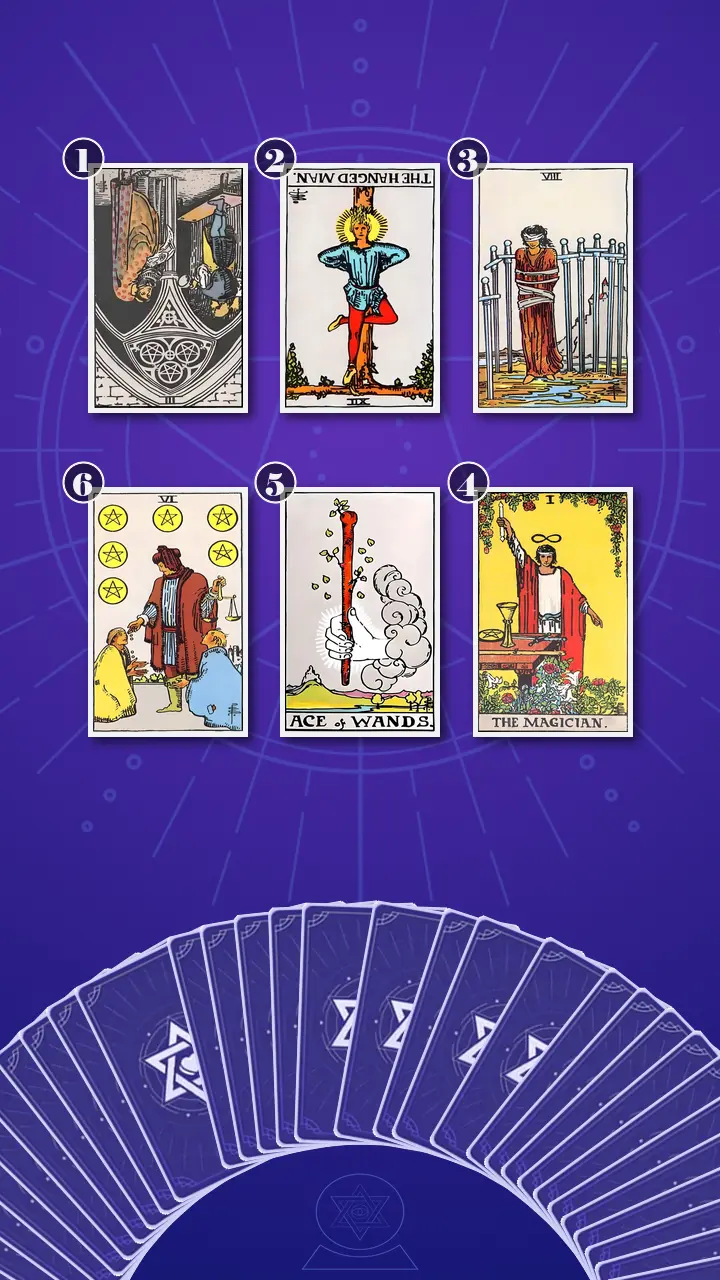
I chose the six-card Transformation Path Grid · Context Edition. For anyone wondering how tarot works in a practical consultation, I use the cards through a Jungian psychological lens: the images give us an external surface on which to examine patterns that are difficult to see while we are living inside them. I was not going to infer the teammates' motives, predict Jordan's grade, or announce a fixed future. I was looking for card meanings in context and for choices Jordan could test.
This spread was more precise than a broad Celtic Cross or a relationship spread because the issue was a self-reinforcing process, not a question of who was secretly right or wrong. The top row would show the visible condition, the immediate blocking habit, and the fear beneath it. The lower row would identify the leverage point, a bounded action, and a sustainable form of exchange. Read in that order, the grid formed a switchback trail from group-project freeze to focused agency.
Five Avatars Around an Empty Workshop
Position 1: The Collaboration That Never Becomes a Paragraph
Now I turned over the card representing the observable symptom: Jordan monitors the group and leaves their own section unfinished because the collaboration has no clear structure. It was the Three of Pentacles, reversed.
I pointed to the figures who should have been coordinating around an architectural plan. In Jordan's life, that workshop was a Google Doc with five profile icons, several headings, unresolved comments, and no clear owner beside any substantive section. Jordan watched for another person's cursor, added another outline bullet, and waited. Everyone was technically present, so why did starting still feel like stepping out alone?
The reversed Earth energy showed a Blockage in coordination. It did not mean Jordan lacked skill. It showed useful skill caught inside unclear roles, standards, and decision paths. The external disorder was real, but Jordan had begun treating visible group agreement as authorization to use abilities they already possessed.
“Which part of your section could still be built if the group changed the presentation format tomorrow?” I asked.
Jordan gave a short laugh with a bitter edge, then rubbed a thumb along the trackpad. “That's so accurate it feels a little brutal. The opening definition would still be needed. I already have the sources for it.” Their answer separated the group's lack of structure from any lack of ability, which was the first distinction I wanted the reading to make.
Position 2: The Pause That Stopped Producing Information
Now I turned over the card representing the immediate blocking behavior: waiting for another message or decision instead of using the information already available. It was The Hanged Man, reversed.
I brought the reading back to 10:47 p.m. Jordan had the chat beside the document and was repeating, “I'll start after the next message.” Ten minutes passed. Their cursor moved from WhatsApp to Google Docs to a seventh research tab, but no paragraph appeared. Nothing relevant had changed, yet another refresh still passed as preparation.
The Hanged Man can describe a purposeful pause that creates perspective. Reversed here, that energy was in Blockage: the pause had no defined question, endpoint, or source of new information. It was like leaving a streaming episode frozen on one frame and checking whether the plot had somehow advanced. I told Jordan, “A pause is useful only while it is producing new information.”
“What exact answer were you expecting the next refresh to give you?” I asked.
Jordan's jaw moved once before they replied. “I guess I wanted someone to say, ‘Yes, that's definitely your section, and this is exactly how it should work.’ But nobody has said they're going to decide that.” Their hand withdrew from the refresh icon and rested flat on the desk.
Position 3: When Unknowns Become an Access-Denied Screen
Now I turned over the card representing the root fear: beginning without group approval might produce rejected work and take away Jordan's control over whether their effort counted. It was the Eight of Swords, upright.
I used the gap in the ring of swords as the central clue. Jordan could see unanswered questions about format, case selection, and slide order, then hear an internal sequence: “This depends on that, which depends on them, so maybe none of it is safe to start.” Yet the opening definition, citation summary, and evidence notes depended only on the brief and readings already confirmed.
The card's Air energy was in Excess. Analysis had promoted several unknowns into a total access restriction, as if silence in the chat meant Jordan's editing permission had been removed. The blindfold did not make the constraints imaginary; it showed that confirmed constraints and predicted constraints had become difficult to distinguish.
“Imagine you post a rough paragraph and someone replies, ‘This isn't the direction we're taking,’” I said. “What lands hardest: losing the time, looking careless, being excluded from the decision, or feeling that your effort did not count?”
Jordan inhaled shallowly and stared at the incomplete ring of swords. “Feeling like everyone else understood something I missed. Like the rejection would prove I shouldn't have trusted my judgment.” Their fingers tightened around a sleeve, their gaze went briefly unfocused, and then the grip loosened as the hidden fear became specific enough to examine.
When The Magician Put the Starting Signal on the Table
Position 4: The Leverage Hidden in Plain Sight
Before I turned the pivotal card, the radiator clicked once and fell quiet. Even the cursor on Jordan's shared document seemed unusually bright against the blank paragraph.
Now I turned over the card representing the leverage point that could close the Manifestation Gap: using available tools and confirmed requirements to create a small draft before complete alignment. It was The Magician, upright.
I pointed to the four suit tools arranged on the table. On Jordan's actual desk, those tools were the rubric, lecture notes, sources, phone timer, and shared document. The Magician's raised and lowered hands translated intention into form. In modern terms, Jordan could stop asking the silent chat for a complete starting signal, select one confirmed requirement, write a rough paragraph, and label the unresolved assumption above it.
The Magician's energy was in Balance: focused agency without the fantasy of total control. Jordan could not determine the final direction or guarantee a positive response, but they could choose one bounded artifact that gave the group something real to accept, revise, or question.
For a moment, the card's orderly table reminded me of communal worktables I had used while travelling across different cultures. Groups rarely begin because everyone reaches the same thought at the same second. More often, movement starts when one person makes a clear, limited offer that others are free to answer. Contribution and collaboration are not opposites.
I call the protective pattern beneath Jordan's blank page Draft Paralysis Deconstruction. The perfectionism was not evidence of laziness; it was a defense designed to prevent academic criticism from landing. If no draft existed, no one could reject it. Unfortunately, the same defense also prevented the group from responding to Jordan's actual thinking.
I paired that with Performance Anxiety Decoupling: a teammate's revision, a project grade, or a confused comment could evaluate one piece of work, but none of those things could measure Jordan's core worth or intelligence. A provisional paragraph was data in a collaboration process, not a verdict on the person who wrote it.
At 10:47 p.m., the Google Doc was still mostly headings. Jordan had refreshed the chat, added one more source, and called it responsible coordination. Their shoulders had tightened because waiting protected their effort from rejection, even while the deadline kept taking time away.
A draft does not have to wait for alignment; sometimes the draft is the thing that gives alignment somewhere to begin.
You do not need the whole group to hand you a starting signal; place one usable draft on the table, as The Magician places every available tool within reach.
I let the sentence sit. Jordan's breath stopped first; two fingers hovered above the trackpad, perfectly still. Their gaze then slipped past the cards as if the last month of late-night refreshes were replaying behind the screen. Their eyebrows drew together. “But doesn't that mean I've been doing it wrong this whole time?” they asked, sharper than before.
I kept my voice level. “It means the waiting had a protective job. It tried to spare you wasted effort and criticism. We can respect that job without letting it run the project.” Their fist loosened; their eyes brightened; then their shoulders dropped on a long, shaky breath. The release carried a brief blankness, the slight vertigo of realizing that a clearer route also returned a choice to them. I asked, “Now, with this new view, was there a moment last week when one visible draft could have changed how the situation felt?” Jordan nodded and named the source summary they had researched twice but never posted.
I named the crossing we had just reached: this was a move from contracted hesitation and permission-seeking to grounded confidence in contributing without total certainty. It was not instant confidence and it did not erase the group's genuine coordination problem. It was the smaller, more credible shift from “What signal am I missing?” to “What confirmed requirement can I make visible?”
A First Sentence, Then a Fair Exchange
Position 5: The Spark Before the Next Refresh
Now I turned over the card representing the practical action: begin one dependency-free piece and make it visible before checking for another group update. It was the Ace of Wands, upright.
I read the hand offering the living wand as a starting signal Jordan could generate internally. In their real study session, that meant opening the document before checking who was online and giving one dependency-free task twenty minutes: a source summary, definition paragraph, evidence table, or three-sentence argument. Bracketed unknowns could preserve flexibility without becoming reasons to stop.
The Ace's Fire was in Balance when used as a bounded ignition. It did not ask Jordan to finish the whole section in a late-night burst. That would push Fire into excess and turn agency into panic. The card asked for one imperfect but reviewable output. I phrased the inner permission plainly: “This is a trial start, not your final claim about what the project must become.”
“What could you produce in twenty minutes that another person could actually read and answer?” I asked.
“The definition paragraph,” Jordan said immediately. Their hand moved toward the document, then stopped with a small smile. “Not tonight during the reading. But tomorrow, before I open the chat.” I heard more energy in the sentence, but it remained measured rather than grand.
Position 6: What I Did, What I Need, What I Am Not Owning
Now I turned over the card representing sustainable integration: contribute visibly, request specific input, and clarify limits so reciprocity replaces passive monitoring. It was the Six of Pentacles, upright.
I translated the scales and measured coins into a concise group update with three visible parts: what Jordan completed, what they needed, and what they were not taking ownership of. In practice, Jordan could post a paragraph, name the assumption behind it, ask one teammate for a specific decision, and state which section still needed an owner.
The card restored Earth in Balance. The answer to passive waiting was not writing the whole assignment or appointing oneself unpaid project manager. Fair collaboration required an exchangeable contribution, an answerable request, and a workload boundary. “I can contribute without taking over” became the final inner-monologue shift.
“Name what you did, what you need, and what you are not owning,” I told Jordan. “A draft can invite alignment without pretending to own the final answer.”
Jordan leaned back far enough for the chair to creak. “That actually makes posting feel less controlling,” they said. “I'm not declaring the plan. I'm giving them something specific to respond to, and I'm not volunteering for everything else.”
Finding Clarity with a Dependency-Free Draft
I gathered the six cards into one coherent story. Repeated vague exchanges had established an externally disorganized workshop. Jordan internalized that disorder as a pause, then the pause hardened into a belief that every route was blocked. More research and monitoring produced no reviewable artifact, and the absence of an artifact preserved the very ambiguity Jordan was waiting to escape. The group chat had become a traffic light that never turned green because everyone was waiting for someone else to enter the intersection.
The cognitive blind spot was treating one unresolved dependency as a stop command for the entire task. Jordan had also been treating revision as proof that an early contribution was useless, rather than as a normal part of collaborative work. The transformation direction was not “be more confident” or “take charge of the group.” It was specific: create one dependency-free draft from a confirmed requirement, label assumptions, and request focused feedback within clear workload boundaries. Clarity could become an output of contribution, not its entry requirement.
I turned that shift into three deliberately small next steps:
- The Eight-Minute Inner-Critic MuteBefore the next group-chat check, sit in your usual study spot and spend sixty seconds separating prediction from task. Write: “Prediction: they may reject this.” Then write: “Observable task: draft three rough sentences under one confirmed heading.” Close the chat, set an eight-minute phone timer, and write only those sentences.If eight minutes feels loaded, write one claim with one supporting source and stop. The protocol succeeds when a visible starting point exists, not when fear disappears.
- The Confirmed-Assumed-Dependent CheckBefore researching again, mark the relevant outline items C for confirmed, A for assumed, or D for genuinely dependent. Draft from one C item, place an “Assumption:” label above any provisional choice, and bracket unresolved details with tags such as “[confirm case choice].”Bracket the unknown instead of researching around it. Keep this check under five minutes so classification does not become a new form of productive procrastination.
- One Draft, One Question, One BoundaryPost the reviewable piece in the existing group chat with a specific update: “Drafted X based on Y. I assumed Z. Could someone confirm A by 6 p.m. tomorrow? I can revise this subsection after feedback, but I cannot own the slides this week.”If posting to the full group feels too exposed, send the draft to one teammate first. Ask one answerable question instead of requesting general thoughts.
I reminded Jordan that these were experiments, not commands from the cards. The group might respond well, slowly, awkwardly, or not at all. The point was to replace repeated monitoring with evidence, then let Jordan decide what the evidence justified. Tarot had made the loop visible; Jordan still owned every next move.

A Week Later: The Quiet Proof
Six days later, I received a message from Jordan. At 3:15 after class, they had sat in a crowded campus café, closed WhatsApp, and set the eight-minute timer. With milk steaming behind the counter and chairs scraping the tile, they wrote three rough sentences from one confirmed requirement. They placed an assumption label above the paragraph and posted it with one specific question.
The response was useful without being perfect. One teammate reacted with a thumbs-up, another suggested moving the definition, and a third finally claimed the evidence table. Jordan revised two sentences. The project was not suddenly solved, but the group now had an artifact around which an actual decision could form.
The project still had two unowned tasks. Jordan slept through the night, then woke to “What if I guessed wrong?” They told me they smiled, checked the labeled assumption, and got out of bed.
For me, that was the honest proof of this Journey to Clarity. Jordan had not become immune to uncertainty. They had moved from waiting for permission to creating one bounded contribution while uncertainty was still present. The cards did not supply the courage or write the paragraph; they helped Jordan recognize the tools already within reach.
I want to leave the same steady ground beneath anyone who knows this screen. When the shared document is open and your shoulders inch toward your ears, waiting can feel like the only way to protect your effort from being dismissed, even while part of you knows the silence is costing the time you hoped to save. Noticing that conflict already means you are no longer completely inside it.
So I will turn the reading toward you: if one rough paragraph could be an invitation rather than a claim to control the project, what confirmed piece would you feel curious enough to place on The Magician's table before your next refresh?
This story is adapted from psychological research, written so that those in a similar struggle can see their own pattern in it — and find their next step clearly.These insights are not a substitute for professional psychological, medical, legal, or financial advice.
Learn more about our Journey to Clarity.
How did this insight land for you?
🫂 This Resonates Deeply
🌀 Living This Story
✨ Now I See Clearly
🌱 Seeing New Possibilities
🧰 Useful Framework
🔮 The Confirmation I Needed
💪 Feeling Empowered
🚀 Ready for My Next Step
Author Profile
 AI
AI“Having traveled across cultures... I've learned that what we often lack isn't a simple answer, but a moment of being truly understood. I use a Jungian psychological lens to help you deconstruct your subconscious patterns—not to prove anything, but to be the gentle companion who helps you unravel your knots, free of judgment, so you can reconnect with your inner wisdom.”
In this Study Tarot Reading :
Core Expertise
- Performance Anxiety Decoupling: Logically separating your core self-worth from exam results, peer comparisons, or mentor evaluations.
- Draft Paralysis Deconstruction: Identifying perfectionism as a subconscious defense mechanism designed to protect you from potential academic criticism.
Service Features
- The Inner-Critic Mute Protocol: A pre-study cognitive exercise to neutralize crippling performance anxiety and restore objective, fearless focus.
Also specializes in :
Explore Related Patterns:
Approval-Driven Decision ParalysisJordan can name an independently workable section and already has the sources for its opening definition, yet they keep the chat visible and wait for someone else to move first. The delay is therefore not caused by an absence of ability or available work. Action has become conditional on receiving a sufficiently clear signal that the group approves the role, direction, and standard in advance. When you make a start contingent on external approval, waiting can impersonate responsible coordination. It reduces the immediate risk of being corrected, but it also transfers your decision threshold to people who have not agreed to provide that permission. Approval-Driven Decision Paralysis names this loop because the hoped-for confirmation is not merely useful information. It has become the psychological authorization required before you trust yourself to act.
Perfectionism-Driven AvoidanceJordan keeps the Google Doc mostly at the heading stage even after identifying a paragraph that would survive a change in presentation format. A rough draft would expose their thinking to revision, while a blank page preserves the possibility that the eventual work could still be perfectly aligned. The avoidance protects against criticism by preventing an imperfect artifact from existing. When you require early work to be safe from rejection before it can be written, quality control stops serving the work and starts defending your self-trust. The standard quietly shifts from producing something useful to producing something that cannot make you look careless. Perfectionism-Driven Avoidance captures that defensive bargain. It offers short-term protection from evaluation, but it also prevents the feedback and shared evidence that could make the project clearer.
Rejection SensitivityJordan does not describe revision as a neutral possibility. They imagine that a changed direction could make them look careless, and that rejection would prove everyone else understood something they missed. Feedback on a paragraph is therefore carrying a second meaning about whether their judgment deserves trust. When you experience correction as evidence about your competence rather than information about one provisional artifact, anticipation of rejection can shape your behavior before anyone has responded. Rejection Sensitivity names that pre-emptive threat filter. It helps explain why waiting feels protective even when no teammate has criticized the work. By keeping the draft private, you avoid the feared verdict, but you also lose the chance to discover that feedback may be specific, ordinary, and survivable.
Loss AversionJordan focuses on the possibility that hours spent drafting could be lost if the group changes direction, even while every refresh consumes time that cannot be recovered. Revision is mentally coded as evidence that the original effort did not count. This makes a hypothetical future loss feel more urgent than the visible loss already accumulating before the deadline. When you overweight the pain of possible rework, waiting can appear economically rational from inside the loop. Loss Aversion explains why the protection remains compelling despite its cost. The mind is trying to preserve effort, but it evaluates only whether the first version survives unchanged, not whether drafting creates reusable thinking, clearer questions, or an artifact that helps the group coordinate.
Assertive CommunicationJordan posts a reviewable paragraph with one specific question instead of asking the silent chat for general alignment. The message makes an assumption visible without presenting it as a final group decision. Teammates can now respond to a concrete object, and one of them finally claims another project task. When you state what you have done and ask for one answerable form of input, communication becomes a tool for generating coordination rather than waiting for it. Assertive Communication is present because the contribution is clear without being controlling. You do not need to declare the entire plan or absorb every unowned task. You make your position legible while preserving other people's freedom and responsibility to answer.
Boundary DiscernmentJordan develops a group update that separates three things: the work completed, the decision needed from others, and the work they are not taking ownership of. This structure allows them to offer a paragraph and remain open to revision without silently becoming responsible for the slides or every unclaimed task. When you distinguish contribution from total responsibility, collaboration no longer requires either passive waiting or taking over. Boundary Discernment names the ability to locate your actual area of agency while leaving other people's choices and obligations with them. The boundary is not a withdrawal from the group. It creates a clearer exchange in which your offer is visible, your request is answerable, and your limit is explicit.
Reality TestingJordan identifies that the opening definition is still required even if the presentation format changes, then separates confirmed requirements from assumptions and genuine dependencies. Six days later, they write from one confirmed requirement, label the assumption above it, and observe what the group actually does. The distinction converts a total feeling of blockage into testable categories. When you compare a prediction with observable constraints, you create distance between what could happen and what is currently preventing action. Reality Testing is active here because uncertainty is neither denied nor treated as proof of restriction. The draft becomes a small experiment that can generate evidence. That evidence gives you a firmer basis for the next decision than repeated monitoring or imagined consensus can provide.
Uncertainty ToleranceJordan writes three rough sentences from a confirmed requirement before the group has resolved every project detail. They label the assumption instead of hiding it or trying to eliminate it through more research. When the thought that they may have guessed wrong returns the next morning, the assumption label remains available as a reminder that the choice was provisional. When you allow uncertainty to remain visible while taking a bounded action, you stop making certainty the entry requirement for participation. Uncertainty Tolerance does not mean expecting the draft to be accepted unchanged. It means giving possible revision a manageable place in the process. You retain enough flexibility to adjust the work without surrendering your ability to begin.
Compulsive CheckingJordan refreshes the group chat and shared document, moves between WhatsApp, Google Docs, and another research tab, and repeats work on a source summary without posting it. Each check looks like preparation because a message could theoretically contain useful information. In practice, the pause has no defined question, endpoint, or reliable source of a decision. When you check again without identifying what new evidence you expect to find, the action can become a short-term uncertainty-regulation ritual. The refresh briefly creates a sense of vigilance and involvement, but nothing in the task actually advances. Compulsive Checking names the repeated relief loop here. The behavior feels safer than drafting because it postpones exposure, even as every cycle strengthens the impression that starting still depends on the next update.
Productive ProcrastinationJordan adds headings, finds another source, checks the chat, and opens a seventh research tab while the paragraph they could independently write remains absent. These actions are connected to the project, so they preserve the feeling of being responsible and productive. They also keep attention away from the one action that would make Jordan's thinking visible to the group. When you replace an emotionally exposing task with lower-risk preparation, activity can conceal avoidance from both other people and yourself. Productive Procrastination is the relevant mechanism because the substitute tasks are not meaningless. Their usefulness is precisely what makes the loop persuasive. They provide evidence that you care while delaying the moment when your actual contribution can be reviewed, revised, or rejected.
Explore Related Struggles:
Agreement-Agency SplitJordan already knows that the opening definition can be written from confirmed sources, yet starting before another person moves feels like stepping outside the collaboration. Agreement is serving two incompatible roles at once: a useful coordination tool and a prerequisite for exercising agency. You can become stuck here even when your part is objectively workable. The struggle is not whether collaboration matters; it is whether you can remain collaborative while allowing your own bounded contribution to begin before consensus is complete.
Ambiguity DependenceJordan waits for the group to remove uncertainty before posting anything, but the group has no visible artifact around which to make a specific decision. More research and monitoring leave the same questions unresolved, while the missing draft conceals which parts are genuinely dependent and which can already be built. You are held by Ambiguity Dependence when uncertainty becomes both the reason you cannot act and the condition preserved by not acting. The loop loosens when ambiguity is given a visible boundary, such as a labeled assumption or a focused question, so that contribution can begin generating the clarity it was previously required to wait for.
Clarity-Exposure SplitJordan's blank section cannot be rejected, but it also cannot give the group anything specific to discuss. When the rough definition finally becomes visible, one teammate approves it, another proposes a change, and a third claims a related task; the exposure produces the clarity that private preparation could not. You face this split when the information you need can only arrive after your unfinished thinking is available for response. The struggle lies in making something visible enough to create clarity without treating every revision as proof that the act of contributing was a mistake.
Future-Proofing ParalysisJordan wants to know that the group's format and direction will not change before investing hours in a section. Because those future decisions cannot be guaranteed, ordinary revision is treated as the possible cancellation of the entire effort, and every unresolved detail gains the power to stop work that does not actually depend on it. You enter Future-Proofing Paralysis when only work protected from every later change feels safe enough to begin. That standard removes the provisional stage from collaboration, leaving you unable to produce the draft through which assumptions could be tested and future changes could become manageable rather than catastrophic.
Permission ParalysisJordan can identify a dependency-free paragraph and already has the sources to write it, but the cursor remains still while they wait for someone to confirm exactly what to do. No teammate has taken responsibility for providing that confirmation, so the expected permission has no reliable source and no defined arrival time. You become locked inside Permission Paralysis when your ability to begin is made conditional on authorization that the situation may never supply. The issue is not a lack of care or competence; it is that your own judgment has been denied permission to initiate even a provisional, clearly bounded piece of work.
Internal Authority CollapseJordan says that a rejected draft would prove everyone else understood something they missed and that they should not have trusted their judgment. Feedback about one provisional paragraph is therefore carrying more authority than the rubric, sources, and confirmed requirements already available to them. You encounter Internal Authority Collapse when your own interpretation cannot count until another person certifies it, while disagreement is allowed to invalidate the act of trusting yourself. Reclaiming authority here does not mean declaring the final plan; it means allowing your informed judgment to produce a limited first version that remains open to evidence and revision.
Monitoring-Safety FusionJordan moves from WhatsApp to Google Docs to a seventh research tab, even though nothing relevant changes and no paragraph appears. Each refresh briefly resembles responsible preparation because it delays the moment when a claim becomes visible and open to response. You are carrying Monitoring-Safety Fusion when watching the environment feels safer than placing your own work into it. Monitoring then stops being a way to collect information and becomes the condition under which you postpone acting, leaving your sense of safety dependent on a signal the next refresh cannot guarantee.
Protection-Progress SplitJordan checks the chat, adds another source, and gains five minutes of protection from possible criticism or wasted effort. The same five minutes disappear from the shrinking window in which a usable paragraph could be written, so the behavior that protects the work also prevents it from progressing. You are caught in this split when caution succeeds in reducing immediate exposure but steadily increases the cost of remaining still. Moving forward requires accepting that progress can include revision, while protection cannot be allowed to consume all the time and evidence needed to make progress real.
Responsibility-Authority SplitJordan is responsible for assessed work inside a document where substantive sections have no clear owners and several decisions remain unresolved. They are accountable for contributing, but they do not hold unilateral authority over the group's final direction, making both action and inaction carry a visible cost. You can feel trapped when responsibility reaches you before decision rights do. The workable distinction is between creating a limited contribution from confirmed requirements and claiming control over the whole project; keeping those actions separate lets you meet your responsibility without absorbing authority the group never assigned.
Explore Related Emotions:
Cautious Self-TrustJordan chooses one confirmed requirement, writes three rough sentences, labels the unresolved assumption, and posts one specific question. Six days later, the thought that they may have guessed wrong still appears, but they check the label and continue with the day rather than treating the thought as a command to retreat. When you trust yourself cautiously, you do not need to claim perfect judgment or suppress uncertainty. Cautious Self-Trust is the steadier feeling that your current evidence is sufficient for one bounded contribution and that future correction can remain information about the work rather than proof that you should never have started.
Certainty HungerJordan moves from WhatsApp to Google Docs to a seventh research tab while waiting for someone to confirm exactly what the section is and exactly how it should work. The available evidence keeps increasing, but it cannot satisfy a request for total alignment that the group has never agreed to provide. When you need every dependency settled before one confirmed piece feels safe to begin, uncertainty spreads beyond the questions that are genuinely unresolved. Certainty Hunger is the restless sense that one more message, source, or clarification might finally make action feel protected enough, even as each search postpones the moment of authorship.
Imperfection Exposure DreadJordan says that hours of work could be wasted if the group changes direction and that an early draft might make them look careless. Their shallow breath and tightening grip show how the imagined response reaches the body before any teammate has actually read a paragraph. When you experience provisional work as a public test of whether you understood what everyone else seems to know, an ordinary rough draft can feel dangerously revealing. Imperfection Exposure Dread captures the urge to remain unseen until the work is protected from criticism, revision, and the possibility of being judged for getting something wrong.
Permission AnxietyJordan keeps a nearly blank Google Doc open beside a silent group chat, adding headings and sources while withholding the independently workable paragraph until someone else moves. When you treat visible group agreement as authorization to use abilities you already possess, silence can feel less like missing information and more like permission being withheld. The result is a watchful inner tension in which acting on your own judgment feels socially risky even inside a clearly bounded task. Permission Anxiety names that subjective pressure to wait for an external starting signal, despite already knowing what you could responsibly begin.
Revision ShameJordan imagines a teammate rejecting the paragraph and immediately reaches the conclusion that everyone else understood something they missed. Later, the realization that waiting had a protective function prompts the sharper question of whether they have been doing it wrong the whole time. When you experience correction as evidence against your intelligence or judgment, revision stops feeling like a normal exchange between collaborators. Revision Shame is the inward sting that turns feedback on one provisional artifact into a verdict on the person who produced it, making a blank page feel temporarily safer than visible work that can be changed.
Standby Mode AnxietyAt 10:47 p.m., Jordan keeps the silent chat beside the nearly blank document, shoulders raised as the cursor cycles through refreshes and research tabs. Every check preserves the possibility that a message could arrive, so the body stays prepared to react while no uninterrupted stretch is given to the paragraph. When you remain available for a signal that may never come, waiting can feel active even while your own work remains suspended. Standby Mode Anxiety names this tense state of being perpetually ready for other people to unlock the next move, with the approaching deadline making it increasingly difficult to disengage from monitoring.
Cautious MomentumJordan closes WhatsApp, sets an eight-minute timer, and produces three sentences from a confirmed requirement. The draft leads to a thumbs-up, a suggestion, two revised sentences, and another teammate finally claiming the evidence table. The movement remains deliberately modest because the project still contains unresolved choices and unowned tasks. Cautious Momentum is the felt sense of progress becoming possible through small, reviewable outputs, with enough restraint to keep one productive step from turning into a demand to finish everything or manage everyone.
Alignment ReliefJordan posts a visible paragraph with one labeled assumption and one answerable question. A teammate acknowledges it, another suggests moving the definition, and a third claims a task that had previously remained ownerless. The response is useful without producing perfect agreement, which allows coordination to become tangible rather than imagined. Alignment Relief is the easing that arrives when silence turns into specific exchange and you can see that contribution does not have to wait for consensus because a limited draft can give consensus something concrete to organize around.
Explore Related Contexts:
Undefined Role ScopeThe project had no clear owner beside any substantive section, while format, case selection, and slide order remained unsettled. You were asked to contribute within a group structure that did not specify which decisions were yours, which belonged to the group, or which tasks were still unclaimed. Because the opening definition depended only on confirmed readings, the whole section was not objectively blocked. The missing role boundaries made one unresolved dependency spread across the task, so starting appeared to require authorization that the project had never assigned to anyone. When you later named what you had done, what input you needed, and what you were not owning, the role became more workable. The draft could be revised by the group while your workload remained bounded, giving you a defined place to act without appointing yourself project manager.