Why Say Yes at Work?

A clear look at why you agree before checking your workload, plus matching tarot cards and tarot card reading insights.

Workplace People-pleasing
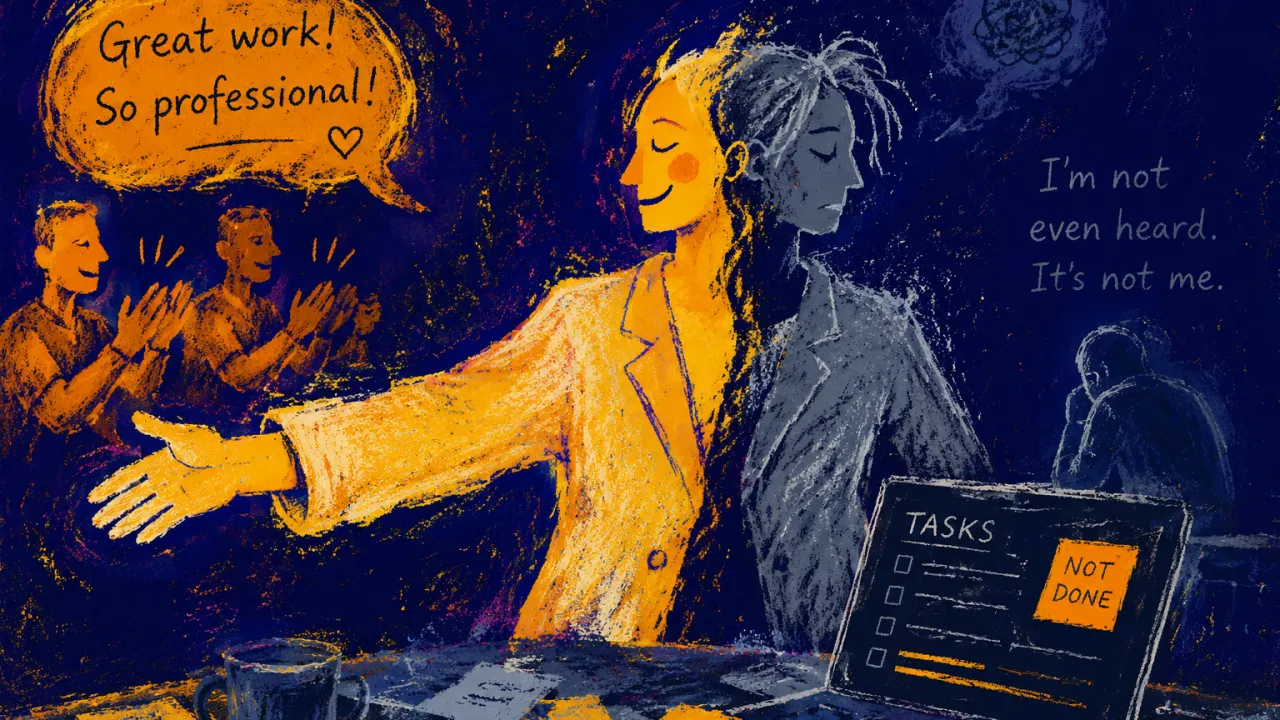
A figure with shoulders drawn back and one palm extended over a meeting table, amber light fading into cool grey.

What is this really?

You answer workplace messages before checking your own workload, lift a hand to volunteer for the awkward task, soften disagreement in meetings, and edit emails until none of your limits sound like limits. You keep the room smooth because being useful, easy to work with, and approved of can feel safer than letting someone see your limits or disappointment. Yet the polished workplace persona receives the approval while the self you cannot hear stays outside the conversation, leaving you caught between a role everyone can rely on and a self you cannot locate - much like the Two of Pentacles, where a figure keeps two coins in motion as ships rise and fall behind him.

Why did it happen?

When approval once seemed tied to staying included or keeping the room calm, you learned to scan faces, answer quickly, and make yourself easy to accommodate; those moves helped you get through moments when you had little room to negotiate. Now the subconscious loop can run before you check your own response: you agree, over-prepare, and feel a private drop in your stomach when praise arrives, leaving you mentally overextended while your limits remain unspoken.

How does it feel?

  • In a meeting, you nod before a coworker finishes, lift one hand from the keyboard, and say, 'I can take that,' while your notes already fill the page. A moment later, your shoulders rise and your breathing turns shallow as you look down at the next line. You can allow that reaction to be present for now.
  • When a late message arrives, you open it before finishing what is in front of you, type 'No worries!' and move a personal block on your calendar to make room. After you send it, your hands hover above the keyboard and your stomach feels tight, even as the thread goes quiet. You can let the pause stay a pause.
  • During a review, you start to name the part of a plan that does not work for you, then press your lips together, nod, and say, 'That works,' as your eyes flick toward the manager's face. Your chest feels heavy and your hands go still before the conversation moves on. It is okay to notice the sensation without forcing it to change.
  • At your desk, you reread a short email, delete one sentence, restore it, and check the recipient list three times before pressing send. Your eyes blur at the screen and your fingers keep moving after the wording is settled. You can allow that moment to exist without naming it.
  • When a manager praises your work, you give a quick laugh, point to a coworker's contribution, and add that it was 'nothing difficult' before the compliment has landed. A warm face and a hollow feeling across your chest may arrive together, leaving you quiet for a beat. You can make room for both sensations without deciding what they mean.

Workplace People-pleasing in Tarot Cards

Workplace People-Pleasing can show up in the reflex to say 'I can take that' before checking your own workload; a moment later, your shoulders rise and your breathing turns shallow as you look down at the next line. Jungian archetypal theory offers a lens for this pattern. The Tarot Cards below mirror the unconscious dynamics between the polished workplace persona and the self you cannot hear. Here are the cards connected to Workplace People-Pleasing.

The Hierophant
Upright
The Hierophant's formal gesture, elevated seat, and kneeling followers organize the image around transmitted rules and sanctioned conduct. The crossed keys suggest that access to legitimacy is mediated by compliance with the established system. You may have internalized workplace obedience, emotional smoothness, and constant helpfulness as evidence of being a good person rather than context-dependent professional behaviors. The growth task becomes visible when organizational norms are separated from moral truth, allowing disagreement to exist without automatically becoming a character indictment.
The Hanged Man
Reversed
The haloed figure remains suspended from the wooden frame, with one leg bound and the other arranged into a composed shape. The image gives sacrifice symbolic dignity, making immobility appear meaningful even when it no longer opens a new perspective. You may idealize self-abandonment at work as maturity, loyalty, or generosity, which prevents the underlying approval bargain from being questioned. In this reversed quality, sacrifice preserves an identity rather than serving a chosen value, and growth stalls because your own position is repeatedly removed from consideration.
The Devil
Upright
Loose chains encircle the two figures beneath the Devil's pedestal, and the figures themselves have begun to echo aspects of the form that dominates them. The image shows how a controlling structure can be internalized until it appears to describe identity rather than a learned relationship. You may confuse being useful at work with being worthy, making every limit feel like evidence of personal failure rather than information about capacity. The visible looseness of the chains supports a precise reframe: the equation is deeply reinforced, but it is still an equation that can be observed rather than an essential truth about you.
Four of Cups
Upright
A seated figure folds his arms beneath a tree while three cups rest before him and a fourth is offered by a hand emerging from a cloud. The gift is present, but the closed posture shows that availability and emotional reception are not the same event. You may receive workplace praise with a smile, a quick deflection, or an immediate reference to someone else's contribution while feeling unexpectedly hollow. The recognition cannot fully land because it addresses the useful persona that earned it, not the limits and preferences excluded from the performance.
Two of Pentacles
Upright
The standing juggler keeps two pentacles moving inside a continuous loop while unstable ships pitch behind him. The performance makes sustained overload look light, flexible, and socially manageable even as the surrounding conditions remain volatile. You may volunteer before checking your workload, absorb changing priorities, and present the resulting strain as no problem. The card exposes the workplace defense beneath the competence display: visible adaptability protects approval, while the private body carries the information that capacity has already been exceeded.
Six of Pentacles
Reversed
A standing merchant holds scales in one hand while distributing coins with the other to two kneeling figures. Resources, judgment, and vertical power occupy the same image, making the terms of exchange dependent on whoever controls the distribution. You may repeatedly contribute more time, emotional labor, or practical support than the workplace returns because unequal exchange feels safer than appearing uncooperative. In this imbalanced register, generosity becomes approval management, and the scales expose a reciprocity problem that the helpful persona has been trained not to name.
Eight of Pentacles
Upright
The seated artisan holds one pentacle close while a column of completed pieces records the same careful process repeated again and again. The distant town and absorbed posture narrow the world to the standard being refined in front of him. You may edit a straightforward email until no sentence could sound firm, overprepare routine work, or keep improving an answer after it already meets the brief. The pattern borrows the language of quality while using perfectionistic labor to lower the imagined risk of criticism, inconvenience, or disapproval.
Two of Swords
Upright
The seated figure's blindfold blocks visual orientation while crossed swords guard her chest and the moon hangs over uneven water. Her controlled stillness separates cognition from the emotional information waiting behind the defensive posture. You may become so practiced at finding the professionally acceptable response that your own preference is no longer immediately audible. The internal deadlock is therefore not an absence of feeling; it is the result of repeatedly intercepting feeling before it can challenge the approval-preserving answer.
Nine of Swords
Upright
A figure sits upright in bed with both hands covering the face while nine swords extend across the dark wall and patterned fabric anchors the body below. The private setting contrasts sharply with the controlled professionalism that may have been visible earlier in the day. You may replay a short email, a manager's expression, or the moment you almost disagreed, searching for evidence that approval has been damaged. This post-event rumination is the hidden maintenance cost of people-pleasing: the outward interaction stays smooth, but the mind continues auditing whether the performance was safe enough.
Six of Wands
Upright
The wreath-bearing rider occupies the center of an approving crowd, with public recognition displayed both on his head and on the wand he carries. Identity and achievement are visually fused through the audience's response. You may gradually build a self-concept around being the employee who never creates difficulty, disappoints authority, or needs accommodation. Growth then becomes confused with improving the performance that earns applause, while developing a self capable of tolerating mixed reactions remains outside the frame.
Seven of Wands
Reversed
The elevated figure grips one wand against six rising challengers while his feet occupy mismatched, unstable positions. The image shows that holding a boundary requires both a clear stance and enough internal footing to tolerate opposition. You may state that your workload is full and then reverse the limit when a manager questions it or a colleague appears disappointed. The collapse is not proof that the boundary was unreasonable; it shows how quickly authority and approval cues can override the capacity information that produced it.
Ten of Wands
Upright
A worker bends beneath ten bundled staffs, with the load obscuring his forward view even though the destination is close. His hands retain every wand, creating no practical space for redistribution, renegotiation, or additional information. You may become the person who can always be relied upon because declining work threatens the identity that secures praise and inclusion. The burden records the cumulative cost of many individually agreeable responses: restricted perspective, reduced agency, and resentment that cannot be expressed without disturbing the role.

Workplace People-pleasing in Tarot Card Reading Insights

For anyone who says 'I can take that' before checking their own workload, Workplace People-Pleasing can also enter a reading. The insights below show how others have sat with these cards and this pattern. Explore the Tarot Reading Insights below.

From Overworking for a Permanent Offer to Sustainable Scope

From Overworking for a Permanent Offer to Sustainable Scope

Topic:Timing Tarot Reading

Struggle:Forced Blooming Trap

Context:Always On Availability

Doing Senior-Level Work Without the Title: Turning Proof into Terms

Doing Senior-Level Work Without the Title: Turning Proof into Terms

Topic:Timing Tarot Reading

Struggle:Responsibility-Authority Split

Context:Promotion Criteria Black Box

Doing Manager-Level Work Without the Title: Naming the Terms

Doing Manager-Level Work Without the Title: Naming the Terms

Topic:Career Tarot Reading

Struggle:Unseen Cost Bind

Context:Promotion Criteria Black Box

Performative Identity Burnout: From Collapse to One Bounded Promise

Performative Identity Burnout: From Collapse to One Bounded Promise

Topic:Personal Growth Tarot Reading

Struggle:Masked Self-Division

Context:Personal Brand Performance

When Availability Replaced Meaning: A Pause Before the Next Yes

When Availability Replaced Meaning: A Pause Before the Next Yes

Topic:Career Tarot Reading

Struggle:Achievement-Meaning Collapse

Context:Values Alignment Crossroads

Cold Coffee and a Hollow Promotion: One Question Before Saying Yes

Cold Coffee and a Hollow Promotion: One Question Before Saying Yes

Topic:Career Tarot Reading

Struggle:Responsibility-Authority Split

Context:Promotion Criteria Black Box

Cold Noodles and Slack Praise Give Way to a Role-Alignment Request

Cold Noodles and Slack Praise Give Way to a Role-Alignment Request

Topic:Career Tarot Reading

Struggle:Reciprocity Deficit

Context:Promotion Criteria Black Box

Six Seconds of Planning Silence Became a Code Ownership Conversation

Six Seconds of Planning Silence Became a Code Ownership Conversation

Topic:Career Tarot Reading

Struggle:Responsibility-Authority Split

Context:Office Housework Trap

The Unsigned Job Offer: Turning a Rushed Yes Into a Paced Choice

The Unsigned Job Offer: Turning a Rushed Yes Into a Paced Choice

Topic:Choice Tarot Reading

Struggle:Security-Identity Fusion

Context:Commitment Cliff Edge

She Deleted Her Recommendation, Then Left the Next One Visible

She Deleted Her Recommendation, Then Left the Next One Visible

Topic:Career Tarot Reading

Struggle:Belonging-Authenticity Split

Context:Corporate Conformity Pressure

Office Housework Crowded Out Design Time: Naming the Trade-Off

Office Housework Crowded Out Design Time: Naming the Trade-Off

Topic:Career Tarot Reading

Struggle:Unseen Cost Bind

Context:Office Housework Trap

Workplace Overfunctioning: From Slack Rescue to Shared Ownership

Workplace Overfunctioning: From Slack Rescue to Shared Ownership

Topic:Career Tarot Reading

Struggle:Systemic Depletion

Context:Undefined Role Scope

Psychological Patterns Related to Workplace People-pleasing