Six Seconds of Planning Silence Became a Code Ownership Conversation

Finding Clarity at the 9:42 p.m. Jira Table
If you are a mid-level engineer on a hybrid city team whose sprint begins with a service to build and ends with notes, triage, and release follow-ups, you may be living the office-housework loop.
At 9:42 p.m. on a Tuesday, Maya (name changed for privacy) sat across from me at the kitchen table in her Toronto apartment. The radiator clicked beside the window, a streetcar ground around the corner below, and the blue-white light from her laptop sharpened the shadows beneath her eyes. Her coffee had gone cold. Her fingers were still converting meeting notes into Jira tickets when a GitHub notification appeared: a teammate had opened the first pull request for the service she had expected to lead.
She stared at the notification, then turned the laptop toward me. “This is exactly what keeps happening. I start the sprint with something I actually want to build. Then I take the notes because it is only one small task. I clean the tickets because it is only one small task. I coordinate the release because it will be faster than arguing about it. By the time I finish helping everyone ship, someone else owns the part I wanted to build.”
Her question was direct: why did she keep automatically volunteering for invisible team chores until they displaced her coding time and eroded her technical ownership? She wanted to remain dependable and collaborative. She also wanted to stop watching reliability turn her into the person who maintained the machinery while somebody else became its recognised author.
I watched her press her tongue against the inside of her cheek. Her shoulders sat high and heavy, and the resigned frustration in her voice felt like a background process consuming most of a machine's memory: never dramatic enough to trigger a crash, but relentless enough to make every meaningful action lag.
“Being useful is not the same as being allowed to own,” I said. “I am not going to tell you that collaboration is the problem, or that one perfect boundary will fix your team. I want us to identify the exact moment when helpfulness becomes lost authorship. Then we can find one place where you still have a choice to test.”
I drew the deck toward me. “Let us make a map of this loop. Not a verdict about your future, and not a judgment of your character. Just a clearer view of what is happening, why it keeps repeating, and what you can realistically do next.”

Choosing the Map for an Office-Housework Loop
I asked Maya to place both feet on the floor, take one slow breath, and hold a single question in mind: “What happens between seeing an unassigned chore and losing ownership of my code?” I shuffled while she breathed. The pause was not a mystical test. It was a practical transition from reliving the week to observing its pattern.
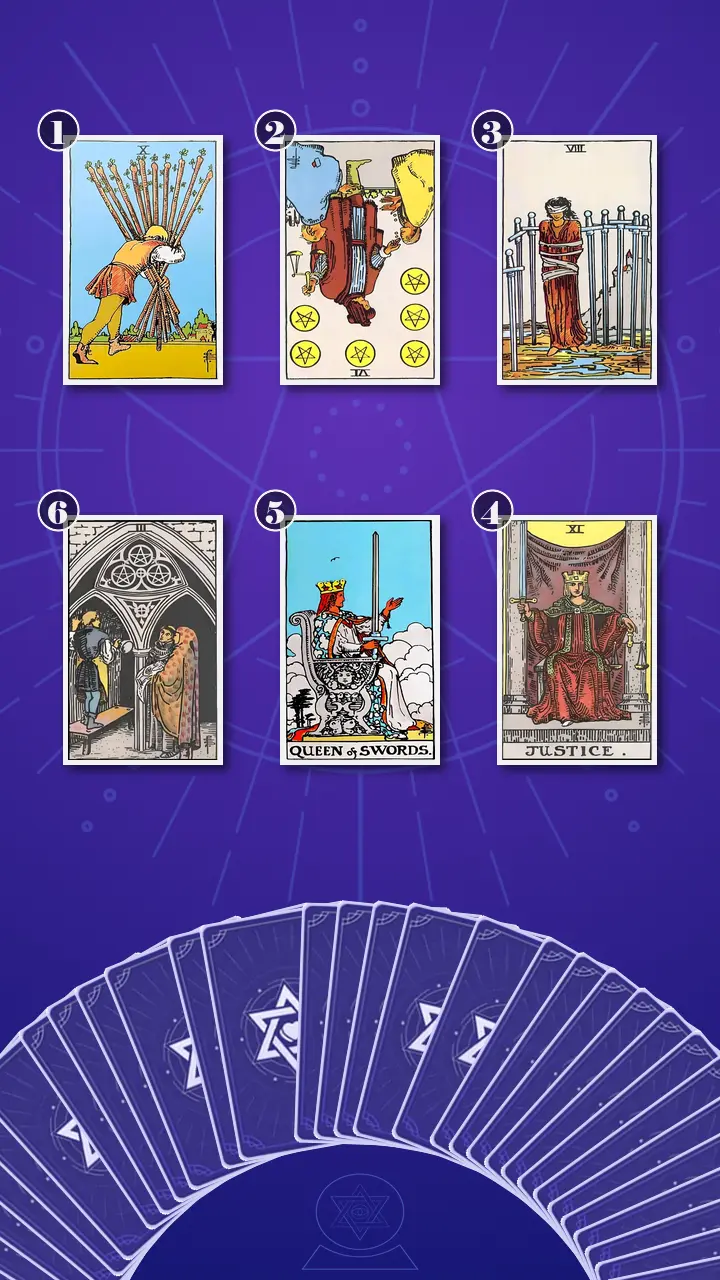
I chose the six-card Transformation Path Grid · Context Edition, a tarot spread for workplace boundaries and technical ownership. For anyone wondering how tarot works in a situation like this, I use the cards as structured psychological prompts. Their symbols slow down an automatic story long enough for us to compare it with observable events. They do not prove motives, predict a manager's response, or remove the need for professional judgment.
This was not a simple choice between helping and refusing. Maya was caught in a feedback loop: she accepted office housework, lost implementation time, watched ownership move elsewhere, and treated that result as evidence that future allocation conversations would not matter. A binary decision spread would have flattened that system into two false options. This grid could separate six functions: the visible burden, the structural imbalance, the psychological root, the interrupting insight, the practical response, and the collaborative principle she wanted to build toward.
I arranged the cards in two rows, tracing a reverse U. The first three would follow the faulty circuit from overload to unequal exchange to assumed powerlessness. The fourth would sit beneath that root as the turning hinge. The fifth would translate insight into language, and the sixth would show integration as a working principle rather than a promised outcome.
“The important thing,” I told her, “is that we are not asking the cards whether you are destined to stay invisible. We are asking where the pattern is observable, where it is constrained, and where your agency can be tested without pretending you control the whole workplace.”
The Load That Kept Multiplying
Position One: Ten Browser Tabs of Team Maintenance
The card I turned over first represented the observable symptom: Maya was claiming coordination, documentation, triage, and support work until the bundle displaced her implementation time. It was the Ten of Wands, upright.
I pointed to the figure bent beneath ten bundled staffs. The destination was still visible, but the load obstructed the carrier's view. I read the upright fire energy as excess rather than deficiency. Maya did not lack motivation, stamina, or team spirit. Her effort had accumulated without a protected direction.
I mapped the image onto her sprint. She entered planning intending to own a new service, then accepted meeting notes, ticket cleanup, onboarding questions, and release follow-ups one by one. Each task was manageable in isolation. Together, they filled her calendar until no uninterrupted coding block remained. By Thursday, the service ticket was still available, and somebody with more protected build time could reasonably claim it.
“It is only one small task,” I said, raising one finger. “It is only one small task. It is only one small task. It is only one small task. Then Thursday arrives, ten maintenance tabs are consuming your working memory, and the editor containing your own code is technically open but no longer usable.”
Maya gave a short, bitter laugh. Her fingers tightened around the cold mug before loosening again. “That is so accurate it is almost rude. I keep closing tiny tickets and wondering, Why is my actual work still untouched?”
“The card is not criticising ordinary collaboration,” I said. “It is making the accumulation countable. The problem begins when recurring shared work is treated as free capacity and your technical destination is expected to survive behind it.”
Position Two: Praise on One Side, Ownership on the Other
The next card represented the structural blockage: helpful labour and technical ownership were being distributed through an unequal, mostly informal exchange. I turned over the Six of Pentacles, reversed.
I showed Maya the scales held by the standing figure and the coins moving downward. Reversed, the earth energy was out of balance. Support flowed outward, while protected coding time, decision rights, and visible authorship did not return at the same rate. That did not require me to declare her teammates malicious. A system can produce an unequal result through habit, urgency, and silence, even when the appreciation inside it is sincere.
I placed two imaginary columns beside the card. In the first were Maya's meeting notes, ticket cleanup, support replies, onboarding answers, and release follow-ups. In the second were a teammate's pull-request authorship, architecture decisions, service-owner label, and demo airtime. Both columns contained work, but only one reliably produced durable evidence of technical ownership.
“At the end of the release, you are thanked for organising the checklist and documenting the decisions,” I said. “In the same week, another engineer is named service owner, presents the architecture, and receives the next implementation task. Appreciation is real, but appreciation does not automatically rebalance allocation.”
Colour rose into Maya's face. She looked away from the spread, then back at the reversed scales. “They do thank me,” she said. “That is why I feel guilty for being angry. But what does the appreciation actually return?”
“That is the useful question,” I replied. “Not whether praise is fake, and not whether every support request is exploitative. The question is whether the exchange is proportionate. What protected time, technical credit, decision authority, or ownership comes back? If those resources are distributed through a different process, the helpfulness tax remains invisible until we compare both sides.”
Position Three: The Two-Second Silence That Writes the Sprint
The third card represented the psychological root: repeated ownership erosion had hardened into the belief that pausing or asking would not affect the allocation. I revealed the Eight of Swords, upright.
I centred the blindfold, the loose bindings, and the incomplete enclosure of swords. I read the air energy as blocked. The landscape contained real constraints, but the figure's field of vision had narrowed until constraint felt identical to total closure.
I asked Maya to replay the last stand-up with me. An unassigned documentation task appeared. The meeting went quiet for two seconds. Her cursor hovered over unmute, her shoulders rose, and before anyone named her, she said, “I can grab it.” The awkwardness disappeared immediately. So did the chance to ask whether the task could rotate, wait, or be traded for preserving her implementation scope.
“Your internal algorithm has been trained on previous sprints,” I said. “Unassigned chore appears. Your name is added. Your coding task moves to the next cycle. After enough repetitions, the system starts recommending the same action before you check whether the current situation is different. A two-second silence can cost an entire sprint of authorship.”
Her breath paused. Her index finger hovered above the table as if it were still over the unmute button. Her gaze lost focus for a moment, replaying meetings I could not see, and then a quiet exhale left her chest. “If I wait, it will still become mine. If I ask, nothing will change. So I make it painless.”
I checked that conclusion through my Imposter Syndrome Auditing lens. I separated objective professional competence from the fear attached to exposure. The available evidence did not show a lack of technical ability: Maya had been trusted with system context, onboarding, design documentation, and the original service plan. Her central fear was not simply, “What if I am not good enough to own the code?” It was, “What if I ask and nothing changes, proving I cannot influence how my contribution is defined?”
That distinction mattered. I did not use the Eight of Swords to tell her that the barriers were imaginary. I used it to separate a real allocation imbalance from an untested total conclusion. Psychology sometimes calls this a learned-helplessness loop, but I treated it as a pattern, not a diagnosis: previous outcomes were being allowed to decide the next conversation before it occurred.
“You do not need control over the whole team to test one allocation moment,” I said. “You need enough room for a breath, a factual question, or one trade. The open route in this card is small, but small is not the same as nonexistent.”
When Justice Put the Chore and the Code on One Scale
The radiator stopped clicking as I reached for the fourth card, and the sudden quiet made the room feel wider. This position represented the key trigger: making chores, displaced coding time, and ownership criteria visible enough to evaluate the pattern through evidence.
I turned over Justice, upright.
The evenly held scales faced the distorted exchange we had just seen. The upright sword faced the Eight of Swords enclosure. I read this as balanced energy: discernment joined to accountability, with neither vague resentment nor forced optimism controlling the conclusion.
I brought Maya back to the 9:42 p.m. snapshot: the ticket list tidy, the coffee cold, GitHub announcing somebody else's first PR. She had been useful all day, yet the service had moved further from her. Her mind was still asking how she could have worked harder.
I described a different planning scene. Maya would bring one short, factual comparison: four hours spent on release coordination, the implementation work those hours displaced, and the ownership that shifted while the code moved forward. She would not need to prosecute the entire team culture or prove anybody's intent. She would place one chore and one code responsibility in the same conversation and ask: if she retained the service implementation, who would own release coordination?
Looking at Justice, I thought not of cosmic punishment but of a clean pull-request diff. An allocation becomes discussable when everyone can see what is being added, removed, and reassigned. Across teams and cultures, I had seen invisible work acquire different names, but the underlying structure remained recognisable: power often appeared in calendars, owner fields, and who was permitted to keep an uninterrupted block.
This was where I used my Authority Archetype Integration framework. Maya was experiencing friction between the individual-contributor reflex to earn legitimacy by completing whatever appeared and the emerging leadership capacity to surface trade-offs before resources were committed. Authority here did not mean becoming controlling or waiting for a management title. It meant trusting herself enough to make capacity, craft, and consequence visible to the group.
When invisible work and visible ownership are allocated separately, helpfulness can become a quiet transfer of authorship. Agency begins by putting both on the same scale and requesting one documented trade.
I let the sentence settle, then gave Justice's message in the clearest language I could.
You do not have to earn code ownership by carrying every invisible task; place chores and authorship on Justice's scales, then ask for one fair, documented trade.
For a beat, Maya stopped breathing. Her fingertips remained suspended above the table, and her pupils widened slightly as if the card had changed distance. Then her eyes moved away from Justice and went unfocused. I watched recognition pass through her face as she replayed sprint planning, the architecture channel, and the demo where she had taken notes while someone else presented.
Her eyebrows pulled together. The first emotion to surface was not relief but anger. “But doesn't that mean I have been doing this wrong for years?” Her voice was low and sharper than before.
“It means the strategy once gave you something valuable,” I said. “It ended uncertainty, kept work moving, and proved you could be relied on. We do not need to shame the part of you that found that solution. We only need to notice that its current cost is authorship.”
Her jaw shifted. The hand around her mug opened one finger at a time. Her shoulders descended, followed by a long breath that trembled at the end. Relief arrived, but so did the slight blankness that can follow a clear insight: if the allocation was not entirely inevitable, she now had a choice to make. I saw the responsibility of that choice land beside the freedom.
“Now, using this new perspective, think back to last week,” I said. “Was there a moment when this insight could have made you feel or act differently?”
Maya nodded slowly. “Thursday. Slack interrupted my coding block with a launch-ticket request. I replied before reopening my editor. I could have said I was on the API until three and asked whether it could wait or needed another owner. I did not need to prove the whole system was unfair. I needed to make that one trade-off visible.”
I watched her sit a little straighter. This was not instant confidence and certainly not proof that her workplace would respond well. It was the first credible movement from resigned frustration and assumed powerlessness toward cautious, evidence-based agency. She had stopped asking whether she controlled everything and started identifying one place where influence could be tested.
The Sword That Made Collaboration More Honest
Position Five: A Boundary That Offers a Trade
The fifth card represented the actionable response: communicate one early boundary and negotiate a specific trade before the invisible work had already consumed the sprint. I turned over the Queen of Swords, upright.
I traced the image of the vertical sword and the Queen's open hand. I read the air energy here as clear and balanced. The sword defined capacity. The open hand kept the conversation collaborative. This was not a dramatic refusal and not an instruction to become less helpful. It was an invitation to replace silent over-functioning with precise planning language.
I staged the next meeting before Maya had accepted either responsibility. “Release notes and service implementation are both beside your name. You take one breath, inventory the work, and say: ‘I can own the release notes or retain the service implementation this sprint, but I cannot responsibly own both. Can we assign the other now?’”
Maya repeated the sentence under her breath, edited “retain” to “own” because it sounded more like her, and tried it again. Her voice steadied on the second version.
“Clear is not cruel,” I said. “Naming capacity is part of planning. A boundary can be a trade, not a shutdown.”
I also made the limits explicit. The card could not guarantee a fair response, and I would not pretend every workplace was equally safe for direct challenge. If speaking live felt exposing, Maya could draft an asynchronous message, ask a clarifying question without making a demand, consult a trusted manager or workplace resource, or keep the experiment private until she understood the risk. The meaningful action was testing one precise request in a context she chose, not performing fearlessness for the cards.
Position Six: Craft With a Name Beside It
The sixth card represented cognitive integration, not a predicted outcome: collaboration in which shared chores and specialist code ownership were explicit, differentiated, and recognised. I revealed the Three of Pentacles, upright.
I pointed to the craftsperson, the two collaborators, and the plan held visibly between them. The earth energy had returned to balance. This was the practical correction to the solitary Ten of Wands. Skill remained visible, while coordination happened around shared work instead of being absorbed by the fastest volunteer.
I translated the scene into a sprint document. For one deliverable, Maya's team could name the implementation owner, release coordinator, reviewer, and demo lead in the same place. The recurring chores could rotate. The code owner could remain visible. Support work and technical craft would both count as real capacity instead of one being planned and the other treated as free.
“This card is a benchmark, not a promise,” I told her. “It asks whether the workflow makes each person's role and ownership legible. A healthy version of collaboration sounds like, ‘I can help the team without becoming its invisible operating layer.’”
Maya looked from the craftsperson to the visible plan. The relief on her face was measured rather than euphoric. “I do not want to stop contributing,” she said. “I want the team to stop treating contribution and ownership as if they happen in separate universes.”
“Exactly,” I said. “The Three of Pentacles does not remove shared work. It gives shared work a structure, and it keeps recognised craft inside that structure.”
Rewiring the Sprint Without Becoming Its Administrator
I read the six cards as one coherent circuit. The Ten of Wands showed abundant effort with no protected direction. The Six of Pentacles reversed showed why the burden did not return value proportionately: team continuity received Maya's labour, while technical visibility was allocated elsewhere. The Eight of Swords showed how repetition became an internal rule, so she volunteered before testing the next moment. Justice made the trade-off visible, the Queen of Swords gave it language, and the Three of Pentacles grounded that language in a shared plan.
The answer to Maya's “why” was therefore neither a character flaw nor a simple time-management failure. An awkward allocation silence triggered pre-emptive volunteering. Volunteering gave her immediate relief and kept the team moving. The accepted chore displaced implementation time, another engineer became the practical owner, and that outcome reinforced her belief that ownership could not be influenced. Her competence was never the missing ingredient. The missing step was an explicit allocation conversation before her capacity disappeared.
I named the blind spot carefully. Maya had not imagined the structural imbalance. The evidence supported it. Her blind spot was treating a repeated pattern as a completely closed rule and treating the fastest way to end discomfort as if no decision had occurred. Automatic acceptance was still an allocation decision; it was simply happening before her priorities entered the room.
The spread contained almost no water, and I did not want that absence to become emotional avoidance. Resentment, guilt, and the wish to remain liked needed private acknowledgement. They did not need to control the next stand-up. Maya could let the feelings tell her that something mattered, then let evidence and chosen language determine the request.
I gave her three small experiments. None required her to solve the team's culture, deliver a speech, or become the unpaid administrator of a new process.
- The Justice Allocation Check Before the next planning session, set a seven-minute timer and open a private note with two headings: “Team chore I am carrying” and “Code ownership it could displace.” Add one current item under each, estimate the time cost, and write one verifiable technical achievement from the last ninety days. This adapts my Competence Anchoring Exercise so the request rests on observable capacity and contribution, not on whether praise arrives. Tip: Keep it private, factual, and free of confidential project details. The minimum version is writing down only X and Y. Stop if the exercise feels exposing.
- The Queen of Swords Capacity Script In the notes app she already uses, Maya would draft: “I can own the release notes or the service implementation this sprint, but not both. Which should I prioritise, and who will take the other?” At the next unassigned-task silence, she would take one full breath before speaking. If the full trade felt too risky, she could begin with, “How are we rotating this?” Tip: Keep the sentence about capacity and allocation, not anyone's character. An asynchronous message or private rehearsal is a valid first version.
- The Visible Craft Plan For one upcoming deliverable, Maya would ask the team to use its existing Jira, Linear, or Notion record to name the implementation owner, shared-chore owner, reviewer, and demo lead in the same planning conversation. She would propose the test for one sprint and one code area, then restate the agreed split in the shared channel. Tip: Do not volunteer to design and maintain the entire rotation. The minimum version is adding two named owner fields to a tool the team already uses.
I reminded Maya that these were experiments, not moral obligations. The six-card Transformation Path Grid had produced actionable next steps, but she remained the person deciding which step fit her workplace, her safety, and her appetite for risk. Tarot could expose the pattern and offer language. It could not make the choice, hold the boundary, or claim the code for her.
“Put the chore and the code on the same scale,” I said. “Then ask for one trade. You do not need certainty about the answer before you are allowed to ask the question.”
A Week Later, the Quiet Proof
Six days later, I received a message from Maya after sprint planning. She had let the unassigned release task sit through one full breath. Her jaw had tightened exactly as expected, but instead of volunteering, she had asked, “How are we rotating this? I want to keep ownership of the service implementation.”
The room had been awkward for about six seconds. Then it had become a planning conversation. A teammate took the release task for that sprint, Maya's name was recorded beside the implementation, and she opened the first draft pull request before lunch. Nothing about that single exchange proved the wider system was fixed. It proved only that one supposedly closed allocation moment had contained more space than the old algorithm predicted.
She added: “I slept properly, then woke up thinking, What if they decide I am difficult? I still opened the editor first.”
I did not credit the cards with giving Maya ownership. Justice gave us a comparison, the Queen gave us a sentence, and the Three of Pentacles gave us a benchmark. Maya supplied the breath, the request, and the follow-through. That was the real Journey to Clarity: not a leap from uncertainty to perfect confidence, but a movement from automatic surrender toward visible boundaries and grounded choice.
When planning goes quiet, some of us feel our jaw tighten and volunteer before we can risk discovering whether our contribution could be defined differently. The relief lasts minutes, but the lost authorship lingers. Noticing that two-second exchange already means the old allocation is no longer entirely invisible.
If you let the next planning silence last for one full breath, which piece of code would you name and place on Justice's scale before offering anything else?