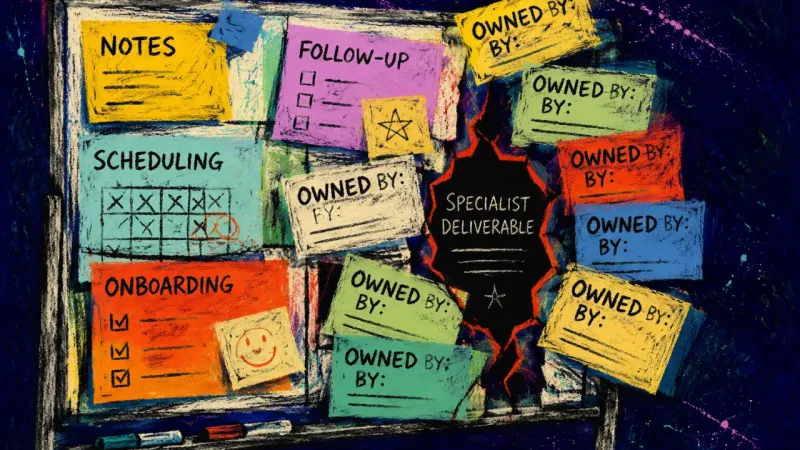
The 6:47 p.m. Figma Spiral
I recognize the scene immediately: if you are a Toronto product designer who opens the Google Doc before anyone volunteers, then finishes the prototype after the rent notification arrives, you may be living the competence-and-care trap called office housework and career visibility anxiety.
When I first met Jordan, it was 6:47 p.m. on a Tuesday in her Toronto apartment. I could hear the laptop fan working beside a cooling mug of tea; I watched her raised shoulders hold the afternoon in place while she refined a Figma prototype after cleaning meeting notes, arranging a stakeholder session, and answering onboarding questions. Slack was open at the edge of the screen. Her update mentioned only the unfinished prototype, not the invisible coordination work that had consumed the day.
Jordan told me, 'They call me dependable, but they cannot name what I built.' I heard the contradiction clearly: she wanted her real design work seen, yet each unassigned note, calendar thread, handoff document, and follow-up kept taking the time and credit that work needed. Her frustration looked to me like a browser with thirty tabs open, each one playing a different warning sound, while the tab containing her own career-defining work stayed muted.
I said, 'You are not tired of helping; you are tired of helping in a way that erases the work you were hired to do. We can look at this without blaming you and without predicting anyone's motives. Today, we will use the cards to turn the fog into a map, so the next choice belongs to you.'
Choosing a Compass for Invisible Work
I asked Jordan to place both feet on the floor, take one slow breath, and name the question exactly as she wanted it answered. I shuffled at an unhurried pace, using the movement to mark a transition from reacting to the latest Slack request to observing the pattern underneath it.
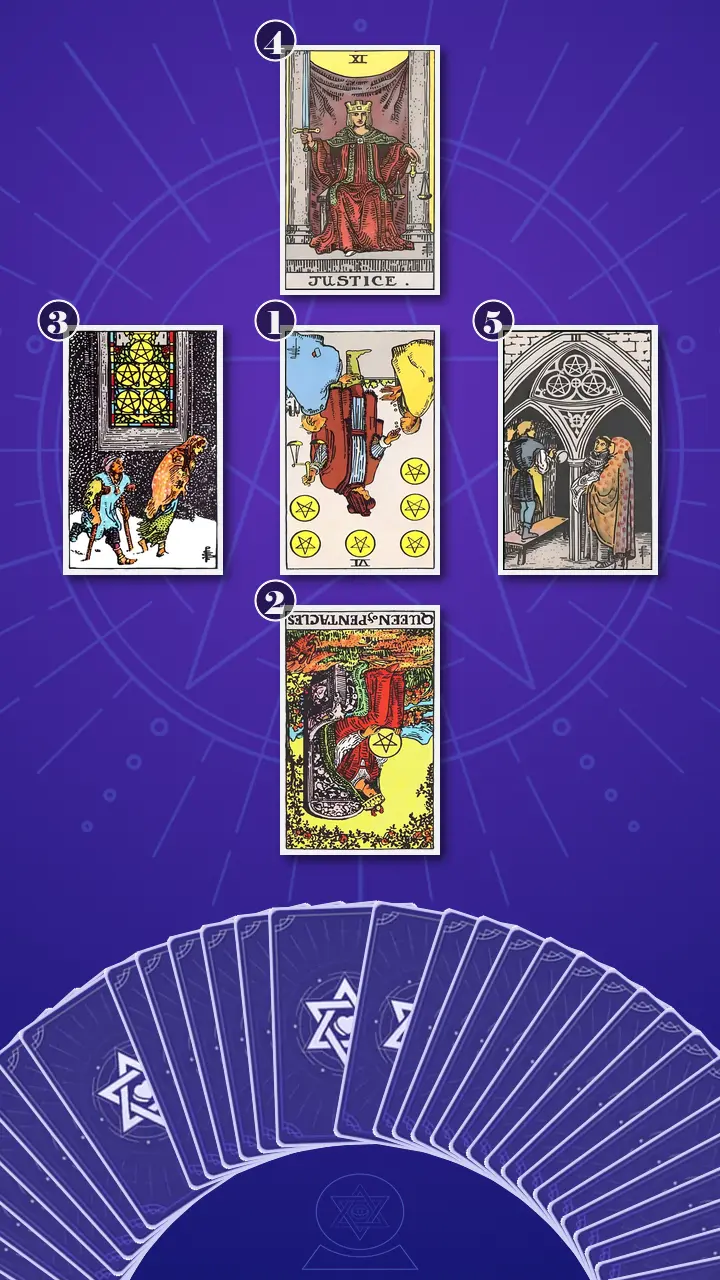
Today I would use a five-position reading called The Shadow Spread. For anyone asking how tarot works in a workplace question, I use the cards as an objective reflection tool: they give a structured set of images and positions through which we can examine behaviour, fear, evidence, and next steps. They do not issue a career verdict or decide what a manager will do.
The wording of Jordan's question, especially the phrase why do I keep doing this, called for inner excavation rather than prediction. The first position would show the observable loop. The second would reveal the protective mechanism beneath it. The third would name the fear that kept the loop in place. I would then rise to the integrating resource in the fourth position and finish with a practical action in the fifth, moving from visible pattern to grounded agency.
Reading the Map, One Unassigned Task at a Time
The Reversed Scales of the Workday
I began with the first position, which shows the diagnosis's observable loop: Jordan repeatedly accepts office housework while her substantive design contribution loses time and visibility.
The card was the Six of Pentacles, reversed. I focused on the standing figure holding the scales above two kneeling recipients. In the modern scene I could see Jordan in a hybrid Toronto product-team meeting, listening through the familiar silence after someone asks for a note-taker. Before the pause becomes awkward, she opens the shared document, handles the follow-up, and later schedules the stakeholder session while the design decision her role is meant to showcase loses the afternoon.
In reversed position, the energy is an excess of giving and a deficiency of transparent reciprocity. The card does not call generosity the problem. It asks who controls the distribution of time, opportunity, and recognition, who performs the low-visibility labour, who benefits from it, and whose name appears beside the visible result. Jordan's short-term relief when she makes a disorganized meeting functional keeps the exchange quiet; the long-term cost is that she returns to Figma after hours and leaves the support work out of her status update.
I also named the overcorrection risk. The answer was not to refuse every shared task in a public channel or to punish colleagues for needing coordination. The more precise move would be to wait for ownership to be discussed, request a rotating note-taker, and identify the specialist deliverable whose time she was protecting.
Jordan gave a small, bitter laugh. 'That is too accurate. It is almost rude.'
I did not argue with the laugh or rush to make it positive. I asked, 'What did the relief of fixing the gap cost you after the meeting ended?' Her fingers tightened around the mug, then loosened. She looked from the reversed scales to the Figma tab and admitted that the quick favour had often become an hour. The pattern was now discussable without turning her into the problem.
The Caretaker Who Became the System
I moved to the second position, which reveals the mechanism beneath the pattern: Jordan equates anticipating practical needs with being dependable and professionally valuable.
The card was the Queen of Pentacles, reversed. I returned to the Tuesday onboarding scene Jordan had described. A new colleague had asked a process question while Jordan prepared a research synthesis. She told herself it would take two minutes, recorded a polished walkthrough, noticed three more unanswered questions in the same thread, and returned to her research after the meeting window had disappeared.
The Queen's pentacle, held closely in both hands, became the shared Notion document, the calendar, and the incomplete handoff that Jordan protected as if their stability were her personal responsibility. The lush garden suggested real practical competence, but the reversal showed that this competence had fused with self-neglect. Care had become overextended caretaking. There was an excess of stewardship and a shortage of protection for her own attention.
I named the two voices directly: 'It will only take two minutes' and 'I am already giving away the hour.' I told her that her attention was acting like an algorithm that auto-routed every missing detail to the nearest reliable person. Because she noticed the problem first, the task began to feel assigned. Caretaker mode had become a background app draining the battery while the design file she needed for promotion sat unopened.
'Dependability is not a blank calendar,' I said. 'If the team can only experience your value when you absorb every gap, the measure of value is the thing we need to examine.'
Jordan stopped scrolling through the thread on her phone. I saw her thumb hover, then fall still. Her mouth pressed into a tired line, and she gave a quiet nod that carried both recognition and irritation. She was not being accused of caring too much; she was seeing that the quick-favour explanation had stopped matching the actual time cost.
The Window She Feared Leaving
I turned to the third position, which names the underlying fear that maintains the behaviour: setting a boundary may appear to threaten Jordan's worth, trust, or workplace belonging.
The card was the Five of Pentacles, upright. I did not read it as a prediction of rejection or job loss. I read the two figures moving through snow beneath an illuminated window as a picture of the consequence Jordan imagined before she had tested a clear request. One reasonable refusal became, in her mind, a possible exit from the trusted Slack channel, the promotion pathway, or the professional inner circle.
At the centre of this fear was a Friday performance-review call from her Toronto home office. Her manager had praised her as dependable and collaborative, then asked for clearer strategic impact. Jordan had a Figma case study open beside a spreadsheet of calendar invites and process questions. She wanted to explain that support work had consumed the time, but she worried the explanation would sound defensive. High rent and a cautious job market made being labelled difficult feel materially risky, even though nobody had directly threatened her position.
I asked, 'When you imagine saying, I cannot take this on without moving my design deadline, what exact consequence do you see first: losing trust, being excluded from opportunity, looking selfish, or appearing less capable?'
Jordan's breath caught. She traced the edge of the spread with one finger and said, 'I picture the room deciding I am not easy to work with anymore.' Outside the window, headlights moved across the wet Toronto street like brief streaks of light beneath the glass. I could see the distinction the card offered: the fear was real as an experience, but it was not evidence that the feared outcome would happen. That difference gave her something to investigate instead of something to obey.
When Justice Made the Trade-Off Visible
The Sword Above the Quiet Slack Thread
The room became unusually still before I turned the fourth card. I told Jordan that this position introduces the key transformation from reflexive agreement to evidence-based evaluation of workload, ownership, priority, and credit.
The card was Justice, upright, the antidote and integrating resource of the spread. Its balanced scales answered the inverted scales of the Six of Pentacles. Its upright sword supplied the clean sentence missing from Jordan's automatic yes: 'I can own the notes or complete the research synthesis by Friday, but not both without changing the timeline.' The card asked for a request, a time estimate, a displaced deliverable, a decision-maker, and a credit path.
At this point I used my signature lens, Career Cycle Phase Identification. I use it to distinguish a personal skill gap from an inevitable industry-wide contraction before someone turns a blocked career into a private character judgment. Jordan had evidence of strong design skill: she could run research, make decisions, prepare prototypes, and stabilize complicated collaboration. The bottleneck I could see was not a lack of competence. It was an organizational pattern that diverted her time and left her impact under-recorded. That did not guarantee a promotion, but it changed the question from what is wrong with me to what exchange is the team actually measuring?
When I apply Promotion Window Calibration, I also look at where organizational shifts are creating the path of least resistance for advancement. I would watch which projects receive leadership attention, who is invited to present, and where strategic decisions are moving, then help Jordan protect time for work that places her in that visible orbit. The cards could not promise that the organization would respond perfectly. They could help her collect better evidence and make a more deliberate choice.
At 6:47 p.m. in Toronto, Jordan had finally reopened Figma after an afternoon of notes, scheduling, and onboarding. Her shoulders were still high, her Slack update hid the support work, and the prototype waited for the room she kept giving away. She was caught between wanting recognition and fearing that naming the cost would sound difficult.
You do not have to earn visibility by remaining endlessly useful; define the exchange, name your contribution, and let Justice's scales make workload and credit measurable.
For the first beat, Jordan's body froze: her breath stopped at the top of an inhale, and her fingers hovered above her phone. Then her gaze lost focus as if it were replaying the manager's word dependable, the silent note-taker pause, and every evening she had reopened Figma after everyone else had gone offline. Finally, the thought reached her body. A long, uneven exhale left her chest; her shoulders dropped; her right hand unclenched one finger at a time. Her eyes grew bright, not with sudden certainty but with the sting of seeing the bargain clearly. 'So I have been trying to earn visibility by making myself harder to see,' she said. A streetcar bell sounded somewhere below us, sharp and ordinary. I let the silence stay long enough for the sentence to belong to her.
I asked, 'Now, use this new perspective to think back over last week: was there a moment when this insight might have made you feel differently?'
Jordan remembered a Monday Slack thread asking for follow-up notes while her research synthesis was due. She had treated the request as a character test and answered before checking her calendar. We began with a low-risk practice instead of a dramatic confrontation. For ten minutes, I asked her to open a blank note and write one recent support request, its actual time cost, the specialist task it displaced, and the person who could own it. I asked her to draft one trade-off sentence and send it only if and when she chose. If the exercise felt too activating, she could close the note and return to a neutral task. No card, manager, or reader was entitled to an immediate confrontation.
I told Jordan that this was the first crossing in her emotional transformation: from fear-driven overfunctioning and silent resentment toward grounded self-trust, explicit workload trade-offs, and visible collaborative authorship. She did not have a solved career. She had a measurable next question.
The Workshop with Her Name on It
The Three of Pentacles and the Visible Plan
I finished with the fifth position, which translates the target state into a practical workplace experiment involving documented contributions, clear role ownership, and negotiated support tasks.
The card was the Three of Pentacles, upright. I focused on the artisan standing where collaborators could examine both the craft and the plan. In Jordan's modern version, this was the next project kickoff: the design owner, presenter, reviewer, and documentation link were visible before the work was complete. At the next review, she could present her own design decisions and link the research evidence instead of hoping the work would speak from behind a wall of administrative support.
The energy had returned to Earth, but it was no longer stagnant. Justice had introduced the clear Air of criteria and language; the Three of Pentacles grounded that clarity in coordinated, recognized work. I explained that collaboration did not require permanent ownership of every support task. A rotating note-taker, a named onboarding owner, and a project record could make care shared rather than silently personal.
When I placed the Five and Three of Pentacles beside each other, the architecture changed. In the Five, people moved through snow outside a lit building, trying to remain close to support. In the Three, an artisan and collaborators stood inside a structured workplace examining the work together. I said, 'Belonging does not have to be earned by staying endlessly available. It can be built through shared plans, differentiated expertise, and visible participation in the work itself.'
Jordan looked at the final card for a long moment. Her jaw was still tight, but her posture had changed. She was not imagining a perfect office. She was imagining a role with an owner, an audience, and a record.
The One-Page Justice Sheet
I gathered the five cards into one story. The Six of Pentacles reversed showed an unequal exchange already visible in Jordan's calendar and Slack history. The Queen of Pentacles reversed explained why the exchange continued: her practical competence had become fused with the obligation to stabilize every gap. The Five of Pentacles revealed the belonging fear underneath, where one boundary felt like standing outside the lit window. Justice supplied measurable language, and the Three of Pentacles turned that language into recognized collaboration.
The core metaphor was a background app draining her battery while her design file stayed unopened. My blind-spot finding was simple but consequential: Jordan had been treating support work as a private test of whether she was valuable, rather than as work with a time cost, an owner, a priority, and a credit path. The key shift was not from helpful to unhelpful. It was from accepting support work on reflex to pausing, naming its cost, and negotiating ownership before saying yes.
I told her that the practical answer was not a personality makeover. It was a small system change. The Shadow Spread had moved from heavy Earth, through the clear Air of Justice, back into collaborative Earth. Feelings such as resentment and fatigue could provide information without making the decision for her. Initiative would come through one pause, one sentence, and one record at a time.
Small Experiments in Measurable Exchange
I gave Jordan three pieces of actionable advice. Each one was deliberately small enough to test without pretending that one conversation could transform a whole workplace.
- The Two-Breath Ownership PauseFor the next Slack request with no named owner, take two full breaths before replying. On your phone or in a private note, write the request, its estimated time, and the design task it would displace. Then type, in the thread or to the meeting owner, 'I can take the notes or protect the design deadline; which priority should move?' Try it once this week.Start with a low-stakes request. If saying the sentence aloud feels too exposed, type it. You can pause, revise, or end the conversation; the pause belongs to you.
- The Visible Workload LedgerEvery Friday, spend five minutes recording four columns in Google Sheets, Notion, Linear, or your existing status template: design work completed, support work completed, time spent, and visible evidence. Add one concrete outcome, such as a research insight, prototype decision, or stakeholder recommendation, with one link. Bring the short log to your next one-on-one and ask which specialist contribution should be highlighted.Keep it to three bullets and one link so the record does not become another piece of office housework. If your manager cannot review it immediately, keep it as evidence for your own performance conversation.
- The Micro-Orbit ObservationFor thirty days, use my Micro-Orbit Observation to track subtle organizational blueshifts and redshifts: new invitations to strategic work, visible project ownership, who presents decisions, repeated support requests, role ambiguity, and changes in priorities. Before the next recurring meeting, add a rotating note-taker field. At the next project kickoff, ask for an owner, presenter, reviewer, and documentation link for each deliverable.Treat the log as observation, not a layoff forecast or a reason to panic. Offer a two-week rotation trial, name the approximate weekly time, and stop or revise it if the arrangement creates a different burden. I use the pattern to calibrate an advancement window, not to make fear the manager of your career.
I reminded Jordan that fairness was not something she had to wait passively to receive. Justice gave her a criterion she could bring into the room, and the Three of Pentacles gave her a structure where specialist work could be built, examined, attributed, and remembered. The next step was hers, and it did not need to be dramatic to be real.
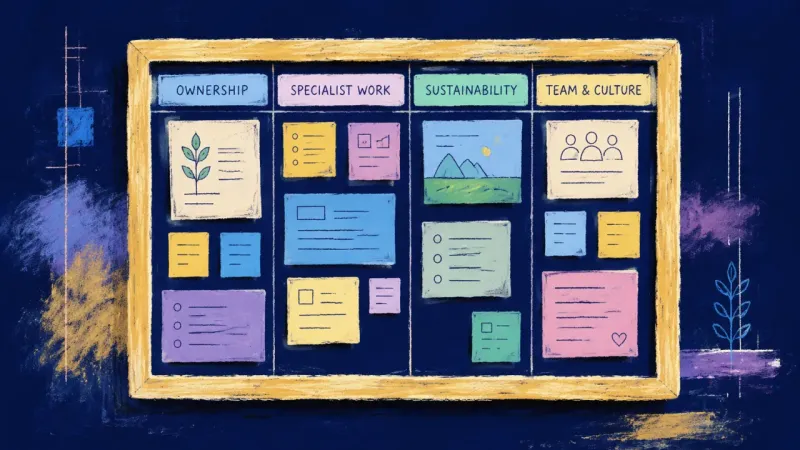
A Week Later, the Prototype Had Room to Speak
Four days later, I received a message from Jordan. She had taken two breaths when a Slack thread asked for a note-taker, written down the forty-five-minute estimate, and asked which priority should move. The team chose a rotating owner for the next two meetings. In her Friday log, she included the onboarding guide and follow-up work, but she also linked the research insight and prototype decision she had previously compressed into one vague sentence.
At her next one-on-one, her manager did not hand her a guaranteed promotion. Instead, the manager could finally see a record of both the coordination labour and the design work, and Jordan asked to present the research synthesis in the next stakeholder review. That was a small change, but it gave her substantive work an audience before a launch post could flatten the story into someone else's visible win.
The shift was clear but fragile: Jordan slept a full night, yet her first thought the next morning was, 'What if I am wrong?' This time, she smiled, opened the workload ledger, and let the question sit beside the evidence rather than erase it.
I saw the reading's Journey to Clarity as a movement from automatic helpfulness to grounded ownership. The cards did not rescue Jordan, predict her workplace, or make the decision for her. They helped her notice the exchange, name the cost, and make one part of her contribution visible. That is how cautious relief becomes self-trust: not by solving the whole career, but by giving the next choice a fairer structure.
When the meeting starts and your jaw tightens before you open the notes document, you can feel the bargain underneath: stay easy to work with by making your own work harder to see. You do not have to reject collaboration; you can let the work have an owner, an audience, and a record.
If you let one request become a visible trade-off this week, what small piece of your own work would you want the room to see?
This story is adapted from psychological research, written so that those in a similar struggle can see their own pattern in it — and find their next step clearly.These insights are not a substitute for professional psychological, medical, legal, or financial advice.
Learn more about our Journey to Clarity.
How did this insight land for you?
🫂 This Resonates Deeply
🌀 Living This Story
✨ Now I See Clearly
🌱 Seeing New Possibilities
🧰 Useful Framework
🔮 The Confirmation I Needed
💪 Feeling Empowered
🚀 Ready for My Next Step
Author Profile
 AI
AI“After a decade of guiding people through the stars, I’ve come to see life much like the orbits of planets: everything has its inevitable cycles. When you feel lost, please don't blame yourself; you might just be in a natural low tide. I’m here to sit under the night sky with you, offering a gentle cosmic perspective to distinguish temporary pain from the beautiful breakthroughs just around the corner.”
In this Career Tarot Reading :
Core Expertise
- Career Cycle Phase Identification: Determining if your current bottleneck is a personal skill gap or an inevitable industry-wide macro contraction.
- Promotion Window Calibration: Mapping the trajectory of organizational shifts to locate the path of least resistance for advancement.
Service Features
- The Micro-Orbit Observation: A 30-day tracking strategy to detect subtle organizational 'blueshifts' (opportunities) and 'redshifts' (layoff risks).
Also specializes in :
Explore Related Patterns:
Competence TrapYou were capable of running research, making design decisions, preparing prototypes, and stabilizing complicated collaboration, yet that capability also made you the first person to absorb notes, scheduling, onboarding, and handoff gaps. The more reliably you fixed what was missing, the more the surrounding work treated your capacity as available. That creates a competence loop rather than a simple time-management problem. Practical skill produces immediate order, but the same order hides the trade-off because the meeting works while the specialist work loses time, authorship, and credit. Reliability becomes the reason you are given more invisible work, which then limits the evidence of the work that could advance you. The interruption is to make capacity and contribution measurable before the next gap is absorbed. Named ownership, a visible project record, and a protected design priority allow competence to support the team without becoming the reason your most important work disappears.
Defensive OverfunctioningYou noticed the missing note-taker, the unanswered onboarding question, the stakeholder scheduling gap, and the incomplete handoff, then moved in before ownership was discussed. Because you could make the situation functional, the responsibility began to feel naturally yours, even when it displaced research or prototype work. The protective move was practical competence used to reduce an immediate gap. Its cost appeared later, when the design file waited until after hours and the coordination work remained outside the status update. The more efficiently you absorbed the missing pieces, the easier it became for the surrounding system to keep sending them to you. The workload ledger and the request for a named owner interrupt that automatic transfer. They preserve your ability to help while making the difference between supporting a project and becoming its unassigned infrastructure visible.
Visibility AvoidanceYour update named the unfinished prototype but left out the coordination work that had consumed the day, and the design tab stayed muted while every unassigned task demanded attention. Later, you described the mechanism with unusual precision: you had been trying to earn visibility by making yourself harder to see. The avoidance is indirect. You remain highly visible as the person who makes the system work, while the design decisions, research insight, and specialist authorship receive less space and less record. This can reduce the exposure of claiming credit in the moment, but it also allows other people to evaluate your contribution through the wrong evidence. The workload ledger, the concrete links, and your request to present the research synthesis give the work an audience without requiring a dramatic self-promotion performance. Visibility becomes an accurate record of contribution rather than a reward for being the easiest person to use.
Workplace People-PleasingAt 6:47 p.m., you were still refining the Figma prototype after cleaning meeting notes, arranging a stakeholder session, and answering onboarding questions. You opened the shared document before anyone volunteered, and a two-minute reply became an hour. The immediate relief of making a gap functional rewarded the automatic yes, while your design work paid the time cost. When you treated the Monday Slack request as a character test, declining stopped being a workload decision and became a threat to being dependable and easy to work with. That is how support became the route through which you sought trust and professional value, even as your own contribution disappeared from the update. Your later two-breath pause showed that the mechanism can be observed before it runs. Naming the time cost, the displaced deliverable, and the available owner lets you remain collaborative without using unassigned labor as proof that you deserve belonging.
Conditional Self-WorthYou said, "They call me dependable, but they cannot name what I built," and the contradiction became clearer when anticipating practical needs was linked to being professionally valuable. The support request was no longer just a task; it became a chance to prove the kind of person and colleague you were. That bargain creates a painful split. You want your design judgment and research insight to be visible, yet you keep spending the time and attention that would make them visible in order to preserve the image of being endlessly dependable. A boundary then feels like a judgment on your worth rather than a normal decision about capacity. The Friday record gives value a wider base. It allows support work, design decisions, and measurable outcomes to exist together, so usefulness is no longer the only evidence you bring into a performance conversation.
Explore Related Struggles:
Competence-Narrative SplitJordan can run research, make design decisions, prepare prototypes, and stabilize complicated collaboration, but the record presented to her manager compresses that range into the word dependable. Her status update shows an unfinished prototype without showing the notes, scheduling, onboarding, and follow-up work that explain why it remains unfinished. Your capability and the story told about your capability are moving on different tracks. You may be doing valuable specialist work and essential coordination at the same time, yet when neither is documented with ownership and outcomes, the public narrative can reduce broad competence to general helpfulness and leave your career-defining contribution without a clear name.
Competence-Obligation FusionJordan opens the shared document during the silence before anyone volunteers, then answers one onboarding question until a supposed two-minute favor becomes a polished walkthrough and several more replies. Because she sees the missing detail first and knows how to fix it, capability begins functioning as an assignment even when no owner has been named. You are caught in this structure when being competent no longer leaves you room to decide where that competence goes. The friction is not between caring and refusing to care; it is between using your skill for the work that defines your role and having every visible gap claim that skill first, until obligation consumes the agency that competence was supposed to create.
Self-Erasure ReliabilityAt 6:47 p.m., Jordan has completed the notes, stakeholder scheduling, and onboarding support, yet her status update mentions only the prototype that remains unfinished. Her manager can call her dependable but cannot name what she built because the work proving her reliability has also removed her specialist contribution from view. You remain reliable in this structure by absorbing what the team leaves unowned, but each successful rescue makes your own authorship harder to locate. The struggle sits inside that bargain: maintaining a reputation for dependability requires you to keep producing evidence that hides the work, time, and expertise you need others to recognize.
Utility-Belonging FusionJordan imagines saying that she cannot take the notes without moving her design deadline, and the first consequence she pictures is the room deciding she is no longer easy to work with. Nobody has directly threatened her position, yet an ordinary workload boundary carries the imagined weight of losing trust, opportunity, and access to the professional inner circle. You keep usefulness flowing because it has become intertwined with your place in the group. Once belonging depends on filling every gap, a support request is no longer just a request; it becomes a test of whether you are still welcome, making the protection of your own work feel socially expensive before anyone has actually responded.
Visibility-Safety SplitDuring the performance review, Jordan is praised as dependable and collaborative, then asked to show clearer strategic impact. She wants to explain that support work consumed the available time, but the sentence catches against her fear that naming the trade-off will make her sound defensive, selfish, or difficult. You need visibility to move your real work forward, yet the act of making its hidden cost visible appears to endanger the trust and access you are trying to preserve. Both forces remain active in the same moment, so silence feels safer while also maintaining the exact conditions that keep your contribution unseen.
Unseen Cost BindA process question that should take two minutes becomes a polished walkthrough, three more replies, and a vanished research window. The notes, scheduling, and follow-ups continue to look like small favors because Jordan's update does not record their actual duration or the design work they displaced. You cannot make a clear choice from a workload story that conceals its own costs. When each request appears minor but the accumulated loss remains invisible, protecting your real work can seem disproportionate, while accepting another task appears reasonable right up to the moment you reopen the specialist deliverable after everyone else has gone offline.
Responsibility-Authority SplitThe note-taking pause arrives without a named owner, and Jordan opens the document before the team decides who should carry the task or which priority should move. She then becomes responsible for the notes, follow-up, stakeholder session, and delayed prototype without having set the workload, timeline, or credit path. You carry the consequences of keeping the system functional while the authority to define the exchange remains elsewhere or goes unused. The resulting strain is deeper than having too much to do because responsibility keeps expanding without an equal ability to negotiate scope, redistribute ownership, or determine how your contribution will be represented.
Explore Related Emotions:
Grounded AgencyFour days later, Jordan takes two breaths, records that the requested notes will require forty-five minutes, and asks which priority should move. She does not reject collaboration or demand an immediate overhaul; she makes the previously hidden trade-off available for a shared decision. Grounded Agency is the felt shift from having to absorb every gap toward knowing that you can pause, measure, and choose. Its steadiness comes from concrete options: draft the sentence, revise it, send it, or stop. Your power does not depend on controlling the entire workplace response; it begins with keeping your own time and priorities present in the exchange.
Invisible Labor DreadSlack remains open at the edge of Jordan's screen while unassigned notes, calendar threads, handoffs, and onboarding questions repeatedly enter the space reserved for design. She already knows the sequence: make the immediate gap disappear, return to the prototype after hours, and leave the support work out of the visible record. The dread comes from anticipating a cycle whose costs are familiar before the next request even arrives. Invisible Labor Dread names the psychological weather of expecting necessary but unattributed work to consume another protected block of time. Making ownership, duration, and displaced work visible gives you concrete variables to examine instead of leaving the entire cycle as an unnamed threat.
Resentful ExhaustionJordan reaches 6:47 p.m. with meeting notes cleaned, a stakeholder session arranged, onboarding questions answered, and the prototype still waiting beside a cooling mug of tea. Her raised shoulders, bitter laugh, and tired expression show that this is no longer the ordinary cost of one collaborative day. When your competence is repeatedly converted into unrecorded maintenance, depletion can carry the heat of an exchange that feels unfair. Resentful Exhaustion names the combination of having little energy left and knowing exactly where it went. Treating that feeling as information lets you distinguish freely chosen support from work that is quietly displacing the contribution you want associated with your name.
Unseen Effort GriefJordan's colleagues call her dependable, yet they cannot name what she built. Her meeting notes, follow-ups, calendar work, and onboarding support keep collaboration moving, but even her own status update mentions only an unfinished prototype and leaves the labour that consumed the day unrecorded. When effort is useful to everyone but unavailable as evidence of your own contribution, the loss is larger than missing praise. Unseen Effort Grief names the ache of watching time, judgment, and care disappear from the story told about your work. Recording that labour and naming what it displaced cannot recover every lost hour, but it can prevent the next account of your contribution from repeating the same erasure.
Usefulness-Based Belonging FearJordan opens the shared document before the silence around an unassigned note-taking request becomes awkward. Later, when she imagines saying that she cannot take on the notes without moving her design deadline, the first consequence she pictures is the room deciding that she is no longer easy to work with. When usefulness becomes the price of staying trusted, every unattended gap can feel like a test of whether you still belong. Usefulness-Based Belonging Fear captures the pressure to remain endlessly available even when availability erases your specialist contribution. Naming that link creates room to test whether belonging actually depends on automatic agreement, instead of treating the feared conclusion as established evidence.
Cautious Self-TrustJordan wakes after a full night's sleep and immediately wonders, 'What if I am wrong?' Instead of allowing the question to invalidate the previous week, she opens the workload ledger and lets her uncertainty sit beside the recorded time, displaced work, and visible outcomes. Cautious Self-Trust does not require the disappearance of doubt. It appears when you allow your observations to retain weight even while uncertainty remains present. By checking interpretation against evidence and naming trade-offs before agreeing, you build confidence that is deliberate, revisable, and still genuinely your own.
Suppressed ResentmentJordan gives a small, bitter laugh when the unequal exchange is named, and her fingers tighten around the mug before loosening. She has repeatedly kept the support work and its cost out of her updates, allowing the team interaction to remain smooth while the objection stays in her body. When naming the cost feels likely to threaten cooperation, resentment can remain contained until it appears as tension, irritation, or a tired edge around another quick favour. Suppressed Resentment identifies that unspoken protest without turning it into a verdict about anyone's motives. You can use it as a signal that consent, workload, or attribution needs to become explicit before the feeling is forced to carry the entire message.
Clarity ShockJordan freezes when she hears the exchange stated plainly, then exhales as her shoulders drop and her hand unclenches one finger at a time. Her sentence, 'I have been trying to earn visibility by making myself harder to see,' gathers the silent note-taking pauses, late Figma sessions, and dependable praise into one coherent contradiction. Clarity can land with a sting when it reorganizes many previous choices at once. Clarity Shock names the jolt of seeing that the problem is not a lack of effort but the way effort has been distributed and recorded. Once the exchange becomes visible, you can examine it as a pattern with adjustable parts rather than as proof that something is inherently wrong with you.
Hollow RecognitionJordan hears the word dependable from colleagues and again during her performance review, followed by a request for clearer strategic impact. The praise recognizes that she stabilizes the workplace, but it does not identify the research, prototypes, or design decisions she wants evaluated. Recognition can sound affirming while still missing the part of you that most needs to be seen. Hollow Recognition captures the emptiness of being valued for availability while your authorship remains indistinct. Separating coordination labour from specialist output gives you a clearer basis for asking which contribution is being praised, measured, and carried forward.
Cautious HopeJordan's team chooses a rotating note-taker for the next two meetings, her manager sees a fuller record of her contribution, and she asks to present the research synthesis herself. None of these changes promises a promotion, but they give her specialist work an owner, an audience, and a record. Cautious Hope grows from credible movement rather than certainty about the outcome. You can see that one negotiated request may create more room for visible work while still recognizing that the wider environment remains imperfect. The future becomes somewhat more open because your next contribution no longer has to depend entirely on silent usefulness.
Explore Related Contexts:
Collaboration Credit ImbalanceJordan says they call her dependable but cannot name what she built. The team benefits when she makes a disorganized meeting functional, yet her update mentions the unfinished prototype without recording the coordination that consumed the afternoon. You are operating in an exchange where the practical result is shared but the authorship trail is incomplete. When a request has no owner, the nearest reliable person supplies the labor and the visible outcome can detach from the person who made it possible.
Competence TaxJordan notices unanswered questions, records a polished walkthrough, follows three more questions, and returns after the meeting window has disappeared. Her practical competence makes her the obvious destination for each missing detail, while the resulting time loss is treated as evidence that she can handle more. You are paying for being reliable with unplanned coordination work that displaces design output. The organization receives the benefit of your anticipation without automatically converting that contribution into protected time, specialist credit, or a named role.
Invisible WorkloadJordan's day contains meeting notes, calendar threads, handoff documents, follow-ups, and onboarding responses alongside research and prototype work. The support tasks are real labor, but they stay outside the short update that carries her contribution to the team. You are carrying a workload whose most time-consuming parts have no stable field in the performance record. The repeated return to Figma after everyone else has gone offline shows how the organization converts hidden coordination into private evening time, leaving the specialist output with less room to register.
Office Housework TrapJordan opens the shared document before anyone volunteers, cleans meeting notes, arranges a stakeholder session, and answers onboarding questions before returning to Figma at 6:47 p.m. The visible record names her as dependable while leaving the coordination labor and its time cost largely unattributed. You keep absorbing the gaps because the team has allowed silence to operate as an informal assignment system. That structure moves your attention away from the design work that could define your contribution, so the issue is a workplace allocation problem rather than a failure to help effectively.
Measured Reciprocity TrialJordan writes the forty-five-minute estimate, names the design task it would displace, and asks which priority should move. The team chooses a rotating owner, and her Friday log records both coordination work and the research insight with links. You are testing an exchange that makes time, ownership, priority, and credit visible at the moment a request arrives. That evidence lets collaboration be negotiated as a shared workplace decision, giving your substantive contribution a measurable place in the record.