Performative Identity Burnout at 11:40 p.m.
If you work where confidence, responsiveness, and personal brand blur together, praise may be the moment your body starts bracing. For a client-facing young professional in an expensive city, that reaction can signal performative identity burnout rather than a simple lack of confidence.
Jordan joined my video call from a small Toronto bedroom at 11:40 p.m. Blue phone light washed across the duvet, the radiator clicked behind her, and a mug of cold tea sat within reach. She tilted her screen toward the camera: three versions of the same LinkedIn update, each polished enough to hide that she was running on fumes. Two friends were still waiting to hear whether she would join them that weekend.
“I know how to look fine long before I know whether I am fine,” she said. Then she gave me the question beneath every edited sentence, fast yes, and carefully managed comeback: “Why do I keep performing a public self I can't sustain?”
I watched her jaw lock as she said it. Her exhaustion looked like a stage set built for the audience's camera angle: seamless from the front, unsupported behind the walls, and shuddering every time another expectation leaned against it. She could present confidence, receive approval, and then feel her limbs turn heavy while calculating whether she could afford to remain that person tomorrow.
“I don't think we need to decide that your competence is fake,” I told her. “I think we need to examine why being seen requires you to hide your actual capacity. Let's give this fog a structure, then find one way forward that your private life can support.”

Choosing the Transformation Path Grid
I asked Jordan to take one slower breath without forcing it to become a wellness performance of its own. I shuffled while she held one question in mind: what changes if a public commitment has to be sustainable, not merely convincing? The preparation was a focusing device, not a supernatural test she could pass or fail.
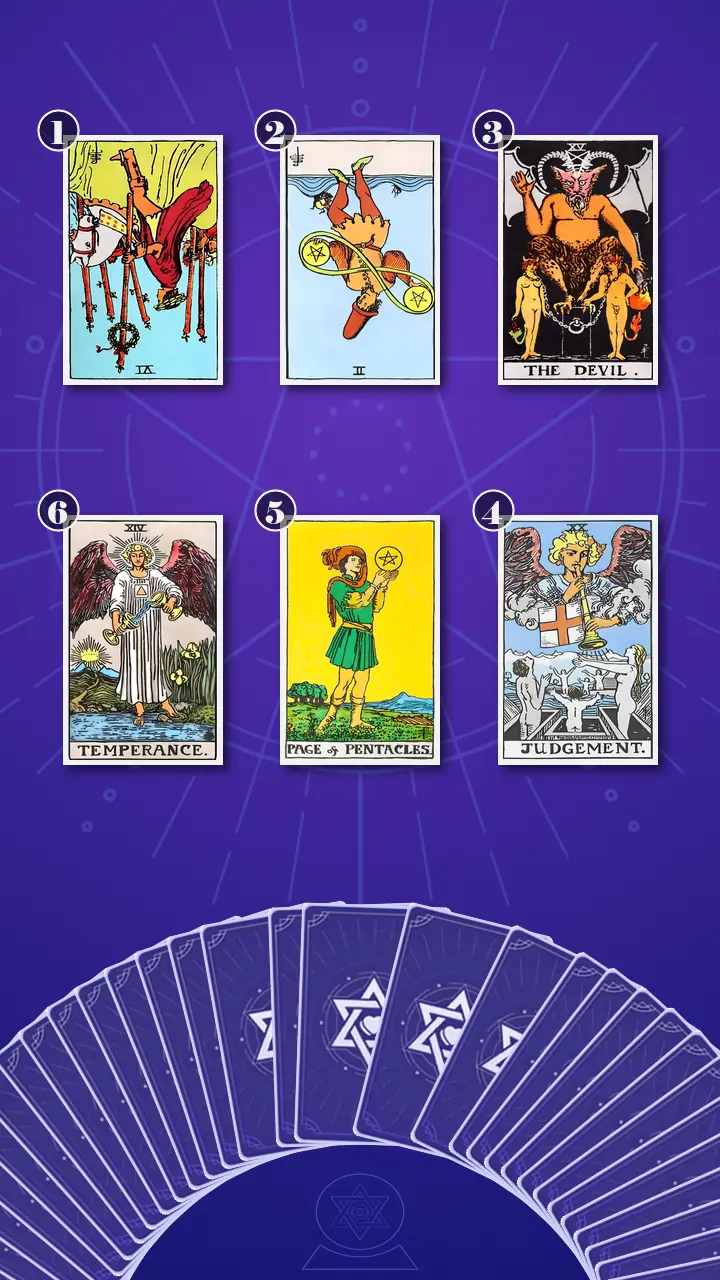
I chose the Transformation Path Grid · Context Edition, a six-card tarot spread arranged as two rows of three. A broad spread could have supplied general context, but Jordan needed to see the architecture of a specific loop: performance produces approval; approval increases expectations; expectations exceed capacity; collapse produces shame; shame finances another polished return.
For anyone wondering how tarot works in a situation like this, I use the cards as an external map for examining patterns. Card meanings in context can separate behavior, pressure, belief, insight, experiment, and integration. They do not predict whether an employer, friend, or online audience will approve of a boundary. They help me ask better questions so the person in front of me can make a more informed choice.
The top row would show Jordan's observable public performance, the overload hidden beneath it, and the worth-based bargain rebuilding the mask. The fourth position would be the catalyst: the honest self-recognition capable of interrupting the cycle. The final two cards would translate that insight into one measurable commitment and a more repeatable form of visibility.
Applause With a Maintenance Bill
Position One: The Victory That Would Not Let Her Rest
I turned the card representing the observable public-performance behavior and the exhaustion hidden beneath Jordan's polished presentation. It was the Six of Wands, reversed.
I pointed to the elevated rider and the crowd surrounding him. Upright, the card can represent recognition, confidence, and a visible success. Reversed, the public elevation becomes unstable. The laurel is still real, but it begins to feel like a standard that could slip at any moment.
I connected it to the Monday presentation Jordan had described. She had delivered a polished client update, watched clapping reactions appear in Slack, and heard a director call her “always so confident.” She smiled on camera. For the next hour, however, she replayed every answer and worried that she had committed herself to reproducing the same energy at every future meeting.
“They saw confidence; you felt the maintenance bill arrive,” I said. “Praise can feel like pressure when it rewards the version of you that costs the most to maintain.”
I read the reversal as both a blockage and an excess. Recognition was not entering Jordan as stable self-belief; it was getting blocked at the point where she might have absorbed it. The excess appeared in the monitoring that followed: checking reactions, editing uncertainty out of updates, and treating one successful appearance as a permanent service-level agreement.
Jordan did not nod. She let out a short, bitter laugh and looked away from the screen. “That is so accurate it feels a little brutal,” she said. Her fingers tightened around the cold mug before loosening again. “The second someone says I handled something well, I think, great, now I can never have an off day.”
“The card isn't saying the success was fraudulent,” I replied. “It's asking what happened after the success entered your body. Which kinds of visibility leave you grounded, and which ones send you into surveillance mode?”
Position Two: Four Apps and No Remaining Capacity
I turned the card representing the practical and emotional overload that makes Jordan's public identity impossible to sustain. It was the Two of Pentacles, reversed.
The infinity-shaped loop binding the two pentacles resembled the circuit Jordan kept running: presentation deck, Slack, dinner group chat, public update, postponed recovery, then back to the presentation deck. She had all four open at once and kept telling herself that a better calendar would fix the strain. By evening, she had missed a deadline, ignored two people, and started building another colour-coded schedule instead of reducing the load.
I read this reversal as excess becoming blockage. Adaptability had been pushed past its useful range. Jordan was treating every request as urgent and every visible role as non-negotiable, so no productivity system could create the missing hours or restore the energy already spent monitoring her image.
“You are not failing at balance when every item has been labelled non-negotiable,” I told her. “A Notion dashboard can document overload beautifully. It cannot make an impossible visibility load sustainable.”
Her shoulders dropped, but her stomach seemed to pull tight beneath her sweatshirt. She looked at the calendar open beside our call as if it had just changed languages.
“But Toronto rent is still Toronto rent,” she said. “I can't just become less useful at work because I need more recovery time.”
“Agreed,” I said. “We are not going to pretend financial risk disappears when you set a boundary. The practical question is narrower: where are you implying speed, scope, or availability that the job did not explicitly require? We protect income by locating the difference between a real obligation and an approval-driven upgrade you added yourself.”
Position Three: The Bargain That Auto-Renewed
I turned the card representing the repetition compulsion and worth-based belief that reconstructs the same public mask after every collapse. It was The Devil, upright.
I kept Jordan's attention on the loose chains around the two figures rather than only on the imposing figure above them. The card did not tell me she was trapped by fate. It showed me a learned bargain that felt compulsory because it paid quickly: conceal uncertainty, perform usefulness, receive approval, and postpone the cost.
Jordan recognised the modern version immediately. After a quiet period online, she knew an ordinary return would cost less, yet she drafted a momentum-heavy announcement. Quick reassurance felt safer than discovering whether colleagues and friends would remain connected to someone who was less available. The polished return restarted the very expectations that had driven her away.
I read The Devil's upright energy as an excess of attachment reinforced by shame. Her public and private selves had developed a Severance-style partition: the competent work self appeared contained, while the person going home absorbed every hidden expense. Like an engagement algorithm trained on polished confidence, the pattern kept serving her more situations that demanded polished confidence because that was the behavior receiving the fastest reward.
“The mask survives because it pays quickly, even when it charges you later,” I said. “The difficult part is that the payment is not imaginary. Approval, credibility, and connection matter. The question is whether the current price is the only price available.”
Jordan's thumb stopped moving along the mug's rim. Her gaze went unfocused for several seconds, as if she were replaying every enthusiastic yes that had become a resentful obligation. Then she swallowed.
“I resent being needed like this,” she said quietly. “But what if needing less from me means wanting less of me?”
I let the question remain intact. “That fear explains why the bargain once made sense. It does not make you fake, manipulative, or weak. But loose chains still matter. They suggest the rule can be examined: what reward are you protecting, and what smaller test could show whether belonging truly requires this much self-concealment?”
When Judgement Turned the Collapse Into Evidence
Position Four: The Call Beneath the Comeback
The radiator clicked once and went quiet. I turned the card representing the self-recognition capable of interrupting the cycle without demanding another perfected reinvention. This was the reading's catalyst: Judgement, upright.
The trumpet sounded above figures rising without costumes or defensive poses. I read its energy as balance returning through honest evaluation: self-forgiveness without avoidance, accountability without prosecution, and the courage to answer an internal standard before automatically obeying an audience's expectations.
Instead of composing another comeback, I asked Jordan to imagine reviewing the panel invitation she had recently accepted and later withdrawn from. She had said yes while activated by being chosen, noticed dread three days later, concealed it, overprepared, and finally cancelled. Judgement did not ask her to brand that sequence as unreliability. It asked her to let the sequence alter her next commitment.
At 11:40 p.m., the post was polished, two friends were still waiting for a reply, and Jordan's jaw was tight. She knew how to look available. The private question was whether her real life could afford what that version of her had just promised.
The trumpet in the card gave me the sentence the entire top row had been moving toward:
The collapse is not proof that you failed to perform the role. It is evidence that the role was asking more of you than your real life could keep funding.
Stop treating the collapse as proof that you failed the role; answer Judgement's trumpet by choosing one honest and sustainable way to be seen.
Jordan's breath stopped first. Her fingers remained suspended above the mug, and her pupils widened as if the last cancellation had begun replaying behind her eyes. Then resistance reached her before relief did. “But doesn't that mean I chose this?” she asked, her voice suddenly sharper. “Doesn't it mean I got it wrong every time?” I let the anger have room before answering. “It means the strategy once protected something important and now costs more than it protects. Information is not an indictment.” Her gaze dropped to the card. The tight line between her eyebrows softened; her fingers opened; one shoulder lowered and then the other. A long breath left her with a faint tremor. Her eyes reddened, but she did not look entirely relieved. For a moment, she looked almost unsteady, as if putting down the verdict had exposed the responsibility of making a different choice. “Oh,” she said. “Then I can't keep calling every crash a discipline problem.”
“Now, using this new perspective, think back: was there a moment last week when this insight might have made you feel different?” I asked.
She chose the panel invitation. The old story said she should have become organised and energetic enough to deserve it. The new reading identified the earlier signal: her pulse had jumped at the visibility, but her calendar already contained two client launches. The collapse had not begun when she cancelled. It had begun when she treated being asked as proof that she had capacity.
I invited her to set an eight-minute timer. In a private note, she wrote three headings: what I presented, what it cost, and what smaller promise my private capacity could have supported. I reminded her that she did not need to send the note, justify herself, or examine any interaction that felt unsafe. The minimum version was one sentence naming the smaller promise.
This was where I used what I call a Potential Actionability Assessment. I separated the role's advertised output from its execution rate in an ordinary week, then added the recovery cost that Jordan's public metrics excluded. If a role worked only while adrenaline was high, meals were skipped, and the weekend was sacrificed, it was not unrealised potential. It was structurally unfunded.
I felt an old Wall Street association surface: a position can look profitable while carrying an unpriced liability. Jordan's applause was visible revenue; the hours of monitoring, withdrawal, and repair had remained off the books. I was not reducing her life to a spreadsheet. I was protecting her from a flattering calculation that had omitted its largest cost.
That distinction marked the first movement from exposure dread and forced confidence to cautious self-trust and repeatable visibility aligned with real capacity. It was not yet certainty. It was the quieter ability to believe a capacity signal before a collapse had to prove it.
One Promise the Private Self Could Keep
Position Five: The Page's Wednesday-Sized Experiment
I turned the card representing one small, measurable public commitment Jordan could sustain in ordinary life. It was the Page of Pentacles, upright.
The Page held one pentacle at eye level with steady, undivided attention. After the reversed Two of Pentacles had shown four active tabs and no real priority, the Page restored Earth energy in a state of grounded balance. The card offered learning through one bounded experiment, not a full identity launch.
I connected it to a Wednesday client check-in. Jordan could prepare one completed deliverable, one unresolved issue, and one realistic Friday response time. She would not volunteer extra revisions to sound proactive. Before anyone reacted, she would define those three elements as enough. Afterward, she could record what happened instead of treating the meeting as a verdict on her worth.
“You are not announcing a new you,” I said. “You are testing one promise your Wednesday-night self can still keep.”
Jordan reached for her phone, but this time she opened Notes rather than LinkedIn. She typed three lines, stopped, and looked almost suspicious of their simplicity.
“So the goal isn't to feel completely confident before I say it?”
“No,” I said. “The goal is to collect evidence that discomfort and sustainable behavior can exist in the same meeting. Confidence is allowed to arrive later.”
Position Six: Water Between the Public and Private Cups
I turned the card exploring how public visibility could become an integrated expression of Jordan's real capacity rather than a separate persona. It was Temperance, upright.
I followed the water moving continuously between the two cups. I read this as balance through ongoing adjustment, not a flawless midpoint Jordan had to maintain. One foot remained on practical ground while the other touched emotional water. Competence and uncertainty, ambition and recovery, visibility and privacy could all belong to the same person.
I described the card in daily terms: a realistic response time in an email, a declined panel invitation, one evening left unscheduled, and a quiet week online that did not require a triumphant comeback post. The public rhythm could include selective invitations and early scope changes. Jordan could be skilled without implying endless availability, and private without turning privacy into disappearance.
“My limits don't have to arrive as a disappearance,” Jordan said, watching the water between the cups. “They can be present in the first answer.”
As she spoke, the radiator started again, but its hum no longer seemed to crowd the room. Her breathing was still careful. The difference was that she was no longer using the next breath to rehearse a defence.
“Exactly,” I said. “Sustainable visibility is allowed to look ordinary. Temperance does not promise that every boundary will be welcomed. It shows a repeatable rhythm in which your private capacity gets a vote before the promise becomes public.”
Making the Stage Load-Bearing
I gathered the six cards into one coherent story. The Six of Wands reversed showed recognition turning into image maintenance. The Two of Pentacles reversed revealed that the workload could not fit inside Jordan's actual week. The Devil exposed the approval bargain making that overload attractive despite its cost. Judgement interrupted the automatic rebuild. The Page of Pentacles offered one bounded test, and Temperance showed how repeated adjustments could let public and private life exchange information before either side collapsed.
The cognitive blind spot was precise: Jordan had been treating an impossible level of visibility as a scheduling problem. Better organisation could help with real work, but it could not support a persona that promised more speed, certainty, enthusiasm, and access than one person could repeatedly provide.
The transformation direction was equally specific. She did not need to replace the polished persona with a newly perfected “authentic” identity. She needed to move from automatically presenting the most impressive version of herself to making one visible commitment at a time that her private self could realistically support.
I call the next part Pseudo-Growth Eradication: I remove any self-improvement idea that sounds profound but cannot survive an ordinary Tuesday. There would be no total rebrand, punishing morning routine, or elaborate dashboard pretending to be change. We kept only actions with a clear context, a low starting cost, and an observable result.
Actionable Advice for the Next Thirty Days
I gave Jordan three next steps. Each was designed to create information rather than demand a personality overhaul.
- The Eight-Minute Collapse Audit On one evening this week, set an eight-minute phone timer and review one recent cancellation, delayed reply, or disappearance. Write four lines: the promised scope, the actual cost, the earliest physical capacity signal, and a neutral conclusion beginning, “This role became unsustainable when...” Keep the note private and factual. If eight minutes feels heavy, write only the first moment your body signalled too much, then stop.
- The One-Promise Visibility Test Before one low-stakes meeting or deliverable, define exactly what counts as enough. Offer two prepared sentences, or reduce the scope by about 20 percent and confirm the revised output with the relevant person. When reasonably safe, use: “I can do X by Y; I cannot add Z this week.” Define the minimum before approval starts arriving. Use email or direct message if live conversation makes overpromising more likely, and choose a private rehearsal if the external test carries material risk.
- The Evolution KPI Framework For thirty days, take under sixty seconds to log each visible commitment in five fields: promise, due date, kept or changed, first capacity signal, and recovery cost from zero to three. Review the note for ten minutes each Friday and count how often a limit was communicated before a crisis. Be strict about honest logging and flexible about scope. The KPI is not how many times you say yes; it is whether the promise and the capacity supporting it are becoming more closely aligned.
I told Jordan these actions were not another audition. Tarot had not issued orders, and the cards could not guarantee that every colleague or friend would respond perfectly. They had helped us identify leverage. She remained the person deciding which experiment was safe, useful, and proportionate to her life.

Six Days Later: The Quiet Proof
Six days later, I received her screenshot: “I can't take the panel during launch week, but I can offer a 30-minute virtual Q&A later this month.” She slept through the night, then woke thinking, “What if I looked difficult?” She smiled and did not send a correction.
The organiser had accepted the alternative without drama. I did not treat that response as proof that every future boundary would be easy. The meaningful evidence was that Jordan had checked her calendar before answering, named a smaller contribution, and remained present after sending it. She had not needed a disappearance or a comeback to regulate the interaction.
For me, that was the honest scale of this Journey to Clarity. Jordan had not solved her entire relationship with visibility. She had made one capacity-accurate promise and allowed the same person who made it to live with its consequences.
The cards did not rescue her or reveal a fixed destiny. They gave her a sufficiently objective map to see where approval had been distorting the numbers. She supplied the discernment, sent the message, and began building cautious self-trust through evidence.
When praise makes your jaw tighten because you can already feel the next expectation arriving, it can be difficult to admit that the version earning respect may also be the version leaving you too depleted to stay connected. Simply noticing that maintenance bill means the old bargain is no longer operating entirely out of sight.
If your next visible choice did not have to repair your image or rebuild the stage set, what is one smaller promise your private self might actually want to stand behind?
This story is adapted from psychological research, written so that those in a similar struggle can see their own pattern in it — and find their next step clearly.These insights are not a substitute for professional psychological, medical, legal, or financial advice.
Learn more about our Journey to Clarity.
How did this insight land for you?
🫂 This Resonates Deeply
🌀 Living This Story
✨ Now I See Clearly
🌱 Seeing New Possibilities
🧰 Useful Framework
🔮 The Confirmation I Needed
💪 Feeling Empowered
🚀 Ready for My Next Step
Author Profile
 AI
AI“I spent years in the intense, high-stakes world of Wall Street. I know exactly how isolating and heavy the weight of uncertainty can feel in the dead of night. I use strategic, commercial logic not to be cold, but to protect you from unnecessary friction. Think of me as a fellow traveler who has walked the same rocky path—offering sharp but deeply supportive wisdom to help you clear the fog and confidently win your narrative back.”
In this Personal Growth Tarot Reading :
Core Expertise
- Pseudo-Growth Eradication: Stripping away 'self-help fluff' to audit the actual ROI and execution rate of your personal development efforts.
- Potential Actionability Assessment: Translating abstract cognitive upgrades and inspirations into ruthless, disciplined strategic milestones.
Service Features
- The Evolution KPI Framework: A 30-day strict execution challenge that forces a philosophical realization into a measurable, real-world behavioral change.
Also specializes in :
Explore Related Patterns:
People-Pleasing Resentment CycleJordan accepts the panel while energized by being chosen, conceals the dread that follows, overprepares, and eventually cancels. Looking back, she recognizes the same sequence in enthusiastic yeses that later became obligations she resented. When you agree in order to protect connection, the immediate yes regulates the fear that a limit could make you less wanted. Because the real no has not disappeared, it returns after the social reward has faded, often as resentment, delayed communication, withdrawal, or a cancellation that now carries more relational weight. People-Pleasing Resentment Cycle captures how accommodation can undermine the connection it was meant to secure. The reversed cycle is not evidence that your limits are unreasonable; it shows what happens when those limits are excluded from the first answer and forced to re-enter the relationship later.
Social MaskingJordan's three versions of the same LinkedIn update, confident on-camera smile, and admission that she can look fine before knowing whether she is fine show a public presentation designed to remove uncertainty from view. The performance does not prove that her competence is fraudulent; it shows that visibility has become conditional on concealing the capacity limits surrounding that competence. When you repeatedly edit out fatigue, hesitation, and ordinary variation before anyone else can see them, the polished surface becomes a defensive buffer against possible disapproval. Because the buffer earns praise, it can feel both effective and compulsory, even as your private life absorbs the preparation, monitoring, and recovery that the audience never sees. Social Masking names this costly partition between what can be publicly displayed and what is privately sustainable. The pattern becomes visible when your public self is not simply selective, but makes ongoing promises that your unedited life was never consulted about.
Usefulness-Based Self-WorthJordan's question, "What if needing less from me means wanting less of me?" exposes the bargain beneath the fast yeses and polished confidence. Her concern is not only whether a task will be completed; it is whether reducing her usefulness might reduce her claim to approval, credibility, or connection. When you organize self-worth around being consistently useful, a finite capacity signal can feel like a threat to belonging rather than neutral information about time and energy. That belief makes overcommitment psychologically rewarding in the short term, because every demanding role offers another chance to prove that you deserve your place. Usefulness-Based Self-Worth explains why the public identity persists even after its cost becomes obvious. You are not merely maintaining a busy schedule; you are protecting a conditional route to feeling valued, which is why a smaller promise can initially feel more exposing than an unsustainable one.
Visibility Shame LoopJordan withdraws when expectations exceed her capacity, then drafts a momentum-heavy announcement instead of allowing herself an ordinary return. The comeback repairs the visible image quickly, but it also restarts the speed, confidence, and availability expectations that contributed to the withdrawal. When you interpret collapse as proof that you failed the role, shame creates pressure to demonstrate that the failure was temporary and the polished identity remains intact. Renewed visibility then becomes a form of image repair, even though the repaired image carries the same maintenance demands as before. Visibility Shame Loop names this self-renewing sequence: performance, approval, escalation, collapse, shame, and another performance. The loop loosens when a crash is treated as capacity evidence rather than a verdict that must be erased through a more convincing return.
Workplace People-PleasingJordan accepts the panel while already carrying two client launches, volunteers extra revisions to sound proactive, and routinely gives a fast yes before checking what her week can hold. These choices make her look responsive and valuable, but they also move her real capacity out of the workplace negotiation. When you use extra availability to lower the immediate risk of disappointing colleagues, agreement becomes an approval-regulation strategy rather than a capacity-based decision. The relief arrives at the moment of being chosen or appreciated, while the practical and emotional cost appears later through dread, overpreparation, resentment, or cancellation. Workplace People-Pleasing captures that sequence because the visible overcommitment is serving a relational function: it tries to secure credibility and acceptance by offering more than the situation explicitly requires. The pattern can be interrupted when your first answer includes both what you can contribute and what you cannot sustainably add.
Black-and-White ThinkingJordan hears that she was "always so confident" and immediately concludes that she can never have an off day. She also treats every visible role as non-negotiable and interprets being asked to participate as proof that she has the capacity to do it. When you convert one successful performance into a permanent standard, ordinary variation disappears from the cognitive map. The available options become fully impressive or visibly failing, endlessly useful or less wanted, certain or exposed, even though the story contains many realistic positions between those extremes. Black-and-White Thinking helps explain why the public self must remain so intense: the mind has classified moderation as evidence against competence. The pattern reverses nuance into threat, making a bounded contribution feel psychologically riskier than an unsustainable display.
Productivity as SafetyJordan misses a deadline, leaves two people waiting, and responds by building another color-coded schedule while four competing channels remain open. The dashboard records the overload, but it does not challenge her assumption that every request, visible role, and response standard must stay in place. When you turn toward increasingly elaborate systems at the moment a commitment needs to be reduced, organization can function as a defense against the more exposing decision to change scope or say no. The system restores a temporary sense of control and keeps the problem framed as personal efficiency, even when the missing resource is actual time and recoverable energy. Productivity as Safety names the point where planning stops serving the work and starts protecting the identity that promised the impossible load. The reversed pattern keeps you optimizing the container so you do not have to examine why every demand was admitted into it.
Strategic VisibilityJordan checks her calendar before answering the next panel request and offers a 30-minute virtual Q&A later in the month instead of performing unlimited availability during launch week. She names both the boundary and the contribution, then remains present after the organizer accepts rather than sending a correction to repair her image. When you define visibility around a bounded, capacity-accurate promise, the audience receives more of the information that your private life already has. The psychological shift is not withdrawal from ambition or a guarantee that every limit will be welcomed; it is a move from automatic impression management toward deliberate scope selection. Strategic Visibility describes this more integrated way of being seen. Your skill remains public, but speed, access, and enthusiasm no longer have to be maximized every time, allowing the same person who makes the commitment to live with it afterward.
Explore Related Struggles:
Compliment Debt LoopJordan hears that she handled the presentation well and immediately thinks, "Great, now I can never have an off day." The compliment does not close around completed work. It follows her into reaction checking, edited uncertainty, and the expectation that every future meeting must reproduce the same energy. Praise becomes debt when you experience recognition as an advance payment on performances you have not yet agreed to provide. You may keep delivering the public self because each compliment appears to raise the cost of showing normal variation later. The loop can be examined at the moment approval arrives: appreciation for what you did does not automatically establish an unlimited obligation to remain identical.
Masked Self-DivisionJordan has three polished LinkedIn drafts open while two friends are still waiting for an answer. On camera she can smile, deliver confidence, and appear fully available; away from the camera, the same performance leaves her monitoring reactions, postponing recovery, and calculating whether she can afford to remain that person tomorrow. The split forms when your public self is permitted to display competence but not the capacity limits attached to it. One side makes the promise and receives the applause, while the private side pays through heavy limbs, lost evenings, delayed replies, and eventual withdrawal. Your competence does not have to be fake for the division to be real; the structural problem is that the audience sees the output while the person producing it is hidden from the terms of the agreement.
Short-Term Maintenance TrapJordan returns from a quiet period by drafting a momentum-heavy announcement, even though she already knows that an ordinary return would demand less from her. The polished comeback restores reassurance quickly, but it also signals renewed confidence, access, and momentum, rebuilding the expectations that previously pushed her away. This keeps you trapped between immediate image repair and long-term sustainability. A convincing return relieves the exposure of being less visible, while its maintenance bill arrives later through monitoring, overpreparation, cancellation, and another disappearance. The cycle persists because the short-term payment is real; seeing the full sequence makes it possible to judge a comeback by what your private life will have to fund after the applause fades.
Utility-Belonging FusionJordan names the bargain directly when she asks whether people needing less from her would mean wanting less of her. Her fast yeses, carefully managed returns, and added offers of speed or scope keep producing immediate signals of approval, credibility, and connection. Once usefulness begins carrying the weight of belonging, reducing a commitment no longer feels like a practical adjustment. It can feel like testing whether you remain worth keeping when you are less available, less impressive, or less convenient. That is why the performance can survive even after its cost is obvious: you are not only deciding how much to do, but confronting whether connection can continue when your actual capacity is allowed into view.
Capacity-Identity FusionJordan accepts the panel while the visibility of being chosen is still activating, even though her calendar already contains two client launches. The capacity signal arrives later, after the invitation has become a public promise, and she responds by concealing the strain, overpreparing, and eventually cancelling. When being selected is treated as proof of capacity, a temporary opportunity starts defining who you are required to be. Your highest-output moments become identity evidence, while the limits of an ordinary week are treated as personal inconsistency. The resulting bind is not simply too much work: it is the pressure to keep embodying a public identity whose advertised capacity was never checked against the life expected to sustain it.
Recognition-Containment SplitJordan smiles through a praised client update, watches the clapping reactions arrive, and then spends the next hour replaying every answer. The director's comment that she is "always so confident" does not remain attached to one successful presentation; it becomes a standard she expects herself to meet in every future room. When recognition reaches you as a maintenance demand, success cannot become stable evidence of competence. You receive the audience's approval while simultaneously preparing for the next test, leaving praise trapped between being seen and being allowed to have an ordinary off day. The issue is not whether the achievement was real, but whether one strong performance is being contained as one moment or expanded into an identity contract.
Explore Related Emotions:
Imperfection Exposure DreadAfter one polished presentation, Jordan interprets "always so confident" as a rule that she can never have an off day. She edits uncertainty out of updates and monitors reactions as though one uneven appearance could expose the whole public identity. Imperfection Exposure Dread is the feeling that normal fluctuation will be read as evidence that you never deserved the recognition. Naming it lets you distinguish actual performance requirements from the internal demand to remain unreproachably consistent.
Polished AlienationJordan smiles on camera while the person going home carries the monitoring, withdrawal, and repair that no audience sees. Two friends remain unanswered as she refines a post designed to make the public version look seamless. Polished Alienation is the estrangement that appears when your most visible self receives recognition but cannot communicate your real capacity. The polish still reflects genuine skill, yet the split can leave you detached from both the audience and the private person funding the performance.
Praise AnxietyJordan's jaw locks when a director calls her "always so confident," and she spends the next hour replaying answers after the Slack applause. The praise registers as a contract to reproduce the same energy, so your body can brace at the very moment everyone else sees success. That shift from recognition to self-surveillance is Praise Anxiety: being seen positively does not feel settling because it raises the perceived cost of an ordinary off day. Naming the maintenance demand separates the real competence from the pressure attached to displaying it continuously.
Usefulness-Based Belonging FearJordan asks, "What if needing less from me means wanting less of me?" after recognizing how quickly concealment and usefulness buy reassurance. The question reveals that each limit can feel like a test of whether connection survives when you stop overdelivering. Usefulness-Based Belonging Fear names the dread that your place with others depends on remaining highly available, polished, and productive. Seeing that bargain clearly gives you room to test belonging with a smaller promise instead of treating the fear as proof.
Capability ShameJordan treats the withdrawn panel invitation and each later crash as evidence that she got the role wrong or lacked discipline. That verdict converts an overextended commitment into a judgment about what kind of person she is. Capability Shame is the felt shrinking that follows when capacity limits are mistaken for proof of inadequacy. Reframing the collapse as information allows you to assess the promise itself without putting your entire competence on trial.
Cautious Self-TrustSix days later, Jordan checks her calendar before offering a 30-minute Q&A and does not send a correction when she wakes wondering whether she looked difficult. She relies on the first capacity signal without waiting for another collapse to validate it. Cautious Self-Trust is not certainty that every boundary will be welcomed; it is the quieter willingness to believe your own limits early enough to act on them. The single kept promise gives you evidence that public visibility and private capacity can belong to the same decision.
Identity PR FatigueJordan is polishing three versions of the same LinkedIn post at 11:40 p.m., even though she knows an ordinary return would cost less. The repeated comeback work turns visibility into ongoing reputation maintenance instead of a simple act of communication. Identity PR Fatigue describes how depleted you feel when every absence, boundary, or quiet week seems to require a persuasive public narrative. The label keeps the focus on the felt cost of managing perception and opens the possibility of being visible without relaunching yourself.
Visibility ReliefJordan remains present after declining the panel during launch week and offers a bounded alternative instead of disappearing or staging a comeback. The interaction continues without the immediate rupture she had been bracing for. Visibility Relief is the felt release of learning that you can stay seen while showing a limit. That experience widens the available choices between total performance and total withdrawal, making ordinary, repeatable visibility easier to imagine.
Resentful ExhaustionJordan watches enthusiastic yeses become obligations and finally says she resents being needed this way. Her public usefulness keeps generating approval while her private life absorbs heavy limbs, withdrawal, and repair. When connection seems tied to continued output, you may keep giving after willingness has run out, leaving exhaustion mixed with protest. Resentful Exhaustion captures that drained inner refusal and makes the hidden cost available for a more deliberate choice.
Accountable Self-CompassionJordan reviews the panel sequence without branding herself unreliable: she names what she presented, what it cost, and what smaller promise was available. The audit keeps the facts intact while removing prosecution from the evaluation. Accountable Self-Compassion is the experience of taking your decisions seriously without turning every miscalculation into a character verdict. It allows you to own the next boundary while understanding why the older strategy once protected approval and connection.
Shocked ClarityJordan's breath stops when the collapse is named as evidence about the role's cost rather than proof that she failed it. Her first response is sharp resistance, followed by an unsteady "Oh" as the old verdict loosens. Shocked Clarity captures the jolt of recognizing a pattern that is both relieving and demanding. Once you can see that being chosen is not the same as having capacity, the next commitment becomes a real choice, and that agency can feel destabilizing before it feels calm.
Alignment ReliefJordan's shoulders lower when one completed deliverable, one unresolved issue, and one realistic response time are allowed to count as enough. The organiser later accepts her smaller contribution, and she sleeps instead of rebuilding the offer. Alignment Relief is the easing that comes when the promise outside you finally matches the resources inside you. It does not erase financial or relational stakes, but it removes the extra strain created by implying more speed, scope, or availability than you can support.
Scattered OverwhelmAt 11:40 p.m., Jordan has LinkedIn drafts, work channels, a dinner chat, a missed deadline, and postponed recovery competing for the same remaining attention. When every visible role is treated as non-negotiable, you can feel mentally dispersed even while working harder to look coordinated. Scattered Overwhelm names the sense that no single task can land because your attention is carrying several audiences at once. The feeling points to a load problem rather than a personal failure to optimize it.
Explore Related Contexts:
Personal Brand PerformanceJordan is editing three polished versions of the same LinkedIn update at 11:40 p.m. after a day of client work, with the presentation designed to conceal that her available capacity has already been spent. Her professional environment bundles confidence, responsiveness, and personal branding together, so an update is no longer just information about her work; it becomes evidence that the polished professional persona remains fully operational. When you work inside that arrangement, managing how you appear can become an unofficial part of the job even when it is absent from the formal role description. Personal Brand Performance names the external stage on which visibility, credibility, and constant polish compete with the limits of an ordinary private life, making it possible to identify which demands belong to the work and which belong to maintaining the image around it.
Praise as Performance ContractAfter Jordan's Monday client update, clapping reactions appear in Slack and a director calls her "always so confident." The recognition attaches to a highly managed display rather than to a clearly bounded piece of work, allowing one successful appearance to establish an informal expectation about how she will show up in later meetings. Praise as Performance Contract captures the maintenance demand hidden inside that recognition. When other people reward your most expensive level of confidence without seeing its private cost, appreciation can start functioning like a standing service expectation; separating the completed achievement from the implied future standard restores room to decide what you can actually repeat.
Public Mask MaintenanceAfter a quiet period online, Jordan knows an ordinary return would cost less, yet she drafts a momentum-heavy announcement. The polished comeback restores the confident and useful version that earns quick approval, but it also reactivates the expectations that contributed to her earlier withdrawal. Public Mask Maintenance describes the recurring external role work required to keep that high-functioning presentation credible across meetings, posts, pauses, and returns. When your public position depends on hiding uncertainty and actual capacity, the mask is maintained not only by what you display but by every private cost kept outside the audience's view; making those costs visible to yourself weakens the assumption that the role must always be rebuilt at full scale.
Public Identity AuditJordan reviews the withdrawn panel invitation under three concrete headings: what she presented, what it cost, and what smaller promise her private capacity could have supported. That review separates the invitation itself from the expansive public role she constructed after being chosen, including speed, enthusiasm, and availability that were not all required by the organiser. A Public Identity Audit creates a structured transition between automatic performance and deliberate participation. When you compare advertised output with execution rate and recovery cost, the public self becomes a set of examinable commitments rather than a fixed identity you must defend, giving you clearer authority over which parts of the role remain workable.
Always On AvailabilityAt 11:40 p.m., Jordan still has the presentation deck, Slack, a dinner group chat, and a public update active in the same personal space. Two friends are waiting for an answer, while professional visibility continues through her phone, leaving no clear interval in which she is unavailable to an audience. Always On Availability describes an environment where work, friendship, and online presence compete through the same demand for immediate access. When you treat every channel as urgent, responsiveness can expand beyond any explicit obligation and become proof that you remain useful; naming that structure makes it possible to distinguish real response requirements from availability that has been silently added to the role.
Work Life Boundary CreepBlue phone light from Jordan's work-facing updates fills her small Toronto bedroom while the radiator clicks and her friends wait for a weekend answer. The same private space carries client preparation, Slack, social coordination, image management, and postponed recovery, while meals and weekends sometimes fund work that does not fit inside the scheduled week. Work Life Boundary Creep names the external arrangement in which professional access steadily occupies time and space that previously served other parts of life. When your bedroom, evening, friendships, and recovery all become overflow capacity for visible work, the issue extends beyond calendar technique; the boundary itself has stopped protecting the resources needed to keep any public commitment sustainable.