What If This Path Is Wrong?

Explore an academic path under evaluation through course feedback, Tarot Cards, and Tarot Reading Insights from related readings.

Academic Direction Validation Trial
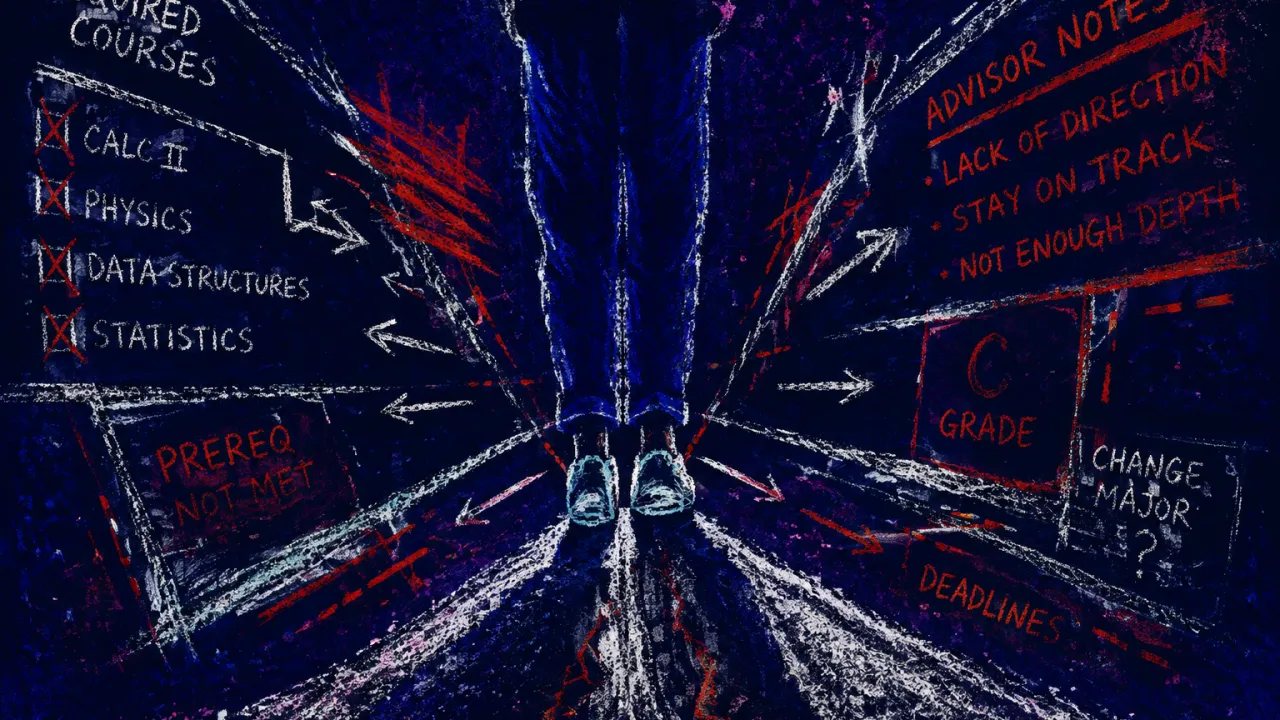
A solitary figure stands at a divided threshold, marked corridors pressing inward around their feet.

What is this situation?

Academic Direction Validation Trial - you enter a semester, placement, or graduate application as a test run for the subject you think might become your future. At the start, the university gives you course lists, prerequisites, grading rubrics, office-hour appointments, and deadlines, while instructors, advisors, and recruiters each offer a different measure of whether the path is practical. A mark on one assignment becomes something to interpret; a vague comment in office hours competes with a job listing, an internship requirement, or a peer's announcement that they have switched programs. You keep registering for the next module, revising a personal statement, comparing syllabi, and waiting for one clean signal that will settle the question, but every answer arrives through another system with its own criteria. By midterm, your shoulders stay raised over the laptop, your schedule is shaped by evaluations, and conversations about the future keep returning to evidence you have not had time to collect. The people setting the requirements may ask for commitment before the trial can give you a stable result, leaving you to carry several competing routes through the same week. You are trying to validate a direction while the environment keeps changing what counts as validation, much like the figure on the Two of Wands, holding the world from a high wall and looking out over routes not yet chosen.

Why it's not you?

The problem is not that you have failed to choose; the trial is built from short deadlines, incomplete feedback, and competing standards. Grades, advisor views, course requirements, and hiring signals are external filters, and their disagreement belongs to the setup around the decision, not to you.

Academic Direction Validation Trial in Tarot Cards

An Academic Direction Validation Trial can keep your shoulders raised over the laptop as each grade, comment, and deadline is treated as evidence about the route ahead. This is an environmental and structural dynamic: different academic and career signals narrow the same decision from different directions. The cards below reflect that evaluative frame without turning it into a verdict. Here are the Tarot Cards for this kind of academic direction trial.

The Hierophant
Upright
A robed authority sits between pillars before two students, with crossed keys placed at the institutional threshold. You receive course sequences, office hours, prerequisites, and recognised assessment methods that make the academic trial possible while also determining which forms of progress count. The upright structure offers usable teaching and a visible pathway through the institution. You can treat that pathway as evidence about succeeding within this educational system, while keeping its jurisdiction clear: formal progression can validate access and performance without automatically validating the route's wider career value or long-term fit.
The Chariot
Reversed
The black and white sphinxes face away from each other beneath a charioteer who holds no visible reins. You may be trying to steer with grades, adviser comments, internship requirements, and recruiter signals, yet each source is pulling toward a different definition of a practical academic future. Reversed, the vehicle exposes a blocked control system rather than a shortage of determination. You cannot create stable direction merely by applying more force to competing metrics; the obstruction becomes legible when you separate evidence about academic performance from evidence about career access, subject interest, and institutional convenience.
Wheel of Fortune
Upright
A large wheel turns in the air while figures rise, descend, and observe it from different positions. You are testing an academic direction inside systems whose prerequisites, grading conditions, application windows, and hiring signals can change before the trial produces a clean conclusion. The upright cycle makes movement itself usable evidence. You can track which aspects of the route remain coherent across changing conditions, allowing timing to be based on repeated patterns rather than on the temporary authority of one deadline, mark, or market signal.
Justice
Reversed
The formal judge holds a scale for measurement and a sword for consequence between two rigid pillars. You may receive a mark that appears precise, only to find that an adviser, another instructor, or a recruiter assigns it a different meaning when assessing your future route. Reversed, the apparatus of evaluation remains active while comparability is blocked. You can audit the criteria behind each result, distinguishing evidence about mastery of one assignment from broader claims about subject fit, graduate readiness, or employment potential.
The Hanged Man
Upright
A figure hangs by one ankle from a wooden frame, his free leg forming a cross while a halo surrounds his head. You may be unable to accelerate the feedback cycle, yet the suspended interval changes what can be observed about the subject, the institution, and the pressure to commit. The upright stillness preserves access to perspective even when ordinary forward movement is unavailable. You can identify which conclusions genuinely require more exposure and which deadlines merely belong to an administrative clock, preventing forced timing from masquerading as reliable validation.
Temperance
Upright
An angel pours water between two cups while standing with one foot on land and one in water; a path leads toward a distant crown. You are trying to combine academic performance with practical fit and future access, even though those forms of evidence arrive at different rates and cannot be reduced to one measurement. The upright flow provides a repeatable calibration process. You can let each stage of the trial modify the working hypothesis about your direction, using timing to integrate evidence gradually instead of demanding that one midterm, meeting, or listing settle the whole route.
The Moon
Upright
A winding path runs between two towers under reflected moonlight while a dog, a wolf, and a creature emerging from the water respond differently to the same landscape. You are moving through formal requirements and instinctive reactions at once, with every grade, adviser comment, and job listing revealing only a portion of the academic route. The upright path remains open even though it is not fully illuminated. You can treat uncertainty as a property of the trial's evidence environment, preserving movement through the next bounded checkpoint without forcing one ambiguous signal to explain the entire future.
Judgement
Reversed
An angel sounds a trumpet above figures rising together from open coffins, creating the image of one call that reaches everyone with the same decisive force. You may be waiting for a grade, adviser, admissions panel, or recruiter to issue that kind of unified verdict about your academic future. Reversed, the promised call is blocked because the external authorities do not share one message or field of vision. You can reconstruct validation as a system of bounded claims, allowing each source to reveal what it genuinely knows while preventing institutional approval from becoming the sole architecture of your direction.
Seven of Cups
Upright
A silhouetted figure faces seven cups floating in clouds, each holding a different object or promise. You may be comparing subjects through prestige, grades, intellectual interest, internship access, and imagined careers, even though these images come from separate systems and rest on different amounts of real experience. The upright display brings every projection into view, which makes categorisation possible. You can identify which options have been tested through coursework or placement and which remain future-facing representations, preventing visual abundance from being mistaken for usable decision evidence.
Two of Pentacles
Upright
The figure loops two pentacles through an infinity-shaped ribbon while ships rise and fall on the sea behind him. You are keeping modules, application revisions, adviser appointments, and career research in motion because each activity may produce the evidence that validates a different academic route. The upright rhythm shows that this provisional system can remain workable when the routes are treated as active trials rather than permanent obligations. You can see the real lifestyle question in the visible loop: which commitments are still generating useful evidence, and which are merely consuming another week because no external authority has closed them?
Three of Pentacles
Upright
A craftsperson stands on a bench beneath a decorated arch while two other figures inspect plans and discuss the unfinished work. You are demonstrating academic skill in front of people who control feedback, progression, placement access, or recommendations, and each observer evaluates from a distinct institutional position. The upright exchange makes expertise, criteria, and visible work available in the same scene. You can locate each comment within the part of the structure that evaluator can actually see, turning mixed feedback into differentiated evidence instead of combining every opinion into one unstable judgment of the future.
Seven of Pentacles
Upright
A worker leans on his tool and studies pentacles growing on a cultivated vine. You have invested time in modules, assignments, meetings, or applications and now need to inspect what that effort is producing before extending the same route into another academic cycle. The upright pause makes evaluation available without declaring the harvest complete. You can separate early evidence from mature evidence, locating the next timing decision at the point where another period of study would answer a defined question rather than merely postpone uncertainty.
Eight of Pentacles
Upright
An artisan sits at a bench carving pentacles one by one while completed pieces are displayed in a visible sequence. You are producing assignments, completing modules, and refining applications that can show whether the subject supports repeatable skill rather than one-off performance. The upright practice creates a body of evidence that can be compared across time. You can read patterns in attention, improvement, feedback, and transfer, allowing repeated study to validate a route without asking each individual result to settle the future alone.
Page of Pentacles
Upright
A young figure holds a single pentacle at eye level while standing in a cultivated landscape with distant mountains. You are examining one subject closely enough to test its practical demands, available skills, and possible future value instead of relying only on its title or reputation. The upright concentration turns study into a usable pilot. You can let the next bounded learning experience answer a specific question about the route, building material evidence through coursework or placement without requiring the trial to prove an entire lifetime direction at once.
Ace of Swords
Reversed
A hand emerges from cloud holding a crown-tipped sword, an image of a single decisive line cutting through uncertainty. You keep receiving apparently authoritative signals about the subject, yet the mark, comment, prerequisite, and job listing do not combine into one stable conclusion. Reversed, the blade remains present but cannot organise the evidence into usable clarity. You can expose the blockage by naming the exact claim each signal supports, preventing a vague remark or isolated result from carrying the authority of a complete academic verdict.
Two of Swords
Upright
A blindfolded figure holds two swords in a precise cross while a rocky sea and distant land remain behind her. You are being asked to choose between academic routes without a clear view of their full requirements, outcomes, or labour-market consequences, so each option currently functions as a defence against choosing the other too soon. The upright stillness makes the information gap visible and preserves a deliberate pause. You can distinguish what is genuinely unknown from what has merely been stated differently by separate gatekeepers, giving the choice a defined evidentiary threshold instead of waiting for impossible certainty.
Nine of Swords
Upright
A figure sits upright in bed with hands covering the face while nine swords remain arranged across the dark wall. You may finish the assignment or adviser meeting physically, yet its possible meaning for the degree, application, and future career continues to run through the night. The upright image makes the accumulated evaluation residue visible and therefore separable. You can identify which concern belongs to an actual pending decision and which has been generated by asking one grade or comment to validate the whole route, restoring boundaries between today's evidence and the future it cannot yet prove.
Two of Wands
Upright
A figure holds the world above a high wall while standing between a secured wand and one he can carry forward. You are using a real course or placement to compare the subject's immediate demands with the larger academic and professional territory it might open. The upright survey position gives the present module a defined role inside the decision. You can treat registration for the next stage as an extension of the trial only when it will test a remaining question, keeping study connected to direction rather than letting institutional sequence choose by default.
Three of Wands
Upright
The figure stands among three planted wands and watches ships move across a broad expanse of water. You have put an academic hypothesis into circulation through modules, applications, or placement work, but the evidence needed to evaluate its future value is still travelling through external systems. The upright lookout provides enough height to compare trajectories without pretending that every result has arrived. You can read the direction through patterns across several returns, keeping the trial connected to a wider horizon rather than allowing the fastest grade or loudest recruiter signal to dominate the route.
Five of Wands
Upright
Five figures raise crossing wands in a crowded scene where no shared formation or target is visible. You may be studying inside a field of competing advice, with instructors prioritising mastery, advisers prioritising progression, recruiters prioritising employability, and peers broadcasting their own programme switches. The upright encounter makes the disagreement observable rather than hidden. You can identify which criteria are being contested and which voices hold actual decision power, turning the clash into a map of the academic ecosystem instead of treating it as one verdict that you have somehow failed to understand.
Ten of Wands
Upright
The bent figure carries ten bundled wands toward a town he can barely see. You may be transporting the full workload of several possible academic futures through one semester, with assignments, prerequisites, applications, and employability checks all treated as if they are already permanent duties. The upright card keeps the destination visible and makes the burden countable. You gain a usable audit point by recognising that the trial has accumulated tasks faster than it has produced direction, allowing the workload itself to show where provisional exploration has quietly become operational overcommitment.

Academic Direction Validation Trial in Tarot Card Reading Insights

People moving through an Academic Direction Validation Trial have brought this clash of grades, advisor views, and career signals into readings. The Tarot Reading Insights below turn from the cards themselves to what appeared in those sessions.
Psychological Contexts Related to Academic Direction Validation Trial