The 8:03 a.m. Rent-Day Tribunal
If the 1st of the month turns into a mini “adulting audit”—rent hits, Slack pings, and suddenly your dating life feels like another KPI—you’re not alone (hello, rent day anxiety).
Jordan sat across from me with her phone facedown like it had teeth. She’s 29, a marketing pro in New York City, the kind of person who can keep a dozen moving parts afloat at work—until the calendar flips and her nervous system decides it’s time for a full-body performance review.
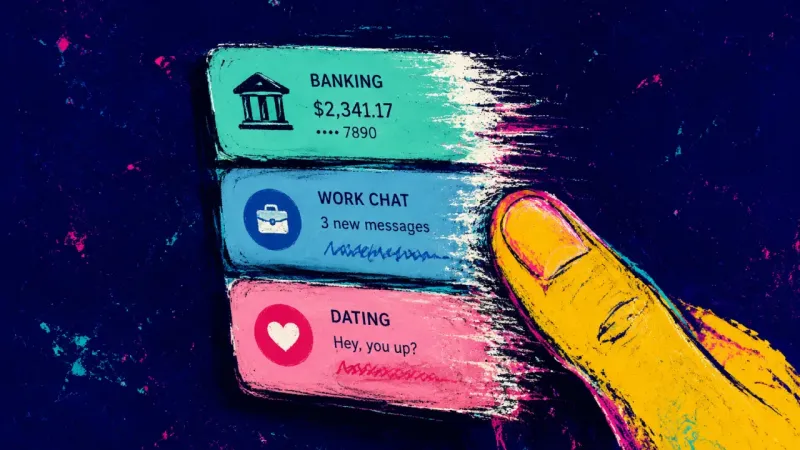
She described 8:03 a.m. on the L train: stale AC, the metal screech, her hand braced against the pole while her thumb opened her banking app. Rent cleared—gone in one clean withdrawal—and her chest tightened like someone had cinched a strap across her ribs. Her leg started bouncing on autopilot. Then: Slack. LinkedIn. Hinge. Notes app. Like one more refresh would finally tell her she was safe.
“I want work, money, and love to feel stable,” she said, voice low, like she didn’t want the universe overhearing. “But every ‘off’ signal makes me feel… behind. Like I’m failing at adulthood. Like I won’t be chosen.”
The dread in her wasn’t abstract. It was electrical—buzzing under the skin, jaw clenching, an urgency to fix everything immediately paired with the inability to pick the first step. It was like trying to read three breaking-news tickers at once while someone kept turning the brightness up.
I leaned in, gentle but direct. “We’re going to treat this like a system, not a personality flaw. And we’re going to find clarity without turning your life into a self-optimization project. Let’s draw you a map for the fog.”

Choosing the Compass: The Energy Diagnostic Map (7)
I asked Jordan to put both feet on the floor and take one slow breath before we did anything else. Not as a mystical ritual—more like closing ten browser tabs so your laptop can stop screaming.
As I shuffled, I watched her body the way I’ve watched weather for most of my life. In my family’s Highland tradition, we don’t pretend humans are separate from nature; we treat the body like a barometer. When your chest tightens, when your leg won’t stop bouncing, when your jaw locks—those are pressure systems moving through you.
“Today,” I told her, “we’ll use my Energy Diagnostic Map (7) · Context Edition.”
For you reading along: this 7-card tarot spread is ideal for recurring patterns—especially the kind that hits on a schedule, like first-of-month anxiety or rent day panic—because it separates what’s happening on the surface from what’s driving it underneath. It doesn’t force a single predictive answer. It shows the links between work stress, money stress, and dating anxiety, so you can rebuild stability through repeatable steps rather than panic monitoring.
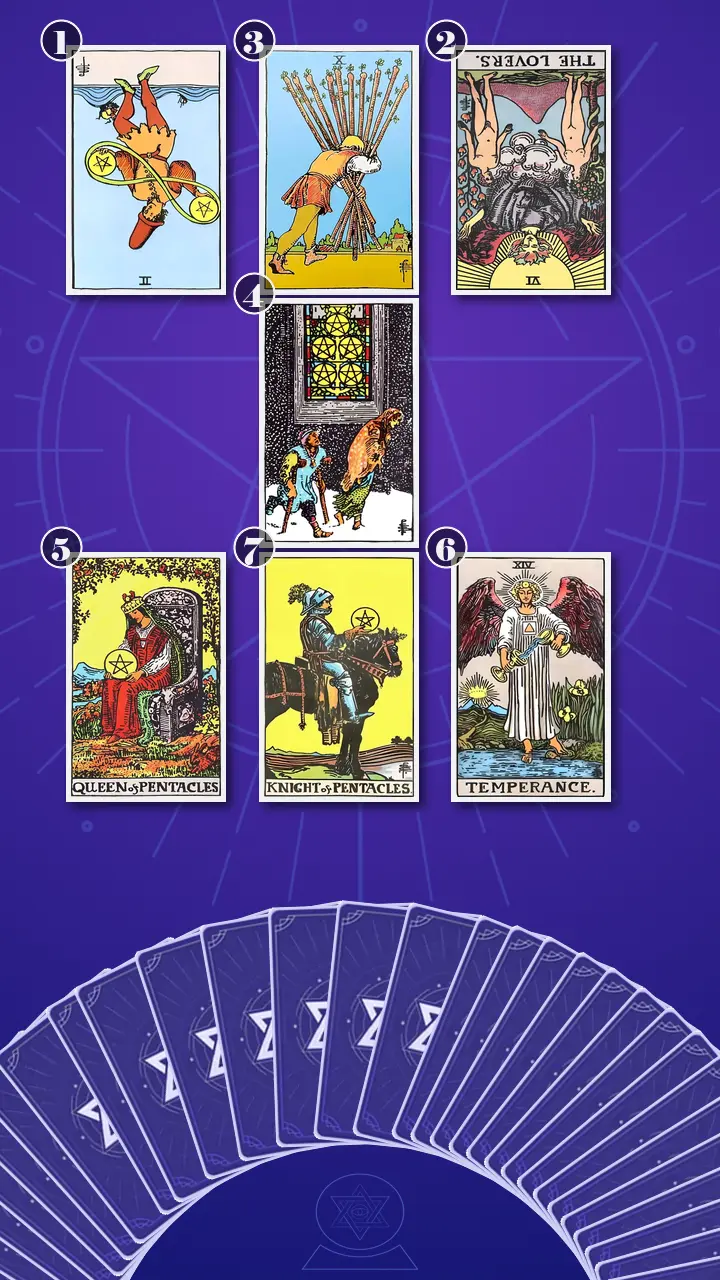
I pointed to the layout as I placed the cards. “We’ll look at your surface symptoms—what you do on the 1st and what your body feels. Then the inner tug-of-war—what you want versus what you fear it means about you. We’ll name the external pressure pressing down. And we’ll put the core blockage in the center, because that’s the choke point. Then we’ll find your usable resource, the key transformation, and finally one grounded next step you can repeat.”
Reading the Map: How Tarot Works When You’re Stuck in Three Tabs
Position 1 — Surface symptoms: the observable 1st-of-month behaviors and immediate emotional/mental state.
Now flipped open was the card representing surface symptoms—the observable rent-day behaviors and the immediate state of mind and body.
Two of Pentacles, reversed.
“Okay,” I said, and Jordan let out a tiny, bitter laugh before she could stop herself. “Yeah. That’s… mean.”
I nodded. “Accurate can feel rude.”
This card’s modern life scenario is basically an app-switching montage: banking app → bill reminders → Slack → LinkedIn → dating messages. You’re not being lazy—you’re trying to prevent danger by staying ‘updated.’ But the constant switching makes you drop the one thing that would actually reduce pressure.
The energy here isn’t a lack of intelligence. It’s an imbalance—Earth energy (money, stability, practical structure) wobbling so hard it can’t hold. Reversed, the Two of Pentacles becomes faux productivity: motion without completion.
I watched Jordan’s throat move as she swallowed. Her foot tapped faster when I said the sentence I always say in moments like this: “Monitoring isn’t movement.”
Her eyes flicked to her phone, then back to me, like she’d been caught mid-scroll.
Position 2 — Inner tug-of-war: the conflict between what you want in love/work/money and what you fear it says about you.
Now we turned over the card representing your inner tug-of-war—the exact thought your brain uses to bundle work, money, and love into one scary story.
The Lovers, reversed.
I kept my voice plain. “This isn’t ‘your love life is doomed.’ This is values conflict.”
Reversed, The Lovers often shows choices made from pressure rather than truth—choosing what keeps you approved, not what fits your values. In modern terms: you treat work, money, and dating like one combined scoreboard. If I’m doing well at work, spending ‘right,’ and getting consistent texts, I’m okay. So you perform: chill, competent, low-maintenance. Then you feel oddly disconnected, because the choices aren’t actually aligned with what you value—rest, honesty, steadiness, being seen.
In energy terms, this is Air in a blockage: too many mental narratives, not enough grounded selection. The mind tries to protect you by running scenarios, but it can’t land on “This is what I choose.”
Jordan’s shoulders lifted like she was bracing for impact. “I hate how much I do timing math,” she admitted. “Like… I pretend I’m not doing it, but I’m doing it.”
“Of course you are,” I said. “When your system feels unsafe, it looks for metrics.”
Position 3 — External pressure: the workload, expectations, timelines, and social comparison that intensify the spiral.
Now flipped open was the card representing external pressure—deadlines, vague feedback, comparison fatigue, and the invisible weight you carry home.
Ten of Wands, upright.
This card has a hunched figure whose arms are so full they can’t see where they’re going. In modern life: your workday ends but the pressure doesn’t. You carry deadlines, shifting priorities, and high standards in your shoulders. By the time you’d do the stabilizing stuff—simple money admin, dinner, an honest text—you’re too depleted. So the month keeps running you.
The energy here is Fire in excess: urgency without relief. And there’s a line I’ve learned to say to New Yorkers who live inside their calendars: “If everything has ‘emergency’ status, nothing gets finished.”
Jordan exhaled through her nose, sharp. Her jaw unclenched a millimeter, like her body recognized itself in the sentence.
Position 4 — Core blockage: the scarcity-rooted belief that turns normal monthly logistics into an identity threat.
We turned over the center card—the one representing the core blockage. This is where the system gets stuck: the belief that turns a normal monthly reset into an identity threat.
Five of Pentacles, upright.
I felt the room go quieter, the way it does right before snow falls.
“This,” I said softly, “is the cold-street card.”
I used the image the card always calls up in a city like this: walking past a warm-lit deli window in NYC winter while pretending you’re fine. Coffee smell, bright fluorescent warmth inside, someone laughing at the counter—while you keep moving because stopping would mean admitting you need something.
And the inner monologue underneath it goes like this: If I ask / I’ll look needy / and then I’ll be unchosen.
That’s the conflict contrast: safety vs pride, support vs self-silencing.
In modern terms, a tight month or a slow reply hits and your brain goes straight to: “I’m on my own.” So you stop asking questions. You stop making requests. You avoid calling the bank, using automation, or asking your manager what success looks like—because it feels like admitting you’re not safe.
Jordan did the exact response I see when someone gets personally called out by a root card: her breath caught, then released in a long exhale. A quiet swallow. Her gaze dropped to the card like she’d been skimming her own life and suddenly had to read it line by line.
She said, almost annoyed at herself, “I literally walk past places like that and think, ‘I can’t go in. I shouldn’t.’”
I let that land. Then I offered the oldest truth I know from my own winters in the Highlands, when the wind can make you proud and stubborn: “Warmth doesn’t require you to earn it first. It requires you to step inside.”
Position 5 — Usable resource: what practical support, skill, or inner capacity can stabilize you this month.
Now we turned over the card representing your usable resource—what you already have that you’re not letting count because it isn’t dramatic enough.
Queen of Pentacles, upright.
The energy shifted immediately—like when you finally get home, take your shoes off, and your feet remember the floor exists.
This card’s modern life scenario is unglamorous on purpose: kettle click, mug warmth, groceries on the counter, laptop closed. A real meal. A shower. One clean money task done calmly. You treat stability like something you can physically hold.
Here the Earth element is in balance. This isn’t “soft life aesthetics.” This is what I call care that is concrete, not performative.
Jordan’s shoulders dropped—just enough to notice. Her hands, which had been clenched around her water bottle, loosened.
She murmured, as if trying the thought on: “If I can hold one thing steady, I don’t have to hold everything steady.”
“Exactly,” I said. “That sentence is your nervous system learning a new language.”
When Temperance Poured Between Two Cups (Finding Clarity Without the Overhaul)
Position 6 — Key transformation: the mindset/skill that integrates work, money, and love so they stop triggering each other.
Before I turned this next card, I paused. The radiator in my studio clicked once—an ordinary sound that suddenly felt like punctuation.
“We’re about to flip the transformation point,” I told her. “The mechanism that changes the pattern.”
Temperance, upright.
Temperance is integration. Moderation. Patient recalibration. Not a dramatic fix—a sustainable blend. The modern life version is simple: one money reality check, one work boundary or next step, and one honest connection check-in. Nothing has to carry your whole worth.
Jordan’s face tightened for a moment, like her brain wanted to argue. I could see the setup clearly: it’s the 1st, you open your banking app and watch rent hit, then your thumb jumps to Slack, then to LinkedIn, then to Hinge—like if you refresh fast enough, you’ll find the one screen that proves you’re okay.
Stop treating the 1st as a crisis you must outrun; start pouring your attention deliberately like Temperance, blending small practical steps until stability becomes your baseline.
Her reaction came in three layers—so quick it almost looked like stillness. First: a freeze. Breath held, eyes widening a fraction. Second: the mind catching up—her gaze went unfocused, like she was replaying a dozen rent days and suddenly watching them from above. Third: the release—a slow, shaky exhale that softened her mouth.
“But if I’m not ‘fixing’ it,” she said, a flash of irritation rising, “doesn’t that mean I’ve been doing it wrong this whole time?”
I didn’t flinch. “It means you’ve been surviving with the tools you had. Temperance isn’t telling you you were wrong. It’s offering you a new method: calibration.”
This is where my Body Signal Interpretation comes in. I pointed gently to her sternum. “When you hear ‘the 1st is a reset, not a verdict,’ your chest loosens. When you hear ‘fix everything,’ it clamps down. Your body is giving you the most honest reading.”
“Do a 9-minute Temperance Pour right now,” I continued, sliding her a pen. “Set a timer for 9 minutes. Split a page into three columns: Money / Work / Love. Under each, write exactly ONE next step that can be completed in under 20 minutes—like ‘schedule the bill payment,’ ‘send the one Slack follow-up,’ ‘text: “Hey—are we still on for Thursday? I’d love clarity.”’ Circle the one you’ll do first today. And if you feel your chest tighten or your brain start negotiating, pause and take 3 slow breaths. You can stop at any point and still count this as a win—naming the next step is already reducing the everything-at-once trap.”
She wrote. Her handwriting started jagged, then steadied. The room held that particular quiet that comes when someone stops arguing with reality and starts working with it.
“Now,” I asked her, “use this new lens and look back—was there a moment last week when this would have changed how you felt?”
Jordan blinked fast, eyes a little wet. “Thursday night,” she said. “I was going to ask my manager what she meant by ‘tighten the narrative.’ I didn’t. I just… rewrote the deck until 1 a.m.”
“That’s the shift,” I said. “Not from chaos to perfection—just from dread and frantic checking to grounded self-trust built through small completions and values-led connection.”
Position 7 — Next grounded step: one repeatable action pattern that makes the new balance real in daily life.
Now we turned over the last card, representing your next grounded step—the routine you protect like a meeting so the new balance becomes real.
Knight of Pentacles, upright.
This is the still horse. The opposite of the app-switching reflex. It’s Earth energy in steady balance—progress through showing up, not rushing.
In modern terms: you pick one routine for money and one routine for work, and you do them even when you don’t feel motivated. Over time, that steadiness lowers the emotional volume in dating, because you’re not asking every text to fix your safety for you.
I smiled, a little wry. “Stability is built in boring minutes.”
Jordan let herself smile back—small, like she didn’t fully trust it yet, but she wanted to.
The One-Completion Baseline: Actionable Advice for the 1st-of-Month Spiral
Here’s the story the whole spread told me, in one thread: On the surface, you juggle and switch (Two of Pentacles reversed) because monitoring gives a quick hit of relief—like you’re informed, like you’re protected. Under that, there’s a values split (The Lovers reversed): you’re trying to be approved rather than aligned. External pressure keeps piling on (Ten of Wands), so your capacity gets eaten before you ever get to the stabilizing tasks. And at the center is the real choke point (Five of Pentacles): the scarcity belief that you’re alone and behind, so asking for clarity or support feels dangerous. The way out is not a life overhaul. It’s grounded resourcing (Queen of Pentacles), then measured integration (Temperance), then one repeatable system that compounds (Knight of Pentacles).
The cognitive blind spot I named for Jordan was simple and brutal: she kept mistaking exposure for control. Seeing the numbers, seeing the inbox, seeing the message thread—over and over—felt like doing something. But nothing moved because nothing finished.
The transformation direction was equally simple: shift from treating the 1st as a global verdict to treating it as a monthly reset—with one completed money step, one completed work step, and one honest relationship check-in.
I offered her a small plan that respects reality: NYC time pressure, nervous-system spikes, and the fact that you still have to live your life while you fix your life.
- The 25-Minute Money AnchorOn the 1st (or the first workday), set a 25-minute timer and reconcile ONLY the last 7 days of transactions. Then schedule the next bill payment or autopay review in your calendar and close the banking app.Stop at 25 minutes even if it feels unfinished—completion is the point. If anxiety spikes, sit with both feet on the floor and a glass of water; write down one number you learned (not a conclusion), then close the app.
- The “Good Enough” Work Boundary QuestionBefore you rewrite anything for the third time, send one clarifying message that reduces ambiguity: “What does success look like for this by Friday—2 bullets or a full deck?” Then do the 80% version and ship it.If your chest tightens before hitting send, name it as Ten of Wands pressure, not a prophecy. One small completion beats a perfect plan you abandon.
- The Temperance Pour TextSend one values-matched clarity text within 20 minutes of drafting it: “I’m enjoying this—can we pick a time for next week?” or “Hey—are we still on for Thursday? I’d love clarity.”Draft in Notes first if you need to. Then use my shower water-flow meditation technique: stand under the water for 60 seconds and imagine the worry rinsing from “verdict” into “data.” Send the text when you step out—fresh towel, fresh nervous system.
And because I’m stubborn about making this embodied, not just intellectual: I also gave her my 5-minute balcony energy awakening practice. “Before you open any app,” I said, “step outside—fire escape, balcony, stoop, whatever counts. Feel the weather. Five minutes. Let your body learn: the day is happening around you, not to you.”

A Week Later: Ownership, Not Certainty
Six days later, I got a message from Jordan. Not a novel. Just: “Did the 25-minute money anchor. It sucked. Then it was… done. Also sent the Slack question. Also sent the text. No one exploded.”
Her follow-up came an hour later: “Still scared, though. But quieter.”
In my mind, I saw the bittersweet version of progress: she’d deleted three half-finished budget tabs, made tea, and sat alone at her kitchen counter for twenty minutes—not celebrating, not spiraling either. The next morning her first thought was still, What if I’m behind?—but this time she exhaled and opened her Notes app instead of Chase.
This is what a Journey to Clarity looks like in real life. Not a dramatic transformation montage. More like a system update: fewer emergency pings inside your chest, more grounded self-trust built in small, boring completions.
When rent hits and a slow reply or vague feedback lands at the same time, it can feel like your chest turns into a tribunal—like you have to prove you’re safe, competent, and chosen all at once.
If you treated the 1st as a reset instead of a verdict, what’s one tiny ‘pour’ you’d want to make this month—toward money, toward work, or toward connection—just 10% at a time?
This story is adapted from psychological research, written so that those in a similar struggle can see their own pattern in it — and find their next step clearly.These insights are not a substitute for professional psychological, medical, legal, or financial advice.
Learn more about our Journey to Clarity.
How did this insight land for you?
🫂 This Resonates Deeply
🌀 Living This Story
✨ Now I See Clearly
🌱 Seeing New Possibilities
🧰 Useful Framework
🔮 The Confirmation I Needed
💪 Feeling Empowered
🚀 Ready for My Next Step
Author Profile
 AI
AI“As the seventh generation of a Highland healing family, I see modern anxieties as a simple, temporary disconnection from nature's rhythm. I bring 67 years of lived seasons not to instruct you, but to hold space for you. Using tarot as a mirror, I want to gently guide you out of the chaos, helping you breathe deeply and rediscover the organic, steady heartbeat of your own life.”
In this Introspection Tarot Reading :
Core Expertise
- Somatic Shadow Sensing: Identifying where chronic mental fatigue and unexpressed emotions are physically trapped within your body's architecture.
- Ecosystem Bandwidth Restoration: Using the metaphor of nature's self-cleansing cycles to diagnose and clear the 'mental static' of an overstimulated nervous system.
Service Features
- The Grounding Transmutation Ritual: A sensory, physical practice designed to literally discharge excessive mental rumination into the earth, instantly restoring bodily presence.
Also specializes in :
Explore Related Patterns:
External ValidationJordan names the mechanism when she says that every off signal makes her feel behind, like she is failing at adulthood, like she will not be chosen. Work, money, and dating are not staying in their separate lanes; they are being used as a combined scoreboard for whether she is okay. External Validation fits because her internal state is being regulated through outside signals. A manager's vague phrase, a rent withdrawal, and a dating app response all become emotional evidence. The mind is trying to build safety from approval, consistency, and performance metrics, but that leaves self-trust dependent on whatever screen last updated. This pattern also explains the disconnection she feels after performing as chill, competent, and low-maintenance. The performance may reduce immediate rejection risk, but it pulls her away from her stated values of rest, honesty, steadiness, and being seen. You can track the turning point when the story shifts from asking every external signal to validate her worth toward choosing one values-led action at a time.
Scarcity MindsetThe center of Jordan's story is not the rent payment by itself; it is the way a normal monthly expense turns into the thought that she is alone, behind, and at risk of not being chosen. The cold-street image captures that inner logic precisely, because she keeps moving past warmth as if needing something would expose her. Scarcity Mindset appears here as a cognitive filter, not a financial verdict. Tight money, slow replies, and vague feedback are all interpreted through the same assumption that support is unsafe and need is costly. That belief makes practical help feel psychologically dangerous, even when help would reduce the actual pressure. The pattern explains why work, money, and love all feel off at once. They are being processed through the same scarcity-based schema, where any gap in reassurance becomes evidence that safety is disappearing. Once you can see that filter, the goal is no longer to prove you need nothing; it is to separate real logistics from the old belief that asking makes you less secure.
Self-SilencingJordan's Thursday night example makes the pattern concrete. She wanted to ask her manager what "tighten the narrative" meant, but instead she rewrote the deck until 1 a.m. The same structure shows up around money and dating when she avoids the bank call, the automation step, or the direct clarity text. Self-Silencing is the coping mechanism underneath that restraint. The silence is not emptiness; it is a defensive strategy designed to prevent the shame of appearing needy, confused, or too much. In the short term, withholding the request protects her from possible judgment. In the longer loop, it leaves ambiguity in charge. The story's repair is not loud confrontation; it is specific self-advocacy. Asking what success looks like by Friday, sending a clear dating text, or using one money task to reduce uncertainty all interrupt the belief that needing clarity makes you less worthy. You can see the pattern change when she asks directly and discovers that no one explodes.
Action ParalysisJordan describes an urgency to fix everything immediately while being unable to pick the first step. That combination matters because it shows a system that is not lazy or careless; it is overloaded by too many perceived threats demanding simultaneous response. Action Paralysis fits when the mind treats work, money, and love as three emergency channels at once. The pressure creates more scanning, more mental comparison, and more imagined consequences, but less movement. The body is mobilized, while decision-making freezes. The 9-minute page split into Money, Work, and Love works because it breaks the paralysis at the level of cognitive load. One next step per column gives the mind a smaller target and teaches the nervous system that stability can begin with a single completed action. You can feel the pattern loosen when the story moves from global dread to one circled first step.
Compulsive CheckingJordan's 8:03 a.m. sequence of opening banking, Slack, LinkedIn, Hinge, and Notes shows how quickly your attention can move from information gathering into safety-seeking. Each refresh promises a tiny hit of certainty, but the story makes clear that the loop does not resolve the rent, the work ambiguity, or the dating uncertainty. The defense mechanism is control through surveillance. When the nervous system reads normal life signals as possible threat signals, checking starts to feel like preparation, even when it is really keeping the threat active. That is why the phrase "monitoring isn't movement" lands so sharply in the story. Compulsive Checking fits because the behavior is repetitive, cross-domain, and self-reinforcing. You are not simply looking at apps; you are trying to make uncertainty emotionally tolerable by watching it more closely. The pattern becomes visible when exposure to more data replaces one grounded action that would actually lower pressure.
Productivity as SafetyJordan's first instinct is to fix, update, monitor, revise, and optimize. The story repeatedly distinguishes that motion from actual stability, especially when it says that one more refresh will not make her safe and that life does not need to become a self-optimization project. Productivity as Safety captures the defense mechanism behind that impulse. Completion, competence, and performance are being recruited to calm a deeper fear of being behind or unchosen. The problem is not that practical action is bad; it is that action becomes emotionally overloaded when every task is asked to prove worth. The healthier version appears through the money anchor, the work boundary question, and the clarity text. Those steps still use structure, but they stop using productivity as a verdict. You can see the pattern recalibrate when one boring completion becomes enough, instead of needing an entire life overhaul to feel briefly safe.
Relationship Performance AnxietyJordan's dating life is described as another KPI, and she admits doing timing math while pretending she is not. That detail shows romance being pulled into a performance frame, where response timing becomes data about whether she is desirable, safe, or falling behind. Relationship Performance Anxiety fits because the relationship field is being measured instead of inhabited. Consistent texts and low-maintenance behavior become ways to manage the fear of not being chosen. The mind is not simply curious about connection; it is trying to score connection fast enough to reduce uncertainty. The clarity text interrupts that pattern because it replaces hidden monitoring with direct, values-matched communication. You are no longer asking a slow reply to carry your whole sense of safety. You are letting one honest request give the relationship enough structure to become real information rather than a private performance review.
Explore Related Struggles:
Approval-Safety FusionJordan treats work performance, spending correctly, and getting consistent texts as one combined scoreboard. When those signals line up, she feels briefly okay; when one goes off, the whole structure starts to shake. The cost is that approval starts making choices before her values can speak. She performs chill, competent, and low-maintenance, even though the story names a different set of needs underneath: rest, honesty, steadiness, and being seen. Approval-Safety Fusion fits because being approved has become a stand-in for being safe. You are not only wanting recognition or connection; you are asking approval signals to stabilize your body, your money fears, and your place in other people's lives all at once.
Identity Verdict LockRent clears at 8:03 a.m., Slack pings, dating apps sit within reach, and Jordan's body reacts as if the month has opened a private hearing on her worth. A bank withdrawal, vague work pressure, and a slow reply do not stay in their own lanes; they merge into one verdict about whether she is safe, competent, and chosen. You can feel the structure in how quickly ordinary logistics become identity evidence. The problem is not that rent is due or that work needs attention; it is that every small signal gets recruited into the same courtroom, where being behind, being unchosen, and failing adulthood start to sound like the same charge. Identity Verdict Lock fits because the 1st stops functioning as a reset point and becomes a judgment point. You are trying to solve practical tasks while also defending your entire sense of adulthood, which makes even a small next step feel loaded with consequences it was never built to carry.
Monitoring-Safety FusionJordan opens her banking app on the L train, watches rent clear, then jumps from Slack to LinkedIn to Hinge to Notes as if the next screen might finally confirm that she is okay. The checking is not random distraction; it becomes a safety ritual built out of numbers, inboxes, work signals, and dating signals. You can see the friction in the sentence that lands hardest for her: monitoring is not movement. Every refresh creates the sensation of staying informed, but it also delays the one grounded action that would change the system, whether that is closing the banking app after one money task, asking a manager for clarity, or sending a direct text. Monitoring-Safety Fusion names the lock where exposure starts masquerading as control. You are not simply looking for information; you are trying to borrow safety from proof, and the more domains you scan at once, the less any single piece of data can settle you.
Support Access SplitJordan needs exactly the kind of support that would make the month feel less sharp: a bank call, an automation check, a manager's definition of success, a clear relationship message. Yet when the pressure rises, she stops asking questions and starts carrying the whole system privately. The split shows up in the story's cold-street image: warmth is visible, but stepping inside would mean admitting she needs something. That is why a clarifying Slack message can feel more exposing than rewriting a deck until 1 a.m.; the request itself becomes the risk. Support Access Split names the point where available help and actual receiving fall out of sync. You are not without possible support, but the act of reaching for it gets coded as danger, so independence becomes a narrow corridor instead of a source of strength.
Systemic DepletionJordan's workday ends, but the pressure does not. Deadlines, shifting priorities, and high standards stay in her shoulders, so by the time she reaches the money task, the meal, or the honest text, the capacity to stabilize has already been spent. The app-switching then burns what little energy remains. It creates movement without completion, keeping her inside the month instead of letting one concrete action give the system a floor. Systemic Depletion names the structure where the same limited capacity is being demanded by too many domains at once. You are not failing because one task is too hard; you are trying to build stability after the system has already consumed the fuel required to do it.
Explore Related Emotions:
Conditional Belonging FearYou want work, money, and love to feel stable, but the moment one of them looks off the whole picture turns personal. 'I won’t be chosen' turns separate problems into one question about whether you still count. Conditional Belonging Fear fits because the story keeps linking safety to being picked and kept. The work signal, the money signal, and the dating signal all start to feel like gates you have to pass before you can relax.
Verdict DreadYou are on the L train, your thumb opens the banking app after rent clears, and then Slack, LinkedIn, Hinge, and Notes all get pulled into the same morning. By the time the story calls it a full-body performance review, the day already feels like a ruling. Verdict Dread fits because every off signal gets treated as evidence. Work, money, and love stop feeling like separate lanes and start feeling like a tribunal deciding whether you are behind, safe, or chosen.
Choice Paralysis OverwhelmEverything is asking for a response at once, and the body is already buzzing before any one task gets a turn. The pressure to fix work, money, and love immediately leaves you unable to choose the first move. Choice Paralysis Overwhelm fits because the load is not just large, it is crowded. You are trying to make a clean decision while three channels keep pulling on the same attention.
Scarcity AnxietyRent clears in one clean withdrawal, and your chest tightens like someone has cinched a strap across it. The account balance changes fast enough to make the whole month feel thinner. Scarcity Anxiety fits because money is not staying in its lane. Once the month feels tight, work and love start to look fragile too, as if one small number can narrow the whole floor under you.
Hollow ControlYour thumb keeps bouncing from banking app to Slack to LinkedIn to Hinge, and each refresh gives a small hit of relief. For a second, it feels like staying updated is the same thing as staying safe. Hollow Control fits because the checking is busy without actually changing the situation. You get the shape of control, but not the steadiness you were reaching for.
Explore Related Contexts:
Adulting Performance PressureJordan's 8:03 a.m. L train scene compresses rent, Slack, LinkedIn, Hinge, and the Notes app into one monthly audit. A rent withdrawal is no longer just a bill; it lands beside workplace pings and dating metrics as if every screen is grading whether she is handling adulthood correctly. Adulting Performance Pressure names the external stage where normal city logistics become a recurring tribunal. You are not dealing with one isolated money task, one work task, and one dating choice. You are watching work, money, and connection get fused into a single public-facing test of stability, competence, and being chosen. That is why everything feels off at once. The pressure is structural because the calendar, rent cycle, workplace tools, social comparison platforms, and app-based dating all deliver their signals in the same narrow window, leaving very little room to treat any one domain calmly.
External Scorecard PressureJordan explicitly bundles doing well at work, spending right, and getting consistent texts into one combined scoreboard. LinkedIn comparison, rent timing, Slack ambiguity, and Hinge responsiveness all become different columns in the same external evaluation sheet. External Scorecard Pressure is the broader social structure behind the feeling that everything is connected. You are surrounded by systems that turn life into visible metrics: career updates, bank balances, response times, productivity signals, and adult milestones. Each one looks small alone, but together they create a constant ranking environment. That is why a single off signal carries too much weight. The real pressure is not only the rent payment or the vague Slack message or the slow reply; it is the way those signals are being used as evidence about Jordan's whole standing in adult life.
Timing Signal OverloadJordan's thumb moves through banking, bill reminders, Slack, LinkedIn, Hinge, and Notes as if one more refresh will finally make the situation safe. The story describes several timing systems firing at once: rent timing, workplace timing, platform timing, dating timing, and the monthly reset. Timing Signal Overload is the external stage where too many channels ask to be interpreted immediately. You are not lacking intelligence or care; you are being asked to read incompatible signals with the same urgency, so attention turns into scanning instead of movement. That overload explains why work, money, and love all feel off together. The screens make every domain available at the same second, but availability is not the same as order. Without a chosen sequence, the month starts as a wall of signals rather than a set of solvable next steps.
Work Life Boundary CreepJordan's workday keeps following her after the official workday ends. Deadlines, shifting priorities, vague feedback, and Slack pressure travel into the commute and into the hours when she would otherwise be eating, doing money admin, or sending an honest text. Work Life Boundary Creep captures the external structure of that leak. You are not just seeing a busy job; you are seeing work expand into the spaces that are supposed to restore capacity. By the time Jordan reaches the tasks that would stabilize the month, her attention has already been spent carrying invisible workplace load. The 1 a.m. deck rewrite makes the boundary problem concrete. Without a clean stopping point or a clear success standard, work keeps claiming more time, and the rest of life starts to feel like it is failing simply because it is being handled after depletion.
Cost-of-Living PressureRent clears from Jordan's banking app in one clean withdrawal while she is already packed into the morning commute. The story does not need to invent a financial catastrophe; the pressure is visible in the basic rhythm of a fixed urban expense landing before the rest of the month has had a chance to organize itself. Cost-of-Living Pressure is the external money stage underneath the 1st-of-month spiral. You meet the month through a non-negotiable payment, then every other domain has to absorb the immediate loss of room. Work feedback feels sharper, dating uncertainty feels louder, and small admin tasks feel heavier because the margin has already been narrowed. This context keeps the money thread grounded in reality rather than turning it into a personal flaw. The issue is not that Jordan lacks discipline; the story shows a high-cost city schedule where rent timing, commute pressure, and monthly bills create a recurring squeeze that has to be managed with structure, not self-blame.
Dating Performance LoopJordan's dating life is described through Hinge, timing math, consistent texts, and the effort to appear chill, competent, and low-maintenance. A slow reply does not stay in the category of one person's response time; it gets pulled into the same evaluation system as rent and work feedback. Dating Performance Loop names the external relationship stage where connection is measured through responsiveness, smoothness, and apparent ease. You are not simply deciding whether someone is a good match. You are trying to read platform signals and texting cadence as proof of whether you are wanted. The loop becomes especially sharp because it rewards performance over clarity. Instead of asking for steadiness, Jordan manages how she appears, and dating starts functioning like another KPI dashboard rather than a space where preferences, limits, and interest can be stated plainly.
Performance Criteria Black BoxJordan names a specific work moment from Thursday night. She was going to ask her manager what “tighten the narrative” meant, did not ask, and then rewrote the deck until 1 a.m. trying to solve an unclear standard through extra labor. Performance Criteria Black Box is the workplace stage where the target exists, but the rules for hitting it are blurry. You can work hard inside that structure and still not know whether the work is enough, because the missing piece is not effort. It is legible criteria, authority to ask, and a shared definition of success. That black box feeds the wider first-of-month spiral because ambiguity at work turns into another signal to monitor. A clear Friday deliverable, a two-bullet versus full-deck expectation, or one direct clarification message gives Jordan a way to convert vague pressure into bounded action.