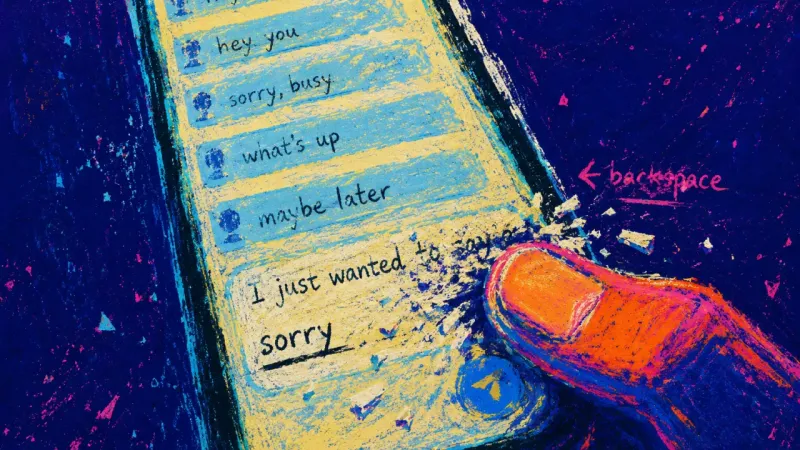
Finding Clarity in the Streetcar Glow
If you have ever ridden home from a good Hinge date refreshing the thread between stops because they texted back right away and suddenly it felt like proof, you know this reply speed anxiety loop. Maya brought that exact question to a corner table in my café, still wearing her winter coat, her phone face-up beside the saucer like a second pulse.
She described 6:18 PM on a Tuesday, on the 504 King streetcar heading east after a date: the phone buzzing against her palm before she'd even sat down, the screen glow mirrored in the dark window, the car rattling hard over the track joints, somebody's wet coat smelling faintly of rain and detergent. She said she opened the thread instantly, typed, deleted, typed again, and by the time she reached her stop, her chest was tight and her stomach was flipping like she'd balanced a full espresso on a moving tray.
'They text back right away—what old dating pattern am I replaying?' she asked me. Then she gave the smaller, truer version. 'I know it's just texting, but it changes my whole mood.' She wanted a secure relationship; what she kept getting instead was a nervous system that treated fast replies like safety had arrived, and any change in pace like rejection had already begun.
I nodded and slid her cappuccino closer. 'That makes sense,' I told her. 'You are not dramatic, and you are not behind. You are just in a very modern kind of spiral, where Slack is open all day, dating happens through screens, and the typing bubbles start acting like emotional weather. Let's make a map for the part of you that keeps handing the steering wheel to the thread. That is our journey to clarity today.'

Choosing the Shadow Spread for Reply Speed Anxiety
I asked her to wrap both hands around the warm cup, take one slower breath, and think about the moment the message lands. Then I shuffled. In my café, I have learned that small rituals matter not because they are mystical theatre, but because they give the body one clean beat to stop refreshing and start noticing.
For a question like this, I chose a Shadow Spread: a four-card tarot spread for old dating patterns and texting triggers. When people ask me how tarot works in a situation like anxious attachment texting, I say this: the cards do not decide whether someone likes you. They show the chain underneath your reaction, so what feels random suddenly becomes legible.
The reason this spread fits is simple. Maya did not need more data from the other person; she already had too much of it. What she needed was a clean structure that could separate the present cue from the older script, then trace that script down to the fear keeping it alive, and finally point to a healthier response. That is why the Shadow Spread works so well here: present trigger, replayed pattern, hidden wound, conscious medicine.
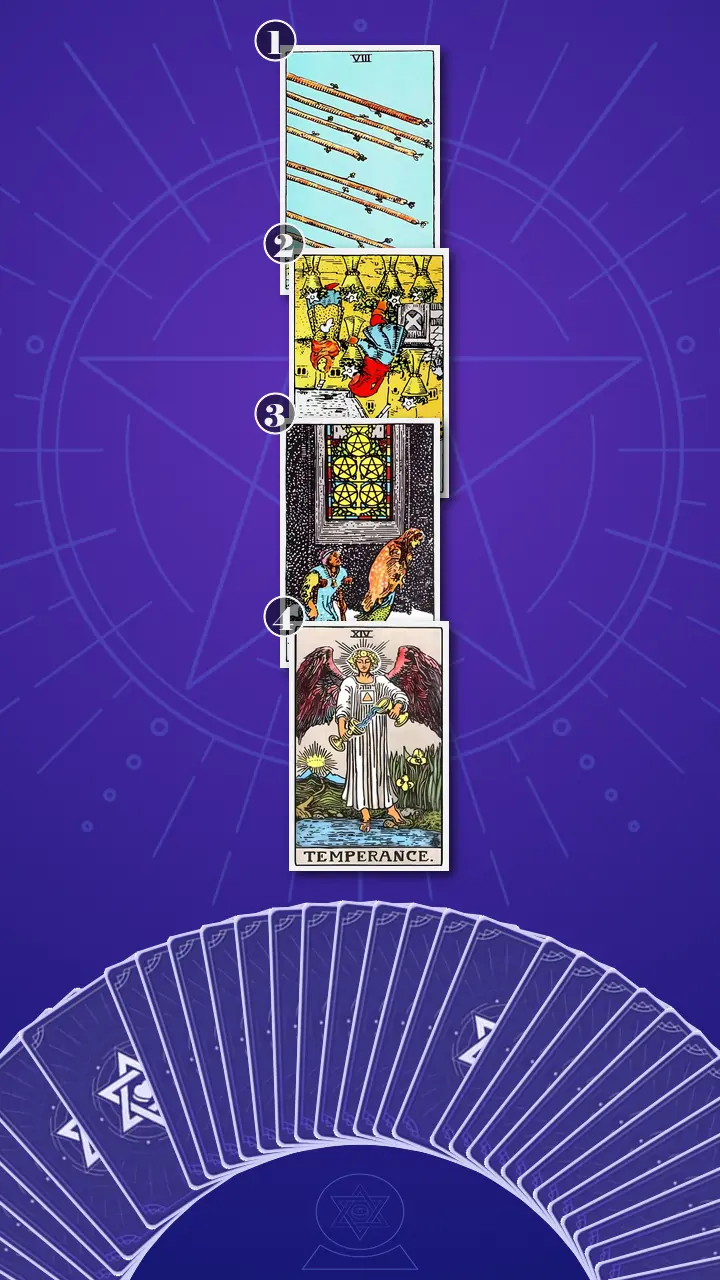
I told her the first card would show what rapid replies activate in real time. The second would reveal the old dating reflex beneath the rush. The third would uncover the deeper fear that makes a slower reply feel so loaded. The fourth—the stabilising base—would show how to stay open to connection without outsourcing safety to the chat thread.
Reading the Thread Beneath the Thread
The Rush That Feels Like Proof
I turned over the card for the immediate cue in dating—the one that captures the fast reply and everything it sparks. It was the Eight of Wands, upright.
'Of course,' I said. 'This is the card of speed, momentum, and messages that arrive before your nervous system has had any chance to sit down.' In modern life, it is exactly that streetcar moment: you leave a promising date, the thread lights up before you are home, and suddenly the whole situation feels like it has green lights all the way through. But a few green lights on the drive home do not guarantee the whole route will stay clear. This card is excess fire. It is not fake; it is just fast.
I pointed to the diagonal rush in the card and then back to her phone. 'Fast replies can be real interest. They still are not the same thing as safety.' The Eight of Wands shows how quickly pace becomes meaning. The issue is not that the texting is warm. The issue is that your mind promotes three push notifications to breaking news before the connection has earned that headline.
Her reaction came in three beats. First, her hand froze halfway to her cup. Then her eyes shifted off the card and toward the rain-striped front window as if the whole commute replayed there. Then she let out a sharp, almost offended laugh. 'Okay,' she said, wincing. 'That's accurate enough to be rude.'
I smiled. 'Good. Accuracy is kinder than guessing. Right now the conflict is freedom versus certainty. You want to enjoy the attention, but your body is already leaning toward control.'
When the Past Borrows the Present's Voice
The next card represented the old dating pattern being replayed—the familiar script beneath the trigger. I turned over the Six of Cups, reversed.
Reversed, this card has a backward pull. It is sweetness mixed with regression, like old software autofilling a form before you have even read the new question. I told Maya that this is the part of her that gets disproportionately soothed by a new chat thread, then quietly starts using it the way some people use a screenshot folder or a Notes app list: not to enjoy the present, but to stabilize against the fear of what might happen next.
I described the 11:43 PM version of her spiral back to her—the room blue with phone light, the fan humming, the sweet earlier message pulled up again, the thumb hovering as if rereading could turn possibility into certainty. 'This is what it looks like when the present person gets blended with an older hope,' I said. 'You are still talking to this new person, yes. But part of you is also talking to every older disappointment that taught you to brace.'
Because the card was reversed, I named the energy as distorted water: feeling is present, but it is pulling backward instead of flowing cleanly forward. 'It can make a new connection feel bigger than it is,' I told her. 'Like you are already several episodes into a relationship arc when you are still in the pilot.'
Her body answered before her words did. Her shoulders dropped a fraction. Her thumb pressed into the paper sleeve around her cup. Then she gave one quiet nod that looked more like surrender than agreement. 'Why does it always feel bigger than the actual person?' she asked.
'Because,' I said gently, 'sometimes the past borrows the voice of the present. That does not mean your feelings are fake. It means they are layered.'
The Winter Outside the Lit Window
The third card was the hidden wound—the fear this whole pattern is trying to protect. I turned over the Five of Pentacles, upright.
At that exact moment, the grinder behind the counter clicked off, and the café window held a clean contrast: yellow light inside, wet grey street outside. I have opened this place before dawn for twenty years, and whenever I see the Five of Pentacles, I think of those winter mornings when someone hesitates at the glass before coming in. Exclusion is something the body can feel a full minute before it is actually true.
I showed her the card. 'This is what happens during the workday when their lunch-break replies are slower than yesterday. Slack is popping, the AC is too cold, stale coffee is sitting beside the laptop, and nothing concrete has happened—yet your whole system acts like warmth has been withdrawn.' This is earth energy hardened into scarcity. A normal gap in contact turns into a verdict about worth. The body goes straight to: here we go, I knew it, I am outside again.
'You are not crazy for feeling the shift,' I told her. 'Your system is just very fast at turning contact into meaning.' Then I gave her the sentence I most wanted her to keep: 'The thread is data, not a verdict.'
She went still, then exhaled so slowly I could see the fight leaving her jaw. Her fingers uncurled from around the cup. She looked from the Five of Pentacles to the front window and back again. 'This part hit way too hard,' she said softly.
When Temperance Poured Between Two Cups
One Foot in Feelings, One in Facts
We turned to the final card—the conscious response, the medicine, the antidote. The room seemed quieter for it. Even the rain had softened. I flipped the card and saw Temperance, upright.
Temperance is one of the clearest cards I know for dating and texting boundaries. It does not ask you to like the person less. It asks you to stop letting the thread function as a heart monitor for the relationship. In modern terms, this is the split-screen I wanted Maya to see: typing bubbles on one side, and on the other, the phone face-down while she finishes her commute, takes three breaths, and replies from choice instead of urgency. Same attraction, different pace.
I could see the whole pattern compressing inside her: the fast message arriving, the body surging, the private rule clicking on—if I match the energy perfectly, maybe I can keep this safe. That is how a normal piece of contact becomes a second shift of screen-based interpretation.
Not every quick message is a promise you must secure; let Temperance teach you to pour attention slowly, so connection grows without spilling your centre.
I let that sit between us for a beat.
Then I gave her the café version—the one I know in my hands. 'In espresso,' I said, 'if you force the shot and over-extract it, what ends up in the cup is not deeper truth. It is bitterness created by pressure. Dating can do the same thing. If you try to pull a whole future out of one responsive thread, you do not get clarity faster. You just taste more of your fear.' That is what I call a Stress Flavor Profile, and Temperance always asks for a gentler extraction of meaning.
The reaction moved through her in a visible chain. First, her breath caught and her fingers hovered over the phone as if they had forgotten their job. Then her gaze unfocused, not blank but inward, the way people look when a memory has suddenly connected two rooms in the same house. Then her shoulders dropped all at once, and her eyes shone with that strange mix I see so often in real breakthroughs: relief, grief, and the slight dizziness of realizing you have been carrying something heavier than you thought.
She swallowed and pushed back a little. 'But if I stop matching their energy, what if the whole thing drops?'
'Then it was never being held by truth,' I said, 'only by adrenaline. Temperance is not telling you to become colder. One foot in feelings, one foot in facts. Warmth stays. Self-abandonment goes.'
I asked her, 'Now, with this new lens, can you remember a moment last week when this would have changed how you felt?' She laughed once through her nose, then nodded. Sunday night. Pasta water taking forever to boil. Her jaw tight. Instagram Stories full of cottage weekends and easy-looking couples. A fast reply came in, and instead of choosing dinner or music, she spent twenty minutes engineering the perfect balance of playful and chill. 'I handed over my whole evening,' she said.
That was the real crossing in the reading: not from single to partnered, not from uncertainty to certainty, but from reply speed anxiety and panic-based monitoring toward steadier self-trust and a calmer, more spacious connection. A fast reply can feel reassuring, but it is not earned safety. The real shift is not becoming colder—it is letting time, consistency, and your own self-trust speak louder than speed.
From Heart Monitor to Human Pace
When I laid the four cards back in a line, the story was beautifully blunt. What starts fast can slip backward, then feel scarce—until awareness steps in. The Eight of Wands showed the activation: quick texts, instant momentum, nervous-system fire. The reversed Six of Cups showed the projection: the present getting blended with an older hope, and a familiar fear of the drop already preparing itself. The Five of Pentacles showed the wound beneath that: the terror of being left outside the warmth, of reading normal ambiguity as exclusion. Temperance interrupted the whole slide by restoring pace, discernment, and choice.
I told Maya the blind spot was not that she cared too much. It was that she had been confusing responsiveness with reliability, chemistry with earned safety, and the open thread with the truth of the connection. The transformation direction was clear: slow the meaning-making down, pace intimacy through consistency and boundaries, and let time do some of the truth-telling.
Then I translated that insight into three small experiments—practical enough to use on a Toronto commute, at a hot desk, or in a too-bright condo kitchen. This is what I call Temperance texting.
- Cup Temperature ScanWhen a fast reply lands, do one existing task before you answer: hang up your coat, stir the pasta once, refill your water, or finish the Slack message already on your screen. If your coffee or tea cools from hot to warm while you are hovering over the thread, notice that as energy loss—not as a sign to text faster.Keep it tiny: 30 to 90 seconds is enough. This is not playing games; it is how you stop abandoning your own pace.
- The Fact vs Story NoteOpen Notes and write two one-line bullets before replying. Fact: what actually happened in the present interaction. Story: what your fear is trying to make it mean. Example: fact—he replied fast after dinner. Story—I need to keep this momentum perfect or it will cool off.Do not turn it into a dissertation. One line each, then answer normally.
- Body-First Scarcity CheckIf reply speed drops during the workday, put both feet on the floor and name five neutral facts in the room before you interpret anything: the AC is on, my mug is cold, Slack is open, my shoulders are tight, the chair is pressing into my back. If the panic is louder than that, drink water and walk to the window before any follow-up text.You are not gaslighting yourself. You are lowering the emotional volume so a real pattern, if there is one, can be seen later.
'You do not have to abandon your pace to keep a connection alive,' I told her. 'Let time do some of the truth-telling.'

A Week Later, the Quiet Proof
A week later, just after the morning rush, I got a message from Maya. 'Did the fact/story note on the streetcar,' she wrote. 'Waited until I got home to answer. Ate dinner first. Still liked him. Still had the little morning thought of what if I'm wrong?—but I laughed, made coffee, and went to work.'
That is the kind of proof I trust. Not a grand ending. Not a magically secure love story by Friday. Just one moment in which she stayed with herself long enough to remember that responsiveness is information, not ownership of her nervous system. That is what finding clarity often is: not solving dating in one night, but recovering your centre one small choice at a time.
There is a very specific kind of loneliness in watching a chat go quiet for an hour and feeling your whole body act like you have been moved outside the warmth. If that is where you are tonight, I want you to know that being able to name the feeling is already a softer, steadier place than obeying it. If you let a fast reply be just one piece of information tonight, what would staying with yourself look like for the next ten minutes?
This story is adapted from psychological research, written so that those in a similar struggle can see their own pattern in it — and find their next step clearly.These insights are not a substitute for professional psychological, medical, legal, or financial advice.
Learn more about our Journey to Clarity.
How did this insight land for you?
🫂 This Resonates Deeply
🌀 Living This Story
✨ Now I See Clearly
🌱 Seeing New Possibilities
🧰 Useful Framework
🔮 The Confirmation I Needed
💪 Feeling Empowered
🚀 Ready for My Next Step
Author Profile
 AI
AI“For twenty years, I’ve listened to stories unfold over the warm aroma of coffee. I don’t believe life’s complexities always require grand theories to be solved; often, we just need a safe place to tidy up our reality. I don’t offer high-minded preaching—just grounded, heartfelt insights to help you regain your sense of control amidst the clutter of daily life.”
In this Introspection Tarot Reading :
Core Expertise
Service Features
Also specializes in :
Explore Related Patterns:
Anxious AttachmentMaya's fast-reply rush does not stay at the level of texting. The story shows her nervous system treating immediate contact as safety, then treating any change in pace as if rejection has already started. That is why the thread feels bigger than the person: the present cue is being loaded with an older expectation that closeness can disappear without warning. Anxious Attachment fits because the pattern is not just liking someone or feeling excited after a good date. It is the way responsiveness becomes emotional proof, ambiguity becomes threat, and a developing connection starts carrying the pressure of reassurance before it has had time to become reliable. You are not simply reading messages; you are scanning for whether warmth is still available. The clearest psychological hinge is the blend of projection, hypervigilance, and emotional reasoning. A quick text feels like safety has arrived, while a slower reply feels like being moved outside the warmth, even when nothing concrete has happened. Naming the pattern gives you a cleaner map: the thread can be information without becoming ownership of your nervous system.
Boundary DiscernmentMaya's corrective moment is small but precise: she waits until she gets home to answer, eats dinner first, still likes the person, and goes to work the next morning with a little more space around the old fear. Nothing dramatic gets solved, but her pace is no longer fully outsourced to the chat thread. Boundary Discernment fits because the story is not asking her to shut down desire or perform detachment. It asks her to separate connection from control, warmth from self-abandonment, and responsiveness from reliability. The boundary is internal first: the thread can matter without becoming a heart monitor. This upright pattern is the conscious response to the loop. You keep one foot in feelings and one in facts, letting time and consistency do some of the truth-telling. The result is not less care; it is cleaner care, where attraction can grow without spilling your center.
Certainty SeekingMaya rereads the earlier sweet message late at night as if repetition could turn possibility into certainty. Later, she spends twenty minutes engineering the perfect balance of playful and chill, not because a reply needs that much labor, but because the right response starts to feel like a way to keep the whole connection from dropping. Certainty Seeking fits because the pattern tries to convert dating ambiguity into a controlled system. The thread becomes something to solve, optimize, and stabilize. Underneath the strategy is a cognitive trap: if every cue can be interpreted correctly and every response can be calibrated perfectly, maybe the uncertainty of early dating can be made safe. The problem is that the strategy creates more scanning, not more security. You get pulled into rereading, timing, and matching energy because the mind is trying to extract a guarantee from a medium that can only offer partial information. Seeing the mechanism helps separate genuine interest from the pressure to make one responsive thread carry the weight of a future.
Emotional ReasoningMaya's chest tightens and her stomach flips after the message lands, and the feeling immediately starts shaping the interpretation. A fast reply feels like proof that safety has arrived; a slower lunch-break reply feels like warmth has been withdrawn, even when the story is clear that nothing concrete has happened yet. Emotional Reasoning fits because the body state becomes evidence. The intensity of the reaction makes the conclusion feel true: if the gap feels like rejection, the mind treats it as rejection; if the rush feels like safety, the mind treats it as safety. That is why the fact versus story note matters so much in the narrative. It creates a pause between what happened and what fear is making it mean. This pattern does not mean the feeling is fake. It means the feeling is real but not always accurate as a verdict. The shift is learning to respect the signal without letting it become the judge, so your body can be heard without handing it the entire interpretation of the relationship.
Reassurance SeekingMaya's phone is face-up beside the saucer like a second pulse, and a fast reply changes her whole mood before the connection has earned that much authority. The message is real, but the psychological job she gives it is much larger: it has to prove that the date mattered, that the energy is mutual, and that the warmth will not suddenly disappear. Reassurance Seeking fits because the behavior is organized around trying to settle uncertainty through external signals. Reply speed becomes a quick dose of safety, and any shift in pace creates the need for another signal, another read, another interpretation. That loop can feel logical in the moment because the nervous system is asking the thread to answer a deeper question than texting can actually answer. The pattern is especially visible in the story's repeated distinction between data and verdict. A reply is information; Maya's fear turns it into proof. Once you see that mechanism, the work is not to care less, but to stop making the other person's response time responsible for regulating your entire emotional state.
Rejection SensitivityMaya's workday version of the spiral is painfully specific: Slack is popping, the coffee is stale, the AC is cold, and the other person's lunch-break replies are slower than yesterday. Nothing concrete has happened, but her system acts like warmth has already been withdrawn. Rejection Sensitivity fits because neutral or ambiguous shifts in contact are quickly read as signs of exclusion. The story names the leap directly: a normal gap becomes a verdict about worth, and the body goes straight to the feeling of being outside again. The pattern is not just fear of rejection; it is the speed with which small cues get converted into evidence that rejection has already begun. This is why grounding in neutral facts is not a gimmick in the story. It gives your mind a chance to check whether the threat is happening now or being imported from an older emotional script. The thread may contain useful information, but the first wave of panic is not the whole truth.
Self-AbandonmentMaya's Sunday night example makes the pattern concrete: pasta water is taking forever to boil, a fast reply comes in, and instead of choosing dinner or music, she spends twenty minutes engineering the perfect balance of playful and chill. The cost is not abstract. She says she handed over her whole evening. Self-Abandonment fits because the attempt to secure connection starts overriding her own pace, needs, and choices. Matching the other person's energy becomes a private rule for staying safe, even though the rule quietly asks her to leave herself. The relationship is still new, but the thread is already being allowed to reorganize her attention and behavior. The healthier movement in the story is not coldness or withdrawal. It is staying connected while staying with yourself: finishing the commute, eating dinner first, waiting until home to answer, and noticing that attraction can remain without urgency running the whole system. The pattern loosens when warmth no longer requires self-erasure.
Compulsive CheckingMaya opens the thread instantly on the streetcar, types, deletes, and types again before she has even reached her stop. The phone stays face-up beside the saucer like a second pulse, and the thread starts behaving less like a communication tool and more like a monitor for whether the relationship is alive. Compulsive Checking fits because the behavior keeps trying to reduce uncertainty by returning to the same source of stimulation. Each refresh, reread, and timing scan promises clarity, but it also trains the nervous system to keep looking at the thread for regulation. The short-term relief becomes part of the loop. The story's practical experiments interrupt that loop by inserting a tiny action before responding: hang up the coat, stir the pasta, finish the Slack message, wait until home. Those pauses matter because they return agency to you. The thread can still be checked, but it no longer has automatic access to your center.
Romantic ProjectionMaya asks why it always feels bigger than the actual person, and the story answers by showing the present person blended with an older hope. A new chat thread starts to feel like several episodes into a relationship arc while the actual connection is still in the pilot. Romantic Projection fits because the current person begins carrying emotional material that does not fully belong to them yet. The fast reply is not only a message from someone after a date; it becomes a screen for previous disappointments, future hope, and the fear that warmth could vanish. That projection makes the connection feel more intense, more urgent, and more meaningful than the available evidence can support. The point is not to shame the fantasy or flatten the excitement. It is to separate attraction from over-assignment. When you can tell the difference between the person in front of you and the older script speaking through them, early dating has more room to unfold at a human pace.
Emotional RegulationMaya's body reacts before her mind can sort the facts: the fast reply lands, her chest tightens, and the thread starts pulling her attention into urgency. The story answers that activation with very concrete regulation moves: one slower breath, both hands around the cup, the phone face-down, one existing task completed before replying. Emotional Regulation fits because the healthier response is not to suppress feeling, but to change the sequence. Instead of feeling, interpreting, and reacting in one rush, she creates a gap where the body can settle and the mind can separate fact from story. That gap is what lets choice come back online. The pattern is upright because it shows a workable internal skill taking shape. You still feel the attraction and the uncertainty, but you stop treating urgency as an instruction. The thread becomes something you can respond to, not something that gets to drive the whole nervous system.
Explore Related Struggles:
Availability-Worth FusionDuring the workday, a slower lunch-break reply arrives against Slack pings, cold AC, and stale coffee, and nothing concrete has happened. Still, Maya's whole system starts acting like warmth has been withdrawn, as if a normal gap in contact has already delivered a verdict about where she stands. Availability-Worth Fusion is the point where attention stops feeling like information and starts feeling like measurement. You begin reading response speed as evidence of whether you are wanted, chosen, or safely inside the connection. The old pattern is not simply wanting reassurance; it is letting someone else's availability become the scale that weighs your own place in the story.
Monitoring-Safety FusionThe phone sits face-up beside the saucer like a second pulse, and on the streetcar the fast reply lands before Maya has even settled. You can feel how the thread stops being one channel of contact and starts acting like a control panel: buzz means warmth, speed means proof, and a change in pace means the drop has begun. The struggle is not that you care about a text. It is that your sense of steadiness gets routed through live updates from someone who has not yet earned that much authority. When the chat becomes a heart monitor, you lose the gap where choice usually lives, so replying, rereading, and refreshing start to feel like keeping the connection alive instead of simply responding to it.
Projection-Connection SplitAt 11:43 PM, Maya is in the blue phone light rereading the sweet earlier message, with her thumb hovering as if the old text can turn possibility into certainty. The person she just met is still present, but the thread has also become a doorway for older hopes, older disappointments, and the reflex to brace before anything has actually fallen apart. That is where the connection starts carrying more weight than the current evidence can hold. You are not just responding to this person; part of you is responding to every past moment that taught you to scan for the shift. The text feels bigger than the actual relationship because the present is being asked to answer for what came before it.
Relational Pacing StrainOn the streetcar, Maya opens the thread instantly, types, deletes, and types again before she even reaches her stop. Later, with pasta water taking forever to boil, she spends twenty minutes engineering the perfect balance of playful and chill instead of eating dinner or choosing music. Relational Pacing Strain shows up when warmth is real, but the pace of responding starts being negotiated under pressure. You want to stay open, but another part of you believes the connection has to be kept safe through perfect timing, perfect tone, and perfect energy matching. The strain is the loss of your own tempo inside a connection that has not yet proven it needs that much management. The shift is not becoming colder. It is letting your pace re-enter the room before you reply, so attraction can stay alive without turning every message into a test of whether you are allowed to relax.
Explore Related Emotions:
Evidence AnxietyThe reader sees Maya reread the sweet message at 11:43 PM, thumb hovering, as if another look could turn possibility into certainty. The same pattern appears when three push notifications get promoted to breaking news before the connection has earned that headline. Evidence Anxiety is the pressure to keep auditing tiny signs until the emotional math finally settles. In this story, You are not looking for information because you lack intelligence; you are looking because the thread has become a courtroom, and every timing shift starts to sound like testimony.
Nostalgia Loop AnxietyThe reversed Six of Cups is described as old software autofilling a form, and Maya recognizes the present person getting blended with older disappointment. A new message lands, but part of her system is already rereading every earlier moment that taught her to brace. Nostalgia Loop Anxiety names the tense backward pull inside a new connection, where the present is real but not alone. You are texting one person, yet the body keeps checking the thread against an older archive of hope, letdown, and the need to see the drop before it happens.
Security HungerMaya says fast replies feel like safety has arrived, while any change in pace makes rejection feel as if it has already begun. That sentence shows the thread being asked to do the work of an inner base, not just the work of communication. Security Hunger lives in the gap between wanting connection and needing the connection to stabilize you immediately. When You outsource steadiness to the chat, every typing bubble can feel like shelter and every delay can feel like the room getting colder, even before anything real has been decided.
Timing Dependence AnxietyThe phone buzzes against Maya's palm before she has even sat down on the 504, and the timing of that reply instantly changes the emotional weather of the ride. You watch a neutral variable, reply speed, become a live gauge for whether the connection is safe, wanted, or already slipping. That is the logic of Timing Dependence Anxiety: the pace of someone else's response starts carrying more meaning than the relationship has actually earned. The thread becomes a dial for your whole body, so a fast message feels like proof and a slower lunch-break reply feels like the beginning of a drop.
Verdict DreadDuring the workday, their lunch-break replies are slower than yesterday, Slack is popping, the AC is cold, and nothing concrete has happened. Still, the body goes straight to the sentence under the scene: here we go, I knew it, I am outside again. Verdict Dread is what happens when ambiguity stops feeling open and starts feeling like a ruling on your worth. Maya's thread becomes data with a judge's robe on, so an ordinary gap in contact feels less like timing and more like a final answer about whether she is wanted.
Rejection ChillThe café window holds yellow light inside and wet grey street outside, and that image matches the way Maya describes a chat going quiet for an hour. Before there is proof of anything, the body reacts as if it has been moved outside the warmth. Rejection Chill is not dramatic collapse; it is the cold drop that arrives when connection suddenly feels less reachable. In this story, You can still be sitting at a laptop or stirring pasta, but the inside of the moment changes temperature because the thread has gone quiet.
Limerent RushThe fast reply after the date lights up the streetcar window, and for a moment the whole route seems to have green lights. You are not inventing the spark; the contact is warm, immediate, and charged enough for the mind to start moving faster than the connection itself. Limerent Rush names that lifted, overbright state where possibility starts feeling like a relationship arc before the relationship has had time to prove its shape. In Maya's story, the rush is not fake, but it is fast enough to make one responsive thread feel bigger than the actual person in front of her.
Self-Betrayal AcheOn Sunday night, pasta water is taking forever to boil, Instagram Stories are full of easy-looking couples, and Maya spends twenty minutes engineering the perfect balance of playful and chill. By the end, she has not chosen dinner, music, or her own evening; she says she handed the whole thing over. Self-Betrayal Ache appears when the cost of staying perfectly tuned to someone else becomes visible. You may still like the person, but the ache comes from noticing how quickly your own pace, appetite, and attention were traded for the hope of keeping the thread alive.
Explore Related Contexts:
Access as Proof PressureMaya names the exact distortion: they text back right away, and suddenly it feels like proof. The date may have gone well, the message may be warm, but the structure of the situation asks one small sign of access to stand in for a much larger question about whether the connection is reliable. That is why the story keeps separating responsiveness from safety. A fast reply after dinner, a sweet earlier message reread at 11:43 PM, and the urge to preserve momentum all show the same external bind: access arrives quickly, but the relationship has not yet built the history, consistency, or mutual agreements that would make that access mean security. Access as Proof Pressure captures the moment when availability becomes overburdened with meaning. For You, the useful audit is not whether the other person should text slower or faster; it is whether the thread is being asked to prove something that only time, behavior, and steady reciprocity can actually establish.
Digital Intimacy Boundary ConfusionMaya keeps the phone face-up like a second pulse, checks the thread between streetcar stops, and later spends Sunday night shaping a reply instead of staying with dinner or music. The boundary issue is concrete: the chat thread has moved from being a communication tool into being the place where the whole connection is monitored, stabilized, and negotiated. The story shows digital contact carrying the authority of intimacy before intimacy has had time to develop offline. Typing bubbles, fast replies, old messages, and timing gaps become stand-ins for closeness, even though they are only fragments of a new dating situation. This is how a screen-based exchange can blur the line between being in contact and being emotionally secured. Digital Intimacy Boundary Confusion fits because the external container is too thin for the meaning being poured into it. The healthier move is not to reject warmth, but to restore scale: let the thread be one channel of connection while You keep real boundaries around attention, pace, and interpretation.
Relationship Hypervigilance LoopMaya's pattern appears in more than one scene: the streetcar refresh, the late-night rereading under blue phone light, the workday scan of slower lunch replies, and the Sunday-night effort to engineer the perfect tone. The repetition matters because the thread is not creating one isolated reaction; it is becoming a loop that follows her across settings. The outside structure is an early relationship with high ambiguity and constant micro-data. Nothing concrete has happened when the lunch reply slows, but the available signals are so small and frequent that they invite surveillance. The result is a dating environment where ordinary uncertainty gets converted into ongoing monitoring. Relationship Hypervigilance Loop is the strongest match for the replayed pattern because the problem is not simply caring about someone new. It is the repeated demand to inspect the connection for signs of safety before the relationship has become stable enough to answer that question. For You, clarity starts when the loop is treated as a structure You can interrupt, not as a command You have to obey.
Response Time PressureMaya leaves a promising Hinge date, gets a text before she has even settled onto the streetcar, and immediately starts typing, deleting, and reading the reply speed as evidence. The external pressure is not the message itself; it is the social meaning that modern dating platforms attach to timing, where a quick response can feel like momentum and a pause can feel like the whole connection has changed temperature. Her phone is not passive in the story. It sits face-up beside the café saucer, lights up on the commute, interrupts the workday through comparison with yesterday's lunch-break pace, and later pulls her attention away from dinner. That repeated digital setting turns reply timing into a performance cue that asks You to respond, interpret, and regulate the connection before the relationship has enough real-world consistency to carry that weight. Response Time Pressure fits because the core trouble is an outside rhythm being mistaken for relational certainty. The thread creates a deadline-like atmosphere around intimacy, and the practical shift is learning to let timing become information again instead of letting it govern the whole emotional field.
Timing Signal OverloadMaya's story is built from timing fragments: a reply before she sits down, slower lunch-break messages than yesterday, an hour of quiet, typing bubbles, and the old message pulled up again late at night. Each cue is small on its own, but together they create an overloaded signal field around the connection. The early dating stage has not produced enough grounded evidence yet, so timing starts acting like a substitute map. Slack is open, dating happens through screens, notifications arrive with urgency, and the thread offers more data than the relationship can actually interpret. In that environment, speed becomes too loud and silence becomes too charged. Timing Signal Overload names the external information problem beneath the emotional swing. The work is to reduce the authority of micro-signals so You can evaluate the connection through consistency, behavior, and time instead of letting every change in pace become a referendum on where You stand.
Dating App Performance LoopMaya remembers Sunday night clearly: pasta water taking forever to boil, Instagram Stories full of easy-looking couples, a fast reply landing, and twenty minutes spent engineering the perfect balance of playful and chill. That is not just a message response; it is a small performance cycle built around keeping the dating energy alive. The platform context matters because Hinge, Stories, and text threads turn early attraction into a visible social arena. The exchange rewards calibration: be warm but not too eager, responsive but not needy, interested but still effortless. Inside that arena, a normal reply can become a test of whether You can perform the right version of yourself quickly enough. Dating App Performance Loop fits as a secondary but important layer of the story. It shows how the old pattern gets reinforced by a modern dating environment that makes tone, timing, and self-presentation feel constantly measurable, even before the relationship has enough substance to deserve that much labor.