What Changed Between Leaving a Friend Out and Speaking Up in the Chat

The 11:40 p.m. Price of Staying Inside
I have learned to notice a particular social reflex: if you are the junior person at work who reads every room before disagreeing, you may also be the friend who waits for the group-chat reaction count before deciding what you “really” think. Groupthink in friendships can look that ordinary.
At 11:40 p.m. on a Tuesday, Maya joined my video session from the kitchen of her Queen Street West apartment. I heard the refrigerator humming through her microphone and saw blue phone light reflected on the cold quartz counter. She had just watched two laughing reactions appear beneath a message saying, “Inviting Leah would change the vibe.” Then she had removed Leah from the OpenTable reservation, added the same reaction, and opened a private DM: “We should catch up soon.”
“What keeps me helping my circle exclude people I actually like?” she asked. “I do like her. I just don't want to make this a whole thing.”
There was the contradiction in one screen-sized sequence. Maya wanted to maintain a genuine connection with Leah, but she was also participating in the circle's effort to deny that connection public recognition. She was trying to keep both relationships, but only one of them was receiving her visible loyalty.
She held her phone with both hands, although it was resting on the counter. Her jaw looked locked in place. When she described the moment Leah's name disappeared from the reservation, the guilt under her ribs seemed to behave like a phone vibrating in a pocket she could not reach: persistent, private, and impossible to silence for long.
“It wasn't really my decision,” she said. Then she looked down. “Even though I went along with it.”
I did not tell her that the feeling was meaningless, and I did not turn it into evidence that she was secretly a terrible person. Guilt can become either a courtroom or a compass. A courtroom demands an identity verdict. A compass asks which behavior needs to change.
“I am not here to prosecute you or predict whether your friends will reject you,” I told her. “I want us to examine the exact mechanism: what happens before you conform, what relief you receive, who carries the cost, and where your own choice is still available. Let us make a map of the fog, then find one next step you can actually own.”

Choosing a Social Compass for Friend-Group Conflict
I asked Maya to place both feet on the floor, take one slower breath, and let her attention settle on the question rather than on the newest notification. I shuffled while she loosened her grip on the phone. The pause was not a mystical performance. It was a transition from reflex to observation.
I explained that I would use the Relationship Spread · Context Edition, a five-card relationship tarot spread designed here as a social compass. I use tarot through a Jungian psychological lens: the images help externalize roles, defenses, values, and choices that are difficult to see while we are living inside them. The cards would not decide whether Leah deserved an invitation, reveal anyone's hidden motives, or predict the group's response. They would help us place observable behavior and Maya's agency in the same frame.
For anyone wondering how tarot works in a friendship conflict, the spread matters because card meanings in context are more useful than isolated definitions. A general relationship spread might invite speculation about what another person secretly thinks. This Context Edition keeps the inquiry grounded. It looks at what Maya does, what the circle visibly rewards, which unwritten rule holds the system together, where Maya's values and behavior divide, and which boundary remains under her control.
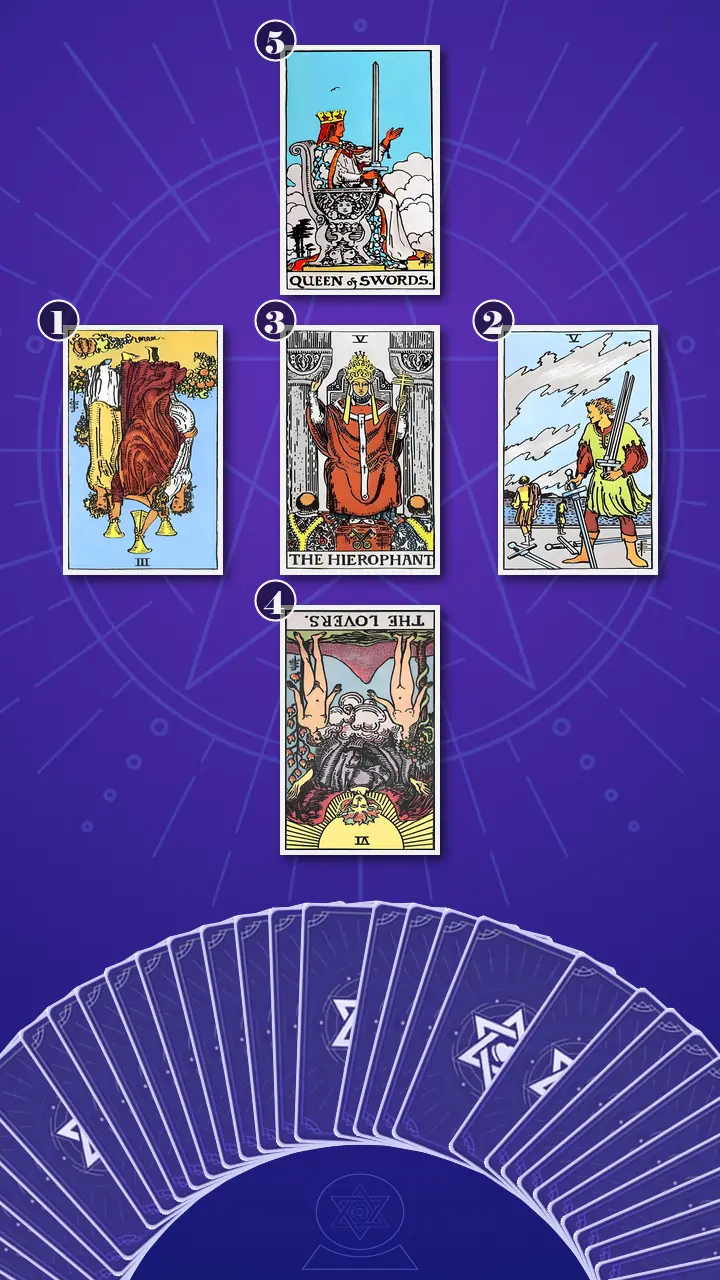
I placed the first card to the left for Maya's enacted role and the second to the right for the circle's observable norms. The third sat in the center as the belonging bargain. Beneath it, the fourth would expose the value split pulling the situation downward. Above it, the fifth would show a user-controlled path forward. The cross looked less like a prediction of fate than a diagram of where intervention was possible.
Reading the Rules Nobody Wrote
Position 1: Three of Cups Reversed and the Closed Celebration
The card I turned over first represented Maya's enacted role: the reactions, omissions, and invitation choices through which she helped the circle exclude people she privately liked. It was the Three of Cups, reversed.
Upright, the three figures raise their cups inside a shared celebration. Reversed, that warmth can become conditional access. The closely linked circle no longer asks only, “Who do we enjoy?” It begins asking, “Who proves they belong by joining our response?” The raised cups looked remarkably like a cluster of approving reaction bubbles.
I brought Maya back to the modern-life scene already sitting on her counter. At 11:40 p.m., the private chat had functioned like a closed party. She removed Leah's name, added a laughing reaction, and opened a separate message offering warmth in private. That sequence transformed discomfort into practical support for the clique. The reaction was small, but it helped the exclusion appear unanimous. The private DM softened Maya's guilt locally without changing the shared behavior that created it.
Energetically, I read the reversed Cups as blocked Water. Maya had genuine affection available, but the flow of connection was being routed into two separate channels: public compliance and private consolation. The blockage was maintained by a familiar inner defense: “I did not start this, so maybe my small part does not count. But if it does not count, why am I hiding that part from her?”
“Private kindness does not cancel public complicity,” I said. “That does not make kindness worthless. It means the private message cannot do the work of the public choice.”
Maya gave one short laugh, but there was no amusement in it. “That is too accurate,” she said. “It's actually a bit brutal.”
I watched a three-part reaction move through her. First, her breathing paused and her thumb froze above the dark phone screen. Then her gaze slipped away from me as if she were replaying other reservation edits, reaction bubbles, and vague explanations. Finally, she exhaled through her nose and set the phone flat on the counter.
“So am I just a bad friend?” she asked.
“No card gets to assign you a permanent identity,” I replied. “I am naming a behavior pattern because behavior can be changed. Your discomfort is not proof that you are beyond repair. It is evidence that your conduct and your values are no longer fitting together comfortably.”
I also cautioned her against the reversed card's overcorrection. Accountability did not require posting screenshots, exposing private conversations, or denouncing the entire circle in a dramatic bid to prove independence. That would turn another person's exclusion into a new status performance. The first task was simpler: notice which of Maya's own visible actions kept closing the circle.
Position 2: Five of Swords and the Status Scoreboard
The second card represented the circle's observable norms and rewards, based on messages, reactions, invitation choices, and consequences rather than guesses about anyone's private motives. I turned over the Five of Swords, upright.
In the image, one figure gathers several swords while two others walk away toward the water. The advantage is visible, but so is its price. Someone gains control of the field because someone else has been made to absorb the loss.
I compared the group chat to a status scoreboard. A friend posts the harshest assessment of Leah. Reactions accumulate around that judgment. The language is repeated when anyone questions the invitation. The group receives a clean story and an easy sense of cohesion; Leah loses access, context, and any realistic opportunity to respond. It resembles a quote-post pile-on in a private channel, where the absent person becomes content while everyone present collects certainty.
“A vibe verdict is still a decision when it changes who gets access,” I told Maya.
The Five of Swords showed Air in excess: language, comparison, and analysis sharpened into competitive narrative control. The problem was not disagreement itself. Friends can have specific concerns, limited capacity, privacy needs, or boundaries around harmful behavior. The problem appeared when a vague phrase such as “not the right vibe” made another person carry the entire social cost while allowing everyone inside the chat to avoid owning a concrete choice.
“Who receives approval when the judgment lands?” I asked. “And who loses something that cannot be replaced by a private catch-up message?”
Maya rubbed the heel of her hand against the space below her ribs. “The person who says it first usually gets everyone agreeing with her,” she said. “Leah loses the plan. And I get to stay out of the argument.”
“So the immediate reward is relief,” I said. “The displaced cost is Leah's exclusion, followed by your guilt. Then the guilt makes the next disagreement feel even riskier because there is more history to acknowledge.”
Her shoulders rose before settling again. She told me that disagreement often felt like volunteering to become the next person discussed. I did not dismiss that fear. Several of her friendships and most of her weekend routines ran through the same six-person circle. The possible social cost was real. The card's useful challenge was not to pretend otherwise; it was to ask whether fear of that cost should be allowed to make every decision in advance.
Position 3: The Hierophant's Unwritten Policy
The third card occupied the center and represented the belonging bargain holding the circle together: the unwritten rule that made group consensus feel more authoritative than Maya's direct experience. I revealed The Hierophant, upright.
The seated authority faced two followers, with crossed keys placed before them. In Maya's social system, those keys resembled informal credentials for being acceptable. Nobody had written a policy requiring her to agree, yet one confident “we all know what she's like” followed by several reaction bubbles could begin functioning like binding guidance.
I described it as a Slack approval chain crossing over into weekend life. The first forceful opinion looked like a proposal. The reactions made it look like policy. Repetition made the policy feel traditional. Before long, questioning one judgment seemed equivalent to questioning the entire group.
The Hierophant's energy was not inherently harmful. Shared norms can create trust, safety, and continuity. Here, however, that energy had moved into excess. Maya was granting an informal consensus more authority than her own direct evidence. She was treating membership as if it required surrendering the right to evaluate the rule.
This was where I used my Group Archetype Decoding lens. I did not assign fixed labels to Maya's friends or claim to know their unconscious intentions. Instead, I mapped the roles produced by their visible pattern: a Rule-Keeper issued the accepted interpretation; several Consensus Followers amplified it; an absent person became the social Scapegoat; and Maya took the role of the Accommodating Insider, translating disagreement into silence so the group would not have to experience friction.
I have travelled through enough cultures to know that every social setting carries codes. Looking at The Hierophant, I remembered arriving at unfamiliar tables where the etiquette changed completely from one city to the next. The healthiest codes could be explained, questioned, and adapted. The most draining ones depended on everyone acting as if the rule were self-evident.
“Belonging is not the same thing as obedience,” I said. “Which rule of this circle would you reject if no status or approval were attached to following it?”
Maya went still. A new notification lit her phone, but she turned it face down without reading it. “That whoever sounds most certain must have noticed something I missed,” she said eventually. “At work, I do the same thing with senior people. I soften my opinion until it sounds like theirs.”
The recognition did not arrive as instant relief. Her fingers tightened around the edge of the counter, then slowly released. I could see her measuring how far the pattern reached. The friend-group dynamic was not an isolated flaw in her character. It was a social survival strategy she had practised in more than one room, and its familiarity had made it look like common sense.
Two Open Chats, One Divided Choice
Position 4: The Lovers Reversed in Split Screen
The fourth card, placed below the center, represented the Meaning-Collapse Split as the central challenge: Maya's private regard for Leah conflicting with the public behavior she used to preserve group membership. I turned over The Lovers, reversed.
The two figures stood apart beneath the angel, with a mountain rising between them. Reversed, the image gave form to Maya's divided line of accountability. Her affection occupied one side. Her group-approved conduct occupied the other. The mountain was the choice she kept trying to describe as something that had simply happened around her.
I asked her to imagine the public thread and private DM as two browser profiles. In one, Maya wrote, “We should catch up soon,” and presented herself as someone who valued the friendship. In the other, her reaction and reservation edit communicated, “I support the judgment that removes your access.” The split-screen logic was almost Severance-like: each version of the friendship had to remain isolated so neither one would confront what the other was doing.
The reversed Lovers showed a blockage in choice and alignment. It did not say that Maya lacked values. It showed that fear had interrupted the bridge between what she valued and what she visibly supported. The phrase “it was not my decision” reduced the discomfort temporarily, but it also erased the exact part of the situation she could change.
“If this was not your choice at all,” I asked, “why do you need Leah not to see what you did?”
Maya's chin lifted. For a moment, I saw resistance before I heard it. “But if I call it a choice, doesn't that mean I was fake the whole time?”
“It means you made choices under social pressure,” I said. “Responsibility should be proportionate. You did not invent the entire dynamic, and you cannot control every invitation. You did choose a reaction, an edit, and an explanation. Naming those actions restores agency. It does not require turning your whole identity into an accusation.”
Her eyes moved between the Lovers and the face-down phone. I watched her lower lip press inward, then release. “I think saying it wasn't my decision has been the only way I could keep liking myself,” she said quietly.
“Then we need a way for you to keep your self-respect through alignment rather than denial,” I replied. “One visible choice is where separate-room friendships begin to meet.”
I did not push her toward an immediate confession or a dramatic confrontation. The first loosening was simply naming the split. A public choice that matched private regard could be small, measured, and specific. It could also leave room for Maya to change her opinion later if concrete information emerged. Independent judgment is not blind loyalty to the excluded person; it is the refusal to borrow certainty from the reaction count.
When the Queen Raised One Sword
Position 5: Queen of Swords and One Owned Sentence
The fifth card sat above the spread as a user-controlled path toward value-aligned participation: one clear boundary, inclusive action, or accountable communication practice Maya could test without controlling the circle. As I turned it over, the refrigerator motor stopped. The sudden quiet made the small kitchen feel wider.
It was the Queen of Swords, upright.
The Queen held one sword vertically rather than gathering a whole arsenal. Her other hand remained open. I read this as balanced Air: independent perception, accountable language, and a firm boundary that did not need to become cruel. The sword separated what Maya directly knew from what the group expected her to repeat. The open hand preserved the possibility of relationship without requiring self-erasure.
In modern terms, the Queen was not a crowded Notion page of arguments proving that Leah was perfect. She was one source-of-truth sentence Maya could stand behind: “I have always enjoyed spending time with her.” If others disagreed, Maya could still decline to repeat a vague character judgment and make her own invitation choices where she had real control.
I used my Persona Fatigue Diagnosis as an energy audit. Maya's social mask was the Easy, Accommodating Insider: the person who could read the room quickly, mirror the strongest signal, and keep everything from becoming “a whole thing.” That mask had once helped her navigate agency hierarchy and friendship uncertainty. But every use now carried a hidden energy invoice.
I traced the cycle aloud. A group verdict appeared. Maya put on the mask and offered the correct reaction. She received immediate insider relief. Then she maintained a second, warmer self in private messages, monitored whether the two versions might collide, and spent the next day carrying a locked jaw, a sinking stomach, and resentment toward the very approval she had worked to preserve. The mask was not proof that her core self was fraudulent. It was a protective strategy whose maintenance costs had become larger than its benefits.
At 11:40 p.m., the reservation had lost one name, the laughing reaction had gone up, and a private “we should catch up” draft had opened seconds later. The chat had gone quiet, but Maya's jaw stayed tight because both versions of the friendship remained on screen.
I slowed my voice.
“The way out of groupthink is not winning the room. It is letting one public choice tell the same truth as your private affection.”
You do not need the circle to approve your judgment; speak one clean truth and let the Queen's upright sword separate belonging from complicity.
I let the sentence sit between us.
For one beat, Maya did not move. Her breath stopped, and her fingers remained suspended above the face-down phone. Then her pupils widened slightly as her attention seemed to move back through previous chats. The tight line around her mouth wavered; her eyes reddened, but she did not look away. Her shoulders dropped a fraction, followed by another fraction, as though she were lowering something heavy without yet trusting the floor to hold it.
“But doesn't that mean I have been wrong every time I stayed quiet?” she asked. The first words came out sharp, almost angry. Halfway through the sentence, her voice thinned. She opened one hand, closed it, then rested both palms on the counter. The release was not clean or triumphant. I saw relief arrive beside a brief, almost dizzy blankness: if the group was not responsible for certifying her judgment, then the next choice belonged to her. She breathed out a small, trembling “Oh,” carrying both grief for what had happened and recognition that something different was possible.
“This is not a verdict on every past moment,” I said. “It is a more accurate description of the next one. Now, using this new perspective, think back to last week. Was there a moment when this insight could have changed how the situation felt?”
Maya remembered Leah posting a photo from a ceramics class. She had wanted to leave a visible comment, but she had sent a private heart instead because mutual friends might interpret the comment as taking sides.
“I could have written that the mug looked great,” she said. “That would not have been a speech. It would just have been true.”
“Exactly,” I replied. “You do not need to prosecute the group or prove Leah is flawless. You can state what you directly know and choose what you support.”
I invited her to open a blank note, not the group chat, and gave her ten quiet minutes to finish three lines: “What I directly know is...” “What I will not automatically endorse is...” and “One sentence I could own is...” I made clear that she did not have to send anything that night, reveal private messages, force an invitation where safety or capacity was a genuine concern, or continue if the exercise felt too exposing.
She wrote that she directly knew she enjoyed Leah's company. She would not automatically endorse vague judgments about Leah's whole character. The sentence she could own was: “That hasn't been my experience, and I am comfortable including her.”
This was the reading's key emotional movement: from guilt-driven conformity and divided friendships to cautious, value-aligned honesty and self-respect. It was not a leap from fear to fearlessness. It was a first crossing from automatic compliance to an independently chosen sentence.
I also pointed out what the spread lacked. Water appeared only in the blocked Three of Cups, while Swords made language and judgment dominant. No Wands or Pentacles had appeared. In practical terms, insight alone would not complete the shift. Maya would have to supply Fire through one moment of courage and Earth through a behavior she could repeat. Otherwise, the reading would become another private draft that never shipped.
The Mask Detachment Protocol: Turning Clarity Into Action
I gathered the five cards into one coherent story. Maya's need for friendship had become contracted inside the Three of Cups reversed. The circle visibly rewarded win-lose certainty through the Five of Swords. The Hierophant revealed the unwritten rule beneath that behavior: insider consensus must outrank individual experience. The Lovers reversed showed the resulting split between Maya's private affection and public conduct. The Queen of Swords offered the unused resource, not more evidence or a louder argument, but one accountable statement in Maya's own voice.
The cognitive blind spot was the belief that not initiating the exclusion made her neutral. In practice, a reaction, omission, repeated phrase, or vague excuse could still help the decision look unanimous. Her responsibility was not equal to everyone else's, and it did not make her responsible for controlling the entire circle. It was simply her part.
The transformation direction was equally specific: move from silently co-signing exclusion to making one observable, low-drama choice that reflected what she genuinely knew. That might mean withholding a reaction, stating her personal experience, asking for a concrete concern, or making an invitation decision according to real capacity and boundaries rather than a borrowed vibe verdict.
I organized her next steps through my Mask Detachment Protocol. The purpose was not to rip off a social identity in public. It was to separate Maya's core observation from the Accommodating Insider's prediction long enough for her to choose deliberately. I asked her to treat the mask as a role she could notice and set down, not as the person she was required to remain.
- The 10-Minute Reaction Pause During the next exclusionary group-chat exchange, wait ten minutes before adding an emoji, agreement, or invitation edit. In that pause, identify whether the urge comes from your own direct observation or from watching the reaction count. Start with the minimum version: add no reaction and take one slow breath. Mute the chat or postpone replying if the exchange becomes hostile.
- The Mask Detachment Note Before the next planning conversation, spend up to ten minutes in Notes completing: “The mask predicts...” “What I directly know is...” and “One sentence I can own is...” Keep the final sentence factual and first-person, such as, “I have always enjoyed spending time with her.” Do not build a full legal defense. One honest sentence is enough, and writing it does not obligate you to send it immediately.
- The Invitation Integrity Rule For one plan you help organize this week, base your choice on your actual relationship, the event's real capacity, and specific safety or privacy boundaries. If someone uses a vague label, ask once, “Is there a specific behavior or practical limit we are responding to?” You do not have to demand universal inclusion. The practice is to own a specific choice instead of enforcing an unexplained group verdict.
Maya frowned at the first action. “Ten minutes sounds tiny, but in that chat it will feel obvious that I am not reacting. Someone will ask why I am being weird.”
“Then the minimum version can be smaller,” I said. “You can read the message, notice your jaw, and put the phone down for one breath. A pause is not a declaration of war. If someone presses, you can say, ‘I am thinking about it.’ The goal is not perfect courage. It is interrupting the automatic sequence once.”
We also agreed that any later repair with Leah would need to be accountable without becoming a spectacle. Maya could correct her own misleading explanation and acknowledge her own action, but she would not expose screenshots, blame the circle for everything, or ask Leah to remove her guilt through immediate forgiveness. Repair would remain Leah's choice as much as honesty remained Maya's.
“You do not need to win the chat,” I reminded her. “You need to own your sentence.”

A Week Later: One Sentence in the Chat
Six days later, I received a message from Maya. At 5:48 p.m., while she was leaving the agency, someone in the group chat had written that inviting Leah to a rooftop plan would make things “complicated.” Maya felt the familiar tightening below her ribs. She watched one reaction appear, then another.
This time, she did not add hers.
She waited ten minutes in the King Street West elevator, opened the note she had prepared, and returned to the chat with one sentence: “That hasn't been my experience. I have always enjoyed spending time with her, and I am comfortable including her.”
The room did not magically reorganize around her clarity. One friend replied, “Okay, but don't make this a whole thing.” Another remained silent. A third wrote, “Honestly, same.” Maya did not build a case, demand agreement, or apologise for having spoken. She answered, “I'm not trying to make it huge. I'm just sharing my view.”
She also kept Leah's name on the plan she was helping organize. That was the missing Fire and Earth: one courageous choice, followed by one observable behavior.
That night, she slept through until morning. Her first thought was, “What if I've made everything weird?” She told me she smiled, not because the risk had vanished, but because the sentence was still hers.
I considered that the quiet proof of our Journey to Clarity. The five-card Relationship Spread · Context Edition had not predicted the group's future or granted Maya courage from outside herself. It had made the social mechanism visible. Maya was the one who paused, examined the mask, and chose what her own conduct would communicate.
I know the particular stomach drop that can arrive when you like someone in private but have helped erase them in public. It is the felt cost of trying to preserve belonging without risking disapproval. If that split feels familiar, noticing it without hiding behind a fixed identity verdict already places your hand back on the compass.
If you let one small public choice carry the same truth as your private liking, what could your one clean, Queen-of-Swords sentence be the next time the reaction pile starts to look like policy?