The Closest Friendship Where “Whatever Works” Made Me the Sidekick
When Alex sat down, I recognized the shape of their question: they could defend a product decision in a Figma critique, but in their closest friendship still typed “I’m good with anything” before checking their own calendar.
They showed me a snapshot from 8:47 p.m. on a Tuesday, standing on a crowded Line 1 train leaving Bloor-Yonge. One hand gripped a cold metal pole while the other held a phone warmed by constant scrolling. Fluorescent lights hummed overhead, and the brakes shrieked as the train pulled into the next station. Their friend had already chosen Saturday’s bar. Alex typed “Works for me!” while their shoulders crept toward their ears, even though what they wanted was a quiet dinner.
“Why do I keep playing sidekick in my closest friendship?” they asked. “My friend makes the plans, chooses the direction, and I keep adapting. Then I feel resentful that they get to be the main character.”
I watched the familiar sequence move through their body: a tight throat before an opinion, a held breath while deciding whether a preference would be too much, and a heavy stomach after agreeing to something they did not want. Their self-silencing anxiety felt like trying to swallow a sentence while carrying a hot coin beneath the ribs. They wanted an equal, self-directed friendship, yet kept surrendering agency to remain needed and protect the closest bond.
“That does not make you petty or ungrateful,” I said. “It tells us that care and compliance have been getting mixed together. We can look at the pattern without turning your friend into a villain or turning you into a problem. Today, I want to help you draw a map through the fog and hand the pen back to you.”

Choosing a Cross-Shaped Map for Friendship Reciprocity
I asked Alex to place both feet on the floor, take one slow breath, and hold the question in a plain sentence: Why do I keep becoming the sidekick when I want to participate as an equal? I shuffled slowly. The small ritual was not a supernatural verdict. It was a transition from reacting to observing, a way to let the body settle before the mind began explaining everything away.
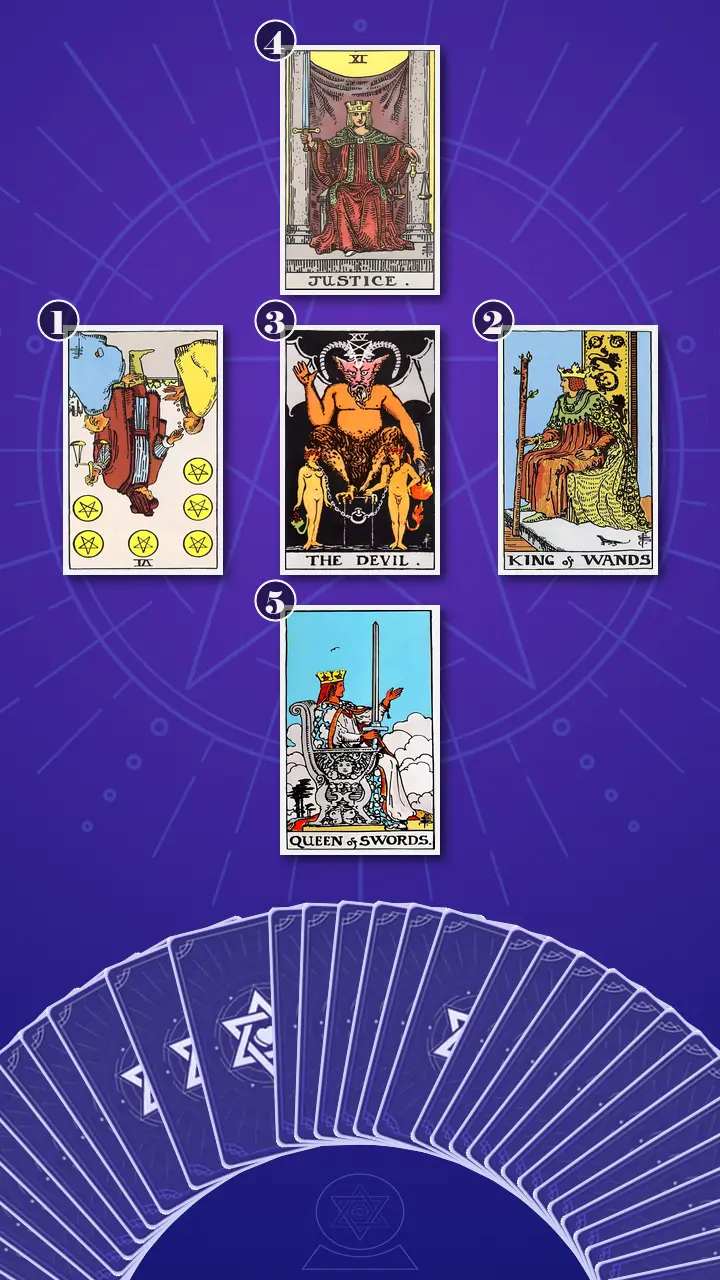
I chose a Relationship Spread · Context Edition, a contextualized five-card Relationship Spread in a cross layout for friendship roles, reciprocity, hidden attachment, and boundaries. For anyone wondering how tarot works in this kind of reading, I use the cards as an objective set of visual prompts. Their symbols help separate observable behaviour from predicted rejection, while the questions keep the interpretation grounded in choices Alex can actually make.
The two horizontal cards would show the relationship axis: the visible sidekick behaviour Alex contributes, and the leadership role they experience their friend occupying. The centre card would reveal the repeated co-dependent loop between support, usefulness, and belonging. Above it, a card would expose the hidden sacrifice-agency bargain and the fear beneath it. Below it, the final card would turn insight into one agency-preserving communication experiment.
The cross would not tell Alex what the friendship was destined to become. It would show where the exchange had become unequal, what kept that arrangement familiar, and what Alex could make visible next.
The Group Chat Poll Already Had a Winner
Position 1: The Scale in Someone Else’s Hand
“Now I’m turning over the card that presents the observable sidekick behaviour, where you defer, self-edit, or make yourself useful instead of naming a preference,” I said. “This position shows your stance, feelings, and active contribution to the relationship.”
The card was the Six of Pentacles, in reversed position.
In the image, the standing figure controls the coins and holds the scale. The people receiving them kneel below. I connected that picture to a Friday at 5:18 p.m., when Alex’s friend dropped a venue and time into the group chat. Alex replied “Perfect” before checking their budget or calendar, moved an existing plan, and later counted every adjustment while rereading the messages. It was the friendship version of a Splitwise ledger where the dinner cost was visible but the emotional labour, schedule changes, and recovery time never appeared in the account.
The reversed energy was a blockage in exchange. It was not generosity itself, and it did not prove that Alex’s friend was deliberately controlling access to the friendship. It showed how flexibility had become an unspoken entry fee. Alex offered reassurance, availability, and practical help, then treated their own preferences as the price of being easy to keep close. The immediate result was smoothness. The later result was private accounting.
I asked, “Think about the last plan your friend proposed. What did you reply, what did you actually want, and what did you change in your calendar after agreeing?”
Alex gave a small, bitter laugh. “That is almost painfully accurate. I told myself I was being flexible, but what I was actually avoiding was finding out whether my preference could survive the room.” Their thumb rubbed the edge of the card, and their eyes dropped to the phone on the table. The defensive joke had softened into recognition.
“Exactly,” I said. “Freely chosen generosity leaves room for your choice. Automatic accommodation hides it. Resentment can be the receipt for a yes you never meant.”
Position 2: The Wand That Filled the Room
“The next card shows the leadership role you perceive your friend to occupy and the authority you may be handing over,” I said. “I’m keeping the focus on your interpretation and participation, not diagnosing the other person.”
I turned over the King of Wands, in upright position.
The king sat with a direct posture, an upright flowering wand, and a throne marked by lions and salamanders. I translated the image into the scene Alex knew well: their friend dropped a restaurant pin into the chat, told the shared story first at dinner, and naturally directed everyone toward the next venue. Alex admired that certainty and quietly decided it meant their friend was better qualified to lead.
This was an excess of delegated authority, not necessarily an excess of leadership in the friend. The King of Wands carries initiative, charisma, and the ability to move an idea forward. The imbalance began when Alex’s silence made the friend’s first suggestion the whole roadmap. Their friend’s confidence became evidence that Alex should wait, and waiting made the friend appear even more naturally entitled to decide.
“Your friend’s certainty is not a vote against your preference,” I said. “In a product meeting, the loudest proposal can become the roadmap before quieter people have entered the discussion. That does not make the first proposal more legitimate. It simply means someone has put an idea into the room.”
Alex nodded, then paused. “They sounded certain, so I treated my uncertainty as a reason not to speak.” Their mouth tightened as they looked from the king’s wand to the blank space beside it. I could see the brief jolt of realizing that admiration had quietly become permission to disappear.
Position 3: The Chain No One Had Locked
“This centre card reveals the repeated co-dependent loop between support, usefulness, and belonging that keeps the sidekick role in place,” I said. “It shows the shared relational pattern, attachment, or energy operating between two people.”
The card was The Devil, in upright position.
The two figures stood beside the dark pedestal with loose chains around their necks. I connected that image to 12:36 a.m. in Alex’s Toronto apartment, when their phone lit the dark bedroom with the message, “Are you awake? I’m spiralling.” The radiator clicked beside the window. Their laptop still held tomorrow’s design review, their eyes burned, and yet their thumb was already drafting reassurance before they had consciously chosen to answer.
The chains were loose. Alex was technically free not to respond, to say not tonight, or to offer less emotional labour. But the familiar script activated before choice could catch up: “If I do not fix this, then I will not be indispensable. If I am not indispensable, my place in the friendship may not be secure.” Immediate anxiety fell when Alex became useful. The next day, resentment rose because the friendship had seen the friend’s need and not Alex’s capacity.
“Being needed can feel like belonging, but it is not the same as being known,” I said. “The card is naming a repeated contract, not sentencing you to it. The question is which part of the sidekick contract you are choosing today, and which part you are repeating because it briefly prevents discomfort.”
At this point, I used the two diagnostic lenses I bring to friendship readings. My Sidekick Syndrome Diagnosis asks what role a close group has learned to rely on: the helper, the therapist, the comic relief, the person who never needs anything. My Clique Power Dynamics lens looks at who frames the plans, whose interruptions are accepted, whose discomfort gets repaired, and whether subtle jealousy, micro-aggressions, or implicit hierarchies are present without assuming a motive.
I told Alex that neither lens required making their friend a narcissist, a user, or a villain. The useful observation was narrower and more powerful: a hierarchy had become comfortable because Alex kept supplying the lower position. The friendship did not need a dramatic confrontation before Alex could question the role.
Alex went still first. Their breath stopped halfway in, and their fingers hovered above the phone as though a reply might arrive there. Then their gaze lost focus, replaying the late-night messages, the changed plans, and every “I don’t mind” they had sent too quickly. Finally, a long breath moved through their chest, their shoulders dropped, and they whispered, “I think I have been confusing being known with being useful.”
When Justice Took the Scale Back
Position 4: The Hidden Bargain Beneath the Bond
I paused before touching the card above the centre. The room became unusually quiet. Outside my window, a streetcar bell sounded once through the rain, then faded.
“This position exposes the hidden sacrifice-agency bargain and the fear that asserting a need could threaten closeness, belonging, or worth,” I said. “It is the challenge beneath the visible behaviour.”
I turned over Justice, in upright position.
Before I interpreted it, I described the setup I had heard in Alex’s body: “You see the group-chat notification, feel your throat tighten, and type ‘anything works’ while the plan you actually wanted sits in your Notes app. The immediate relief feels like loyalty; the heavy stomach afterward tells a different story.”
Justice brought the scale back into the centre. Its balanced pans, upright double-edged sword, red robe, and two gray pillars suggested discernment rather than punishment. The modern version was simple: before replying to the next invitation, Alex could open a note with two equally sized lines, “What they want” and “What I want.” They could write both without arguing either one away, then decide whether to adapt.
I linked the image to restoring equal edit permissions in a shared Figma file. Alex’s preference did not have to control the final design, but it had to enter the live document before anyone could respond to it. Their friend’s need could be real, and Alex’s need did not become fake because it differed.
“You are not required to purchase closeness with self-sacrifice; place your needs on the same scales as your friend’s and let Justice replace the sidekick contract with an honest choice.”
I let the sentence remain between us. Then I gave the central delivery I wanted Alex to remember: “An equal friendship is not something you earn by becoming easier to accommodate; it begins when your real preference is allowed into the room.”
Alex’s breath stopped first. Their face went blank, pupils widening as if the sentence had interrupted an old reflex before it could finish. Their fingers curled around the edge of the chair, and their eyes shifted toward the rain-streaked window, replaying the group chat and the unsent Notes draft. Then a flash of anger crossed their face. “But does this mean I got it wrong all those times?” they asked, their voice suddenly sharper. I did not hurry them past it. We were not turning past accommodation into moral failure. Their shoulders lowered by degrees, the grip in their hand released, and a tremor moved through the breath they finally let out. Their eyes shone, though they smiled only faintly. “It feels fair,” they said, “and also a little terrifying.” The clear path had brought relief, but it had also removed the excuse that someone else had to choose first.
“Now, use this new perspective to recall last week,” I said. “Was there a moment when placing your need on the same scale could have made the situation feel different?”
Alex looked down at the card. “When I agreed to the expensive bar. I could have said I wanted ramen, and I could have let them answer instead of predicting that disappointment would mean I was difficult.”
I named the movement plainly. This was the first credible crossing from self-silencing accommodation used to secure belonging toward clear, reciprocal participation that lets closeness include two full people. It was not a promise about the friendship’s future. It was a change in who was allowed to provide information about the friendship.
The Sentence That Could Stand on Its Own
Position 5: The Clear Witness at the Edge of the Frame
“The final card translates the transformation into one agency-preserving communication or boundary experiment,” I said. “This is guidance for relating with greater clarity, without predicting what your friend will choose.”
The closing card was the Queen of Swords, in upright position.
Her sword stood vertically, her open hand remained receptive, and her gaze stayed steady beneath a clouded sky. The butterfly carved into the throne suggested change without performance. I connected her to the late-night message Alex might receive: “Are you awake?” The Queen’s answer was not coldness. It was, “I care about this, but I can’t talk tonight. I can check in tomorrow after work.”
The upright energy was balanced Air, the clarity Justice had made practical. Directness did not have to become harshness. An open hand did not require automatic compliance. Alex could stay warm without making the answer unclear, and could treat the act of speaking as the practice rather than measuring their worth by the friend’s immediate reaction.
I asked Alex to imagine a text cursor blinking after the words, “I want to see you, but...” The old pattern would have added three softening clauses, an apology, a joke, and several alternative offers. The Queen of Swords let the sentence end.
Alex opened Notes and typed, “I want to see you, and I’d rather do ramen near Ossington at seven.” They did not send it. Their thumb rested above the screen, then moved away. “I can be warm without making my answer unclear,” they said. I saw their jaw loosen as the preference remained visible without being immediately negotiated away.
The Sidekick Contract Audit and the Next Small Move
I drew the five-card story together for Alex. The reversed Six of Pentacles showed how practical favours, schedule changes, and emotional support had become an uneven currency. The King of Wands showed how a friend’s visible initiative could occupy the centre when Alex withheld an equally specific idea. The Devil revealed the bargain connecting usefulness with belonging: self-sacrifice lowered immediate tension, then made Alex’s choices less visible and their resentment louder. Justice reclaimed the scale as a shared standard, and the Queen of Swords gave that standard one spoken sentence.
“The spread did not reveal one hidden reason your friend is doing this,” I said. “It showed a loop you have been participating in because it has protected closeness in the short term. You have been standing just outside the spotlight with a backstage clipboard, carrying everyone else’s needs while calling your own silence loyalty. The next act is not becoming the loudest person in the room. It is letting the real version of you enter the scene.”
The blind spot was treating flexibility as neutral. Alex had been calling every automatic yes generous, even when their throat tightened and their stomach grew heavy. They had also treated a confident first suggestion as legitimate authority and an unanswered text as predicted rejection. The transformation direction was more precise: name one genuine preference before offering flexibility, weigh both people’s needs, and let the friendship respond to information rather than to a carefully edited version of Alex.
I framed the next steps as small experiments, not tests Alex could pass or fail. The point was not to force a confrontation, collect proof that the friend was good or bad, or decide the entire friendship after one text. The point was to stop silence from making every decision by default.
- The Justice Same-Scale CheckBefore replying to the next WhatsApp, iMessage, or group-chat plan, put both feet on the floor, open a note titled “Same Scale,” and write “What they want” and “What I want.” Take ten seconds before offering flexibility.A preference is information, not a demand. The minimum version is noticing the first choice privately before sending the usual automatic agreement.
- The Role Resignation ActFor one low-stakes group plan this week, resign from the invisible assistant role by offering one specific vote: “I’d be up for ramen near Ossington at seven; that’s my preference.” Say it once, then let the others answer.Draft the plain sentence first and wait one minute before adding “sorry,” a joke, or extra options. A clear preference does not control anyone else’s response.
- The Queen’s Boundary and Evidence LogWhen the next late-night support request arrives, try, “I care about this, but I can’t talk tonight. I can check in tomorrow after work.” Then record what you said, what your friend actually did, and what you predicted.Use a twenty-minute pause before sending a smoothing follow-up when no deadline exists. Track observable behaviour, not guessed motives, and let one experiment remain one experiment.
“This is how I want tarot to serve you,” I said. “Not by deciding whether the friendship will survive your honesty, but by making your participation visible enough for you to choose it. You are the person who directs the next scene.”

A Week Later, One Preference in the Room
Three days later, I received a message from Alex: “I’d rather do ramen near Ossington at seven.” Their friend agreed. Alex slept through the night, then woke with the old thought, What if I got it wrong?, and smiled before checking their phone. The friendship was not solved; one preference had simply entered the room.
Alex told me that the pause before sending had felt strange, almost like waiting for an app to finish updating. The predicted rejection never arrived. More importantly, the absence of rejection was not the whole point. Alex had noticed what they wanted before volunteering to adapt, and they had allowed another person to respond to the real information.
I thought about the film language I have carried for years. A painful scene can become so familiar that staying in it starts to look like loyalty to the whole story. Tarot cannot write the next act for anyone. It can slow the frame, show the old role from another angle, and help the person holding the pen recognize that the page is still open.
When your throat tightens over one small preference and your hand reaches for “whatever works,” I hope you can recognize the exhausting fear underneath it: that closeness can hold your care or your full self, but not both. Noticing that reach is already a small edit to the old script.
If one honest preference could enter your friendship without having to decide its future, what small truth would you be curious to let stand, perhaps the one waiting in your Notes app before the group-chat poll closes?
This story is adapted from psychological research, written so that those in a similar struggle can see their own pattern in it — and find their next step clearly.These insights are not a substitute for professional psychological, medical, legal, or financial advice.
Learn more about our Journey to Clarity.
How did this insight land for you?
🫂 This Resonates Deeply
🌀 Living This Story
✨ Now I See Clearly
🌱 Seeing New Possibilities
🧰 Useful Framework
🔮 The Confirmation I Needed
💪 Feeling Empowered
🚀 Ready for My Next Step
Author Profile
 AI
AI“I’ve always felt our lives are films currently in production. As an artist, I know that when you feel stuck, it’s often because you’ve bravely stayed in a painful scene for just a little too long. I’m not here to coldly analyze you. I want to sit closely with you, look at those difficult moments with profound empathy, and gently hand you the pen so you have the courage to write your next beautiful act.”
In this Friendship Tarot Reading :
Core Expertise
- Clique Power Dynamics: Deconstructing the subtle jealousy, micro-aggressions, and implicit hierarchies hidden within tight-knit friend groups.
- Sidekick Syndrome Diagnosis: Identifying how your friend group has boxed you into a specific, restrictive role (e.g., the clown, the therapist) to maintain their status quo.
Service Features
- The Role Resignation Act: A creative conversational pivot designed to gracefully but firmly refuse your assigned 'character' during your next group interaction.
Also specializes in :
Explore Related Patterns:
Approval-Driven Self-SilencingAt 8:47 p.m. on Line 1, Alex types "Works for me!" while wanting a quiet dinner, and on another occasion says "Perfect" before checking either their budget or calendar. The agreement arrives before the friend has any opportunity to accept, negotiate, or reject Alex's real preference. This is how approval can drive self-silencing: the unspoken preference is treated as the dangerous part of the interaction, while rapid compliance functions as a defense against anticipated disapproval. When you edit yourself before another person responds, the friendship may remain smooth in the moment, but it can only respond to the accommodating version of you. The pattern becomes visible when you notice that your silence is not neutral; it is making the relational decision in advance.
Borrowed Certainty LoopWhen Alex's friend drops a restaurant pin into the chat, tells the shared story first, or confidently directs the group toward the next venue, Alex treats that certainty as evidence that the friend is better qualified to lead. Alex's own uncertainty then becomes a reason to remain silent. The loop borrows another person's certainty to escape the discomfort of forming and exposing your own position. Silence gives the first proposal more control, and that expanded control then appears to confirm that the other person is naturally the decision-maker. The sidekick role is therefore reproduced through feedback: you defer because they seem certain, and your deference makes their certainty look increasingly authoritative. Recognizing the loop separates confidence from legitimacy; another person's clear proposal is still only one proposal.
Friendship OverfunctioningAlex changes plans, absorbs higher costs, adapts to the chosen venue, and becomes available for late-night emotional support before checking what they can realistically give. The behavior repeats across planning, practical help, and emotional care rather than appearing as one isolated favor. This creates friendship overfunctioning: you perform extra relational work so consistently that the friendship learns to organize itself around your adaptability. The friend does not need to be deliberately controlling for the imbalance to persist; your anticipatory labor can keep removing the moments in which reciprocity would otherwise have to be negotiated. The sidekick role is reinforced each time you manage both the friend's need and the possible reaction while leaving your own capacity unreported.
People-Pleasing Resentment CycleAfter Alex agrees to the chosen venue, moves an existing plan, and absorbs the practical cost, the immediate interaction stays easy. Later, Alex rereads the messages, counts every adjustment, and resents that the friend gets to occupy the main-character role. The cycle is maintained by a short-term reward: an automatic yes quickly removes the uncertainty of expressing a different need. The delayed cost is that an unspoken sacrifice cannot be recognized, negotiated, or reciprocated, so it returns as private scorekeeping. When you repeatedly trade an honest preference for immediate peace, resentment can become the delayed evidence that your agreement was a protective reflex rather than a freely chosen act of generosity.
Usefulness-Based Self-WorthAt 12:36 a.m., Alex sees "Are you awake? I'm spiralling" and begins drafting reassurance despite burning eyes, an open laptop, and a design review the next day. Their own capacity is displaced almost instantly by the opportunity to become necessary. The deeper bargain links usefulness with relational security: fixing, reassuring, and remaining available temporarily quiet the fear that an ordinary limit could make Alex less important. When you rely on being indispensable to confirm your place, a boundary can feel like a threat to your worth rather than information about your capacity. Alex's recognition that they have confused being known with being useful exposes the mechanism clearly: labor is being used to secure belonging, even though belonging based on constant usefulness leaves much of the self unseen.
Boundary DiscernmentBefore the next invitation, Alex is given two equally sized lines: "What they want" and "What I want." Alex then practices a late-night limit and later allows a specific ramen preference to stand without immediately negotiating it away. Boundary discernment begins in the pause between receiving a request and volunteering to adapt. It lets you separate care for another person from responsibility for eliminating every possible disappointment, while also separating a preference from a demand. The goal is not to make your choice dominate the friendship; it is to ensure that your capacity and desire enter the shared information before a decision is made. That distinction gives both people room to choose and turns flexibility back into a conscious option rather than an automatic entry fee.
Mind ReadingAlex predicts that a preference may not survive the room and imagines that the friend's disappointment would prove they are difficult. The story also notes that an unanswered text can be interpreted as rejection and that the friend's confident suggestion can feel like a vote against Alex's choice. These interpretations fill missing relational information with a feared conclusion. When you respond to a predicted reaction as though it has already happened, you may accommodate a person who has not actually asked you to disappear. The defense lowers uncertainty, but it prevents reality from updating the belief because the honest preference is never presented. Alex's ramen message matters because it creates observable evidence: the friend can answer the real request, and the prediction no longer has to act as the decision-maker.
Explore Related Struggles:
Belonging-Authenticity SplitAcross the train ride, the expensive bar, and the late-night support message, Alex keeps the friendship moving by editing out a quiet-dinner preference, a budget concern, an existing plan, and the need for sleep. The friend receives a consistently agreeable and available version of Alex, while the version with separate wants and finite capacity remains in the Notes app or arrives later as private resentment. This creates a painful division inside a close relationship: the more important the bond feels, the more pressure there is to present only the parts of yourself that seem easiest for the bond to hold. You can remain deeply involved while still standing outside the relationship as a fully represented person. Activity and closeness continue, but authenticity has no dependable route into the exchange. Belonging-Authenticity Split names the fear that the friendship can contain your care or your full self, but not both at once. The story's small ramen message matters because it lets belonging encounter unedited information without forcing a verdict about the friendship's future. Your distinct preference can enter the relationship as participation, not as a threat or demand.
Internal Authority CollapseAlex's friend drops a restaurant pin into the chat, tells the shared story first at dinner, and directs the group toward the next venue. Alex admires that certainty and quietly treats it as proof that the friend is better qualified to lead. Because no equally specific preference enters from Alex, the first suggestion becomes the entire roadmap and the friend's initiative appears more authoritative each time. The contrast with the Figma critique matters: Alex can defend a product decision at work, yet in friendship interprets uncertainty as a reason to withhold their vote. Your preference does not need the confidence of a finished argument to count as valid information. When only certainty is granted decision-making legitimacy, your internal authority can go offline precisely where the relationship matters most. Internal Authority Collapse does not require the other person to seize control deliberately. It can be maintained through a feedback loop in which you wait for permission, your silence enlarges the other person's apparent mandate, and that enlarged mandate gives you another reason to wait. Interrupting the loop starts with treating a tentative preference as sufficient grounds to participate.
Sacrifice-Agency SplitOn the crowded Line 1 train, Alex types “Works for me!” while wanting a quiet dinner. On another Friday, they reply “Perfect” before checking their budget or calendar, move an existing plan, and only later count what the agreement cost. Each sacrifice keeps the immediate interaction smooth, but it also prevents Alex from participating in the choice they are helping to carry out. When you rely on adaptation to protect closeness, care and self-surrender can become embedded in the same action. Your agency has not disappeared, but it enters too late, showing up as a heavy stomach, private accounting, or resentment after the shared decision has already been made. That is the central friction of Sacrifice-Agency Split: the bond is protected through choices that repeatedly remove you from the bond's decision-making space. Reclaiming agency does not require controlling the plan; it begins by letting your preference become part of the information from which the plan is made.
Utility-Belonging FusionAt 12:36 a.m., Alex sees “Are you awake? I’m spiralling” while tomorrow's design review remains open on the laptop. Their eyes burn, but reassurance is already being drafted before they have consciously decided whether they can offer it. The same structure appears in changed plans, practical help, and constant availability: usefulness is supplied first, while capacity is checked later or not at all. The story makes the underlying contract explicit: if Alex does not fix the immediate problem, they may no longer feel indispensable; if they are not indispensable, their place in the friendship may not feel secure. When usefulness carries the burden of proving that you belong, declining a request can register as more than a boundary. It can feel like withdrawing the very evidence that justifies your place. Utility-Belonging Fusion keeps the sidekick role stable because service produces immediate relational relief, even as it leaves less room for you to be known outside what you provide. Seeing that contract clearly restores a distinction the loop has obscured: being valuable to someone can include what you offer, but belonging does not have to depend on remaining continuously useful.
Voice-Safety FusionThe group-chat notification appears, Alex's throat tightens, and “anything works” is typed while the plan they actually want remains in Notes. The friend's disappointment has not occurred, but Alex's body and reply are already organized around preventing it. A predicted reaction therefore shapes the decision before the other person has received anything real to respond to. When your voice becomes fused with relational risk, stating a preference can feel less like contributing information and more like testing whether the bond will tolerate you. Silence offers immediate relief because it prevents that test, but it also ensures that the relationship keeps responding to an edited version of your position. The absence of conflict then looks like safety, even though your voice had to disappear to produce it. Voice-Safety Fusion is visible in the gap between having a preference and allowing it to be heard. Alex's later ramen message provides an important reality check: the friend agrees, but the deeper shift occurs before that response, when Alex permits the sentence to stand without an apology, a joke, or several escape routes. Speaking becomes an act of participation whose legitimacy does not depend on controlling the answer.
Explore Related Emotions:
Cautious VulnerabilityIn Notes, Alex types, “I want to see you, and I'd rather do ramen near Ossington at seven,” then lets their thumb move away from the screen. The sentence reveals desire, limit, and continued care without hiding behind “whatever works.” You make yourself more visible while leaving the other person fully able to answer with information of their own. Cautious Vulnerability captures why this simple sentence can feel fair and frightening at the same time. The exposure is real because the friendship is finally meeting a less edited version of you, but the risk is contained within one preference rather than being turned into a verdict on the entire bond. Warmth remains present, and clarity prevents that warmth from requiring automatic compliance.
Defensive ReliefAlex sends “Perfect” before checking their budget or calendar, and the exposed moment closes immediately. There is no disagreement to navigate, no pause to tolerate, and no possibility of seeing disappointment on the screen. You receive a short bodily release because agreement restores smoothness before uncertainty can expand. That release is protective, but it is not the same as freely chosen generosity. Defensive Relief names the brief easing that makes automatic accommodation compelling even when the later cost is a heavy stomach, lost time, and private resentment. Recognising the relief as part of the loop lets you understand why the sidekick role repeats without treating the repetition as weakness or proof that you truly wanted to comply.
Grounded AgencyAlex places both feet on the floor, opens a note with “What they want” and “What I want,” and gives the two lines equal space. The pause interrupts the automatic reply long enough for a real preference to become available. You do not need certainty, dominance, or a guarantee of agreement to participate; you need enough steadiness to let your information enter the exchange. Grounded Agency is the felt return of authorship when action and internal knowledge begin moving together. It remains relational because the friend is still free to answer, negotiate, or disagree, while you stop using silence to decide on everyone's behalf. The power comes from occupying your part of the friendship clearly, not from taking over the role previously assigned to the other person.
Hidden ResentmentAt 5:18 p.m. on Friday, Alex replies “Perfect,” moves an existing plan, and later rereads the chat while counting every adjustment. The interaction looks easy from the outside because the objection never enters the room. You are left holding an invisible ledger of schedule changes, emotional labour, recovery time, and preferences no one else knew they were receiving at your expense. Hidden Resentment grows in the distance between the consent you displayed and the choice you actually experienced. The other person responds to an edited version of your availability, while part of you expects them to recognise costs you never made visible. Naming that resentment does not assign villainy; it reveals that smoothness has been financed by information withheld from the relationship, giving you a clearer place to intervene.
Preference Exposure DreadOn the crowded Line 1 train, Alex wants a quiet dinner but types “Works for me!” as their shoulders rise and their throat tightens. The preference exists clearly enough to be felt, yet making it visible seems more dangerous than accepting a plan they do not want. You may recognise the strange escalation in which naming ramen or checking your calendar feels less like sharing information and more like exposing something socially unacceptable. The dread belongs to the moment before another person has responded, when a predicted rejection fills the empty space. Your preference starts carrying imagined consequences for closeness, worth, and acceptability, so silence offers the quickest exit. Preference Exposure Dread identifies that anticipatory inner weather while preserving a crucial distinction: a preference can be exposed without becoming a demand, and the other person's actual response can replace the one you predicted.
Usefulness-Based Belonging FearAt 12:36 a.m., Alex sees “Are you awake? I’m spiralling,” notices their burned eyes and unfinished design review, and begins drafting reassurance before consciously deciding to answer. The same sequence appears in changed plans, practical help, and immediate agreement. You can feel needed very quickly in this position, while your actual capacity remains unseen. When usefulness becomes the fastest available proof of belonging, offering less can feel as though you are risking your place rather than merely setting a limit. Usefulness-Based Belonging Fear names that inner weather precisely: the bond seems secure while you are indispensable, but uncertain when you arrive with needs of your own. Seeing the condition clearly gives you room to test whether closeness can include being known, not only being useful.
Cautious Self-TrustThree days later, Alex sends the ramen preference, receives agreement, and wakes with the familiar thought, “What if I got it wrong?” They smile before checking the phone instead of treating the thought as an instruction to retract themselves. You can still feel uncertainty while allowing the choice you made from honest information to remain valid. Cautious Self-Trust is not certainty that every preference will be accepted or that every boundary will feel comfortable. It is the growing willingness to regard your own signals as credible enough to inform a conversation. The trust becomes more durable when it rests on noticing, speaking, and observing what actually happens rather than on securing the response you hoped to receive.
Low-Maintenance ShameAlex can defend a product decision in a Figma critique, yet types “I'm good with anything” in their closest friendship before checking their own calendar. The hesitation is not caused by an absent preference; it begins when Alex wonders whether that preference would be too much. You may then shrink an ordinary need until being effortless appears safer than being accurately known. Low-Maintenance Shame is the felt suspicion that needing consideration makes you difficult, ungrateful, or less desirable to keep close. It turns flexibility into a measure of acceptability and treats your separate vote as a social burden. Once that shame is visible, you can distinguish considerate adaptation from the belief that your needs must remain small for the bond to tolerate you.
Clarity ReliefAlex goes still while replaying the late-night messages, changed plans, and rapid “I don't mind” replies, then releases a long breath and says, “I think I have been confusing being known with being useful.” The scattered scenes organise into one observable sequence without requiring the friend to become a villain or Alex to become a problem. You gain language for the difference between chosen care and compliance used to secure closeness. Clarity Relief arrives because the sidekick role becomes understandable and therefore interruptible. The friendship is not suddenly solved, but the fog no longer has to make every decision by default. A visible sequence gives you specific points of choice, including the pause before replying, the preference waiting in Notes, and the moment when predicted rejection can be separated from evidence.
Self-Betrayal AcheAlex agrees to the expensive bar, moves an existing plan, and feels a heavy stomach afterward. The body holds the information that the chat never received: the answer looked voluntary, but the quiet dinner, budget limit, and calendar conflict were edited out. You remain present for the exact moment your own knowledge is overridden, even when everyone else sees only a cooperative yes. Self-Betrayal Ache names the pain of repeatedly leaving yourself outside decisions that directly affect you. It is more intimate than disappointment with the friend because it comes from watching your action contradict a preference you had already recognised. The ache can become useful evidence, pointing to the moment when adaptation stopped being a choice and became self-abandonment.
Explore Related Contexts:
Friendship Reciprocity GapAt 5:18 p.m., Alex agreed to the restaurant and time before checking their budget or calendar, moved an existing plan, and later counted every adjustment. At 12:36 a.m., the friend's request for reassurance drew attention toward their need while tomorrow's design review and Alex's capacity stayed outside the account. The agreement is smooth at the point of contact, but the exchange carries unequal costs. You are not only choosing to be flexible; your time, money, recovery time, and emotional labour are being left out of the information used to make the plan. That omission makes mutuality hard to measure. The useful question is not whether either person is automatically at fault. It is whether the friendship can respond to both people's actual information. Naming your preference before you adapt gives reciprocity something real to work with and lets the next response provide evidence.
Sidekick Role Lock-InOn the crowded Line 1 train leaving Bloor-Yonge, Alex typed 'Works for me!' to a bar already chosen by their friend even though they wanted a quiet dinner. On Friday, they replied 'Perfect' before checking their budget or calendar, moved an existing plan, and later counted the adjustment. Those repeated choices give the friendship a reliable division of labour. The friend supplies the visible direction, while you supply flexibility, availability, practical help, and the adjustment that follows an automatic yes. Because your preference disappears before the exchange is complete, the supporting position keeps reproducing itself. The role is therefore held in place by repeated participation, not by a verdict about your friend's character. You can audit it without staging a confrontation by naming one specific preference before offering to adapt and then observing how the friendship responds to the unedited information.
Friendship Role RenegotiationAlex could defend a product decision in a Figma critique, then wrote in Notes, 'I want to see you, and I'd rather do ramen near Ossington at seven.' Their friend agreed when the preference was finally placed in the conversation. Those details mark a live change in the friendship's social roles. You do not have to take over planning to move from automatic accommodation toward equal participation; you only have to make your information available before the decision closes. The later agreement supplies one concrete piece of evidence that a specific preference can occupy space without ending the exchange. Treat the moment as a renegotiation, not a final ruling on the friendship. Repeating the same clear contribution across ordinary plans will show whether the new role can become part of the relationship's normal structure.