When Code-Switching Becomes Performance: Keeping Meaning Audible
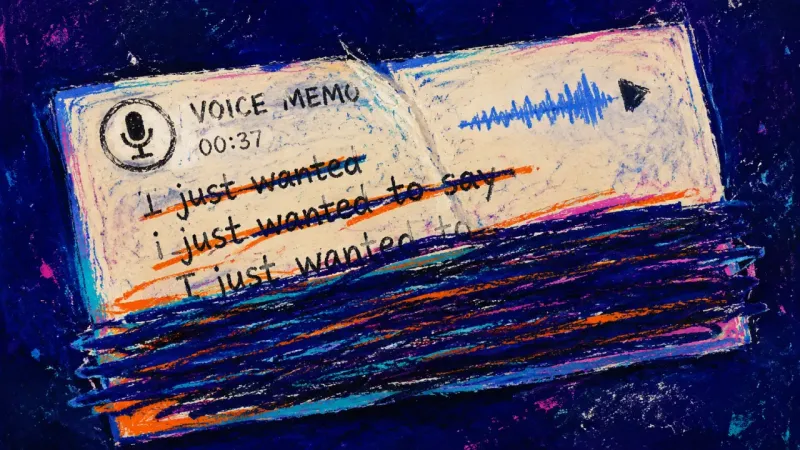
The Voice Note That Never Made It to the Call
I recognized the pattern before Jordan (name changed for privacy) sat down: a 27-year-old junior UX researcher in Toronto, recording a voice note before a team call, deleting the natural version, and replacing it with polished jargon because the room seemed to reward a different sound.
At 8:47 PM on the Line 1 train home from a UX research office near Union Station, Jordan had scrolled back through a Slack thread to inspect one harmless sentence. The carriage hummed around them, cold blue phone light reflected in the window, and the device warmed their palm. Their jaw ached from holding it still while they wondered whether the phrase that earned a tiny thumbs-up had sounded like them or like a safer, colleague-shaped version.
When Jordan told me, "I can fit into almost any room, but I do not know which voice comes with me when I leave," I heard the central tension clearly: the desire to fit in against the fear of losing who they were. They changed their accent, vocabulary, volume, humour, and opinions across work meetings, dates, and friend groups, then replayed each conversation as if it were a usability test with their identity as the product under review.
Their throat felt like a drawstring pulled too tight, their breathing stayed shallow, and their mind ran twenty browser tabs at once for pronunciation, tone, status, punctuation, and other people's reactions. I could hear the longing for belonging underneath the shame and exhaustion. I said, "You are not fake because your voice changes; the question is whether you are still choosing what it means. We can look at this without judging you or predicting anyone else's behaviour. Today, our Journey to Clarity is simply to draw a map through the fog and give the authorship back to you."
A Crossroads on the Table: The Celtic Cross Context Edition
I asked Jordan to put both feet on the floor, take one slower breath, and hold the question without trying to improve its wording. Then I shuffled slowly, using the sound of the cards as a small transition from post-call replay into deliberate attention, not as a supernatural test.
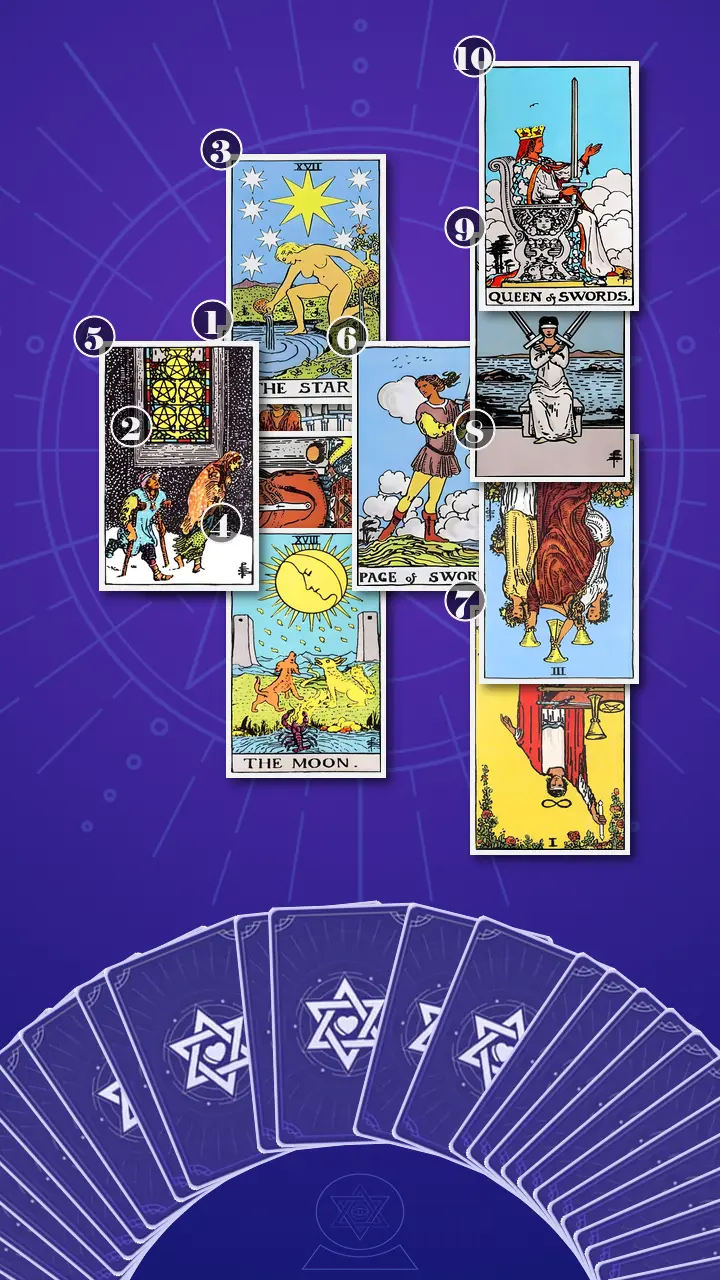
For you reading this, this is how tarot works in this consultation: the cards offer an objective symbolic structure for examining patterns, assumptions, and choices. They do not decide Jordan's identity, guarantee a social outcome, or tell them which group will accept them. I chose the Celtic Cross · Context Edition because this is an inner excavation rather than a choice between two external options. Its familiar ten-card structure can hold the visible habit of changing voice, the pressure of unwritten social codes, the belonging wound underneath, the surrounding social field, and a practical experiment without turning the future into a fixed prediction.
I explained the route before beginning. The first card would show the present symptom, the second the immediate challenge crossing it, and the third the conscious ideal of authentic belonging. The fourth would reach the unconscious root, while the fifth would show the accumulated template that made adaptation feel safer. On the other side of the spread, the Page of Swords would offer a next experiment, and the final Queen of Swords would point toward self-authored integration: flexible delivery with meaning and boundaries still audible.
Reading the Map Without Losing the Speaker
The Room Before the Sentence
Now I turned over the card for the present symptom: the observable moment when Jordan changes voice, wording, or behaviour to fit the room. The card was The Eight of Swords, in the upright position.
In the Toronto UX research meeting shown by this card, Jordan hears their natural phrasing begin to surface, imagines the room judging it, and edits the sentence before speaking. The Eight of Swords is the invisible style guide about what intelligent, polished, or likable speech is supposed to sound like. Jordan is not short of language; they are waiting for certainty before allowing any version to count as theirs.
The energy is excessive Air turned inward: thought has become self-surveillance. The blindfold maps to imagined reactions blocking direct perception, while the surrounding swords resemble rules Jordan inferred rather than rules anyone explicitly stated. The loose bindings matter to me. They suggest that the first opening may come from questioning one assumed rule, not from inventing a perfect new voice.
Jordan gave a small, bitter laugh. "That is too accurate. Almost rude." I let the reaction stand instead of rushing to make the card comforting. "The card is describing a mechanism, not judging your character," I said. "Which rule about sounding acceptable have you obeyed without checking whether anyone actually asked for it?" Their thumb stopped over the edge of their phone, and their eyes dropped to the table as though one deleted voice memo had just become visible again.
The Invisible Admission Code
Now I turned over the card for the immediate challenge: the inner conflict between fitting in and recognizing a voice that still feels like Jordan's own. It was The Hierophant, in reversed position.
Here I saw the team jargon, friend-group humour, or networking vocabulary that Jordan treats as an admission code. Before speaking, they copy the latest speaker's rhythm and replace a plain sentence with a more institutional one. The crossed keys become hidden passwords: repeat the approved language correctly and the door seems to open.
The reversed energy is a blockage around belonging. Jordan is not simply adapting for clarity, accessibility, or context; sometimes the adjustment is an approval ritual performed before anyone has evaluated the actual message. I also cautioned against the opposite trap. Not every shared convention is a threat, and rejecting every group code could create unnecessary isolation. I asked Jordan to inspect each convention: does it help the meaning travel, protect a boundary, or merely make them appear acceptable?
Jordan rubbed the side of their jaw and said, "I think I keep trying to show the room I know its password." I nodded. "Then the keys are not telling you to break into every room. They are inviting you to notice which doors are worth entering and what you are being asked to leave outside." Their shoulders moved a fraction lower, though their mouth stayed tight around the thought.
The Star Above the Performance
Now I turned over the card for the conscious ideal: what authentic belonging and a recognizable personal voice would mean to Jordan. The card was The Star, in the upright position.
The Star is Jordan writing a message in the words they would naturally use with a trusted friend, then editing only enough to make the meaning clear. It is not a fantasy of one permanent voice. It is the experience of staying connected to the source of the message while adapting how it reaches a workplace, a date, or a group chat.
The energy here is balanced and restorative. One stream of water nourishes the ground while another returns to the pool, suggesting that inner truth and practical communication can support each other. I asked Jordan to write one definition of belonging that did not depend on sounding identical to anyone else. They wrote, "Being able to be understood without having to become a replica."
I watched their fingers pause above the notebook. The answer did not look dramatic, but the tightness around their eyes softened. For a moment, hope was not a polished LinkedIn idea or a promise that every room would welcome them. It was a small, usable standard for noticing whether a connection made room for a real person.
The Story Fear Adds to Silence
Now I turned over the card for the unconscious root: the ambiguity and existential drift underneath the code-switching inclusion gap. It was The Moon, in the upright position.
The Moon appeared in the moment a delayed text, neutral facial expression, or pause after Jordan speaks becomes proof that their natural voice was unacceptable. The social cue is real, but the rejection story around it may be an interpretation. Like a prototype tested with one unclear user reaction, Jordan has been treating a single data point as the final research finding.
The energy is blocked Water: feelings and instinct rise before evidence has had time to arrive. The winding path and the crayfish leaving the pool show a vague fear becoming visible enough to observe. Before editing themselves, Jordan can separate what was actually said from what fear supplied in the blank space. A delayed reply is an event; "they disliked how I sounded" is a conclusion.
I asked, "When someone says, 'What do you mean?' what happens before you check whether they are simply asking for clarification?" Jordan's breathing caught. Their gaze moved to the window, then back to the Moon. "I switch into formal language before I even realize I am doing it," they said. I heard the old loop beginning, and I asked them to notice it without turning that observation into another reason to monitor themselves.
The Cold Street Beside the Lit Window
Now I turned over the card for the accumulated template: the felt memory of being outside a group that makes adaptation seem safer than direct self-expression. The card was the Five of Pentacles, in the upright position.
After a networking event, Jordan remembers one awkward phrase more vividly than the colleague who invited them into the conversation. The snow-covered street is the accumulated feeling of being outside, while the illuminated stained-glass window represents support that may be nearby but difficult to trust. Adaptation has become a way to earn warmth instead of asking whether warmth is being offered reciprocally.
The energy is concentrated in lack. It narrows attention toward rejection until available support becomes hard to see. I did not need to invent one defining exclusion event to take the wound seriously. Jordan's daily evidence was enough: laughing at a joke they did not find funny, agreeing to plans they did not want, then arriving home with a tired jaw and no clear memory of what they themselves had preferred.
"A borrowed tone can open a door, but it cannot tell you whether anyone inside is meeting you," I said. Jordan looked at the lit window on the card for a long time. Their fingers tightened around the notebook, released it, and then rested flat on the table. I asked them to name one person who had already shown care, not for reassurance, but as a possible place to test direct inclusion rather than perform access.
The Raised Sword: A Tiny Usability Test
Now I turned over the card for the next experiment: the smallest observable communication action that can test whether Jordan can adapt without self-erasure. The card was the Page of Swords, in the upright position.
The Page turns Jordan's monitoring into a small communication experiment. In the moment they notice the urge to copy a colleague's wording, they can ask, "Am I changing this for clarity, or to avoid being judged?" Then they can try one more natural sentence and observe the actual response rather than predicting it.
I framed it as a tiny UX usability test: change one variable, ask what the change is supposed to accomplish, and collect three observable facts. No dramatic confrontation, no declaration that every adaptation is false, and no requirement to disclose anything unsafe. The raised sword is one clean question that interrupts the Moon's imagined rejection before it grows into a full post-event analytics report.
Jordan leaned forward and opened the Notes app. Their shoulders were still guarded, but their attention had shifted from the imagined audience to the next usable moment. They typed the question down, then whispered, "I could try it in Tuesday stand-up. That feels small enough to be real." I saw curiosity begin to occupy the space where automatic imitation usually arrived first.
When the Tools Started Performing
Now I turned over the card for the self-position: how Jordan currently experiences their agency, expressive tools, and ability to author a voice. The card was The Magician, in reversed position.
The reversed Magician showed Jordan drafting three Slack messages, choosing the one that sounded most like their colleagues, and later forgetting what they originally meant. Their language skill is real, but its tools are aimed at manufacturing approval instead of expressing intention. The blockage is not a lack of intelligence or communication ability; it is misdirected authorship.
I used the sentence frame from the card's echo: "I have the tools to say this; I am using them to manufacture a reaction." Then I placed the four symbols in the card beside the three imagined drafts. The sword was analysis, the cup was feeling, the wand was energy, and the pentacle was practical wording. Nothing was missing. The tools simply were not coordinated around Jordan's meaning.
My own ten years of sound-energy research flashed into the interpretation. I have learned to hear internal friction less as a moral failing and more as several incompatible frequencies competing for the same channel. When the approval track, the fear track, and the meaning track overlap, even a skilled communicator can mistake the noise for proof that they have no real voice. I told Jordan that I call this lens Mental Noise Cancellation: first identify the competing signals, then turn down the one that is pretending to be the only truth.
Jordan opened the three old drafts on their phone. Their face tightened as they reread the version they had sent that morning, then their expression went blank, as if the words belonged to a colleague whose name they could not recall. Finally, they exhaled and said, "I have been calling fluency connection, even when I cannot find myself in the sentence." I did not tell them to stop editing. I asked them to make one clarity edit while keeping the original intention audible.
The Circle That Did Not Quite Include Them
Now I turned over the card for the social field: how groups, colleagues, and conversational norms contribute to the inclusion gap without determining Jordan's identity. It was the Three of Cups, in reversed position.
The reversed Three of Cups is a group chat where Jordan can mirror the jokes, attend the events, and raise the right reactions while still feeling absent from the exchange. The group visibly celebrates together, but Jordan cannot tell whether they are being met as a person or rewarded for matching the tone.
The energy is disrupted Water: connection is present as a shape, but it is not flowing equally in every direction. I asked Jordan to notice which groups permit a real preference, disagreement, slower speech, or a pause without demanding immediate self-correction. Not every circle needs to be entered, and no circle gets to define the value of the person standing just outside it.
Jordan's mouth lifted briefly, then fell back into a thoughtful line. "I have friends who know different versions of me," they said, "but not many places where I do not have to translate first." I heard both grief and useful information in that sentence. The card did not tell them to withdraw. It helped them distinguish visible participation from reciprocal belonging.
The False Binary at the Waterline
Now I turned over the card for hope and fear: the wish for a clear answer about who Jordan is versus the fear that choosing a voice will create exclusion. The card was the Two of Swords, in the upright position.
The Two of Swords captured Jordan asking whether they must always speak exactly as they do at home or always adapt to the room, as if one answer has to cancel the other. They wait for every social consequence to become knowable before choosing. The crossed swords reveal a false binary, while the still water shows how much energy is consumed by keeping authenticity and belonging permanently unresolved.
The energy is suspended Air: thoughtful discernment has become a stalemate. I asked, "What value needs protection in this specific conversation?" Perhaps it is clarity. Perhaps it is privacy, a boundary, cultural ease, access, or a genuine preference. The question does not demand one permanent voice for every context. It asks Jordan to decide what remains personally true while the delivery changes around it.
Jordan held the card with both hands. Their breath paused, their eyes moved between the crossed swords and the open space beyond them, and then their grip loosened. "I keep trying to solve my whole identity before I answer one message," they said. I answered, "One message can be a place to gather information. It does not have to carry the weight of your entire self."
When the Queen of Swords Cut Through the Static
The room grew quieter when I reached the final card. Even the sounds from the street seemed to recede as I turned it, and I noticed Jordan's hand hover above the table before settling beside the deck.
The Sentence With Its Author Still Attached
Now I turned over the card for self-authored integration: the boundary-setting and clear communication practice that can reconcile flexibility with a recognizable self. It was the Queen of Swords, in the upright position.
The Queen of Swords offered clarity, self-trust, and boundaries. I read her upright sword as precision, her open hand as a boundary that remains available for dialogue, and her direct gaze as the willingness to receive information without begging for approval. Her message was not to use one rigid voice everywhere. It was to ask whether each adaptation remained honest, intentional, and connected to what Jordan meant.
I returned to the Toronto meeting scene and imagined the upright sword as one direct sentence. Jordan could say, "That wording is not how I would put it, but here is what I mean," and allow the conversation to continue without immediately translating themselves into someone else's voice. I said, "You can change the interface for different users without changing the underlying product requirement. The meaning stays yours while the delivery adjusts."
At 8:47 PM on the Line 1 train, Jordan had scrolled through a Slack thread after a meeting, checked a harmless phrase for signs of rejection, and felt their jaw tighten. The room had gone quiet, but the monitoring had continued long after the conversation ended. They were still trying to earn certainty before allowing any sentence to belong to them.
Stop treating a borrowed voice as the price of belonging; practice the Queen of Swords' clear, discerning speech by naming what you mean in your own words and letting boundaries distinguish connection from performance.
Jordan stopped breathing for half a beat. Their eyes fixed on the card, then drifted past it as though the train window had opened inside the room. I watched a memory move across their face: a manager's pause, a deleted voice note, a friend asking what they actually wanted. Their fingers tightened once around the edge of the chair and slowly released. First came the frozen stillness, then the recognition, then a small sound from deep in the chest: "Oh." Their shoulders lowered, but the release brought a brief, dizzying blankness with it. Clear speech meant responsibility; no borrowed tone could make the choice for them. Their eyes grew bright, and their voice arrived quieter but steadier. I asked, "Now, use this new perspective to remember last week: was there a moment when this insight might have let you feel differently?"
Jordan named the meeting where they had replaced a plain observation with strategic jargon. "I could have kept my meaning and just made the sentence easier to follow," they said. That was the first movement from contracted self-monitoring toward grounded clarity: not a final answer about identity, but a lived distinction between changing the self to earn inclusion and choosing flexible communication while keeping personal meaning and boundaries audible.
From Borrowed Tone to a Chosen Instrument
I gathered the cards into one story. The Five of Pentacles showed the old coldness of feeling outside; the Eight of Swords showed how that memory became constant self-surveillance. The reversed Hierophant revealed the unwritten admission code, while the Moon showed how uncertain reactions became imagined rejection. The reversed Magician explained why the exhaustion persisted: Jordan had plenty of expressive tools, but those tools had been aimed at reproducing acceptance. The Page offered curiosity, the Three of Cups asked for reciprocity, the Two of Swords exposed the false choice, and the Queen of Swords returned authorship to Jordan's own meaning.
I told Jordan that the central blind spot was not simply changing their accent, vocabulary, humour, or volume. It was treating every adjustment as evidence of falseness and every social reaction as a verdict on identity. The more they searched for one perfectly consistent voice, the more they turned ordinary flexibility into another impossible test. The key shift was this: move from changing the self to earn inclusion toward adapting communication deliberately while checking whether the adaptation still expresses what they mean.
"Adapt the delivery if it helps the message travel. Do not outsource the meaning," I said. "Keep adaptations that improve clarity, access, safety, or comprehension. Question the ones whose only job is to make you appear acceptable. You do not owe any workplace, date, friend group, or audience a performance of one pure, unchanging self."
Before we chose the next steps, I introduced my Frequency Reset Pause. I asked Jordan to tap four quiet beats with a thumb against the table, breathe in for four counts and out for six, and repeat the pattern five times before speaking or sending a message. The gentle rhythm gives the mind a chance to move from frantic, beta-like monitoring toward a more restorative alpha-like pace. It is acoustic grounding, not a demand to reveal anything or a promise that one technique will solve a complex social history. Jordan could stop, keep the draft private, or choose a smaller test at any point.
The One-Page Voice Check
I turned the reading into small, observable next steps. The goal was not to solve belonging in one week. It was to let an unedited phrase receive a little practice, compare fear with evidence, and see whether a connection could meet Jordan's meaning without requiring a borrowed voice.
- The One Natural Sentence ExperimentIn one low-stakes conversation this week, such as Tuesday stand-up or a message to a familiar colleague, keep one phrase you would naturally use with a trusted friend. Within ten minutes, record three facts in Notes: what you said, what the other person actually did, and what your fear predicted.Keep the experiment deliberately ordinary. If speaking naturally feels too exposed, start with one word, punctuation choice, or small preference in a group chat. You can stop or keep the draft private.
- Meaning Before MannerFor one Slack or email draft, make two brief columns: "What I mean" and "How I want it to land." Write one sentence under each, then replace one approval-seeking edit with a clarity edit. If a group phrase does not fit, try, "That is not how I would put it, but what I mean is..."Keep adaptations that improve access or comprehension. You do not need to refuse every shared convention or disclose every private reaction. A clear boundary can be brief.
- The Frequency Reset PauseBefore that meeting, date, or group-chat reply, tap four steady beats, breathe in for four counts and out for six, and repeat for about two minutes. Then name the sentence you want to communicate before choosing the delivery. Ask once: "Am I changing this for clarity, or to avoid being judged?"Use the pause as a choice point, not another performance rule. If the rhythm makes you more uncomfortable, return to ordinary breathing, wait, or choose a private written experiment instead.
These next steps kept the work practical and kind. They did not ask Jordan to prove courage, force intimacy, or abandon a useful professional register. They created evidence. A natural phrase could remain audible, a message could be edited without being replaced, and another person's response could become data about the connection rather than a verdict on Jordan's identity.

A Sentence That Stayed Audible
Four days later, I received a message from Jordan. At a Tuesday stand-up, they had kept their natural opening, "I have a hunch the interviews are pointing us toward a simpler fix," and made one clarity edit instead of rewriting it into executive jargon. A colleague asked a genuine follow-up question. Jordan answered without changing their volume or adding a second explanation to fill the silence.
That night, Jordan slept through the night but woke with the old thought, "What if I got it wrong?" They smiled at it, made tea, and left the question unanswered long enough to start the morning.
I had not given Jordan a new identity, and the cards had not certified which voice was real. The Celtic Cross Context Edition had helped them see the pattern from several angles, but Jordan made the experiment, chose the boundary, and gathered the evidence. That is what finding clarity looked like here: a little less borrowed tone, one meaning kept intact, and enough room to hear what came next.
When you leave a room with your throat tight and your jaw tired from sounding acceptable, it can be hard to tell whether you found belonging or simply became difficult to hear. Clarity is sometimes the first clean note beneath a crowded arrangement, the moment you notice that flexible delivery and a recognizable self can exist in the same sentence.
If you allowed your delivery to stay flexible while keeping one meaning, preference, or boundary unmistakably yours, what small sentence, like one clean note beneath a changing arrangement, would you feel curious to let remain audible?