Three Near-Identical Replies, One Deleted Question—Then One Clear Ask

Three Replies, One Deleted Question
“You can spend all day wording messages for work, then delete the clearest sentence you have written when your own group chat says it is fine,” I told Jordan, a 26-year-old junior communications coordinator in Toronto whose closest friendships overlapped with their professional network.
They had brought me one precise moment: 8:47 p.m. on a northbound Line 1 train. Their phone felt warm in their palm as the brakes shrieked into Bloor-Yonge. They had noticed that the person now responsible for an upcoming plan had never appeared in the version they originally agreed to. Before recording that change, they posted, “Is this weird, or am I overthinking?” Three near-identical replies arrived within minutes. One heart reaction. One “You’re good.” One confident “Honestly, it’s fine.”
I watched Jordan press two fingers lightly against their throat as they described the release that followed the third reply. Then they placed a flat hand beneath their ribs, where the same detail returned once the train grew quiet. The relief had felt like noise-cancelling headphones: immediate and real, but useless for inspecting the sound outside.
“This is exactly what I do,” they said. “I feel better when they agree, then replay the same detail alone because nobody actually answered it.”
I heard the core contradiction clearly. Jordan wanted the clique’s calm to be true because the friendship mattered, yet some part of them needed the original doubt to receive a fair hearing. Their self-doubt did not feel like a vague cloud. It felt like one clean sentence caught in a throat lined with wet wool: present, specific, and repeatedly swallowed to keep the social air comfortable.
“I’m not going to tell you that every doubt is correct,” I said. “I’m also not going to treat your friends as villains because they reassured you. I want us to examine what happened between the first observation and the moment you stopped trusting it. Let’s draw a map through that fog, then give you a next step that does not require certainty, confrontation, or leaving the group.”
Choosing the Intersection Map
I invited Jordan to take one ordinary breath and hold the question in practical terms: “Why do I keep ignoring doubts when my clique says everything is fine?” I shuffled slowly, using the movement as a transition from replaying the chat to examining its structure. I treat this preparation as focused attention, not a supernatural performance.
I chose the five-card Relationship Spread · Context Edition. I explained that this friendship problem was not only happening inside Jordan’s mind. It emerged through an interaction: Jordan noticed something, the clique responded, an unwritten rule shaped what happened next, and Jordan carried the consequence privately. A contextualized relationship tarot spread could keep those parts separate long enough to see how they influenced one another.
This is how tarot works in my practice: the cards do not issue a verdict about who is right. They provide distinct analytical positions, symbolic language, and questions that interrupt automatic thinking. Card meanings in context become useful when they help someone compare a felt impression with observable behavior and available evidence.
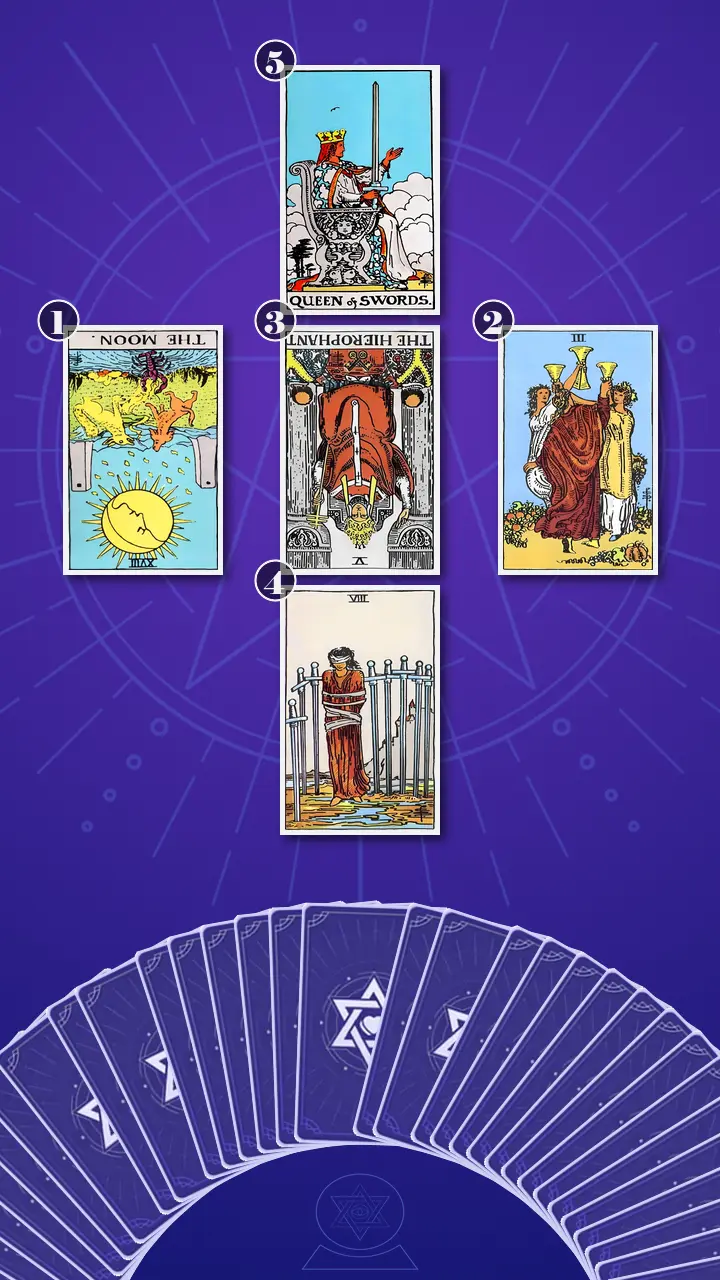
I placed the first card on the left for Jordan’s personal stance: how they noticed, reinterpreted, and dismissed a doubt. The second went on the right for the clique’s influence: its real warmth, repeated reassurance, and pressure toward agreement. The center card would identify the group norm created between them. Below it, the fourth would expose the hidden tension that made silence feel safer than inquiry. Above the center, the fifth would offer a healthier way to stay connected while retaining independent discernment.
The cross resembled a small intersection. Two voices entered from opposite sides, an informal rule formed in the middle, a mental trap developed below, and one clear question could open a route upward.
Reading the Group-Chat Weather
Position One: The Moon Beneath the Phone Light
I began with the card representing Jordan’s personal stance within the clique: the way they noticed, reinterpreted, and eventually dismissed a doubt before seeking independent clarity. I turned over The Moon, in the reversed position.
I pointed to the uneven moonlight, the winding path between two towers, and the small creature emerging from dark water. “The perception is already surfacing,” I said. “The problem is not that you notice nothing. The problem is that you stop trusting what you noticed after a more socially comfortable interpretation arrives.”
I brought the card directly into Jordan’s life. At 12:36 a.m., they had lain in their Toronto apartment with the group chat lighting one side of their face. The radiator clicked. Before asking anyone, they had noticed that the shared plan changed after they agreed to it. After three friends wrote that it was fine, they renamed the concern “overthinking” and deleted the sentence that identified the change. The doubt remained visible, but the group’s confident interpretation had begun to look brighter than the original message.
I described The Moon reversed as a blockage of discernment rather than an absence of discernment. Uncertainty was being forced into premature resolution. Jordan was using the clique’s calm to erase ambiguity instead of asking what the ambiguity contained. That did not make the doubt infallible. It meant the doubt had not yet been tested.
“Can you put the sequence into three lines?” I asked.
Jordan looked down at the card. “I saw that the plan changed. They said the new version was normal. Now I’m telling myself I imagined the importance of the change.”
They gave one brief, bitter laugh. “That is too accurate. Kind of brutal.” Their fingers stopped against the edge of the table.
“Accurate is not the same as condemning,” I replied. “This card is showing us an editable process, not a defective personality. Reassurance can lower the volume of a doubt without answering it. We only need to preserve your first observation long enough to examine it.”
I also named the overcorrection to avoid. Independent discernment did not require Jordan to reject all outside feedback, interrogate every kind reply, or assume that discomfort proved danger. The task was narrower: write down one observable fact and one uncertainty before social interpretation changed the wording.
Position Two: Three Cups in a Busy Thread
I turned to the card representing the clique’s influence: the emotional reassurance, shared interpretation, and social pressure that made risk normalization feel acceptable. The card was the Three of Cups, upright.
The three figures raised their cups together beneath flower garlands. I compared them to three rapid reactions in a busy group chat: a heart, “You’re good,” and “Everyone’s comfortable with it.” On the ride home, those replies had loosened Jordan’s throat and helped them feel held by people they genuinely cared about.
“This is not a secret-malicious-friends card,” I said. “The support is real. They answered quickly because connection exists here.”
Jordan exhaled, and I saw some of the defensiveness leave their jaw. “Good,” they said. “Because I love that they show up for me. That’s why asking one more question feels ungrateful.”
I explained the energy as balanced affection being pushed into an excessive job. Friendship was being asked to perform factual verification. A heart reaction could be emotional first aid, but it was not a source link. Three synchronized feelings did not establish that three people had independently checked the changed detail.
“The cups can hold warmth,” I said. “They cannot certify the plan. Support and evidence are both valuable, but they are not interchangeable.”
Jordan looked back at the chat screenshot they had brought. They began separating the replies aloud. “This one is care. This one is an opinion. This one sounds factual, but they never said how they knew.”
I nodded. That distinction preserved the friendship without outsourcing judgment to it.
Position Three: The Rule Nobody Remembered Choosing
I revealed the card representing the group norm created between Jordan and the clique: the mechanism through which agreement became an authority that overrode personal observation. It was The Hierophant, in the reversed position.
I traced the raised blessing hand, the two followers, and the crossed keys at the figure’s feet. Then I asked Jordan to return to a crowded Queen West table. Music had vibrated through the glasses. Citrus from their drink had caught sharply in their nose. One person had said, “We all know it’s fine,” two others had nodded, and Jordan had laughed before putting their phone face down and changing the subject.
No one had formally ordered silence. Still, the most confident tone settled the room. The crossed keys resembled an absorbed social code: agreement opened the door to belonging; visible doubt seemed to lock Jordan outside. Their private sentence had been, “Nobody ordered me to drop it, but I know what keeps the vibe intact.”
The reversed Hierophant showed blocked tradition: a shared rule that had acquired authority without being deliberately chosen or tested. In this group, calm agreement had become shorthand for maturity, while requesting specifics risked being framed as dramatic. That was how groupthink in friendships could make a risk feel normal without any single person intending harm.
I used one of my diagnostic lenses, Toxic Hierarchy Filtration, but I applied it carefully. The framework does not automatically label a person or group toxic. It filters the interaction for subtle authority: Who gets to close the question? Whose comfort defines what is reasonable? Whose uncertainty must be converted into a joke? In a clique that also overlaps with professional connections, those questions matter because the perceived cost can include invitations, references, and access to the room.
The card pulled me briefly back to my years on Wall Street. I remembered desks where five people repeated the same assumption because each believed someone else had opened the source document. Five confident voices still amounted to one crowded position, not five independent facts.
“Group calm is social information, not a safety certificate,” I told Jordan. “And belonging should not require you to edit the first thing you noticed.”
Their throat moved before any words came. Their fingers tightened around their water glass, their gaze drifted toward the rainy window as if replaying the table scene, and then their grip slowly loosened. “I thought I was choosing harmony,” they said quietly. “I didn’t realize I was also choosing whose version counted.”
I reminded them that the answer was not automatic rebellion. Challenging every shared opinion would let the clique keep controlling the frame, only in reverse. The useful move was one neutral process question: “What are we basing that on?” Then Jordan could listen and decide whether the answer addressed the concern.
Position Four: The Third Button on the Screen
I turned over the card representing the hidden tension beneath the dynamic: the perceived choice between staying silent and appearing disloyal. It was the Eight of Swords, upright.
The figure stood blindfolded and bound within a fence of swords. I saw Jordan’s unsent message in the image. On a Sunday evening, they had drafted, “I noticed the plan changed after I said yes. Can we confirm who made that decision?” Then their mind had presented two imaginary buttons: agree or start a fight.
They had watched the cursor blink as subway doors closed nearby. Their hands had gone still over the keyboard. The neutral question became “lol maybe I’m spiralling,” and then became nothing at all.
I described the card as an excess of threat framing that produced a blockage in action. Jordan’s mind had narrowed the available responses to two extremes: silence preserved belonging; inquiry destroyed it. Inside that framing, ignoring the doubt looked like the only socially survivable option.
“But the sword fence is not sealed,” I said. “There is a third option: leave the draft unchanged, ask one specific question, or pause your participation while you check. A clear question is not the same thing as an accusation.”
Jordan’s shoulders lowered by almost an inch. “I keep preparing for an entire confrontation before I’ve even asked for one detail.”
“Exactly,” I said. “You are rehearsing the trial before opening the issue ticket.”
The card did not promise that every question would receive a warm response. It showed something more useful: Jordan possessed more responses than their fear had displayed on the screen.
When the Queen Raised One Clear Sentence
Position Five: Discernment Stays in the Room
The radiator clicked once and then went quiet as I reached for the final card. Against the window, the rain had thinned into straight silver lines. I turned over the card representing a healthier way to participate: separating group opinion from evidence, asking one precise question, and holding a personal boundary. It was the Queen of Swords, upright.
I showed Jordan the vertical sword, the Queen’s raised hand, and the open sky around her. Her energy was balanced air: clear observation without emotional exile, direct language without cruelty, and a boundary without a theatrical departure. She did not ask Jordan to distrust the clique. She asked them to stop making the clique the sole custodian of reality.
I brought the symbol into a blank Notes page. Jordan could write three lines: “I observed that the plan changed after I agreed.” “What are we basing the reassurance on?” “I will wait to confirm until that part is clear.” The upright sword became one sentence precise enough to examine. The raised hand became a calm invitation for someone to respond. The open sky allowed Jordan’s view and the group’s view to coexist before either became a verdict.
I asked Jordan to return once more to 12:36 a.m. The radiator clicked while they reread three versions of “it’s fine.” Their chest loosened for a second, then tightened around the exact detail they had noticed before anyone replied.
Stop treating group calm as evidence that nothing is wrong; use the Queen of Swords' clear blade to name what you observed, ask for specifics, and let your own discernment remain in the room.
I left the sentence between us for a few quiet seconds. Then I gave Jordan the distinction beneath it.
“Group calm can tell you that you are still connected; it cannot tell you whether your observation is wrong. Reassurance is a viewpoint, not a verdict.”
I watched Jordan’s inhale stop halfway. Their fingers, which had been rubbing the table edge, froze against the wood. For two beats, their eyes left the card and lost focus, as though the past week were replaying behind them: the changed plan, the laughing reactions, the deleted draft. Their jaw tightened before it softened. “But if I can see this now,” they said, with a flash of frustration, “does that mean I was wrong every time I stayed quiet?” I told them no. Staying quiet had been an understandable strategy for protecting belonging when disagreement felt expensive; seeing its cost now did not turn their past self into a failure. Their eyes reddened slightly. Their shoulders descended, their curled hand opened on the table, and a shaky breath left their chest. “Okay,” they said. “That feels simpler, but also scarier. It means I get to ask, and then I have to decide what the answer means.” I invited them: “Now, using this new view, think back to last week. Was there a moment when this insight could have made the experience feel different?”
Jordan returned to the Sunday draft. “I could have left the original sentence alone for thirty seconds,” they said. “I didn’t need certainty. I could have asked before I decided.”
I then applied my Network ROI Analytics to the Queen’s guidance. I was not reducing friendship to a spreadsheet or demanding that affection pay dividends. I was separating the returns produced by an interaction: emotional support, usable evidence, and energetic friction. Three near-identical replies from one clique were correlated signals, not three independent confirmations. Jordan’s accounting error had been booking three units of care as three units of evidence.
That distinction gave the Queen’s sword an edge Jordan could actually use. They could value the return of care, ask whether any return of information existed, and notice when the cost of remaining agreeable was repeated self-silencing. Their own observation no longer had to outperform the group’s view. It only had to remain on the page beside it.
I named the movement directly: this was a shift from socially pressured self-doubt to connected, evidence-aware self-trust. It was not certainty, and it was not a declaration that Jordan’s suspicion must be correct. It was the first responsible step from borrowed authority toward self-authorship.
The Three-Line Route Out of the Loop
I gathered the spread into one coherent story. The Moon reversed showed that Jordan’s perception was active but overwritten after reassurance arrived. The Three of Cups explained why that reassurance felt so persuasive: it carried genuine warmth and belonging. The Hierophant reversed revealed the unwritten agreement-first rule that turned shared feeling into authority. The Eight of Swords showed the internal result, a false choice between silence and conflict. The Queen of Swords restored the missing option: specific observation, one direct question, and a temporary boundary.
The spread contained Cups and Swords but no Wands or Pentacles. I read that absence practically. The clique supplied emotion, and Jordan’s mind supplied increasingly restricted thought. Independent initiative and concrete grounding would not appear automatically. Jordan had to create them through one written fact, one named unknown, and one chosen response.
The cognitive blind spot was not simply “trusting friends too much.” It was counting repeated, socially connected opinions as independent verification, then treating the physical relief of agreement as proof that the external concern had been resolved. The group-chat poll answered “How do we feel?” while Jordan used it to answer “What actually happened?”
The transformation direction was equally specific: preserve the observation before polling the clique, distinguish support from evidence, ask what was actually checked, and keep a temporary boundary while the answer remained open. Jordan did not need to decide the whole friendship in order to examine one detail.
I framed the actions through a low-drama version of my Social Divestment Plan. I did not advise Jordan to liquidate valued friendships on the basis of one tarot reading. I asked them to divest from one high-drain position: buying short-term social relief with their own silence. They could reduce that energetic investment without an announcement, a pile-on, or a dramatic exit.
The Before-the-Chat Protocol
- The Before-the-Chat Fact Log.Before polling the clique about the next concern, Jordan would open Notes, set a three-minute timer, and write one sentence under “Observed” and one under “Still unknown.” The wording would remain private unless they chose to share it.Tip: If three minutes feels heavy, use the minimum version: “Before anyone replied, I noticed…” Stop after that single sentence. The purpose is preservation, not prolonged analysis.
- The Observation-Question-Boundary Note.Before one group conversation that week, Jordan would write three one-sentence lines: “I observed…”; “My question is…”; and “Until I know more, I am or am not comfortable with…” They could then ask one relevant person, “What are we basing that on?” and pause instead of apologizing or adding an accusation.Tip: Jordan could send it, save it as a draft, or read it aloud privately. A boundary could be temporary: “I’m going to wait to confirm until that part is clear.” If a concern involved immediate safety, the appropriate next step would be direct practical support rather than relying on the group chat alone.
I asked Jordan to cap the complete exercise at ten minutes. Clarity did not require an all-night investigation. The goal was to separate observation, uncertainty, and social interpretation before the familiar algorithm downranked the question for slowing the feed.

Thirty Seconds Without Editing
Four days later, I received a screenshot from Jordan. The sentence “What are we basing that on?” had remained unchanged for thirty seconds, and then they had sent it. One friend admitted they were going on vibes; another checked with the organizer and returned with actual details.
The answer did not prove Jordan’s worst interpretation, and it did not transform the clique overnight. It simply showed that the changed detail had not been checked before everyone offered reassurance. Jordan chose to wait before confirming the plan, and the conversation continued.
They slept through the night, then woke with “What if I made it weird?” as their first thought. They smiled at it. Discomfort was still present, but it no longer counted as evidence that they had done something wrong.
I saw the quiet proof of our Journey to Clarity in that unchanged sentence. Tarot had not made Jordan’s decision or exposed a predetermined truth. The cards had made the influence pattern visible; Jordan had supplied the courage, language, and judgment that changed their participation in it.
I left them with the Queen’s central lesson: they did not need certainty to keep their discernment in the room. Connection could remain, outside feedback could remain, and their own observation could remain too.
If everyone around you sounds certain and your throat tightens around one honest sentence, I hope you remember Jordan’s blank Notes page. Taking your perception seriously does not decide the whole friendship; it simply allows you to stay present inside it.
If your doubt could stay in the group-chat room without becoming a verdict on the friendship, what is the smallest Queen-of-Swords sentence you would let remain unchanged for thirty seconds?